
Disclosure: Vital Signs Today may earn a commission if you buy through links on this page, at no extra cost to you. This does not influence our evidence-based assessments. We are not a medical provider; talk to a clinician before acting on test results.
Related: HDL levels by age: chart · Triglyceride normal range by age (full chart)
Your standard cholesterol panel hands you a wall of numbers, and most of them are quietly lying to you about your real risk. The single most useful figure on that page is one your doctor probably never circled: the ratio between your triglycerides and your HDL. Cardiologists have called it a back-door window into insulin resistance, and one classic study found it predicted heart attacks better than LDL ever did.
What does the triglyceride to HDL ratio actually mean?
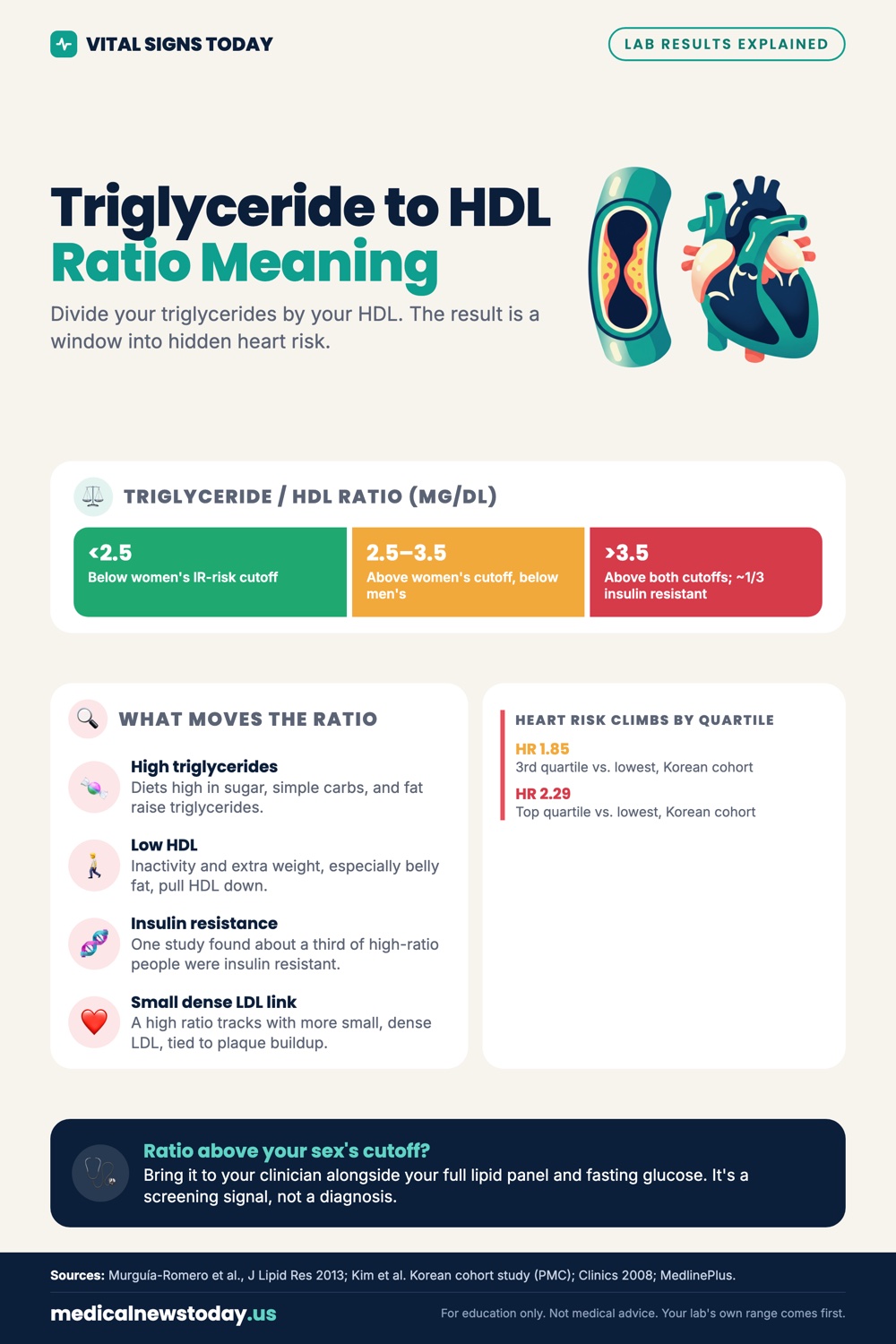
The triglyceride to HDL ratio divides your fasting triglyceride level by your HDL cholesterol (both in mg/dL). It works as a low-cost surrogate marker for insulin resistance and a strong predictor of cardiovascular risk. A lower number signals good metabolic health; a higher number flags hidden problems that a normal-looking LDL can mask.
How do you calculate the triglyceride to HDL ratio?
The math is grade-school simple, which is part of why the number is so underused. You take your fasting triglycerides and divide by your HDL cholesterol. If your triglycerides are 120 mg/dL and your HDL is 50 mg/dL, your ratio is 2.4.
The catch that trips up almost everyone: units matter enormously. In the United States, labs report in mg/dL. Much of the rest of the world reports in mmol/L, and the two are not interchangeable because triglycerides and HDL convert with different factors. To approximate a mg/dL ratio from a mmol/L ratio, multiply by roughly 2.2 (mmolltomgdl.com). Mistake one unit for the other and your interpretation flips from reassuring to alarming. Always confirm which units your report uses before you do anything with the number.
What is a good triglyceride to HDL ratio?
Here is where I want you to ignore the “within normal limits” flag on your lab report and look at the actual number. Most clinical sources converge on these bands for mg/dL:
- Below 2.0: optimal, consistent with good insulin sensitivity (Lamkin Clinic).
- 2.0 to 3.5: a gray zone suggesting emerging insulin resistance and rising metabolic risk.
- Above 3.5: associated with significant insulin resistance, a predominance of small dense LDL particles, and elevated cardiovascular risk.
The threshold is not one-size-fits-all. A study of 2,244 healthy young adults aged 17 to 24 published in the Journal of Lipid Research found sex-specific cutoffs that best flagged cardiometabolic risk: above 3.5 in men and above 2.5 in women (PubMed, Murguia-Romero et al., 2013). Roughly one in three young people with an elevated ratio turned out to be insulin resistant, and the ratio actually caught more high-risk individuals than a formal metabolic syndrome diagnosis did.
Why does this ratio reveal insulin resistance?
This is the part that makes the number genuinely clever. The TG/HDL ratio behaves as a simple, accessible stand-in for insulin resistance, performing comparably to far more expensive lab tests like HOMA-IR or the gold-standard euglycemic clamp (Biomedicines, 2024).
The biology is tidy. When cells stop responding well to insulin, the liver pumps out more triglyceride-rich particles while HDL gets dragged down. So a rising ratio is metabolic smoke from the same fire that drives prediabetes, fatty liver, and abdominal fat. In one analysis, people with a high TG/HDL ratio carried sharply higher odds of obesity and abdominal obesity, and nearly half showed insulin resistance by HOMA-IR. The ratio has also been validated as a non-invasive marker for early-stage non-alcoholic fatty liver disease in a study of 2,588 patients (PMC, 2024).
How well does it predict heart disease?
The cardiovascular evidence is where this number earns its keep. The TG/HDL index was popularized by Gaziano and colleagues, whose work found that the highest ratio quartile was associated with roughly a 16-fold increase in myocardial infarction risk compared with the lowest, even in people with no prior coronary disease (Clinics, review citing Gaziano et al.). In that body of work the ratio outperformed total cholesterol-to-HDL and LDL-to-HDL as a predictor.
It holds up in large modern cohorts too. A longitudinal Korean study of 16,455 adults without diabetes found rising ischemic heart disease risk across ratio quartiles, with hazard ratios climbing to 2.29 in the top group versus the bottom (PMC, 2021). The mechanism connects back to those small, dense LDL particles: triglyceride-rich blood favors their formation, and they are more atherogenic than larger, fluffier LDL. That is why someone with a “normal” LDL number can still be at meaningful risk, and why this ratio sees what the headline number hides. If you want the bigger picture on these markers, our overview of biomarkers worth tracking puts it in context.
What can move your ratio in the right direction?
The encouraging part is that this number responds, often quickly, to the same levers that improve insulin sensitivity. Triglycerides are notably diet-sensitive, particularly to refined carbohydrates, sugar, and alcohol, while HDL tends to respond to physical activity and weight loss. Because both halves of the ratio move together when metabolism improves, the number can shift faster than you might expect.
None of this replaces a full clinical workup. The ratio is a screening signal, not a diagnosis, and it should sit alongside your full lipid panel, fasting glucose or A1c, blood pressure, and your doctor’s judgment. If your ratio is elevated, that is a conversation to have, not a reason to panic. Curious how lipids fit into the broader longevity picture? See our primer on longevity basics.
Want to check your HDL?
Three ways to get it measured. Pick whichever fits you.
Affiliate links: we may earn a commission at no extra cost to you. A lab test does not replace a visit with your clinician.
Frequently asked questions
What is the ideal triglyceride to HDL ratio?
In mg/dL, a ratio below 2.0 is generally considered optimal, and many functional-medicine sources aim lower still. Values between 2.0 and 3.5 suggest emerging insulin resistance, and above 3.5 is linked to significant insulin resistance and higher cardiovascular risk (Lamkin Clinic).
Does the ratio differ between men and women?
Yes. Research in young adults found sex-specific cutoffs, with about 3.5 in men and 2.5 in women best identifying elevated cardiometabolic risk (Murguia-Romero et al., 2013). Women generally have a lower threshold.
Why do my units matter so much?
Triglycerides and HDL convert between mg/dL and mmol/L using different factors, so a ratio calculated in mmol/L is not the same number as one in mg/dL. As a rough guide, multiply a mmol/L ratio by about 2.2 to estimate the mg/dL equivalent. Always use matching units for both values.
Can a normal LDL still hide heart risk?
It can. A high TG/HDL ratio correlates with a predominance of small, dense LDL particles, which are more atherogenic than larger ones, even when total LDL looks normal. This is part of why the ratio can flag risk a standard panel misses (Clinics review).
How fast can the ratio improve?
Triglycerides respond quickly to changes in refined carbohydrate, sugar, and alcohol intake, while HDL improves with activity and weight loss. Because both move together as metabolic health improves, meaningful shifts can appear within weeks to months, though individual results vary.
This article is for general information only and is not medical advice. The triglyceride to HDL ratio is a screening signal, not a diagnosis. Talk to a qualified clinician before making decisions about your health, medications, or test results.