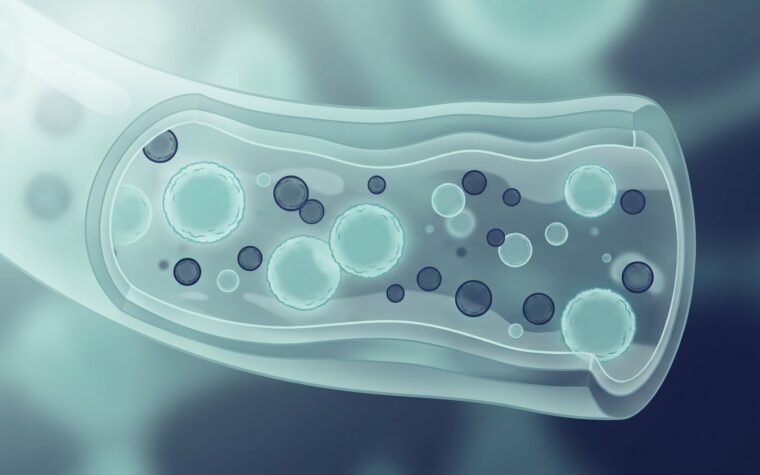
You opened your blood work, and this time there was a flag. Next to RBC, the little arrow pointing up, maybe a number printed in red. Your red blood cell count came back high, and now your brain is running through everything from “I am probably fine” to “is this cancer.” Take a breath. A high RBC is a real finding worth understanding, but in most people it traces back to something far more ordinary than the worst case, and the difference between the two is usually a few follow-up questions and a repeat test.
Here is what most quick explainers get wrong. They treat a high RBC as one thing. It is not. There are two completely different reasons your count can be high, and they carry very different weight. Knowing which camp you are in is the whole game.
Part of our Complete Blood Count guide.
What is a high RBC blood test, and what does it mean?
A high RBC blood test means your complete blood count (CBC) found more red blood cells in a set volume of blood than the reference range allows. Red blood cells carry oxygen, so the body normally keeps their number in a fairly tight band. When the count climbs above that band, the clinical term is erythrocytosis, and the broader term you will hear is polycythemia (Cleveland Clinic).
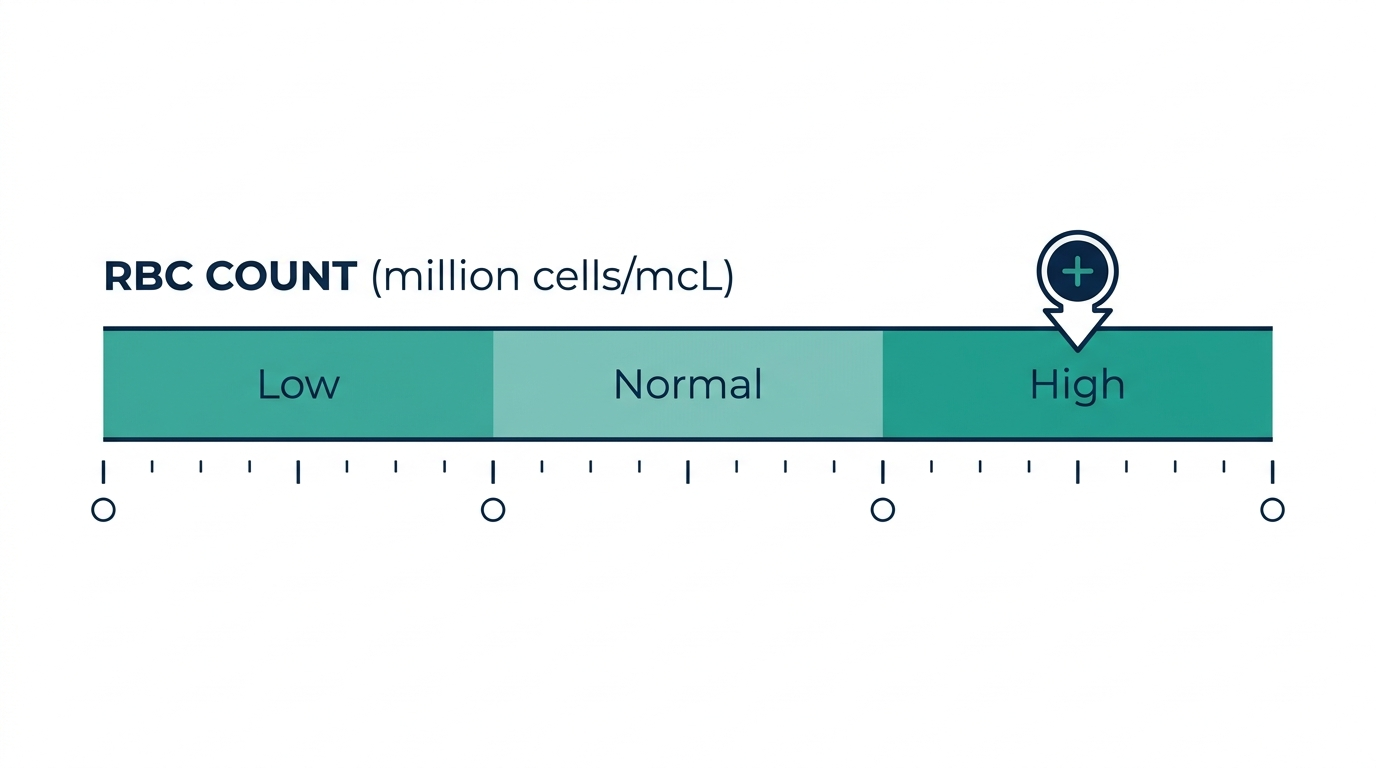
The thresholds that count as high, by sex, are roughly:
- Adult men: above about 6.1 million cells per microliter (typical range 4.7 to 6.1) (Cleveland Clinic).
- Adult women: above about 5.4 million cells per microliter (typical range 4.2 to 5.4) (Cleveland Clinic).
- Children: above roughly 5.5 million cells per microliter.
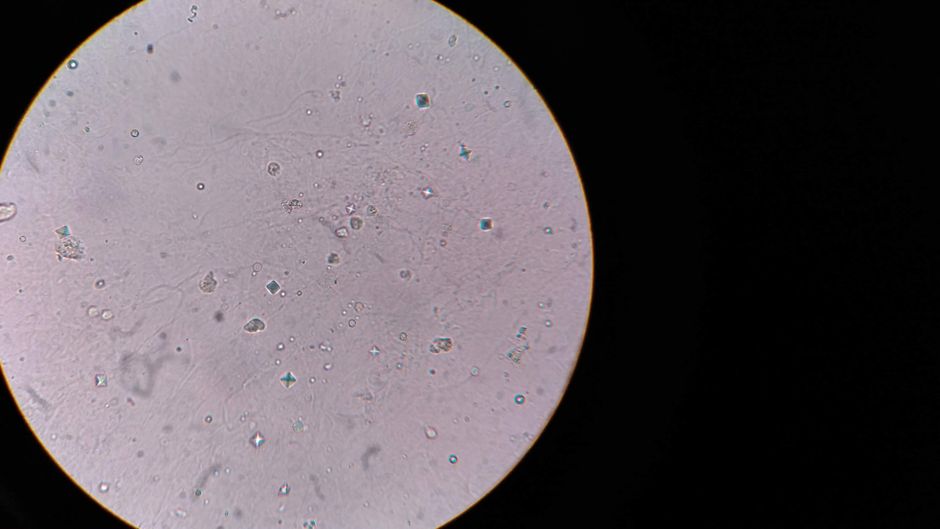
Here is the single most important idea in this entire article. A high RBC splits into two buckets. In relative polycythemia, the actual number of red cells is normal, but your plasma (the watery part of blood) has shrunk, so the cells are simply more concentrated. The classic cause is dehydration. In absolute polycythemia, you genuinely have too many red cells being made (StatPearls, NIH). Relative is usually a quick fix. Absolute is the one that needs a real workup. Same flag on the report, very different story.
What causes a high RBC?
Run through the differential the way a clinician would, most common and most benign first.
1. Dehydration. This is the leading cause of a mildly high RBC and the one people forget. If you had your blood drawn after a workout, a hot day, a poor night of fluids, or a stomach bug, your plasma volume dropped and your cells got concentrated. This is relative polycythemia, and a repeat test when you are properly hydrated often comes back normal (StatPearls, NIH).
2. Smoking. Carbon monoxide from cigarettes binds your hemoglobin and steals oxygen-carrying capacity, so the body compensates by making more red cells (StatPearls, NIH). A smoker with a high RBC has, in a sense, a self-inflicted secondary polycythemia.
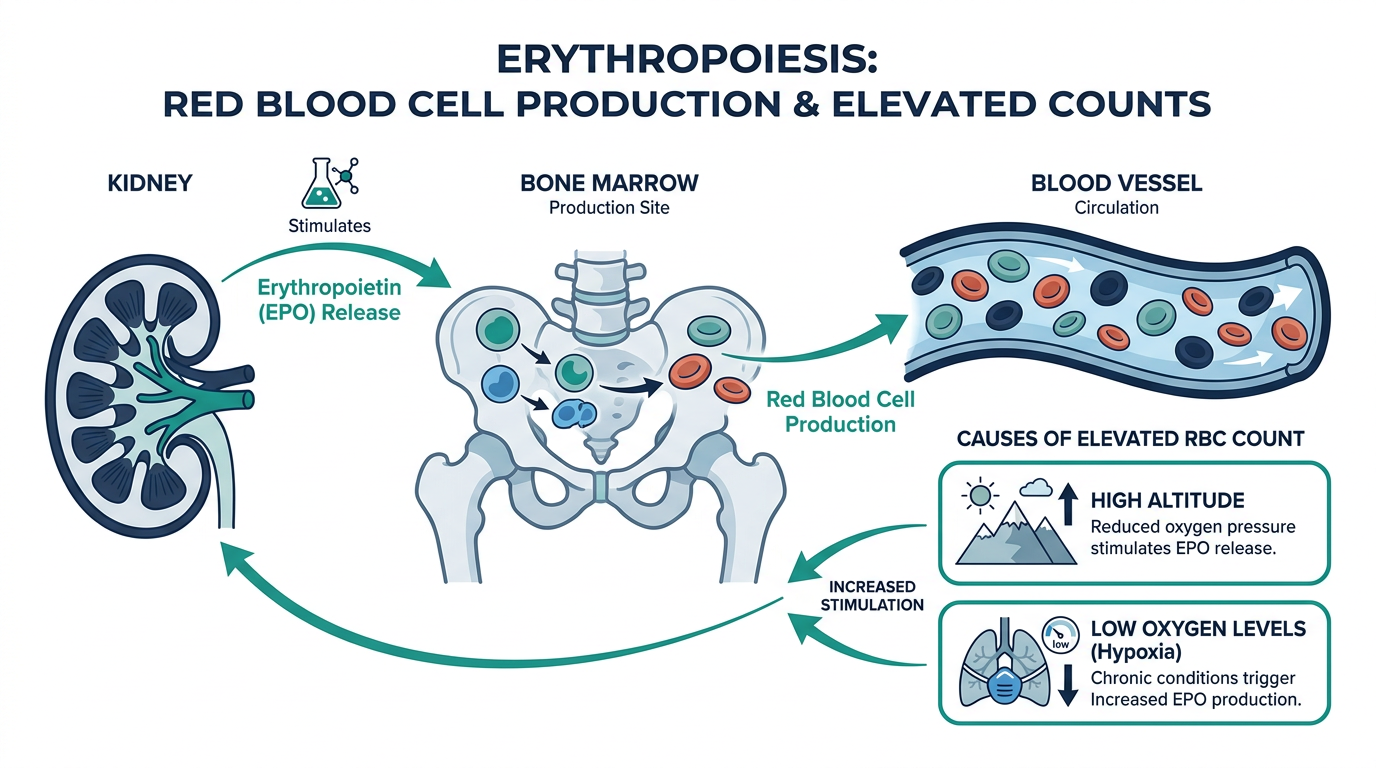
3. Low oxygen states (secondary polycythemia). When your tissues are chronically short on oxygen, the kidneys release more erythropoietin (EPO), the hormone that tells marrow to build red cells. Triggers include chronic lung disease such as COPD and emphysema, untreated sleep apnea, congenital heart disease, and living at high altitude (MedlinePlus). The body is doing exactly what it should. The high RBC is a symptom of the oxygen problem, not the disease itself.
4. Polycythemia vera (PV). This is the one people fear, and it is real but uncommon. PV is a bone marrow disorder, driven by a JAK2 gene mutation in roughly 95 percent of cases, where the marrow makes too many red cells on its own with no oxygen signal telling it to (StatPearls, NIH). It is a slow chronic blood cancer that needs ongoing management (Cleveland Clinic).
5. Other secondary causes. Kidney tumors or cysts, certain other tumors that secrete EPO, anabolic steroid or performance-drug misuse, and some heart conditions can all push the count up (MedlinePlus).
Notice the shape of that list. The top three causes are dehydration, smoking, and an oxygen problem. The blood cancer most people jump to sits well down the order. That ordering is not a reason to ignore the result. It is a reason not to panic before the follow-up is done.
What are the symptoms of a high RBC?
Often, nothing. A mildly elevated RBC, especially from dehydration or in an early stage, frequently produces no symptoms at all and is found only because a routine CBC happened to catch it (Cleveland Clinic). That is exactly why it gets missed for years.
When the count climbs high enough to thicken the blood, symptoms appear because thicker blood moves more sluggishly and delivers oxygen less efficiently:
- Headaches and dizziness (MedlinePlus).
- Fatigue and shortness of breath.
- Blurry or disturbed vision.
- Itchy skin, classically after a warm shower or bath.
- Numbness, tingling, joint pain, or nosebleeds (Cleveland Clinic).
That itch deserves a flag of its own. Intense itching triggered by contact with water, called aquagenic pruritus, is a hallmark of polycythemia vera and can show up years before the diagnosis is made. If you itch every time you towel off and your RBC is high, mention it by name to your doctor. It is a clue that often gets dismissed as dry skin.

When is a high RBC dangerous or a medical emergency?
The danger of a high RBC is not the number on its own. It is what thick blood does. As red cell concentration rises, blood viscosity climbs, flow through small vessels slows, and the risk of clots goes up. Both arterial clots (heart attack, stroke) and venous clots (deep vein thrombosis, including the liver-vein clot called Budd-Chiari syndrome) become more likely (StatPearls, NIH).
Clinicians watch hematocrit, the percentage of your blood made up of red cells, more closely than the raw RBC number for risk. The thresholds that define high are above roughly 49 percent in men and 48 percent in women (StatPearls, NIH). The higher above that, the more viscosity matters. In polycythemia vera, keeping hematocrit controlled is the core of preventing clots.
Treat these as get-care-now signs, because they can mean a clot is already forming:
- Sudden chest pain or trouble breathing.
- Face drooping, arm weakness, slurred speech, or sudden confusion (stroke signs).
- Sudden severe headache or vision loss.
- A red, swollen, painful leg.
None of that is meant to frighten you. The vast majority of people with a high RBC never see these. But a high RBC is the kind of result where you want to understand the why, not file it away.
What should you do about a high RBC?
The good news is that the workup is logical and stepwise. You do not jump from one flagged number to a serious diagnosis.
Step one: rule out the simple stuff. Hydrate properly and ask whether a repeat CBC makes sense. If dehydration concentrated your sample, a clean redraw often settles the question on its own.
Step two: read the rest of the CBC. Your RBC almost never travels alone. Hemoglobin and hematocrit moving up together strengthens the picture of true erythrocytosis, while platelets and white cells also being high can point toward polycythemia vera specifically (Cleveland Clinic).
Step three: targeted follow-up tests. Depending on your story, a clinician may check an erythropoietin (EPO) level and a JAK2 gene test. Low EPO with a JAK2 mutation points to polycythemia vera. High EPO points instead to a secondary cause such as low oxygen or a tumor (StatPearls, NIH). This one branch point sorts most cases.
Step four: treat the cause, not just the number. If you smoke, quitting is the single highest-yield move. If sleep apnea or lung disease is driving it, treating that lowers the count. For polycythemia vera, management centers on therapeutic phlebotomy (removing blood to drop hematocrit), low-dose aspirin to cut clot risk, and sometimes medication such as hydroxyurea (Cleveland Clinic).

When should you see a doctor?
Any high RBC on a lab report deserves a conversation with the clinician who ordered it. You do not need to rush to the emergency room for the number alone, but do not let it sit unexplained either, especially if hemoglobin and hematocrit are flagged alongside it. Book a visit sooner rather than later if you also have persistent headaches, dizziness, the water-triggered itch, unexplained fatigue, or shortness of breath. Go to emergency care for the clot signs listed above. The goal is to find out which bucket you are in, relative or absolute, and act on that.
The insider read: the trap of the single high RBC
Here is the nuance that gets people sent down the wrong path. A high RBC in isolation, with normal hemoglobin and normal hematocrit, is frequently not true polycythemia at all. It can be a concentration effect from dehydration, or a quirk of conditions like thalassemia trait, where the body makes many small red cells. Count the cells and the number looks high, but the total red cell mass and oxygen-carrying capacity are fine.
This is the mirror image of the trap clinicians know well. Iron deficiency and thalassemia trait both make small cells, and people get misclassified. With a high RBC, the equivalent mistake is reading the RBC number alone and either over-worrying about a cancer that is not there, or under-worrying when hematocrit is the value that actually signals risk. The fix is the same in both directions. Never read RBC by itself. Read it next to hemoglobin, hematocrit, and the red cell indices, and look at the trend over time rather than one snapshot. A high RBC that has been stable on three reports across two years tells a very different story than one that jumped this month. The single number is a question, not an answer.
The red cell indices that sit beside your RBC count
Your RBC count never appears alone on a complete blood count. It comes bundled with a set of red cell indices that describe the size and hemoglobin content of your cells, and reading them alongside the count is what turns a raw number into a diagnosis.
- Hemoglobin (Hgb) measures the oxygen-carrying protein. When it rises together with the RBC count, true erythrocytosis becomes more likely.
- Hematocrit (Hct) is the percentage of blood volume made of red cells. This is the number clinicians actually watch for clot risk, more than the raw RBC.
- MCV (mean corpuscular volume) is the average size of your red cells. A high RBC with a low MCV, meaning many small cells, is the classic fingerprint of thalassemia trait rather than true overproduction.
- MCH and MCHC describe how much hemoglobin each cell carries, adding detail about cell quality.
- RDW (red cell distribution width) measures how uniform the cells are in size. A high RDW signals a mixed population, which can hint at an evolving process.
The single most useful pairing is RBC with MCV. A high RBC count with small cells (low MCV) points toward thalassemia trait, where the body compensates for small cells by making many of them, and total oxygen-carrying capacity is normal. A high RBC with normal or large cells and a rising hemoglobin and hematocrit points toward genuine polycythemia. Same high count, completely different meaning, decided by the indices sitting next to it.
The EPO and JAK2 branch point explained
When true erythrocytosis is confirmed, two tests do most of the diagnostic sorting: the erythropoietin (EPO) level and the JAK2 gene test. Understanding how they combine demystifies the workup.
EPO is the kidney hormone that tells the marrow to build red cells. The logic is a see-saw:
- Low EPO with a JAK2 mutation points to polycythemia vera. The marrow is overproducing on its own, so the body has switched off EPO because it does not need more red cells, yet they keep coming. Roughly 95 percent of polycythemia vera cases carry the JAK2 mutation.
- High EPO points instead toward a secondary cause. The body is deliberately driving red cell production, usually because tissues are short on oxygen (lung disease, sleep apnea, high altitude) or because a tumor is secreting EPO abnormally.
- Normal EPO can accompany relative polycythemia from dehydration or an early or mixed picture, which is why the test is read alongside everything else.
This single branch point, low EPO plus JAK2 positive versus high EPO, sorts the majority of cases into primary marrow disease versus a secondary response. It is the reason a clinician orders these two specific tests rather than guessing.
Altitude, athletes, and the blood-doping angle
Not every driver of a high RBC is a disease, and two non-disease causes are worth knowing because they are easy to overlook.
Living at high altitude is a completely physiological cause. Thinner air means less oxygen, so the body sensibly makes more red cells to compensate. People who live in mountain regions often run higher RBC, hemoglobin, and hematocrit than sea-level reference ranges assume, and this is normal adaptation rather than illness. If your lab range was set for sea level, an altitude dweller can look falsely alarming.
The performance angle is the mirror image, and it is why endurance athletes are sometimes tested. Training at altitude, and illicitly, EPO doping or transfusion, raises red cell mass to boost oxygen delivery. Anabolic steroid misuse can also push the count up. This matters clinically because a high RBC in an otherwise healthy young athlete should prompt an honest conversation about supplements, performance drugs, and training environment before anyone reaches for a rare-disease diagnosis. The context of the person changes the meaning of the number.
How to prepare and avoid a misleading RBC result
Because so many high RBC results are concentration artifacts, a little preparation makes a repeat test far more trustworthy:
- Hydrate well before the draw. The most common cause of a spuriously high RBC is dehydration, which shrinks plasma and concentrates the cells. Being properly hydrated, and testing when you are not recovering from a stomach bug, heavy sweating, or a hard workout, avoids the most frequent false flag.
- Note your altitude and travel. If you recently moved to or from a high-altitude area, mention it, since your baseline may shift.
- Be honest about smoking and supplements. Smoking is a genuine cause of secondary polycythemia, and certain performance supplements or steroids raise the count. These are not judgments, they are direct explanations that can spare an unnecessary workup.
- Bring prior results. A high RBC that has been stable across years reads very differently from a new jump. The trend is often more informative than any single value.
A worked example of interpreting a high RBC
Picture three people whose reports each flag a high RBC count.
- A construction worker tested after a hot day, RBC high but hemoglobin and hematocrit only borderline, MCV normal. This has the hallmarks of dehydration and relative polycythemia. Rehydrating and repeating the test is the sensible first move, and it often normalizes.
- A young adult with a lifelong high RBC, low MCV, normal hemoglobin, and a family history of anemia. This pattern fits thalassemia trait, many small cells, and it is a benign inherited trait rather than overproduction.
- A 60-year-old with high RBC, high hematocrit, elevated platelets, water-triggered itching, and a low EPO. Here the picture points toward polycythemia vera, and a JAK2 test is the logical next step.
Three high RBC counts, three entirely different conclusions. The count alone could not separate them. The indices beside it, the symptoms, the history, and a couple of targeted tests are what turned one flagged number into an actual answer.
Frequently asked questions
Is a high RBC count serious?
It depends on the cause and how high it is. A mildly high RBC from dehydration is usually not serious and often normalizes on a repeat test. A truly elevated red cell mass, especially with high hematocrit, can thicken the blood and raise clot risk, so it needs a proper workup (StatPearls, NIH). The job of follow-up is to find out which situation you are in.
What is the most common cause of a high RBC?
Dehydration is a leading cause of a mildly high RBC, because a smaller plasma volume concentrates the cells without your body actually making more. Smoking and low-oxygen conditions such as sleep apnea or lung disease are the next most common true causes (MedlinePlus).
Can dehydration cause a high RBC count?
Yes. This is called relative polycythemia. When you are short on fluids, plasma volume drops and your red cells become more concentrated, so the count reads high even though the actual number of cells is normal (StatPearls, NIH). Rehydrating and repeating the test often resolves it.
What RBC level is dangerous?
Risk is tied more to hematocrit than to the raw RBC number. Hematocrit above roughly 49 percent in men and 48 percent in women is considered high, and the further above that, the more blood viscosity and clot risk rise (StatPearls, NIH). Sudden chest pain, stroke symptoms, or a swollen painful leg are emergencies.
Does a high RBC mean I have polycythemia vera?
Not necessarily. Polycythemia vera is an uncommon bone marrow disorder driven by a JAK2 mutation, and it is only one of several causes of a high RBC (Cleveland Clinic). Most high counts trace to dehydration, smoking, or low oxygen. An EPO level and JAK2 test help separate polycythemia vera from secondary causes.
This article is for general educational purposes and is not medical advice. It cannot diagnose or treat you and does not replace your clinician. Always discuss your lab results and any health decisions with a qualified healthcare professional.
Vital Signs Today may earn a commission if you buy through links on this page. It does not affect our editorial assessments.