
You got your blood work back, scanned the page, and near the top of the complete blood count you saw three letters: RBC, followed by a number with a lot of decimal places. Maybe it had a tiny H or L next to it, maybe nothing at all. Either way, it is one of the most fundamental numbers on the whole report, because it counts the cells that keep every organ in your body supplied with oxygen.
Most people glance at RBC and move on to the markers with scarier names. That is a mistake. RBC is the anchor of the red cell section, and once you understand what it is and what nudges it up or down, the rest of your CBC suddenly makes a lot more sense.
Part of our Complete Blood Count guide.
What is RBC in a blood test?
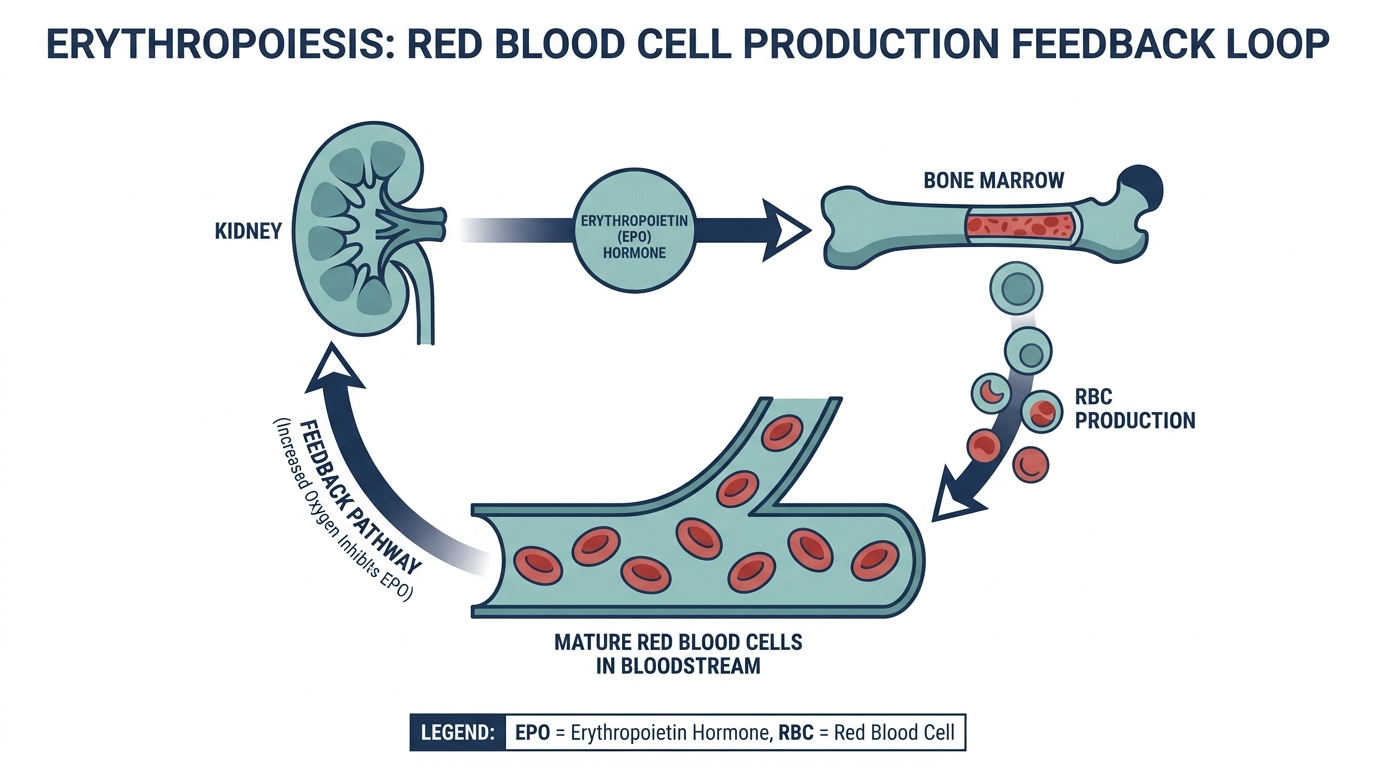
RBC in a blood test stands for red blood cell count, and it measures how many red blood cells are in a set volume of your blood. It is reported as part of a standard complete blood count, or CBC, which counts and sizes the different cells in your blood (MedlinePlus). Red blood cells are the ones that carry oxygen from your lungs to the rest of your body and ferry carbon dioxide back out, so the count is essentially a headcount of your oxygen delivery fleet.
The result is usually written as something like 4.8 million cells per microliter, often shortened to a figure such as 4.8 with units of x10^12 per liter. A higher number means more red cells packed into each drop of blood. A lower number means fewer. That single idea, how many oxygen carriers you have on hand, is the thread that runs through everything below.

What does RBC mean in a blood test, and what does it actually measure?
When people ask what does RBC mean in a blood test, the short answer is the literal number of red blood cells, nothing more complicated than that. It is a raw count, not a measure of cell size or hemoglobin content. Those qualities are captured by separate numbers called the RBC indices, which sit right next to the count on your report (MedlinePlus).
Here is the useful distinction. The RBC count tells you the quantity of red cells. The indices, such as MCV (average cell size) and MCH (average hemoglobin per cell), tell you about their quality (MedlinePlus). You can have a normal count of cells that are individually undersized, or a low count of perfectly normal cells. That is why no clinician reads RBC in isolation. The count sets the stage and the indices fill in the detail.
What is a normal RBC level?
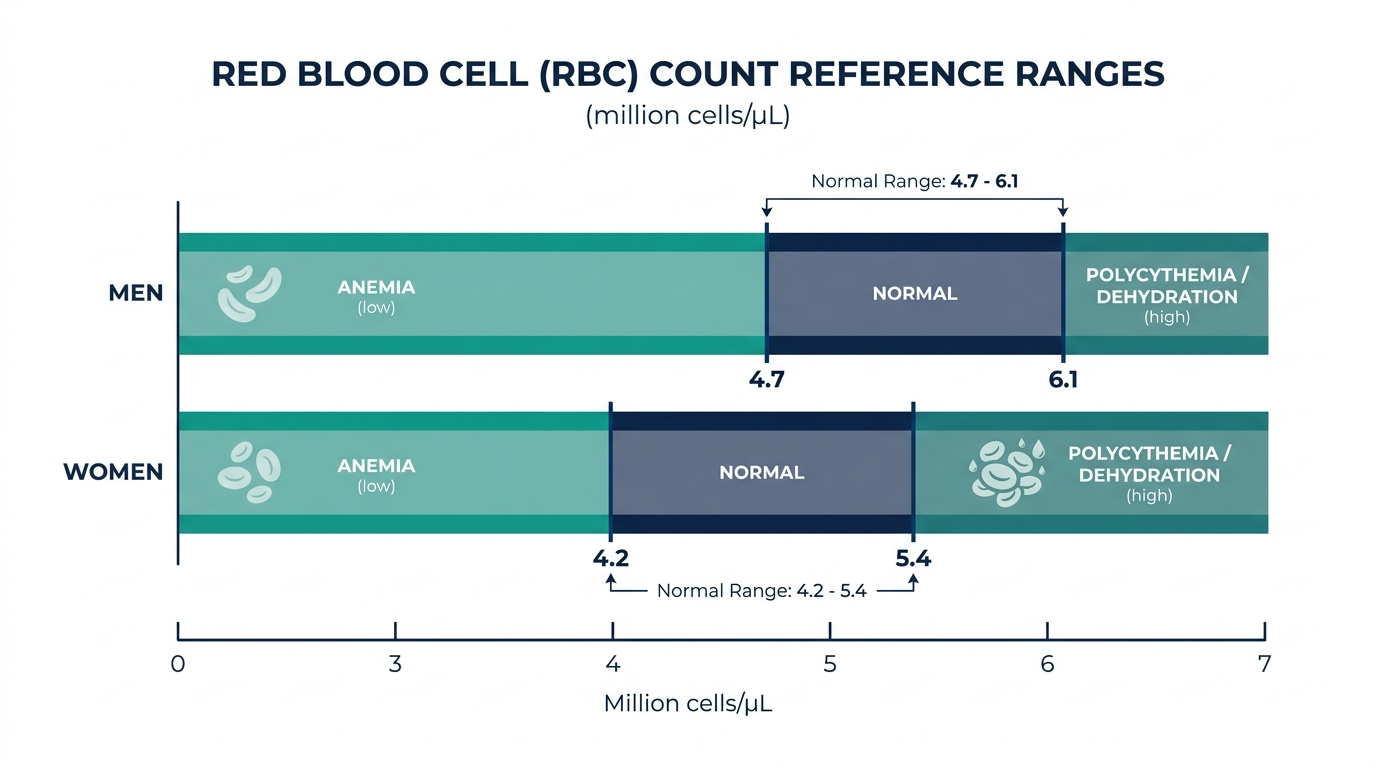
A normal RBC count depends on your sex and age, and it differs slightly from one lab to the next. Cleveland Clinic lists typical ranges of about 4.7 to 6.1 million cells per microliter for males, 4.2 to 5.4 million for females, and 4.0 to 5.5 million for children (Cleveland Clinic). MedlinePlus gives slightly different cutoffs, roughly 4.2 to 5.7 million for men and 3.8 to 5.1 million for women, which is a good reminder that the exact boundary moves with the lab and the instrument (MedlinePlus).
The practical takeaway is simple. Always read your result against the reference range printed on your own report, not against a number you found online. That printed range is the one your lab actually calibrated for the equipment that ran your sample. Men tend to run higher than women, largely because testosterone drives red cell production, which is also why the male and female ranges genuinely differ rather than being interchangeable.

What does a high RBC count mean?
A high RBC count means your blood carries more red cells than expected, a state doctors call erythrocytosis or polycythemia. It is not a diagnosis on its own, but it points to a short list of explanations, and they fall into two broad buckets (Cleveland Clinic):
- Your body needs more oxygen carriers. Living at high altitude, smoking, chronic lung disease such as COPD or emphysema, sleep apnea, and some forms of heart disease all push the body to make extra red cells to compensate for low oxygen (Cleveland Clinic).
- Your blood is concentrated. Dehydration shrinks the fluid part of your blood, so the same number of cells looks crowded and the count reads high even though you have not made more cells (MedlinePlus).
- Production is being driven up directly. Polycythemia vera, a bone marrow disorder, kidney tumors that overproduce erythropoietin, and drugs such as anabolic steroids, testosterone, or erythropoietin can all raise the count (MedlinePlus).
Why does it matter? Because more red cells make blood thicker, and thicker blood is harder to pump and more prone to clotting. Cleveland Clinic notes that a high count can make your blood thicker than it should be, which raises the risk of blood clots (Cleveland Clinic). That is the real reason clinicians pay attention to an elevated RBC rather than waving it off.
What does a low RBC count mean?
A low RBC count means you have fewer red blood cells than expected, and the most common label for that picture is anemia. With fewer oxygen carriers in circulation, tissues get less oxygen, which is why low counts so often come with fatigue, weakness, shortness of breath, and pale skin. The causes cluster into three categories (MedlinePlus):
- You are losing red cells. Bleeding, whether obvious like an injury or hidden like a slow gastrointestinal bleed, drops the count.
- You are not making enough. Deficiencies in iron, folate, vitamin B12, vitamin B6, or copper starve the marrow of raw materials. Bone marrow disorders, kidney disease that lowers erythropoietin, and some cancers also cut production (MedlinePlus).
- Your cells are being destroyed too fast. Certain conditions break red cells down faster than the body can replace them.
A single mildly low RBC count is not a verdict. It is a prompt to look at the rest of the CBC, especially MCV and hemoglobin, and often to run follow-up tests to find the why behind the number.

Why is RBC read together with hemoglobin, hematocrit, and MCV?
RBC rarely tells the full story alone, so it is read alongside hemoglobin, hematocrit, and the RBC indices, which together describe both the number and the character of your red cells (MedlinePlus). Think of it as three angles on the same population of cells. RBC is the headcount, hemoglobin is how much oxygen-carrying protein is on board, and hematocrit is what fraction of your blood volume the red cells take up.
MCV is where it gets clinically powerful. Once you know the count is low, the average cell size narrows down the cause fast (MedlinePlus):
- Low RBC with small cells (low MCV): points toward iron deficiency or thalassemia.
- Low RBC with large cells (high MCV): points toward vitamin B12 or folate deficiency, and sometimes liver disease.
- Low RBC with normal-sized cells (normal MCV): can appear with recent blood loss, chronic disease, or kidney problems.
This is why a smart clinician never treats the RBC number as a standalone answer. The count opens the question, the indices close in on the answer, and the combination is what makes a CBC genuinely diagnostic rather than just descriptive.
The part most people never hear: RBC count can predict more than anemia
Here is the insider angle that almost never makes it into the patient handout. The RBC count is not just a screen for anemia or polycythemia. In cardiology research it behaves like a quiet prognostic signal, and the direction of that signal surprises people.
In a study of patients with mildly reduced heart pumping function, each increase of one unit in RBC count (1.0 x10^12 cells per liter) was associated with a 28 percent lower risk of cardiovascular death in men and a 43 percent lower risk in women, after adjusting for other factors (PMC, RBC count and adverse outcomes in mildly reduced ejection fraction). In that high-risk group, a fuller red cell count tracked with better survival, likely because it reflected both adequate oxygen delivery and the absence of the malnutrition and chronic illness that drag the count down.
The honest caveat is that this is an association in a specific patient population, not a license to chase a higher RBC for its own sake. Push the count too high and you swing into the thick-blood, clot-prone territory described above. The real lesson is that the RBC number carries information well beyond a simple normal or abnormal flag. It is a sensitive readout of your overall physiology, which is exactly why it deserves a second look instead of a scroll-past.

Symptoms that often accompany an abnormal RBC count
The RBC number itself is silent, but the states it reflects usually announce themselves through the body. Knowing which symptoms pair with which direction helps you connect a lab value to how you actually feel.
When the count runs low and tissues are short on oxygen, common complaints include:
- Fatigue and a general lack of stamina that rest does not fully fix.
- Shortness of breath, especially with exertion like climbing stairs.
- Pale skin, and sometimes pallor inside the lower eyelids or gums.
- Lightheadedness, headaches, or a racing heartbeat as the body works harder to move oxygen.
- Cold hands and feet.
When the count runs high and the blood grows thicker, the picture shifts:
- Headaches, dizziness, or a feeling of fullness in the head.
- Flushed or reddened skin.
- Itching, classically after a warm shower, which is a well known clue in polycythemia vera.
- Blurred vision or ringing in the ears.
- In more serious cases, symptoms tied to clotting, which is the reason a high count is not ignored.
A red flag worth acting on quickly is any sudden severe symptom such as chest pain, one sided weakness, or breathlessness at rest. Those point beyond the lab value to a possible acute event and deserve urgent care rather than a wait and see approach.
How to prepare for an RBC test and what skews the result
RBC is measured as part of a standard complete blood count, and a basic CBC generally does not require fasting. You can usually eat and drink normally beforehand. That said, a few practical factors genuinely move the number, and being aware of them helps you avoid misreading a temporary blip as a real change.
- Hydration status. This is the single most underappreciated influence. Dehydration concentrates the blood and pushes the count up, while being well hydrated or overhydrated can dilute it and read lower. A count drawn after a workout in the heat is not the same as one drawn after a calm, well hydrated morning.
- Altitude. Living at high elevation genuinely raises red cell production over time, so a real range shift is expected, not an error.
- Recent blood loss or donation. A recent donation or bleed lowers the count until the marrow catches up.
- Pregnancy. Blood volume expands in pregnancy, diluting the cells so the count often reads lower even when red cell mass is fine.
- Posture and tourniquet time. Standing versus lying down and a prolonged tourniquet during the draw can nudge the value slightly, which is why lab technique is standardized.
The practical rule: interpret a borderline RBC in the context of the day it was drawn, and confirm a surprising result with a repeat rather than reacting to a single number.
Reading RBC alongside the rest of the panel: worked scenarios
Because RBC opens the question and the indices answer it, the most useful skill is reading the numbers together. A few realistic combinations show how quickly a pattern points toward a cause.
- Low RBC, low hemoglobin, low MCV. Small cells and a low count classically suggest iron deficiency, one of the most common anemias, especially in menstruating women or people with slow gastrointestinal blood loss.
- Low RBC, low hemoglobin, high MCV. Large cells with a low count point toward vitamin B12 or folate deficiency, and sometimes liver disease or alcohol use.
- Low RBC, normal MCV. Normal sized cells with a low count can reflect recent blood loss, chronic disease, or kidney problems that blunt erythropoietin.
- High RBC, high hematocrit, otherwise well. Often dehydration or a smoking or altitude effect. If it persists in a well hydrated person, it prompts a look for polycythemia.
- High RBC with itching and a large spleen. This combination raises suspicion for polycythemia vera and warrants specialist evaluation.
The reason a comprehensive panel beats a single value is right here. One draw that captures RBC, hemoglobin, hematocrit, and the indices lets a clinician see the pattern instantly instead of guessing from a lone count.
Who should test, how often, and what happens after an abnormal result
An RBC count is part of the CBC, one of the most commonly ordered blood tests, so most adults have it checked during routine physicals or any workup for fatigue, dizziness, or unexplained symptoms. There is no universal schedule for a healthy person, but reasonable prompts to test include new fatigue or breathlessness, a history of anemia or a blood disorder, heavy menstrual bleeding, chronic kidney or lung disease, or monitoring a treatment known to affect red cells.
If the count comes back abnormal, the next step is rarely a single dramatic action. For a low count, a clinician typically confirms with the hemoglobin and MCV, then runs targeted follow ups such as iron studies, B12 and folate levels, or a reticulocyte count to see whether the marrow is responding. For a high count, the workup may check hydration, oxygen levels, and in persistent cases a marrow related test such as erythropoietin or genetic testing for polycythemia vera. The count opens the investigation. The follow up tests close it.
Common misconceptions about the RBC count
- “A high RBC means my blood is healthy and strong.” Not necessarily. Above the normal range, more cells make blood thicker and raise clot risk. Higher is not automatically better.
- “RBC and hemoglobin are the same thing.” They are related but distinct. RBC is the headcount of cells, hemoglobin is the oxygen carrying protein inside them. You can have a normal count with low hemoglobin, or the reverse.
- “One slightly low RBC means I have a serious disease.” A single borderline value is a prompt, not a diagnosis. Hydration, timing, and a repeat test often clarify it before any deeper workup is needed.
- “The online normal range applies to me.” Ranges vary by lab, instrument, sex, and age. The reference range printed on your own report is the one calibrated for the equipment that ran your sample.
- “If the RBC is normal, my red cells are fine.” A normal count can still hide undersized or oddly shaped cells. That is exactly why the indices sit next to the count and why clinicians read them together.
How to track your RBC count over time and read the trend
A single red blood cell count is a snapshot, and snapshots can mislead. The count shifts with hydration, so a dehydrated draw can look falsely high while a large fluid load can dilute the blood and make the count read low, neither of which reflects a real change in how many cells your marrow is making. Because of this, the value worth watching is the trend across several draws taken under similar conditions rather than any one reading in isolation. Standardize what you can: draw at roughly the same time of day, in a similar hydration state, and ideally at the same laboratory so the ruler stays constant.
The trend also has to be read with its companions rather than alone, because the RBC count rarely moves in a vacuum. A count drifting down alongside falling hemoglobin and hematocrit tells a consistent anemia story, and the MCV then hints at why, whether the cells are small, normal, or large. A count nudging up together with rising hemoglobin can reflect something as simple as dehydration or as meaningful as the body making extra cells in response to low oxygen or, less often, a marrow disorder. Watching the whole cluster move together keeps you from overreacting to one number that wobbled on its own.
The practical habit is to log each result with its date, the lab, and any recent context such as illness, altitude travel, blood donation, or a new medication, then bring that log to the same clinician so one person can see the arc. A slow decline over a year is easy to miss on a single sheet and obvious on a chart, and a value that dips once then recovers is reassuring in a way no lone reading can be. If you switch labs, note it, because small differences in method and reference range can make a stable count look like it moved when only the measuring stick changed.
Frequently asked questions
What is an RBC blood test used for?
An RBC blood test, run as part of a complete blood count, measures the number of red blood cells in your blood to help screen for and diagnose conditions like anemia, dehydration, and polycythemia (MedlinePlus). It is also used to monitor conditions and treatments that affect red cell production.
What is a normal RBC count?
A normal RBC count is roughly 4.7 to 6.1 million cells per microliter for males and 4.2 to 5.4 million for females, with children around 4.0 to 5.5 million, though ranges vary slightly by lab (Cleveland Clinic). Always compare your result to the reference range on your own report.
Should I worry about a high RBC count?
Not automatically, but it is worth investigating. A high count can come from something simple like dehydration or smoking, or from conditions like lung disease or polycythemia vera, and it can thicken the blood and raise clot risk (Cleveland Clinic). Your clinician will look at the rest of your CBC to interpret it.
What does a low RBC count mean?
A low RBC count usually points to anemia from blood loss, reduced production due to iron, B12, or folate deficiency, or faster destruction of red cells (MedlinePlus). It is interpreted alongside hemoglobin and MCV to find the cause.
What is the difference between RBC and hemoglobin?
RBC counts how many red blood cells you have, while hemoglobin measures the amount of oxygen-carrying protein inside them. Both are reported in a CBC and read together, because you can have a normal cell count with low hemoglobin or the reverse (MedlinePlus).
This article is for general educational purposes and is not medical advice. It cannot diagnose or treat you and does not replace your clinician. Always discuss your lab results and any health decisions with a qualified healthcare professional.
Vital Signs Today may earn a commission if you buy through links on this page. It does not affect our editorial assessments.