
Disclosure: Vital Signs Today may earn a commission if you buy through links on this page, at no extra cost to you. This does not influence our evidence-based assessments. We are not a medical provider; talk to a clinician before acting on test results.
Part of our Complete Blood Count guide.
Here is a quiet irony of modern lab work: you can be running low on one of the most important minerals in your body, walk out of the clinic with a “normal” magnesium result, and never know it. The standard blood test most doctors order looks at the wrong pool. The RBC magnesium test was built to look at the right one, and once you understand why, you stop trusting that reassuring number on the regular panel quite so much.
What is an RBC magnesium test, in plain terms?
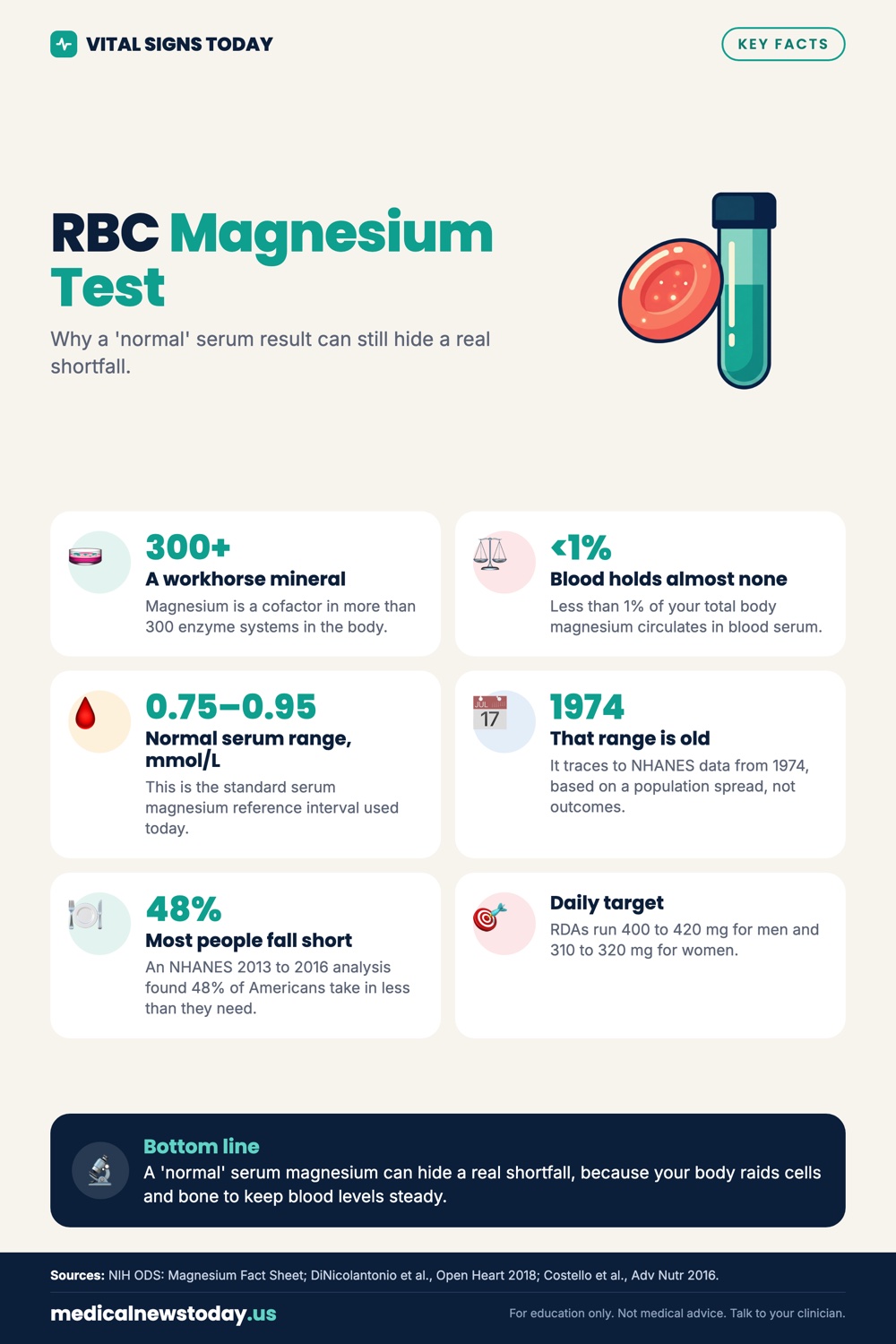
An RBC magnesium test measures the magnesium stored inside your red blood cells rather than the small fraction floating in serum. Because more than 99% of the body’s magnesium lives inside cells and bone and only about 1% circulates in blood, the RBC test gives a more stable, longer-term read of your true magnesium reserves than a standard serum test does.
That distinction matters more than it sounds. Magnesium is the fourth most abundant mineral in the body and a cofactor in over 300 enzyme reactions, from making energy to firing nerves to steadying heart rhythm. Yet the blood compartment most labs sample is the one place magnesium is least represented.
How is RBC magnesium different from a regular serum magnesium test?
The everyday test, serum (or plasma) magnesium, measures what is dissolved in the liquid part of your blood. The catch is that your body guards serum magnesium fiercely. When intake drops, the body pulls magnesium out of cells and bone to keep blood levels steady, which means serum can read perfectly normal while your tissues are quietly running on empty.
According to a 2018 analysis in Open Heart, because serum magnesium does not reflect intracellular magnesium (the 99% that actually does the work), most cases of magnesium deficiency go undiagnosed (DiNicolantonio et al., Open Heart 2018). The same authors point out something uncomfortable about the “normal” range itself: the commonly used serum reference interval of roughly 0.75 to 0.95 mmol/L traces back to NHANES I data from 1974, and it was built from the statistical spread of a general population rather than from any clinical outcome (Costello et al., Advances in Nutrition 2016). In other words, “normal” here means “common,” not “optimal.”
RBC magnesium sidesteps part of that problem. Red blood cells live about 120 days, so the magnesium packed inside them reflects your average exposure over weeks to months, not a single morning’s snapshot. That makes the RBC result harder to fool with a good breakfast and a better proxy for what is happening inside your cells.
| Feature | Serum magnesium | RBC magnesium |
|---|---|---|
| What it measures | Magnesium in blood plasma (~1% of body total) | Magnesium inside red blood cells (intracellular) |
| Time window | Single-moment snapshot | Reflects roughly the 120-day red cell lifespan |
| Sensitivity to early shortfall | Often stays “normal” until deficiency is advanced | Drops earlier as tissue stores fall |
| Availability and cost | Cheap, on most standard panels | Less common, usually ordered separately |
Want to check your red blood cells?
Three ways to get it measured. Pick whichever fits you.
Affiliate links: we may earn a commission at no extra cost to you. A lab test does not replace a visit with your clinician.
What is a normal RBC magnesium range?
Reference ranges vary by laboratory and by the assay used, so always read your result against the range printed on your own report. Many commercial labs report an RBC magnesium reference interval in the neighborhood of about 4.0 to 6.4 mg/dL, with some labs citing a slightly wider window. For comparison, a typical adult serum magnesium range runs roughly 1.7 to 2.4 mg/dL (about 0.75 to 1.0 mmol/L), reflecting that much smaller circulating pool.
A word of caution on chasing “optimal” numbers near the top of the range. Some functional-medicine clinics argue you want to sit comfortably in the upper half of the RBC range, but that target is largely opinion-based rather than proven against hard outcomes. The honest summary: a clearly low RBC magnesium is a meaningful red flag worth acting on, while small differences within the normal band are not something to lose sleep over.
Why might my serum magnesium be normal but I still feel deficient?
This is the whole reason the RBC test exists. Because the body sacrifices its internal magnesium stores to protect blood levels, serum can stay in range while a real shortfall builds in muscle, nerve, and heart tissue. Researchers call this subclinical magnesium deficiency, and they argue it is common precisely because the usual test misses it.
The scale of the underlying gap is striking. An analysis of NHANES 2013 to 2016 dietary data cited by the U.S. National Institutes of Health found that about 48% of Americans of all ages take in less magnesium from food and drink than their estimated average requirement (NIH Office of Dietary Supplements). The recommended daily allowance sits around 400 to 420 mg for adult men and 310 to 320 mg for adult women. When nearly half the population eats below the bar, a test that hides early shortfall is not doing anyone favors.
Symptoms of low magnesium are frustratingly nonspecific, which is part of why it slips by. Per the NIH, early signs can include loss of appetite, nausea, fatigue, and weakness, while a more pronounced shortfall may bring muscle cramps and twitches, numbness or tingling, abnormal heart rhythms, and personality changes (NIH Office of Dietary Supplements). Severe deficiency can also drag down calcium and potassium levels. None of these by themselves prove a magnesium problem, which is exactly why a targeted test can help connect the dots.
Is RBC magnesium the gold-standard test? Where it falls short
RBC magnesium is better than serum for spotting depleted reserves, but calling it a flawless gold standard oversells it. The first issue is technical. A 1995 review in Magnesium Research noted that measuring magnesium inside red cells comes with real method-related variability, because the result depends on the assay used and on cleanly separating and processing the cells (Millart et al., Magnes Res 1995). Sloppy sample handling can skew the number.
The second issue is biological. Red cells are one tissue compartment, not the whole body. RBC magnesium does not perfectly track magnesium in every tissue, and at least one older study in patients with mitral valve prolapse found no clear clinical difference between those with normal versus low RBC magnesium, hinting that red cells may not mirror every organ’s stores. Some researchers consider a magnesium loading (retention) test, where you measure how much of an infused dose your body holds onto, to be a more direct functional measure, though it is impractical for routine screening.
So the practical framing is this: RBC magnesium is a useful, widely available upgrade over serum for anyone worried about a quiet shortfall, but it is one data point. It works best read alongside your symptoms, your diet, and your overall clinical picture rather than as a standalone verdict.
Who should consider getting an RBC magnesium test?
You do not need this test if you eat well and feel fine. It earns its place when there is a reason to suspect depletion that a standard panel might miss. Reasonable candidates include people with persistent muscle cramps or twitches, unexplained fatigue, frequent migraines, or heart-rhythm concerns, as well as those with conditions and medications that drain magnesium, such as poorly controlled type 2 diabetes, chronic alcohol use, long-term proton pump inhibitor use, certain diuretics, and digestive disorders that impair absorption.
If any of that fits, it is a conversation worth having with your clinician rather than a test to order in isolation. Magnesium does not act alone in the body; it works in close partnership with other minerals and signaling molecules, the same way many of the body’s chemical messengers operate in concert, a theme we explore in our overview of how the body’s signaling molecules work.
Frequently asked questions
Is the RBC magnesium test better than a regular blood test?
For detecting depleted magnesium reserves, generally yes. RBC magnesium reflects intracellular stores over the roughly 120-day life of a red blood cell, while serum magnesium can stay normal even when tissue levels are low. RBC magnesium is not flawless, though, and is best interpreted with your symptoms and history.
Do I need to fast before an RBC magnesium test?
Requirements vary by lab and by what else is being tested at the same time. Because RBC magnesium reflects long-term stores rather than a recent meal, fasting matters less than it does for some other tests, but always follow the specific instructions your ordering clinician or laboratory gives you.
Can I just take a magnesium supplement instead of testing?
Many people tolerate dietary magnesium and modest supplementation well, but more is not automatically better, and excess supplemental magnesium can cause side effects such as diarrhea, and risks rise with kidney problems. Testing helps target the decision rather than guess. Talk to a clinician before starting supplements, especially if you have kidney disease or take other medications.
What does a high RBC magnesium result mean?
True magnesium overload from diet is uncommon in people with healthy kidneys, since the body excretes the excess. A high result more often points to supplementation, certain medications, or impaired kidney function. As with any out-of-range value, it should be interpreted by your clinician in context.
How often should I retest?
There is no universal schedule. Because RBC magnesium shifts slowly, retesting after a few months of dietary change or supplementation is usually enough to see a trend. Your clinician can advise based on your situation.
This article is for general information only and is not medical advice. It is not a substitute for diagnosis or treatment by a qualified clinician. Talk to your doctor before making decisions about testing, supplements, or your care.