Disclosure: Vital Signs Today may earn a commission if you buy through links on this page, at no extra cost to you. This does not influence our evidence-based assessments. We are not a medical provider; talk to a clinician before acting on test results.
You scanned your complete blood count, and there it was: RBC, flagged low, sitting just under the reference range. Maybe your doctor mentioned it in passing, maybe a patient portal alert beat them to it. Either way, you are now staring at three letters wondering whether this is a nothing-burger or the first sign of something real.
Here is the straight answer most explainers bury. A low RBC is rarely the whole story by itself. It is the headline, not the article. What matters is why it is low, and that question has a short, well-worn list of answers that a clinician walks through every day.
Part of our Complete Blood Count guide.
What does low rbc mean in a blood test?
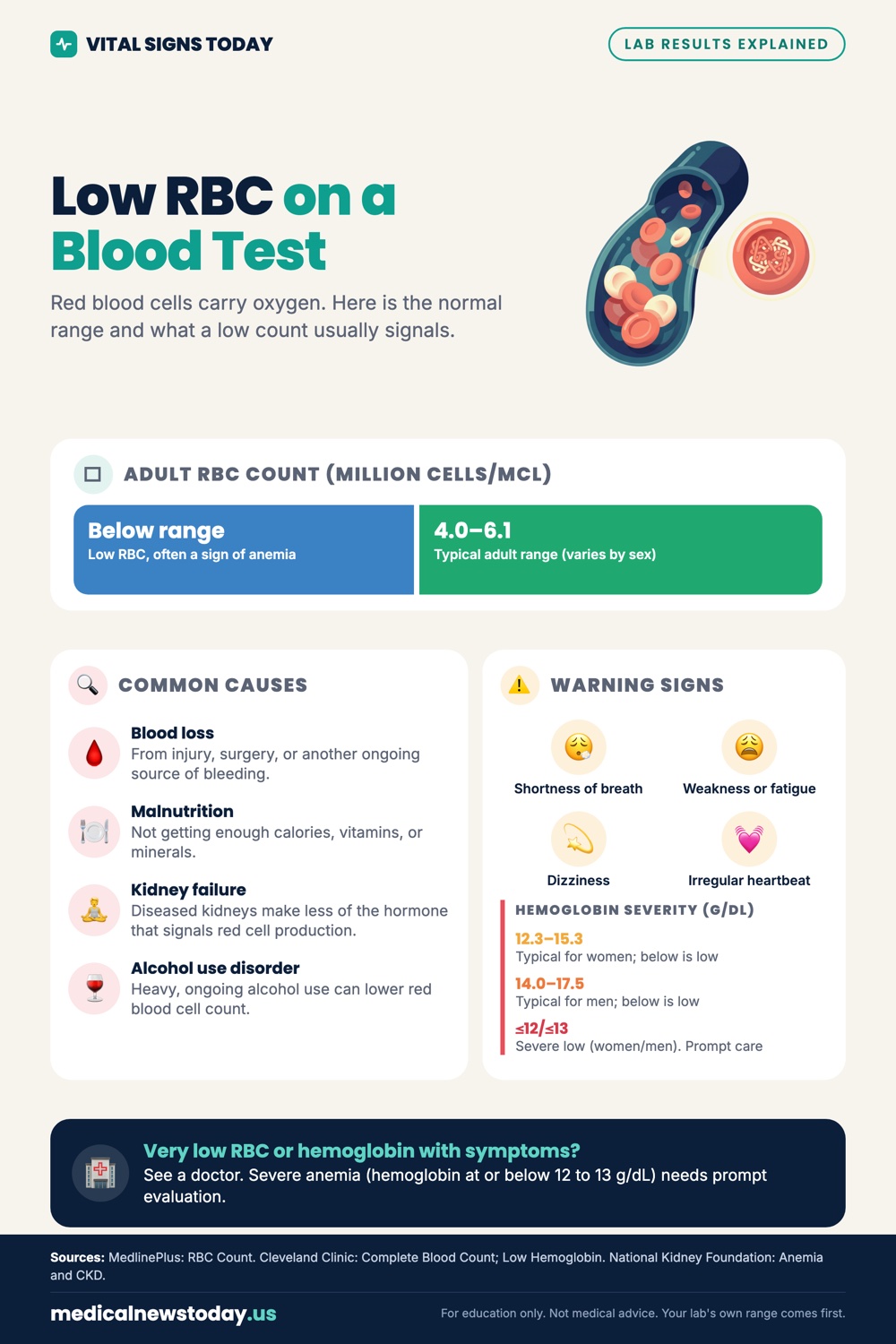
A low RBC means your blood contains fewer red blood cells than expected, which usually points to anemia, a state where your blood carries less oxygen than your body wants (Cleveland Clinic). Red blood cells, also called erythrocytes, are the carriers that haul oxygen from your lungs out to every tissue (MedlinePlus). Fewer carriers means less oxygen delivered, which is why a low count tends to show up as tiredness before anything else.
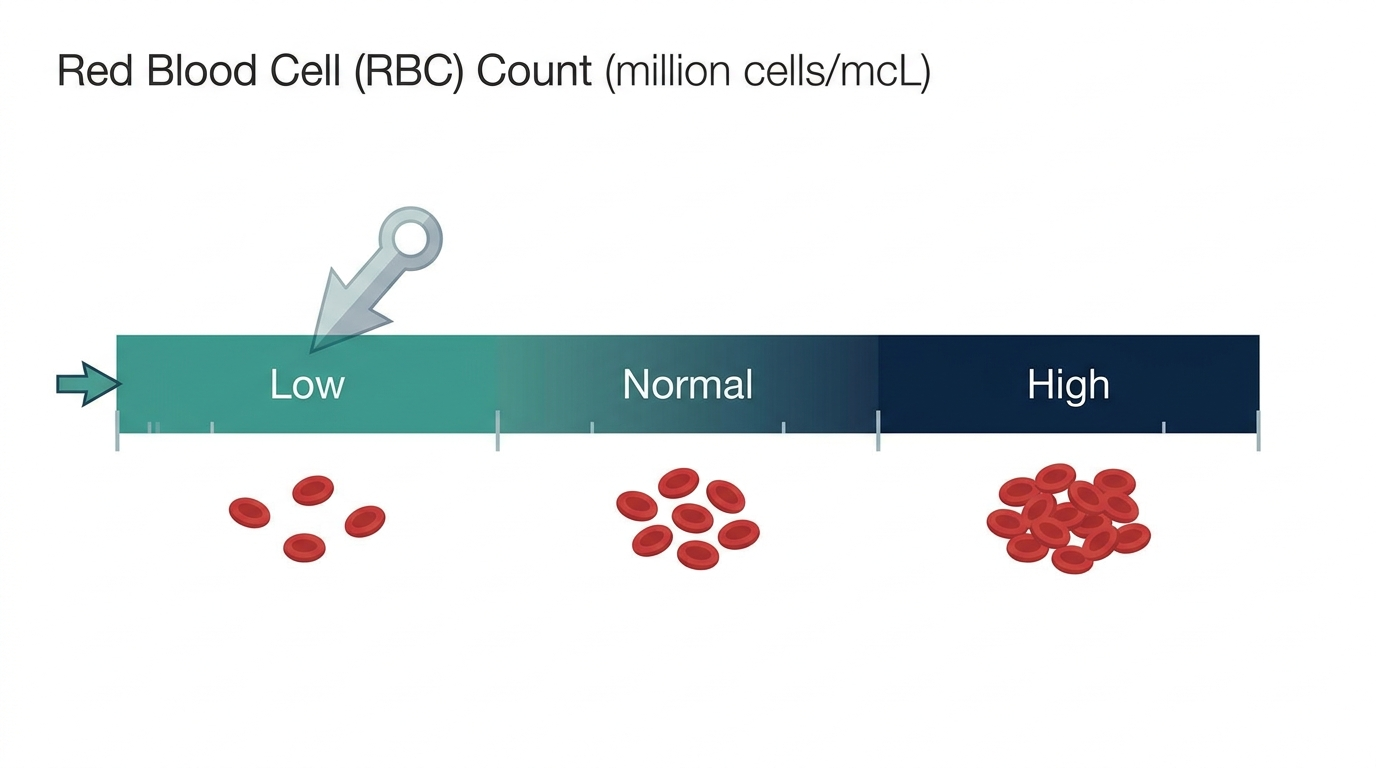
What counts as low depends on the reference range printed on your own report, but the typical adult cutoffs are well established. A normal RBC count runs about 4.5 to 6.1 million cells per microliter for men, and about 4.0 to 5.4 million cells per microliter for women or people taking estrogen (Cleveland Clinic). Fall below the bottom of your lab’s range and the result gets flagged low. The further below, and the faster it dropped, the more it matters.
One important nuance up front: RBC count rarely travels alone. It is read next to hemoglobin and hematocrit, the two numbers that actually define anemia in clinical practice. A mildly low RBC with normal hemoglobin is a very different conversation from a low RBC with low hemoglobin and symptoms.
What causes a low RBC?
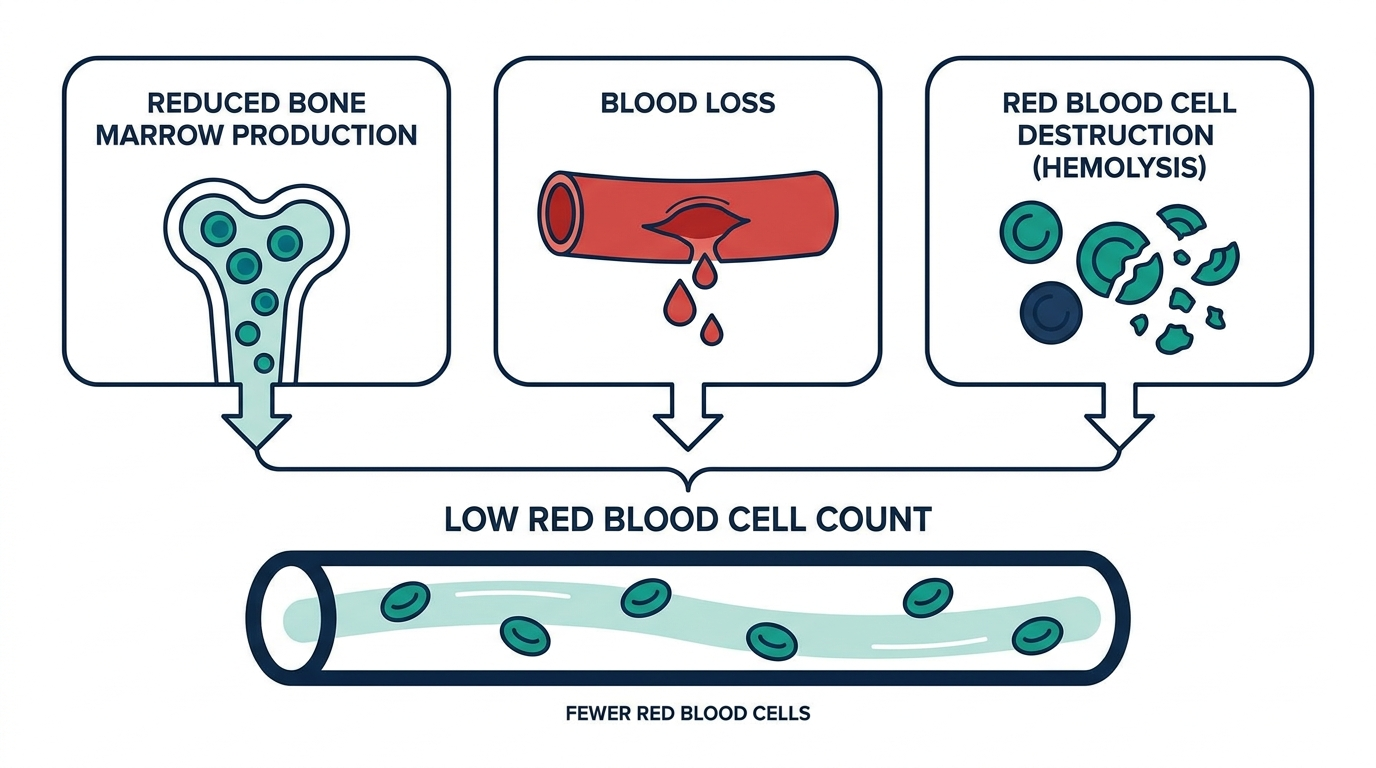
Low RBC counts come from three broad mechanisms: you are not making enough red cells, you are destroying them faster than you can replace them, or you are losing them through bleeding (Cleveland Clinic). Sorted roughly by how often they turn up in everyday practice, the real differential looks like this.
- Iron deficiency. The single most common cause worldwide. Without enough iron, your marrow cannot build hemoglobin, so it produces fewer and smaller red cells (Cleveland Clinic). In women of reproductive age, heavy periods are a frequent driver.
- Blood loss. Obvious bleeding from injury or surgery, but also the quiet kind: a slow gastrointestinal bleed from an ulcer or polyp can drag your count down for months before you notice (MedlinePlus).
- Vitamin B12 or folate deficiency. These nutrients are essential raw material for red cell production, and running short slows the whole assembly line (Cleveland Clinic).
- Chronic kidney disease. Healthy kidneys make erythropoietin, the hormone that tells your marrow to build red cells. As kidney function falls, that signal fades and production slows, which is why anemia is common in advanced kidney disease (National Kidney Foundation).
- Bone marrow and blood disorders. Conditions such as leukemia, lymphoma, multiple myeloma, and aplastic anemia disrupt the factory itself (Cleveland Clinic). These are far less common but are exactly why a persistent, unexplained low RBC gets a proper workup.
- Other contributors, including malnutrition, pregnancy, heavy alcohol use, certain medications including chemotherapy, and conditions that destroy red cells faster than the body can replace them (MedlinePlus).
The everyday pattern is reassuringly simple: most low RBC results trace back to iron, blood loss, or a B vitamin. The serious causes are real but uncommon, and the job of follow-up testing is to tell the two groups apart.
What are the symptoms of a low RBC?
A mildly low RBC often causes no symptoms at all, which is exactly why so many cases are caught by accident on routine blood work. When symptoms do appear, they reflect the simple problem underneath: not enough oxygen reaching your tissues.
The classic signs of a low RBC, or the anemia it usually represents, include (MedlinePlus, Cleveland Clinic):
- Fatigue and weakness that rest does not fix
- Shortness of breath, especially on exertion like stairs
- Dizziness or lightheadedness
- Headache
- Pale skin
- Heart palpitations or an irregular heartbeat
The pattern that should grab your attention is the slow creep. People are remarkably good at writing off mounting fatigue as stress, poor sleep, or getting older. If you find yourself winded by tasks that used to be easy, that is worth a conversation, not a shrug.
When is a low RBC dangerous or a medical emergency?
Most low RBC results are not emergencies. The dangerous scenarios are about speed and severity, not the flag itself. Severe anemia can be life-threatening, and chronic untreated anemia raises the risk of heart attack and heart failure because the heart is forced to overwork to move enough oxygen (Cleveland Clinic).
Treat it as an emergency and call 911 if a low count comes with red-flag symptoms such as (Cleveland Clinic):
- Chest pain
- Severe shortness of breath or trouble breathing
- Fainting, or feeling like you are about to pass out
- A racing or pounding heartbeat with a sense of impending doom
- Signs of significant blood loss, like vomiting blood or black, tarry stools
The reason these matter is that anemia symptoms overlap heavily with heart attack symptoms, and the two can be mistaken for each other (Cleveland Clinic). When in doubt, err toward being checked. A rapid drop in red cells from active bleeding is far more urgent than the same number reached slowly over months.

What should you do about a low RBC?
A single low RBC is the start of an investigation, not the end. The next steps are usually straightforward and follow a logical order.
- Look at the rest of the CBC first. Your clinician reads RBC alongside hemoglobin, hematocrit, MCV (average red cell size), and RDW (variation in size). MCV in particular splits the causes apart: small cells point toward iron deficiency, large cells toward B12 or folate (Cleveland Clinic).
- Targeted follow-up labs. Depending on the picture, that means iron studies including ferritin, B12 and folate levels, kidney function, and sometimes a reticulocyte count to see whether your marrow is responding.
- Find the source of any bleeding. If iron deficiency turns up with no obvious cause, a hunt for hidden gastrointestinal blood loss is standard, especially in men and postmenopausal women.
- Address the cause, not just the number. Treatment depends entirely on the why: iron supplements and dietary iron for deficiency, B12 or folate replacement, treating kidney disease, or referral to hematology for marrow disorders (Cleveland Clinic).
Lifestyle helps when the cause is nutritional, but it is not a substitute for finding the cause. Loading up on spinach will not fix a bleeding ulcer. The point of the workup is to make sure you are treating the actual problem.
When should you see a doctor?
See your clinician if a low RBC shows up on your report, even without symptoms, so the cause can be sorted out. Book a visit promptly if fatigue or other changes persist beyond about two weeks despite adequate rest, or if symptoms keep getting worse despite treatment (Cleveland Clinic). And as above, do not wait for an appointment if you have chest pain, severe breathlessness, fainting, or signs of active bleeding. Those go to emergency care now.
The insider read: the trap of a falsely low or misleading RBC
Here is the nuance that experienced clinicians watch for and that almost never makes it into the patient version. The RBC number can be misleading in both directions, and acting on it without context is a classic mistake.
The first trap is dilution. Plasma volume expands in pregnancy, which lowers the concentration of red cells even when the total number is fine. This produces a real, expected dip on the report that is physiologic, not a disease, and it is one reason pregnancy is listed among the causes of a low RBC count (MedlinePlus). Overhydration around the time of the draw can nudge the count the same way.
The second trap is the opposite: a normal or borderline RBC that hides a real problem. Dehydration concentrates the blood and can prop the count up into the normal range, masking an anemia that is genuinely there. This is why a one-off RBC in isolation is weak evidence. The smart move is to read it together with hemoglobin, hematocrit, MCV, and RDW, and to recheck rather than overreact to a single borderline value (Cleveland Clinic). The number is a starting point. The pattern is the diagnosis.

Reading a low RBC with MCV and RDW: classifying the anemia
The reason a clinician can often narrow the cause of a low RBC before ordering a single extra test is that the CBC already contains two clues sitting next to the count: MCV and RDW. Learning to read them turns a vague low flag into a short list of likely causes.
- MCV (mean corpuscular volume) is the average size of your red cells. It sorts anemia into three families. Small cells (low MCV, called microcytic) point toward iron deficiency or thalassemia. Normal-sized cells (normocytic) point toward blood loss, chronic disease, or kidney-related anemia. Large cells (high MCV, called macrocytic) point toward vitamin B12 or folate deficiency, or heavy alcohol use.
- RDW (red cell distribution width) measures how much the cells vary in size. A high RDW means a mixed population, which is common early in iron deficiency, when fresh small cells are joining older normal ones. A normal RDW with small cells is more typical of an inherited trait like thalassemia.
Put them together and you get a fast, useful read. Small cells with a high RDW strongly suggests iron deficiency and points to iron studies. Large cells point to B12 and folate testing. Normal-sized cells with a low count shift the search toward blood loss, chronic disease, or kidney function. This is exactly why reading RBC in isolation is weak, and why the same panel that flagged your count also holds most of the answer.
The reticulocyte count: is your marrow responding?
One test that adds a lot when a low RBC is being worked up is the reticulocyte count, which measures young, newly released red cells. It answers a simple but important question: is the bone marrow trying to fix the problem, or has it stalled?
- High reticulocytes with a low RBC means the marrow is responding, pumping out fresh cells. This fits blood loss or red cell destruction, where the factory is fine but cells are being lost or broken down.
- Low or normal reticulocytes with a low RBC means the marrow is not keeping up. This fits production problems such as iron, B12, or folate deficiency, kidney disease, or a marrow disorder.
This single distinction, response versus no response, is one of the most efficient forks in the anemia workup, and it explains why your clinician may add a reticulocyte count rather than jumping straight to invasive testing.
Iron, B12, and folate: closing the nutritional gaps
Because nutritional deficiencies drive most low RBC counts, it helps to know what actually moves the needle when the cause is dietary, and where diet alone falls short.
- Iron: heme iron from animal sources such as lean red meat, poultry, and fish is absorbed more efficiently than the non-heme iron in plants. Pairing plant iron sources like lentils, beans, tofu, and fortified cereals with vitamin C improves absorption, while tea, coffee, and calcium taken at the same meal reduce it. When deficiency is established, diet usually is not enough on its own, and a clinician-directed iron supplement is typically needed to rebuild stores over months.
- Vitamin B12: found in meat, fish, eggs, and dairy, so strict vegetarians and vegans are at higher risk and often need a supplement. B12 deficiency can also come from absorption problems, such as pernicious anemia or after certain gut surgeries, in which case injections or high-dose oral replacement may be required.
- Folate: found in leafy greens, legumes, and fortified grains. Deficiency is treated with folic acid, but B12 should be checked first, because correcting folate alone while B12 is low can mask an ongoing problem.
The consistent theme is that supplementation should be matched to the confirmed deficiency, not taken blindly. Taking iron you do not need is not harmless, and it will not help an anemia caused by something else.

Want to check your red blood cells?
Three ways to get it measured. Pick whichever fits you.
Affiliate links: we may earn a commission at no extra cost to you. A lab test does not replace a visit with your clinician.
How to prepare, and what can distort an RBC result
An RBC count is part of a routine CBC and does not usually require fasting, though the panel it rides on sometimes does. A few factors can move the number enough to matter:
- Hydration: dehydration concentrates the blood and can prop the count up, masking a real anemia. Overhydration dilutes it and can push the count down. Ordinary hydration is best.
- Posture and timing: lying down versus standing can slightly shift the measured concentration, and there is minor variation across the day.
- Altitude: living at high altitude raises red cell counts over time as the body adapts to thinner air, which is a normal adaptation rather than a problem.
- Pregnancy: plasma volume expands, producing an expected dilutional dip.
- Recent transfusion or bleeding: either can shift the count sharply, so timing matters when interpreting a result.
Because of these, a single borderline low value is often rechecked under ordinary conditions before conclusions are drawn.
Monitoring after treatment: what recovery should look like
Once the cause of a low RBC is found and treated, follow-up bloodwork confirms it is working. The timeline depends on the cause. With iron deficiency, a reticulocyte bump appears within a week or so of effective treatment, hemoglobin typically starts climbing over several weeks, and iron stores measured by ferritin take longer to refill, often a few months, which is why iron is usually continued past the point where the count normalizes. B12 and folate replacement produce a similar marrow response once the missing nutrient is restored.
The practical guidance is to keep your past results and watch the trend, not just the single value. A count that is low but steadily rising on treatment is good news, while one that is not budging despite treatment is a signal to look again for a missed cause, such as ongoing blood loss. As with every part of the CBC, the direction of travel over time tells you more than any one report.
Worked interpretation scenarios
The same low RBC can mean very different things depending on the numbers around it. Here is how a clinician mentally sorts the common patterns. None of these replace your own doctor, but they show why context changes everything.
- Low RBC, low MCV, high RDW, low ferritin, heavy periods. The textbook iron-deficiency picture. Treatment is iron replacement plus addressing the source of blood loss, and the count climbs back over weeks.
- Low RBC, high MCV, low B12. A large-cell anemia driven by vitamin deficiency. Replacing B12 corrects it, and the reason for the deficiency, such as poor absorption, needs its own look.
- Low RBC, normal MCV, known kidney disease. Fits anemia of chronic kidney disease from reduced erythropoietin, managed alongside the kidney condition.
- Low RBC with a high reticulocyte count and dark stools. The marrow is responding to loss. This shifts the search toward a gastrointestinal bleed.
- Low RBC that dropped fast after surgery with a fast heart rate and low blood pressure. Suggests acute blood loss and is an urgent situation rather than a routine finding.
The other red cell indices: MCH and MCHC
Beyond MCV and RDW, your CBC reports two more red cell indices that fine-tune the picture when RBC is low. They describe how much hemoglobin the cells carry, which is really a measure of how well oxygen can be transported per cell.
- MCH (mean corpuscular hemoglobin) is the average amount of hemoglobin inside each red cell. It tends to track with MCV, so a low MCH usually accompanies the small, pale cells of iron deficiency.
- MCHC (mean corpuscular hemoglobin concentration) is the concentration of hemoglobin within a given volume of red cells. A low MCHC describes cells that look pale under the microscope, again pointing toward iron deficiency, while an unusually high MCHC can be a clue to specific conditions such as hereditary spherocytosis or can flag a lab artifact.
These indices rarely change the plan on their own, but they add confidence. When MCV, MCH, and MCHC all point the same way, the classification of the anemia is more secure, and the follow-up testing can be more targeted. This is one more reason the low RBC flag is only the opening line of a longer, readable story that the rest of the panel tells.
Frequently asked questions
Is a low RBC count serious?
It depends on the cause and how low it is. Most low RBC results trace back to iron deficiency, blood loss, or a B vitamin deficiency and are very treatable (Cleveland Clinic). A persistent or unexplained low count, or one with significant symptoms, deserves a proper workup because it can occasionally point to kidney or bone marrow problems.
What is the normal RBC count range?
A normal RBC count is roughly 4.5 to 6.1 million cells per microliter for men and 4.0 to 5.4 million cells per microliter for women or people taking estrogen, though ranges vary slightly by lab (Cleveland Clinic). Always compare your result to the reference range printed on your own report.
What is the most common cause of a low RBC?
Iron deficiency is the most common cause worldwide, because without enough iron the body cannot build hemoglobin and produces fewer red cells (Cleveland Clinic). Blood loss and vitamin B12 or folate deficiency are the other frequent culprits (MedlinePlus).
Can a low RBC count have no symptoms?
Yes. A mildly low RBC often causes no symptoms and is found by chance on routine blood work. When symptoms do appear they usually include fatigue, shortness of breath, dizziness, and pale skin (Cleveland Clinic).
When is a low RBC a medical emergency?
Seek emergency care if a low count comes with chest pain, severe shortness of breath, fainting, a pounding heartbeat, or signs of active bleeding such as black stools or vomiting blood (Cleveland Clinic). Anemia symptoms can be mistaken for a heart attack, so when in doubt, get checked.
This article is for general educational purposes and is not medical advice. It cannot diagnose or treat you and does not replace your clinician. Always discuss your lab results and any health decisions with a qualified healthcare professional.
Vital Signs Today may earn a commission if you buy through links on this page. It does not affect our editorial assessments.