
Disclosure: Vital Signs Today may earn a commission if you buy through links on this page, at no extra cost to you. This does not influence our evidence-based assessments. We are not a medical provider; talk to a clinician before acting on test results.
Related: How to bring AST back into range
You scanned your liver panel expecting the usual worry, a number that is too high. Instead, the AST line sits below the reference range, with a little “L” next to it. Most people never get told what that means, because almost every explainer on the internet is obsessed with high AST and liver damage. A low AST is the quieter, stranger result, and it deserves a real answer instead of a shrug.
Here is the short version before we go deep. A low AST is usually nothing to panic about, but it is not always meaningless. In the right context it can be a quiet fingerprint of a vitamin deficiency or kidney disease, and that is exactly the part the standard report leaves out.
Part of our Liver Function Tests guide.
What is AST in a blood test low, and what does it mean?
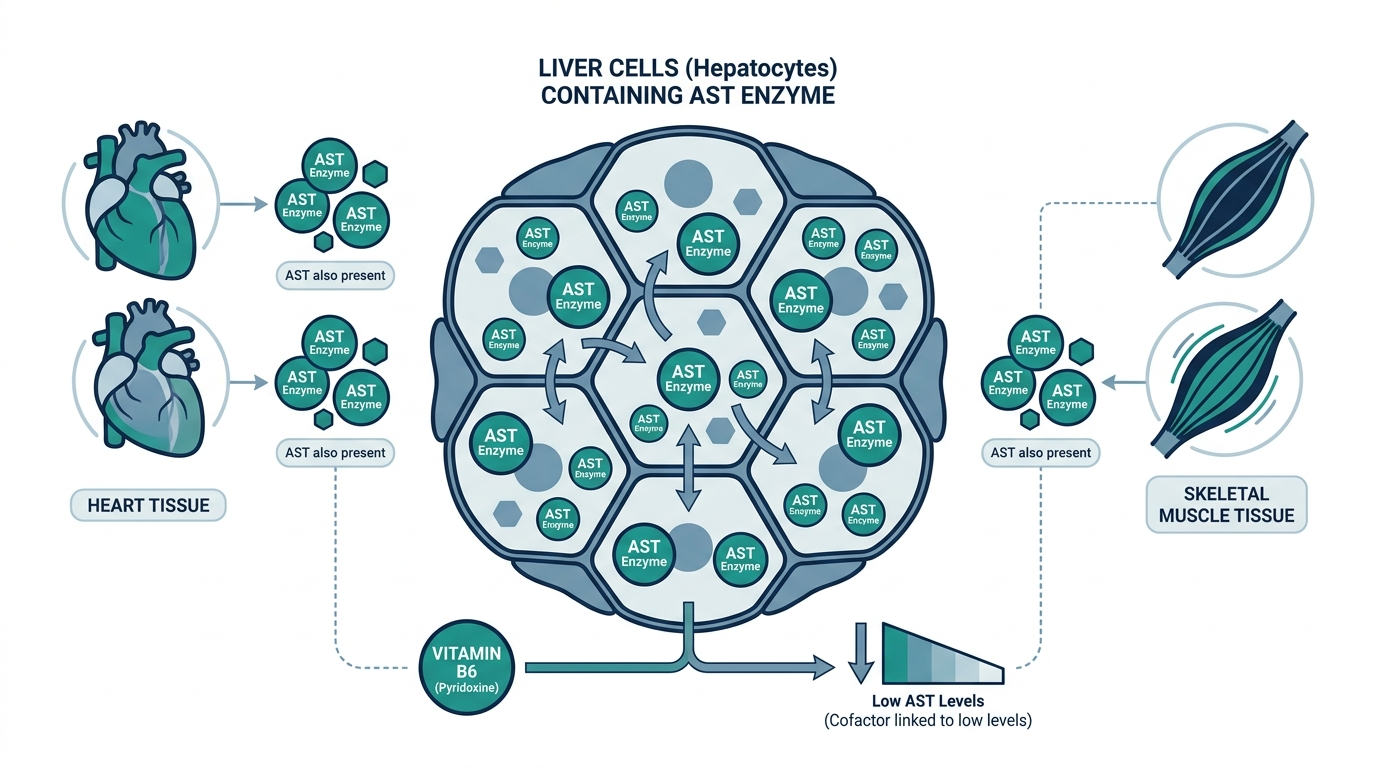
AST stands for aspartate aminotransferase, an enzyme that lives inside your liver, heart, muscles, kidneys, brain, and many other tissues. When those cells are damaged, they leak AST into the bloodstream, which is why doctors mainly use it to look for liver or muscle injury (Cleveland Clinic). A low AST simply means there is very little of this enzyme circulating in your blood.
So what is AST in a blood test low telling you? In most cases, not much. A below-range AST is generally considered a normal, benign finding, and low levels of AST in the blood are usually treated as nothing to chase (MedlinePlus). The whole test was designed to flag the enzyme spilling out of injured cells, so having less of it floating around is rarely a red flag on its own.
The catch is the word “usually.” A genuinely low result, especially a repeatedly low one, can occasionally point to something worth knowing about, and that is where most articles stop talking.

What does a low AST mean on a blood test, and what counts as low?
A low AST means your blood holds less aspartate aminotransferase than the lab expects for a healthy adult. To know whether you are actually low, you need the cutoff, and that is where people trip up.
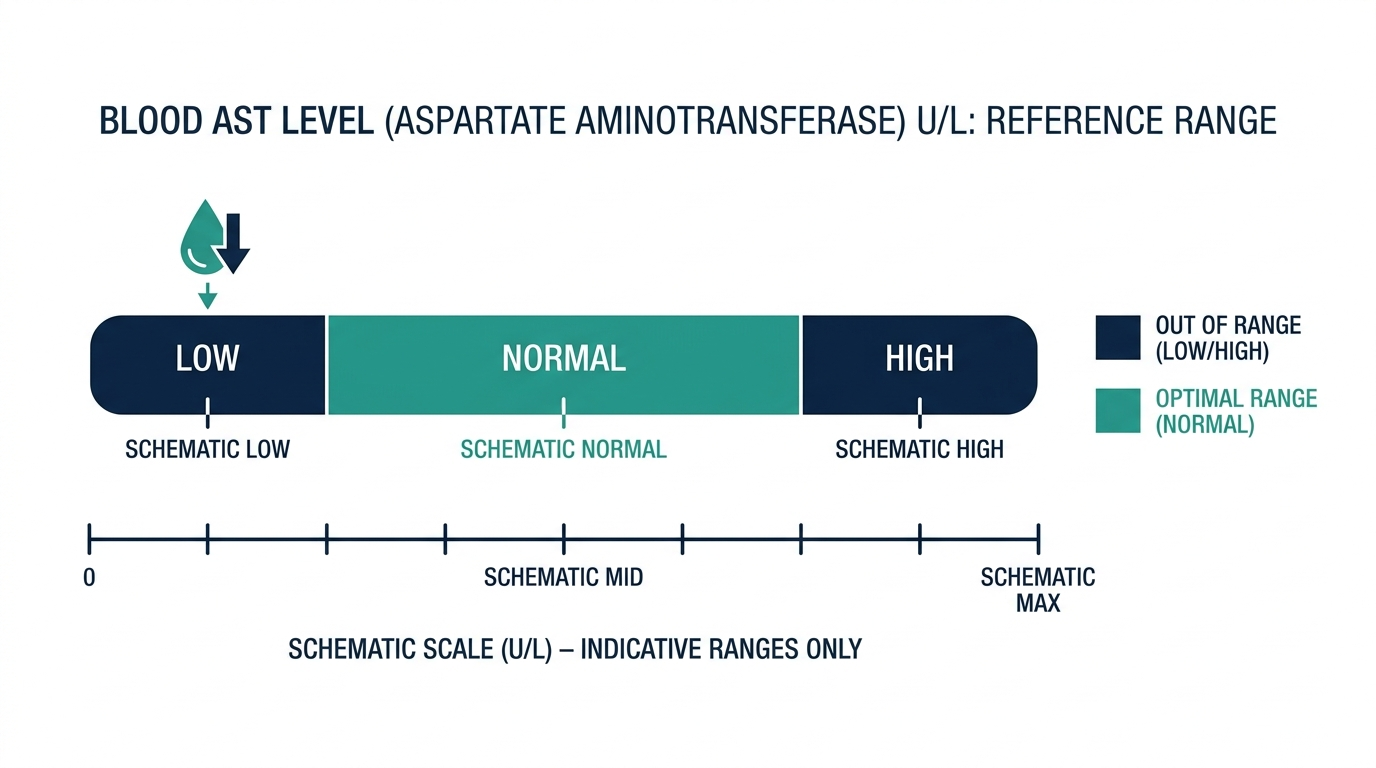
One commonly cited reference range for AST is roughly 8 to 33 units per liter (U/L), though the exact numbers vary by laboratory and the equipment they use (Cleveland Clinic). A result is flagged “low” when it falls under the bottom of your own lab’s printed range, not under some universal number. This matters more than it sounds, because two labs can draw the line in different places, and a value that reads “low” on one report would read “normal” on another.
The practical takeaway: ignore round numbers you read online and look at the reference range on your specific report. If your AST sits just a point or two below the floor and everything else on the panel is clean, that is almost always biological noise rather than disease.
What causes a low AST?
When a low AST is real and repeatable, there is a short, sensible differential. Here are the actual causes, most common and benign first.
- Normal variation. By far the most common reason. Healthy people simply land across a spread, and some sit at the low end. A mildly low AST with a normal liver panel is, in the overwhelming majority of cases, just you.
- Vitamin B6 deficiency. This is the cause worth knowing. A lower than normal transaminase result can indicate a vitamin B6 deficiency (Cleveland Clinic). The reason is mechanical, not vague: AST needs the active form of vitamin B6, called pyridoxal-5-phosphate (PLP), to do its job. PLP works as the coenzyme for the amino transfer reaction the enzyme runs (NCBI Clinical Methods). Run low on B6 and the enzyme reads low, because the assay is partly measuring how much functioning AST you have.
- Chronic kidney disease. A lower than normal transaminase level can also point to chronic kidney disease (Cleveland Clinic). In people on dialysis, low AST and ALT are partly explained by a shortage of PLP, the same B6 coenzyme, and supplementing B6 has been shown to push those low enzyme levels back toward normal (PubMed). So the kidney link and the B6 link are often the same story.
- Pregnancy. Some pregnant people run lower transaminase activity, in part because of shifts in B6 status. It is generally a benign, expected change rather than a sign of trouble.
Notice the thread running through this list. Two of the more meaningful causes, B6 deficiency and chronic kidney disease, both come back to the same missing coenzyme. That is the unifying idea most explainers miss entirely.
What are the symptoms of a low AST?
A low AST itself causes no symptoms. None. It is a lab value, not a disease, and you would never feel it the way you might feel a fever or fatigue. People are not low in AST and “sick from it.” The number is a signal, not the problem.
What can carry symptoms is the underlying cause when there is one. Vitamin B6 deficiency, for example, can show up as a sore or cracked tongue, skin rashes around the mouth, tingling or numbness in the hands and feet, irritability, and in some cases a particular type of anemia (NIH Office of Dietary Supplements). Chronic kidney disease has its own picture, including fatigue, swelling, and changes in urination. The honest framing is this: you do not treat a low AST, you investigate whether anything behind it needs attention, and you let the symptoms guide that.
If your AST is mildly low and you feel completely fine with a clean panel, the lack of symptoms is reassuring rather than suspicious.

When is a low AST dangerous or a medical emergency?
Let me be direct, because the internet tends to catastrophize lab values. A low AST is not a medical emergency. There is no red-flag threshold at which a low AST, by itself, means you should head to the emergency room. Unlike a sky-high AST, which can reflect acute liver or muscle injury, a low value does not represent active damage.
The danger, when it exists, is never the AST number. It is whatever might be driving it. The scenarios that deserve prompt attention are not about the AST at all, they are about the cause:
- Neurological symptoms of significant B6 deficiency, such as new numbness, tingling, or trouble walking, paired with a low transaminase reading.
- Known or suspected kidney disease with worsening symptoms like marked swelling, breathlessness, or sharply reduced urination.
In other words, react to the symptoms and the full clinical picture, not to the three letters with an “L” beside them. The AST is a breadcrumb, not the threat.
What should you do about a low AST?
The single best move is to read the result in context rather than in isolation. A low AST on an otherwise normal comprehensive metabolic panel, in someone who feels well, typically needs nothing more than awareness.
When it is worth a closer look, here is the reasonable next-step ladder a clinician tends to follow:
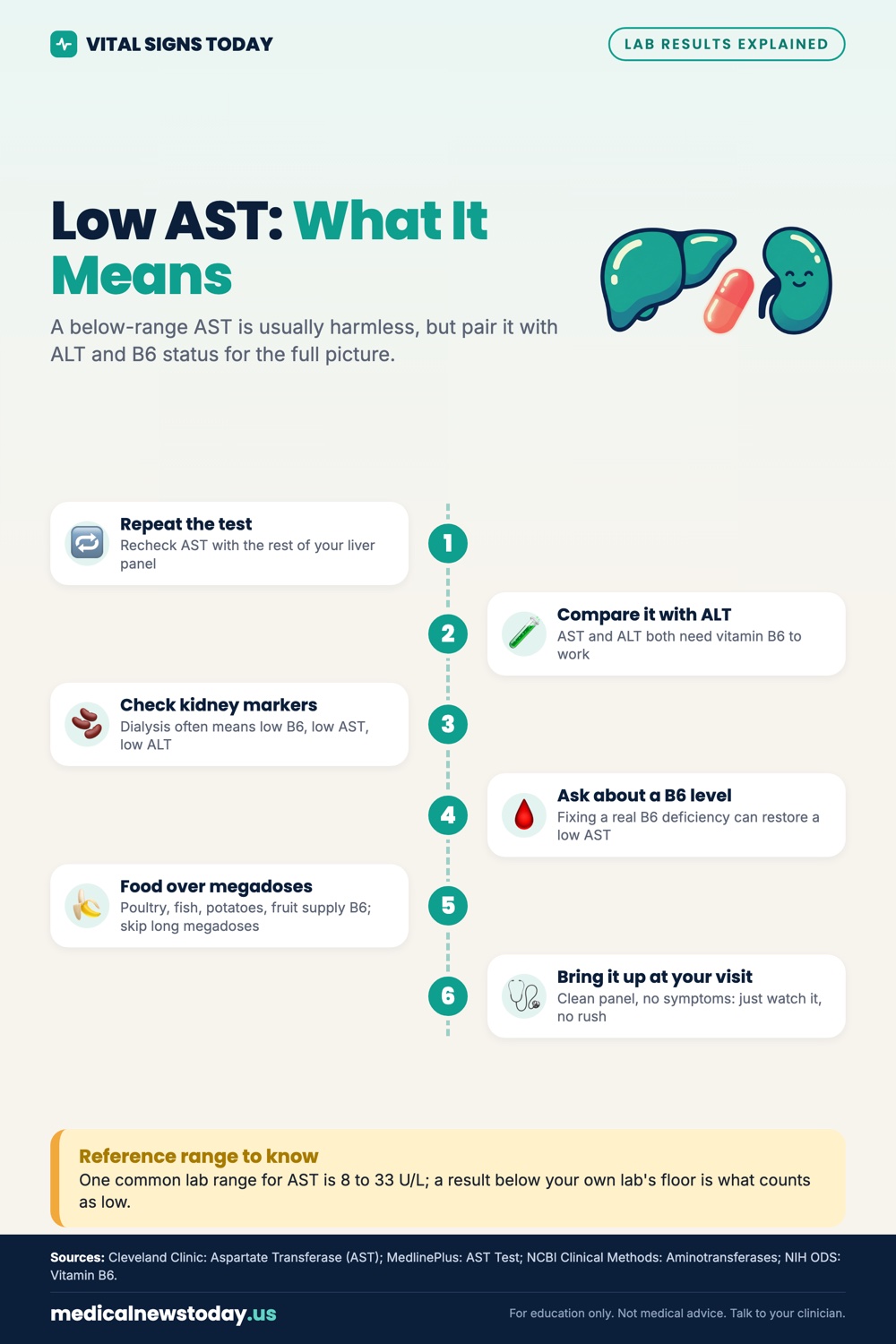
- Repeat the test. Lab values bounce. If a low AST is unexpected, the first sensible step is often to recheck it, sometimes alongside the rest of the liver panel (Cleveland Clinic).
- Look at the company it keeps. Is ALT also low? Are kidney markers like creatinine and eGFR off? Patterns mean far more than a single low enzyme.
- Check vitamin B6 if there is reason to. If diet is poor, if you are on dialysis, or if you have B6-related symptoms, your clinician may assess B6 status. Where deficiency is confirmed, correcting it can normalize the enzyme reading (PubMed).
- Mind your diet, not a supplement aisle. B6 is plentiful in foods like poultry, fish, chickpeas, potatoes, and bananas. Do not megadose B6 on your own to “fix” a number, because too much B6 can itself cause nerve problems. Treatment, when needed, is targeted at a confirmed deficiency, not at the lab line.
Most low AST results need no treatment whatsoever. The ones that do are really being treated for the underlying B6 or kidney issue, with the AST quietly recovering as a side effect.
When should you see a doctor?
You do not need an urgent appointment for a mildly low AST alone. You should bring it up at a routine visit if it is repeatedly below range, if other liver or kidney markers are also abnormal, or if you have symptoms that fit B6 deficiency or kidney disease, such as tingling extremities, a sore tongue, persistent fatigue, or swelling. Your clinician can decide whether the low value is just your normal baseline or a clue worth following (Cleveland Clinic). The goal of the visit is interpretation, putting the number in the context of you, not panic.

The part most people never hear: a low AST can hide a sick liver
Here is the counterintuitive nuance that almost never reaches patients, and it flips the usual logic on its head.
Because AST depends on vitamin B6 to function, a person who is B6 deficient can show a falsely low or falsely normal AST even when their liver is genuinely inflamed. Lab researchers know this well: when you add PLP back to a blood sample from a B6-deficient patient, the measured enzyme activity jumps, sometimes substantially, revealing how much the deficiency was masking (NCBI Clinical Methods). The clinical implication is unsettling. In someone low on B6, a “reassuringly low” transaminase can underestimate real liver injury, because the assay needs the very coenzyme that patient lacks.
This is the kind of detail that matters in the populations where it is most likely to occur, like dialysis patients, who are both prone to B6 deficiency and prone to low transaminases for the same reason (PubMed). The lesson is not to distrust every low AST. It is to remember that a low AST is not automatic proof of a healthy liver. Context, the full panel, and B6 status decide what the number truly means. A single low value, read alone, can quietly mislead.
What AST actually does, and why the body has it everywhere
Understanding what AST is for makes a low result far less mysterious. Aspartate aminotransferase is a metabolic enzyme, part of a family called transaminases. Its job is to shuttle an amino group from one molecule to another, a reaction at the heart of how your body processes amino acids and feeds them into energy production. Because nearly every tissue runs this chemistry, AST is found in the liver, heart muscle, skeletal muscle, kidneys, brain, and red blood cells (Cleveland Clinic).
That wide distribution is why AST is a sensitive but not very specific marker. When it is high, the enzyme could be leaking from the liver, the heart, or muscle, which is why it is rarely interpreted alone. When it is low, the same biology explains why the result is usually harmless: a low reading does not mean any tissue is failing to make the enzyme, it simply means little is spilling into the blood, which is the normal, healthy state. The enzyme is meant to stay inside your cells doing its work, not floating in your serum. Seen this way, a low AST is closer to the enzyme behaving exactly as designed than to a sign of disease.
Reading AST with ALT: why the pair matters more than the single number
AST is almost never interpreted on its own. Its constant companion on a liver panel is ALT, alanine aminotransferase, a closely related transaminase that is more specific to the liver. The relationship between the two, sometimes expressed as the AST-to-ALT ratio, carries information that neither number gives alone.
For a high result, this ratio is a classic clue: certain patterns of AST relative to ALT point toward particular kinds of liver injury. For a low result, the pairing is still useful, just in a different way. If both AST and ALT are low together, the shared explanation is more likely something that affects both transaminases at once, and the leading candidate is a shortage of their common coenzyme, vitamin B6, which both enzymes need to function (NCBI Clinical Methods). This is exactly why low AST and low ALT so often travel together in the same person, and why the workup for one is essentially the workup for both.
The practical habit worth adopting when you read your own panel: never look at a low AST in isolation. Check what ALT is doing, and check the kidney markers. A low AST with a normal ALT and clean kidneys is reassuring noise. A low AST with a low ALT, especially with a reason to suspect poor nutrition or dialysis, is the pattern that makes B6 worth a thought.

Other things that can nudge AST toward the low end
Beyond the main causes, a handful of everyday factors can shift AST slightly downward or affect how it is measured. None of these is usually a problem, but knowing them prevents over-reading a borderline value:
- Being female and older. AST activity tends to run modestly lower in women than in men, and reference behavior shifts somewhat with age. A value at the low end can simply reflect who you are rather than anything wrong.
- A very low muscle mass. Because skeletal muscle is a meaningful source of AST, a person with low muscle bulk may have a naturally lower baseline. This mirrors the way muscle mass affects other muscle-derived lab values.
- Sample handling and assay method. Whether the lab adds pyridoxal phosphate to the assay reagent affects how much AST activity it measures, particularly in someone who is B6 deficient. Two labs using different methods can report slightly different values on the same blood.
- Recent B6 status and diet. Because the enzyme reading partly reflects available coenzyme, short-term shifts in B6 intake can influence the measured activity. This is the mechanistic thread that ties several of the low-AST causes together.
The recurring lesson is that a low AST is influenced by biology and measurement as much as by disease, which is why a single borderline value in a well person rarely means anything.
The vitamin B6 balance: neither too little nor too much
Since vitamin B6 sits at the center of the low-AST story, it is worth understanding how to handle it correctly, because the instinct to fix a low number with a supplement can backfire.
On the deficiency side, B6 shortfall is uncommon in people who eat a varied diet but shows up in specific situations: poor overall nutrition, alcohol use disorder, certain medications, and kidney disease, especially in people on dialysis, where B6 is lost during treatment (PubMed). In those settings, correcting a true deficiency can bring low transaminases back toward normal, and it addresses the real health issue rather than the lab line.
On the excess side, there is a firm reason not to megadose. Very high intakes of supplemental B6, taken over time, can cause nerve damage with symptoms like numbness and tingling, which is ironic because those are among the symptoms of deficiency too (NIH Office of Dietary Supplements). The safe approach is to get B6 from food. Good sources include poultry, fish, chickpeas, potatoes, and bananas. If a deficiency is confirmed by a clinician, they will guide dosing. Chasing a low AST with over-the-counter B6 on your own risks trading a harmless lab value for a real neurological problem.
Want to check your AST?
Three ways to get it measured. Pick whichever fits you.
Affiliate links: we may earn a commission at no extra cost to you. A lab test does not replace a visit with your clinician.
Two ways to read a low AST, depending on the rest of the panel
The single most useful move is to interpret a low AST against everything around it. Here are the two realistic scenarios and what each suggests.
Scenario one: low AST, everything else normal, you feel well. ALT is normal, kidney markers are fine, bilirubin and albumin are unremarkable, and you have no symptoms. This is the common case, and it almost always means nothing. A below-range AST here is treated as a benign finding, and no treatment or further testing is usually needed beyond awareness (MedlinePlus).
Scenario two: low AST alongside other clues. ALT is also low, or kidney function is reduced, or you have symptoms that fit B6 deficiency such as a sore tongue, skin changes around the mouth, or tingling in the hands and feet. Here the low AST stops being noise and becomes a supporting piece of a larger picture. The reasonable response is to look at B6 status and kidney function and treat whatever real problem is found, after which the AST tends to recover on its own (PubMed).
The difference between these two scenarios is entirely context. The AST number is identical, but what surrounds it decides whether it is a shrug or a clue.
Common misunderstandings about a low AST
- “A low AST proves my liver is healthy.” Not necessarily. Because AST depends on vitamin B6, a B6-deficient person can show a reassuringly low reading that underestimates real liver inflammation (NCBI Clinical Methods). A low AST is not automatic proof of a healthy liver.
- “Lower is always better for a liver enzyme.” For enzymes that signal injury when high, a low value is usually fine, but it is not a health score to minimize. There is no benefit to pushing AST lower, and a truly low value can occasionally flag a deficiency worth correcting.
- “I should take B6 to raise it.” Only under guidance. Excess supplemental B6 can cause nerve damage, so the target is a confirmed deficiency addressed through food or clinician-directed dosing, not the lab number itself (NIH Office of Dietary Supplements).
- “A single low reading is meaningful.” Lab values fluctuate, and a lone AST a point or two below the range in a well person with a clean panel is usually just biological variation, best confirmed with a repeat rather than acted on.
Frequently asked questions
What does a low AST mean in a blood test?
A low AST means your blood has less aspartate aminotransferase than your lab’s reference range expects. It is usually a normal, benign finding, since the test is built to catch the enzyme leaking from damaged cells (MedlinePlus). Occasionally a true low can point to vitamin B6 deficiency or chronic kidney disease (Cleveland Clinic).
What is the normal range for AST, and what counts as low?
One commonly cited range is about 8 to 33 U/L, but it varies by laboratory and equipment (Cleveland Clinic). A result is “low” when it falls below the bottom of the reference range printed on your own report, so always compare against that rather than a number from online.
Can a low AST be caused by vitamin B6 deficiency?
Yes. AST needs the active form of vitamin B6, pyridoxal-5-phosphate, to function, so low B6 can produce a low reading (NCBI Clinical Methods). In dialysis patients, B6 supplementation has raised low AST and ALT back toward normal (PubMed).
Is a low AST dangerous?
No. A low AST is not a medical emergency and does not signal active organ damage on its own. Any concern comes from a possible underlying cause, such as B6 deficiency or kidney disease, which is judged by symptoms and the rest of your panel, not by the AST number alone.
Should I take a vitamin B6 supplement to raise a low AST?
Not on your own. B6 is best obtained from food, and excess supplemental B6 can cause nerve damage. Treatment is aimed at a confirmed deficiency, not at the lab value, so discuss any supplement with your clinician first (Cleveland Clinic).
This article is for general educational purposes and is not medical advice. It cannot diagnose or treat you and does not replace your clinician. Always discuss your lab results and any health decisions with a qualified healthcare professional.
Vital Signs Today may earn a commission if you buy through links on this page. It does not affect our editorial assessments.