
Related: How to bring AST back into range
Part of our Liver Function Tests guide.
You scanned your lab report, found your way to the liver section, and there it was: AST, with a number beside it. Maybe it was flagged high, maybe it looked fine, and either way you were left guessing what those three letters actually mean for you. Here is the part most explainers skip. AST is one of the most ordered enzymes in all of medicine, but on its own it is a surprisingly blunt instrument. The real signal lives in how it sits next to one other number on the same page.
Understanding that pairing is the difference between panicking over a single high value and actually knowing what your liver is telling you.
What is AST in a blood test?
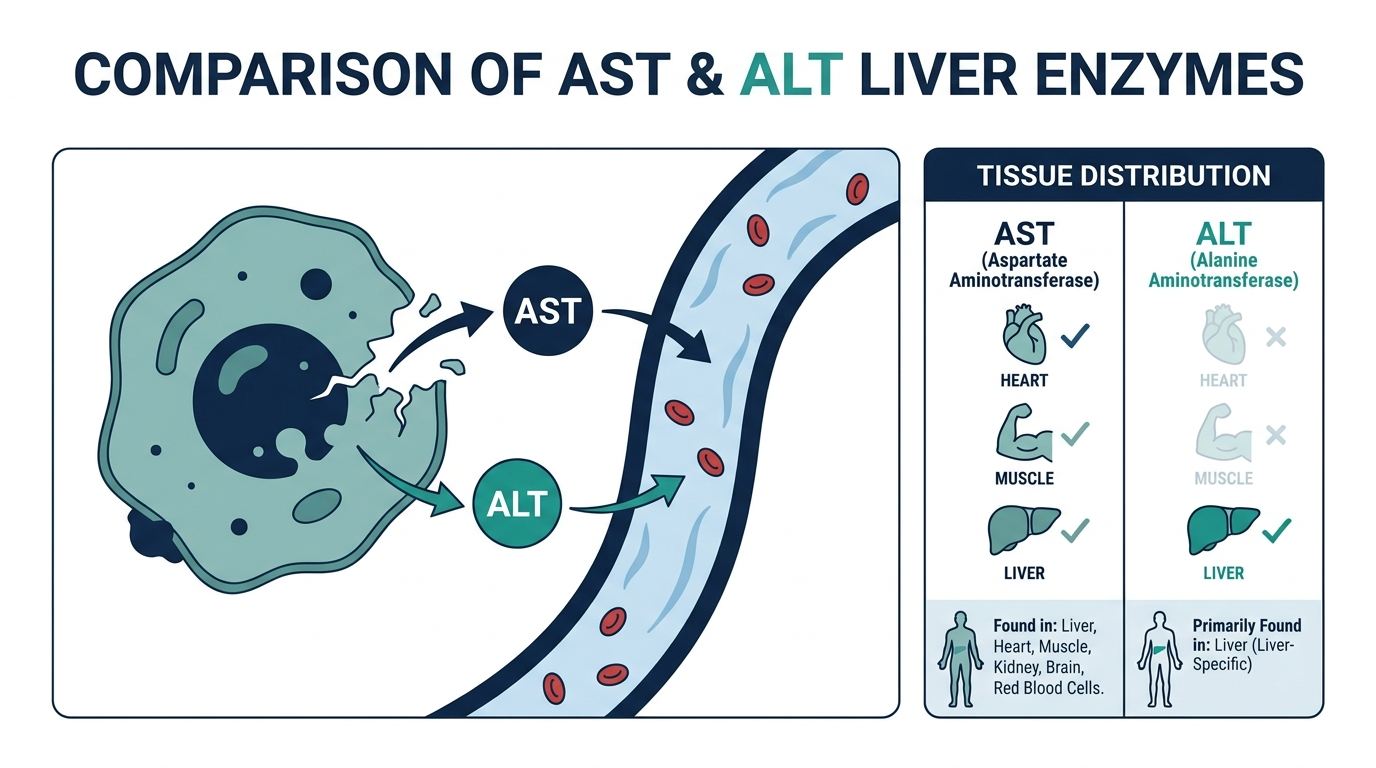
AST in a blood test stands for aspartate aminotransferase, an enzyme found in your liver, heart, muscles, pancreas, kidneys, and other tissues. When the cells that hold it are damaged, AST leaks into your bloodstream, so a higher level can be a clue that something is stressing one of those organs, most often the liver (Cleveland Clinic). You may also see it written as SGOT on older reports, which is an outdated name for the exact same enzyme.
In plain terms: AST is a leak detector. Healthy cells keep it locked inside. When cells are injured, the enzyme spills out and the number climbs. That is the whole concept, and almost everything below follows from it.

What does AST mean in a blood test, and why is it measured?
When people ask what does AST mean in a blood test, the short answer is that it is a marker of cell damage, used mainly to check the health of your liver. Doctors order it to help diagnose and monitor liver conditions, and it is a standard component of liver function test panels and many routine metabolic screens (MedlinePlus).
An AST test is often ordered if you have symptoms that could point to a liver problem, such as yellowing of the skin or eyes, persistent fatigue, nausea, abdominal pain, or dark urine (MedlinePlus). It is also drawn routinely with no symptoms at all, which is how many people first run into a value they did not expect. Because AST sits inside so many different tissues, it answers the question “is something leaking?” without telling you, by itself, exactly where the leak is.
What is a normal AST level?
A normal AST level is generally low. One commonly cited reference range is 8 to 33 U/L (units per liter), although the exact cutoff varies by laboratory, instrument, age, and sex (Cleveland Clinic). Always read your result against the reference range printed on your own report, because that is the range your lab actually calibrated its machines to.
A few everyday things can nudge AST up without any disease being present. Pregnancy, certain medicines, your age, your sex, and even a hard workout in the days before the draw can all move the number (MedlinePlus). This matters more than people realize. A single mildly elevated AST after a heavy gym session or a long run is a common false alarm, which is why one number in isolation rarely settles anything.

What does a high AST level mean?
A high AST means an unusual amount of the enzyme has leaked into your blood, signaling that liver cells, or sometimes heart or muscle cells, have been damaged. It points to a problem, but it does not name one by itself (Cleveland Clinic). The common culprits include:
- Liver conditions. Hepatitis, cirrhosis, alcohol-related liver injury, fatty liver disease, liver cancer, and reduced blood flow to the liver can all raise AST (MedlinePlus).
- Heart and muscle injury. Because AST also lives in the heart and skeletal muscle, a heart attack, muscle disease, or muscle trauma can push it up (MedlinePlus).
- Other organ and systemic causes. Pancreatitis, mononucleosis, and hemochromatosis are on the list (MedlinePlus).
- Temporary, harmless triggers, such as intense exercise, surgery, severe burns, or seizures (MedlinePlus).
Here is the insider point that rarely reaches the patient version. AST is a generalist. It is found in more tissues throughout the body than its sister enzyme ALT, which makes ALT the more specific marker for the liver (Cleveland Clinic). So an isolated high AST with a perfectly normal ALT often points away from the liver, toward muscle or heart, especially if you have been exercising hard or have sore muscles. Clinicians who see this pattern do not immediately worry about the liver. They ask what your muscles have been doing.
What does a low AST level mean?
A low AST is generally not a concern. AST is normally present in small amounts in the blood, so a low result usually just means your tissues are not leaking the enzyme, which is exactly what you want (MedlinePlus). There is no widely recognized disease defined by an abnormally low AST. If your AST sits at the low end of the range and the rest of your liver panel looks fine, it is typically nothing to chase.

Why is AST always read together with ALT?
AST rarely tells the full story alone, which is why doctors almost always read it next to ALT (alanine transaminase). Both are liver enzymes, but ALT is far more concentrated in the liver, so the two together let your clinician separate a true liver problem from a muscle or heart issue (Cleveland Clinic, Liver Function Tests). High levels of AST and ALT together suggest liver damage (MedlinePlus), whereas a high AST with a normal ALT pulls attention elsewhere.
The relationship between the two goes a step further, and this is where AST quietly earns its place on the panel. The AST to ALT ratio, known as the De Ritis ratio, is a clue to the cause of liver injury. A ratio of 2 to 1 or higher is suggestive of alcohol-related liver disease. In one analysis the ratio ran as high as about 2.3 to 1 in patients with alcoholic liver disease, compared with roughly 1.1 to 1 in controls (PMC, De Ritis ratio review).
The biology behind that ratio is genuinely elegant. Heavy alcohol use damages mitochondria, which are packed with AST, and it depletes vitamin B6, which the body needs to make ALT. So in alcohol-related injury, AST climbs while ALT lags behind, and the ratio tips upward. That single comparison can hint at the story behind the numbers, which is something neither enzyme could do on its own. The ratio also tends to rise as scarring advances toward fibrosis and cirrhosis (PMC, De Ritis ratio review).
What happens if your AST comes back high?
A high AST is a prompt to look closer, not a diagnosis. Because AST and ALT are starting points rather than final answers, your clinician will usually interpret them alongside the rest of your liver panel, your symptoms, your medications, and your history before deciding anything (Mayo Clinic). A mild, isolated elevation is often rechecked after you avoid alcohol and strenuous exercise for a few days, since both can inflate the number.
If AST stays up, or if it is high alongside ALT or other liver markers like bilirubin and alkaline phosphatase, the next steps may include repeat blood work, viral hepatitis testing, a review of your medications and supplements, and imaging such as an ultrasound (Cleveland Clinic, Liver Function Tests). The point is that a number on a page is the beginning of a conversation, not the end of one.
How much a high AST is elevated changes the meaning
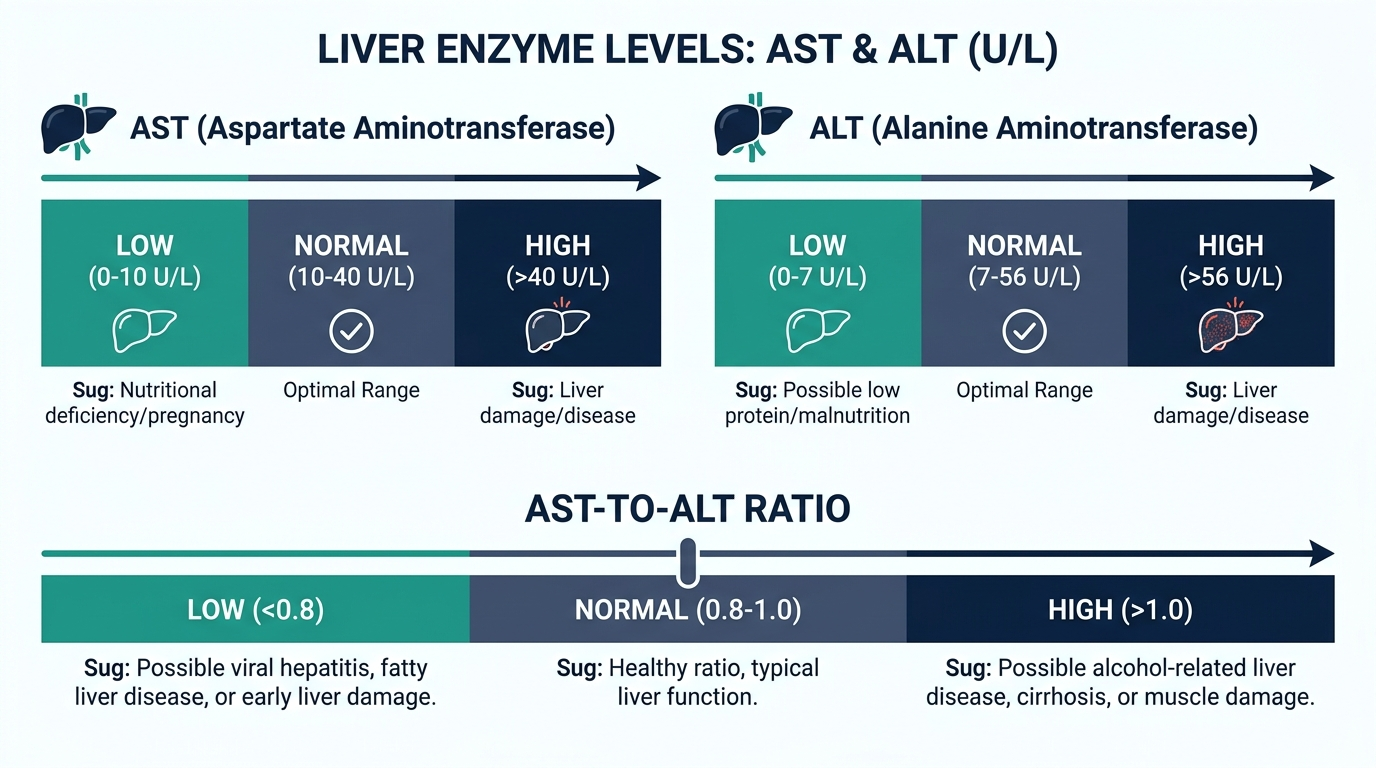
Clinicians do not just ask whether AST is high, they ask how high, because the magnitude of the elevation narrows the list of likely causes dramatically. Reading your number in bands, rather than as a single flag, is one of the most useful shifts you can make.
- Mild elevation, roughly up to two or three times the upper limit. This is the most common and least dramatic pattern. It fits fatty liver disease, medication effects, mild alcohol use, and recent exercise. Metabolic-associated fatty liver disease, the modern name for the most common cause of chronically mildly raised liver enzymes, affects a large share of adults and usually shows only modest elevations.
- Moderate elevation, several times the upper limit. This widens the concern toward more active liver inflammation, significant alcohol injury, or certain medications, and usually prompts a fuller workup.
- Marked elevation, into the hundreds or over a thousand U/L. Very high transaminases, often more than fifteen to twenty five times normal, point toward a small set of serious causes: acute viral hepatitis, a toxic injury such as acetaminophen overdose, or ischemic hepatitis where blood flow to the liver dropped. When AST and ALT are both extremely high and rise together, this is an urgent picture.
This is why a value of 45 and a value of 1,400 are not the same story with a bigger number. They belong to different diagnostic worlds. Knowing roughly which band your result falls into helps you understand why your clinician is calm about one and urgent about another.
AST inside the full liver panel
AST and ALT are only two lines on a liver panel, and the other markers change how any AST elevation is read. Seeing how they fit together turns a confusing block of abbreviations into a coherent picture of two different kinds of liver trouble.
| Marker | What it reflects |
|---|---|
| ALT | The most liver-specific transaminase. Read against AST to separate liver injury from muscle or heart. |
| Alkaline phosphatase (ALP) | Rises more with blockage or cholestasis, meaning bile is not draining. A high ALP with modest AST suggests a plumbing problem rather than pure cell injury. |
| GGT | Helps confirm that a high ALP is coming from the liver rather than bone, and tends to rise with alcohol and bile-duct issues. |
| Bilirubin | The pigment that causes jaundice. A rise signals the liver is struggling to process or excrete it, and it factors heavily into how serious a picture is. |
| Albumin and INR | Reflect the liver’s manufacturing work. Low albumin or a prolonged INR points to reduced synthetic function, a marker of more advanced or chronic disease. |
Two broad patterns emerge. A hepatocellular pattern, where AST and ALT dominate, points at injury to the liver cells themselves. A cholestatic pattern, where ALP and bilirubin dominate, points at obstructed bile flow. AST is one voice in that chorus, and its meaning depends entirely on which instruments are playing loudest alongside it.
The AST to ALT ratio beyond alcohol
The De Ritis ratio, AST divided by ALT, is a genuinely useful clue, and it says more than just alcohol. Reading it well adds nuance to a pair of numbers you already have.
- Ratio well above 1, often 2 or higher: classically suggests alcohol-related liver disease, for the reasons already described, since alcohol damages AST-rich mitochondria and depletes the vitamin B6 needed to make ALT.
- Ratio below 1: is the more typical pattern in many chronic liver conditions, including fatty liver disease and chronic viral hepatitis in their earlier stages, where ALT tends to sit higher than AST.
- A ratio that climbs over time in a non-drinker: can signal advancing scarring, since the ratio tends to rise as fibrosis progresses toward cirrhosis, even when alcohol is not the cause.
- A high ratio with a normal ALT: should make you and your clinician think about muscle or heart rather than liver, since AST outside the liver is doing the talking.
No ratio is diagnostic on its own, but it is a fast, free clue that helps your clinician decide which direction to investigate first.
When AST points away from the liver
Because AST lives in the heart and skeletal muscle as well as the liver, a raised value sometimes has nothing to do with your liver at all. This is the classic trap that catches people off guard, and it is worth understanding.
- Recent hard exercise. Marathons, heavy weightlifting, or any unaccustomed intense effort can leak AST from muscle for days. If you tested soon after a big workout, a mild elevation may simply be sore muscles showing up in your blood.
- Muscle injury or disease. Trauma, a muscle disorder, or a condition called rhabdomyolysis where muscle breaks down can raise AST substantially. A related enzyme, creatine kinase, is checked to confirm a muscle source.
- Heart events. Decades ago, AST was used as a heart-attack marker before more specific tests like troponin existed. It is no longer used that way, but the biology remains: heart muscle injury can raise AST.
The tell in every one of these is the same: AST is up but ALT is normal or barely moved. When your clinician sees that split, the smart next question is not about your liver, it is about your muscles and heart. This is the single most practical reason AST is never read alone.
Common misconceptions about AST
A few beliefs cause unnecessary alarm or false comfort around this enzyme.
- “A high AST means I have liver disease.” Not necessarily. AST leaks from muscle and heart too, and a normal ALT alongside a high AST often points away from the liver entirely.
- “A bigger AST number means worse liver damage.” The height of a single value is only meaningful in context. A very high transaminase in acute hepatitis and a mild rise in fatty liver are different situations, and the pattern across the panel matters more than the raw number.
- “A normal AST guarantees a healthy liver.” Not always. In some chronic conditions, and even in established cirrhosis, transaminases can be normal or only mildly elevated. Markers like albumin, bilirubin, and imaging fill in what enzymes miss.
- “AST alone can tell me what is wrong.” It cannot. AST answers only whether cells are leaking, not which cells or why. It earns its value in combination with ALT and the rest of the panel.
- “I should retest until AST is perfectly low.” Chasing a specific number is not the goal. A mild, stable elevation with an otherwise normal panel and no symptoms is often monitored rather than aggressively pursued.
The throughline is the same one experienced clinicians rely on: AST is a sensitive leak detector for several organs, and it only becomes informative when read next to ALT, the rest of your liver panel, your history, and, when needed, imaging. If you take one habit away, let it be this: before reacting to an AST value, glance at your ALT, note whether you exercised hard recently, and compare the result to your own prior panels rather than to a stranger’s textbook average.
Medications and supplements that can lift AST
One of the most overlooked reasons for a mildly high AST is not disease at all, it is something in your medicine cabinet. Many common drugs and even some over-the-counter products can nudge liver enzymes upward, which is why a careful clinician reviews your full medication and supplement list before assuming the worst.
- Acetaminophen: safe at recommended doses, but higher intake, especially combined with alcohol, is a well known cause of liver injury and rising transaminases.
- Statins: cholesterol-lowering drugs can cause modest, usually reversible enzyme elevations that are monitored rather than an automatic reason to stop.
- Certain antibiotics and antifungals: some are known to raise liver enzymes in a minority of people, so a recent course is worth mentioning.
- Herbal and bodybuilding supplements: some botanical products and anabolic or muscle-building supplements have been linked to liver injury, and because they are not regulated like drugs, they are easy to forget to report.
The practical move is to bring a complete list, prescription, over the counter, and every supplement, to the appointment where an AST result is discussed. A drug-related rise often settles once the cause is identified, which spares you an unnecessary hunt for liver disease that is not there.
Following AST over time rather than reacting to one draw
A single AST value is a snapshot, and its real meaning often emerges only across several readings. Because so many temporary factors, from a hard workout to a short medication course, can move the number, the trend usually tells a cleaner story than any lone result.
A sensible way to follow it:
- Compare to your own history: your previous panels are a better yardstick than a textbook average, since they reflect your normal baseline.
- Recheck after removing the obvious confounders: a mild elevation is commonly repeated after a few days without alcohol or strenuous exercise to see whether it settles.
- Track AST and ALT together: watching how the pair moves, and how their ratio shifts, is far more informative than following AST alone.
- Look for a direction, not a perfect number: a stable, mild elevation with an otherwise normal panel is often monitored, while a steady climb is what prompts a closer look.
This is why clinicians rarely act on one enzyme reading in isolation. A trend over weeks or months, read alongside the rest of the liver panel, turns a confusing one-off flag into a pattern you can actually interpret.
Frequently asked questions
Is a high AST something to worry about?
Not on its own. A high AST is a clue that some tissue, often the liver but sometimes muscle or heart, has leaked the enzyme. It is interpreted alongside ALT and the rest of your liver panel, and mild elevations are common and frequently temporary (Cleveland Clinic). Your clinician decides what, if anything, it means in your case.
What is a normal AST level?
A commonly cited normal range is about 8 to 33 U/L, though it varies by laboratory, age, and sex (Cleveland Clinic). Compare your result to the reference range printed on your own report.
What is the difference between AST and ALT?
Both are liver enzymes, but AST is found in many tissues across the body while ALT is more concentrated in the liver, which makes ALT the more specific liver marker (Cleveland Clinic). Doctors read the two together to tell a liver problem apart from a muscle or heart issue.
Can exercise raise AST?
Yes. Intense exercise can temporarily raise AST because the enzyme is also present in skeletal muscle, and other factors like certain medicines and pregnancy can affect results too (MedlinePlus). This is why a single mildly high value is often rechecked after a few low-activity days.
Should I be concerned about a low AST?
Generally no. A low AST simply means little of the enzyme is leaking into your blood, and there is no recognized disease defined by an abnormally low value (MedlinePlus).
This article is for general educational purposes and is not medical advice. It cannot diagnose or treat you and does not replace your clinician. Always discuss your lab results and any health decisions with a qualified healthcare professional.
Vital Signs Today may earn a commission if you buy through links on this page. It does not affect our editorial assessments.