Disclosure: Vital Signs Today may earn a commission if you buy through links on this page, at no extra cost to you. This does not influence our evidence-based assessments. We are not a medical provider; talk to a clinician before acting on test results.
Related: ALT normal range by age (full chart)
You scanned your liver panel expecting trouble at the top of the range, and instead your ALT came back low. Maybe it was flagged with an L, maybe it just sat below the printed range with no comment at all. Either way, you are now staring at a number that almost every article online treats as a non-event, because nearly all of them are written about high ALT, not low.
Here is the part that gets buried. For decades a low ALT was dismissed as the healthy end of the scale. Recent research tells a more interesting story, and in older adults especially, a genuinely low ALT can be one of the more useful quiet signals on the report.
Part of our Liver Function Tests guide.
What is ALT in a blood test low, and what counts as low?
ALT stands for alanine transaminase, an enzyme concentrated mostly in your liver cells. When liver cells are damaged, they spill ALT into the bloodstream, which is why a high ALT gets all the attention as a marker of liver injury (Cleveland Clinic). The phrase “what is ALT in blood test low” is really asking the opposite question: what does it mean when there is unusually little of this enzyme in your blood?
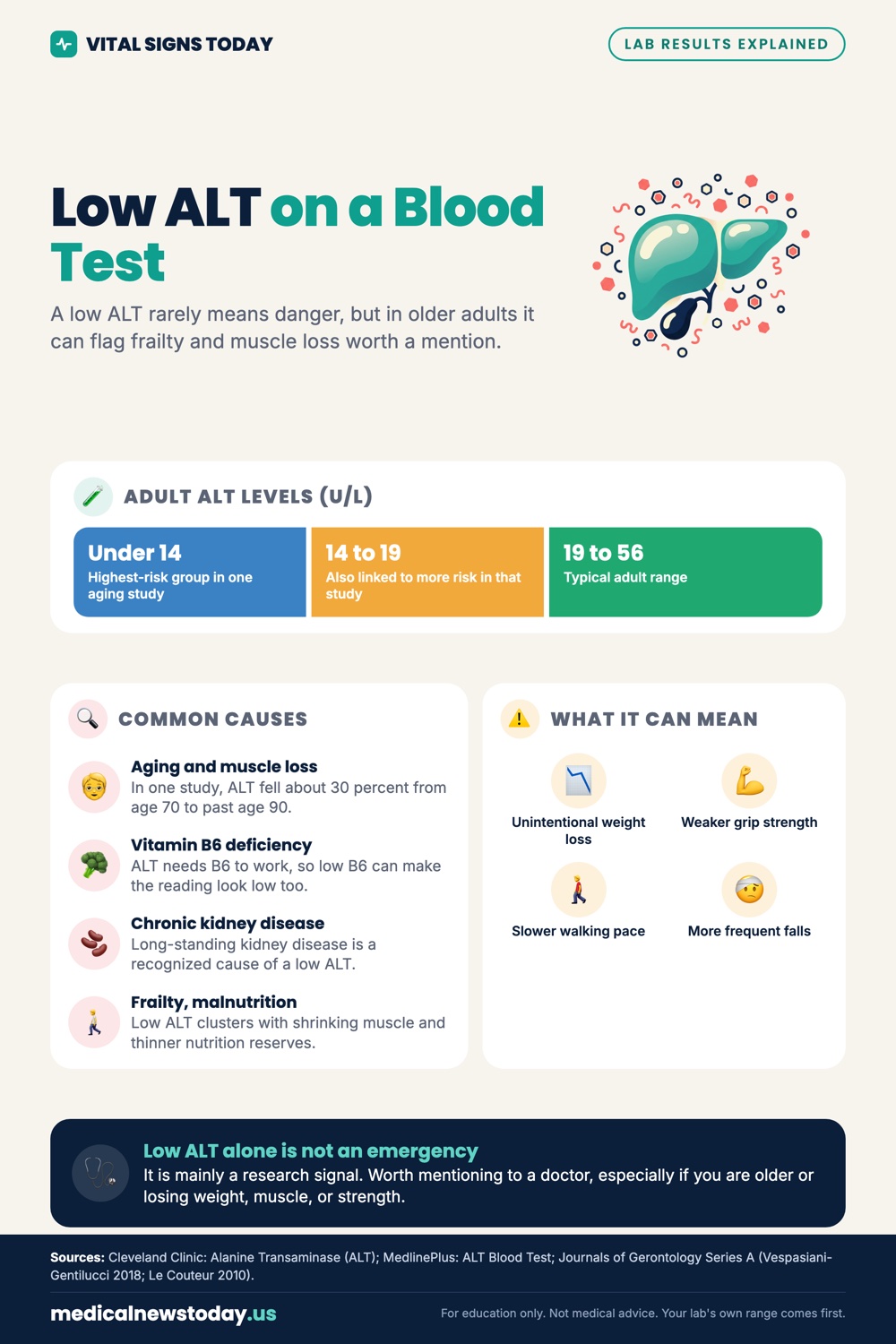
Reference ranges vary by lab, but a common adult range runs from about 7 to 56 U/L, and many labs report the bottom of normal somewhere in the single digits to low teens (Cleveland Clinic). In plain terms, a low ALT means your blood holds less of this liver enzyme than the lab expects. On its own that sounds reassuring, and often it is. The nuance is that researchers studying older adults have drawn a line lower than your lab’s flag: values under roughly 17 U/L, and especially under 14 U/L, are where the interesting associations begin (Journals of Gerontology, Series A).
So there are two thresholds to keep straight. There is “low” as your lab defines it, below its printed range. And there is “clinically low” in the research sense, a value in the bottom slice of the population that tends to travel with things worth knowing about.

What causes a low ALT?
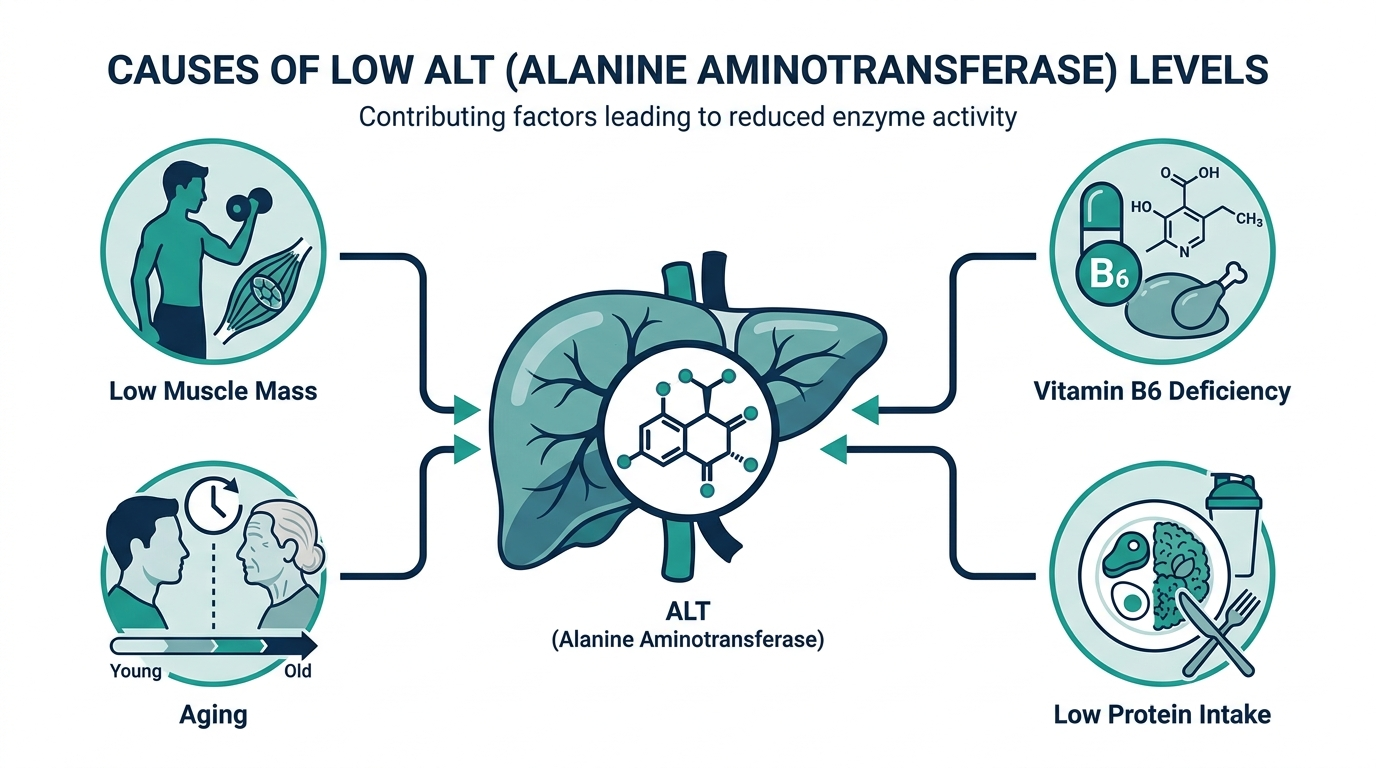
A low ALT is uncommon, and when it shows up it usually points to one of a short list of causes rather than a liver problem. Liver disease pushes ALT up, not down, so a low value is almost never about your liver being sick. The real differential, most common first:
- Aging and low muscle mass. This is the big one and the most overlooked. ALT activity falls steadily with age. In one large study of men over 70, average ALT dropped about 30 percent across the age bands, from roughly 25 U/L in the youngest group to under 17 U/L in those over 90 (PMC, ALT and aging). Because skeletal muscle is a meaningful source of ALT, shrinking muscle mass tends to drag the number down.
- Vitamin B6 deficiency. ALT needs vitamin B6, in its active form pyridoxal phosphate, to function. If B6 is low, measured ALT activity can read artificially low even when the liver is fine (MedlinePlus).
- Chronic kidney disease. Long-standing kidney disease is a recognized cause of a lower than normal ALT, which is one reason a low result sometimes prompts a closer look rather than a shrug (MedlinePlus).
- Frailty, malnutrition, and sarcopenia. These overlap with the first point. Low ALT clusters with frailty and disability in older adults, and tends to mark people who are losing muscle and nutritional reserve (Journals of Gerontology, Series A).
For a healthy younger adult, none of this may apply. A young, lean, well person can simply have a naturally low ALT with no underlying problem at all. Context decides which story is yours.
What are the symptoms of a low ALT?
A low ALT itself produces no symptoms. It is a lab value, not a disease, and you cannot feel your enzyme level. There is no headache, no fatigue, no pain that a low ALT directly causes.
What matters is whether the conditions that often accompany a low ALT are producing symptoms of their own. Because low ALT in older adults travels with frailty and muscle loss, the things to notice are the signs of sarcopenia and decline: unintentional weight loss, weakening grip, slower walking speed, more frequent falls, and loss of stamina. A low ALT paired with any of those is more meaningful than the number alone. If you are young and feel well, a low ALT with no other findings is usually just a number on the low end.
When is a low ALT dangerous or a medical emergency?
A low ALT is never an emergency in itself. There is no number low enough to call an ambulance over, and no acute danger that a low ALT directly creates. The risk it carries is statistical and longer term, not something that requires same-day action.
That said, the long-term signal is real, particularly in older adults. In a study of people averaging 75 years old, the relationship between ALT and mortality was J-shaped. Those in the lowest ALT group, under 14 U/L, had more than four times the risk of death over the follow-up, with an even higher risk of cardiovascular death (Journals of Gerontology, Series A). Low ALT has independently predicted higher mortality in specific groups too: older adults after ischemic stroke (PMC, ALT after ischemic stroke), patients with atrial fibrillation (PMC, ALT in atrial fibrillation), and patients with chronic lymphocytic leukemia (PMC, ALT in CLL).
Read that correctly. The danger is not the enzyme. Low ALT is a mirror reflecting frailty, muscle loss, and low reserve, which are the things that actually shorten survival. The red flag to act on is not the lab value alone, it is a low ALT in an older or unwell person who is also losing weight, losing muscle, or declining. That combination deserves a real conversation with a clinician, not a delay.

What should you do about a low ALT?
Start by putting the number in context instead of reacting to it alone. The first move is to check whether it is even abnormal for you, because a single low ALT in a healthy young adult often needs nothing.
- Look at the company it keeps. Read your low ALT next to the rest of your panel: AST, albumin, kidney function, and your blood count. A low ALT with normal everything else and no symptoms is reassuring.
- Consider B6. Because ALT depends on vitamin B6, your clinician may check or address B6 status, since a deficiency can both lower the reading and cause its own problems (MedlinePlus).
- Protect muscle. The most actionable lever, especially with age, is preserving muscle mass through adequate protein intake and resistance training. Low ALT tracks with sarcopenia, and muscle is the part of this picture you can actually build (Journals of Gerontology, Series A).
- Address the cause, not the number. There is no treatment that “raises ALT,” nor should there be. If chronic kidney disease, malnutrition, or frailty is driving it, those are what get managed.
The goal is never to chase a higher ALT for its own sake. It is to ask why the number is low and to act on whatever underlying answer that question reveals.
When should you see a doctor?
See a clinician if a low ALT comes with any of the warning signs that make it meaningful: unexplained weight loss, noticeable muscle loss or weakness, declining energy and stamina, more frequent falls, or known chronic kidney disease. In older adults, a low ALT alongside frailty is worth raising specifically, because it can be an early, quiet marker of reduced physiological reserve that deserves a fuller assessment.
If you are young, feel well, and the rest of your bloodwork is normal, an isolated low ALT is usually not a reason for alarm, though it is always fair to confirm that interpretation with the clinician who ordered the test. Either way, do not self-diagnose from a single value. The number is a starting point for a conversation, not a verdict.
The insider read: why a “perfect” low ALT can be the most misleading result on the page
Here is the clinical nuance that rarely reaches patients. For years a low ALT was filed under “nothing to see here,” the calm opposite of the dangerous high reading. That instinct is exactly what causes it to be missed. The misread is treating low as automatically good.
The subtler trap is the false-low. Because ALT requires vitamin B6 to register its activity, a B6 deficiency can make the enzyme look low when the underlying tissue is normal (MedlinePlus). A clinician who does not account for B6 status can misjudge the result in either direction.
There is also a deeper point about what ALT mediates. In the aging study, once researchers accounted for frailty and age, the link between low ALT and death largely disappeared (PMC, ALT and aging). That is not a reason to ignore a low ALT. It is the reason to pay attention to it. A low ALT is valuable precisely because it is a cheap, early readout of frailty and shrinking muscle, the forces doing the real damage. The number itself is not the threat. It is the smoke that points you to the fire, in a person who might otherwise look fine on paper.

Low ALT reference ranges, and why the number shifts with age and sex
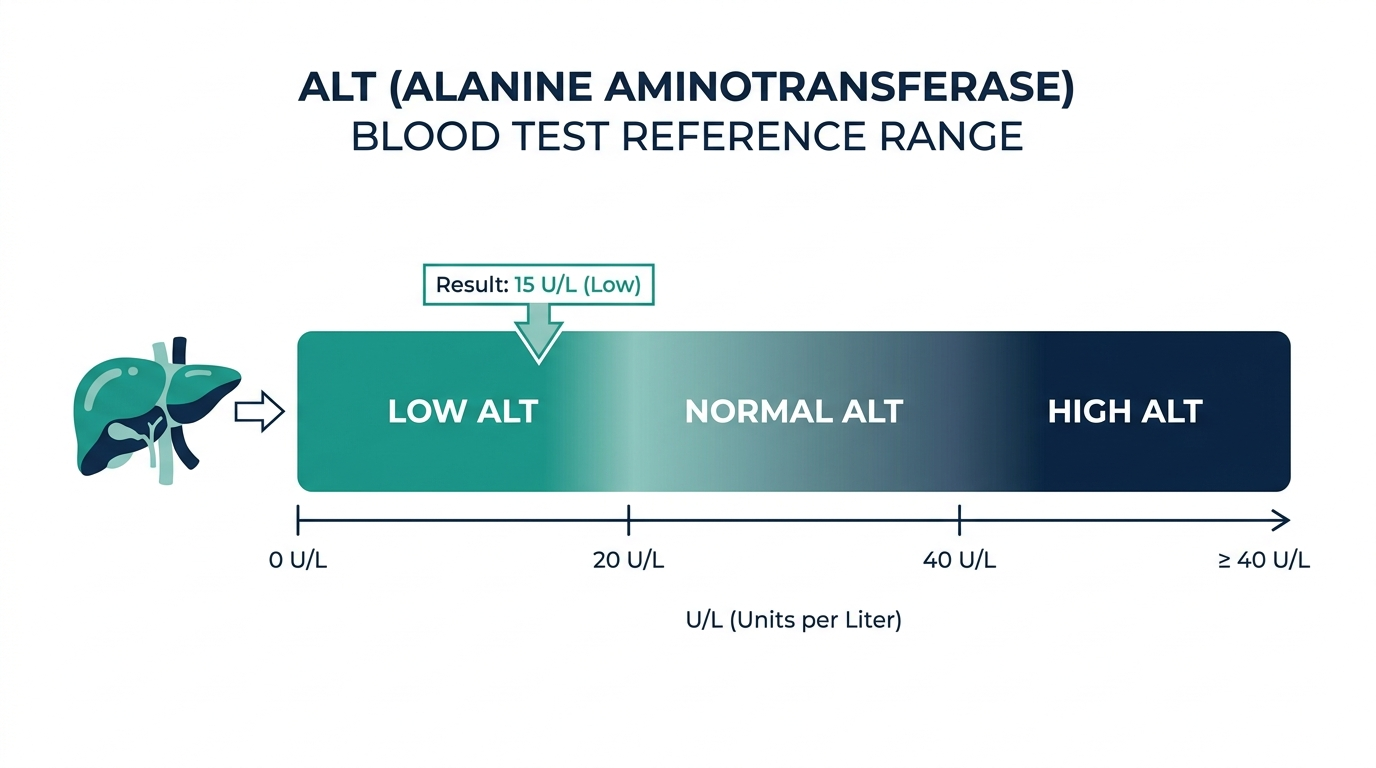
The single biggest source of confusion about a low ALT is that there is no universal “low” line. The reference interval printed on your report is set by the lab that ran the assay, and those intervals genuinely differ. Many US labs use an adult range of roughly 7 to 56 U/L, but others cap the lower bound at 10, and some report male and female ranges separately (Cleveland Clinic). That is why a value of 12 U/L might trigger an L flag at one lab and sit comfortably inside range at another.
Three patterns are worth carrying with you when you read the number:
- Sex. Men tend to run higher ALT than women, largely because men carry more skeletal muscle, a tissue that contributes to the measured enzyme. A “low” reading in a man and the same figure in a woman do not always carry the same weight.
- Age. ALT activity falls with advancing age. A value that would look modestly low in a 40 year old can be closer to the population norm in a person in their eighties, because average ALT declines across the later decades (PMC, ALT and aging).
- Body composition. Two people of the same age and sex can differ simply because one carries more lean mass. More muscle, more ALT, all else equal.
The practical takeaway: never interpret a low ALT against a generic number in your head. Read it against your own lab’s stated range, your sex, and your age band. A 13 U/L in a lean, athletic 30 year old woman and a 13 U/L in a frail 82 year old man are the same digits telling two completely different stories.
Why ALT drops: the biology behind a low reading
To understand why a low ALT can be meaningful, it helps to know what the enzyme actually does. Alanine transaminase catalyzes a reaction that moves an amino group between alanine and a molecule called alpha-ketoglutarate, a step that sits at the crossroads of protein metabolism and energy production. The enzyme is concentrated in the liver, but it is also present in skeletal muscle, kidney, and heart tissue.
Two mechanisms explain most genuinely low readings. The first is a loss of source tissue. Because muscle contributes to circulating ALT, shrinking muscle mass lowers the baseline amount of enzyme available to spill into blood. This is the link that ties low ALT to sarcopenia and frailty rather than to any liver problem (Journals of Gerontology, Series A).
The second is a cofactor problem. ALT cannot do its job without vitamin B6, which the body converts into an active form called pyridoxal 5-phosphate. Most laboratory ALT assays do not add extra B6 to the reaction, so if your own B6 stores are low, the enzyme in the test tube runs slowly and the analyzer reports a lower number, even when your tissue holds a normal amount of ALT protein (MedlinePlus). This is a measurement effect, not a tissue effect, and it is one of the reasons a low ALT is worth interpreting rather than accepting at face value.
Which markers to read alongside a low ALT
A single enzyme in isolation rarely tells the full story. A low ALT becomes far more interpretable when you read it next to the rest of a standard metabolic and liver panel. Here is how the neighbors help you triangulate.
| Marker | What it adds to a low ALT |
|---|---|
| AST (aspartate transaminase) | The other transaminase. If both AST and ALT are low together, the picture leans toward reduced muscle mass or a cofactor issue rather than liver injury, since liver injury would push them up, not down. |
| Albumin | A protein made by the liver and a rough gauge of nutritional reserve. Low albumin alongside low ALT strengthens the case for malnutrition or frailty. |
| Creatinine and eGFR | Kidney function. Because chronic kidney disease is a recognized cause of low ALT, an abnormal kidney panel reframes the low reading (MedlinePlus). |
| Complete blood count | Anemia and low counts often travel with the frailty and nutritional depletion that low ALT can flag. |
| Total protein and prealbumin | Additional readouts of protein and nutritional status that help confirm or rule out malnutrition. |
Want to check your ALT?
Three ways to get it measured. Pick whichever fits you.
Affiliate links: we may earn a commission at no extra cost to you. A lab test does not replace a visit with your clinician.
The pattern matters more than any single value. A low ALT with pristine albumin, normal kidney function, and a normal blood count in a person who feels well is reassuring. The same low ALT sitting beside low albumin, rising creatinine, and a falling hemoglobin is a different conversation entirely.

Sample interpretations: reading the number in context
Because a low ALT means different things in different people, it helps to walk through a few realistic scenarios. These are illustrative patterns, not diagnoses, and none of them replaces a clinician who can see your full history.
- Low ALT, everything else normal, young and well. A lean 28 year old with an ALT of 11 U/L, normal AST, albumin, kidney function, and blood count, and no symptoms. This is the most common benign version. It usually needs nothing beyond confirming the interpretation with the ordering clinician.
- Low ALT with low B6 intake or restrictive diet. A value that reads low in someone with poor dietary variety, heavy alcohol use, or a condition affecting absorption may partly reflect a B6 shortfall rather than true tissue change (MedlinePlus). Correcting the deficiency can normalize both the reading and the underlying problem.
- Low ALT in an older adult who is losing weight. An 80 year old with an ALT of 10 U/L, unintentional weight loss, and weakening grip. Here the number is a supporting clue pointing toward sarcopenia and reduced reserve, and it deserves a fuller assessment rather than reassurance (Journals of Gerontology, Series A).
- Low ALT with abnormal kidney numbers. A low ALT sitting next to a reduced eGFR shifts attention to chronic kidney disease as a contributor, and the workup follows the kidney findings.
How to prepare for the test, and what can skew the result
ALT is usually drawn as part of a liver panel or comprehensive metabolic panel, and the preparation is simple, but a few factors can nudge the number in either direction. Knowing them keeps you from over-reading a value that was influenced by timing or circumstance.
- Fasting. ALT is not strictly a fasting test, but it is often bundled with glucose and lipids, which do require fasting. Follow whatever instructions the ordering clinic gives for the full panel.
- Recent intense exercise. Strenuous activity can transiently raise transaminases, so a hard workout the day before is more likely to mask a low ALT than to create one. If you are trying to interpret a genuinely low value, note whether you had trained heavily right before the draw.
- Medications and supplements. Many drugs affect ALT, mostly by raising it. A vitamin B6 supplement, by contrast, can support the enzyme reaction. Tell your clinician everything you take, prescription and over the counter, so the result can be read correctly.
- Time of day and biological variation. ALT shows some day to day and within day variation. A single borderline low value is best confirmed with a repeat rather than treated as fixed.
Common misconceptions about a low ALT
Several stubborn myths cause people to either panic or dismiss a low ALT when neither reaction fits. Clearing them up is most of the battle.
- “Low ALT means my liver is extra healthy.” Not necessarily. A low ALT does not measure liver excellence. In older or unwell people it can instead mark muscle loss and reduced reserve, which is the opposite of reassuring (Journals of Gerontology, Series A).
- “A low number is always better than a high number.” The relationship between ALT and outcomes in older adults is J-shaped, meaning both very high and very low values carry risk. The lowest group is not the safest group.
- “I need to eat to raise my ALT.” There is no target to chase. The goal is to find and address the cause, whether that is a B6 shortfall, kidney disease, or muscle loss, not to nudge a lab value upward for its own sake.
- “One low reading settles it.” A single borderline value, especially one influenced by B6 status or recent activity, is a starting point. Interpretation improves with a repeat test and the surrounding panel, not with a lone number.
Frequently asked questions
What does a low ALT mean on a blood test?
A low ALT means your blood holds less of this liver enzyme than the lab expects. Unlike a high ALT, it does not point to liver disease. It is uncommon and most often reflects aging and low muscle mass, vitamin B6 deficiency, or chronic kidney disease (MedlinePlus). In a healthy young adult it is often nothing to worry about.
What is a normal ALT level, and what counts as low?
A common adult reference range is roughly 7 to 56 U/L, though it varies by lab (Cleveland Clinic). Below your lab’s printed range counts as low. In research on older adults, values under about 17 U/L, and especially under 14 U/L, are where associations with frailty and mortality become notable (Journals of Gerontology, Series A).
Is a low ALT dangerous?
A low ALT is never an emergency by itself. In older adults, however, a very low ALT has been linked to higher long-term mortality, mainly because it tracks with frailty and muscle loss rather than causing harm directly (Journals of Gerontology, Series A). The signal to act on is a low ALT alongside weight loss, weakness, or decline.
Can a low ALT be a lab error or false result?
Yes, in effect. Because ALT depends on vitamin B6 to register its activity, a B6 deficiency can make the enzyme read artificially low even when the underlying tissue is normal (MedlinePlus). This is why a low result is sometimes worth confirming and interpreting in context.
How do I raise a low ALT?
There is no treatment aimed at raising ALT, and chasing the number is not the goal. The useful response is to address the cause: correcting a B6 deficiency, managing kidney disease, and above all preserving muscle through adequate protein and resistance training, since low ALT tracks with muscle loss (PMC, ALT and aging).
This article is for general educational purposes and is not medical advice. It cannot diagnose or treat you and does not replace your clinician. Always discuss your lab results and any health decisions with a qualified healthcare professional.
Vital Signs Today may earn a commission if you buy through links on this page. It does not affect our editorial assessments.