
Part of our Complete Blood Count guide.
You got your blood work back, and tucked into the complete blood count was a three letter code with a number next to it: MCV. No asterisk, no flag, so you moved on. But MCV is quietly one of the most useful numbers on the whole page. It is the first thing a hematologist looks at when anemia is on the table, because in a single value it tells you what kind of red cells you are making.
Most people treat MCV as background noise. Read it correctly and it changes how you understand every other line on your report.
What is MCV in a blood test?
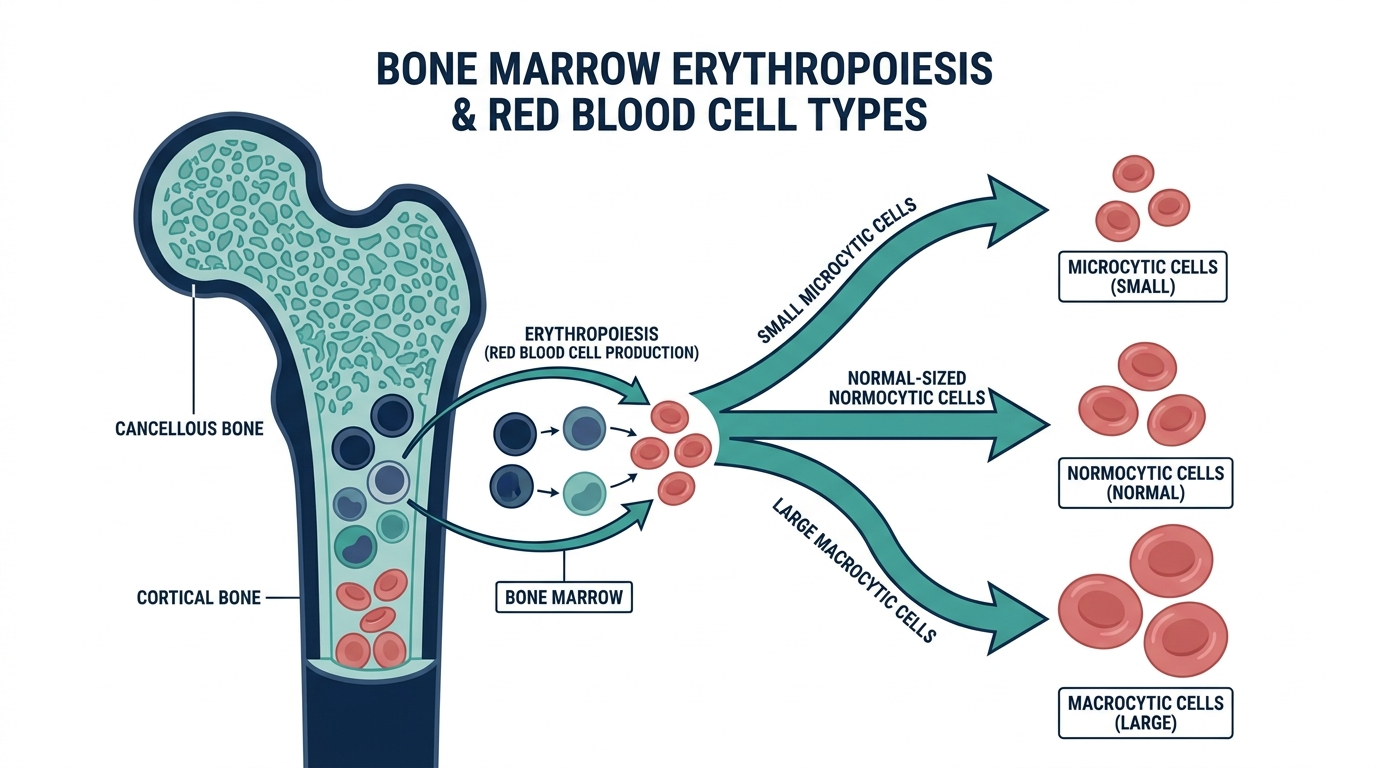
MCV stands for mean corpuscular volume, and it measures the average size of your red blood cells. It is calculated automatically as part of a standard complete blood count (CBC) (MedlinePlus). A low MCV means your red cells are smaller than average. A high MCV means they are larger than average. In plain terms, MCV is a size score for your red blood cells, and a typical adult result sits between 80 and 100 femtoliters (Cleveland Clinic).
That single idea, average cell size, is what makes MCV so powerful. The size of a red cell is a fingerprint of how it was built, and when something interferes with production, the cells come out too small or too large in a predictable way.

What does MCV mean in a blood test, and what does it measure?
MCV puts a number on the average volume of a single red blood cell, measured in femtoliters, which are quadrillionths of a liter. Your lab does not measure each cell with a ruler. It calculates MCV from the hematocrit and the red cell count, or measures it directly on modern analyzers, and reports the average.
Why does average size matter so much? Because the building blocks of a red cell, iron, vitamin B12, and folate, each leave a size signature when they run short. Iron shortage tends to produce small cells. B12 and folate shortage tends to produce large ones. So before any expensive testing, MCV sorts anemia into broad buckets and points your clinician in the right direction (MedlinePlus). That is why MCV is read as one of the red blood cell indices, alongside MCH, MCHC, and RDW.
What is a normal MCV level?
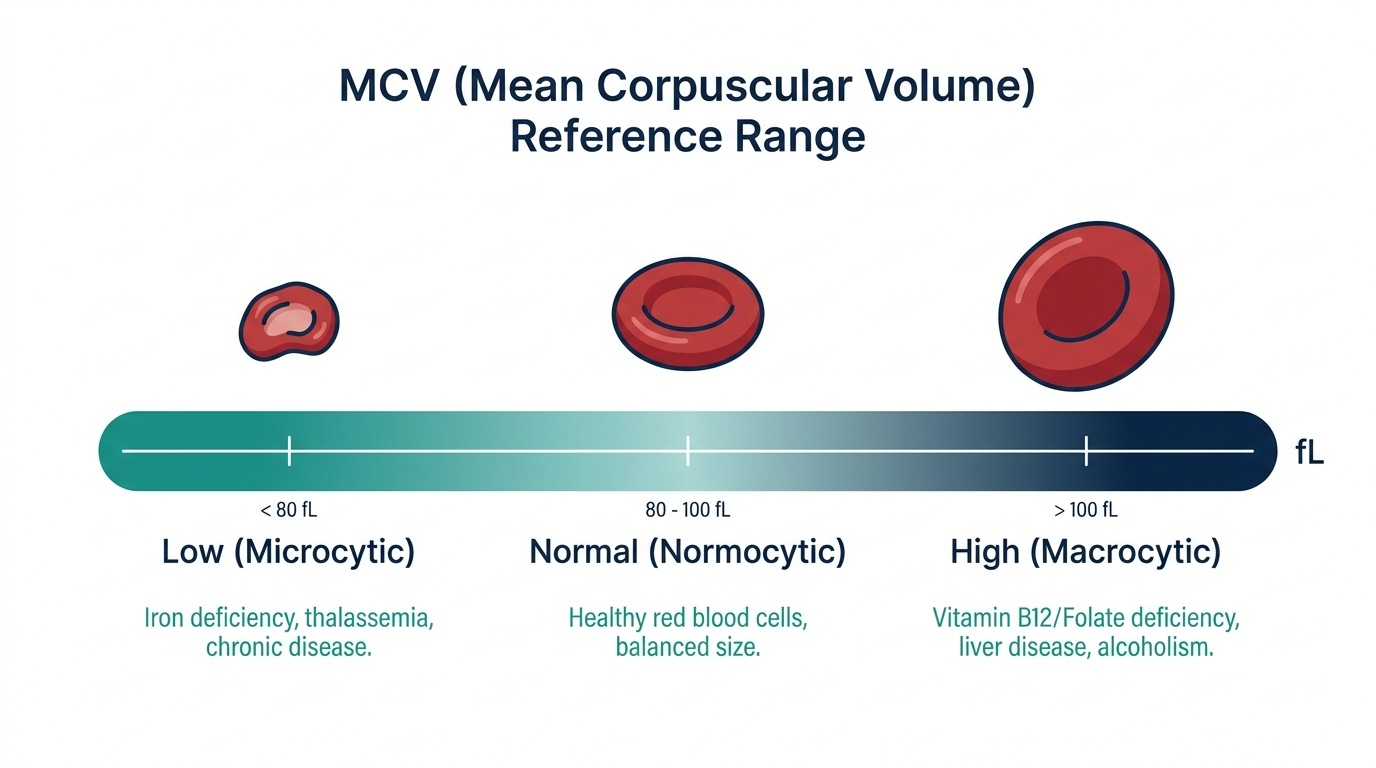
A normal MCV is generally 80 to 100 femtoliters for adults, although the exact cutoff varies slightly by laboratory and instrument (Cleveland Clinic). Below 80 is called microcytosis, meaning your cells are small. Above 100 is called macrocytosis, meaning your cells are large (Cleveland Clinic). Always read your result against the reference range printed on your own lab report, because that is the range your lab actually calibrated.
Here is the practical takeaway. An MCV inside the normal window is called normocytic, and it does not rule out anemia. You can be anemic with perfectly normal sized cells, which is exactly why MCV is never read in isolation.
What does a high MCV mean?
A high MCV means your red blood cells are larger than normal, a state called macrocytosis, which doctors define as an MCV above 100 femtoliters (Cleveland Clinic). It is not a diagnosis by itself, but it narrows the cause to a short list:
- Vitamin B12 deficiency. Without enough B12, red cells cannot mature properly and come out oversized. This includes pernicious anemia, an autoimmune cause of B12 deficiency (MedlinePlus).
- Folate deficiency. Folate, like B12, is needed to build red cells, and a shortage produces the same large cell picture (MedlinePlus).
- Heavy alcohol use. Alcohol both interferes with nutrient absorption and has a direct effect on the bone marrow, and a raised MCV is one of its classic quiet fingerprints (Cleveland Clinic).
- Liver disease and certain medications, including chemotherapy drugs and some HIV treatments, can also push cells larger (Cleveland Clinic).
One detail worth knowing. About 60 percent of people with macrocytosis also have anemia, which means a high MCV often is not just a curiosity, it is an early footprint of a B12 or folate problem worth chasing down (Cleveland Clinic).

What does a low MCV mean?
A low MCV means your red blood cells are smaller than normal, a state called microcytosis, defined as an MCV below 80 femtoliters (Cleveland Clinic). The single most common reason is iron deficiency, because iron is needed to fill each cell with hemoglobin, and when iron runs short the cells are built smaller (MedlinePlus).
The main causes of a low MCV are:
- Iron deficiency anemia, the most common form of anemia in adults and children, often from blood loss or poor absorption (Cleveland Clinic).
- Thalassemia, an inherited condition that disrupts hemoglobin production and keeps red cells small (MedlinePlus).
- Anemia of chronic disease, where ongoing inflammation from infection, kidney disease, or autoimmune illness blocks the body from using iron properly (Cleveland Clinic).
Because both iron deficiency and thalassemia trait produce small cells, a low MCV alone cannot tell them apart. This is exactly where the next marker earns its keep.
Why is MCV read together with RDW?
MCV rarely tells the full story alone, so clinicians read it next to RDW, the red cell distribution width, which measures how much your red cells vary in size (MedlinePlus). Think of MCV as the average size and RDW as the spread. Together they describe the whole red cell population, not just its midpoint.
The pairing is most useful when MCV is low. Both iron deficiency and thalassemia trait shrink red cells, but iron deficiency tends to scatter the sizes, which pushes RDW up, while thalassemia trait keeps cells uniformly small, leaving RDW normal. So a low MCV with a high RDW leans toward iron deficiency, and a low MCV with a normal RDW leans toward thalassemia trait. Two cheap numbers separate two conditions that look identical at first glance, often before any iron study is ordered.
The part most people never hear: MCV is more than an anemia clue
Here is the insider point that rarely makes it into the patient version. An abnormal MCV is sometimes the very first hint of a problem, before you feel a thing, and before the rest of your CBC looks off. A creeping macrocytosis in an otherwise healthy person is a recognized early flag for B12 or folate depletion, for thyroid trouble, or for an alcohol intake that has quietly grown. Clinicians are trained to treat a high MCV with no obvious cause as a reason to dig, not to dismiss.
There is an emerging research angle too. In a study of older emergency patients, MCV and RDW together carried real predictive value for short term mortality, with the combined reading reaching roughly 71 percent accuracy, better than RDW alone (PMC, MCV and RDW as mortality predictors in older patients). The researchers suspect that abnormal red cell size reflects deeper processes, reduced regenerative capacity and underlying biological stress, the same forces that age the whole body. This is preliminary, and no one should read a survival forecast into a single MCV. But it reframes the number. MCV is not just a label for the type of anemia. It can be a sensitive, inexpensive mirror of how your body is building cells right now, which is a good reason to look closer rather than scroll past.

How MCV is calculated, and why the method matters
MCV is not measured by photographing individual cells. On older systems it is derived arithmetically: the hematocrit (the fraction of blood made up of red cells) is divided by the red blood cell count, and the result is scaled into femtoliters. Modern automated hematology analyzers do it more directly, passing cells one at a time through a sensing aperture and recording the volume of each, then averaging. Because MCV is an average, it hides a critical blind spot: two very different cell populations can average out to a normal number.
Picture someone who has both iron deficiency (which makes small cells) and B12 deficiency (which makes large cells) at the same time. The small and large cells can average to an MCV of 90, squarely in the normal range, while the person is meaningfully anemic. This is called a dimorphic picture, and it is the single biggest reason clinicians never read MCV alone. RDW usually rescues the interpretation here, because even when the average looks normal, the spread of sizes is wide. That is also why a peripheral blood smear, where a technologist actually looks at the cells, still matters when the numbers do not add up.
How to prepare, and what can throw an MCV off
MCV is part of the CBC, which generally does not require fasting. You can usually eat and drink normally before the draw unless your clinician is bundling other tests (a lipid panel or glucose, for example) that do require an overnight fast. That said, several real world factors can distort the number, and knowing them prevents a needless second workup:
- Cold agglutinins. In some people, antibodies make red cells clump at room temperature. An analyzer can read two stuck-together cells as one giant cell, falsely raising MCV. Warming the sample corrects it.
- Very high blood sugar. Marked hyperglycemia draws water into red cells during processing and can spuriously inflate MCV. The lab often flags or repeats these.
- A high white blood cell count. Extremely elevated white counts, as seen in some leukemias, can interfere with the red cell measurement and shift the reported MCV.
- Recent blood transfusion. Transfused cells are a different age and size than your own, so MCV reflects a blend for weeks afterward.
- Sample age and storage. Blood left too long before analysis can swell, nudging MCV upward. Reputable labs run samples within a defined window for this reason.
If your MCV looks surprising and nothing in your history explains it, a simple repeat draw handled promptly is often the first sensible step before any deeper testing.
MCV, MCH, MCHC, and RDW: how the red cell indices fit together
MCV is one member of a family called the red blood cell indices, and each describes a different property of your cells. Reading them as a set is far more informative than reading any one alone.
| Index | What it describes | Typical adult range | What it adds |
|---|---|---|---|
| MCV | Average size (volume) of a red cell | About 80 to 100 fL | Sorts anemia into small, normal, or large cell types |
| MCH | Average amount of hemoglobin per red cell | About 27 to 33 pg | Tracks closely with MCV; low in iron shortage |
| MCHC | Hemoglobin concentration within each cell | About 32 to 36 g/dL | A high MCHC can flag spherocytosis; a low one, iron deficiency |
| RDW | How much cell sizes vary (the spread) | About 11.5 to 14.5 percent | Separates iron deficiency (high) from thalassemia trait (normal) |
Ranges vary by lab, so use the ones printed on your report. The pattern is what matters. Iron deficiency classically drives MCV down, MCH down, and RDW up. Thalassemia trait drives MCV down but keeps RDW near normal. B12 or folate deficiency pushes MCV and MCH up together. When MCV moves, its neighbors usually move in a consistent story, and a reading that breaks the pattern is itself a clue.

Reading MCV in context: worked scenarios
Numbers become useful when you can place them in a scenario. Here is how clinicians reason through common combinations. None of these replace a real evaluation, but they show how the pieces connect.
- Low MCV, high RDW, low hemoglobin. Small, uneven cells with true anemia point strongly toward iron deficiency. The next step is usually an iron panel including ferritin, and a search for a source of blood loss.
- Low MCV, normal RDW, mild or no anemia. Uniformly small cells with a stable spread, often lifelong, suggest thalassemia trait. Hemoglobin electrophoresis confirms it, and it changes family planning conversations more than daily health.
- High MCV, symptoms of fatigue or tingling. Large cells alongside neurological symptoms raise concern for B12 deficiency, which can damage nerves before anemia even appears. B12 and folate levels come next, and B12 deficiency is treatable.
- High MCV, normal B12 and folate. With those causes excluded, attention shifts to thyroid function, alcohol intake, liver health, and certain medications. A quietly rising MCV in a healthy adult is a recognized reason to ask about drinking honestly.
- Normal MCV with anemia. Normocytic anemia keeps the size normal and often reflects chronic disease, recent blood loss, or early mixed deficiencies. Here RDW and the reticulocyte count do the heavy lifting.
Who should pay attention to MCV, and what to do with an abnormal result
MCV is measured on every standard CBC, so most people already have a recent value on file. It deserves closer attention if you fall into a higher-risk group: menstruating or pregnant people (higher iron demand), older adults (B12 absorption declines with age), people with heavy alcohol use, those with gastrointestinal conditions that impair absorption such as celiac disease or after bariatric surgery, vegans and strict vegetarians (dietary B12 risk), and anyone with unexplained fatigue, shortness of breath, or pale skin.
If your MCV comes back abnormal, a reasonable sequence looks like this. First, confirm it is real, not a lab artifact, especially if it is an isolated finding. Second, read it with hemoglobin, MCH, MCHC, and RDW to define the pattern. Third, pursue the targeted next test the pattern suggests: an iron panel and ferritin for small cells, B12 and folate for large cells, thyroid and liver studies when the usual suspects are clear. Fourth, treat the cause, not the number, and recheck after enough time for new cells to be produced, which takes weeks, not days. Red cells live around 120 days, so trends over months tell you more than any single reading.
Common misconceptions about MCV
- “A normal MCV means I am not anemic.” Not true. Normocytic anemia has normal-sized cells. MCV describes size, not whether you have enough red cells; hemoglobin and hematocrit answer that question.
- “A high MCV means I have anemia.” Not necessarily. Macrocytosis can appear with a completely normal hemoglobin, especially early in B12 or folate depletion or with alcohol use. The large cells can precede any drop in count.
- “Low MCV always means iron deficiency.” It is the most common cause, but thalassemia trait and anemia of chronic disease also shrink cells. RDW and an iron panel are what separate them.
- “MCV can diagnose my condition.” On its own it cannot. It is a sorting tool that points toward the right next test. Diagnosis comes from the full pattern plus targeted follow-up.
- “If MCV is off, I need to fix my diet.” Sometimes, but not always. A high MCV can signal a thyroid or liver issue, and a low one can reflect blood loss that needs its source found. Treating the underlying cause matters more than guessing at supplements.
- “My MCV changes day to day, so it is unreliable.” In reality MCV is one of the more stable CBC values, because red cells turn over slowly. A meaningful shift usually reflects a real biological change over weeks, which is exactly what makes a trend worth watching.
Questions people ask most after seeing their MCV
Once an MCV lands outside the reference range, the same handful of questions come up again and again. The first is whether the number is dangerous on its own. It rarely is. MCV describes the average size of your red cells, not how well your blood carries oxygen, so a flagged MCV with a normal hemoglobin is usually a clue to investigate rather than an emergency. The urgency comes from the cause behind it, not the millimeter of deviation on the report.
The second common question is whether diet alone will move it. For a low MCV driven by iron deficiency, replacing iron often does help the cells return to normal size over a couple of months, but only once the reason for the iron loss has been identified and addressed. For a high MCV from B12 or folate depletion, correcting the vitamin can normalize cell size, yet a high MCV from alcohol use or a thyroid problem responds to fixing that specific issue instead. This is why guessing at a supplement before you know the cause tends to waste time.
People also ask how fast the number should change after they start treatment. Because red cells live for roughly three to four months, MCV shifts slowly. A recheck too soon can look discouraging even when treatment is working, since the older cells are still in circulation. A repeat test a few months out gives the marrow time to produce a fresh population of correctly sized cells, which is when a real trend appears.
Tracking MCV over time, and what a shifting number tells you
A single MCV is a snapshot. The more useful picture comes from watching it across several tests, because the direction of change often says more than any one value. An MCV that was comfortably mid range last year and has crept upward toward the top of normal can be an early signal, even while it still reads as normal, that B12 or folate stores are quietly falling or that alcohol intake has climbed. The number has not crossed a line yet, but its trajectory has changed, and that is worth a conversation.
The same logic works in the other direction. A slow drift downward within the normal band, paired with a rising RDW, can flag developing iron deficiency before hemoglobin ever falls far enough to be called anemia. Catching that early gives you the chance to find and stop a slow source of blood loss, whether that is heavy periods or something in the gut, long before symptoms set in.
To make a trend trustworthy, compare results drawn under similar conditions and ideally from the same lab, since instruments differ slightly. Keep a simple running record of your MCV alongside hemoglobin and RDW so the three can be read together at each check. When the values move as a group in a consistent direction, you are looking at a real biological shift rather than day to day noise, and that pattern is exactly the kind of thing worth bringing to your clinician rather than filing away and forgetting.
Frequently asked questions
What is a normal MCV level?
A normal MCV for adults is generally 80 to 100 femtoliters, though ranges vary slightly by lab and instrument (Cleveland Clinic). Compare your result to the reference range printed on your own report.
What does a high MCV mean?
A high MCV, above about 100 femtoliters, means your red cells are larger than normal. It most often points to vitamin B12 deficiency, folate deficiency, heavy alcohol use, or liver disease, and is read alongside your other results (Cleveland Clinic).
What does a low MCV mean?
A low MCV, below about 80 femtoliters, means your red cells are smaller than normal. The most common cause is iron deficiency, followed by thalassemia and anemia of chronic disease (Cleveland Clinic).
Can my MCV be normal and I still have anemia?
Yes. Anemia with normal sized cells is called normocytic anemia, so an MCV inside the normal range does not rule out anemia. An MCV test alone cannot diagnose any condition and must be read with hemoglobin and the rest of your CBC (MedlinePlus).
What does low MCV with high RDW mean?
That combination leans toward iron deficiency anemia, where red cells are both small and varied in size. A low MCV with a normal RDW points more toward thalassemia trait (MedlinePlus).
This article is for general educational purposes and is not medical advice. It cannot diagnose or treat you and does not replace your clinician. Always discuss your lab results and any health decisions with a qualified healthcare professional.
Vital Signs Today may earn a commission if you buy through links on this page. It does not affect our editorial assessments.