You scanned your complete blood count, and one line stopped you: MCV, with a number under it that the lab flagged as low. Maybe there was a little “L” next to it, maybe your doctor circled it. Either way, you are here because a low MCV sounds like something is wrong with your blood, and you want a straight answer about what it actually means.
Here is the honest version most explainers skip. A low MCV is rarely the problem itself. It is a fingerprint that points to a specific, short list of causes, and the most common one is both ordinary and fixable. The number matters less than the story it tells.
Part of our Complete Blood Count guide.
What is MCV in a blood test low, and what does it mean?
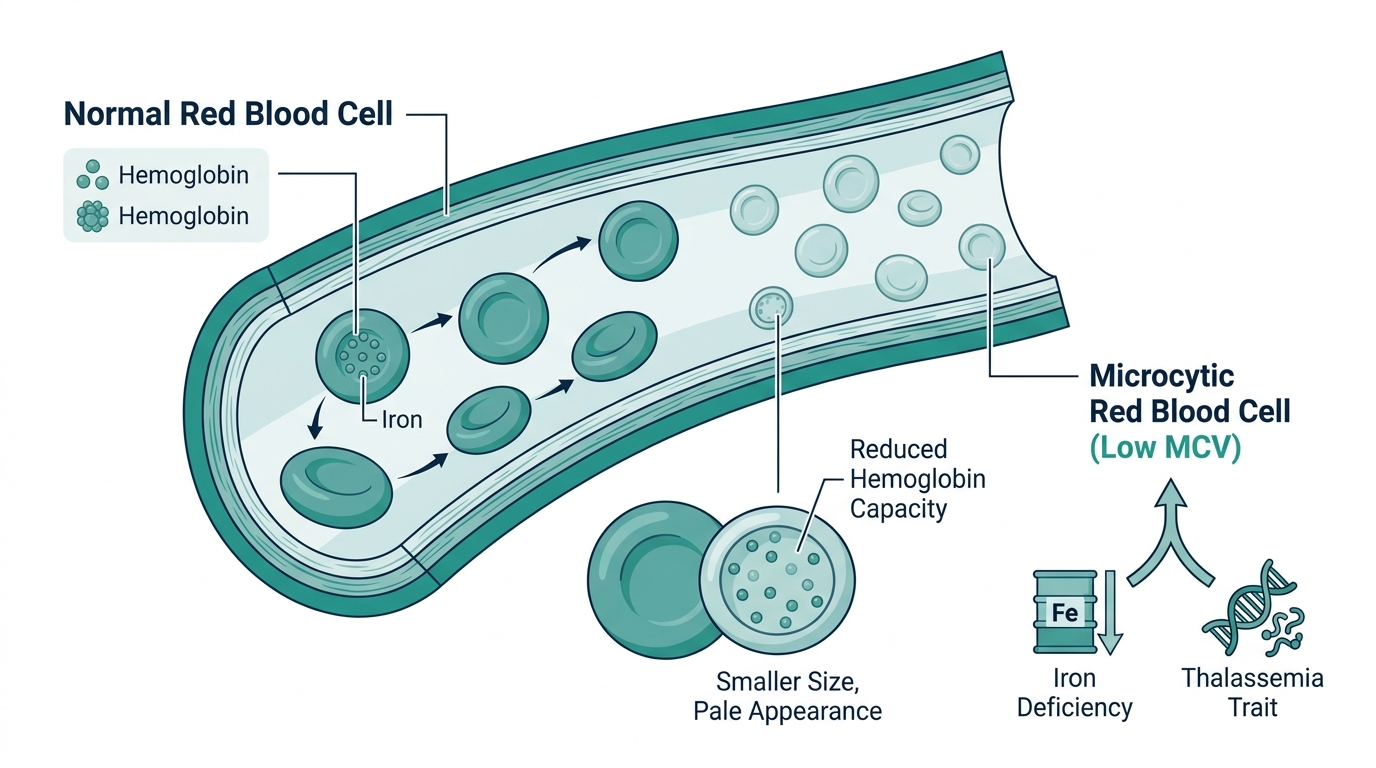
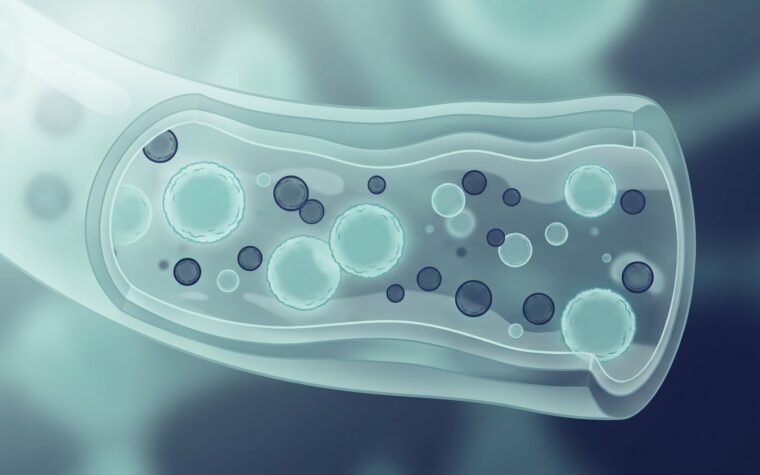
MCV stands for mean corpuscular volume, and it measures the average size of your red blood cells (MedlinePlus). When the question is “what is MCV in a blood test low,” the plain answer is this: your red blood cells are smaller than they should be. The clinical word for that is microcytosis, and the cutoff in adults is an MCV below 80 femtoliters (Cleveland Clinic).
The normal adult MCV range runs from about 80 to 100 femtoliters (Cleveland Clinic). A femtoliter is a unit of volume so small it only makes sense at the scale of a single cell. So if your result reads 76 or 72, your red cells are running on the small side. The further below 80 you go, the more it shifts which cause is most likely, and we will get to that.
One thing to hold onto from the start: a low MCV by itself is not a diagnosis. An MCV test alone cannot diagnose any disease (Cleveland Clinic). It is a clue your clinician reads alongside hemoglobin, RDW, iron studies, and how you actually feel.
What causes a low MCV?
Small red blood cells almost always trace back to a problem making hemoglobin, the oxygen-carrying protein that fills each cell. When a cell cannot pack in enough hemoglobin, it ends up smaller. Here is the real differential, most common first (Cleveland Clinic, StatPearls / NCBI):
- Iron deficiency. This is by far the most common cause of a low MCV and the most common form of anemia overall (MedlinePlus). No iron means no hemoglobin, which means small, pale cells. In adults the iron usually drains away through slow blood loss: gastrointestinal bleeding from ulcers, gastritis, or tumors, and heavy menstrual periods (American Society of Hematology).
- Thalassemia. A group of inherited blood disorders where the body makes faulty hemoglobin (Cleveland Clinic). Thalassemia trait often produces a strikingly low MCV, sometimes under 70 femtoliters, in a person who feels completely fine (StatPearls / NCBI).
- Anemia of chronic disease. Long-running conditions such as autoimmune disease, chronic infection, or kidney disease can lock iron away and shrink red cells over time (Cleveland Clinic).
- Less common causes. Lead poisoning, sideroblastic anemia, copper deficiency, and certain genetic conditions round out the list (Cleveland Clinic, StatPearls / NCBI).
In practice, when a clinician sees a low MCV, iron deficiency is the first thing they want to rule in or out, because it is common, it is often a sign of bleeding somewhere, and it is very treatable.
What are the symptoms of a low MCV?
This catches people off guard: a low MCV often causes no symptoms at all. Microcytosis on its own is just a characteristic of your red blood cells, and plenty of people walk around with small cells and feel perfectly normal (Cleveland Clinic). This is especially true for thalassemia trait, which can sit quietly for a lifetime.
Symptoms tend to show up only when the small cells come with actual anemia, meaning your hemoglobin has dropped low enough that your tissues are short on oxygen. When that happens, the classic signs are (MedlinePlus, Cleveland Clinic):
- Fatigue and weakness
- Shortness of breath
- Headache and dizziness
- Pale skin
- A fast or irregular heartbeat
There is also one symptom that is almost a signature of iron deficiency specifically: pica, an urge to chew or eat non-food things like ice, clay, or paper (Cleveland Clinic). If you have been crunching ice obsessively and your MCV is low, mention it to your doctor. It is a surprisingly useful clue.
When is a low MCV dangerous or a medical emergency?
A low MCV number on a page is not an emergency. The danger, when there is any, comes from two things: how low your hemoglobin has fallen, and what is causing the iron to disappear in the first place.
The cell size itself does not put you in the hospital. Severe anemia can. If your hemoglobin drops far enough, your heart has to work overtime to move oxygen, and that is when symptoms turn serious. Seek urgent care if you have chest pain, severe shortness of breath, fainting, or a racing heartbeat, particularly alongside the fatigue and pallor of anemia (MedlinePlus).
The quieter danger is the cause. A low MCV from iron deficiency in an adult, especially a man or a postmenopausal woman who is not losing blood through periods, can be the first sign of bleeding in the digestive tract, sometimes from a source that needs to be found (American Society of Hematology). The small red cell is harmless. What it is pointing at may not be. That is why “your MCV is a little low, ignore it” is the wrong instinct in this specific situation.

What should you do about a low MCV?
Do not treat the MCV. Treat the cause. The number is a direction sign, not a destination. Here is the sensible path most clinicians follow.
First, get iron studies. A low MCV gets sorted out mostly by checking your iron, and ferritin is the key test. A low ferritin, generally below 15 to 30 nanograms per milliliter in the absence of infection, strongly indicates iron deficiency (StatPearls / NCBI). If iron is low, the conversation shifts to why, and where it is going.
Second, if iron studies are normal but your MCV stays low, your clinician will look toward thalassemia trait, often with a hemoglobin electrophoresis test (Cleveland Clinic). This matters for family planning even if you feel fine.
Third, if iron deficiency is confirmed, treatment is usually straightforward: more dietary iron, oral iron supplements, and in some cases intravenous iron or, rarely, transfusion (American Society of Hematology). The crucial part is finding and fixing the source of loss, not just topping up the tank. Pouring iron in while a slow bleed drains it out solves nothing.
Do not start high-dose iron supplements on your own just because your MCV is low. If the cause is thalassemia rather than iron deficiency, extra iron does not help and can cause harm over time.
When should you see a doctor about a low MCV?
Book a visit any time your lab flags an abnormal MCV, or if you have symptoms of anemia such as ongoing fatigue, breathlessness, or pallor (Cleveland Clinic). You do not need to panic, but a low MCV is worth a real conversation rather than a scroll-past, for two reasons.
See a doctor sooner rather than later if you have risk factors that change the stakes: heavy menstrual bleeding, a family history of thalassemia, any sign of digestive bleeding such as black or bloody stools, or you are an adult male or postmenopausal woman with new iron deficiency (Cleveland Clinic, American Society of Hematology). In those cases the low MCV is a prompt to look for the source, not just to take a supplement.
The insider read: why a low MCV with a normal RDW can outsmart your doctor
Here is the nuance that separates a careful read from a rushed one, and it is one of the most commonly missed calls in primary care. Two very different conditions, iron deficiency and thalassemia trait, both produce small red cells and a low MCV. On the MCV alone, they look identical. The number that quietly tells them apart is sitting one line away: RDW.
RDW measures how much your red cells vary in size. In iron deficiency, the cells are small but mismatched, so RDW runs high. In thalassemia trait, the cells are small but remarkably uniform, so RDW stays normal (StatPearls / NCBI). A low MCV with a high RDW leans toward iron deficiency. A low MCV with a normal RDW, particularly a very low MCV under 70 with a normal or even high red blood cell count, leans toward thalassemia trait.
Why does this matter to you and not just to a hematologist? Because the wrong call has real consequences. The person with thalassemia trait who gets told “you are anemic, take iron” can end up on supplements for years that never fix a number that was never going to budge, while iron slowly accumulates. And the person with genuine iron deficiency who gets reassured “it is probably just thalassemia in your family” can miss a bleed that needed finding. One cheap, already-printed number, the RDW next to your MCV, helps avoid both mistakes. If your clinician interprets a low MCV without ever mentioning your ferritin or your RDW, that is a fair thing to ask about.

How the MCV number is actually produced
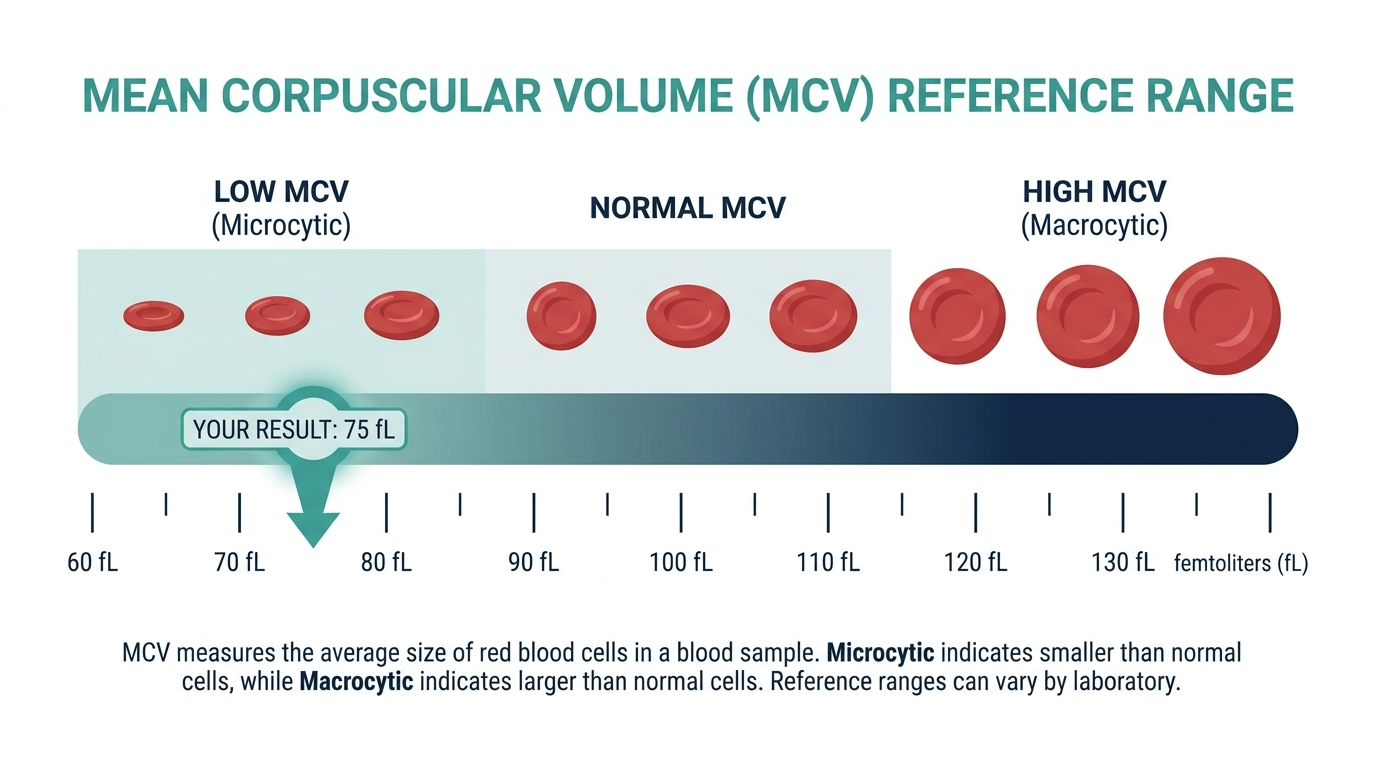
Knowing where the MCV comes from makes it easier to read. Modern analyzers do not eyeball your cells under a microscope. They pass your red cells one at a time through a sensor and measure the volume of each, then report the average as the mean corpuscular volume. So the MCV is a true average size of a huge population of your red cells, which is exactly why a companion number, the RDW, matters so much: the average can look one way while the spread of sizes tells a different story (MedlinePlus).
Two related indices travel with the MCV and sharpen the picture. MCH, the mean corpuscular hemoglobin, is the average amount of hemoglobin per cell, and MCHC is the concentration of hemoglobin within each cell. In iron deficiency and thalassemia, the cells are not just small but also pale, meaning MCH and MCHC run low too. When your cells are described as microcytic and hypochromic, that is the analyzer saying they are both small and light on hemoglobin, which is the fingerprint of a hemoglobin production problem.
The numbers to read alongside a low MCV
A low MCV is a starting point, and the surrounding results decide where it leads. This small cluster does most of the work.
| Marker | What it adds to a low MCV |
|---|---|
| Hemoglobin | Decides whether small cells come with actual anemia or are an isolated finding. |
| RDW | High RDW leans toward iron deficiency; normal RDW leans toward thalassemia trait (StatPearls). |
| RBC count | Often preserved or even high in thalassemia trait, but low in iron deficiency anemia. |
| Ferritin | The key iron store test. Low ferritin points strongly to iron deficiency (StatPearls). |
There is also a quick bedside calculation clinicians use to separate the two most common causes of a low MCV. The Mentzer index is the MCV divided by the RBC count. A value of 13 or higher favors iron deficiency, while a value below 13 favors beta thalassemia trait, because thalassemia preserves the red cell count while shrinking the cells (Mentzer index). It is a screening aid, not a diagnosis, but it captures in one number why iron deficiency and thalassemia look identical on the MCV alone yet differ underneath.
Reading your low MCV: three scenarios
- Low MCV, low hemoglobin, high RDW, low ferritin. This is textbook iron deficiency anemia. The action is to confirm iron deficiency, treat it, and in the right person look for a source of blood loss (American Society of Hematology).
- Very low MCV under 70, normal RDW, normal or high RBC count, normal ferritin. This pattern leans toward thalassemia trait. Extra iron will not fix it, and hemoglobin electrophoresis is the confirmatory test (Cleveland Clinic).
- Mildly low MCV with a chronic inflammatory or kidney condition. This suggests anemia of chronic disease, where iron is present but locked away. The plan is to manage the underlying condition rather than simply add iron.

Test preparation and what can distort the result
MCV is a robust measurement, but a handful of situations can shift or confound it.
- Recent blood transfusion. Transfused cells mix with your own and blur the average size, so an MCV soon after a transfusion may not reflect your native cells.
- Cold agglutinins and sample clumping. If red cells clump in a cold sample, the analyzer can misread the volume, occasionally producing a falsely high MCV that masks true microcytosis. A flagged or rerun sample resolves this.
- A mixed deficiency. If iron deficiency, which shrinks cells, coexists with B12 or folate deficiency, which enlarges them, the MCV can land deceptively in the normal range while both problems are present. A high RDW is the tell that two populations are hiding inside one average.
- Fasting is not required. A CBC does not require fasting, so a low MCV is rarely a preparation artifact. What it does require is interpretation against ferritin and RDW.
Treating iron deficiency well, and monitoring the response
When iron deficiency is the confirmed cause, the goal is to refill iron stores and to fix whatever is draining them. Oral iron is the usual first step, and a few practical points make it work better.
- Absorption. Iron is absorbed better with vitamin C and on an emptier stomach, while calcium, coffee, and tea taken at the same time reduce uptake.
- Tolerability. Oral iron commonly causes constipation and stomach upset. Some people tolerate alternate day dosing better, and it may absorb comparably, which is worth discussing with a clinician.
- Diet. Heme iron from meat, poultry, and fish is absorbed more readily than the non heme iron in beans, lentils, and leafy greens, though a varied diet contributes to both.
- Monitoring. The MCV does not jump back overnight. Reticulocytes rise within days, hemoglobin climbs over weeks, and the MCV normalizes more slowly as a whole new generation of properly sized cells replaces the old. A recheck in a couple of months shows whether the trend is moving the right way (American Society of Hematology).
The single most important part is not the supplement but the search for the cause. In an adult man or a postmenopausal woman, new iron deficiency is a prompt to look for a source of blood loss, not just to refill the tank.
Common misconceptions about a low MCV
- “Low MCV always means anemia.” No. MCV describes cell size, not cell count. You can have small cells with a completely normal hemoglobin, which is common in thalassemia trait (Cleveland Clinic).
- “I should just take iron.” Only if iron deficiency is the confirmed cause. In thalassemia trait, iron does not help and can accumulate to harmful levels over time. Check ferritin first (StatPearls).
- “A low MCV is a diagnosis.” It is a clue, not a disease. The diagnosis comes from reading it with hemoglobin, RDW, ferritin, and the person’s history (Cleveland Clinic).
- “Normal MCV means my blood is fine.” Not always. A combined iron and B12 or folate deficiency can average out to a normal MCV while both problems remain, which is why the RDW is worth a look even when the MCV is normal.
Frequently asked questions
What does a low MCV mean on a blood test?
A low MCV means your red blood cells are smaller than normal, a state called microcytosis, defined in adults as an MCV below 80 femtoliters (Cleveland Clinic). It is most often caused by iron deficiency and is read alongside hemoglobin and iron studies, not on its own.
What is the normal MCV range?
A normal adult MCV is generally about 80 to 100 femtoliters, and a result below 80 is considered low (Cleveland Clinic). Always compare your number to the reference range printed on your own lab report.
Is a low MCV always anemia?
No. A low MCV means small cells, which is not the same as anemia. You can have small red cells with a normal hemoglobin, as often happens in thalassemia trait (Cleveland Clinic). Anemia is diagnosed by hemoglobin, while MCV describes cell size.
What is the most common cause of a low MCV?
Iron deficiency is the most common cause of a low MCV and the most common form of anemia overall (MedlinePlus). In adults it usually reflects slow blood loss, such as from the digestive tract or heavy periods (American Society of Hematology).
Should I take iron supplements if my MCV is low?
Not without checking first. If the cause is iron deficiency, iron helps, but if it is thalassemia trait, iron does not help and can cause harm over time. Ask your clinician for iron studies, including ferritin, before starting supplements (StatPearls / NCBI).
This article is for general educational purposes and is not medical advice. It cannot diagnose or treat you and does not replace your clinician. Always discuss your lab results and any health decisions with a qualified healthcare professional.
Vital Signs Today may earn a commission if you buy through links on this page. It does not affect our editorial assessments.