
You scanned your complete blood count, hit MCV, and saw a number above 100 with a little flag next to it. Maybe your doctor mentioned it in passing, or maybe you found it yourself and your stomach dropped. The good news up front: a high MCV is almost never an emergency, and on its own it is not even a diagnosis. It is a clue. The trick is knowing what it is pointing at, because the answer ranges from “eat more leafy greens” to “let us check your B12 and your thyroid.”
Most explainers stop at “your red blood cells are large.” That is true and almost useless. What you actually want to know is why they got large, whether it matters, and what to do next. Let us go through it the way a clinician reading your chart would.
Part of our Complete Blood Count guide.
What is high MCV in blood test results?
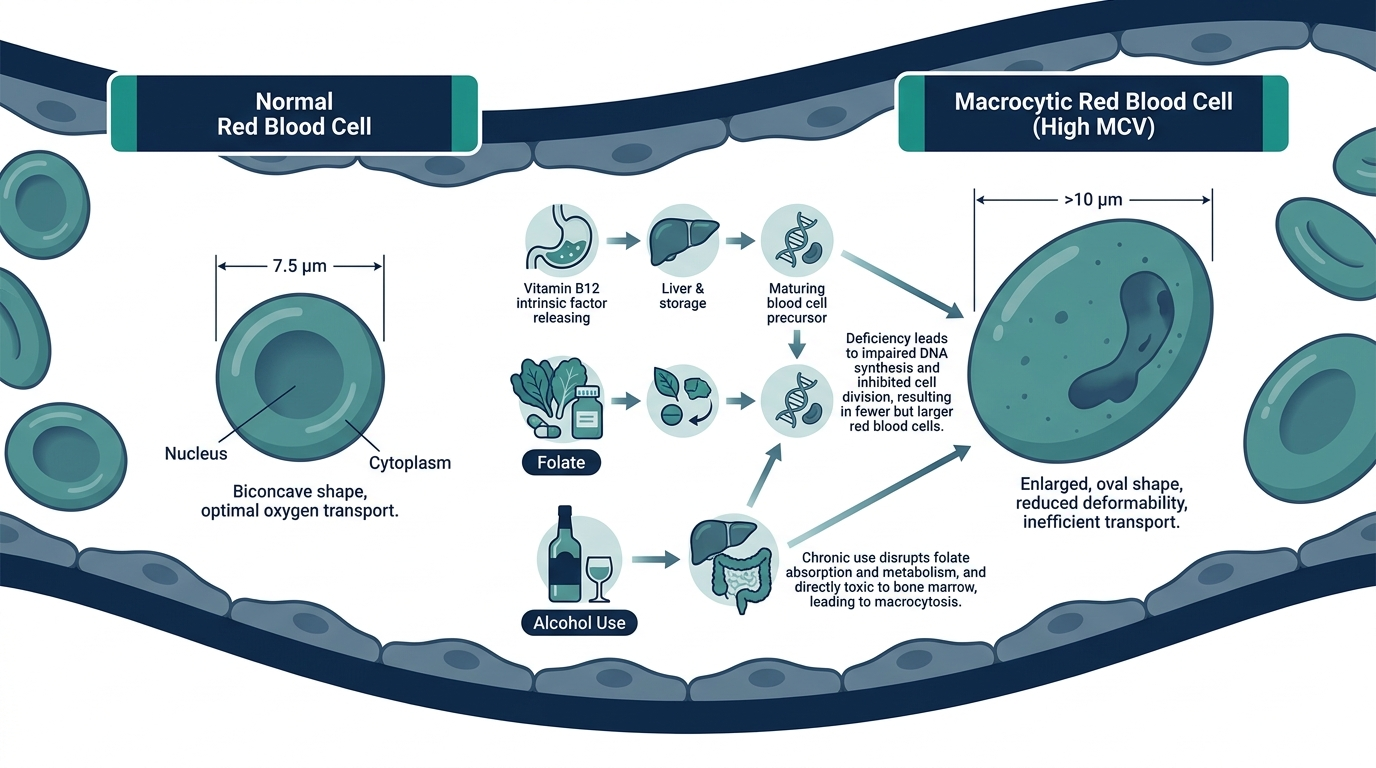
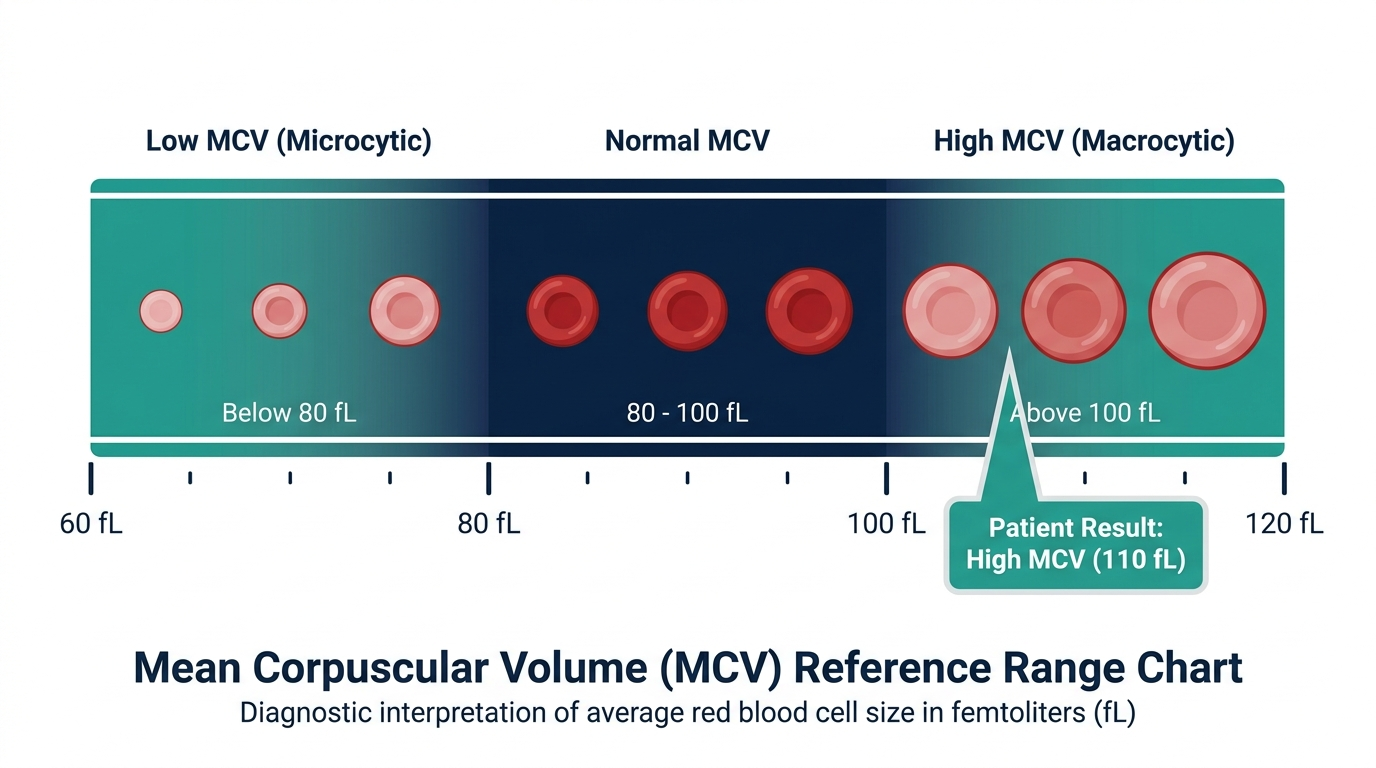
MCV stands for mean corpuscular volume, the average size of your red blood cells, reported automatically as part of a standard complete blood count. A normal MCV runs from about 80 to 100 femtoliters (fL), so a high MCV means your result is above 100 fL (Cleveland Clinic). The medical word for larger than normal red cells is macrocytosis, and you officially have it when your MCV crosses 100 fL (Cleveland Clinic).
In plain terms: MCV is a size score for your red blood cells. A low number means they are small. A high number means they are big. Healthy bone marrow stamps out red cells of a fairly predictable size. When something interferes with how those cells are built, the most common result is cells that come out too large. That single fact, oversized red cells, is the thread that connects every cause below.
One thing worth saying clearly: macrocytosis is a finding, not a disease (Cleveland Clinic). It is your body raising a hand and asking you to look closer.

What does a high MCV mean on a blood test?
A high MCV means your red blood cells are larger than they should be, which tells a clinician that red cell production has been disrupted somewhere upstream. The cutoff that counts as high is greater than 100 fL (Cleveland Clinic). How high it goes is itself a clue. A mildly elevated MCV in the 100 to 116 range tends to come from things like alcohol, liver disease, or certain medications, while a markedly high MCV in the 116 to 130 range points more strongly toward a problem with DNA building blocks, namely vitamin B12 or folate deficiency (StatPearls).
The other number that changes the meaning is your hemoglobin. If your MCV is high but your hemoglobin is normal, you have macrocytosis without anemia, which is common and usually less urgent. If your MCV is high and your hemoglobin is low, you have macrocytic anemia, and that is the version your clinician will want to chase down, because untreated macrocytic anemia can cause real harm (Cleveland Clinic).
What causes a high MCV?
Here is the real differential, roughly in order of how often it shows up in practice. The three biggest drivers of a high MCV in adults are alcohol use, vitamin B12 and folate deficiencies, and certain medications (StatPearls, Macrocytic Anemia).
- Alcohol. Regular drinking is one of the most common causes of a raised MCV, and it can push the number up through a direct toxic effect on bone marrow, through associated liver disease, and through folate deficiency all at once (StatPearls).
- Vitamin B12 or folate deficiency. These vitamins are needed to build DNA inside developing red cells. Without them, cells keep growing but cannot divide properly, so they come out oversized. Macrocytosis is often the earliest blood count abnormality in B12 or folate deficiency, showing up before anemia does (PMC, Megaloblastic Anemia and Other Causes of Macrocytosis).
- Medications. Drugs that interfere with DNA synthesis are classic culprits, including hydroxyurea, chemotherapy agents, and some antiretroviral therapies (Cleveland Clinic).
- Liver disease. Even without alcohol, chronic liver disease can enlarge red cells.
- Hypothyroidism. An underactive thyroid is an easily missed, easily fixed cause of a mildly high MCV.
- Reticulocytosis. When your marrow pumps out a flood of young red cells after blood loss or hemolysis, those immature cells are larger and drag the average up.
- Myelodysplastic syndrome. A bone marrow disorder, more common with age, where cells are produced abnormally. This is the cause clinicians least want to miss in an older adult with an unexplained high MCV (Cleveland Clinic).
Clinicians also split macrocytosis into two families. Megaloblastic causes, mainly B12 and folate deficiency, leave a fingerprint on the blood smear called hypersegmented neutrophils. Nonmegaloblastic causes, like alcohol, liver disease, and hypothyroidism, do not (StatPearls). That distinction is exactly how a hematologist narrows the list without ordering every test at once.
What are the symptoms of a high MCV?
Most of the time, a high MCV has no symptoms at all. Very often the only sign of macrocytosis is the number itself on your CBC, which is precisely why it gets discovered by accident during routine blood work (Cleveland Clinic).
When symptoms do appear, they usually belong to the underlying cause rather than the enlarged cells themselves. If a high MCV comes with anemia, you may feel tired, weak, or short of breath and look pale (Cleveland Clinic). When the cause is B12 deficiency, the more telling clues can be neurological: tingling or numbness in the hands and feet, balance problems, or memory and mood changes. Those nerve symptoms matter because they can become permanent if a B12 deficiency goes untreated long enough, which is one reason a high MCV deserves a follow-up rather than a shrug.

When is a high MCV dangerous or a medical emergency?
A high MCV by itself is rarely an emergency. The danger lives in two places: the size of the number and what it is sitting next to.
First, the magnitude. A markedly elevated MCV, often quoted around 110 to 115 fL or higher, strongly suggests megaloblastic anemia from B12 or folate deficiency and warrants prompt investigation (Cleveland Clinic). An MCV in the 116 to 130 range in particular leans hard toward a nutritional or DNA-synthesis problem rather than something benign like a couple of glasses of wine (StatPearls).
Second, the company it keeps. A high MCV paired with a low hemoglobin, low platelets, or low white cells is more concerning, because falling counts across the board can signal a bone marrow problem such as myelodysplastic syndrome that needs specialist evaluation. And untreated macrocytic anemia, whatever the cause, can lead to serious medical problems over time (Cleveland Clinic). The practical red flags worth urgent attention are a very high MCV combined with significant anemia, new neurological symptoms like numbness or unsteadiness, chest pain, or marked breathlessness.
What should you do about a high MCV?
Start by not panicking and not self-diagnosing from one line on a lab report. The right next step is almost always more information, not treatment.
A sensible workup, the kind your clinician will reach for, usually includes blood levels of vitamin B12 and folate, thyroid function tests, liver function tests, a reticulocyte count, and often a look at the blood smear under a microscope to check for hypersegmented neutrophils and abnormal cell shapes (PMC, Diagnosis and treatment of macrocytic anemias in adults). Your history does a lot of the heavy lifting too: alcohol intake, diet, and a list of your medications can point straight at the cause before any extra blood is drawn.
Treatment, when it is needed, targets the cause rather than the MCV itself. B12 or folate deficiency is corrected with supplements or injections. Alcohol-related macrocytosis improves with reduced drinking. A medication cause may prompt a dose review with your prescriber. Often, fixing the underlying problem brings the MCV back toward normal on its own (Cleveland Clinic). On the lifestyle side, the highest-yield moves are honest about alcohol, a diet with enough B12 (meat, eggs, dairy, or fortified foods) and folate (leafy greens, legumes, fortified grains), and not ignoring a thyroid that might be sluggish.
The insider part: the high MCV that is not really high
Here is the nuance that rarely makes it into the patient version, and it can save you a needless scare. Not every elevated MCV reflects genuinely large red cells. Analyzers can be fooled.
Cold agglutinins, antibodies that make red cells clump together, can trick the machine into counting two clumped cells as one giant cell, falsely inflating the MCV. Severe leukocytosis (a very high white cell count) and marked hyperglycemia (very high blood sugar) can also cause the analyzer to overestimate MCV (StatPearls). These are pseudomacrocytosis: the number is high, but the underlying cells are not truly enlarged. A good lab and an alert clinician catch this, often by warming the sample or checking the smear.
The flip side is the cause that gets masked. If you happen to have iron deficiency or anemia of chronic disease at the same time as a macrocytic process, the small cells and the large cells can average out to a deceptively normal MCV, hiding the very deficiency that should be treated (StatPearls). This is exactly why MCV is read alongside RDW and the blood smear, and why a “normal” average does not always mean a normal population of cells. One number rarely tells the whole story.

When should you see a doctor?
If your blood work flagged a high MCV, the simplest rule is to bring it up at your next visit rather than letting it sit. Make it sooner if the MCV is markedly high, if it comes with a low hemoglobin, or if you have symptoms like persistent fatigue, breathlessness, pale skin, or any tingling, numbness, or balance trouble. Because elevated MCV can be the first sign of a B12 deficiency that quietly damages nerves, and occasionally the first hint of a bone marrow disorder in older adults, it is the kind of result worth a real conversation, not a Google search and a sigh of relief.
Megaloblastic versus nonmegaloblastic: the split that guides the workup
The most useful way clinicians sort a high MCV is into two families, because the split points straight at the likely cause and the smear finding that confirms it.
- Megaloblastic macrocytosis. Caused by impaired DNA synthesis, mainly vitamin B12 and folate deficiency, and by drugs that block DNA building blocks. Developing red cells keep growing but cannot divide, so they come out large. The telltale smear finding is hypersegmented neutrophils, white cells with too many lobes in their nucleus (StatPearls, Macrocytic Anemia).
- Nonmegaloblastic macrocytosis. Caused by alcohol, liver disease, hypothyroidism, and reticulocytosis (a surge of young, large red cells after bleeding or hemolysis). Here the cells are large for different reasons, and hypersegmented neutrophils are absent.
This distinction is why the blood smear is such a high-value, low-cost test in a macrocytosis workup. Seeing hypersegmented neutrophils pushes the search toward B12 and folate, while their absence, especially with a history of drinking or a known thyroid or liver problem, points the other way. A clinician often knows which family they are dealing with before the vitamin levels even return.
Reading MCV with RDW and hemoglobin: the full picture
MCV is an average, and averages hide detail. Reading it next to RDW (how much the cell sizes vary) and hemoglobin (whether you are anemic) turns a single number into a real interpretation.
| Pattern | What it suggests |
|---|---|
| High MCV, high RDW, low hemoglobin | Macrocytic anemia with varied cell sizes, classic for B12 or folate deficiency where a mix of cell sizes is present. |
| High MCV, normal RDW, normal hemoglobin | Uniform large cells without anemia, more typical of alcohol, liver disease, or a stable nonmegaloblastic cause. |
| Normal MCV, high RDW | A warning that a mixed population may be averaging out. A macrocytic process and a microcytic one (like iron deficiency) can cancel to a normal MCV. |
| High MCV with low platelets and low white cells | Falling counts across all lines raise concern for a bone marrow process such as myelodysplastic syndrome and warrant specialist evaluation. |
The third row is the trap most worth remembering. A normal MCV does not guarantee normal red cells, because large and small populations can average out. A high RDW alongside a normal or high MCV is the clue that tells a careful reader to look deeper (StatPearls).

B12 versus folate: why getting the right one matters
Both vitamin B12 and folate deficiency cause an identical-looking megaloblastic macrocytosis, but they are not interchangeable, and treating the wrong one can cause harm. This is one of the most important nuances behind a high MCV.
Folate supplementation can correct the anemia and normalize the MCV even when the real problem is B12 deficiency. That sounds helpful, but it is dangerous, because the neurological damage of B12 deficiency, the numbness, tingling, balance problems, and memory changes, can keep progressing while the blood count looks fixed (PMC, Megaloblastic Anemia and Other Causes of Macrocytosis). The blood improves while the nerves quietly worsen.
This is exactly why a proper workup checks both B12 and folate levels before treatment, and why B12 deficiency in particular is taken seriously. Common causes of B12 deficiency include pernicious anemia (an autoimmune loss of the protein needed to absorb B12), a strict plant-based diet without supplementation, gastrointestinal conditions that impair absorption, and long-term use of certain acid-reducing or diabetes medications. The practical lesson: never self-treat a high MCV with over-the-counter folic acid alone, because you could be masking a B12 problem that needs its own treatment.
Sample interpretations: the same high MCV, different next steps
Because a high MCV can mean very different things, walking through realistic patterns shows how context decides the follow-up. These are illustrative, not diagnoses, and none replaces the clinician who ordered your test.
- MCV of 103 in a regular drinker, normal hemoglobin. A mildly high MCV with no anemia in someone who drinks regularly often reflects alcohol or early liver effects. Honest reduction in drinking and a recheck is a reasonable path (StatPearls).
- MCV of 118 with low hemoglobin and tingling feet. A markedly high MCV with anemia and neurological symptoms strongly suggests B12 deficiency and needs prompt evaluation, because the nerve damage can become permanent (PMC).
- MCV of 104 with fatigue and constipation. A mildly high MCV alongside symptoms of a sluggish metabolism is a reminder to check thyroid function, an easily missed and easily fixed cause.
- High MCV with low platelets and low white cells in an older adult. Falling counts across all cell lines is the pattern that raises concern for a bone marrow disorder and warrants specialist referral (Cleveland Clinic).
How the test is done, and monitoring after treatment
MCV is calculated automatically as part of a complete blood count, a routine blood draw that needs no fasting or special preparation. A few points help you read it and track it well.
- No prep needed, but context matters. Tell your clinician about alcohol intake, diet, and all medications, since these explain a large share of high MCV results before any extra test is run.
- Sample handling can matter. Cold agglutinins and delayed processing can distort the reading, which is why an unexpected high value is sometimes rechecked or examined on a smear (StatPearls).
- Recovery is gradual. When a deficiency is corrected, the MCV does not normalize overnight. Because red cells live about three months, it can take weeks to months for the average size to fall back into range as old large cells are replaced by new normal ones.
- Retest to confirm. A follow-up CBC after treating the cause confirms the MCV is trending down and that the right problem was addressed.
Frequently asked questions
What does a high MCV mean in a blood test?
A high MCV means your red blood cells are larger than normal, a finding called macrocytosis, defined as an MCV above 100 fL (Cleveland Clinic). It is a clue rather than a diagnosis, most often pointing to alcohol use, vitamin B12 or folate deficiency, certain medications, liver disease, or thyroid problems.
What level of MCV is considered high?
A normal MCV is about 80 to 100 fL, so anything above 100 fL counts as high (Cleveland Clinic). A markedly high MCV in the 116 to 130 range points more strongly toward vitamin B12 or folate deficiency (StatPearls).
Can MCV be high without anemia?
Yes. You can have macrocytosis with a perfectly normal hemoglobin. In fact, a high MCV is often the earliest CBC abnormality in B12 or folate deficiency, appearing before anemia develops (PMC). It is still worth investigating.
Is a high MCV dangerous?
Usually not on its own, but it depends on the cause and the context. An MCV around 110 to 115 fL or higher suggests megaloblastic anemia and needs prompt evaluation, and untreated macrocytic anemia can cause serious problems over time (Cleveland Clinic).
Can a high MCV be a false result?
Yes. Cold agglutinins that clump red cells, a very high white cell count, or very high blood sugar can all cause an analyzer to overestimate MCV, producing pseudomacrocytosis where the number is high but the cells are not truly enlarged (StatPearls).
This article is for general educational purposes and is not medical advice. It cannot diagnose or treat you and does not replace your clinician. Always discuss your lab results and any health decisions with a qualified healthcare professional.
Vital Signs Today may earn a commission if you buy through links on this page. It does not affect our editorial assessments.