You scanned your complete blood count, saw a row labeled HCT with a percentage next to it, and moved on. That single number is one of the most useful figures on the whole report, and also one of the most easily misread. A high hematocrit can mean your bone marrow is working overtime, or it can simply mean you walked into the lab dehydrated. Same number, two completely different stories.
Here is what most explainers skip. Hematocrit is a ratio, not a head count, and that detail quietly changes how you should read your own result.
Part of our Complete Blood Count guide.
What is hematocrit in a blood test?
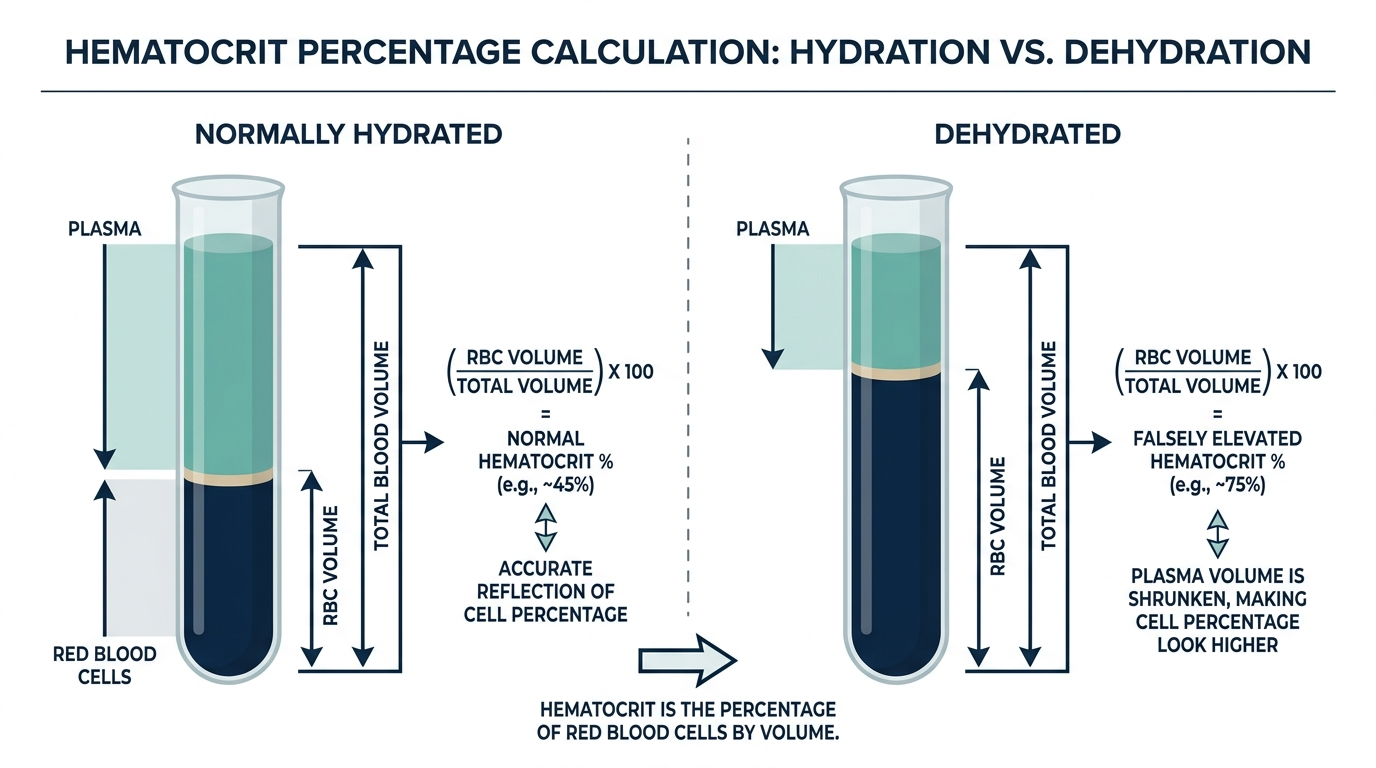
Hematocrit is the percentage of your blood that is made up of red blood cells, and it is reported automatically as part of a standard complete blood count (CBC) (MedlinePlus). A result of 45 means 45 percent of your blood volume is red cells and the other 55 percent is plasma, the watery fluid they float in. Red blood cells carry oxygen from your lungs to the rest of your body, so hematocrit is essentially a measure of how much oxygen-carrying capacity is packed into a given volume of blood (Cleveland Clinic).
That ratio framing is the key to everything below. Because hematocrit is red cells divided by total blood volume, it can shift when the red cells change, when the plasma changes, or both. Hold that thought.

What does hematocrit mean in a blood test, and what does it measure?
When people ask what does hematocrit mean in a blood test, the short answer is the proportion of red cells to whole blood, expressed as a percentage. The classic way to picture it is the original method: spin a thin tube of blood in a centrifuge and the heavier red cells pack down to the bottom while plasma rises to the top. Hematocrit is simply the height of that packed red cell column divided by the height of the whole sample (StatPearls).
Modern labs no longer spin a tube by hand for routine work. Automated analyzers count and size your red cells electronically and calculate hematocrit from those measurements (StatPearls). Either way, the number answers the same question: of all the blood in that tube, what fraction is red cells?
Hematocrit travels closely with hemoglobin, the iron-rich protein inside red cells that actually binds oxygen. They measure overlapping things from different angles, which is why a CBC reports both and clinicians read them together.
What is a normal hematocrit level?
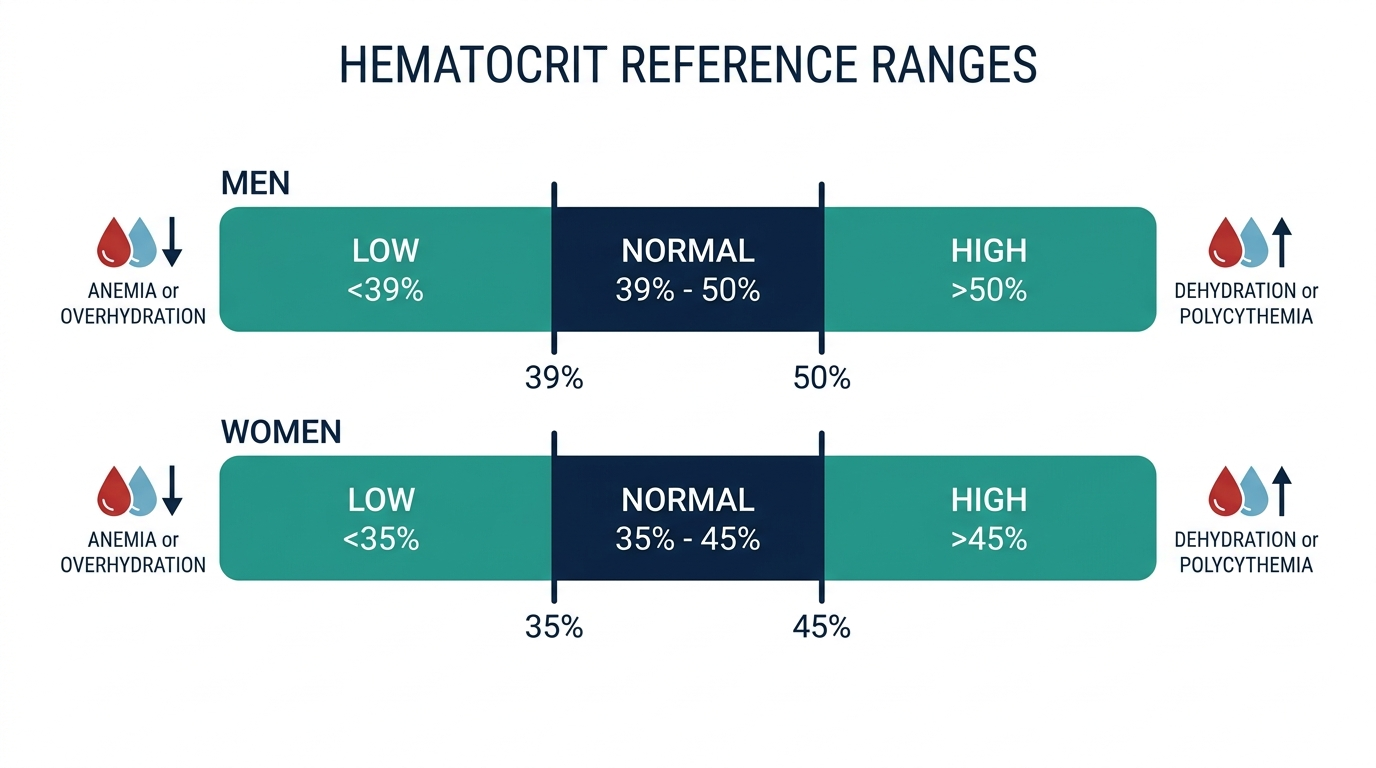
A normal hematocrit depends on your sex, and the exact cutoffs differ by lab. Cleveland Clinic lists roughly 41 to 50 percent for adult men and 36 to 44 percent for adult women (Cleveland Clinic). MedlinePlus does not publish a single fixed range and instead notes that normal levels vary by sex, age, smoking, and altitude, so it advises checking with your provider (MedlinePlus). Newborns and young children run higher, and the figures shift again in pregnancy.
Your level also depends on factors that have nothing to do with disease, including whether you smoke and the altitude where you live, because both push the body to make more red cells (MedlinePlus). The practical rule: always read your result against the reference range printed on your own report, because that is the range your lab actually calibrated for its instruments and population.
What does a high hematocrit mean?
A high hematocrit means red cells make up a larger than usual share of your blood, a state clinicians call erythrocytosis or polycythemia. It splits into two very different categories, and telling them apart is the whole game (MedlinePlus).
The common causes include:
- Dehydration. Lose plasma volume through poor fluid intake, vomiting, diarrhea, or diuretics and the red cells become more concentrated, so the percentage rises even though the actual number of red cells has not changed (MedlinePlus Encyclopedia).
- Low oxygen states. Living at high altitude, smoking, chronic lung disease, sleep apnea, or certain heart conditions push the body to make extra red cells to carry more oxygen (MedlinePlus).
- Polycythemia vera. A bone marrow disorder in which the marrow overproduces red cells on its own, independent of the body’s oxygen needs (MedlinePlus Encyclopedia).
- Kidney problems, including tumors that secrete excess erythropoietin, the hormone that tells marrow to build red cells.
Doctors investigating a high reading start by asking whether it is real. True or absolute polycythemia means a genuine increase in red cell mass, while relative or spurious polycythemia is just concentrated blood from a shrunken plasma volume, often from dehydration or diuretics (PMC, polycythemia in primary care). One published case showed a patient’s hematocrit of 56 percent resolve simply with hydration, confirming it was relative rather than a marrow problem (PMC, polycythemia in primary care). For that reason the standard move is to repeat the count before chasing exotic diagnoses.

What does a low hematocrit mean?
A low hematocrit means red cells make up too small a share of your blood, which is the definition of anemia. It signals that your blood is carrying less oxygen than it should, and it has a long list of possible causes (MedlinePlus).
The usual suspects include:
- Blood loss, whether sudden from injury or slow and hidden, such as bleeding in the gut or heavy menstrual periods.
- Nutritional deficiencies, especially low iron, vitamin B12, or folate, which the marrow needs to build healthy red cells (MedlinePlus Encyclopedia).
- Chronic kidney disease, because failing kidneys make less erythropoietin, the hormone that drives red cell production.
- Bone marrow disorders, including some cancers and the effects of chemotherapy or radiation.
- Overhydration or pregnancy, where extra plasma dilutes the red cells and drops the percentage even if red cell mass is normal (MedlinePlus).
Notice that the last bullet mirrors dehydration in reverse. The number can fall not because you lost red cells, but because you gained plasma. This is why hematocrit is rarely interpreted in isolation.
Why is hematocrit read together with hemoglobin?
Hematocrit is almost always interpreted next to hemoglobin because the two measure red cell adequacy from different angles, and a mismatch between them is itself a clue. Hemoglobin tells you how much oxygen-carrying protein is present, while hematocrit tells you how much space the red cells occupy. In most healthy people they move together in a fairly steady proportion, and the CBC reports both side by side (MedlinePlus).
The pairing matters because conditions that change cell size can pull the two apart. In iron deficiency, for example, red cells turn out small and pale, so hemoglobin can drop more than the cell count alone would suggest. Reading hematocrit, hemoglobin, and red cell indices together lets a clinician separate the kind of anemia from the mere fact of it. One number rarely names a cause, but the pattern across several often does.
The part most people miss: your hematocrit is a fraction, so plasma can fool it
Here is the insight that experienced clinicians carry but patient summaries almost never state plainly. Hematocrit is a percentage, red cells divided by total blood volume, which means the denominator can move the result as much as the numerator does. Your red cell count can be perfectly normal while the hematocrit reads high or low, purely because your plasma volume changed.
This is not a rare quirk. It is the single most common reason a hematocrit looks abnormal in an otherwise healthy person. Walk into a morning blood draw dehydrated, after a workout, a sauna, or a night of poor fluid intake, and your plasma volume is down, so the same red cells now make up a bigger slice of a smaller pie. The reading climbs. Researchers have a name for this concentrated state, relative or spurious polycythemia, and the textbook fix is hydration and a repeat test rather than a marrow biopsy (PMC, polycythemia in primary care). The reverse happens in pregnancy and with overhydration, where expanded plasma dilutes the cells and drags hematocrit down even though red cell mass is fine (StatPearls).
The practical lesson is twofold. First, a single borderline hematocrit, high or low, is often worth confirming on a repeat draw before anyone draws conclusions. Second, hydration status on the morning of your test genuinely affects the number, so consistency matters if you are tracking results over time. A hematocrit is a snapshot of a ratio, and ratios lie when you only watch one half of them.

How your body actually controls hematocrit
To understand why hematocrit drifts, it helps to see the control loop behind it. Red cell production is governed largely by a hormone called erythropoietin, made mostly by your kidneys. When the kidneys sense that tissues are getting less oxygen, they release more erythropoietin, which tells the bone marrow to build more red cells. When oxygen delivery is plentiful, that signal quiets down and production eases. This feedback loop is why hematocrit is so tightly linked to oxygen supply.
That single mechanism explains a surprising amount. Living at high altitude means thinner air and less available oxygen, so the kidneys crank up erythropoietin and your baseline hematocrit rises to compensate. Chronic lung disease, sleep apnea, and heavy smoking do the same thing from the opposite direction, by lowering how much oxygen reaches the blood in the first place. On the flip side, chronic kidney disease often lowers hematocrit precisely because damaged kidneys make less erythropoietin, so the marrow never gets the signal to keep up. Once you picture the kidney as the oxygen sensor and erythropoietin as the throttle, high and low hematocrit stop looking random and start looking like the body responding to its oxygen environment.
The hydration factor, in practical detail
Because this number is so easily faked by fluid shifts, it is worth being precise about how hydration moves it. Plasma is mostly water, so anything that changes your body water changes the size of the denominator in the hematocrit ratio.
- Dehydration concentrates. A morning draw after a night of little fluid, a long flight, heavy sweating, a sauna, vomiting, diarrhea, or a dose of a diuretic all shrink plasma volume. The red cells you have now occupy a bigger share of a smaller total, and the percentage climbs. Nothing changed about your marrow.
- Overhydration dilutes. Drinking a large volume of fluid shortly before a draw, or receiving intravenous fluids, expands plasma and can drop the reading even when red cell mass is fine.
- The fix is boring on purpose. When a high hematocrit is suspected to be from dehydration, the standard next step is to rehydrate and repeat the test rather than launch an aggressive workup. A number that normalizes with fluids was relative, not a marrow problem.
If you are tracking your hematocrit over time, the single most useful habit is consistency: test at a similar time of day, in a similar hydration state, ideally not right after intense exercise or a sauna. That turns a noisy snapshot into a trend you can actually trust.
Hematocrit, athletes, altitude, and why doping agencies watch it
Hematocrit sits at the center of endurance sport for a simple reason: more red cells mean more oxygen delivered to working muscles. This is why endurance athletes sometimes train at altitude, letting the natural erythropoietin response nudge their red cell mass upward before returning to sea level. It is also why hematocrit has a notorious history in anti-doping. Artificially raising red cell mass, whether through synthetic erythropoietin or transfusion, boosts oxygen delivery but also thickens the blood, which is why sporting authorities have long treated an unusually high hematocrit as a warning sign worth investigating.
For an ordinary person reading their own report, the takeaway is not about sport. It is that a high hematocrit is not automatically good just because oxygen delivery sounds beneficial. Blood that is too concentrated flows less easily and raises the risk of clots. There is a healthy window, and both ends of it carry trade-offs.

A worked example: is this high hematocrit real or just concentrated?
Say a report shows a hematocrit of 53 percent, flagged high. Rather than jumping to a marrow disorder, a careful reading works through the fluid question first:
- Assess hydration. Was the person dehydrated, sweating, recently in a sauna, or on a diuretic before the draw? If so, the blood may simply be concentrated, a state called relative or spurious polycythemia.
- Rehydrate and repeat. The classic next step is to restore fluids and retest. A value that falls back into range confirms the high number was about plasma, not red cells.
- Check the oxygen story. If hydration is fine, consider whether smoking, sleep apnea, lung disease, or altitude could be driving genuine extra red cell production.
- Then consider the marrow. Only when hydration and oxygen are ruled out does a persistent high value raise the question of a primary marrow disorder like polycythemia vera, which prompts further testing.
The order matters. Starting with the boring, common explanation spares many people an unnecessary scare, and it reflects how the number actually behaves.
Symptoms that tend to accompany an abnormal hematocrit
Hematocrit produces no sensation of its own. The symptoms come from what it reflects.
A low hematocrit shows up as the signs of anemia and reduced oxygen delivery: persistent fatigue, weakness, dizziness, shortness of breath with everyday effort, pale skin, cold hands and feet, and sometimes a racing heart. When the drop is slow, people often adapt and dismiss the symptoms for months.
A high hematocrit from truly concentrated or excess red cells can bring headaches, dizziness, flushing, blurred vision, and in some cases itching after a warm shower. The more serious risk is clotting, because thicker blood moves more sluggishly. Warning signs that call for prompt care include chest pain, sudden severe shortness of breath, one-sided weakness or trouble speaking, or a swollen, painful leg, all of which can point to a clot.
Hematocrit in pregnancy: a normal dip that is easy to misread
Pregnancy is the clearest everyday example of hematocrit falling for reasons that have nothing to do with losing red cells. During pregnancy, plasma volume expands substantially, and it expands faster than red cell volume does. The result is a dilutional drop in hematocrit that is a normal, expected part of pregnancy rather than a sign of disease. This is sometimes called physiologic anemia of pregnancy.
The catch is that true iron deficiency anemia is also common in pregnancy, so a low hematocrit still deserves evaluation rather than automatic dismissal. The way clinicians tell the two apart is by looking at the red cell indices and iron studies, not the hematocrit alone. It is a perfect illustration of the article’s central theme: the same low percentage can be a normal dilution or a genuine deficiency, and only the surrounding numbers reveal which.
How to raise or lower hematocrit safely
You do not treat a hematocrit number directly. You treat whatever is moving it, and the number follows. The first and most important step is deciding whether the value is even real, because dehydration and over-hydration can fake a change without touching the actual red cell mass. Once a genuine abnormality is confirmed, the approach depends on the direction and the cause.
For a genuinely low hematocrit, the goal is to correct the reason cells are missing:
- Iron, B12, or folate deficiency: Rebuilding the missing nutrient lets the marrow resume normal red cell production, and the hematocrit climbs over the following weeks as new cells accumulate.
- Blood loss: Finding and stopping the source, whether menstrual, gastrointestinal, or otherwise, is what allows the count to recover.
For a genuinely high hematocrit, the response depends on why cells are elevated. If it is concentration from dehydration, restoring normal fluids is the fix. If the body is making extra cells because of low oxygen, from lung disease, sleep apnea, altitude, or heavy smoking, treating or removing that trigger is what matters. When a bone marrow disorder is driving the rise, that is a specialist question, and self-directed tinkering is the wrong move. In every case the safe path is confirming the cause with your clinician rather than chasing the percentage on your own.
Questions patients ask about an abnormal hematocrit
An out-of-range hematocrit tends to raise the same practical questions, and clear answers keep a single value from spiraling into worry. A common first question is whether the result is real or just concentration. Because hematocrit is a fraction of blood that is red cells, hydration alone can move it, so a mildly abnormal value in someone who was dehydrated or over-hydrated is often rechecked before anything else.
The next question is usually what the number means for how you feel. A low hematocrit that developed slowly may cause few symptoms because the body adapts, while a faster drop is more likely to bring fatigue, breathlessness, or paleness. A high hematocrit thickens the blood and can show up as headaches, flushing, or dizziness. The third question is what happens next, and the honest answer is that the hematocrit rarely decides alone. Your clinician reads it beside hemoglobin, the red cell indices, and your symptoms, then chooses whether a recheck or a targeted test is the right step. That context, not the isolated percentage, is what turns an abnormal hematocrit into a clear plan.
Frequently asked questions
What is a hematocrit blood test used for?
A hematocrit blood test measures the percentage of your blood made up of red blood cells and is usually run as part of a complete blood count. It helps screen general health and diagnose conditions like anemia, where the level is low, or polycythemia, where it is high (MedlinePlus).
What is a normal hematocrit level?
For adults, a normal hematocrit is roughly 41 to 50 percent in men and 36 to 44 percent in women, though the exact cutoffs vary by lab and by age (Cleveland Clinic). Compare your result to the reference range printed on your own report.
Can dehydration cause a high hematocrit?
Yes. Dehydration shrinks your plasma volume, so the same red cells make up a larger percentage of your blood and the hematocrit rises without any real increase in red cell mass. This is called relative or spurious polycythemia and often resolves with hydration and a repeat test (PMC).
What does a low hematocrit mean on a blood test?
A low hematocrit usually means anemia, meaning too few red blood cells to carry oxygen well. Common causes include blood loss, iron or vitamin deficiency, kidney disease, and bone marrow problems, while pregnancy and overhydration can lower it through dilution (MedlinePlus).
Is hematocrit the same as hemoglobin?
No. Hematocrit is the percentage of blood volume made of red cells, while hemoglobin measures the oxygen-carrying protein inside them. They track closely and are reported together, and a mismatch between them can itself point to a specific type of anemia (MedlinePlus).
This article is for general educational purposes and is not medical advice. It cannot diagnose or treat you and does not replace your clinician. Always discuss your lab results and any health decisions with a qualified healthcare professional.
Vital Signs Today may earn a commission if you buy through links on this page. It does not affect our editorial assessments.