Part of our Complete Blood Count guide.
You scanned your blood work, found the complete blood count, and there it was: HCT, with a number and a percent sign. Maybe it was flagged, maybe it was not, and either way you probably moved on. Here is what most explainers skip. HCT is one of the most physical, literal numbers on your whole report. It is not an abstract index. It is the actual fraction of your blood that is made of red cells, and reading it correctly tells you a surprising amount about your oxygen delivery, your hydration, and sometimes your bone marrow.
The trick is that HCT can mislead you in both directions if you read it alone. Understanding what is HCT in blood test terms, and why the number can fool you, is the difference between panicking over a result and actually knowing what it means.
What is HCT in blood test results?
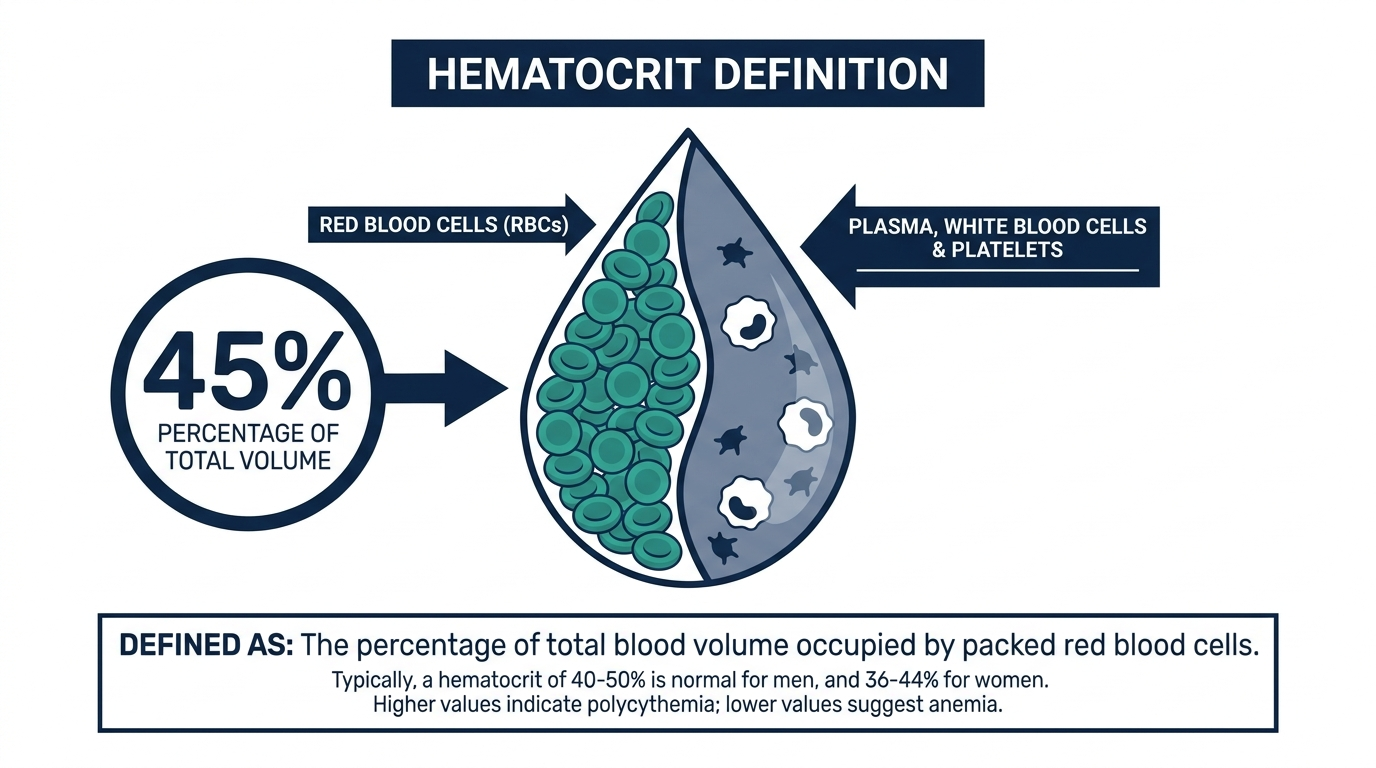
To answer what is HCT in blood test reports directly: HCT stands for hematocrit, and it is the percentage of your blood volume that is made up of red blood cells (MedlinePlus). It is reported automatically as part of a standard complete blood count (CBC). If your HCT comes back as 42, that means 42 percent of your blood is red cells, and the rest is plasma, white cells, and platelets. In plain terms: hematocrit is how packed your blood is with the cells that carry oxygen.
Red blood cells are the delivery trucks for oxygen, moving it from your lungs out to every tissue. Because hematocrit counts how many of those trucks are on the road relative to everything else in your blood, it doubles as a rough read on your blood’s oxygen-carrying capacity (Cleveland Clinic). That single idea, the packed fraction of red cells, is the key to everything below.
What does HCT mean in a blood test, and how is it measured?
When people ask what does HCT mean in a blood test, the cleanest answer is that it is a ratio: red cells divided by total blood. Picture spinning a tube of blood in a centrifuge. The heavier red cells pack down to the bottom, the straw-colored plasma rises to the top, and the height of the red layer as a fraction of the whole column is your hematocrit. Modern analyzers calculate it electronically rather than spinning every sample, but the concept is exactly that physical.
This is why the number is expressed as a percent. A hematocrit of 45 percent literally means red cells fill 45 percent of the tube. It is one of the few lab values you can almost visualize. That physicality also explains its main weakness, which we will get to: anything that changes the amount of plasma, like dehydration, changes the percentage without a single red cell being gained or lost.
What is a normal HCT level?
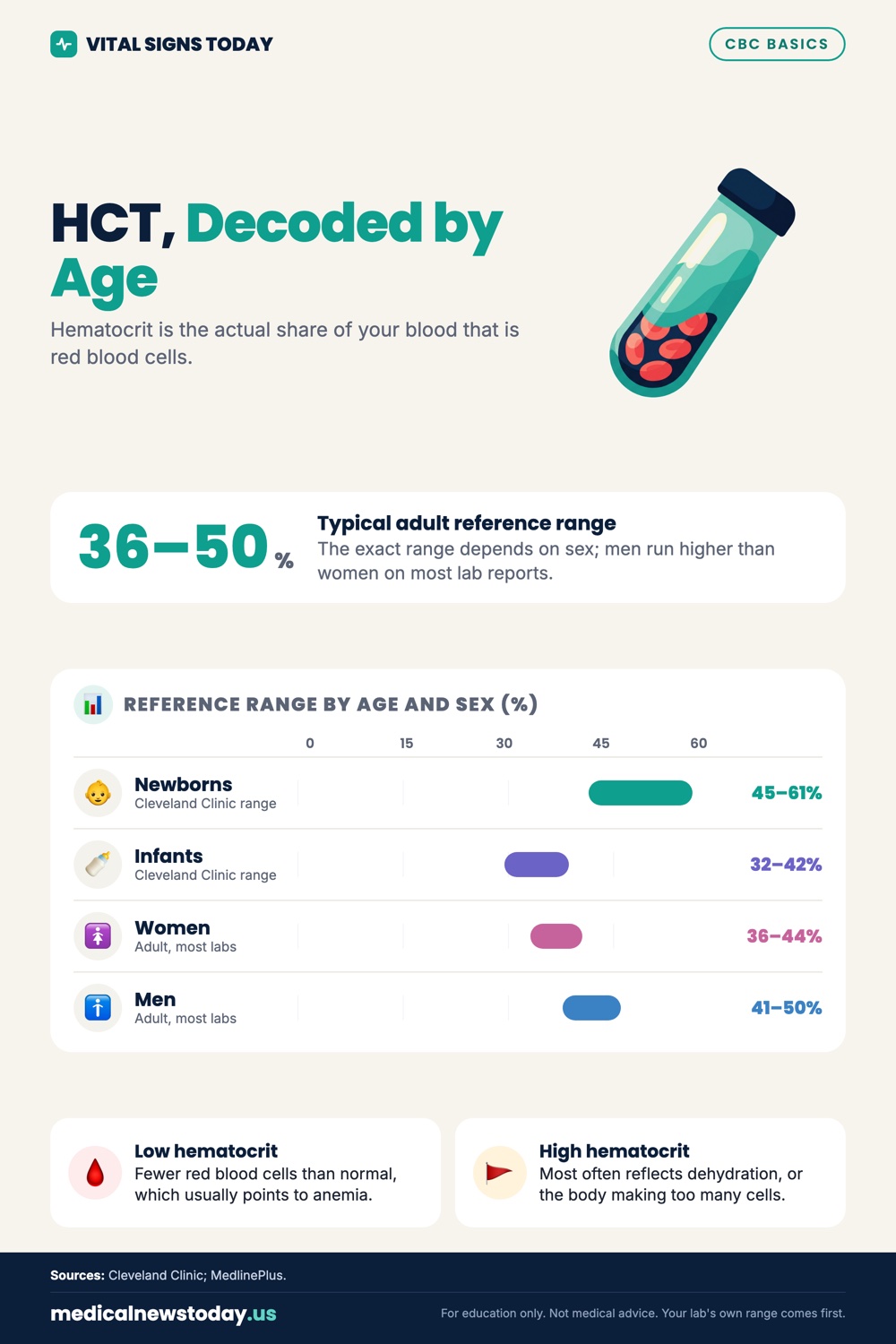
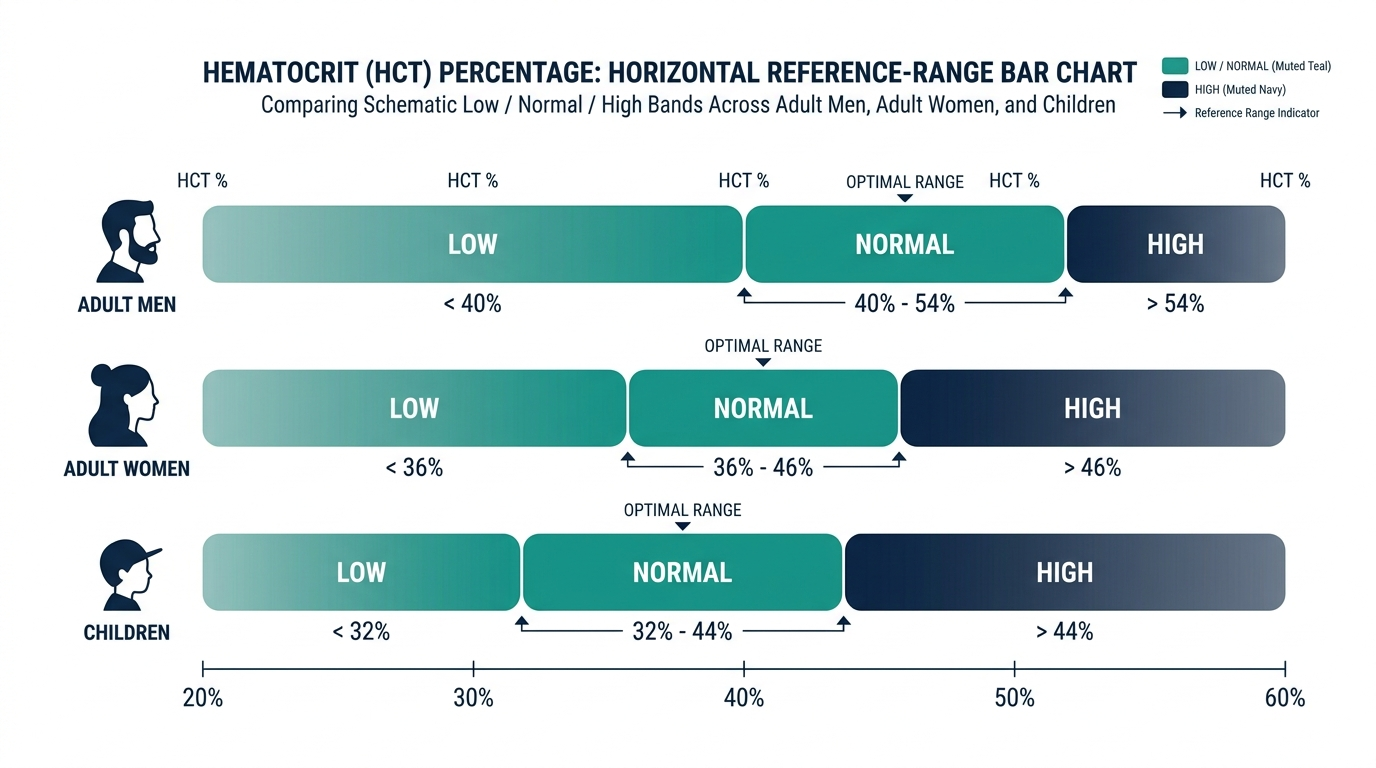
Normal hematocrit depends on your sex and age. For adult men, a typical range is about 41 to 50 percent, and for adult women it is roughly 36 to 44 percent (Cleveland Clinic). The ranges differ because men, on average, carry more red cell mass than women. Children and infants have their own ranges entirely, with newborns running high, around 45 to 61 percent, before settling down.
The number that matters most is the reference range printed on your own report. Labs calibrate their instruments slightly differently, so the cutoff that defines high or low for you is the one next to your result, not a number you read online. Living at high altitude can also nudge a healthy person’s hematocrit upward, because thinner air prompts the body to make more red cells.
What does a high HCT mean?
A high hematocrit means red cells make up an unusually large share of your blood, and there are two very different ways that happens. Either you genuinely have too many red cells, or your plasma volume has dropped and the red cells you do have are now more concentrated (MedlinePlus). Telling those apart is the whole game.
- Dehydration. This is the most common and most benign cause. Lose fluid and your plasma shrinks, so the same red cells fill a bigger fraction of a smaller total. The hematocrit looks high, but nothing is wrong with your marrow. Rehydrate and it falls back (MedlinePlus).
- Low oxygen states. Chronic lung disease, sleep apnea, heart conditions, smoking, and living at high altitude all push the body to make extra red cells to compensate for less available oxygen (Cleveland Clinic).
- Polycythemia vera. A bone marrow disorder where the marrow overproduces red cells on its own. Under WHO criteria, a hematocrit above 49 percent in men or above 48 percent in women is one of the red flags that prompts a workup for it (StatPearls, NCBI).
The reason a high HCT is worth attention beyond finding the cause is that thicker, more concentrated blood flows less easily and can raise the risk of clots. That is why a persistently elevated hematocrit, especially one not explained by dehydration, deserves a real look rather than a shrug.

What does a low HCT mean?
A low hematocrit means red cells make up less of your blood than they should, which usually points to anemia (Cleveland Clinic). Suspected anemia is the single most common reason clinicians order a hematocrit in the first place, because the symptoms, fatigue, weakness, dizziness, and shortness of breath, are so common (MedlinePlus).
The causes fall into three buckets, matching the three ways you can run short on red cells (MedlinePlus):
- Blood loss, whether sudden, like an injury, or slow and hidden, like heavy periods or a bleeding ulcer.
- Reduced production, from iron, B12, or folate deficiency, kidney disease, bone marrow problems, or certain cancers like leukemia.
- Increased destruction, where red cells are broken down faster than they are replaced.
One important caveat in the other direction: just as dehydration can fake a high hematocrit, overhydration or pregnancy can dilute the blood and make hematocrit look low even when red cell mass is fine. In pregnancy especially, plasma volume expands faster than red cell volume, producing a normal physiologic dip.
Why is HCT read together with hemoglobin?
Hematocrit and hemoglobin are almost always reported as a pair, often labeled H and H, because they measure the same thing from two angles (MedlinePlus). Hemoglobin measures the actual oxygen-carrying protein inside red cells, while hematocrit measures the volume those cells take up. When both move together, the picture is consistent and easier to trust.
There is a clinical shortcut clinicians keep in their heads called the rule of three: in normal blood, hematocrit runs roughly three times the hemoglobin value. So a hemoglobin of 14 g/dL should pair with a hematocrit near 42 percent. When the two do not line up by that ratio, it is a hint that something is off, either with the red cell indices or with the sample itself, and it is worth a second look.
The insider catch: HCT can lie when plasma volume shifts
Here is the detail that separates a careful read from a naive one. Hematocrit is a ratio, not a count, which means it can change without a single red cell appearing or disappearing. Anything that shrinks plasma raises it; anything that expands plasma lowers it. The red cell mass, the thing you actually care about, can be completely steady the whole time.
This matters most in a condition called masked polycythemia vera. In some patients the bone marrow really is overproducing red cells, yet an expanded plasma volume dilutes the sample enough that the hematocrit lands in the normal range, hiding the disease behind a reassuring number (PMC, Polycythemia Vera: Thinking Beyond the Hematocrit). The same physics works in reverse with iron deficiency that develops alongside polycythemia, where one process pulls hemoglobin down while another pushes red cell production up, and the hematocrit splits the difference into apparent normalcy.
The takeaway is not that hematocrit is unreliable. It is that hematocrit is a snapshot of concentration, and concentration depends on two variables, red cells and plasma, not one. A smart clinician reads HCT next to hemoglobin, red cell count, and your hydration status before drawing any conclusion. When the marker that should be definitive sits suspiciously in the middle while symptoms persist, the answer is often more testing, not less. That is exactly the kind of nuance a flat normal on a report can bury.

Symptoms that tend to travel with an abnormal HCT
Hematocrit itself causes no symptoms. What you feel comes from what the number reflects: either too little oxygen delivery when it is low, or blood that is thicker and moves less easily when it is high. Knowing which symptoms cluster with which direction helps you read your own result in context.
When HCT is low (the anemia side): the classic picture is oxygen shortfall. Fatigue that rest does not fix, weakness, dizziness or lightheadedness, shortness of breath with ordinary activity, pale skin, cold hands and feet, and sometimes a fast or pounding heartbeat as the heart works harder to move less-oxygenated blood. These symptoms build gradually with slow blood loss, so people often normalize them for months before testing catches up.
When HCT is high (the concentrated side): thicker blood shows up differently. Headaches, dizziness, flushing or ruddy skin, blurred vision, and sometimes itching after a warm shower are described with true red cell excess. The more serious concern is clotting, since sluggish, concentrated blood raises the risk of a clot in a vein or artery. A very high hematocrit paired with these symptoms is a reason to be seen rather than to wait.
The red flags that warrant prompt care regardless of the number: chest pain, severe shortness of breath, one-sided weakness or trouble speaking, or a swollen painful leg. Those point to a possible clot or a heart or oxygen problem and are emergencies, not lab curiosities.
What can falsify an HCT result before the lab even runs it
Because hematocrit is a concentration, not a headcount, several everyday things move it without any real change in your red cell mass. Understanding these keeps you from over-reading a single value.
- Hydration status. A draw taken when you are dehydrated concentrates the blood and lifts HCT; a draw when you are well hydrated or slightly overhydrated dilutes it. This is the single biggest reversible reason a number looks off.
- Body position and tourniquet time. Standing versus lying down and a tourniquet left on too long can shift the reading modestly by moving fluid between the blood and surrounding tissue. Standardized draws reduce this.
- Recent altitude. Time spent at high elevation genuinely raises red cell production, so a hematocrit measured soon after a mountain trip may run higher than your sea-level baseline.
- Pregnancy. Plasma volume expands faster than red cell volume, so a lower hematocrit in pregnancy is often a normal physiologic dilution rather than true anemia.
- Sample handling. A clotted or improperly filled tube can distort the automated calculation, which is one reason a surprising result is sometimes simply repeated.
You do not typically need to fast for a hematocrit, but if a doctor is tracking yours over time, being consistently hydrated and testing under similar conditions makes the trend far more meaningful than any one reading.
The red cell indices that give HCT its meaning
Hematocrit rarely travels alone. On a CBC it sits inside a small family of red cell measurements, and reading them together turns a bare percentage into an actual story about your red cells.
| Index | What it adds to HCT |
|---|---|
| RBC (red blood cell count) | The actual number of red cells. HCT and RBC usually move together; when they diverge, the cell size is the reason. |
| Hemoglobin | The oxygen-carrying protein. Paired with HCT as H and H, with hematocrit running roughly three times hemoglobin in normal blood. |
| MCV (mean corpuscular volume) | Average red cell size. Small cells point toward iron deficiency; large cells toward B12 or folate issues. This is the index that explains an anemia. |
| RDW (red cell distribution width) | How uniform the cells are in size. A high RDW can flag a mixed or evolving problem before other numbers shift. |
The practical value: a low hematocrit with small cells and a low MCV points strongly toward iron deficiency, while a low hematocrit with large cells and a high MCV points toward a B12 or folate problem. The same low HCT means very different things depending on the company it keeps.

A worked example: reading a high HCT from common to rare
Say your report shows a hematocrit of 52 percent in a man, flagged high. A sensible interpretation walks from the likely to the serious:
- Check hydration first. Were you dehydrated, exercising hard, or short on fluids before the draw? Dehydration is the most common and most benign cause, and rehydrating with a repeat test often settles it.
- Look at oxygen supply. A smoker, someone with sleep apnea or chronic lung disease, or a person living at altitude may make extra red cells to compensate for lower oxygen. That is a real cause with a clear explanation.
- Weigh the marrow. If hydration is fine and oxygen is not the issue, a persistently high hematocrit, especially above the WHO thresholds of about 49 percent in men or 48 percent in women, raises the question of polycythemia vera and prompts further testing.
The point is that a single high number is a starting question, not a diagnosis. The same 52 percent is trivial in a dehydrated marathoner and important in a nonsmoker at sea level with headaches. Context decides.
Common misunderstandings about hematocrit
- “A high HCT means I have too many red cells.” Not necessarily. Because hematocrit is a ratio, a high value can simply mean your plasma is low from dehydration while your actual red cell mass is normal. The number rose because the denominator shrank, not because you gained cells.
- “A normal HCT rules out a red cell problem.” A shifting plasma volume can park a genuinely abnormal red cell mass in the normal range, which is why a normal hematocrit alongside persistent symptoms sometimes still warrants a closer look.
- “HCT and hemoglobin are the same test.” They measure related but different things, volume occupied versus oxygen-carrying protein, and they are reported as a pair precisely so that discrepancies between them can be spotted.
- “My online normal range is the one that counts.” The range printed on your own report is calibrated to your lab’s instruments and to your age and sex, and that is the one your result should be read against.
Who should keep an eye on their hematocrit
- People with unexplained fatigue or shortness of breath, since a low HCT is one of the first clues to anemia.
- People with chronic lung or heart conditions, sleep apnea, or a smoking history, whose bodies may push red cell production up over time.
- Anyone living at high altitude, where a higher baseline is expected and worth knowing so it is not misread later.
- People with a known bleeding source, such as heavy periods or a history of ulcers, where a falling hematocrit signals ongoing loss.
- Anyone with a persistently high result not explained by dehydration, because thicker blood carries a clotting risk that is worth investigating rather than ignoring.
Frequently asked questions
What does HCT mean on a blood test?
HCT means hematocrit, the percentage of your blood made up of red blood cells. A result of 42 means red cells fill 42 percent of your blood volume, with plasma, white cells, and platelets making up the rest (MedlinePlus).
What is a normal HCT level?
For adult men a normal hematocrit is generally about 41 to 50 percent, and for adult women about 36 to 44 percent, though ranges vary slightly by lab and age (Cleveland Clinic). Always compare your result to the reference range on your own report.
What does a high HCT mean on a blood test?
A high HCT means red cells make up an unusually large share of your blood. The most common cause is dehydration, which concentrates the blood, but it can also reflect low oxygen states like lung disease or living at altitude, or a marrow disorder such as polycythemia vera (MedlinePlus).
What does a low HCT mean?
A low HCT usually points to anemia, meaning too few red cells to carry oxygen well. It can come from blood loss, reduced red cell production such as iron deficiency, or increased red cell destruction (MedlinePlus).
Is HCT the same as hemoglobin?
No. Hemoglobin measures the oxygen-carrying protein inside red cells, while HCT measures the volume those cells occupy. They are reported together as H and H, and in normal blood the hematocrit runs roughly three times the hemoglobin value (MedlinePlus).
This article is for general educational purposes and is not medical advice. It cannot diagnose or treat you and does not replace your clinician. Always discuss your lab results and any health decisions with a qualified healthcare professional.
Vital Signs Today may earn a commission if you buy through links on this page. It does not affect our editorial assessments.