Disclosure: Vital Signs Today may earn a commission if you buy through links on this page, at no extra cost to you. This does not influence our evidence-based assessments. We are not a medical provider; talk to a clinician before acting on test results.
You scanned your blood work, hit the line marked HCT, saw a number lower than the range printed beside it, and your stomach dropped a little. Three letters, one percentage, and suddenly you are typing your result into a search bar at 11 p.m. Take a breath. A low HCT is one of the most common abnormal results on a routine panel, and most of the time it has a boring, fixable explanation.
Here is what actually matters: HCT is a number that tells a story when you read it correctly, and that story usually starts with a question your body is trying to answer. Let me walk you through it the way a clinician reading your chart would.
Part of our Complete Blood Count guide.
What does low HCT mean in a blood test?
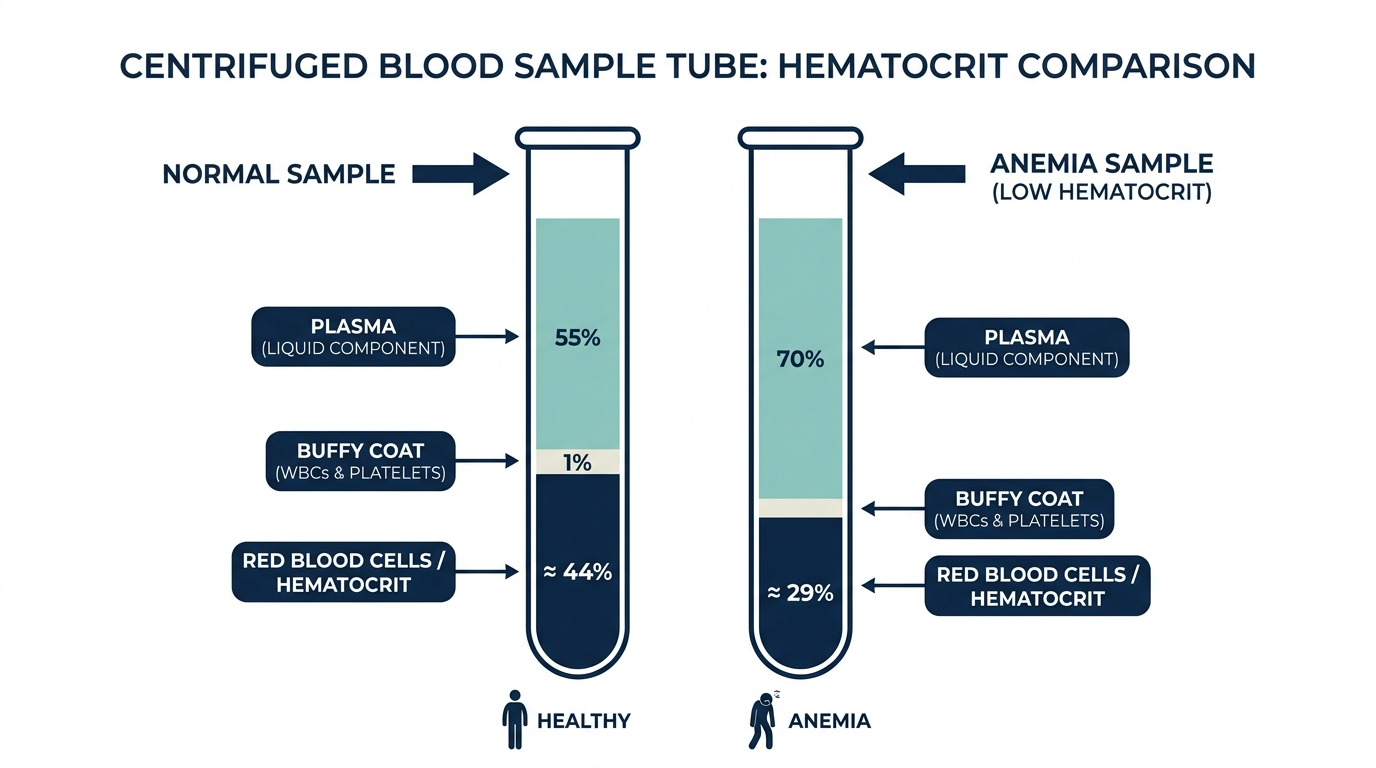
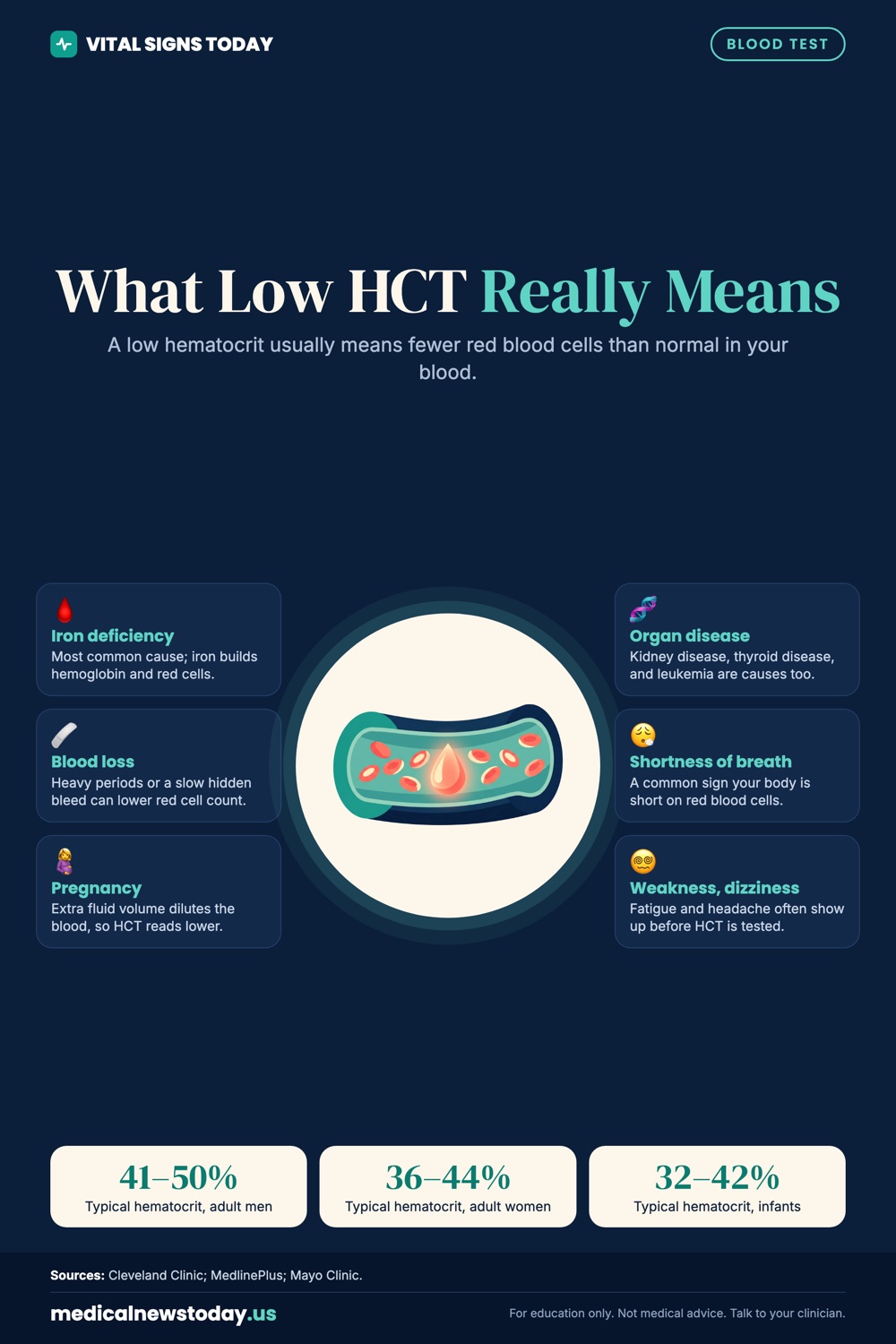
HCT stands for hematocrit, and it measures the percentage of your blood made up of red blood cells. A low HCT means a smaller-than-expected share of your blood is red cells, which most often points to anemia, meaning your body does not have enough healthy red blood cells to carry oxygen the way it should (MedlinePlus). It is reported automatically as part of a complete blood count (CBC), the most common blood panel ordered.
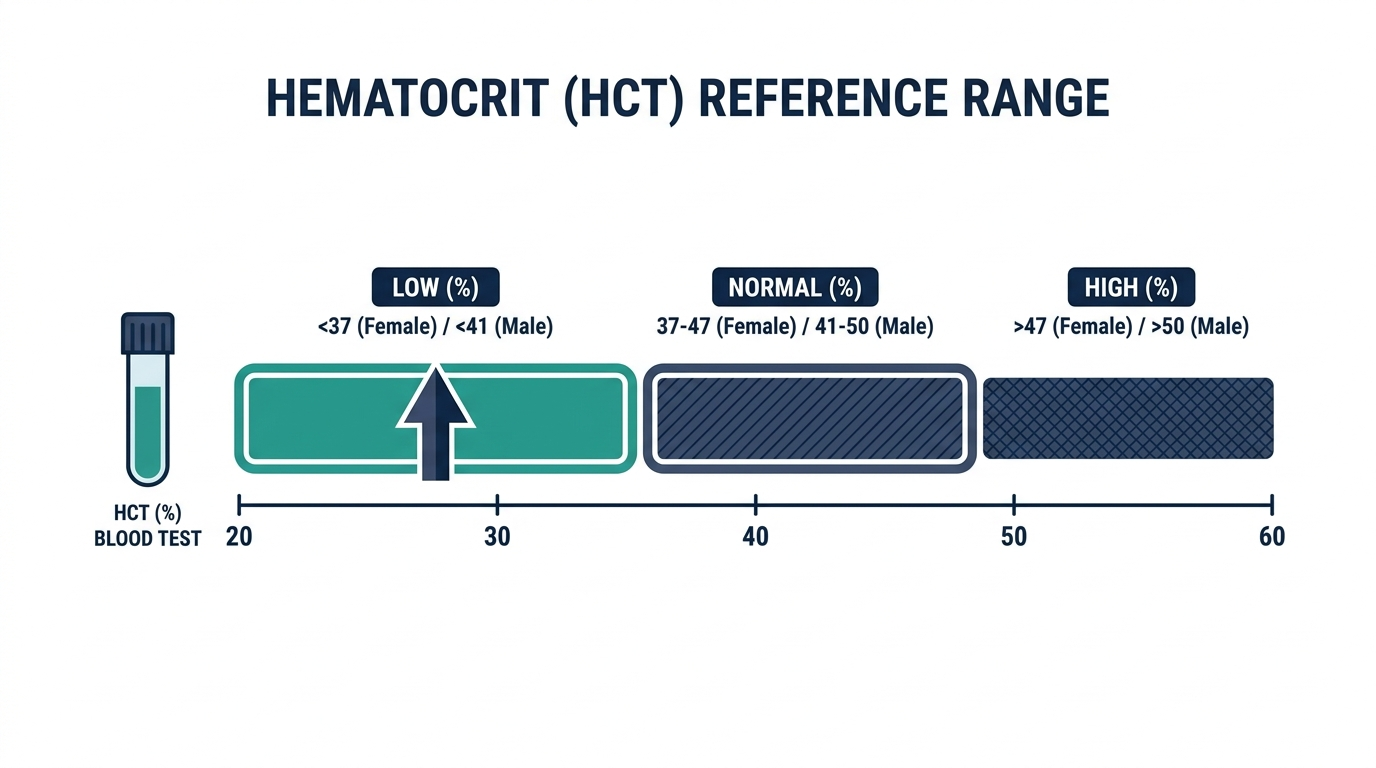
What counts as low depends on who you are. Normal hematocrit runs roughly 41 to 50 percent for adult men and 36 to 44 percent for adult women, with different ranges for infants and newborns (Cleveland Clinic). Anything below the bottom of your lab’s printed range is flagged as low. The single most useful move you can make is to compare your result to the reference range on your own report, because the cutoff shifts by lab, instrument, age, and sex.
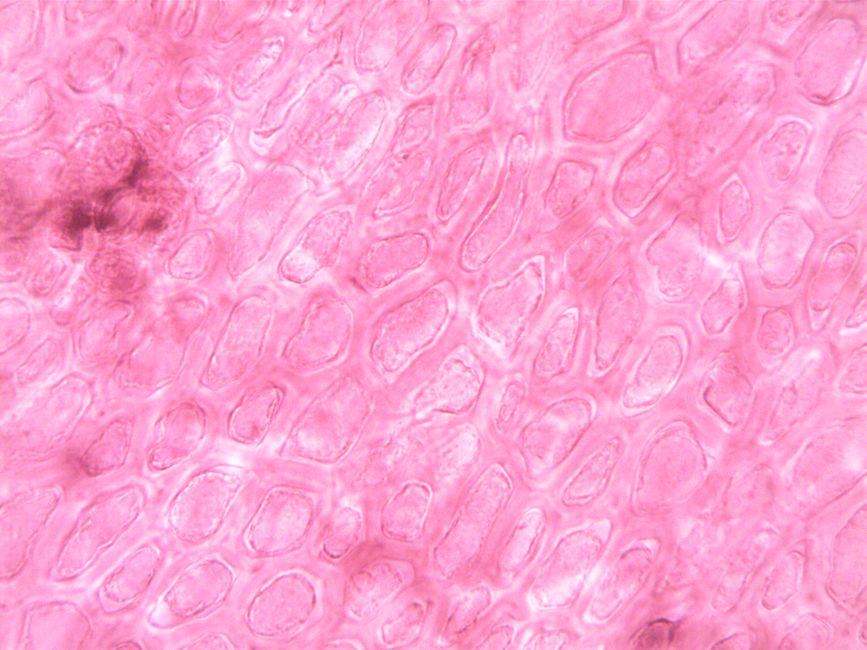
In plain terms: think of your blood as a glass of layered liquid. Hematocrit is how much of that glass is packed red cells versus clear plasma. A low HCT means the red cell layer is thinner than it should be.
What causes a low HCT?
A low HCT is a finding, not a diagnosis. The job is to figure out why, and the differential is shorter than the internet makes it feel. Here are the real causes, most common first (MedlinePlus, Cleveland Clinic):
- Iron deficiency. By far the most frequent cause. Without enough iron, your body cannot build hemoglobin, the oxygen-carrying protein inside red cells, so red cell numbers fall (Mayo Clinic).
- Blood loss. Obvious sources like injury or surgery, but also quiet ones: heavy menstrual periods, a slow bleed in the stomach or colon, or even frequent blood donation. Heavy periods are a leading reason younger women run low (Mayo Clinic).
- Vitamin B12 or folate deficiency. Both are required to manufacture red cells. Run low and production stalls.
- Chronic disease and inflammation. Long-running conditions, including kidney disease and thyroid disease, can suppress red cell production (Cleveland Clinic). Failing kidneys make less erythropoietin, the hormone that tells marrow to build red cells.
- Bone marrow problems. Less common but more serious: leukemia, lymphoma, multiple myeloma, or marrow suppression from chemotherapy or radiation can shut down red cell production at the source (MedlinePlus).
- Dilution. Pregnancy and overhydration increase the fluid part of your blood, so the red cell percentage drops even when the actual cell count is fine (MedlinePlus). This is a real low HCT, but not a disease.
Notice the spread. Most low HCT results trace back to iron, blood loss, or a vitamin gap. The scary causes are real but rare, and they almost never show up as an isolated low HCT with everything else normal.
What are the symptoms of a low HCT?
A mildly low HCT often causes no symptoms at all. Many people find out only because a routine CBC flagged it. Your body is good at compensating for a slow decline, which is exactly why anemia can sneak up on you (Mayo Clinic).
As HCT falls further and less oxygen reaches your tissues, symptoms appear and worsen with the drop:
- Fatigue and weakness, the most common and earliest complaint (Cleveland Clinic)
- Shortness of breath, especially with exertion
- Pale skin, and cold hands and feet
- Dizziness or lightheadedness
- A fast or pounding heartbeat, and sometimes chest pain (Mayo Clinic)
The pattern matters more than any single symptom. Anemia symptoms are about oxygen delivery, so they tend to cluster: tired plus breathless plus pale is a more meaningful signal than fatigue alone, which can mean a hundred things.
When is a low HCT dangerous or a medical emergency?
Most low HCT results are mild and managed in an unhurried clinic visit. But there is a point where low becomes urgent, and it is worth knowing where that line sits.
Severity is judged more by hemoglobin (which moves in lockstep with HCT) and by symptoms than by the HCT number alone. In hospitalized adults, current transfusion guidelines generally hold off on red cell transfusion until hemoglobin drops below about 7 g/dL, which corresponds to a hematocrit in the low 20s percent, and use a slightly higher threshold near 8 g/dL for people with established heart disease (PMC, How I treat anemia with transfusion). That gives you a rough sense of where clinicians consider anemia severe.
Seek urgent or emergency care, regardless of the exact number, if a low HCT comes with any of these:
- Chest pain, severe shortness of breath, or a racing heart at rest
- Fainting, confusion, or feeling like you might pass out
- Signs of active bleeding: vomiting blood, black or tarry stools, bright red blood in stool, or very heavy menstrual bleeding
- A HCT that has dropped fast over days, especially after surgery, injury, or childbirth
The speed of the drop matters as much as the depth. A person whose HCT slid slowly over months can feel surprisingly functional at a low number, while a fast bleed to the same level can be a true emergency because the body never had time to adapt.

What should you do about a low HCT?
Do not start iron pills the moment you see a low number. That is the most common self-inflicted mistake, and taking iron you do not need can build up and damage your liver and other organs (Mayo Clinic). The right sequence is to find the cause first.
Here is the practical path:
- Read the rest of the CBC. A low HCT almost never travels alone. Look at hemoglobin (it tracks HCT), MCV (average red cell size), and RDW (size variation). Small cells point toward iron deficiency; large cells point toward B12 or folate.
- Expect follow-up tests. The standard next step for suspected iron deficiency is a ferritin and iron studies panel. Your clinician may also check B12, folate, kidney function, and thyroid depending on the picture.
- Look for a bleeding source. If iron is low without an obvious cause, a clinician will ask about periods and may screen for gastrointestinal blood loss. This step is where serious causes get caught early.
- Treat the cause, not the number. Iron-deficiency anemia is corrected with iron replacement and by fixing the source of loss. A vitamin deficiency is corrected with that vitamin. Dilutional drops from pregnancy resolve on their own.
- Recheck. After treatment, a repeat CBC confirms the HCT is climbing back. Recovery is gradual, not overnight.
When should you see a doctor?
If your lab flagged a low HCT, bring it to a healthcare professional rather than diagnosing yourself, even if you feel fine (Mayo Clinic). A single mildly low value with no symptoms is usually a routine appointment, not an alarm.
Move faster if you have symptoms that are progressing, if the low HCT is new compared to past results, if you have any sign of bleeding, or if you are pregnant and the drop is steeper than expected. And as covered above, the red-flag symptoms of chest pain, fainting, confusion, or visible blood loss mean same-day care.
The insider read: the trap of the falsely low HCT
Here is the nuance that gets missed even by people who think they understand their own labs. A low HCT on paper does not always mean your body is short on red cells. Hematocrit is a percentage, and a percentage can fall two completely different ways: fewer red cells, or more plasma diluting them.
That distinction changes everything. Pregnancy is the textbook example. Blood volume expands so much that the red cell percentage drops even though red cell production is normal or even increased (MedlinePlus). The same dilution effect shows up with aggressive IV fluids in the hospital or simple overhydration. This is sometimes called pseudoanemia, and treating it with iron would be chasing a number that is not telling you what it appears to.
The reverse trap is just as real. Someone who is dehydrated can show a normal or even high HCT that masks a true anemia, because the plasma has been concentrated. Rehydrate them and the real, lower number appears. This is why a clinician will not act on one HCT in isolation. They read it next to your hydration status, your hemoglobin, your MCV and RDW, and ideally a prior result for comparison. One number out of context lies more often than people expect, and the most common misread of a low HCT is forgetting to ask whether it is a red cell problem or a water problem.

Using MCV and RDW to classify the anemia
Here is the trick clinicians use to narrow the cause of a low HCT in seconds, using two numbers that sit right next to it on the same CBC. Red cell size is the fastest sorting tool in all of anemia workup.
MCV, the mean corpuscular volume, is the average size of your red blood cells. It splits anemia into three families:
- Low MCV (microcytic, small cells). The cells are small and pale. This overwhelmingly points to iron deficiency, and less often to thalassemia, a genetic condition. Iron deficiency is the single most common cause of a low HCT, so a small-cell anemia is the most common picture of all.
- Normal MCV (normocytic). The cells are normal-sized but there are too few. This fits anemia of chronic disease, kidney disease, acute blood loss before iron stores run down, and early marrow problems.
- High MCV (macrocytic, large cells). The cells are oversized. This points toward vitamin B12 or folate deficiency, and can also reflect alcohol use, certain medications, or thyroid and liver disease.
RDW, the red cell distribution width, measures how much the cell sizes vary. A high RDW means a mix of sizes, which typically appears early in iron deficiency and in mixed deficiencies. It helps separate iron deficiency, which usually raises RDW, from thalassemia trait, where the cells are uniformly small and the RDW often stays normal.
The panel that surrounds a low HCT
A low HCT should never be read as a lone number. These are the companions a clinician checks to build the full picture.
| Test | What it adds to a low HCT |
|---|---|
| Hemoglobin | Moves in lockstep with HCT and is the value transfusion decisions are actually based on. |
| MCV and RDW | Sort the anemia by cell size and variation, pointing toward iron, B12/folate, or chronic disease. |
| Ferritin and iron studies | The key test for iron deficiency. Low ferritin is the most specific sign that iron stores are depleted. |
| Vitamin B12 and folate | Ordered when the cells are large, to confirm a vitamin cause. |
| Reticulocyte count | Shows whether the marrow is responding. A low count with anemia suggests a production problem, a high count suggests loss or destruction with the marrow trying to catch up. |
| Creatinine and eGFR | Failing kidneys make less erythropoietin, a common cause of chronic anemia. |
| TSH (thyroid) | Both underactive and overactive thyroid can affect red cell production. |
Want to check your hematocrit?
Three ways to get it measured. Pick whichever fits you.
Affiliate links: we may earn a commission at no extra cost to you. A lab test does not replace a visit with your clinician.
Reading the pattern: worked scenarios
- Low HCT, low MCV, high RDW, low ferritin, heavy periods. The textbook iron-deficiency anemia. Treatment is iron replacement plus addressing the blood loss.
- Low HCT, high MCV, low B12. A vitamin-driven anemia. Replacing B12 corrects it, and the cause of the deficiency, such as poor absorption, needs a look.
- Low HCT, normal MCV, known kidney disease. Fits anemia of chronic disease from reduced erythropoietin. Managed alongside the kidney disease.
- Low HCT and hemoglobin in a pregnant person, red cell indices normal. Often dilutional pseudoanemia from expanded blood volume, though true iron deficiency is also common in pregnancy and worth confirming.
- Low HCT that dropped fast after surgery, with a low blood pressure and fast heart rate. Suggests acute blood loss and is an urgent situation.

How the test is done and what can skew it
Hematocrit comes from a routine CBC drawn from a vein, and no fasting is needed. A few practical factors change the number without any change in your actual red cell mass:
- Hydration. Dehydration concentrates the blood and can hide a true anemia, while overhydration and IV fluids dilute it and can create a falsely low reading.
- Body position and tourniquet time. Prolonged tourniquet application can slightly concentrate the sample.
- Recent large fluid shifts, such as after heavy exercise with sweating, or a recent transfusion, which changes the value directly.
- Living at high altitude, which raises baseline HCT over time, so a “normal” value there differs from sea level.
Because of this, the most reliable read comes from comparing your HCT to your own past results and to your hemoglobin and red cell indices, rather than reacting to a single flagged percentage.
Common misconceptions about a low HCT
- “Low HCT always means I need iron.” Only if iron deficiency is the cause. Large-cell anemia needs vitamins, chronic-disease anemia needs the underlying condition treated, and dilutional drops need nothing. Taking iron you do not need can be harmful.
- “A low number means something serious.” Most low HCT results trace to iron, blood loss, or a vitamin gap, all treatable. Marrow disease is real but rare and rarely shows up as an isolated low HCT.
- “HCT and hemoglobin are different tests I should compare against each other.” They measure related things and move together. A mismatch usually reflects lab or hydration effects, not two separate problems.
- “If I feel fine, the low HCT does not matter.” Slow anemia is often symptomless because the body adapts. It still deserves a workup to find the cause.
- “I can fix it with diet alone.” Diet helps prevent deficiency, but an established iron or B12 deficiency, or an active bleed, usually needs targeted treatment and a search for the source.
Who should have HCT checked, and how often
Hematocrit is part of the CBC, one of the most commonly ordered blood tests, so most adults have it measured at routine visits. Closer monitoring is warranted in specific situations.
- People with heavy menstrual periods, who are at high risk of iron deficiency.
- Those with chronic kidney disease or chronic inflammatory conditions, where anemia is tracked over time.
- Pregnant people, who are screened for anemia during pregnancy.
- Anyone with symptoms of anemia, such as fatigue, breathlessness, and pallor.
- People with a prior low HCT, who need a repeat after treatment to confirm recovery, since the climb back to normal is gradual.
The unifying idea is that a low HCT is the beginning of a question, not the end of one. Read it with hemoglobin, MCV, RDW, and ferritin, and against your own past results, and the number tells you not just that you may be anemic, but why, which is what actually guides treatment.
Frequently asked questions
What does a low HCT mean on a blood test?
A low HCT means a smaller-than-normal percentage of your blood is made up of red blood cells, which usually points to anemia (MedlinePlus). It is a finding rather than a diagnosis, and the cause is most often iron deficiency, blood loss, or a vitamin deficiency. Compare your result to the reference range on your own report.
What HCT level is considered low?
It depends on age and sex. Normal hematocrit is roughly 41 to 50 percent for adult men and 36 to 44 percent for adult women, so anything below your lab’s printed range counts as low (Cleveland Clinic). A hematocrit in the low 20s percent generally reflects severe anemia.
What is the most common cause of a low HCT?
Iron deficiency is the most common cause, because iron is needed to build hemoglobin and red blood cells (Mayo Clinic). Blood loss, including from heavy periods or a slow gastrointestinal bleed, and vitamin B12 or folate deficiency are the next most frequent.
Can a low HCT be wrong or misleading?
Yes. Because hematocrit is a percentage, it can fall simply from extra fluid diluting the blood, as in pregnancy or overhydration, even when red cell production is fine (MedlinePlus). Dehydration can do the opposite and hide a true anemia, which is why one HCT is read in context.
When is a low HCT an emergency?
Seek urgent care if a low HCT comes with chest pain, severe breathlessness, fainting, confusion, or signs of active bleeding such as black stools or vomiting blood. In hospitalized patients, anemia is generally considered severe when hemoglobin falls below about 7 g/dL (PMC, How I treat anemia with transfusion).
This article is for general educational purposes and is not medical advice. It cannot diagnose or treat you and does not replace your clinician. Always discuss your lab results and any health decisions with a qualified healthcare professional.
Vital Signs Today may earn a commission if you buy through links on this page. It does not affect our editorial assessments.