If your lab report flags a C-reactive protein (CRP) result on the low side, your first instinct may be worry. In reality, a low CRP is almost always the result you want. Here is what the number actually tells you, when it matters, and the one situation where a low reading deserves a second look.
- A low CRP blood test means your body shows little to no active inflammation, and any value under 0.9 mg/dL (or under 3 mg/L) is considered normal, so there is no clinically harmful “too low” CRP (Cleveland Clinic, MedlinePlus).
- For heart risk, a high-sensitivity CRP (hs-CRP) below 1 mg/L places you in the lowest cardiovascular risk group, which is the desirable target (AHA/CDC).
- A low CRP is reassuring on its own, but because CRP is nonspecific it cannot rule out every illness, so it must be read alongside your symptoms and other tests.
Part of our Inflammation Blood Tests guide.
A low CRP is the result you want. See it alongside 100+ other markers for the full picture. One at-home Superpower draw checks 100+ biomarkers, physician-reviewed.
What does a low CRP result mean and what is the cutoff?
A low CRP result means there is little measurable inflammation in your body, and this is the normal, healthy state. Cleveland Clinic states the normal CRP level is less than 0.9 mg/dL, and because healthy people sit at or below this value, there is no clinically significant “low” result to fear. In many labs the standard CRP reference range is reported as under 3 mg/L, with most healthy adults under 0.3 mg/dL (MedlinePlus, StatPearls).
The important distinction is which test you had. Standard CRP detects larger swings tied to infection or injury. High-sensitivity CRP (hs-CRP) is calibrated to read the very low end for heart risk. A low number on either test points the same direction: your inflammatory signal is quiet.
Standard CRP: normal is under 0.9 mg/dL, or under 3 mg/L in many labs.
hs-CRP: under 1 mg/L is the low cardiovascular risk band (AHA/CDC).

What causes a low CRP level?
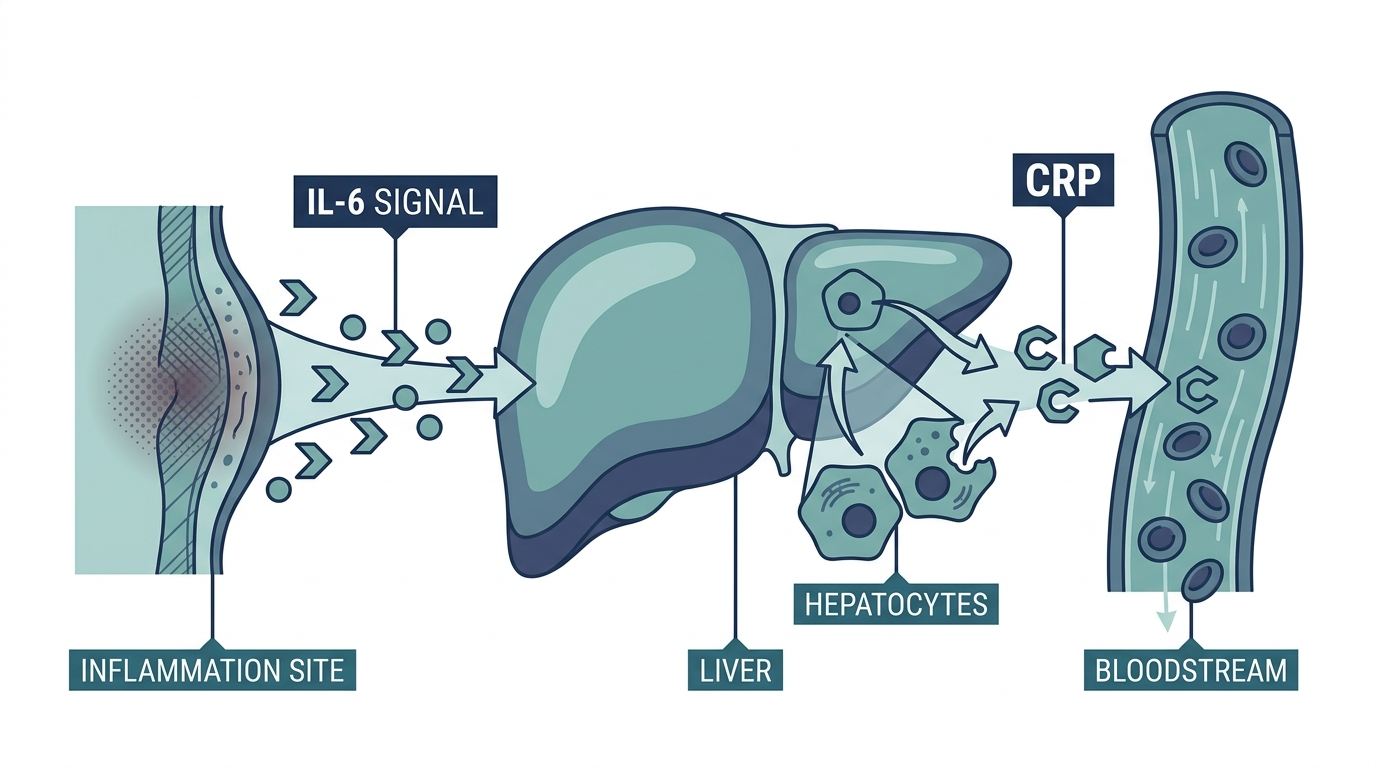
A low CRP is most often caused by the simple absence of active inflammation, meaning no significant infection, tissue injury, or inflammatory flare is present at the time of the draw. CRP is made by the liver in response to inflammatory signals, so when those signals are absent the level stays at baseline, typically under 1 mg/L on a sensitive assay (StatPearls, MedlinePlus).
Common reasons your CRP reads low:
- No current inflammation: the healthiest and most common explanation.
- Successful treatment: if a previous CRP was high, a now-low value suggests inflammation is resolving or therapy is working (Cleveland Clinic).
- Lifestyle factors: regular physical activity, not smoking, and a normal body weight are associated with lower baseline CRP.
- Certain medications: statins and some anti-inflammatory drugs can lower CRP.
A genuinely “abnormally low” CRP is not a recognized medical condition, so doctors do not chase low numbers the way they investigate high ones.
What are the symptoms of a low CRP, or is it silent?
A low CRP produces no symptoms at all, because it simply reflects the absence of inflammation rather than a disease state. CRP is a marker, not a hormone or nutrient, so there is nothing for a low level to cause. You will not feel a low CRP the way you might feel low iron or low blood sugar.
This matters for interpretation. People often expect every lab abnormality to come with a feeling, but a low CRP is, in effect, the lab quietly telling you that one specific alarm system is not going off. If you feel well and your CRP is low, the two findings agree. If you feel genuinely unwell yet your CRP is low, that mismatch is the cue to look further rather than to celebrate the number, since some serious conditions do not raise CRP.
When is a low CRP dangerous?
A low CRP is essentially never dangerous in itself, and a value under 1 mg/L on hs-CRP is the lowest cardiovascular risk category according to AHA/CDC criteria. The risk is not from the low number but from over-trusting it. Because CRP is a nonspecific marker, a normal or low result does not guarantee you are free of disease (StatPearls).
The scenario to respect is a low CRP alongside concerning symptoms. CRP can stay near baseline early in some infections, in localized problems, in many viral illnesses, and in certain conditions that do not strongly trigger the liver’s inflammatory response. So a low CRP should reassure, not silence, clinical judgment.
Treat a low CRP as a green light only when it lines up with how you feel. Persistent fever, unexplained weight loss, severe pain, or new neurological symptoms still warrant evaluation regardless of a calm CRP.

What should you do next, and when should you see a doctor?
If your CRP is low and you feel well, the usual next step is nothing, since a low CRP under 1 mg/L (hs-CRP) is a desirable, reassuring result (AHA/CDC). Note the value, keep it for trend comparison, and continue routine care. There is no treatment for a low CRP.
Practical next steps:
- If tracking heart risk: a low hs-CRP supports a low-inflammation profile; combine it with blood pressure, lipids, and glucose for the full picture.
- If monitoring a known condition: a falling CRP toward the low range is a sign treatment is working (Cleveland Clinic).
- If you still feel sick: tell your clinician, because a low CRP does not rule out illness and other tests may be needed.
See a doctor when symptoms and labs disagree, when a fever or pain persists, or when you simply want help interpreting the result in context.
The insider nuance: a low CRP can hide behind a flawed sample
Here is what experienced clinicians watch for: a low CRP is meaningful only if the right test was ordered and timed well. Ordering a standard CRP when you actually need cardiovascular risk stratification can mask useful detail, because standard assays are not built to discriminate at the low end the way hs-CRP is, where the 1 mg/L threshold lives (AHA/CDC, Medscape).
Timing matters too. CRP rises within roughly 6 to 8 hours of an inflammatory trigger and peaks around 48 hours (StatPearls). A blood draw taken very early in an acute illness can show a deceptively low CRP simply because the liver has not ramped up yet. In that window, a “low” result is a snapshot, not the whole movie. When the clinical suspicion is high, doctors often repeat the test or pair it with other markers rather than rest on a single low reading.
What CRP actually is, and why the liver makes it
Understanding what CRP is makes every result easier to read. C-reactive protein is what clinicians call an acute-phase reactant, a substance the liver produces and releases into the blood in response to inflammatory signals, chiefly a messenger called interleukin-6 that immune cells send out during infection or tissue injury. When those signals are present, the liver ramps up CRP within hours. When they fade, CRP falls again, because the protein has a relatively short life in the blood.
This biology explains why a low CRP is the resting, healthy state rather than a deficiency. There is nothing for the body to store or run short of. CRP is simply a signal that rises and falls with inflammation, so a low value means the signal is quiet. It also explains why CRP is so useful for tracking: because it responds and clears quickly, a series of CRP measurements can show whether an inflammatory problem is getting better or worse over days, which slower markers cannot do as nimbly.

Standard CRP versus hs-CRP: reading the right test
One of the most common sources of confusion is that CRP is measured two ways for two different purposes. They use the same protein but are calibrated and interpreted differently.
| Standard CRP | High-sensitivity CRP (hs-CRP) | |
|---|---|---|
| Main purpose | Detect and monitor infection, injury, and inflammatory flares | Assess long-term cardiovascular risk |
| Range it reads best | Larger elevations tied to active illness | The very low end, where small differences matter |
| Typical normal | Under about 3 mg/L (under 0.9 mg/dL) | Under 1 mg/L is the low-risk band |
| When it is ordered | You feel sick, or a known inflammatory condition is being tracked | You are stratifying heart risk while otherwise well |
For cardiovascular risk, the American Heart Association and CDC describe three hs-CRP bands: under 1 mg/L is low risk, 1 to 3 mg/L is average risk, and over 3 mg/L is higher risk. A low hs-CRP therefore signals a quiet, low-grade inflammatory background, which is one favorable piece of the larger heart-risk puzzle alongside blood pressure, cholesterol, and blood sugar. The practical lesson is to make sure the test ordered matches the question, since a standard CRP is not designed to discriminate finely at the low end where heart-risk decisions live.
Other inflammation markers read alongside CRP
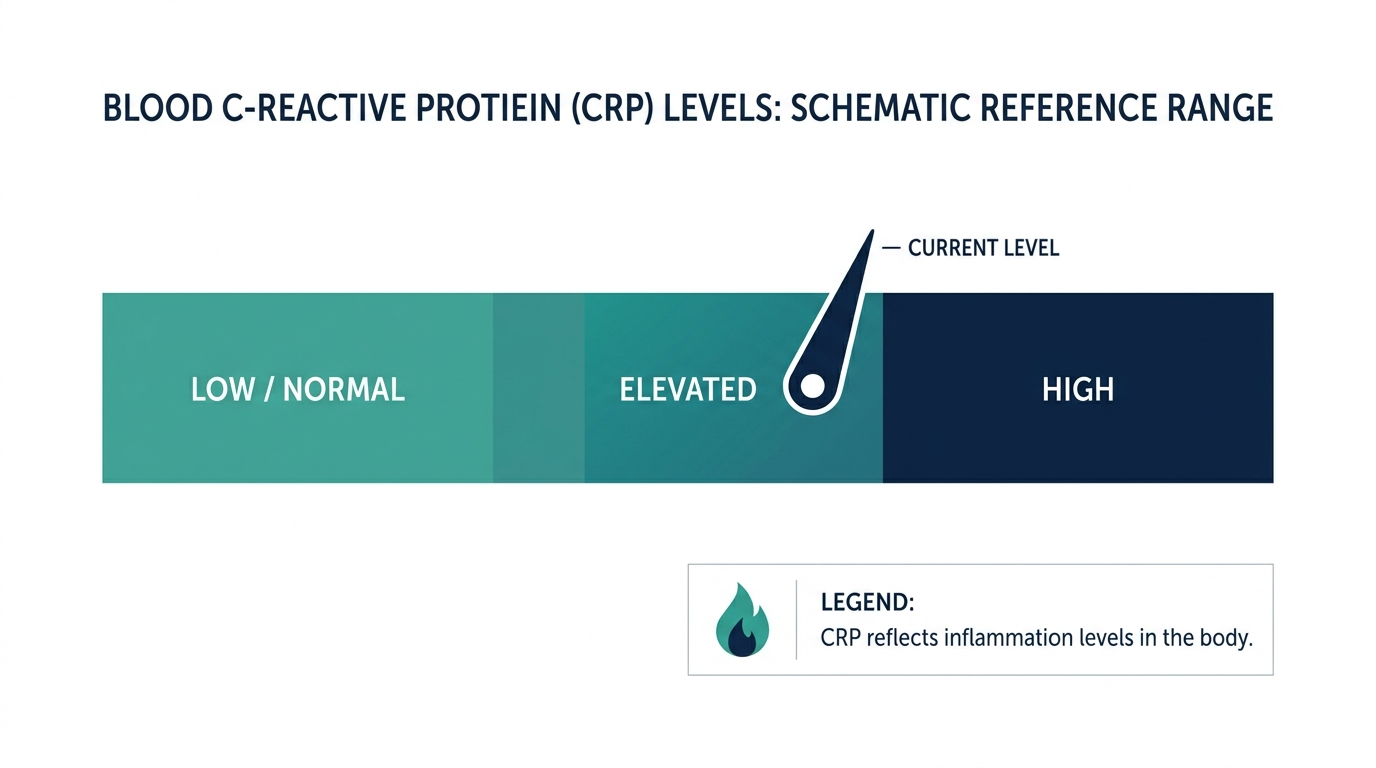
CRP is rarely the only inflammation marker a clinician considers, and knowing its companions clarifies what a low CRP does and does not tell you.
- ESR (erythrocyte sedimentation rate): an older, slower marker of inflammation. It rises and falls more gradually than CRP, so the two can disagree in timing. A low CRP with a high ESR, or the reverse, sometimes reflects where you are in the course of an illness.
- Ferritin: although best known as an iron marker, ferritin is also an acute-phase reactant that climbs with inflammation, which is why it is interpreted cautiously when inflammation is present.
- White blood cell count: a rise can accompany infection or inflammation, complementing CRP in building a picture.
The takeaway is that a low CRP is one instrument in a small orchestra. When it agrees with a normal ESR, a normal white count, and how you feel, the reassurance is strong. When markers disagree, that mismatch is a clue for a clinician to look at timing and context rather than trust any single value.
Situations where CRP can stay low despite real disease
Because CRP is nonspecific, a low value cannot rule out every problem, and it is worth knowing the specific situations where this matters most. These are the cases where a reassuring number can be misleading if taken alone.
- Very early in an acute illness: CRP takes roughly 6 to 8 hours to begin rising and peaks around 48 hours, so a draw taken in the first hours of an infection can read deceptively low.
- Some viral infections: many viral illnesses trigger less of a CRP rise than bacterial ones, so a modest or low CRP does not exclude a viral cause of symptoms.
- Localized problems: a small, walled-off or localized issue may not release enough inflammatory signal to move CRP much.
- Conditions that do not strongly drive the liver’s acute-phase response: not every disease raises CRP, so certain chronic or non-inflammatory conditions can coexist with a normal value.
None of this diminishes the value of a low CRP. It simply means the number is read alongside symptoms. If you feel genuinely unwell and your CRP is low, that disagreement is the signal to keep looking, not to stop.
How to keep your baseline CRP low
Because a low CRP reflects a low-inflammation lifestyle, the habits that keep it low are the familiar pillars of cardiovascular and metabolic health, and they work through reducing chronic, low-grade inflammation over time.
- Move regularly: consistent physical activity is associated with a lower baseline CRP, likely by improving body composition and metabolic health.
- Do not smoke: smoking drives systemic inflammation, and not smoking is linked with lower CRP.
- Maintain a healthy weight: excess body fat, especially around the abdomen, is a source of inflammatory signaling, so weight management tends to lower CRP.
- Manage metabolic conditions: keeping blood sugar and blood pressure in range reduces chronic inflammatory drive.
- Consider prescribed medications: some drugs such as statins can lower CRP, but these are decisions for your clinician, not a reason to self-treat a number.
Rather than chasing the CRP value itself, the goal is the healthy pattern that produces a low CRP naturally. A low reading is best seen as a byproduct of good overall health, not a target to game.
Who benefits most from an hs-CRP test
Not everyone needs an hs-CRP, and a low result is most useful for specific people. It tends to add the most value when it helps refine an already uncertain picture of heart risk.
- People at intermediate cardiovascular risk: when standard risk factors leave the decision borderline, a low hs-CRP can support a lower-risk interpretation, while a higher value may tip toward more aggressive prevention.
- People tracking the effect of lifestyle change: a baseline hs-CRP followed by a repeat after months of exercise, weight change, or quitting smoking can show whether chronic inflammation is trending down.
- People on therapy that affects inflammation: a falling CRP can be one signal that treatment is working, when interpreted by the clinician who ordered it.
For a healthy person with no risk factors, a low hs-CRP is simply confirmation of a quiet inflammatory background. It is reassuring, but it is one input among several, and it should be read next to blood pressure, lipids, and glucose rather than in isolation.
The bottom line on a low CRP
A low CRP is almost always the result you want. It reflects little to no active inflammation, which is the normal, healthy state, and there is no recognized harmful condition of having CRP too low. On the high-sensitivity version, a value under 1 mg/L places you in the lowest cardiovascular risk band, a genuinely favorable finding. Doctors do not treat or chase low CRP numbers the way they investigate high ones.
The one caveat worth carrying is that CRP is nonspecific, so a low value cannot rule out every illness on its own. When a low CRP matches how you feel, treat it as the green light it is. When you feel unwell despite a calm CRP, or when the test was drawn very early in an illness, let symptoms and clinical judgment lead, and talk with your clinician about whether a repeat test or additional markers make sense. Read in context, a low CRP is one of the quieter pieces of good news a lab report can deliver.
Questions patients most often ask about a low CRP
A low CRP is one of the more reassuring lines on a report, yet the same questions come up every time it appears. Answering them plainly settles most of the uncertainty.
- “Does a low CRP mean I have no inflammation anywhere?” Not quite. CRP reflects system-wide inflammation the liver responds to, so a low value means little active inflammation of that kind. A localized or very low-grade process can still exist without lifting a standard CRP, which is one reason CRP is read alongside symptoms rather than alone.
- “Can a low CRP falsely reassure me?” Occasionally. Timing matters, because CRP rises hours after inflammation begins and falls as it resolves, so a sample drawn too early or after recovery can read low even when something was recently active. Context and repeat testing guard against this.
- “Should I use standard CRP or hs-CRP?” It depends on the question. A standard CRP is aimed at detecting active inflammation or infection, while the high-sensitivity version, hs-CRP, is used to stratify long-term cardiovascular risk at much lower concentrations. Ordering the wrong one is a common mix-up.
- “Do I need to do anything about a low result?” Generally no. A low CRP is the normal, healthy state and is not something you treat. It is most useful as a baseline you can compare future results against.
The unifying answer is that a low CRP is good news read in context. It tells you there is little system-wide inflammation at the moment of the draw, but it is most powerful next to your symptoms, the right version of the test, and your own prior values. Used that way, a low CRP becomes a genuine baseline rather than a single reassuring number in isolation.
Don’t just read about your health, track it.
A single result is a snapshot. Superpower re-tests 100+ markers over time so you can watch them move as you change sleep, food, and training.
Frequently asked questions
Is a low CRP level good or bad?
A low CRP is generally good. It means little to no active inflammation, which is the normal, healthy state. Any value under 0.9 mg/dL is considered normal, and on hs-CRP, under 1 mg/L is the lowest cardiovascular risk band (Cleveland Clinic, AHA/CDC).
Can CRP be too low?
No. There is no recognized “too low” CRP and no associated condition. Because healthy people normally sit at the bottom of the range, doctors do not treat or investigate a low CRP the way they do a high one (Cleveland Clinic).
Does a low CRP mean I do not have an infection?
Not always. A low CRP usually means no active inflammation, but CRP is nonspecific and can stay low early in an illness or in some viral and localized infections. If you feel unwell, tell your clinician despite a low result (StatPearls).
What is a good hs-CRP number for heart health?
Under 1 mg/L is the desirable, low cardiovascular risk category. Levels of 1 to 3 mg/L are average risk, and over 3 mg/L is higher risk, per AHA and CDC criteria (AHA/CDC).
How can I keep my CRP low?
Lower baseline CRP is associated with regular physical activity, not smoking, maintaining a healthy weight, and managing conditions like diabetes. Some medications, such as statins, can also reduce CRP. Discuss specifics with your clinician (MedlinePlus).
Sources
- Cleveland Clinic, C-Reactive Protein (CRP) Test
- MedlinePlus, C-Reactive Protein (CRP) Test
- StatPearls (NCBI), C-Reactive Protein: Clinical Relevance and Interpretation
- Medscape, High-Sensitivity C-Reactive Protein: Reference Range
- American Heart Association, Circulation: C-Reactive Protein
This article is for general educational purposes and is not medical advice. It cannot diagnose or treat you and does not replace your clinician. Always discuss your lab results and any health decisions with a qualified healthcare professional.
Related: compare the best at-home biomarker and blood tests.
Vital Signs Today may earn a commission if you buy through links on this page. It does not affect our editorial assessments.