Part of our Inflammation Blood Tests guide.
Your doctor orders a round of blood work, and tucked among the familiar tests is one labeled ESR, or sometimes “sed rate.” There is no single disease it points to, no neat target number you are supposed to hit, and the result can swing for reasons that have nothing to do with anything serious. That vagueness is exactly why so many people quietly ignore it.
ESR is an old marker that flags inflammation without naming the cause. Want a panel that digs deeper? One at-home Superpower draw checks 100+ biomarkers, physician-reviewed.
That is a mistake. ESR is one of the oldest blood tests still in routine use, and in the right context it can be the first hint that something inflammatory is brewing long before you feel sick. Used well, it is a smoke detector. Used badly, it is just noise. Knowing the difference is the whole game.
What is an ESR blood test?
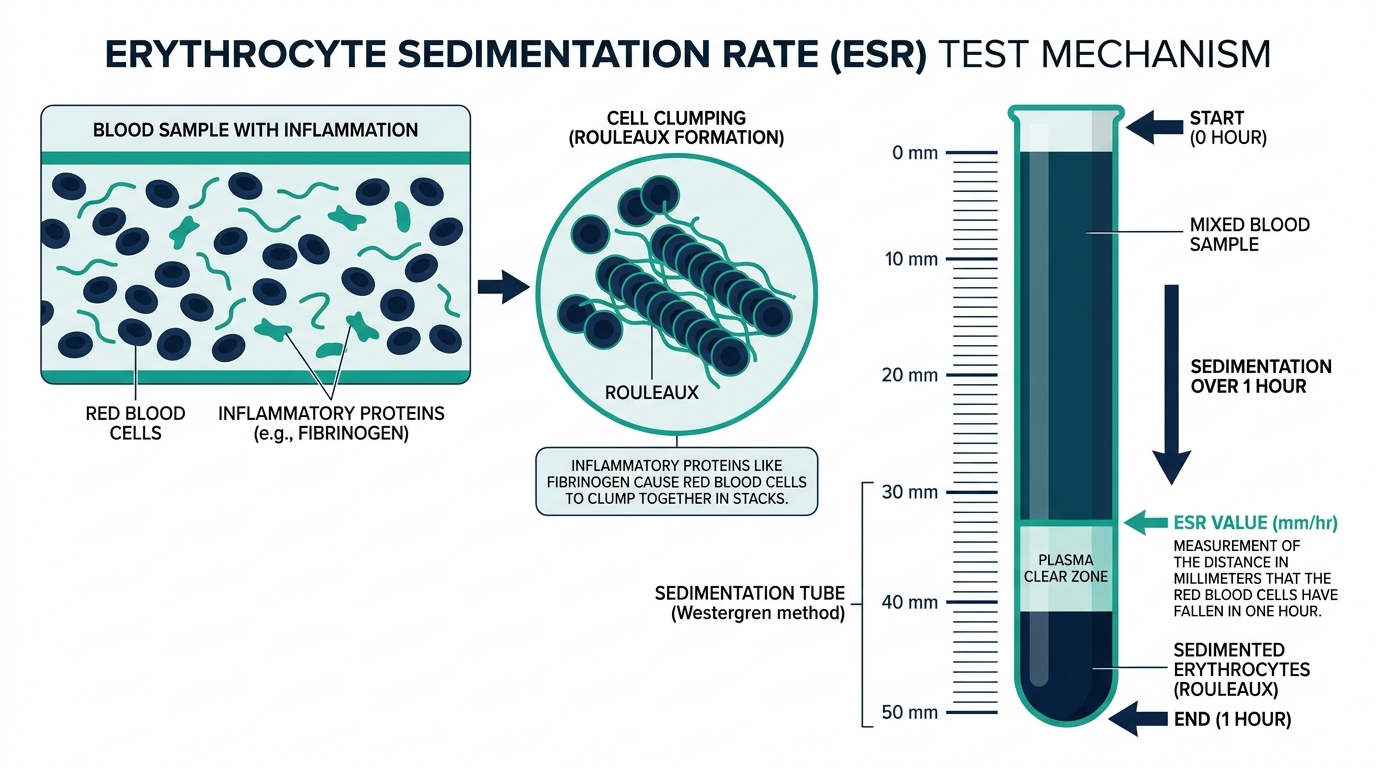
An ESR blood test, short for erythrocyte sedimentation rate, measures how quickly your red blood cells settle to the bottom of a thin tube over one hour. It is a simple, indirect way to detect inflammation somewhere in your body (Cleveland Clinic). The result is reported in millimeters per hour, written as mm/hr, which is literally how far the cells fell in sixty minutes.
The physics behind it is clever. When inflammation is present, your liver pumps out extra proteins, especially fibrinogen, that make red blood cells stick together in stacks called rouleaux. Heavier stacks sink faster than single cells, so a faster fall, and therefore a higher number, signals more inflammation (StatPearls, NCBI Bookshelf). So when someone asks what is the esr in blood test terms, the short answer is this: it is a sinking-speed test that doubles as an inflammation gauge.

What does an ESR test measure, exactly?
It measures sedimentation speed, not any specific molecule or disease. Blood is drawn, placed upright in a calibrated Westergren tube, and after one hour a technician reads how many millimeters of clear plasma sit above the settled red cells (StatPearls, NCBI Bookshelf). The bigger that clear gap, the higher your ESR.
This is why the test is called nonspecific. A high ESR tells you inflammation is likely present, but not where it is or what is causing it (MedlinePlus). Infections, autoimmune disease, anemia, even pregnancy or older age can all push the number up. ESR answers the question “is there a fire?” and leaves “where” and “why” to other tests. Anyone searching for what is an esr blood test should anchor on that one idea: it is a screening signal, never a verdict.
What is a normal ESR level?
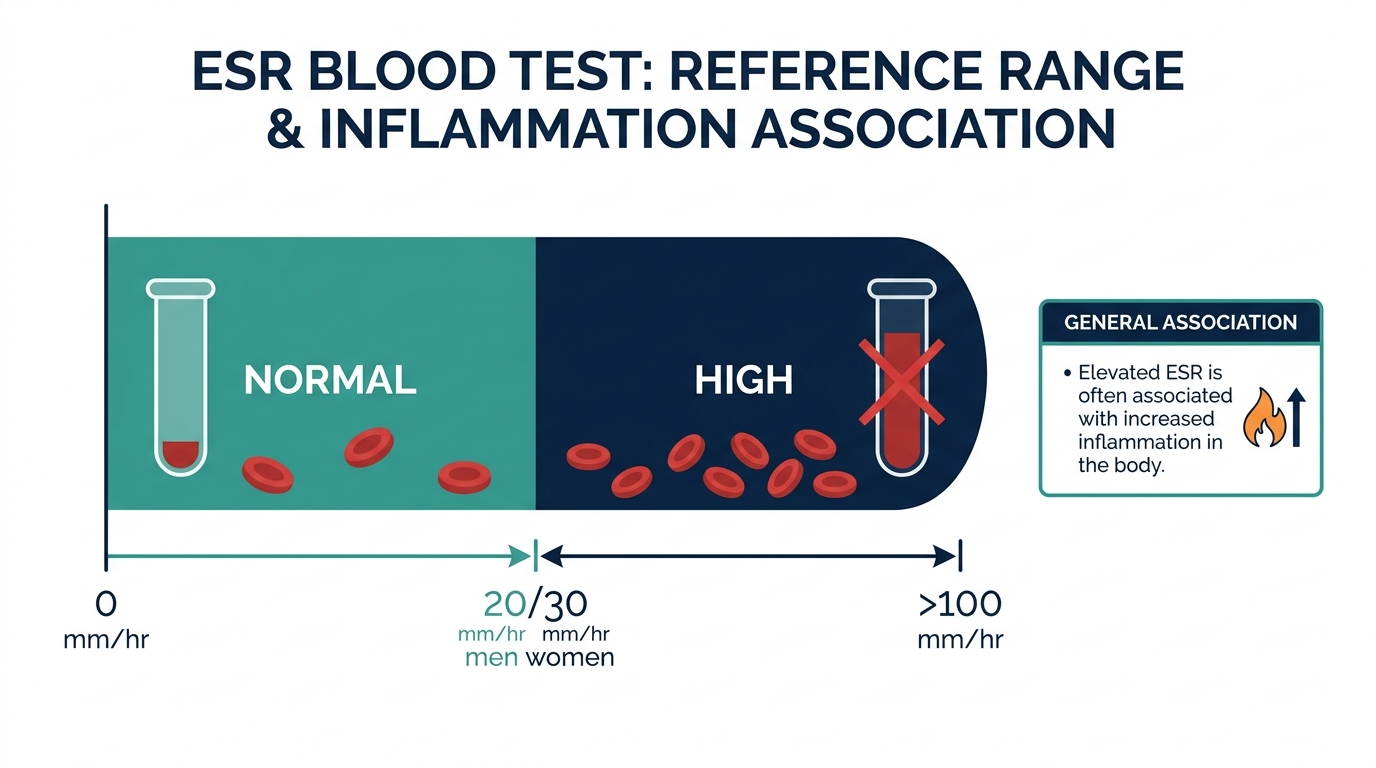
A normal ESR depends heavily on your age and sex, because the baseline naturally drifts upward as people get older and runs slightly higher in women. There is no single number that fits everyone. Using the standard Westergren method, the commonly cited reference ranges are (StatPearls, NCBI Bookshelf):
- Men under 50: 15 mm/hr or lower
- Men over 50: 20 mm/hr or lower
- Women under 50: 20 mm/hr or lower
- Women over 50: 30 mm/hr or lower
- Children: 10 mm/hr or lower
A widely used rule of thumb among clinicians is that the upper limit of normal for a man is roughly his age divided by two, and for a woman his age plus 10, divided by two. It is a rough guide, not a hard cutoff, but it captures why a 70-year-old and a 25-year-old should not be judged against the same line. Always read your result against the reference range printed on your own report, since labs and instruments differ. If you are wondering what is esr test for blood at your specific age, the answer lives in that printed range, not a generic chart.
What does a high ESR mean?
A high ESR means your red cells settled faster than expected, which points to inflammation somewhere in the body. It is a clue, not a diagnosis, and the list of possible causes is long (Cleveland Clinic):
- Infections, from a simple bacterial infection to deeper, hidden ones like bone or heart valve infections.
- Autoimmune and rheumatic disease, including rheumatoid arthritis, lupus, and vasculitis (MedlinePlus).
- Polymyalgia rheumatica and giant cell arteritis, two linked inflammatory conditions in older adults that often drive ESR sharply up.
- Certain cancers, particularly multiple myeloma and lymphoma, which can produce strikingly high values (StatPearls, NCBI Bookshelf).
- Kidney disease, anemia, advanced age, and pregnancy, all of which can raise ESR without any active illness.
Here is the practical nuance that gets lost. A mildly elevated ESR, say in the 20s or 30s, is common and frequently means very little on its own. A dramatically elevated ESR, north of 100 mm/hr, is a different animal. Values that high narrow the field considerably and most often point to serious infection, active autoimmune disease, or malignancy. The size of the number matters as much as the fact that it is up.

What does a low ESR mean?
A low ESR is usually nothing to worry about and most often simply reflects an absence of inflammation (Cleveland Clinic). Unlike a high result, a low number is rarely the thing your clinician is hunting for.
That said, a few conditions can artificially suppress ESR by changing the shape, number, or stacking behavior of red cells. These include polycythemia, where there are too many red cells, sickle cell disease, where the cells are misshapen and do not stack neatly, and sometimes severe heart failure or liver problems (MedlinePlus). In these cases a deceptively normal or low ESR can mask real inflammation, which is one more reason the test is never read in isolation.
Why is ESR often ordered alongside CRP?
ESR and CRP, C-reactive protein, are both inflammation markers, and clinicians frequently order them together because they move on different timelines. CRP rises and falls fast, often within hours of inflammation starting or resolving. ESR is the slow, steady cousin: it takes days to climb and days to come back down (StatPearls, NCBI Bookshelf).
That lag is a feature, not a flaw. CRP captures what is happening right now, while ESR reflects the smoldering, longer-running picture. When both are elevated, the case for meaningful inflammation gets stronger. When they disagree, the gap itself is informative. A high CRP with a normal ESR might mean a very fresh process, while a high ESR with a normalizing CRP can mean inflammation that is fading but has not fully settled. Two cheap tests, read against each other, tell a richer story than either alone (MedlinePlus).
The insider angle: when a high ESR is an emergency, not a footnote
Most of the time a raised ESR earns a follow-up appointment, not an ambulance. But there is one scenario where seasoned clinicians treat it with real urgency, and it is worth knowing about because the stakes are your eyesight.
In an adult over 50 with new headache, scalp tenderness, jaw pain when chewing, or sudden visual changes, a markedly elevated ESR raises the alarm for giant cell arteritis, an inflammation of the arteries supplying the head and eyes. Left untreated, it can cause sudden, permanent blindness, often striking the second eye soon after the first (Cleveland Clinic). This is one of the few situations in medicine where doctors will start high-dose steroids on suspicion alone, before a biopsy confirms anything, precisely because waiting risks irreversible vision loss.
The takeaway is not that every high ESR is a crisis. It is that the same number means wildly different things depending on who you are and what symptoms you have. A 35-year-old with a sore throat and an ESR of 35 is in a completely different world from a 68-year-old with a new throbbing headache and an ESR of 90. Context is the entire diagnostic value of this old, humble test. That is why “your ESR is a little high” should never be the end of the conversation, only the start of one.

How the ESR test is run and what can skew it
Understanding how the sample is handled explains why the ESR is both useful and quirky. Blood goes into a tube with an anticoagulant, is stood upright in a calibrated column, and after exactly one hour someone measures how far the red cells have fallen. Because it is a physical settling process rather than a chemical assay, several everyday factors nudge the result, and knowing them keeps you from over-reading a single number.
- Age and sex. The baseline rises with age and runs higher in women, which is why the reference ranges split those groups out. This is normal physiology, not disease.
- Anemia. Fewer red cells in the tube settle differently and tend to push the ESR up, independent of any inflammation. A low hemoglobin can inflate the number.
- Pregnancy. ESR climbs substantially during pregnancy, so the usual cutoffs do not apply cleanly.
- Technical factors. A tilted tube, a warm room, or a delay in running the sample can all alter how fast the cells fall, which is one reason the test is standardized so carefully.
- Certain medications. Anti-inflammatory drugs and steroids can lower the ESR by damping the inflammation it reflects, potentially masking an active process.
The ESR itself needs no fasting and no special preparation. The most useful thing you can do is tell your clinician what medications and supplements you take and whether you are pregnant, because those facts change how the number should be read.
Reading ESR and CRP together: worked scenarios
Because ESR moves slowly and CRP moves fast, the pair read together tells a story that neither tells alone. The table below lays out the common combinations and how a clinician typically thinks about each.
| ESR | CRP | Common interpretation |
|---|---|---|
| High | High | Active inflammation is likely, and the case is strengthened by two markers agreeing |
| Normal | High | A very fresh or fast-moving process, since CRP rises first |
| High | Normal or falling | Inflammation that is resolving, since ESR lags behind and takes days to settle |
| Normal | Normal | Reassuring for active inflammation, though it never rules everything out |
| Very high (over 100) | High | A red flag that narrows toward serious infection, active autoimmune disease, or malignancy |
The disagreements are often the most informative rows. A high CRP with a normal ESR points toward something that started recently, while a lingering high ESR after CRP has normalized suggests a fire that is dying down but not yet out. This time-offset is exactly why clinicians value ordering the two cheap tests together rather than picking one.
Using ESR to track a known condition over time
Beyond spotting new inflammation, the ESR earns much of its keep in following conditions that are already diagnosed. Its slow, steady behavior makes it a reasonable gauge of the longer arc of disease activity.
- Polymyalgia rheumatica and giant cell arteritis. These linked inflammatory conditions in older adults often drive the ESR sharply up, and the marker is commonly followed as treatment brings the inflammation down.
- Rheumatoid arthritis and other autoimmune disease. ESR is one of several inputs clinicians watch to judge whether disease activity is rising or responding to therapy, usually alongside CRP and a symptom assessment.
- Chronic or deep infections. In conditions like bone infection or infected heart valves, a falling ESR over weeks can support the sense that treatment is working, though it is never the sole measure.
The key is that ESR is a trend marker here, not a single-snapshot verdict. One value tells you little about progress. A series of values moving in the right direction, read against how the patient feels, is what makes the humble sed rate useful in long-term care.

When a normal ESR can still mislead
A reassuring ESR is not always the all-clear it seems. A handful of conditions can suppress the number by changing the red cells themselves, so inflammation can be present while the ESR stays deceptively normal or low.
- Polycythemia. Too many red cells crowd the tube and slow the settling, dragging the ESR down.
- Sickle cell disease. Misshapen cells do not stack into the neat rouleaux that make ESR rise, so the number can stay low despite real inflammation.
- Severe heart failure or certain liver problems. These can alter the proteins and cells enough to blunt the ESR response.
This is the mirror image of the false-high problem, and it is a big reason ESR is never read in isolation. When the clinical picture and the ESR disagree, the picture usually wins, and a normal sed rate does not close the door on inflammation in someone who is clearly unwell.
Who gets an ESR, and what happens after an abnormal one
ESR is not a routine screening test for healthy people the way cholesterol is. It is ordered when a specific question comes up: unexplained symptoms that might be inflammatory, a suspected autoimmune or infectious process, or the need to monitor a condition already diagnosed. So the very fact that it was ordered usually means your clinician had a reason.
After an abnormal result, the next step depends entirely on context rather than the number alone:
- A mildly high ESR with no worrying symptoms often warrants a recheck and a look for simple explanations like anemia or a recent minor infection, rather than an aggressive workup.
- A high ESR with specific symptoms guides the search, prompting targeted tests or imaging aimed at the suspected source of inflammation.
- A very high ESR, or red-flag symptoms in an older adult, can trigger urgent evaluation, as in the giant cell arteritis scenario above, where treatment may start before confirmation.
In every case the sensible response is a conversation with your clinician, not a late-night search spiral. The ESR points, and the follow-up decides.
Common misunderstandings about the ESR
A few myths cause needless worry over this old test. Clearing them up changes how you read your own result.
- “A high ESR means I have an infection.” ESR reflects inflammation of any kind, and plenty of noninfectious states raise it, from autoimmune disease to anemia to simply getting older.
- “A normal ESR means there is no inflammation.” Some conditions suppress the number, so a normal or low result does not guarantee an absence of inflammation, especially in someone who feels unwell.
- “The ESR can diagnose my condition.” It cannot. It is a nonspecific signal that says a fire may be burning, not where it is or what is fueling it.
- “My number is different from a chart online, so something is wrong.” Reference ranges shift with age, sex, and lab. The only range that governs your result is the one printed beside it on your own report.
The thread through all of these is the article’s core idea. The ESR is a smoke detector, valuable precisely because it is sensitive and cheap, and dangerous only when it is read without the context of your age, your symptoms, and the other tests around it.
Everyday factors that can nudge your ESR
One reason the ESR is read so cautiously is that plenty of ordinary, non-disease factors move it. Knowing them helps you avoid reading too much into a mildly raised number that has a harmless explanation.
- Age and sex: The baseline drifts upward with age and runs a little higher in women, which is why the reference range is not one-size-fits-all.
- Pregnancy: ESR rises substantially in normal pregnancy, so a high value in a pregnant person is often expected rather than alarming.
- Anemia: Fewer red cells settle faster, which can lift the ESR independently of any inflammation, one of the classic ways the test misleads.
- Obesity and menstruation: Both can be associated with modestly higher readings in otherwise well people.
- Recent minor illness: A cold or a small infection weeks ago can leave the number still settling back down.
The flip side matters too. Some conditions and factors push the ESR falsely low, including very high red cell counts and certain cell-shape disorders. Because so many benign influences tug the number in both directions, a single ESR is best treated as one input among several, not a verdict on its own.
What patients most often ask about a high ESR
A raised ESR tends to generate the same handful of worries, and having plain answers ready takes the edge off the result. The first is whether a high number means something serious is wrong. Usually not on its own, because the test is sensitive but nonspecific, so a mild elevation with no symptoms often traces back to something ordinary like age, anemia, or a recent minor infection.
The second common question is what to do next. The honest answer is that the number does not decide anything by itself. Your clinician reads it against your symptoms, your age, and often a CRP drawn at the same time, then chooses whether a recheck or a targeted test makes sense. The third is how to bring it down, and here the framing matters: you do not treat the ESR, you treat whatever is raising it. When the underlying cause settles, the number follows, though because the ESR moves slowly it can lag behind how you feel by days to weeks. That lag is normal and is why a single follow-up value is interpreted as part of a trend rather than a pass or fail.
Curious where your ESR really sits?
Baseline ESR and 100+ biomarkers today and retest as life changes, all in one membership with physician review.
Frequently asked questions
Should I worry if my ESR is high?
Not automatically. A mildly high ESR is common and often means little on its own, since age, sex, anemia, and even a recent minor infection can raise it. It is a clue, not a diagnosis, and is always read alongside your symptoms and other tests (Cleveland Clinic). A very high value, especially over 100 mm/hr, deserves prompt follow-up.
What is a normal ESR level?
It depends on age and sex. Common Westergren reference ranges are 15 mm/hr or lower for men under 50, 20 mm/hr or lower for women under 50 and men over 50, and 30 mm/hr or lower for women over 50 (StatPearls, NCBI Bookshelf). Compare your result to the range printed on your own lab report.
Can ESR be high without infection?
Yes. Many noninfectious states raise ESR, including autoimmune diseases, anemia, kidney disease, pregnancy, older age, and some cancers (MedlinePlus). That is why a high ESR points to inflammation in general, not to infection specifically.
What is the difference between ESR and CRP?
Both measure inflammation, but on different timelines. CRP rises and falls within hours, capturing current activity, while ESR changes over days and reflects a slower, longer-running picture (StatPearls, NCBI Bookshelf). Doctors often order them together because the comparison is more informative than either alone.
Do I need to fast before an ESR test?
No. An ESR test is a simple blood draw that does not require fasting or special preparation (Cleveland Clinic). Tell your provider about any medications you take, since some can affect the result.
This article is for general educational purposes and is not medical advice. It cannot diagnose or treat you and does not replace your clinician. Always discuss your lab results and any health decisions with a qualified healthcare professional.
Vital Signs Today may earn a commission if you buy through links on this page. It does not affect our editorial assessments.