Inflammation Blood Tests: CRP and ESR Explained
Key Takeaways
- An inflammation blood panel usually pairs two markers, C-reactive protein (CRP) and erythrocyte sedimentation rate (ESR), to detect and track inflammation anywhere in the body without saying exactly where it is.
- CRP rises and falls within hours to days, so it reflects what is happening right now, while ESR changes over days to weeks and reflects a slower, more sustained picture.
- These tests confirm whether inflammation is present and how active it is, but they cannot name the cause on their own, so results are always read alongside your symptoms, history, and other labs.
An inflammation blood test panel measures markers in your blood that climb when your body mounts an inflammatory response, most commonly C-reactive protein (CRP) and the erythrocyte sedimentation rate (ESR). Doctors order it when they suspect infection, an autoimmune or rheumatologic condition, or unexplained symptoms like persistent fever, joint pain, or fatigue, and they also use it to monitor whether a known inflammatory disease is flaring or settling down. The panel is a sensitive alarm rather than a diagnosis, so a high result tells your clinician that inflammation exists and how strong it is, not what is driving it.

What is a Inflammation Blood Tests?
An inflammation blood test is a group of lab measurements that gauge how much inflammation is active in your body at the moment your blood is drawn. Inflammation is your immune system’s normal response to injury, infection, or irritation, but when it runs high or never switches off it can signal an underlying problem that needs attention.
CRP and ESR flag inflammation but not its source. Find out what’s driving it with a 100+ biomarker panel. One at-home Superpower draw checks 100+ biomarkers, physician-reviewed.
The two workhorses of this panel, CRP and ESR, are both called acute-phase markers because they shift in response to the chemical signals the immune system releases during inflammation. They are nonspecific, meaning they go up in many different conditions, from a simple infection to rheumatoid arthritis. That lack of specificity is actually their strength as a screening tool: a single inexpensive blood draw can flag that something inflammatory is going on, prompting your doctor to look further. Because the two markers move on different timelines and respond to different triggers, ordering them together gives a fuller picture than either one alone.
What does a Inflammation Blood Tests measure?
This panel typically reports two markers. Each one is summarized below in a single line, and each has its own detailed article linked nearby.
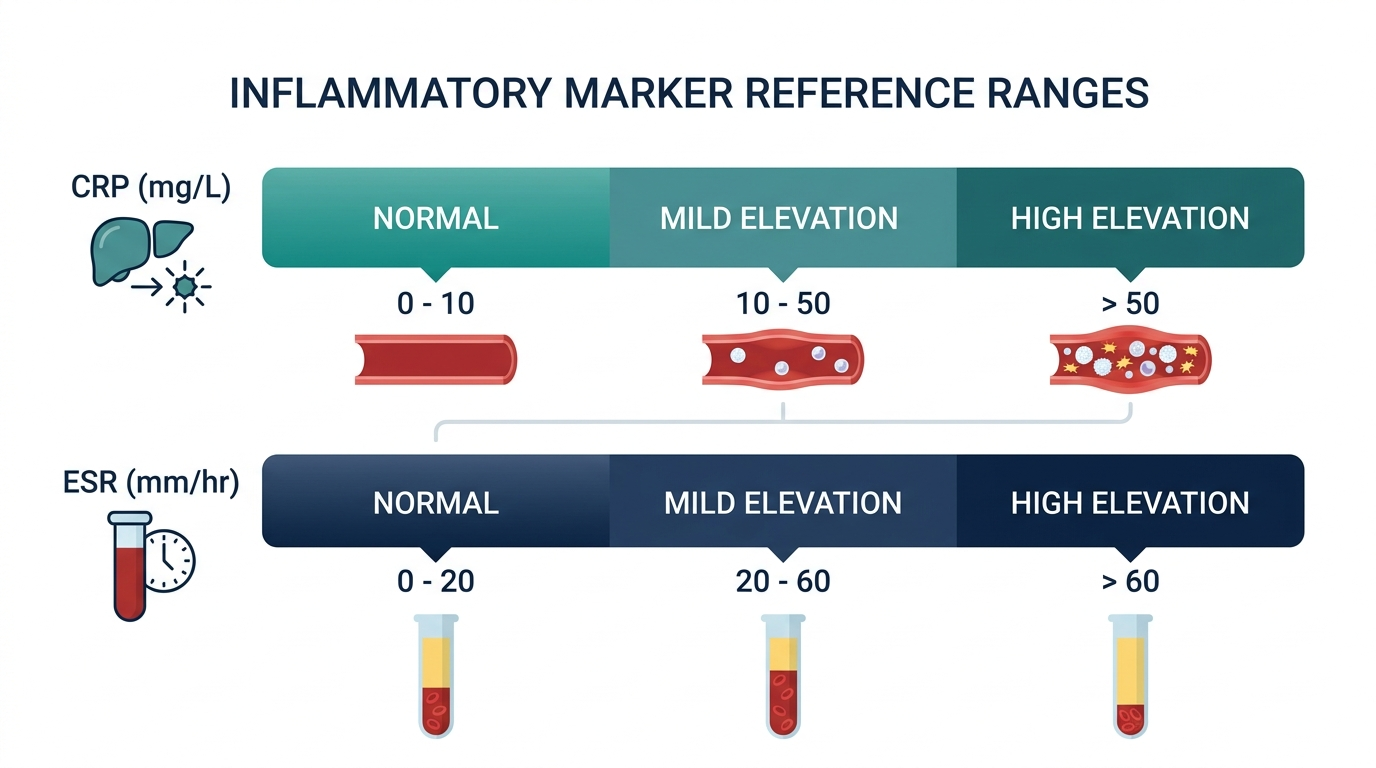
- CRP (C-reactive protein): a protein made by the liver that rises within hours of inflammation and falls quickly once it resolves, making it a fast, real-time signal of current inflammatory activity.
- ESR (erythrocyte sedimentation rate): a measure of how fast red blood cells settle in a tube over one hour, which rises and falls more slowly than CRP and reflects sustained, longer-running inflammation.
Some labs also offer high-sensitivity CRP (hs-CRP), a more precise version of the CRP test that detects very low levels and is used mainly to estimate cardiovascular risk rather than to find active infection.
Why would a doctor order a Inflammation Blood Tests?
Your clinician usually orders an inflammation panel to answer one of three questions. The first is whether inflammation is present at all when you have vague or hard-to-pin-down symptoms such as a fever with no obvious source, unexplained weight loss, night sweats, or widespread aches. A normal result can be reassuring, while a high result justifies more focused testing.
The second reason is to help evaluate a suspected inflammatory or autoimmune condition. Diseases such as rheumatoid arthritis, lupus, inflammatory bowel disease, polymyalgia rheumatica, and giant cell arteritis often raise CRP, ESR, or both, so these markers support the diagnostic workup even though they never confirm a specific disease by themselves.
The third reason is monitoring. If you already carry a diagnosis of an inflammatory condition, your doctor may repeat these tests over time to see whether treatment is working, whether the disease is flaring, or whether an infection has taken hold. Falling numbers generally suggest improvement, and rising numbers suggest the opposite. CRP is also sometimes used after surgery or during a serious infection to track recovery, because it drops fast once the problem is controlled.

How to read your Inflammation Blood Tests results
Start with the lab’s reference range printed next to each value, because methods and cutoffs vary between laboratories. As a general guide, standard CRP under about 10 mg/L is considered normal, and many healthy adults sit between roughly 0.8 and 3.0 mg/L (Medscape). For ESR using the common Westergren method, a typical normal range is up to about 15 mm/hr in men and up to about 20 mm/hr in women, and normal values tend to rise with age (Cleveland Clinic).
Next, read the two markers together. Because CRP responds within hours and ESR over days, a high CRP with a still-normal ESR can point to very recent or acute inflammation, while a high ESR with a settling CRP may suggest inflammation that is improving or has been present for a while. When both are elevated, it strengthens the signal that an inflammatory process is active.
Finally, remember what these numbers cannot do. A high value does not name the cause, and a normal value does not completely rule inflammation out, especially early in an illness. Many ordinary things nudge the numbers, including a recent cold, pregnancy, obesity, older age, and certain medications. For that reason, your clinician interprets the trend over repeated tests and the full clinical picture rather than reacting to a single isolated number.
When should you get this panel tested?
There is no routine schedule for inflammation markers the way there is for cholesterol or blood sugar, because these tests are driven by symptoms and clinical context rather than by calendar screening. You are most likely to have the panel drawn when you have new, persistent, or unexplained symptoms that could be inflammatory, such as ongoing fever, swollen or painful joints, morning stiffness, marked fatigue, or unintended weight loss.
If you already live with an inflammatory or autoimmune condition, your specialist sets the rhythm, often repeating the markers every few weeks to months or whenever symptoms change, to judge whether treatment is holding. People recovering from a serious infection or surgery may have CRP checked more frequently over a short window to confirm things are settling.
For hs-CRP used to estimate heart disease risk, testing is usually done when you are feeling well and free of acute illness, because a recent infection or injury can temporarily inflate the result and make it misleading. Whenever you test, tell your provider about recent illnesses, injuries, pregnancy, and all medications and supplements, since these can shift the readings.
Every marker in this panel
Tap any marker for a full plain-English explainer, including what high and low results mean.
- What Does a High CRP Blood Test Mean? Causes, Cutoffs & When to Worry
- What Is a CRP Blood Test? The Inflammation Alarm Your Doctor Reads First
- What Does a High ESR Blood Test Mean? Causes & Red Flags
- What Is an ESR Blood Test? The Old Inflammation Marker Worth Understanding
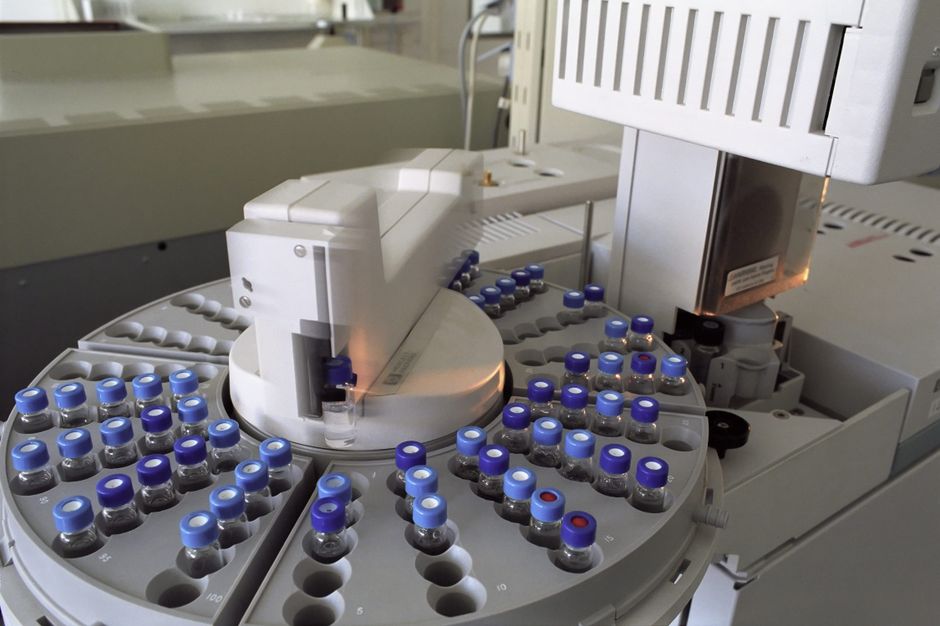
The biology: why CRP and ESR rise at all
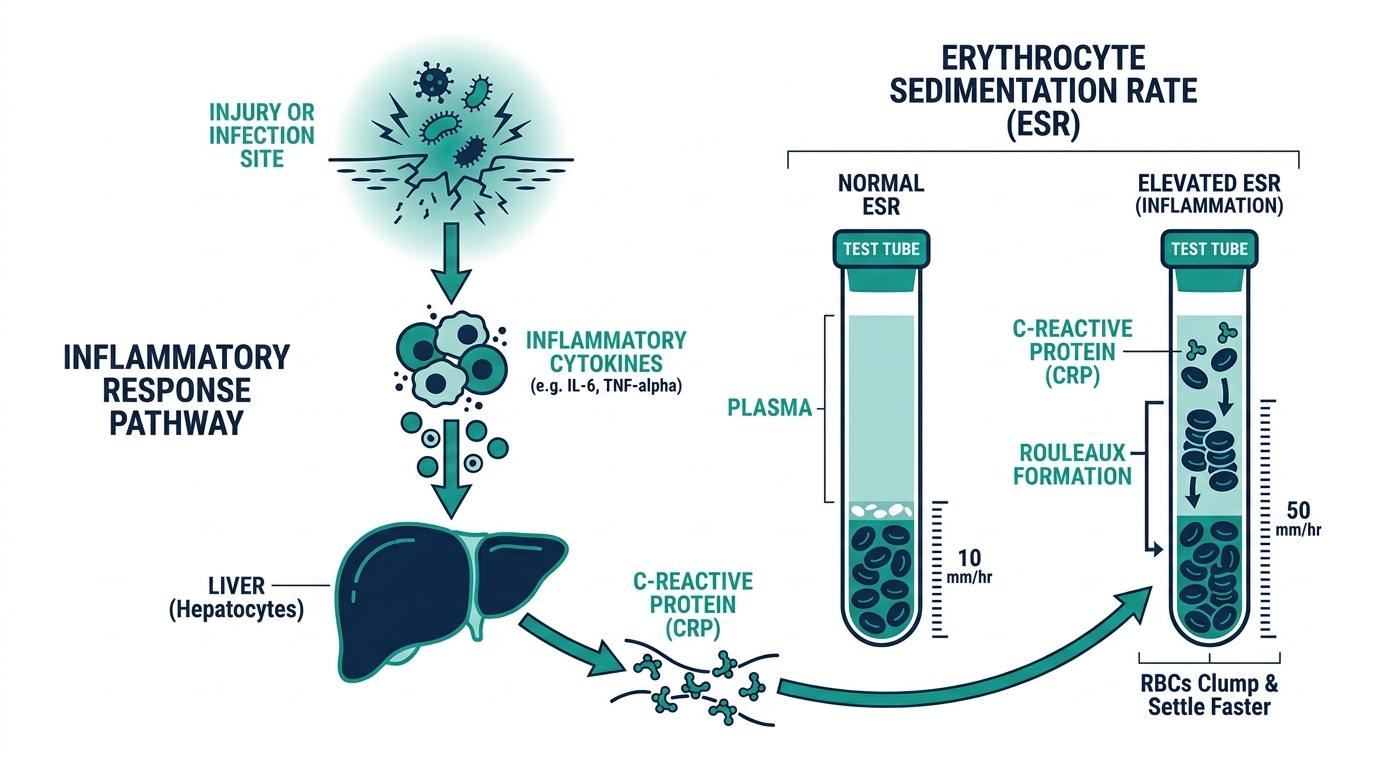
The two markers move for genuinely different reasons, and that is why they are ordered as a pair rather than as interchangeable copies. CRP is a protein your liver produces on demand. When immune cells detect injury or infection, they release a signaling molecule called interleukin-6, which travels to the liver and switches on CRP production within hours. Once the trigger is gone, IL-6 falls and CRP clears quickly because the protein has a short half-life. That fast on, fast off behavior is what makes CRP a near real-time gauge of what is happening right now.
ESR works by an entirely indirect mechanism. It does not measure a protein directly at all. Instead, it measures how quickly red blood cells sink in a tube over one hour. During inflammation the liver makes more of certain large proteins, especially fibrinogen, which coat red cells and make them stack together and fall faster. Because these proteins accumulate and clear slowly, ESR lags behind the actual inflammation by days and stays elevated after CRP has already normalized. So CRP reflects the flame, and ESR reflects the smoke that lingers after it.
CRP versus ESR at a glance
| Feature | CRP | ESR |
|---|---|---|
| What it measures | A liver protein directly | How fast red cells settle (indirect) |
| Speed of rise | Within hours | Over days |
| Speed of fall | Falls quickly once resolved | Falls slowly over days to weeks |
| Best for | Acute, current inflammation | Sustained or chronic inflammation |
| Affected by | Less swayed by age, sex, anemia | Rises with age, female sex, anemia, pregnancy |
Reading the pair together is where the value lives. A high CRP with a still-normal ESR suggests something very recent. A settling CRP with a still-high ESR suggests a process that is improving but has not fully cleared. Both high strengthens the signal that inflammation is genuinely active.
hs-CRP and cardiovascular risk categories
High-sensitivity CRP measures the same protein as standard CRP but detects it at much lower concentrations, which matters for heart risk rather than infection. Low-grade inflammation in blood vessel walls contributes to atherosclerosis, and hs-CRP puts a number on that background inflammation. The American Heart Association and CDC established three widely used risk bands, which should be measured when you are well and free of acute illness (AHA/CDC scientific statement):
- Under 1.0 mg/L: lower relative cardiovascular risk.
- 1.0 to 3.0 mg/L: average relative cardiovascular risk.
- Above 3.0 mg/L: higher relative cardiovascular risk.
One practical rule saves confusion. If an hs-CRP comes back above about 10 mg/L, it is usually not reflecting cardiovascular risk at all but an acute event like an infection, and the guidance is to treat that first and retest once you are well. hs-CRP is a risk modifier, not a diagnosis, and it is most useful when your heart risk sits in an intermediate zone where it might tip a decision about treatment.

What raises these markers, and what quietly lowers them
Because CRP and ESR are nonspecific, a long list of things can move them, and knowing the ordinary ones prevents overreaction to a mildly high number. Common causes of elevation include:
- Infections, from a passing viral illness to a serious bacterial one.
- Autoimmune and rheumatologic disease such as rheumatoid arthritis, lupus, and polymyalgia rheumatica.
- Recent injury, surgery, or tissue damage.
- Obesity, which maintains a low-grade inflammatory state.
- Pregnancy and older age, which nudge ESR in particular upward.
Just as important, a few situations can falsely lower the numbers or mask real inflammation. ESR can read deceptively low in conditions like polycythemia (too many red cells), sickle cell disease, and heart failure, because the physics of how cells settle is altered. Very high blood sugar and certain protein abnormalities can also distort it. CRP is more robust but can be blunted by some anti-inflammatory and immune-suppressing medications, which is one reason a normal result in someone on such drugs does not fully exclude inflammation. This is exactly why clinicians weigh the clinical picture, not just the printout.
How to prepare, and who should consider hs-CRP
Standard CRP and ESR do not require fasting, and you can usually take your medications and eat normally beforehand. The main preparation is honesty about context: tell your clinician about any recent cold or infection, injury, surgery, vaccination, pregnancy, and every medication and supplement you take, because each can shift the result. Timing matters most for hs-CRP used for heart risk. That test should be drawn when you are feeling completely well, because a recent infection or even a hard bout of the flu can inflate it for days and make a heart-risk reading meaningless. Many clinicians repeat hs-CRP and average two readings taken a couple of weeks apart to get a stable baseline.
Who benefits from hs-CRP specifically? It is most useful for people whose cardiovascular risk sits in an intermediate range, where an elevated inflammatory marker might tip the balance toward more aggressive prevention. It is less useful at the extremes, since someone already known to be high risk will be treated regardless, and a very low-risk young person rarely needs it. It is also not a screening test for healthy people with no risk factors. As always, the number informs a decision, it does not make one.
Worked interpretation scenarios
Seeing how the two markers behave together in real situations makes them far easier to read:
- High CRP, normal ESR, sudden fever. The pattern of a fast riser fits a very recent or acute infection, before the slower ESR has had time to climb.
- Normal CRP, high ESR, weeks of joint stiffness. A lingering elevation points toward a more chronic or resolving process, common in some rheumatologic conditions.
- Both markedly high. A strong, consistent signal that active inflammation is present, warranting focused workup rather than watchful waiting.
- Both normal, but symptoms persist. Reassuring against major active inflammation, yet not a full all-clear early in an illness or with conditions that do not strongly raise these markers.
- Isolated mildly high CRP in a well person. Often traceable to a recent cold, extra weight, or a minor injury, and best rechecked once you are back to baseline rather than chased immediately.
What to do after an elevated result
If your inflammation markers come back high, a sensible sequence looks like this. First, connect the number to your story: any recent illness, injury, new joint pain, fever, or weight change. Second, read CRP and ESR together to judge whether the process looks acute or sustained. Third, expect your clinician to pursue targeted next steps rather than treat the number itself, which may include a physical exam, imaging, or condition-specific antibody tests depending on your symptoms. Fourth, if the cause is unclear and you feel well, a repeat test after a couple of weeks often clarifies whether it was a transient blip or a genuine trend. Treating the underlying cause, not the marker, is what brings these numbers down, and a falling trend on repeat testing is usually the most reassuring sign of all.
Common misconceptions
- “A high CRP or ESR means I have a specific disease.” No. These are nonspecific alarms. They confirm inflammation exists and gauge its intensity, but the cause comes from the fuller clinical picture.
- “Normal markers mean nothing is wrong.” Not necessarily. Early illness and some conditions do not strongly raise CRP or ESR, so normal values lower the odds of major inflammation without erasing them.
- “hs-CRP and regular CRP are different tests for different things I can swap.” They measure the same protein. hs-CRP simply detects lower levels for heart-risk assessment, while standard CRP is used to find and follow active inflammation.
- “One high reading means I should start anti-inflammatory treatment.” A single value is a snapshot. The trend over repeat tests, read with symptoms, guides decisions far better than any lone number.
How inflammation markers behave across age and sex
Reference ranges for CRP and ESR are not identical for everyone, and knowing the pattern keeps you from over-reading a mildly high number. ESR in particular tends to drift upward with age, which is why many labs quote higher upper limits for older adults. A rough guide that clinicians have used for years is to take age divided by two for men, and age plus ten divided by two for women, as an approximate ceiling for the ESR in millimeters per hour. That is a guide, not a hard rule, but it explains why an ESR that would look high in a twenty year old can be unremarkable in someone in their seventies.
Sex matters too. Women generally run slightly higher ESR values than men at the same age, partly because of differences in red cell concentration and fibrinogen. Pregnancy raises ESR substantially and can also nudge CRP, so both markers are interpreted with extra caution during and shortly after pregnancy. Body composition plays a quieter role: carrying more fat tissue is associated with higher baseline CRP, because fat cells release low grade inflammatory signals, so a modestly raised hs-CRP in someone with a higher body weight may reflect metabolic load rather than an acute illness.
The practical takeaway is to always read your result against the range printed for your age and sex on your own report, not against a single universal cutoff you saw online. If your lab flags a value as high but it sits close to the age adjusted ceiling and you feel well, that context often changes the interpretation from worrying to expected. When in doubt, a repeat test that shows a stable or falling trend is far more reassuring than any one snapshot.
Don’t just read about inflammation, track it.
A single result is a snapshot. Superpower re-tests inflammation and 100+ markers over time so you can watch them move as you change sleep, food, and training.
Frequently asked questions
What is the difference between CRP and ESR?
CRP is a liver protein that rises within hours of inflammation and falls quickly once it resolves, so it reflects current activity. ESR measures how fast red blood cells settle and changes more slowly over days to weeks, so it reflects sustained inflammation. Doctors often order both because the two timelines complement each other.
Can an inflammation blood test tell me what is wrong with me?
No. CRP and ESR are nonspecific markers that confirm inflammation is present and show how active it is, but they cannot identify the cause on their own. Your clinician combines the results with your symptoms, history, physical exam, and other tests to reach a diagnosis.
What does a high CRP or ESR mean?
A high value means an inflammatory process is active somewhere in your body. Common causes range from infections and injuries to autoimmune diseases, and even ordinary factors like obesity, pregnancy, or older age can raise the numbers. Because many things lift these markers, a high result calls for further evaluation rather than a single conclusion.
Do I need to fast before an inflammation blood test?
Fasting is generally not required for CRP or ESR. However, your doctor may bundle these tests with others that do require fasting, so always follow the specific preparation instructions you are given for your blood draw.
Can my inflammation markers be normal even if I feel unwell?
Yes. Normal CRP and ESR make significant active inflammation less likely but do not completely rule it out, particularly very early in an illness or with conditions that do not strongly raise these markers. If your symptoms persist despite normal results, tell your clinician so they can investigate further.
Sources
- Medscape: C-Reactive Protein, Reference Range and Interpretation
- Medscape: High-Sensitivity C-Reactive Protein, Reference Range
- Cleveland Clinic: Sedimentation Rate (ESR)
- UCSF Health: C-Reactive Protein
- Erythrocyte Sedimentation Rate, overview and Westergren method
This article is for general educational purposes and is not medical advice. It cannot diagnose or treat you and does not replace your clinician. Always discuss your lab results and any health decisions with a qualified healthcare professional.
Vital Signs Today may earn a commission if you buy through links on this page. It does not affect our editorial assessments.