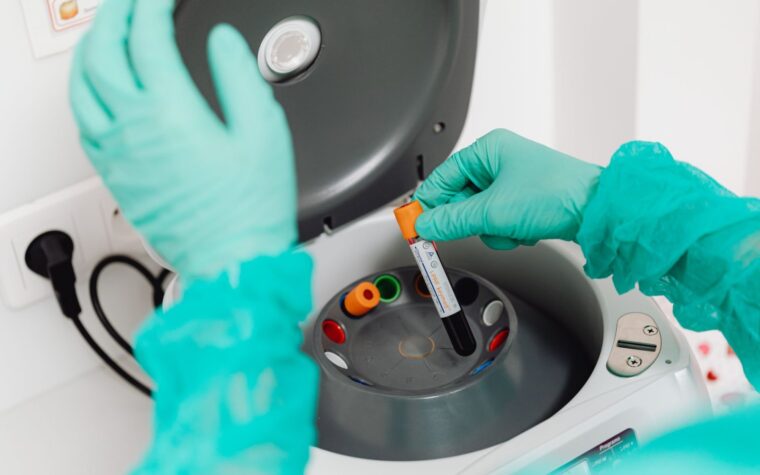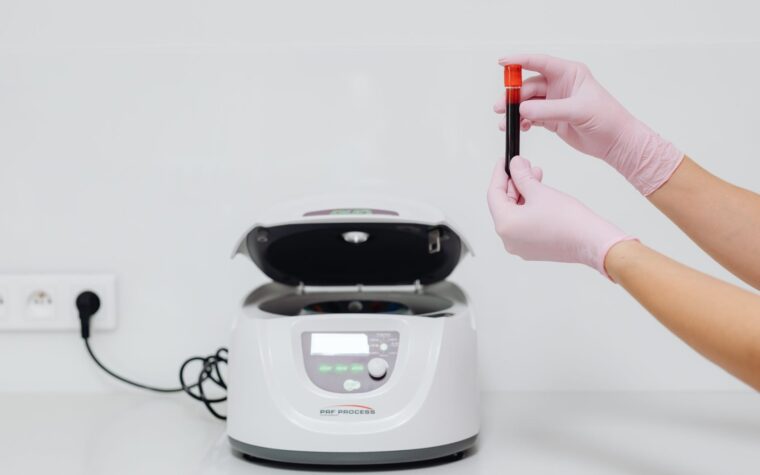
- A low ESR blood test means your red blood cells settled slower than expected, and on its own it is usually harmless rather than a sign of disease.
- Common reasons for a low ESR include having too many red blood cells (polycythemia), abnormally shaped red cells (such as in sickle cell disease or spherocytosis), and certain medications like NSAIDs or statins.
- The Westergren normal range tops out at about 15 mm/hr for men under 50 and 20 mm/hr for women under 50, so a result below those numbers is generally considered normal, not concerning.
If your lab report flags a low erythrocyte sedimentation rate (ESR), it is natural to wonder whether something is wrong. The reassuring news is that a low ESR rarely points to a serious problem by itself. ESR is mainly a marker of inflammation, so a low number usually just means little to no inflammation is present. This article explains what a low ESR means, what causes it, when it matters, and what to do next.
Part of our Inflammation Blood Tests guide.
A low ESR is usually harmless, but see the fuller inflammation picture to be sure. One at-home Superpower draw checks 100+ biomarkers, physician-reviewed.
What does a low ESR result mean and what is the cutoff?
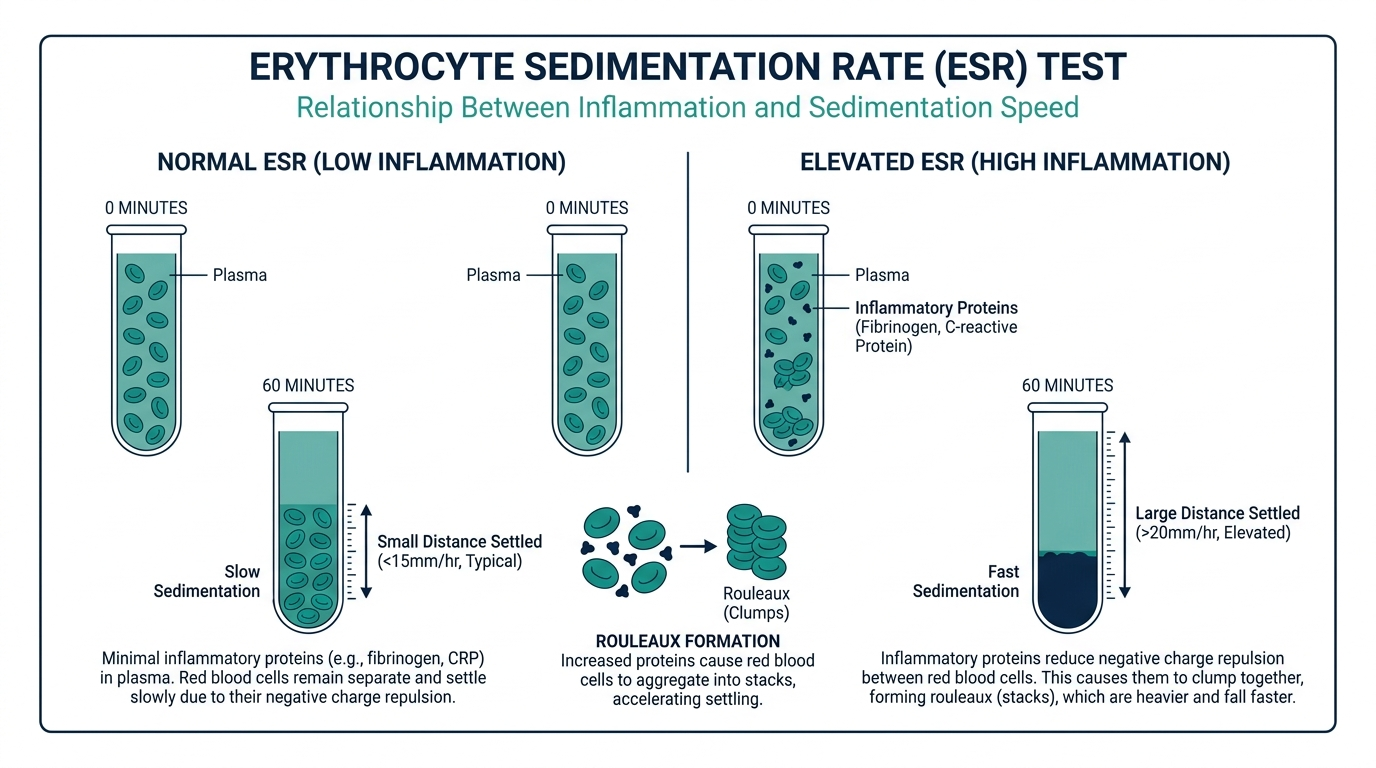
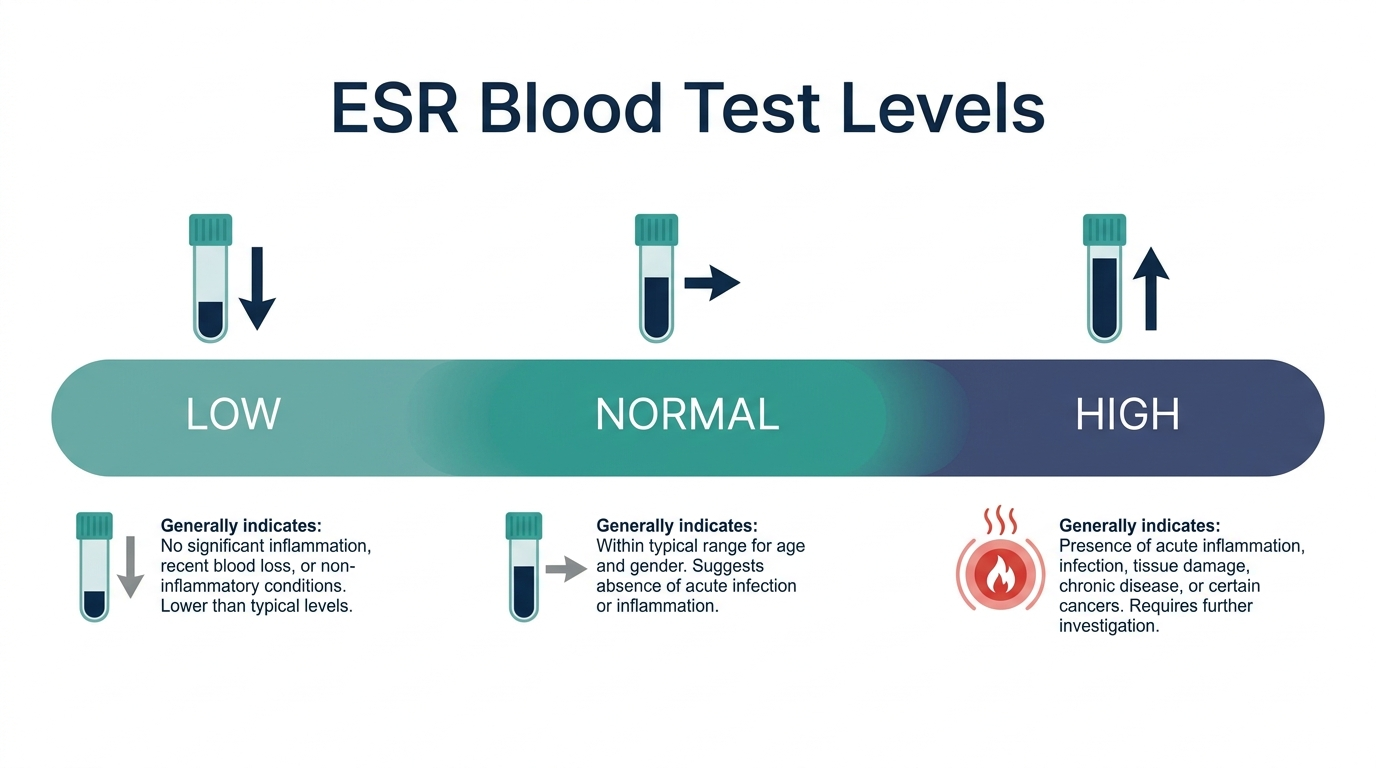
A low ESR means your red blood cells settled to the bottom of a test tube more slowly than average over one hour, which generally signals little or no inflammation in the body. Because ESR has no clinically defined “too low” threshold, most labs only report the upper limit of normal. Using the Westergren method, the standard upper limits are 15 mm/hr for men under 50, 20 mm/hr for women under 50, 20 mm/hr for men over 50, and 30 mm/hr for women over 50, with children at 10 mm/hr or lower (NCBI StatPearls).
So a value of 2 mm/hr or 4 mm/hr sits comfortably inside the normal range. The Cleveland Clinic notes that ESR is a nonspecific screening test and cannot diagnose or rule out any single condition on its own (Cleveland Clinic). A low number is most often a normal, healthy finding.

What causes a low ESR?
A low ESR is most often caused by physical properties of your blood that slow red cell settling, rather than by illness. The main documented causes are polycythemia (too many red blood cells), abnormal red cell shapes, low fibrinogen, and certain medications (NCBI StatPearls).
- Polycythemia: An increased number of red blood cells raises blood viscosity and slows the rate at which cells stack and settle, lowering the ESR (NCBI StatPearls).
- Abnormal red cell shape: Conditions like sickle cell disease and spherocytosis distort red cells so they cannot form the orderly stacks (rouleaux) needed to settle quickly, which reduces ESR (NCBI StatPearls).
- Low fibrinogen and plasma proteins: ESR depends on proteins that make red cells clump. When these are low, cells settle slowly and ESR drops (MedlinePlus).
- Medications: NSAIDs, statins, and valproic acid are known to lower ESR values (NCBI StatPearls).
- Lab handling: Delays in processing the blood sample cause red cells to lose their shape and settle more slowly, falsely lowering the result (NCBI StatPearls).
What are the symptoms, or is it silent?
A low ESR causes no symptoms of its own and is almost always silent. ESR is a number on a lab report, not a condition you can feel. The Cleveland Clinic describes ESR as a simple screening test, meaning it points toward areas to investigate rather than producing physical effects (Cleveland Clinic).
If symptoms exist, they come from an underlying cause that happens to also lower ESR, not from the low ESR itself. For example, polycythemia can cause headaches, dizziness, flushing, or itchy skin, and sickle cell disease can cause pain episodes and fatigue. In those cases, the low ESR is a side clue, and the symptoms are what guide your clinician toward the real diagnosis.
When is a low ESR dangerous?
A low ESR is rarely dangerous in itself, and isolated low values are generally considered a normal finding (Cleveland Clinic). The potential concern is not the low number but a condition that can produce it, such as polycythemia, which raises blood thickness and stroke or clot risk if left untreated.
There is also a subtler risk worth knowing. When an ESR-lowering factor coexists with a condition that would normally raise ESR, the two can cancel out and mask real inflammation, producing a misleadingly “normal” result (NCBI StatPearls). That is one reason ESR is interpreted alongside other tests like C-reactive protein (CRP) and a complete blood count, never in isolation. A single low ESR with no symptoms almost never needs urgent action.

What should you do next and when should you see a doctor?
For most people, an isolated low ESR needs no action beyond a routine conversation at your next visit, since it is usually a normal result (Cleveland Clinic). Bring the full report so your clinician can read ESR in context with your CRP, complete blood count, symptoms, and medications.
You should contact a doctor sooner if the low ESR appears alongside symptoms such as persistent headaches, dizziness, unusual flushing or itching after a warm shower, unexplained fatigue, or episodes of pain. These could point to an underlying cause like polycythemia or a red cell disorder that deserves follow-up. Also mention any NSAIDs, statins, or other medications you take, since these can lower the number and explain it entirely (NCBI StatPearls).
Insider nuance: why a low ESR can hide a real problem
The detail many patients miss is that ESR can read normal or low even when significant inflammation is present, because opposing forces cancel out. A person with both anemia-driven shape changes and active inflammation may land in the normal range, hiding the inflammation (NCBI StatPearls).
This is why experienced clinicians rarely trust ESR alone. CRP responds faster and is less affected by red cell shape and count, so the two tests are often ordered together. If your symptoms strongly suggest inflammation but your ESR is low or normal, do not assume you are in the clear. A normal ESR lowers but does not eliminate the chance of inflammatory disease, and your clinician may add CRP or repeat testing to get a clearer picture.
How ESR actually works, and why “low” is different from most tests
To understand a low ESR, it helps to know what the test physically measures. A tube of anticoagulated blood is stood upright, and over one hour the red blood cells sink under gravity. The result is the distance, in millimeters, that the cells fall in that hour. What makes them fall faster is a stacking behavior called rouleaux, where red cells clump into coin-like columns that are heavier and drop quickly.
Whether that stacking happens depends heavily on proteins in the plasma, especially fibrinogen. Inflammation raises fibrinogen, which promotes rouleaux, which speeds settling, which raises ESR. That is the whole logic behind ESR as an inflammation marker. A low ESR simply means the cells settled slowly, which usually means little fibrinogen-driven stacking, which usually means little inflammation.
This is why ESR is unusual: for most lab values, being outside the range in either direction is a concern, but ESR has essentially no clinically meaningful floor. Labs report an upper limit and treat anything below it as normal. A very low number is not a deficiency of anything. It is often the most reassuring result the test can give.

Westergren and the newer automated methods
The reference standard for ESR is the Westergren method, the manual tube technique the classic ranges are built on. Many labs now run automated analyzers that report results correlated to Westergren, which is convenient and fast but can differ slightly at the edges. A few practical implications:
- Compare to your own report. Because methods and ranges vary, judge your value against the range printed on your specific lab report rather than a fixed online number.
- Method affects sensitivity to artifacts. The manual method is more sensitive to sample handling. A sample that sits too long or is tilted can settle abnormally, nudging the result.
- Automated does not mean superior for every case. The classic Westergren remains the yardstick, and discrepancies are usually small and clinically unimportant for a low value.
ESR versus CRP: a side-by-side you can use
ESR is rarely the only inflammation marker a clinician looks at, and its natural companion is C-reactive protein. The two answer overlapping but different questions, which is exactly why they are ordered together.
| Feature | ESR | CRP |
|---|---|---|
| What it measures | How fast red cells settle, an indirect read on inflammatory proteins | A specific protein the liver makes in response to inflammation |
| Speed of change | Slow to rise and slow to fall, lags the actual process | Rises and falls within hours to days, more real-time |
| Affected by red cells | Yes, cell count and shape strongly influence it | No, largely independent of red cell properties |
| Best use | Tracking chronic conditions over weeks, some specific diseases | Catching acute inflammation and quick response to treatment |
The takeaway for a low ESR: if you have symptoms that suggest an active, acute process, a normal or low ESR does not close the door, because ESR lags. CRP is the faster witness. When they disagree, the discrepancy itself is information your clinician uses.
When a low ESR is actually a useful clue
Most of the time a low ESR is simply a normal finding, but there are specific situations where it earns its place as a diagnostic hint rather than background noise:
- Pointing toward polycythemia. A persistently very low ESR alongside a high red cell count can support a picture of polycythemia, where thickened blood slows settling. That matters because polycythemia raises clot risk and is treatable.
- Flagging a red cell shape disorder. Conditions like sickle cell disease or hereditary spherocytosis distort red cells so they cannot stack, keeping ESR low. In someone with anemia and other clues, a low ESR fits that pattern.
- Explaining a “too normal” result. When a person with clear inflammatory symptoms has a low or normal ESR, an ESR-lowering factor may be masking the inflammation. Recognizing that prevents false reassurance.
- Reconciling with medications. A low ESR in someone on NSAIDs or statins may be fully explained by the drug, which spares an unnecessary hunt for disease.
Preparation and what can throw the result off
ESR needs no fasting and little preparation, but the test is sensitive to a handful of technical and physiological factors that can lower it artificially. Knowing them helps you and your clinician judge a borderline value:
- Delayed processing. If the sample sits too long before it is run, red cells lose their shape and settle more slowly, falsely lowering the number.
- Tube position and temperature. A tilted tube or an unusually warm or cold environment can alter settling. Labs control for this, which is another reason to trust a properly run result over a home guess.
- Recent medications. NSAIDs, statins, and valproic acid can genuinely reduce ESR, so list everything you take.
- High red cell count from any cause. Living at high altitude or having polycythemia raises red cell numbers, which slows settling.
Because a low ESR is generally benign, these interferences matter most in the opposite direction, when they mask an inflammation that would otherwise show up. That is the scenario where a careful clinician double-checks with CRP.
Worked scenarios: reading a low ESR the way a clinician would
A number gains meaning from its context. Here is how the same low ESR reads differently depending on the rest of the picture.
- Low ESR, no symptoms, routine checkup. The overwhelmingly likely interpretation is a normal, healthy result. No follow-up is needed beyond mentioning it at your next visit.
- Low ESR, on a daily NSAID or statin. The medication is a sufficient explanation. The result is expected and reassuring rather than a puzzle.
- Low ESR with headaches, facial flushing, and itching after a warm shower. This cluster raises the question of polycythemia. The low ESR is a supporting clue, and a complete blood count showing a high red cell count would be the next step.
- Low or normal ESR but clear signs of an active inflammatory problem. Here the low value is treated with caution, not relief. A masking factor may be hiding inflammation, and CRP plus repeat testing gives a truer read.
- Low ESR in someone with known sickle cell disease. Expected. The abnormal red cell shape prevents stacking, so a low ESR fits the diagnosis rather than adding new concern.
The unifying principle: ESR is never the whole answer. It is one line in a report that becomes meaningful only next to your symptoms, medications, and companion labs.
Who gets an ESR test, and how it is followed over time
ESR is not a routine screening test for healthy people the way a lipid panel might be. Clinicians order it in targeted situations, and how they use a low value depends on why it was drawn.
- Suspected or known inflammatory disease. ESR is often used to monitor conditions such as certain forms of arthritis or vasculitis. In that setting, a low or falling ESR can suggest the process is quiet or responding to treatment, though CRP is usually watched alongside it.
- Vague symptoms needing a broad screen. When someone has nonspecific complaints, ESR is sometimes drawn as a general inflammation screen. A low result helps steer away from an active inflammatory cause.
- Tracking a trend, not a single point. For chronic conditions, the direction of ESR over weeks matters more than any one reading. A stable low value across visits is reassuring in a way a single snapshot cannot be.
If your ESR is low and you have no relevant symptoms, there is usually no need for a special monitoring schedule. If it is being used to follow a diagnosed condition, your clinician will set the retest interval based on that disease, not on the ESR number in isolation.
Common misunderstandings about a low ESR
- “Low ESR means I am unhealthy or deficient.” No. Unlike vitamins or electrolytes, there is no such thing as being deficient in sedimentation rate. A low value usually just means minimal inflammation.
- “A normal or low ESR proves I have no disease.” Not by itself. ESR is a nonspecific screen, and inflammation can be masked. Symptoms and companion tests like CRP carry the interpretation.
- “I need to raise my ESR.” There is nothing to raise and no treatment aimed at the number. If a low ESR reflects an underlying condition, that condition is what gets addressed.
- “ESR and CRP are interchangeable.” They overlap but behave differently in timing and in what influences them, which is precisely why doctors often order both rather than picking one.
How age and sex shape what counts as a normal ESR
ESR is one of the few common blood tests where the normal range shifts noticeably with age and sex, and missing that context leads to a lot of misread results. The rate tends to climb gradually as people get older, so an ESR that would be borderline high in a young adult can be entirely ordinary in an older one. Women generally run somewhat higher than men across the board. A widely used rule of thumb estimates the upper limit of normal from age, which is why a fixed single cutoff often does not fit the person being tested.
For a low ESR the age and sex effect works in your favor for interpretation. Because older people and women sit higher to begin with, a genuinely low value in those groups can stand out more clearly against their expected baseline, while a low value in a young man may simply reflect the lower end of a normal spread. In practice this means a low ESR is best judged against what would be expected for that person rather than against a generic chart. It also explains why the same number can be flagged at one lab and ignored at another, since reference ranges built for different populations will place the same result differently. The lesson is to read a low ESR with age and sex in mind before deciding whether it means anything at all.
How a low ESR fits into monitoring a known condition
ESR is used far more often to follow a condition over time than to make a diagnosis on its own, and this is where a low or falling value becomes genuinely useful. In someone being treated for an inflammatory condition, a high ESR that drifts downward toward or below the normal range is one signal that treatment is calming the underlying inflammation. Watched as a trend, a declining rate can support the sense that a flare is settling.
The catch is that ESR is slow and nonspecific, so it should never be the only thing being tracked. It changes over days to weeks rather than hours, which makes it poor for spotting rapid shifts, and many harmless factors can nudge it. For this reason clinicians usually pair it with C-reactive protein, which responds faster, and with how the person actually feels and looks on examination. A low ESR that matches improving symptoms is reassuring, but a low ESR alongside persistent symptoms is a reminder that some serious inflammatory problems do not raise the rate at all, so a normal or low number does not close the case. Used as one thread in a larger picture, and read as a trend rather than a single point, a low ESR earns its place in monitoring without being asked to carry more weight than it can bear.
Don’t just read about your health, track it.
A single result is a snapshot. Superpower re-tests 100+ markers over time so you can watch them move as you change sleep, food, and training.
Frequently asked questions
Is a low ESR something to worry about?
Usually not. A low ESR is most often a normal finding that simply reflects little inflammation. The Cleveland Clinic notes isolated low values are generally not a cause for concern. Discuss it with your clinician alongside your other results and symptoms.
What is a normal ESR number?
Using the Westergren method, normal upper limits are about 15 mm/hr for men under 50, 20 mm/hr for women under 50, 20 mm/hr for men over 50, 30 mm/hr for women over 50, and 10 mm/hr for children (NCBI StatPearls). Lower values are typically normal.
Can medications lower my ESR?
Yes. NSAIDs, statins, and valproic acid can reduce ESR values (NCBI StatPearls). Regular alcohol use and high physical activity may also correlate with lower readings. Tell your clinician what you take so they can interpret your result accurately.
Does a low ESR mean I have no inflammation?
Often, but not always. A low ESR usually suggests little inflammation, yet certain conditions can mask inflammation and keep ESR low (NCBI StatPearls). That is why doctors often pair ESR with CRP and a complete blood count for a fuller view.
What is the difference between ESR and CRP?
Both detect inflammation, but CRP rises and falls faster and is less affected by red blood cell shape or count. ESR is slower and influenced by red cell properties, so the two are frequently ordered together to cross-check each other (MedlinePlus).
Sources
- Cleveland Clinic, Sedimentation Rate (ESR): What It Is and Normal Range
- NCBI StatPearls, Erythrocyte Sedimentation Rate
- MedlinePlus, Erythrocyte Sedimentation Rate (ESR)
This article is for general educational purposes and is not medical advice. It cannot diagnose or treat you and does not replace your clinician. Always discuss your lab results and any health decisions with a qualified healthcare professional.
Related: find the right at-home biomarker test.
Vital Signs Today may earn a commission if you buy through links on this page. It does not affect our editorial assessments.