Your platelet count is one of the numbers that shifts most predictably with age and sex, yet most lab reports flatten everyone into a single adult range. As a clinician, I see this cause needless worry in healthy newborns, children, and older adults whose normal counts simply do not match the printed cutoffs. This guide gives you the real age and sex reference values, from authoritative population data, so you can read your result in context.
- A normal adult platelet count is generally 150,000 to 450,000 platelets per microliter of blood, according to Cleveland Clinic, and most labs flag results outside this band.
- Platelet reference ranges shift with both age and sex: in a study of 40,987 people, children under 15 ran about 176 to 452 x10⁹/L, while men over 64 ran lower at roughly 122 to 350 x10⁹/L (Biino et al., Haematologica).
- An out-of-range platelet count is a signal to investigate, not a diagnosis: counts under 150,000 (thrombocytopenia) or over 450,000 (thrombocytosis) need a clinician to interpret alongside your history and other blood values.
Part of our Complete Blood Count guide.
Platelet ranges shift with age and sex more than most reports show. See where you actually stand. One at-home Superpower draw checks 100+ biomarkers, physician-reviewed.
What is a normal platelets level?
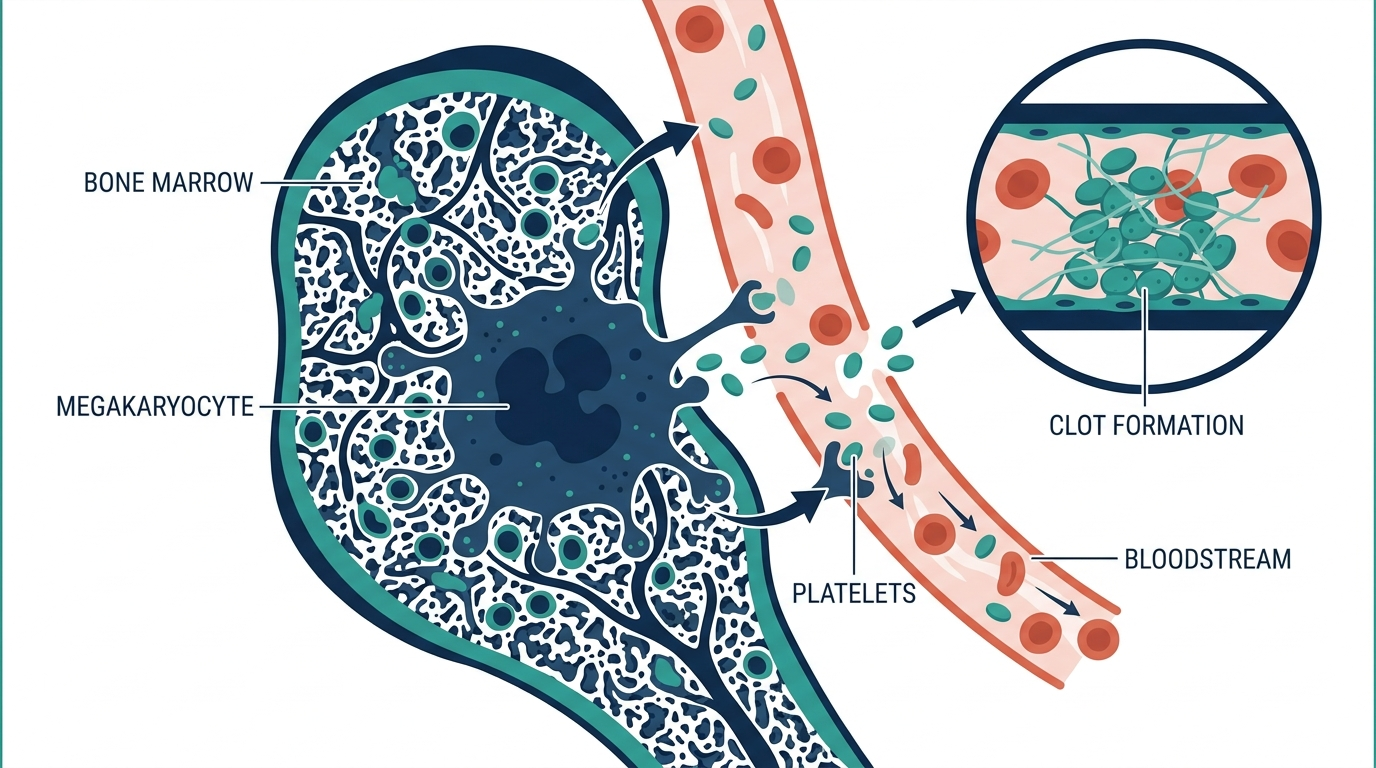
A normal platelet count in adults is 150,000 to 450,000 platelets per microliter (mcL) of blood, per Cleveland Clinic. The same value is often written as 150 to 450 x10⁹/L, which is identical, just different units. Platelets, also called thrombocytes, are the smallest blood cells and their job is to clump together and form clots that stop bleeding (MedlinePlus).
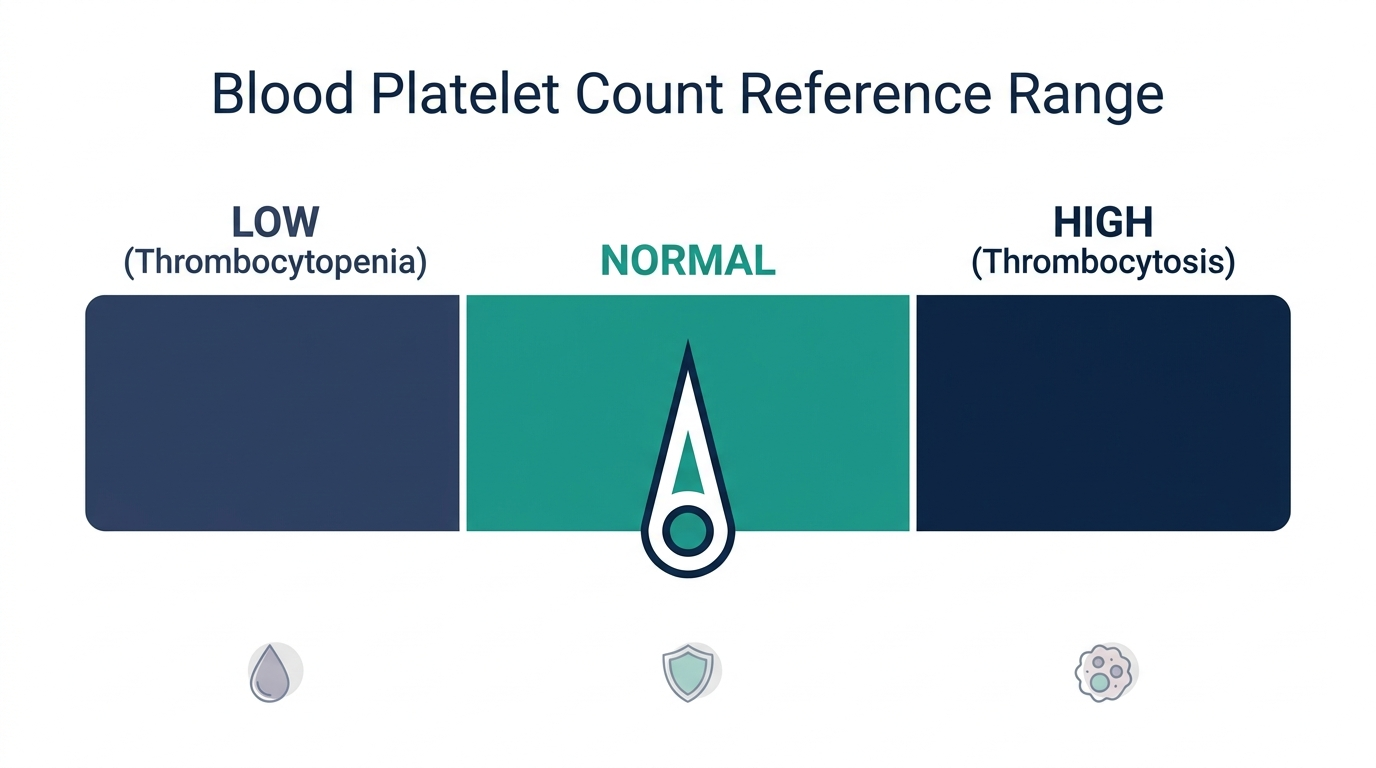
This 150 to 450 range is a statistical reference interval, meaning it covers the central 95 percent of healthy people. About 1 in 20 perfectly healthy individuals will fall slightly outside it without anything being wrong. That is exactly why a single number near the edge matters far less than the trend over time and the rest of your complete blood count (CBC). Two terms describe results outside the band: thrombocytopenia means a low count under 150,000, and thrombocytosis means a high count over 450,000 (Cleveland Clinic).
It helps to know what these cells actually do before you judge a number. Platelets have no nucleus and live only about 8 to 10 days in circulation, so your marrow replaces the entire platelet population roughly every week. At any moment about a third of your platelets are not in the bloodstream at all: they sit pooled in the spleen and are released when the body needs them (StatPearls). That reservoir is part of why an enlarged spleen can drag a count down and why hard exercise or acute stress can briefly lift it. The count on your report is really a balance between marrow output, spleen storage, and how fast platelets are being used up.
Most modern lab reports pair the raw count with a second platelet figure: mean platelet volume, or MPV, the average size of your platelets. Younger, freshly released platelets are larger, so a rising MPV often signals that the marrow is pushing out new platelets to replace losses, while a low MPV can point to reduced production. The typical MPV band runs roughly 7 to 12 femtoliters, but this varies by analyzer, so read it against your own lab’s printed range rather than a universal cutoff. On its own MPV rarely changes management, yet paired with the count it hints at whether a low reading is a production problem or a destruction problem.
Platelets normal range by age
The simplest way to actually get this done
Superpower is a full-body lab membership that runs 100+ biomarkers, has each result reviewed by a doctor, and tracks your numbers year over year (about $199/year). It is what we point readers to when they would rather get one clean, complete draw than chase single tests one at a time. Here is superpower reviewed in full.
Platelet counts are highest in childhood and drift downward with age, so a single adult range misreads both ends of life. In a population study of 40,987 people, children under 15 averaged higher counts (about 176 to 452 x10⁹/L) than adults over 64 (Biino et al., Haematologica, 2013). The table below pairs the widely used clinical adult range with age and sex specific values from that large dataset.
| Age group | Sex | Reference range (x10⁹/L) | Same value (platelets/mcL) |
|---|---|---|---|
| Newborns and neonates | All | About 135 to 430 | 135,000 to 430,000 |
| Children under 15 | All | 176 to 452 | 176,000 to 452,000 |
| Adults 15 to 64 | Women | 156 to 405 | 156,000 to 405,000 |
| Adults 15 to 64 | Men | 141 to 362 | 141,000 to 362,000 |
| Adults over 64 | Women | 140 to 379 | 140,000 to 379,000 |
| Adults over 64 | Men | 122 to 350 | 122,000 to 350,000 |
| General adult (lab standard) | All | 150 to 450 | 150,000 to 450,000 |
A few notes on reading this table. The age and sex specific ranges come from Biino et al. (Haematologica, 2013), a study of 40,987 subjects; the neonatal band reflects multihospital neonatal data (5th to 95th percentile); and the general adult range is the standard Cleveland Clinic clinical cutoff your lab most likely uses. Healthy newborns can briefly spike above 500,000 during normal early growth (StatPearls), which is why infant results need a pediatric eye rather than the adult ruler.
One nuance the table cannot show is direction of travel. A count sitting at 155 x10⁹/L means one thing if it has been stable there for years and something very different if it has slid from 300 over six months. The lab prints a static snapshot, but clinicians read platelets as a trend line. If you have older results, line them up before you decide a single value is abnormal. The change from your own baseline is often more informative than where you land inside a population band, because your personal setpoint may sit anywhere within that wide interval and still be perfectly healthy for you.
How does sex change the range?
Sex shifts the platelet range modestly but consistently: across adult age bands, women run higher than men by roughly 15 to 30 x10⁹/L at both ends of the interval (Biino et al., Haematologica). For example, among 15 to 64 year olds, women span 156 to 405 x10⁹/L while men span 141 to 362 x10⁹/L. The gap persists after 64 as well.
The leading explanation is iron status and menstruation. Iron deficiency, more common in menstruating women, nudges platelet production upward, and estrogen also appears to influence platelet biology. The practical upshot: a count of 400,000 is comfortably normal for a young woman but sits at the very top edge for an older man. This is one reason a result that triggers a flag on a generic adult range may still be normal for you once sex and age are factored in. If your report does not break ranges down this way, your clinician can.
How is a platelet count measured, and what can skew it?
Almost every platelet count today comes from an automated hematology analyzer that sizes and tallies cells as they stream past a sensor. The technology is fast and accurate for typical blood, but it has predictable blind spots, and knowing them saves a lot of unnecessary worry over a flagged result.
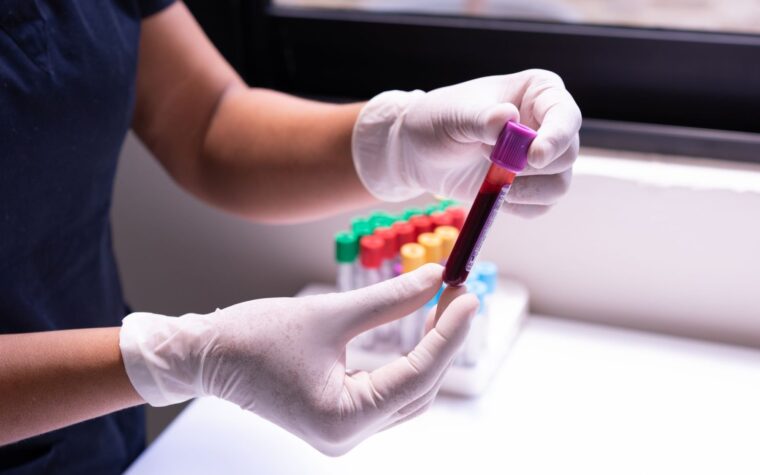
The most common false alarm is EDTA-dependent pseudothrombocytopenia. The purple-top tube used for a CBC contains EDTA to keep the blood from clotting, and in a small number of people that additive makes platelets clump together inside the tube. The analyzer reads each clump as one large object, or skips it, so the machine reports a low count even though the person’s true count is normal. The tell is a low result with no bleeding, no bruising, and no other CBC abnormality. The fix is straightforward: redraw into a different tube, usually citrate, or examine a blood smear under the microscope, where the clumps are obvious.
A few other technical factors move the number without any real change in your body:
- Clumping and micro-clots: a slow or difficult draw can start tiny clots in the tube that consume platelets, falsely lowering the count.
- Giant platelets: unusually large platelets, seen in some inherited traits and after brisk marrow output, can be sized as red or white cells by the analyzer and undercount the total.
- Recent hard exercise: vigorous activity mobilizes the spleen’s platelet reserve and can lift a count modestly for a short time.
- Hydration and posture: dehydration concentrates the blood and can nudge counts up, while being well hydrated gives a truer reading.
None of these require fasting, and there is no special preparation for a platelet count. If a result surprises you or your clinician, the standard move is not to treat it but to repeat it, ideally with a fresh draw and a look at the smear. A genuinely abnormal platelet count almost always reproduces on a second sample; an artifact usually vanishes.
What makes platelets rise or fall with age?
Platelet counts decline gradually across the lifespan because bone marrow output softens and the marrow becomes less cellular with age, which is why older men in particular show the lowest reference values, down to about 122 x10⁹/L at the low end (Biino et al., Haematologica). This is a population trend, not a disease.
Beyond the slow age drift, several everyday factors move platelets up or down in the short term:
- Reactive rises: infection, inflammation, recent surgery, vigorous exercise, and iron deficiency can all push counts up temporarily (StatPearls).
- Pregnancy: counts often fall somewhat, a pattern called gestational thrombocytopenia, usually mild and benign (MedlinePlus).
- Medications and alcohol: some drugs and heavy alcohol use lower platelet production or survival.
- Spleen and marrow conditions: an enlarged spleen traps platelets, while marrow disorders reduce how many are made.
Because so many transient things move the number, clinicians rarely act on one borderline reading. They repeat the test and look at the pattern.
Reactive versus clonal: why the cause matters more than the number
When a count runs high, clinicians sort the cause into two buckets. Reactive, or secondary, thrombocytosis is by far the more common. The marrow is simply responding to something else: iron deficiency, infection, inflammation, recent surgery or blood loss, or the rebound after a low count recovers. Treat the underlying trigger and the platelets settle. Clonal, or primary, thrombocytosis, such as essential thrombocythemia, is a marrow disorder in which platelet production runs on its own, often pushing counts well above 600,000 and sometimes past a million. The two look identical on the raw number, which is why a persistently high count gets worked up with iron studies, inflammatory markers, and sometimes genetic testing rather than acted on blindly.
Low counts split the same way. Reduced production from certain medications, alcohol, viral infection, B12 or folate deficiency, or marrow disease is a different problem from increased destruction or sequestration, as happens in immune thrombocytopenia, an enlarged spleen, or a clotting disorder that consumes platelets. The MPV and the blood smear help point to which is happening, which is one more reason the platelet count is rarely read in isolation.
When is an out-of-range result a concern?
An out-of-range platelet count is a prompt to investigate, not an automatic diagnosis, and the degree of abnormality matters more than crossing the line by a little. A mildly low count of 140,000 in an older man may be his normal, whereas a count under 50,000 raises real bleeding risk and a count under 20,000 can cause spontaneous bleeding (Cleveland Clinic).
Seek prompt medical attention if a low count comes with warning signs: easy bruising, tiny red or purple skin spots (petechiae), bleeding gums or nosebleeds, blood in urine or stool, or unusually heavy periods. On the high side, very elevated counts can paradoxically raise clotting risk, so symptoms like headache, dizziness, or chest pain alongside a high count deserve evaluation (Cleveland Clinic). For any result your lab flags, the right next step is the same: do not self-interpret the number in isolation. Bring it to a clinician who can repeat the test, compare it to your past results, and read it next to the rest of your CBC.
What to do next if your count is flagged
For most people a single mildly abnormal platelet count follows a predictable path, and knowing it removes the fear of the flag:
- Repeat the test. A borderline count, high or low, is usually rechecked in a few weeks unless it is severe or you have symptoms. Many flags resolve on the redraw.
- Check the obvious drivers. For a high count, iron studies and inflammatory markers catch the common reactive causes. For a low count, a look at your medications, alcohol intake, and recent infections often explains it.
- Ask for the smear. A pathologist reviewing your blood film can spot clumping, giant platelets, and other cell clues in minutes, and it settles many artifact questions on the spot.
- Read it with the rest of the CBC. An isolated platelet change is reassuring; a platelet change alongside abnormal red or white cell counts raises the priority and points attention toward the marrow.
Severe numbers change the timeline. A count under 20,000, any active bleeding, or a very high count with clotting symptoms is not a wait-and-recheck situation. It needs same-day assessment (Cleveland Clinic).
Two real reading scenarios
Numbers make more sense in context, so here are two everyday situations that show why the same count can mean opposite things.
Scenario one: the low that is not low. A 71-year-old man sees 138,000 on his report, flagged in red against the 150,000 floor. He feels well, bruises no more than usual, and his last three counts over five years all sat between 135,000 and 150,000. Read against the older-men reference band, which dips to about 122 x10⁹/L, this is his stable normal, not thrombocytopenia. The right move is to note the trend and carry on, not to chase a phantom problem.
Scenario two: the high worth watching. A 34-year-old woman with heavy periods shows 465,000, just over the line. She is tired and slightly short of breath on stairs. Here the elevated count is most likely reactive thrombocytosis driven by iron deficiency from menstrual blood loss, a classic pairing. The platelet number itself needs no treatment; correcting the iron does, and the platelets typically drift back into range once iron stores refill. Two flagged results, two completely different stories, and neither is readable from the number alone.
Don’t just read about your health, track it.
A single result is a snapshot. Superpower re-tests 100+ markers over time so you can watch them move as you change sleep, food, and training.
Frequently asked questions
Is a platelet count of 450,000 normal?
Yes. 450,000 platelets per microliter sits at the top of the standard adult reference range of 150,000 to 450,000 (Cleveland Clinic). It is considered the upper limit of normal, not high. Your clinician may simply recheck it to confirm the trend.
What platelet count is dangerously low?
Bleeding risk rises as counts fall. A count under 50,000 can increase bleeding, and a count under 20,000 may cause spontaneous bleeding and is considered dangerous (Cleveland Clinic). Counts in this range warrant urgent medical evaluation.
Do platelet counts decrease with age?
Yes, modestly. Population data show counts drift downward with age, with older men reaching the lowest reference values, about 122 to 350 x10⁹/L after age 64, compared with 176 to 452 in children (Biino et al., Haematologica). This is a normal trend, not disease.
Why are platelet counts higher in women?
Women average higher counts than men by roughly 15 to 30 x10⁹/L across adult ages (Biino et al., Haematologica). Iron loss from menstruation and the effect of estrogen on platelet production are the main reasons behind this consistent sex difference.
What is a normal platelet count for a newborn?
Newborns generally fall around 135,000 to 430,000 per microliter, and healthy infants can briefly spike above 500,000 during early growth (StatPearls). Infant results should be read against pediatric ranges, not the adult cutoffs, to avoid false alarms.
Does dehydration affect a platelet count?
It can, slightly. Dehydration concentrates the blood, which can nudge the platelet count and other cell counts upward, while being well hydrated gives a truer reading. The effect is small, but it is one more reason a single borderline-high result is usually rechecked rather than acted on.
What does MPV mean on my platelet report?
MPV stands for mean platelet volume, the average size of your platelets. Larger, younger platelets raise the MPV and often signal that your marrow is actively replacing platelets, while a low MPV can suggest reduced production. It is most useful read alongside the count, not on its own, and the normal band varies by lab, so compare it to your report’s printed range.
Do I need to fast before a platelet count?
No. A platelet count needs no fasting and no special preparation. If your platelets are drawn as part of a wider panel that also checks glucose or cholesterol, you may be asked to fast for those other tests, but the platelet number itself is not affected by a recent meal.
Can I raise a low platelet count with food?
Diet alone rarely moves a genuinely low count, because the cause is what matters. If low B12, folate, or iron is behind it, correcting that can help, and treating an underlying infection or stopping a triggering medication often does more than any food. There is no single food that reliably raises platelets, so a low count is worth investigating rather than self-treating with supplements. Our guide on how to increase platelets covers the evidence in detail.
Sources
- Cleveland Clinic, Platelet Count (PLT)
- Cleveland Clinic, Thrombocytopenia
- Biino et al., Age- and Sex-Related Variations in Platelet Count, Haematologica (PMC)
- MedlinePlus, Platelet Tests
- StatPearls, Physiology, Platelet (NCBI Bookshelf)
- Cleveland Clinic, Complete Blood Count (CBC)
This article is for general educational purposes and is not medical advice. It cannot diagnose or treat you and does not replace your clinician. Always discuss your lab results and any health decisions with a qualified healthcare professional.
Related: best at-home biomarker tests of 2026.
Vital Signs Today may earn a commission if you buy through links on this page. It does not affect our editorial assessments.