Part of our Complete Blood Count guide.
You scanned your blood work, hit the row marked PLT, saw a big number in the hundreds of thousands, and figured it was fine because nothing was flagged. Fair enough. But PLT is one of the most action oriented numbers on the whole panel, because platelets are the cells that decide whether you bleed too much or clot too easily. When this number drifts, your body is telling you something about bone marrow, infection, inflammation, or even how your blood sample was handled at the lab.
Most explainers stop at “platelets help you clot.” That is true and also the least interesting part. Here is the fuller picture, including a quirk that sends thousands of healthy people for unnecessary testing every year.
What is PLT in a blood test?
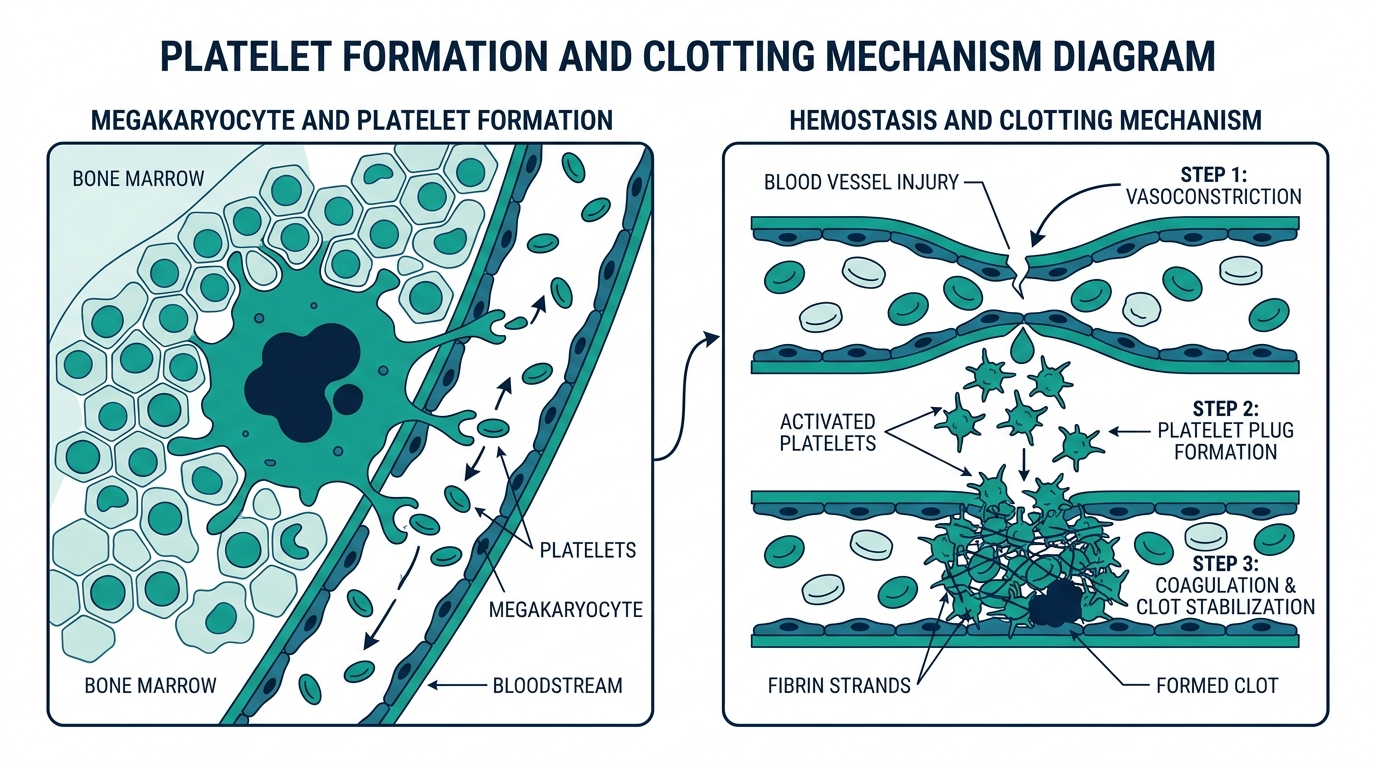
PLT stands for platelet count, and it measures the number of platelets in your blood. Platelets are tiny cell fragments made in your bone marrow whose main job is to clump together and form clots that stop bleeding (Cleveland Clinic). The result is reported automatically as part of a standard complete blood count, or CBC, and it is usually given as platelets per microliter of blood.
So when someone asks what is PLT in a blood test, the short answer is this: it is a headcount of your clotting cells. Too few and you bruise and bleed easily. Too many and your blood can clot when it should not. That single number sits at the center of how your body balances bleeding against clotting.

What does PLT actually measure?
PLT counts how many platelets are circulating in a set volume of your blood, nothing more and nothing less. It does not measure whether those platelets work properly. That is a separate test called a platelet function test (MedlinePlus). You can have a perfectly normal PLT number and still have platelets that do not clot well, which is why your clinician sometimes orders more than just the count.
Platelets form in your bone marrow from giant parent cells called megakaryocytes, then live in your bloodstream for about a week to ten days before your spleen and liver clear them out. Your PLT result is a snapshot of that constant production and turnover. A platelet count is most often used to monitor or diagnose conditions that cause too much bleeding or too much clotting (MedlinePlus), and it is also tracked closely during chemotherapy and other treatments that hit the bone marrow.
What is a normal PLT level?
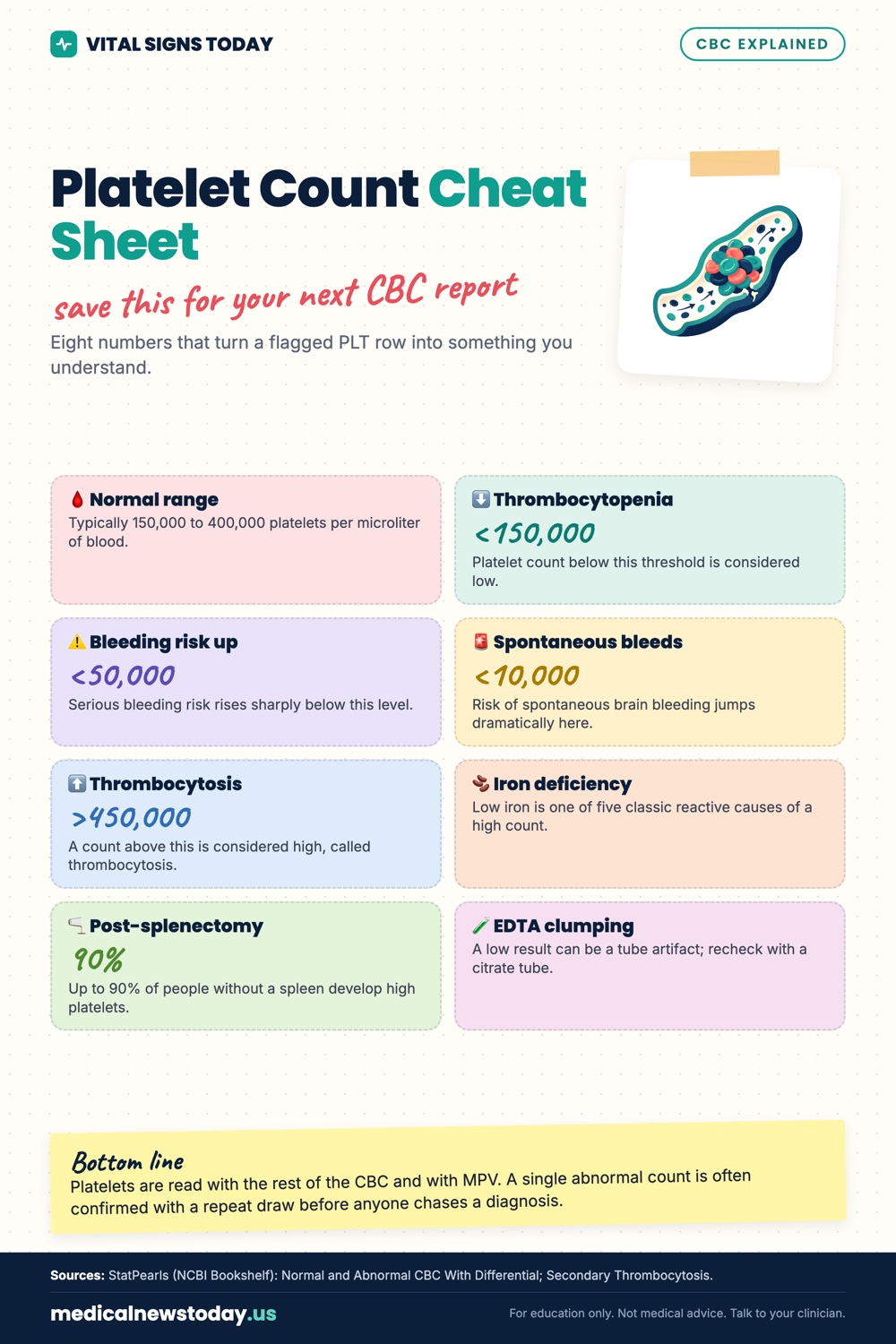
A normal platelet count is generally 150,000 to 400,000 platelets per microliter of blood (Cleveland Clinic). You may also see this written as 150 to 400 x 10^9 per liter, which is the same thing on a different scale. Some labs extend the upper end to around 450,000, so the exact cutoff varies slightly by laboratory and instrument.
The practical takeaway is simple. Below 150,000 is considered low and is called thrombocytopenia. Above the upper limit is considered high and is called thrombocytosis. Always read your result against the reference range printed on your own report, because that is the range your lab actually calibrated its machines to.
What does a high PLT mean?
A high PLT, generally above 400,000 to 450,000 per microliter, means you have more platelets than usual, a state called thrombocytosis. On its own it is a clue, not a diagnosis, and it points to a short list of common causes (Cleveland Clinic):
- Reactive thrombocytosis, the most common type, where the count rises in response to something else such as infection, inflammation, recent surgery, or iron deficiency.
- Recent significant blood loss, which prompts the marrow to ramp up production.
- Cancer, including some solid tumors that drive platelet production, and inflammatory bowel disease (MedlinePlus).
- A bone marrow disorder such as essential thrombocythemia, where the marrow makes too many platelets on its own.
Why it matters: when platelets pile up, they can clump and form clots where you do not need them, raising the risk of dangerous clots, heart attack, or stroke (Cleveland Clinic). The vast majority of high counts are reactive and settle once the underlying trigger clears, but a persistently high number is worth chasing down rather than ignoring.
What does a low PLT mean?
A low PLT, generally below 150,000 per microliter, means you have fewer platelets than usual, a state called thrombocytopenia. Because platelets are what stop bleeding, a low count can cause you to bleed too much after a cut or other injury (MedlinePlus). Common causes include viral infections, autoimmune diseases, leukemia and other bone marrow problems, cirrhosis of the liver, certain medications, and vitamin B12 deficiency.
How low matters a great deal. A mildly reduced count rarely causes symptoms. But once platelets fall below roughly 50,000 per microliter, the risk of bleeding during normal daily activities rises sharply (Cleveland Clinic). Warning signs of a meaningfully low count include easy bruising, tiny red or purple spots on the skin called petechiae, bleeding gums, nosebleeds, and bleeding that takes a long time to stop.
Why is PLT read together with MPV?
PLT tells you how many platelets you have, but it does not tell you their size or how fast your marrow is replacing them. That is why clinicians often read it next to MPV, the mean platelet volume, which measures the average size of your platelets (Cleveland Clinic). Think of PLT as the count and MPV as the size, and together they sketch a fuller picture of platelet health.
The pairing helps explain the cause of a low count. A low PLT with a high MPV often means the marrow is working hard, pumping out fresh, larger platelets to replace ones that are being destroyed or used up faster than normal. A low PLT with a low or normal MPV points more toward a marrow that is not producing enough in the first place (Cleveland Clinic). One number tells you the headcount; the other hints at whether the factory is running overtime or shutting down.
Can a low PLT be a lab artifact rather than a real problem?
Yes, sometimes it can, and this is the detail that rarely reaches the patient version, so it can save you a frightening week. A surprising number of “low platelet” results are not real. They are a laboratory artifact called EDTA dependent pseudothrombocytopenia, and they happen because of the chemical in the standard blood collection tube, not because of anything in your body.
Most CBC tubes contain an anticoagulant called EDTA. In a small slice of people, EDTA triggers their platelets to clump together inside the tube. The automated analyzer cannot count clumps, so it reads them as missing, and the machine reports a falsely low platelet count even though the person has plenty of healthy platelets (PMC, EDTA-induced pseudothrombocytopenia). This is not rare in the way you might assume. The reported prevalence runs from about 0.1 to 2 percent of hospitalized patients and can reach as high as 17 percent in some outpatient groups (PMC, EDTA-induced pseudothrombocytopenia).
The fix is cheap and fast. If you have an isolated low PLT with no bruising or bleeding, a smart next step is a peripheral blood smear, where a technician looks at the blood under a microscope and spots the platelet clumps directly, plus a repeat draw using a different anticoagulant such as sodium citrate. If the count comes back normal in the citrate tube, the EDTA was the villain all along (PMC, EDTA-induced pseudothrombocytopenia). Failing to recognize this leads to expensive, invasive, and entirely unnecessary workups. So if a single low platelet count surprises you and you feel completely well, ask whether clumping has been ruled out before anyone panics.

Can PLT predict more than bleeding and clotting?
Increasingly, yes. Platelet count is turning out to be a quiet prognostic signal, not just a bleeding and clotting gauge. A large study of people who had an ischemic stroke or TIA found that platelet count predicted outcomes even within the normal range. Patients in the higher platelet group had a meaningfully greater risk of recurrent stroke and all cause death, while both the high and low ends were tied to worse functional recovery, forming a U shaped pattern (PMC, platelet count and stroke outcomes).
The likely reason is that platelets are not just clotting cells. They are active players in inflammation and in the buildup of arterial plaque, so a platelet count drifting toward the edges of normal may quietly reflect the same underlying processes that drive cardiovascular disease. Researchers like PLT for this role because it is cheap and universally available (PMC, platelet count and stroke outcomes). You will not get a diagnosis from one platelet number, but it is a reasonable reason to look at the trend over time rather than scroll past a result that sits inside the reference range.
Bleeding risk by platelet count: what the numbers mean in practice
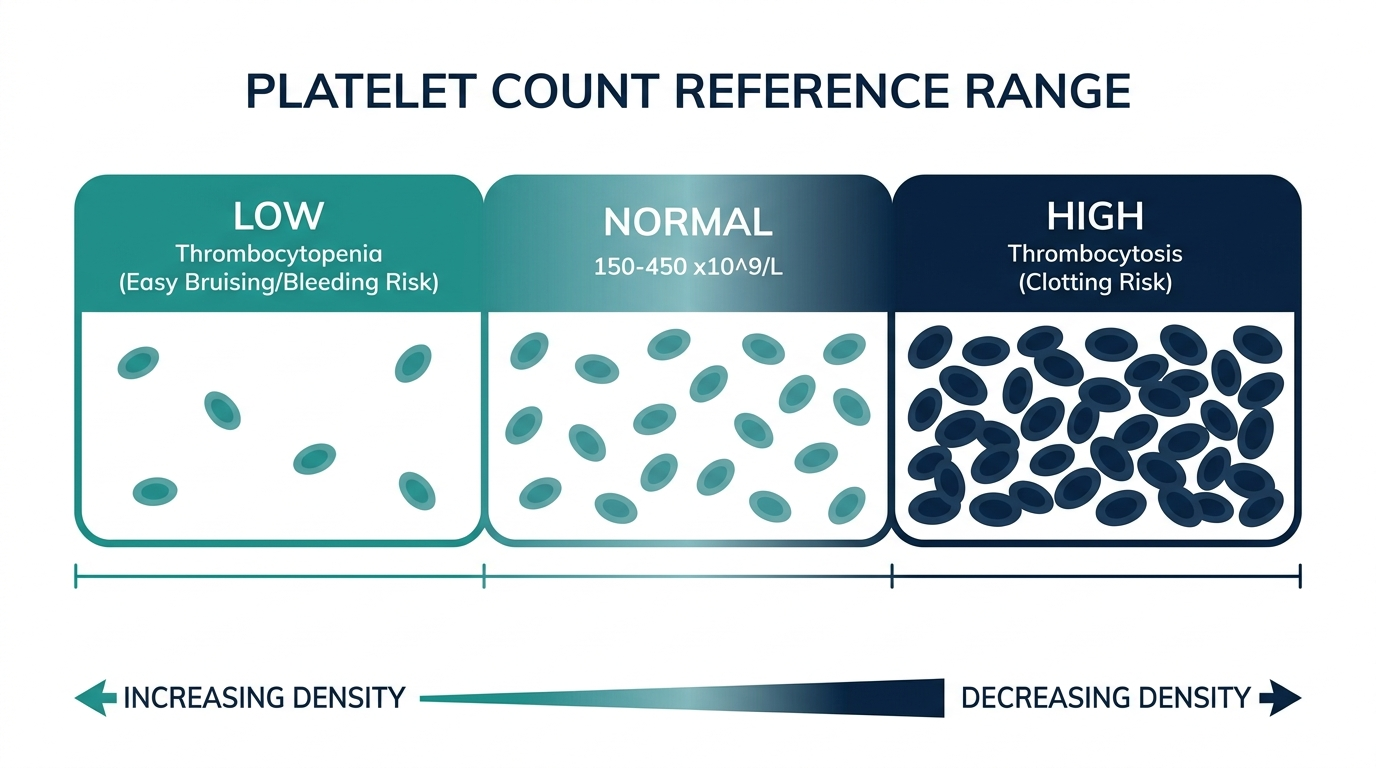
The single most useful thing to understand about a low platelet count is that the number itself maps roughly onto how much bleeding risk you carry. A count of 149,000 and a count of 15,000 both read as low, but they live in completely different worlds. Here is the general framework clinicians use, keeping in mind that individual risk also depends on why the count is low and what medications you take.
| Platelet count (per microliter) | General practical meaning |
|---|---|
| 100,000 to 150,000 | Mildly low, usually no symptoms, often monitored and rechecked |
| 50,000 to 100,000 | Bleeding still uncommon with everyday activity, but caution with surgery or injury |
| 20,000 to 50,000 | Higher risk of bleeding with trauma; easy bruising more likely |
| Below 20,000 | Risk of spontaneous bleeding rises; medical attention warranted |
| Below 10,000 | Significant risk of serious spontaneous bleeding; urgent |
This is why the exact number matters, not just the word low. A count of 130,000 with no symptoms is a very different conversation from a count of 12,000. The symptoms to watch for as the count falls are easy bruising, pinpoint red or purple spots called petechiae, bleeding gums, frequent nosebleeds, blood in urine or stool, and unusually heavy menstrual bleeding. Bleeding that will not stop, blood in the stool or urine, or any bleeding with a very low count are reasons to seek care promptly.
A closer look at what drives PLT up or down
Because platelets are made in the marrow, used up in clotting, and cleared by the spleen, the count moves whenever any of those three processes changes. Sorting causes by mechanism makes an abnormal result far less mysterious.
Reasons a count runs high (thrombocytosis):
- Reactive causes, the most common by far: infection, inflammation, tissue injury, recent surgery, and iron deficiency anemia, which paradoxically pushes platelets up
- Recovery after major blood loss, when the marrow overshoots
- Removal of the spleen, since the spleen normally stores a share of your platelets
- Bone marrow disorders such as essential thrombocythemia, which are less common but more persistent
Reasons a count runs low (thrombocytopenia):
- Decreased production: leukemia and other marrow disorders, chemotherapy, radiation, alcohol excess, and deficiencies of vitamin B12 or folate
- Increased destruction: immune thrombocytopenia, some viral infections, and certain medications that trigger the immune system to clear platelets
- Sequestration: an enlarged spleen, often from liver disease such as cirrhosis, traps platelets away from the circulation
- Dilution or consumption: massive bleeding, transfusion, or widespread clotting can use platelets up faster than they are replaced
Medications deserve a special mention because they are a common and reversible cause. Heparin, certain antibiotics, some anti-seizure drugs, and quinine are among the agents known to lower platelet counts in susceptible people, which is why a full medication review is part of any workup for a new low count.
Immune thrombocytopenia: the common cause of an isolated low count
When a healthy person turns up with a genuinely low platelet count and everything else on the CBC is normal, one of the frequent explanations is immune thrombocytopenia, or ITP. In ITP the immune system mistakenly tags platelets for destruction, so the marrow is making them fine but they are cleared too fast. It can follow a viral illness, particularly in children, where it often resolves on its own, and it can be more chronic in adults.
The reason ITP is worth knowing about is that it is a diagnosis of exclusion. There is no single test that confirms it. Clinicians reach it after ruling out other causes, including the platelet clumping artifact discussed earlier, medication effects, and marrow disorders. Mild ITP with no bleeding is often simply monitored, while lower counts or active bleeding may prompt treatment. If you are told you may have ITP, the key questions are how low the count is, whether you are bleeding, and whether other causes have been excluded.
How to prepare, and what can move the number
A platelet count is part of a routine CBC and does not require fasting or special preparation. A few factors are still worth knowing so you read a result fairly:
- The collection tube: as covered above, EDTA in the standard tube can cause platelet clumping in some people and a falsely low count. A repeat in a citrate tube resolves it.
- Recent exercise: vigorous activity can transiently raise the platelet count.
- Recent illness or inflammation: can push a reactive count up for days to weeks.
- Pregnancy: platelet counts commonly drift modestly lower in pregnancy, which is usually benign.
- Time and trend: because platelets live only about a week to ten days, the count can move noticeably between draws. A single value means less than the direction across several.
What to do after an abnormal PLT, and how often to retest
An out-of-range platelet count is a prompt to look closer, and the sensible steps depend on how far out of range it is and whether you have symptoms.
- Isolated mild abnormality, no symptoms: usually confirmed with a repeat CBC and a look at the smear. For a low count, ruling out clumping comes first.
- Read it with the rest of the CBC. Whether red cells and white cells are also abnormal tells the team if this is an isolated platelet issue or a whole-marrow problem, which changes the urgency completely.
- Persistent or marked abnormality: may lead to iron studies, B12 and folate testing, autoimmune screening, or referral to a hematologist.
- Monitoring cadence: people on chemotherapy or with a known platelet disorder are retested frequently, sometimes weekly, while a mild incidental finding in a well person is often simply rechecked in a few weeks to confirm it is stable.
The recurring lesson with PLT is the same one that runs through the whole complete blood count. A single number inside or just outside the range is a starting point, not a verdict. Confirm a surprise with a repeat draw, read the count alongside MPV and the rest of the CBC, and pay attention to the trend over time, because the direction the number is moving usually says more than the value on any one report.
How the platelet count shifts across pregnancy and age
The reference range for platelets does not move much across adulthood, but two situations reliably pull the number down without signaling danger, and knowing them saves a lot of unnecessary alarm. The first is pregnancy. Platelet counts drift lower as pregnancy progresses, and a mild dip below the usual floor is common and benign in an otherwise healthy expectant mother, a pattern clinicians call gestational thrombocytopenia. It typically stays in the moderately low band, causes no bleeding, and resolves on its own after delivery. What separates it from a problem that needs attention is context: it appears without other abnormal counts, without symptoms, and without a steep downward slide. A count that keeps falling, or that arrives with high blood pressure, headaches, or abnormal liver numbers, is a different conversation and needs prompt evaluation.
Age matters in a quieter way. Platelet counts in healthy older adults tend to sit a little lower on average than in young adults, so a value near the bottom of the range in someone in their seventies is often just their normal, not a new disease. Newborns and young children, by contrast, can run counts at the higher end and still be perfectly well. Because of this drift, the smartest reading of a platelet number always asks who the person is and what their own baseline has been, rather than treating a single printed range as the whole story.
Common misconceptions about the platelet count
The first misconception is that a low platelet count automatically means you are about to bleed. In reality, spontaneous bleeding is uncommon until the count falls well below the low end of normal, and many people with mildly reduced counts have no bleeding tendency at all. The number sets a risk backdrop, not a verdict. The second is the mirror image: that a high count means dangerous clotting is imminent. Most mildly elevated counts are reactive, a temporary response to infection, inflammation, iron deficiency, or recovery from bleeding, and they settle once the trigger passes.
A third misconception is that one abnormal platelet result must be acted on immediately. Because clumping in the tube and other collection quirks can falsely lower the count, a lone abnormal value is often best confirmed with a repeat draw and a look at the blood film before anyone reaches for a diagnosis. Finally, many assume platelet supplements or specific foods can raise a genuinely low count. Nutrition supports normal marrow function, but no diet reliably corrects true thrombocytopenia, and the real fix depends entirely on the cause. Treat the driver, and the count follows.
Frequently asked questions
What does PLT mean in a blood test?
PLT means platelet count, the number of platelets in your blood. Platelets are cell fragments that clump together to form clots and stop bleeding, and the count is reported as part of a standard CBC (Cleveland Clinic).
What is a normal PLT level?
A normal platelet count is generally 150,000 to 400,000 platelets per microliter of blood, though some labs extend the top of the range to around 450,000 (Cleveland Clinic). Compare your result to the reference range printed on your own report.
Should I worry about a low PLT?
A mildly low platelet count often causes no symptoms, but the bleeding risk rises sharply once it drops below about 50,000 per microliter (Cleveland Clinic). An isolated low result in someone who feels well can also be a lab artifact from platelet clumping, so ask whether that has been ruled out (PMC).
What does a high PLT mean?
A high platelet count, called thrombocytosis, most often reflects something else such as infection, inflammation, iron deficiency, or recent blood loss, and less often a bone marrow disorder. A persistently high count can raise clotting risk and is worth investigating (Cleveland Clinic).
Why is PLT measured with MPV?
PLT counts your platelets while MPV measures their average size, so reading them together helps show whether a low count comes from rapid destruction or low production (Cleveland Clinic).
This article is for general educational purposes and is not medical advice. It cannot diagnose or treat you and does not replace your clinician. Always discuss your lab results and any health decisions with a qualified healthcare professional.
Vital Signs Today may earn a commission if you buy through links on this page. It does not affect our editorial assessments.