
Last updated 18 June 2026. Educational content, not medical advice. Talk to a licensed clinician before starting any supplement regimen, especially if you have a health condition or take medications.
Short answer: Take one scoop (10 g) to two scoops (20 g) of Vital Proteins Collagen Peptides daily, dissolved in 8 to 12 oz of any liquid. For joint and connective-tissue goals, a 2017 study by Dr. Keith Baar at UC Davis found that consuming 15 g of collagen with 50 mg of vitamin C roughly 60 minutes before exercise boosted collagen synthesis markers significantly more than taking it at random times. For skin goals, most placebo-controlled trials show measurable improvements in elasticity and hydration starting at 8 weeks of daily use, with the clearest results appearing around the 12-week mark.
Collagen can support joints and skin, but it can’t tell you what’s actually happening inside your body. Want to see your real numbers? One at-home Superpower draw checks 100+ biomarkers, physician-reviewed.
Why are so many people confused about how to use collagen peptides?
The supplement aisle answer is simple: “add one scoop to your coffee.” But that two-second instruction buries a handful of details that actually change whether you see results. Do you take it before or after a workout? Hot or cold liquid? With food or on an empty stomach? Does vitamin C really matter? What about the claim that boiling coffee destroys the peptides?
Confusion is also driven by the fact that Vital Proteins sells several different collagen products, each with slightly different formulas, and the instructions on each container are nearly identical. This article walks through the science behind each decision, so you are not just following the scoop on autopilot.
What is in Vital Proteins Collagen Peptides, exactly?
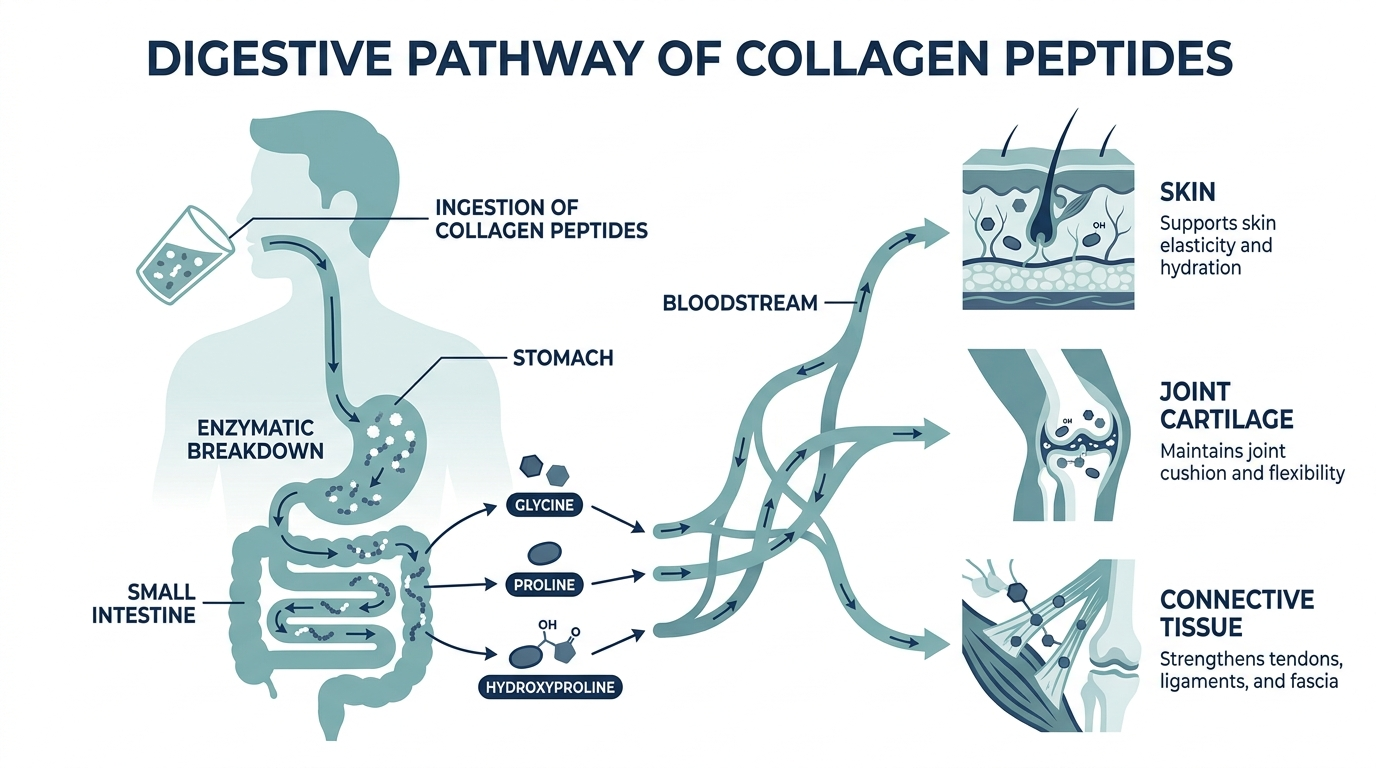
The original Vital Proteins Collagen Peptides powder has a single ingredient: hydrolyzed bovine collagen peptides sourced from grass-fed, pasture-raised bovine hides. One serving is 20 g (roughly two level scoops), delivering 18 g of protein and a concentrated dose of the three amino acids that are almost exclusive to collagen: glycine, proline, and hydroxyproline.
Glycine makes up about one-third of collagen’s amino acid profile. Proline accounts for roughly 15%. Hydroxyproline, formed when vitamin C hydroxylates proline residues after the peptide chain is assembled, is the structural lock that gives the collagen triple helix its tensile strength. This amino acid profile is what separates collagen from whey or plant protein, neither of which delivers meaningful amounts of hydroxyproline.
The “Advanced” version of the same product adds 80 mg of vitamin C and 80 mg of hyaluronic acid per serving, pricing it at $49.99 for 20 oz (27 servings) directly from Vital Proteins. The original unflavored 20 oz runs the same retail price. At Costco, the 1.5-lb (24 oz) bag has been available for $23.99 to $29.99 for members, making per-gram cost considerably lower.
Vital Proteins was acquired by Nestlé Health Science in 2022 and is now backed by a corporate distribution footprint that puts it in over 35,000 retail doors, including Whole Foods, Costco, Target, and Walgreens. That scale matters for quality consistency, because every batch is subject to larger-company QC standards than a small-brand startup operates under.
How much should you actually take?
Vital Proteins recommends one serving per day, which it defines as 20 g (approximately four level tablespoons or two rounded scoops). The brand also offers a personalized “Collagen Calculator” that adjusts the recommendation by age, sex, and dietary protein intake, though it has not published the underlying formula.
Clinical research supports a range rather than a single magic number:
-
Skin outcomes: The majority of placebo-controlled trials showing significant improvements in skin elasticity and hydration have used doses between 2.5 g and 10 g per day. A 2025 randomized controlled trial published in the Journal of Clinical Medicine found that 10 g of hydrolyzed collagen peptides daily for 8 weeks produced significant improvements in skin elasticity (p = 0.009), hydration, and roughness in 112 female participants. A 2026 study found significant increases in dermal density and moisture content at 12 weeks with 5,000 mg (5 g) per day.
-
Joint and connective-tissue outcomes: Research from Penn State (a study published in Current Medical Research and Opinion by Shaw et al.) showed athletes taking 10 g of collagen daily for 24 weeks reported reduced knee-joint pain at rest and activity compared to placebo.
-
Tendon and ligament outcomes: The Baar protocol, which is now the most-cited practical approach in the sports-medicine community, uses 15 g per dose taken 60 minutes pre-exercise, not as a daily background supplement.
Do not believe the common claim that “more is always better” with collagen. A 2022 study published in the Journal of Nutrition found that 30 g of hydrolyzed collagen post-exercise raised collagen synthesis markers in resistance-trained men compared to 15 g, but the difference between 15 g and 30 g was small relative to the difference between 0 g and 15 g. Past a certain threshold, you are mostly paying for additional protein with diminishing structural returns.
When is the best time to take it?
The timing question has a real answer that most collagen content glosses over, and it depends on your goal.
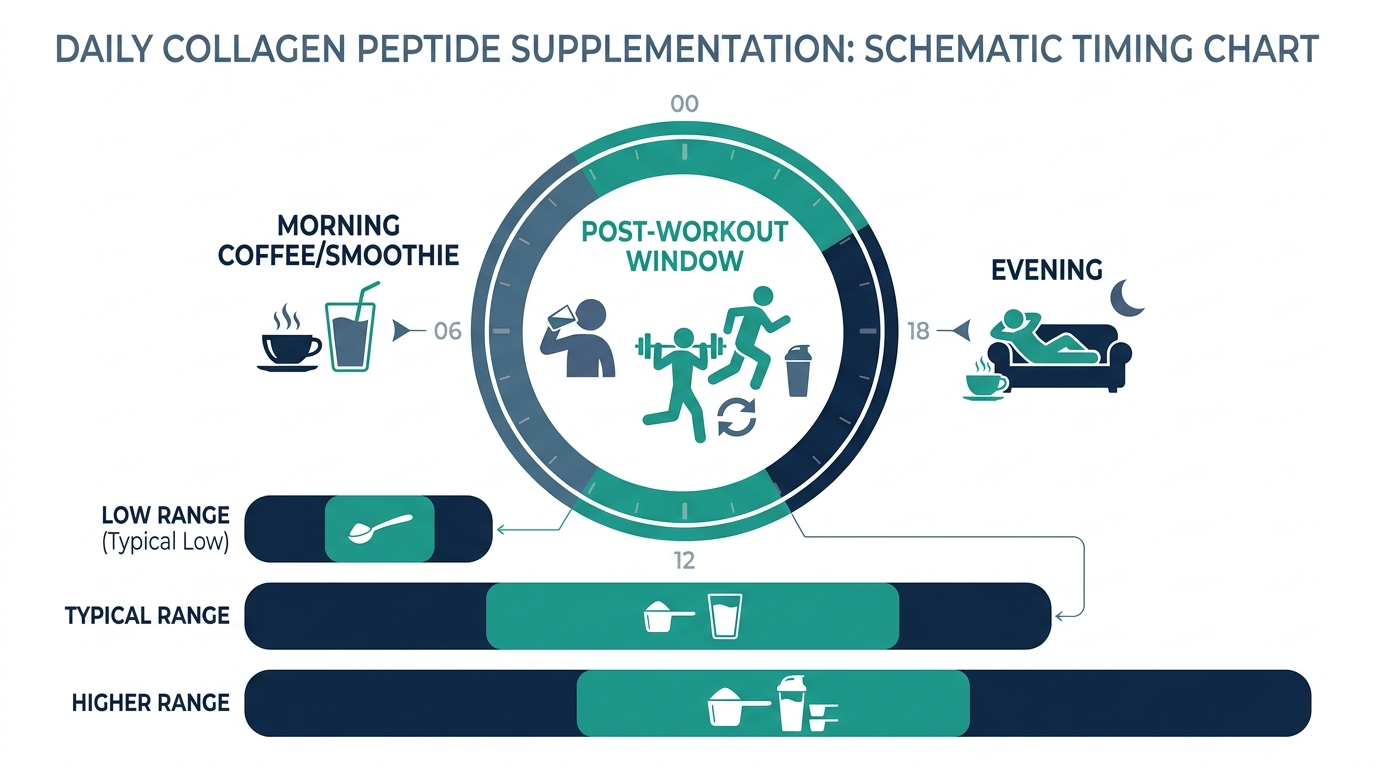
For joint and tendon repair: The timing window matters. The 2017 Baar lab study, published in the American Journal of Clinical Nutrition, tested 5 g and 15 g of vitamin C-enriched gelatin (a structurally identical source to hydrolyzed collagen peptides) taken 60 minutes before six minutes of jumping exercise. The 15 g group showed blood concentrations of amino acids that peaked at the one-hour mark, precisely when the exercise-induced signaling would be calling for raw materials to build connective tissue. Taking collagen on the couch at 9 pm means that amino acid peak hits when you are watching television, not when your tendons are under load and sending signals to build.
For skin outcomes: Timing does not appear to be a significant variable in skin trials. Studies testing morning doses and evening doses produce comparable outcomes. The important variable for skin is consistency over weeks and months, not the clock.
With food or fasted: No strong clinical evidence supports one position. A common forum claim is that “fasted collagen absorbs better,” but a 2024 randomized crossover study in Nutrients found that plasma concentrations of collagen-specific metabolites were consistent regardless of feeding state or molecular weight of the hydrolysate. Take it when you will actually take it consistently.
Full-body lab membership: 100+ biomarkers, doctor-reviewed, tracked over time.
How do you mix it without clumps?
Vital Proteins Collagen Peptides is hydrolyzed, meaning the long collagen protein chains have been enzymatically cut into shorter fragments (peptides) that dissolve in both hot and cold liquids. This is a different product category from gelatin, which gels when chilled.
That said, clumping is still a real user complaint, and it is almost always a technique problem, not a product defect. The three reliable fixes:
-
Add the powder to liquid, not liquid to powder. Pour your coffee or water into the glass first, then spoon in the collagen. Dumping powder into an empty cup and adding liquid on top creates a dry powder island that takes longer to wet evenly.
-
Use warm liquids or stir before chilling. Hot liquids dissolve collagen fastest. If you want a cold drink, pre-dissolve in two tablespoons of warm water first, then add to the cold beverage.
-
Shaker bottle or milk frother beats a spoon every time. A 15-second shake or 10 seconds with a handheld frother produces a fully lump-free result. Vital Proteins’ own blog post on preventing collagen clumping recommends both methods.
The myth worth addressing directly: boiling or hot coffee does not degrade collagen peptides. This claim circulates frequently and is based on confusing raw collagen with hydrolyzed peptides. Raw collagen “denatures” at high heat, but hydrolyzed collagen peptides are already denatured by definition. They are short-chain amino acid sequences, not the long triple-helix structure that heat could disrupt. A 2016 clinical study evaluating collagen peptides dissolved in hot beverages produced results similar to studies using cold beverages. Drinking your collagen in scalding espresso is a comfort issue, not a chemistry one.
Do you need to take vitamin C with it?
For skin: probably not, because most people have sufficient circulating vitamin C for baseline collagen synthesis. The cofactor question only matters at the margin of deficiency.
For connective tissue and the Baar protocol: yes, the evidence is clear. Vitamin C is required by two enzymes, prolyl hydroxylase and lysyl hydroxylase, that catalyze the post-translational modification of proline and lysine into hydroxyproline and hydroxylysine. Without hydroxylation, the collagen triple helix cannot form correctly. Vitamin C does not “boost” collagen absorption in a supplementation-marketing sense; it is a literal biochemical requirement for the structural step that creates stable collagen fibers.
The Baar lab study used 48 mg of vitamin C per dose, a modest amount. The Vital Proteins Advanced formula adds 80 mg. If you use the plain unflavored version, squeezing half a lemon (roughly 20 to 30 mg of vitamin C) into your collagen drink or taking a separate 100 mg supplement 30 minutes before exercise covers the requirement without buying a separate premium SKU.
I would personally reach for the plain version and add a small piece of citrus or a dedicated vitamin C supplement rather than paying a premium for the Advanced formula, unless the hyaluronic acid content is a specific goal. The Advanced version has a nice profile, but it is not a meaningful functional upgrade for most users.
What results should you realistically expect, and when?
This is where most collagen content either over-promises or under-informs. Here is what properly conducted randomized controlled trials have actually found:
| Goal | Dose tested | Trial length | Measured outcome | Result |
|---|---|---|---|---|
| Skin elasticity | 2.5 g/day | 8 weeks | R2 elasticity index | +15% vs. placebo (Proksch et al.) |
| Skin hydration | 10 g/day | 8 weeks | Corneometer reading | Significant improvement (p < 0.05) |
| Dermal density + hydration | 5 g/day | 12 weeks | Ultrasound imaging | Significant at 12 weeks; sustained at 4-week washout |
| Joint pain (athletes) | 10 g/day | 24 weeks | VAS pain scale | Reduced pain at rest and activity vs. placebo |
| Skin + hair quality | 5 g/day | 12 weeks | Clinical scoring, photography | Improvements in skin collagen, hydration, elasticity, wrinkle depth, scalp condition (Reilly et al. 2024) |
| Knee-joint comfort (OA) | Type I+III peptides | 8 weeks | WOMAC scores | Significant reductions in pain and physical function scores |
The takeaway that most supplement brands skip: skin results from 2.5 g to 5 g/day are well-supported by the data, and 20 g/day (the full Vital Proteins serving) is more than most skin trials actually use. You are not throwing away money by taking 10 g rather than 20 g. The upside of the higher dose is more total protein and more raw material for whole-body connective tissue, which may be meaningful for athletes or people recovering from injury.
Do not expect results in days. Collagen turnover in human tissue is measured in weeks and months. Most well-designed trials see the first measurable differences at the 4-week mark, with the clearest separation from placebo at 8 to 12 weeks of daily use. Anyone who claims visible skin improvement after one week is responding to hydration from extra fluid intake, not new collagen deposition.
Hydrolyzed type I & III collagen peptides, third-party tested, unflavored.
How does bovine collagen compare to marine collagen for these goals?
Vital Proteins Collagen Peptides is a bovine Type I and Type III collagen. Its main competitor in the premium segment is marine (fish-derived) collagen, which is exclusively Type I.
The bioavailability argument for marine collagen is real: marine peptides are smaller on average (molecular weight around 300 to 1,000 Da vs. 1,000 to 5,000 Da for some bovine preparations), and a 2024 absorption crossover study in Nutrients confirmed that all tested hydrolysates yielded comparable plasma metabolite concentrations regardless of source or molecular weight. In practice, once both sources are properly hydrolyzed, the absorption gap largely disappears.
Where bovine has a practical advantage: Type III collagen, which bovine hides deliver in meaningful quantities, is found in higher concentrations in skin, blood vessels, and internal organs compared to fish skin. For gut, joint, and body-composition support, the Type I + III combination covers more tissue types. For pure skin surface goals, marine and bovine are close to equivalent.
The honest answer: the majority of high-quality collagen peptide trials published in 2024 and 2025 used bovine hydrolysates, so the evidence base is stronger there by volume of studies, even if marine collagen is not inferior by mechanism.
Five practical ways to take Vital Proteins collagen every day
Consistency at 8 to 12 weeks is the actual bottleneck for collagen results. The best delivery method is the one you will not skip. Here are five that avoid the “plain powder in water” experience most people quit after two weeks:
-
Morning coffee or latte: Dissolve one to two scoops in hot coffee before adding creamer. Completely unflavored and invisible in a dark roast. This is the most common use case for a reason.
-
Smoothie: Add two scoops to any blended drink. The blender handles mixing automatically. The collagen contributes 18 g of protein without changing texture.
-
Overnight oats or yogurt: Stir one scoop into yogurt or into the oat mixture the night before. The liquid overnight fully dissolves it.
-
Bone broth: The flavor synergy is deliberate. One scoop per cup adds roughly 10 g of protein on top of the bone broth’s own collagen content, which is relevant for the Baar joint-support protocol.
-
Pre-workout shake (for connective tissue goal): Two scoops in water plus a squeeze of lemon or a 100 mg vitamin C tablet, consumed 60 minutes before resistance training or tendon-loading exercise. This is the protocol-specific use case that has the strongest mechanistic backing.
When should you NOT use it, or use less?
Collagen peptides are generally low-risk, but three situations deserve attention:
Kidney concerns: Collagen peptides are high-protein, and individuals with existing kidney disease are typically advised by nephrologists to moderate total protein intake. Collagen is not uniquely harmful here, but 20 g added on top of an already protein-heavy diet is worth flagging with your doctor if kidney function is a factor.
Collagen is not a complete protein. It is missing tryptophan, one of the nine essential amino acids. Using collagen as your primary protein source will leave a gap. It works as a targeted supplement alongside a diet with complete protein sources, not as a protein-powder replacement.
The “food-state” collagen myth: Several products marketed as “whole food collagen” or “collagen broth concentrate” use marketing language that implies they are superior to “processed” hydrolyzed peptides. In practice, the hydrolysis process increases, not decreases, bioavailability. Your digestive system would hydrolyze intact collagen on its own, just slower and less completely. The processing step is an advantage.
Curious what your own levels look like?
Baseline 100+ biomarkers today and retest as life changes, all in one membership with physician review.
Frequently asked questions
How many scoops of Vital Proteins collagen peptides should I take per day?
The brand recommends one full serving, which is two scoops (20 g). Clinical evidence supports half that dose for skin goals; the full serving is more relevant for joint support, athletic recovery, or higher total protein targets. Do not exceed two servings (40 g) without clinical guidance.
Can you take Vital Proteins collagen peptides with hot coffee?
Yes. Collagen peptides are already hydrolyzed (denatured) and are not structurally damaged by heat. Add the powder to hot coffee, stir or froth, and the claim that hot liquid destroys the peptides is false.
Does Vital Proteins collagen peptides dissolve in cold water?
It does, though more slowly than in warm liquid. Stir vigorously for 30 to 60 seconds, or pre-dissolve in a tablespoon of warm water before adding to cold beverages. A shaker bottle eliminates the issue entirely.
How long before you see results from Vital Proteins collagen peptides?
Most randomized controlled trials find the first measurable skin improvements at 4 weeks and clear, statistically significant results at 8 to 12 weeks of daily use. Joint and tendon improvements in clinical trials are typically assessed at 12 to 24 weeks. Anyone claiming visible results in under two weeks is almost certainly responding to improved hydration, not new collagen synthesis.
Should you take collagen peptides on an empty stomach?
There is no strong clinical evidence that fasted collagen absorbs better. The 2024 crossover absorption study in Nutrients found comparable plasma amino acid profiles regardless of feeding state. Take it with whatever meal or drink pattern you will maintain daily.
Is Vital Proteins collagen peptides grass-fed and third-party tested?
Vital Proteins states the bovine source is grass-fed and pasture-raised from bovine hide. Following Nestlé’s 2022 acquisition, the brand operates under larger-company quality systems. ConsumerLab, an independent supplement testing body, has reviewed Vital Proteins products; check their current database for the most recent testing status before purchase.
Does taking collagen peptides replace the need for protein powder?
No. Collagen is an incomplete protein, missing tryptophan. It works as a targeted connective-tissue supplement, not as a primary protein source. Combine it with complete protein from diet or whey, plant, or egg-based protein powder to cover all essential amino acids.
Author: Vital Signs Today Editorial Team, [credential]”]. Educational content, not medical advice. Sources linked inline.
Primary sources
- Vital Proteins product page: vitalproteins.com/products/collagen-peptides
- Baar et al., “Vitamin C-enriched gelatin supplementation before intermittent activity augments collagen synthesis” (2017): pmc.ncbi.nlm.nih.gov/articles/PMC5183725/
- Shaw et al., “The effect of dietary protein and exercise training on collagen synthesis in athletes”, referenced via PMC8521576
- Proksch et al. (2.5 g/day, 8-week skin elasticity trial), cited in multiple systematic reviews
- Reilly et al. 2024 collagen + hair trial: onlinelibrary.wiley.com/doi/10.1155/2024/8752787
- Absorption crossover study 2024: pmc.ncbi.nlm.nih.gov/articles/PMC11325589/
- MDPI Cosmetics 2025, bovine-derived bioactive collagen peptides dermal matrix: mdpi.com/2079-9284/12/2/79
- Nestlé Health Science acquisition of Vital Proteins: nestlehealthscience.com/newsroom/press-releases/nhs-completes-acquisition-of-vp
- Collagen peptide supplementation musculoskeletal meta-analysis 2024: germanjournalsportsmedicine.com
- Vital Proteins clumping prevention tips: vitalproteins.com/blogs/stay-vital/prevent-collagen-clumping
Related reading
Vital Signs Today may earn a commission if you buy through links on this page. It does not affect our editorial assessments.