Last updated 18 June 2026. Educational content, not medical advice. Several peptides discussed below are investigational or not approved for human use. Work with a licensed clinician before starting any peptide protocol.
Short answer: The only peptides with strong clinical evidence for weight loss are the GLP-1 receptor agonists, semaglutide and tirzepatide, which produced 15 to 22.5% body weight reduction in phase 3 trials. They are administered as weekly subcutaneous injections under a doctor’s supervision, starting at a low dose and stepping up over 4-week intervals. CJC-1295, ipamorelin, AOD-9604, and retatrutide all have far weaker evidence or are still investigational, and none is a substitute for a licensed protocol.
Before you try peptides for weight loss, do you know what’s driving your metabolism right now? One at-home Superpower draw checks 100+ biomarkers, physician-reviewed.
What kind of peptide are you actually asking about?
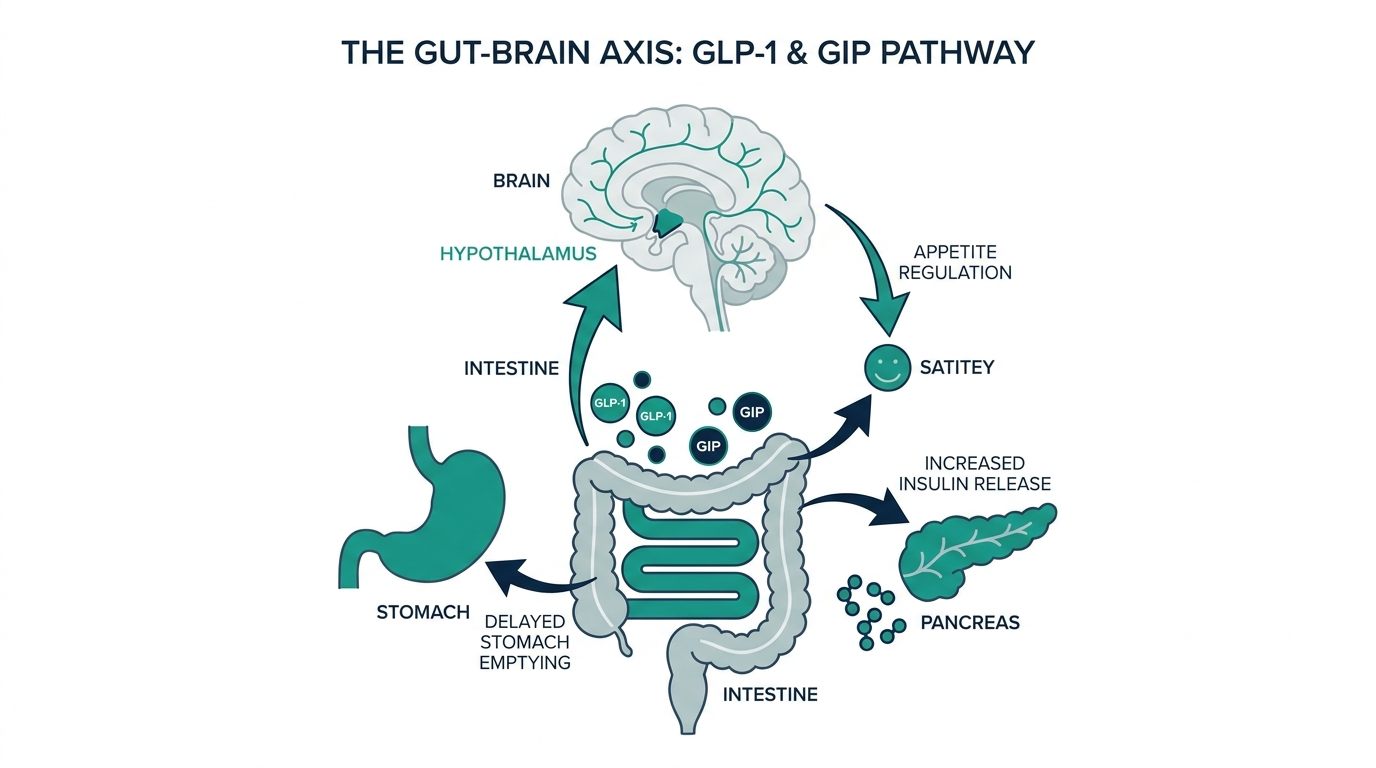
This is the question almost nobody answers clearly, and it matters because the answer changes everything about how the peptide is used, obtained, and how much you can trust the evidence behind it.
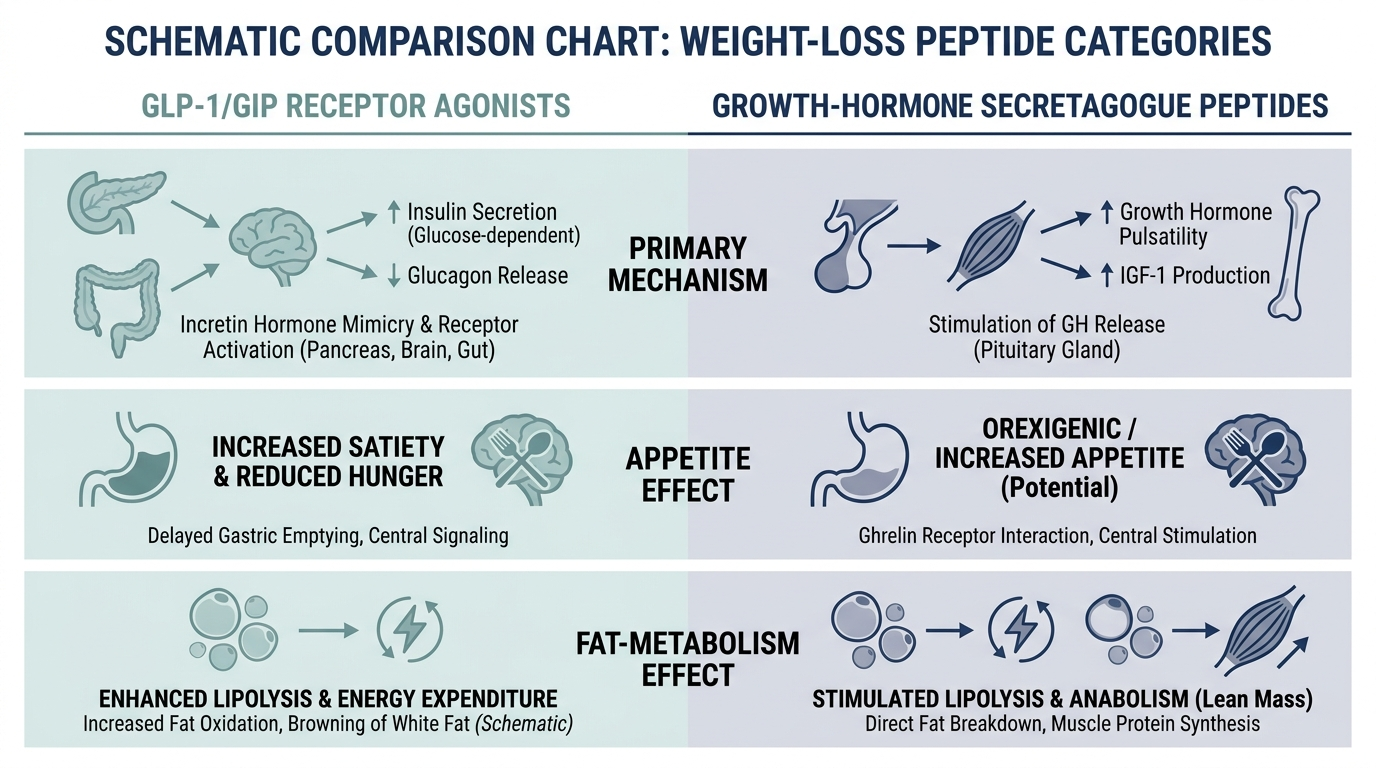
Three completely different categories sit under the word “peptide” when people search for weight loss help.
Category 1: GLP-1 receptor agonists. Semaglutide (Ozempic, Wegovy) and tirzepatide (Mounjaro, Zepbound) are FDA-approved prescription drugs with years of phase 3 data. They are given as weekly subcutaneous injections from a licensed prescriber, often through a telehealth clinic. This is where the meaningful clinical evidence lives.
Category 2: Growth hormone secretagogues. CJC-1295, Ipamorelin, and Sermorelin stimulate the pituitary to release more natural growth hormone. Sermorelin is FDA-approved and available through licensed telehealth providers. CJC-1295 and Ipamorelin are available as compounded medications through licensed pharmacies (check your provider for current 503A status). These have a body composition rationale but no large randomized weight-loss trials.
Category 3: Research and investigational peptides. AOD-9604, retatrutide (still in trials), BPC-157, and similar compounds are either unproven for weight loss in humans, still investigational, or sold “for research use only.” Retatrutide is the most watched of this group, with phase 3 TRIUMPH-1 data released in 2026 showing 28.3% mean body weight loss, but an NDA submission is not expected before Q4 2026 and approval not before late 2027 at the earliest.
If you found “peptides for weight loss” through a forum and the source is a research-chemical vendor, you are in Category 3. If your doctor mentioned it and handed you a prescription, you are in Category 1 or 2. The protocols, risks, legal status, and realistic outcomes are entirely different.
Full-body lab membership: 100+ biomarkers, doctor-reviewed, tracked over time.
The clinical numbers you should hold in your head
The simplest way to actually get this done
Superpower is a full-body lab membership that runs 100+ biomarkers, has each result reviewed by a doctor, and tracks your numbers year over year (about $199/year). It is what we point readers to when they would rather get one clean, complete draw than chase single tests one at a time. Here is superpower reviewed in full.
Doing a Google image search for “before and after peptides” and reading forum posts does not tell you what the medicine can actually do. The trial data does.
Tirzepatide (Zepbound/Mounjaro): In the SURMOUNT-1 trial of 2,539 adults with obesity (no diabetes), participants on the highest 15 mg dose lost an average of 22.5% of body weight, equivalent to roughly 52 pounds, over 72 weeks. On the 10 mg dose the average was 21.4%, and on 5 mg it was 16%. To put that in perspective: 96% of participants on the 10 mg and 15 mg doses achieved at least 5% weight loss, compared to 28% on placebo.
Semaglutide (Wegovy): The STEP-1 trial showed an average of 14.9% body weight loss over 68 weeks on 2.4 mg weekly. GI side effect rates are slightly lower for semaglutide: about 5% less nausea, 4% less diarrhea, and 2% less vomiting than tirzepatide in head-to-head comparisons.
Retatrutide (investigational): Phase 3 TRIUMPH-1 data reported in June 2026 showed a mean 28.3% body weight loss at 12 mg over 80 weeks, with 45.3% of participants losing 30% or more. This is the largest weight loss number yet from a pharmaceutical trial, but the drug is not approved and an NDA is the next step, not a prescription. Eli Lilly’s announcement also showed a 75.8% reduction in osteoarthritis pain as a secondary finding, which explains the intense clinical interest.
CJC-1295 and Ipamorelin: No large randomized controlled trial has measured their effect on body weight specifically. The rationale is that increasing growth hormone pulses shifts body composition toward lean mass and away from fat, but the size of that effect in normal adults is modest and inconsistently documented. Clinics that prescribe these are offering a plausible mechanism, not proven weight loss numbers.
How GLP-1 peptide injections are actually done
Personally, I think the gap between “I’ve heard about these injections” and “I understand what a weekly shot actually involves” is one reason people either avoid a genuinely effective treatment or walk into it unprepared. The physical reality is far less dramatic than it sounds.
A licensed GLP-1 prescription comes with a prefilled auto-injector pen. There is no vial to mix, no syringe to draw, and no dose math for the patient to do. The pen is dialed to the prescribed dose and delivers the medication subcutaneously through a tiny 4 to 6 mm, 32-gauge needle.
Injection sites approved for these pens are the abdomen (at least 2 inches from the navel), the front outer thigh, and the back of the upper arm. Most people default to the abdomen because it is easy to see and pinch. Rotating the injection site with every dose matters: up to two-thirds of long-term GLP-1 users develop lipohypertrophy (a firm, lumpy deposit of scar tissue under the skin) when they consistently use the same spot.
Storage and handling require refrigeration between 36 and 46 degrees Fahrenheit. Most pens can survive up to 28 days at room temperature if kept below 77 degrees Fahrenheit, which matters for travel.
The dose escalation schedule is not optional. Starting too high causes nausea, vomiting, and sometimes hospitalization. A standard tirzepatide ramp looks like this: 2.5 mg weekly for 4 weeks, then 5 mg for 4 weeks, then 7.5 mg, then 10 mg, then 12.5 mg, then 15 mg, with each step separated by at least 4 weeks and guided by how the patient tolerates the current dose. Many people stay at 5 mg or 7.5 mg and lose significant weight. Reaching 15 mg is not required.
One thing that catches patients off guard: the appetite suppression does not kick in at the first injection. It builds over the first 2 to 4 weeks of each dose tier. If you feel nothing in week 1, that is normal. If you still feel nothing after 4 weeks, talk to your provider about escalation.
What to expect: results, timeline, and the plateau
The most common pattern is that weight loss is rapid in months 1 through 3 as appetite suppression is strongest and the calorie deficit is deepest. Then it slows. By months 6 through 12, many patients hit a plateau. This is not the medication failing. It is metabolic adaptation: as you lose weight, your resting metabolic rate drops, and your body becomes more efficient at the lower calorie intake.
According to Mochi Health’s clinical team, most plateaus on GLP-1 therapy have one of three causes: the current dose has reached its ceiling for that individual, caloric intake has crept back up (often because patients stop tracking), or lean muscle loss has slowed the metabolism further.
Breaking a plateau typically means one of: a supervised dose increase, switching from a GLP-1 mono-agonist like semaglutide to a dual agonist like tirzepatide (which targets both GLP-1 and GIP receptors), or addressing the muscle loss directly through resistance training and protein intake. Do not believe anyone who tells you the plateau means you should stop the medication.
The muscle loss problem almost nobody warns you about
Here is the piece of information most telehealth signup pages quietly skip: GLP-1 weight loss is not fat-only. Clinical trial analysis shows that 25 to 40% of total weight lost on GLP-1 medications is lean mass, including muscle. In one study published in 2025, the average breakdown was 8.36 kg of fat and 5.26 kg of lean body mass in a significant weight loss cohort.
Losing muscle matters because muscle is metabolically active tissue. Less muscle means a slower resting metabolic rate, which makes the plateau come sooner and makes it harder to keep weight off after stopping.
The fix is not complicated, but it requires intention. Current evidence-based recommendations from endocrinologists:
- Protein: Target 1.2 to 1.6 grams per kilogram of body weight per day, distributed across meals (not one large bolus). On GLP-1 therapy, appetite suppression makes it easy to under-eat protein because patients feel full on smaller portions. Tracking protein specifically, even loosely, is the single most reliable countermeasure to lean mass loss.
- Resistance training: Two to three sessions per week of compound movements (squats, deadlifts, rows, presses) significantly reduces lean mass loss during caloric restriction. One review found structured resistance exercise can cut lean mass loss by 50 to 95% during aggressive dieting.
- Do not chase the fastest possible weight loss. A slower rate of loss (0.5 to 1% of body weight per week) preserves more muscle than an aggressive deficit, even on the same medication.
The CJC-1295 and Ipamorelin stack is sometimes added by longevity-focused clinics specifically to address this problem, on the theory that higher endogenous growth hormone levels support muscle protein synthesis during caloric restriction. There is reasonable physiology here, but no large trial confirming the effect in GLP-1 users specifically.
Comparing the main approaches: which peptide for which goal?
| Approach | How it’s used | Evidence level | Realistic weight loss | Monthly cost (2026) |
|---|---|---|---|---|
| Tirzepatide (Zepbound) | Weekly sub-Q injection, telehealth Rx | Phase 3 (SURMOUNT-1) | 16 to 22.5% over 72 weeks | $199 to $349 compounded; ~$1,100 brand |
| Semaglutide (Wegovy) | Weekly sub-Q injection, telehealth Rx | Phase 3 (STEP-1) | ~14.9% over 68 weeks | $149 to $199 compounded; ~$1,350 brand |
| Sermorelin | Daily or 5x/week sub-Q, telehealth Rx | Limited RCTs; mechanistic | Modest body comp shift | $175 to $225 |
| CJC-1295 + Ipamorelin | Nightly injection, licensed provider | Mechanistic, no weight RCT | Body composition, not scale | $199 to $399 (bundled) |
| Retatrutide | Investigational, not available | Phase 3 TRIUMPH-1 (28.3%) | N/A, not approved | Not available |
| AOD-9604 | Research use only | Failed phase 2 trial | Not established | N/A |
The table makes the practical decision obvious for most people. If scale weight loss is the goal, the GLP-1 prescription drugs have the evidence and the licensed infrastructure. If body composition (more muscle, less fat) without aggressive appetite suppression is the goal, the growth hormone secretagogue stack is the adjacent tool, available through the same telehealth providers.
Telehealth GLP-1 program with provider visits and pharmacy coordination.
What an actual clinic-based protocol looks like, week by week
Clinic protocols differ by provider, but the structure is consistent enough that this outline is representative. None of this replaces the guidance of your specific prescriber.
Before week 1: Intake questionnaire, provider video call or asynchronous review, labs ordered (fasting glucose, HbA1c, lipid panel, thyroid, kidney function at minimum). Labs can be done at home or at a local draw site. Prescription sent to the compounding pharmacy or brand distributor.
Weeks 1 through 4: Starting dose (typically 2.5 mg tirzepatide or 0.25 mg semaglutide). Side effects are most common here: nausea, mild fatigue, and constipation. Provider check-in via messaging or call. Appetite suppression may be minimal at this stage.
Weeks 5 through 16: Dose escalation every 4 weeks as tolerated. Appetite suppression becomes noticeable. Most patients start seeing scale movement here.
Months 4 through 12: Titration to maintenance dose based on response and tolerance. Active weight loss phase. Monthly provider check-ins.
Month 12 onward: Assessment of whether to continue, reduce dose, or transition to a maintenance strategy. The STEP-4 trial for semaglutide found that participants who discontinued the drug regained about two-thirds of their lost weight within a year. Long-term use is expected for most patients, similar to blood pressure or cholesterol medication.
Side effects and how to manage them
GI symptoms are by far the most common: nausea (in roughly 30 to 40% of patients at some dose stage), constipation, diarrhea, and reduced appetite. They are most pronounced when the dose increases and tend to improve over the following 2 to 4 weeks.
Management strategies that actually work, from clinical practice:
- Eat smaller, slower meals. GLP-1 drugs already slow gastric emptying. Eating quickly or in large volume amplifies nausea.
- Avoid high-fat and high-sugar foods in the early weeks. These meals are the most common trigger for vomiting.
- Anti-nausea medication (ondansetron or metoclopramide) is sometimes prescribed alongside GLP-1 therapy for the initial dose escalation phase. Ask your provider, not a search engine.
Less common but important signals: acute pancreatitis (rare but noted in the MHRA’s January 2026 product information update as a known infrequent risk), gallbladder disease (associated with rapid weight loss generally, not uniquely GLP-1), and injection-site lipohypertrophy from skipping site rotation.
The muscle loss concern addressed above is not a side effect in the traditional sense. It is a structural outcome of caloric restriction and requires active countermeasures, not just awareness.
The myth of “peptide cycling” for weight loss
Do not believe the idea that cycling on and off GLP-1 or growth hormone peptides every 8 to 12 weeks is a scientifically validated or safer protocol. This is a bodybuilding community convention borrowed from anabolic steroid use and applied, without evidence, to a completely different class of drug.
For GLP-1 drugs, the data from the STEP-4 trial is direct: stopping the medication causes rapid weight regain. There is no published evidence that a cycling structure prevents this or provides any metabolic benefit. Providers who suggest cycling are deviating from the clinical data without a strong rationale.
For growth hormone secretagogues, the cycling argument has more theoretical grounding (pituitary desensitization is a real concern with some GH analogs), but the practical evidence is thin and the decision should belong to a prescriber reviewing labs, not a forum recommendation.
Don’t just read about your health, track it.
A single result is a snapshot. Superpower re-tests 100+ markers over time so you can watch them move as you change sleep, food, and training.
Frequently asked questions
How long does it take for peptides to work for weight loss?
For GLP-1 drugs, meaningful appetite suppression typically appears in weeks 2 through 4 of each dose tier, and visible weight loss on the scale in weeks 4 through 8. The largest weight loss in clinical trials occurred over 68 to 72 weeks. Expecting significant results in 2 to 3 weeks is the fastest way to be disappointed and quit something that was actually working.
Can you use peptides for weight loss without injections?
For GLP-1 drugs, oral semaglutide (Rybelsus) is FDA-approved for type 2 diabetes but its weight-loss data is weaker than the injectable version, and the dosing requirements (fasting for 30 minutes, specific water volume) reduce real-world compliance. Collagen peptides taken orally do not directly cause weight loss. There is currently no oral peptide that produces GLP-1-equivalent weight loss.
Do you need to diet while using weight-loss peptides?
The clinical trials that produced 14 to 22.5% weight loss all included a reduced-calorie diet and lifestyle counseling alongside the medication. The peptide suppresses appetite and shifts hormonal signaling, but the weight loss comes from the resulting calorie deficit. You are not required to count calories precisely, but eating to satiety is not the same as eating a calorie surplus.
Is tirzepatide or semaglutide better for weight loss?
Tirzepatide produces more weight loss in every direct head-to-head comparison because it hits both the GLP-1 and GIP receptors. In the SURMOUNT-1 trial the maximum dose averaged 22.5% loss; semaglutide’s STEP-1 maximum dose averaged 14.9%. However, semaglutide has a slightly better GI tolerability profile and a longer track record. Which is “better” depends on your starting weight, GI sensitivity, cost coverage, and prescriber preference.
What happens if you stop taking weight-loss peptides?
The STEP-4 semaglutide trial found participants who discontinued regained an average of 6.9% of their body weight within 1 year, recovering roughly two-thirds of what they had lost. This is the single most important thing to understand before starting: these are long-term medications for a chronic condition, not short-term fixes.
Are research peptides like AOD-9604 worth trying for fat loss?
AOD-9604 failed its phase 2 clinical trial for obesity in 2007 and has no subsequent published evidence demonstrating meaningful human fat loss. It is sold as a “research chemical,” which means no quality oversight, no clinical accountability, and no regulatory protection if the vial is mislabeled or contaminated. The risk-to-evidence ratio makes it a poor choice.
How much do weight-loss peptides cost per month?
Compounded semaglutide through telehealth runs $149 to $199 per month in 2026 (Hims/Hers being one example). Compounded tirzepatide is $199 to $349 per month through providers like Eden or TrimRx. Brand-name Wegovy or Zepbound at retail runs $1,100 to $1,350 per month without insurance. Growth hormone secretagogue stacks (CJC-1295 plus Ipamorelin) through longevity clinics typically land at $199 to $399 per month bundled with consultations.
Telehealth GLP-1 program with provider visits and pharmacy coordination.
Author: Vital Signs Today Editorial Team, [credential]”]. Educational content, not medical advice. Sources linked inline.
Primary sources:
– Eli Lilly SURMOUNT-1 tirzepatide phase 3 results: https://investor.lilly.com/news-releases/news-release-details/lillys-surmount-1-results-published-new-england-journal-medicine
– Eli Lilly retatrutide TRIUMPH-1 phase 3 results: https://investor.lilly.com/news-releases/news-release-details/lillys-triple-agonist-retatrutide-delivered-weight-loss-average
– Semaglutide STEP-4 discontinuation trial (PMID 34170647): https://pubmed.ncbi.nlm.nih.gov/34170647/
– GLP-1 lean mass preservation review (PMC12444289): https://pmc.ncbi.nlm.nih.gov/articles/PMC12444289/
– GLP-1 adverse events systematic review (PMC12532569): https://www.ncbi.nlm.nih.gov/pmc/articles/PMC12532569/
– TrimRx 2026 GLP-1 program comparison: https://trimrx.com/blog/8-best-glp-1-weight-loss-programs-2026-comparison-guide/
– Middleway Nutrition GLP-1 injection site guide: https://www.middlewaynutrition.com/glp-1/glp-1-injection-sites
– Scientific American retatrutide phase 3 coverage: https://www.scientificamerican.com/article/next-gen-weight-loss-drug-retatrutide-trial-brings-it-one-step-closer-to-fda-approval/
Want a real clinician to run the numbers, not a guess?
Joi + Blokes is a telehealth clinic that prescribes GLP-1 medication (Zepbound, compounded semaglutide and tirzepatide), hormone therapy (TRT, HRT), thyroid care, and peptides after a real lab panel and clinician review, with no membership or consult fee (prescriptions from about $59/month, lab panels from $149). If the scale will not budge, this is where you find out whether insulin, thyroid, or hormones are the real reason. Here is Joi + Blokes reviewed in full.
Related reading
Related: which GLP-1 telehealth service fits you.
Vital Signs Today may earn a commission if you buy through links on this page. It does not affect our editorial assessments.