Last updated June 2026. Educational content, not medical advice. Peptides vary widely in legal status, mechanism, and risk. Talk to a licensed clinician before starting any peptide therapy.
Short answer: The most clinically proven method is a once-weekly subcutaneous injection of a GLP-1 receptor agonist, semaglutide or tirzepatide, prescribed through a licensed telehealth provider, starting at a low titration dose and escalating monthly. Tirzepatide produced a 20.2% mean body-weight reduction versus 13.7% for semaglutide at 72 weeks in the head-to-head SURMOUNT-5 trial. Growth hormone secretagogues like CJC-1295/Ipamorelin are taken differently, typically at bedtime in a fasted state, but they lack that level of clinical evidence for weight loss specifically.
GLP-1 peptides work on your metabolism, so shouldn’t you know your metabolic baseline before starting? One at-home Superpower draw checks 100+ biomarkers, physician-reviewed.
Why does it matter which peptide you’re starting with?
There is no single answer to “how to take peptides for weight loss” because the word “peptide” covers at least four entirely different mechanisms, and each one has its own administration logic, legal lane, and evidence base. Using the rules for one on another is the first mistake most people make.
The four practical categories in 2026:
- GLP-1 receptor agonists (semaglutide, tirzepatide): Prescription. Once-weekly subcutaneous injection. The highest-evidence category for weight loss in human clinical trials. Regulated, dispensed by pharmacy.
- Growth hormone secretagogues (CJC-1295, Ipamorelin, sermorelin): Prescription or grey market depending on source. Subcutaneous injections, usually nightly in a fasted state. Modest fat-loss support; primary mechanism is GH stimulation, not direct appetite suppression.
- Fragment peptides (AOD-9604): Research-use only. Failed to produce consistent results in human trials despite promising animal data; the FDA has explicitly stated it is not an approved treatment.
- Collagen and topical peptides: Oral powder or serum. No injection. Zero overlap with the above.
Everything below is organized by that framework, so you can skip to the lane that applies to you.
Full-body lab membership: 100+ biomarkers, doctor-reviewed, tracked over time.
How do you actually take semaglutide or tirzepatide?
The simplest way to actually get this done
Superpower is a full-body lab membership that runs 100+ biomarkers, has each result reviewed by a doctor, and tracks your numbers year over year (about $199/year). It is what we point readers to when they would rather get one clean, complete draw than chase single tests one at a time. Here is superpower reviewed in full.
These are the gold-standard weight-loss peptides. The administration protocol is well-established because both have gone through large randomized controlled trials with hundreds of thousands of real-world patients now on them.
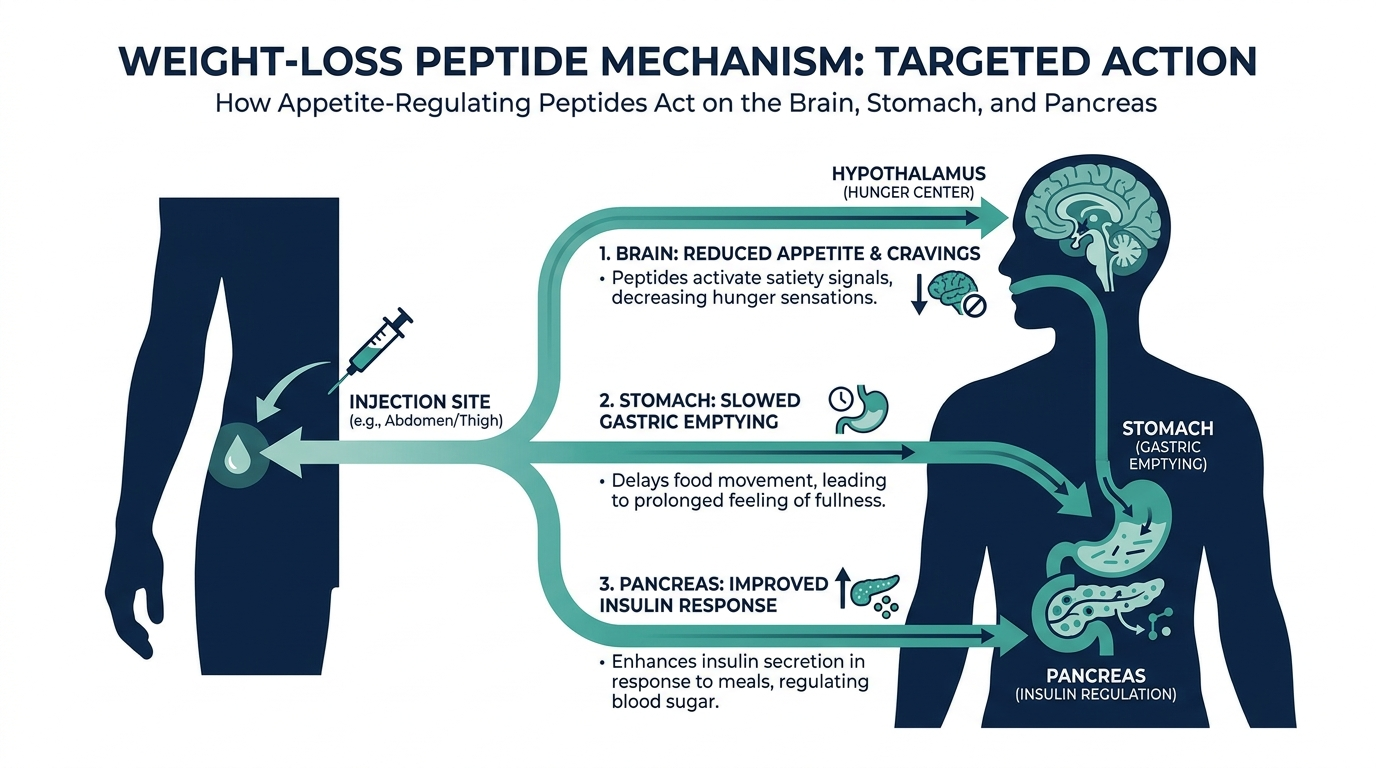
Injection method. Both are given as subcutaneous injections, meaning into the fat layer just beneath the skin, not into muscle. Approved sites are the abdomen (most commonly used for self-injection), the front or outer thigh, or the back of the upper arm. Rotate sites at each weekly injection to prevent lipohypertrophy, a localized fat buildup that slows absorption if you keep hitting the same spot.
Needle angle and technique. Pinch a fold of skin, insert the needle at 90 degrees, depress the plunger slowly. Pre-filled auto-injector pens (the commercial Wegovy and Zepbound formats) remove most of this from the equation, which is one genuine advantage over reconstituted research vials. If you are using a compounded version drawn into an insulin syringe, the technique matters more, and the margin for error is entirely yours.
Dose escalation, not a jump start. This is where a lot of patients go wrong. GI side effects (nausea, vomiting, reflux) are dose-dependent and largely preventable if you respect the titration schedule. Semaglutide typically starts at 0.25 mg weekly for four weeks, then 0.5 mg, then escalates in steps up to 2.4 mg (Wegovy). Tirzepatide starts at 2.5 mg for four weeks, then 5 mg, with escalation steps up to 15 mg. Skipping steps to “get results faster” is the single most common reason people abandon the medication in month two.
Timing relative to meals. Unlike GH secretagogues (see below), GLP-1 injections do not need to be timed around food. Pick the same day each week and inject at any time of day that is convenient. Consistency of schedule matters more than the specific hour.
What the SURMOUNT-5 head-to-head data actually showed. This trial, published in the New England Journal of Medicine in early 2026, enrolled 751 adults without type 2 diabetes and is the first randomized direct comparison between the two drugs. At 72 weeks: tirzepatide produced 20.2% body-weight reduction, semaglutide 13.7%. That 47% relative advantage is the largest confirmed gap in a head-to-head obesity drug trial. Waist circumference shrank 18.4 cm on tirzepatide versus 13.0 cm on semaglutide. Extrapolated to 1,000 patients, tirzepatide was associated with roughly 70 fewer new cases of type 2 diabetes and 10 fewer cardiovascular events.
The implication for anyone doing research: if your only goal is maximal weight loss and you can tolerate either drug, tirzepatide’s dual GIP/GLP-1 agonism appears to be the more powerful lever, at least at the 72-week mark.
How do you take CJC-1295 and Ipamorelin for weight loss?
These two are usually stacked together, and they work through a completely different mechanism than GLP-1s: they stimulate your pituitary gland to release more growth hormone, which in turn shifts body composition toward fat oxidation and lean mass retention over time. They do not suppress appetite the way semaglutide does, and the clinical evidence for weight loss specifically is far thinner.
Why they are taken at bedtime. Growth hormone is released in pulses, and the largest natural pulse occurs in the first 90 minutes of deep sleep. Dosing CJC-1295/Ipamorelin at bedtime allows the peptide to amplify that pulse rather than fire at a random point in the circadian cycle. The fasted state requirement matters because elevated insulin blunts GH release. The standard guidance from compounding clinicians is: inject at least two hours after your last meal and 30 to 60 minutes before sleep.
Subcutaneous injection, not IV. These are injected into subcutaneous fat, the same sites as GLP-1s: abdomen, thigh, or upper arm.
What “research grade” means in practice. If you are sourcing CJC-1295/Ipamorelin from a research vendor rather than a compounding pharmacy, the reconstitution step falls entirely on you. You add bacteriostatic water to a lyophilized (freeze-dried) powder vial, then calculate your own dose volume. A single decimal error in that calculation changes the dose by a factor of ten. This is not a hypothetical risk; it is the unglamorous reality that the discount price hides.
The honest clinical ceiling. No large-scale randomized controlled trial has confirmed that CJC-1295 or Ipamorelin alone produces meaningful weight reduction in humans. The mechanism is plausible, the anecdote volume is high, but the evidence quality is nowhere near semaglutide territory. If weight loss is the primary goal, starting here instead of a GLP-1 is a faith-based decision, not a data-based one.
What about growth hormone fragment AOD-9604?
AOD-9604 was designed specifically for fat loss, as a modified fragment of human growth hormone’s C-terminal region, stripped of the anabolic effects. In animal studies the results were promising. In humans they were not, and the FDA has explicitly stated AOD-9604 is not an approved treatment for any condition. Multiple human clinical trials failed to reach statistical significance on weight loss endpoints.
Do not let the marketing copy for this peptide outrun the human clinical record. The animal data created expectations the human data never matched.
How do you avoid losing muscle while using weight-loss peptides?
This is the detail that separates people who look better after peptide therapy from those who just become smaller versions of themselves. GLP-1 receptor agonists suppress appetite so effectively that without active intervention, a meaningful percentage of the weight lost comes from lean mass.
The risk is quantified: research published in 2026 found that without countermeasures, up to 25 to 40% of total weight lost during rapid GLP-1-driven loss can come from lean body mass. That is metabolically damaging because muscle burns more calories at rest than fat, so losing it creates a ratchet toward future regain.
The two non-negotiable countermeasures:
- Protein intake at 1.2 to 1.6 g per kilogram of body weight daily, evenly distributed across meals. If you eat less because your appetite is suppressed, make sure protein is not the thing you are eating less of. Clinicians who run GLP-1 programs will tell you that patients who track protein outperform those who track calories on body composition metrics.
- Resistance training at least twice per week. Aerobic exercise alone does not preserve lean mass at the rates that combined aerobic and resistance training does. Two structured lifting sessions per week is the minimum the evidence supports.
Personally, the patients who do best on GLP-1 therapy are the ones who treat the appetite suppression as an opportunity to hit protein targets they never could before, not as permission to eat less of everything.
What are the most common side effects and how do you manage them?
The GI side effects of GLP-1 peptides are real, frequent, and largely dose-dependent. According to a 2026 Frontiers in Endocrinology consensus paper, nausea affects more than 40% of patients during early dose escalation. Vomiting, diarrhea, and constipation are also common.
The management framework that works:
- Eat smaller volumes per sitting. GLP-1s delay gastric emptying, so a full meal-sized bolus of food lands very differently than it did before. Three medium meals often feel like one large one.
- Avoid high-fat foods during escalation. Fat slows gastric emptying independently; combining that with a GLP-1-slowed gut is where most vomiting episodes originate.
- Stay ahead of nausea with ginger or B6. Over-the-counter options; your prescribing clinician can also prescribe ondansetron for the first few weeks if symptoms are interfering with adherence.
- Do not rush the dose escalation. The titration schedule exists for this reason. Staying at a lower dose for an extra month is not failure; it is strategy.
Injection-site reactions (redness, mild swelling, bruising) are common at first and typically resolve with consistent site rotation and proper technique.
| Side effect | Frequency | When it peaks | Practical fix |
|---|---|---|---|
| Nausea | >40% | Weeks 1-8 of each dose increase | Smaller meals, ginger, avoid high-fat meals |
| Vomiting | ~20% | Same window as nausea | Same as above; B6, ondansetron if prescribed |
| Constipation | ~20-30% | Persistent across therapy | Fiber, hydration, magnesium (if cleared by clinician) |
| Diarrhea | ~15% | Early weeks | Usually self-resolving |
| Injection-site irritation | Common | First weeks | Site rotation, room-temp injection |
| Fatigue | ~10-15% | Early dose escalation | Often correlates with low calorie intake; monitor protein |
What does the prescription lane actually cost and include?
The cost gap between a grey-market vial and a telehealth clinic is real, but the comparison is not clean because they are not the same product.
A research vial of CJC-1295/Ipamorelin might cost $60 to $120. A telehealth sermorelin program runs $175 to $310 a month. A full GLP-1 telehealth program, semaglutide or tirzepatide with labs and monitoring, runs $199 to $599 a month depending on the platform and what is bundled.
What the clinic price includes that the vial price does not:
- A licensed clinician’s prescription and medical review
- Medication dispensed by a named, verifiable 503A or 503B compounding pharmacy
- Baseline lab work before the first dose
- Structured follow-up with dose adjustments tied to labs and clinical response
- Someone accountable if something goes wrong
From July 1, 2026 through December 31, 2027, eligible Medicare members may access select FDA-approved GLP-1 medications including Wegovy and Zepbound for $50 per month through the Medicare GLP-1 Bridge Program, which materially changes the math for patients over 65. Private insurance coverage for GLP-1s in obesity (not diabetes) remains inconsistent and employer-dependent.
Telehealth GLP-1 program with provider visits and pharmacy coordination.
What is retatrutide and why is everyone talking about it?
Retatrutide is the next-generation GLP-1 class drug being developed by Eli Lilly. It is a triple agonist, hitting GLP-1, GIP, and glucagon receptors simultaneously. In Phase 2 trials, the 12 mg dose produced a mean weight reduction of 24.2% over the study period. Phase 3 TRIUMPH trials are now reporting: TRIUMPH-1 confirmed 28.3% weight loss in 2,339 patients on May 21, 2026. TRIUMPH-4 confirmed 28.7% in patients with obesity and osteoarthritis. NDA submission is expected Q4 2026 or Q1 2027, with FDA approval currently projected for late 2027 or early 2028.
Those numbers are extraordinary if they hold through full Phase 3. A 28% mean weight reduction would make it, by a wide margin, the most effective obesity drug ever to reach the FDA.
What that also means: retatrutide is not approved, not legally dispensable through any licensed clinic, and available only as a “research use only” compound with no regulatory oversight on quality. The independent testing platform Finnrick tested 37 batches of retatrutide sold by Peptide Sciences before the company’s March 2026 shutdown and found purity as low as 75%, with the product earning a failing “E” grade across the entire batch set. The most-wanted molecule in the weight-loss space was also the most reliably adulterated one. Patience is not just a virtue here; it is the difference between a clinical outcome and a contamination incident.
What is the myth about peptides that most people believe?
The dominant myth is that “peptide” means “natural” or “gentle” and therefore lower risk than a pharmaceutical drug. In fact, most injectable peptides marketed for weight loss are synthetic molecules that did not exist in nature before a chemist made them, and the “research use only” ones have zero regulatory testing for what is actually in the vial. The gentleness assumption comes from the word’s biochemistry-class associations, not from any actual safety data.
The practical consequence: a grey-market vial carrying a real peptide is not “almost as safe” as a compounding pharmacy product. It is a categorically different thing from a quality assurance standpoint. The pharmacy product has a pharmacist, a required purity certificate, a licensed prescriber, and a regulatory body. The grey vial has whatever was in the batch that day.
How long does it take to see results from weight-loss peptides?
Timeline varies significantly by mechanism:
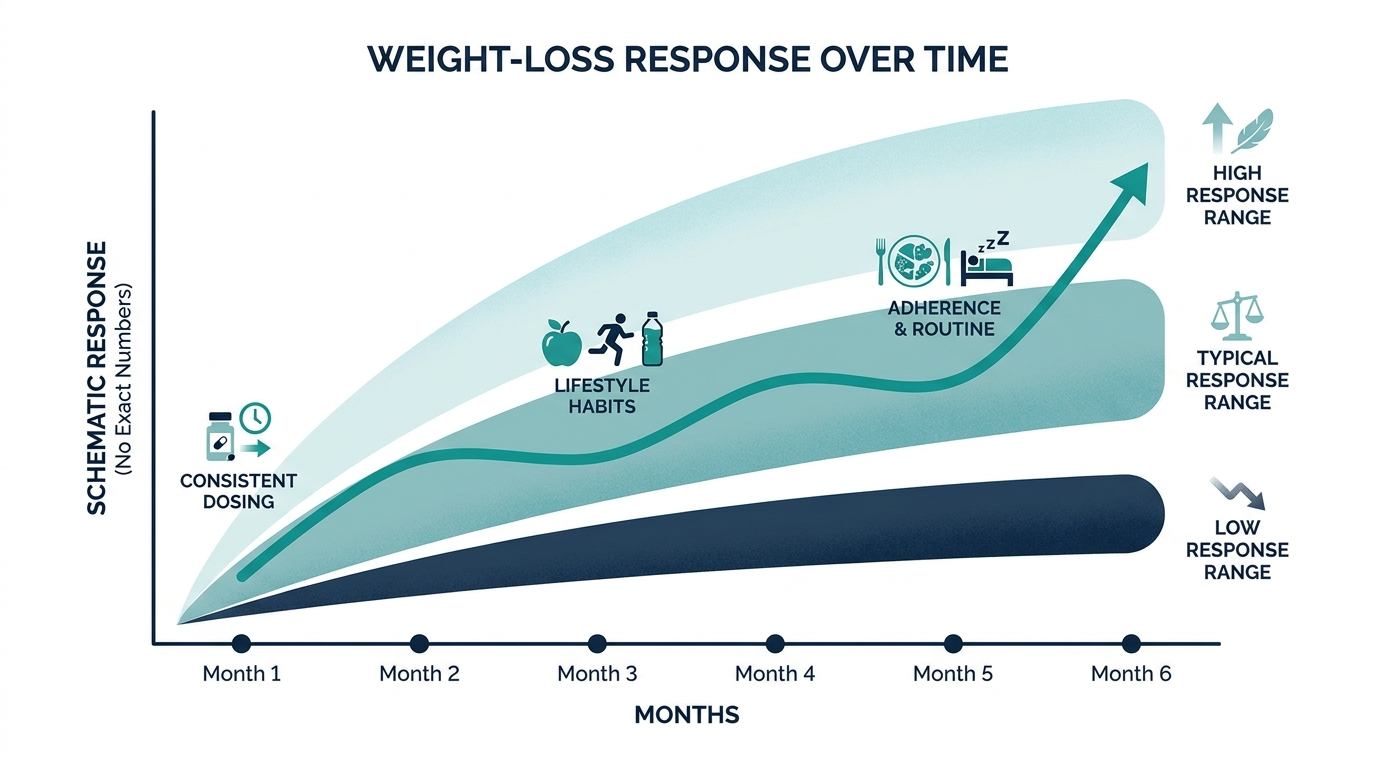
- GLP-1 receptor agonists: Measurable appetite suppression begins within the first week for most patients. Scale weight typically moves within four to eight weeks of reaching an effective dose (not the starting titration dose). Maximum effect in clinical trials is observed between 48 and 72 weeks of continuous use. This is not a 30-day intervention; it is a 12-to-18-month commitment to see full outcome.
- GH secretagogues (CJC-1295/Ipamorelin, sermorelin): Body composition changes (fat loss, lean mass retention) emerge over three to six months. These peptides work through slower hormonal shifts, not the acute appetite suppression of GLP-1s. People who expect scale results in four weeks are usually disappointed and quit before the mechanism has time to work.
- AOD-9604 and similar fragments: The human trial timelines are irrelevant because the trials did not show results at any time point.
Weight loss plateaus are common on GLP-1 therapy, usually appearing around months six to twelve. The mechanism is adaptive: as body weight drops, total energy expenditure drops with it, and the metabolic brake engages. Breaking through a plateau requires either a dose adjustment (discuss with your prescriber), added resistance training, or a protein intake audit, not switching to a different peptide.
Don’t just read about your health, track it.
A single result is a snapshot. Superpower re-tests 100+ markers over time so you can watch them move as you change sleep, food, and training.
Frequently asked questions
Do peptides for weight loss require injections?
It depends on the peptide. GLP-1 receptor agonists (semaglutide, tirzepatide) and growth hormone secretagogues (CJC-1295, Ipamorelin, sermorelin) are all injected subcutaneously. Oral semaglutide (Rybelsus) is a tablet but is approved only for type 2 diabetes management, not obesity. Collagen peptides are taken orally as powder or capsules. If a site is selling an “oral injectable peptide” or claiming injections are optional for GLP-1s, that is a red flag about the quality of the source.
How often do you inject weight-loss peptides?
GLP-1 agonists like Wegovy (semaglutide) and Zepbound (tirzepatide) are once-weekly injections. Growth hormone secretagogues like CJC-1295/Ipamorelin are typically once daily, at bedtime. Sermorelin is similarly once daily. The once-weekly schedule is a practical advantage of GLP-1s that improves adherence significantly compared to daily protocols.
Can you take peptides for weight loss without a prescription?
For GLP-1 receptor agonists, no. Those are prescription drugs. For research-labeled peptides like CJC-1295 or Ipamorelin, you can legally purchase them labeled “for research purposes only,” but injecting them into yourself moves you entirely outside any regulatory protection. The safety profile you are trusting is whatever the grey-market vendor did or did not test that batch for. Collagen peptides and topical copper peptides (GHK-Cu serum) can be purchased without a prescription and used as directed.
What is the best time of day to inject weight-loss peptides?
For GLP-1 agonists: any consistent time on the same day each week. Timing relative to meals does not affect efficacy. For GH secretagogues (CJC-1295, Ipamorelin, sermorelin): bedtime is strongly preferred, injected at least two hours after your last meal, to amplify the natural growth hormone pulse that occurs during early deep sleep. High insulin from a recent meal blunts this pulse. Morning is the second-best option if bedtime is not practical.
Is it safe to combine GLP-1 peptides with other weight-loss peptides?
Only under medical supervision. Some telehealth clinics layer a GH secretagogue alongside a GLP-1 for body composition reasons, reasoning that the GLP-1 drives fat mass down while the GH secretagogue helps preserve lean mass. This is a plausible clinical rationale but one that should be monitored with regular labs, not self-assembled from a vendor catalog.
Why do you need to rotate injection sites?
Repeated injections into the exact same spot cause lipohypertrophy, a buildup of scar-like fat tissue that absorbs medication irregularly. If you inject into a lipohypertrophied area, the dose may be absorbed faster or slower than expected, making blood levels erratic. Site rotation (using a consistent pattern around the abdomen, thigh, and upper arm) prevents this and keeps absorption predictable throughout a long-term protocol.
What happens if you stop taking peptides for weight loss?
For GLP-1 agonists, weight regain is documented and significant. The SELECT trial extension data showed patients regain roughly two-thirds of the lost weight within 12 months of stopping semaglutide. The mechanism is not willpower failure; the GLP-1 receptor agonist was suppressing appetite and modulating energy balance pharmacologically, and when that signal stops, the underlying physiology reasserts. This does not make the drugs less valuable; it means the conversation about long-term use should happen at the start, not as a surprise after year one.
Telehealth GLP-1 program with provider visits and pharmacy coordination.
Author: Vital Signs Today Editorial Team, [credential]”]. Educational content, not medical advice. Sources linked inline.
Primary sources:
– SURMOUNT-5 head-to-head trial, NEJM 2026
– Tirzepatide vs Semaglutide SURMOUNT-5, Applied Clinical Trials
– Frontiers in Endocrinology: GLP-1 nausea/vomiting management, 2026
– Optimizing GLP-1 therapies for obesity and diabetes, PMC 2026
– Retatrutide TRIUMPH-1 Phase 3 data, GLP-3 Planner
– Retatrutide Phase 3 TRIUMPH program, Parahealth
– CJC-1295 Ipamorelin dosage protocol, PerfectB
– Peptides and Fasting: food timing guide, PeptideDeck
– Peptide weight loss cost 2026, Peptide Publicus
– GLP-1 muscle loss prevention, Ubie/Endocrine Direct Care Physicians
– Finnrick independent peptide testing database
– FDA bulk drug substances 503A list
Want a real clinician to run the numbers, not a guess?
Joi + Blokes is a telehealth clinic that prescribes GLP-1 medication (Zepbound, compounded semaglutide and tirzepatide), hormone therapy (TRT, HRT), thyroid care, and peptides after a real lab panel and clinician review, with no membership or consult fee (prescriptions from about $59/month, lab panels from $149). If the scale will not budge, this is where you find out whether insulin, thyroid, or hormones are the real reason. Here is Joi + Blokes reviewed in full.
Related reading
Related: best GLP-1 telehealth providers for 2026.
Vital Signs Today may earn a commission if you buy through links on this page. It does not affect our editorial assessments.