
Last updated 18 June 2026. Educational content, not medical advice. Talk to a licensed clinician before starting any peptide protocol. Most injectable peptides sold outside a pharmacy are labeled “for research use only” and are not approved for human use.
Short answer: The correct way to take a peptide depends entirely on which one you have. Prescription GLP-1 drugs like semaglutide and tirzepatide come in prefilled autoinjector pens with a fixed weekly dose. Collagen peptides dissolve in any beverage at 10 to 15 grams daily and need no special timing. Lyophilized research or compounding-pharmacy peptides require reconstitution with bacteriostatic water, a 29 to 31 gauge insulin syringe, and subcutaneous injection at a confirmed site: usually the abdomen at least two inches from the navel. Each category has a different error profile, and conflating them is the fastest way to get something wrong.
Every peptide route has different risks, but almost none of them tell you what’s happening inside your bloodwork. Curious? One at-home Superpower draw checks 100+ biomarkers, physician-reviewed.
There is no single “peptide routine.” A GLP-1 pen, a collagen powder scoop, and a freeze-dried BPC-157 vial are three different things that happen to share a category name, and the instructions for one will not transfer to the others. This guide covers all three lanes with the specifics that matter: injection mechanics, reconstitution math, site rotation, storage rules, and the timing details that most explainers skip because they assume you already know them.
Full-body lab membership: 100+ biomarkers, doctor-reviewed, tracked over time.
Which form of peptide do you actually have?
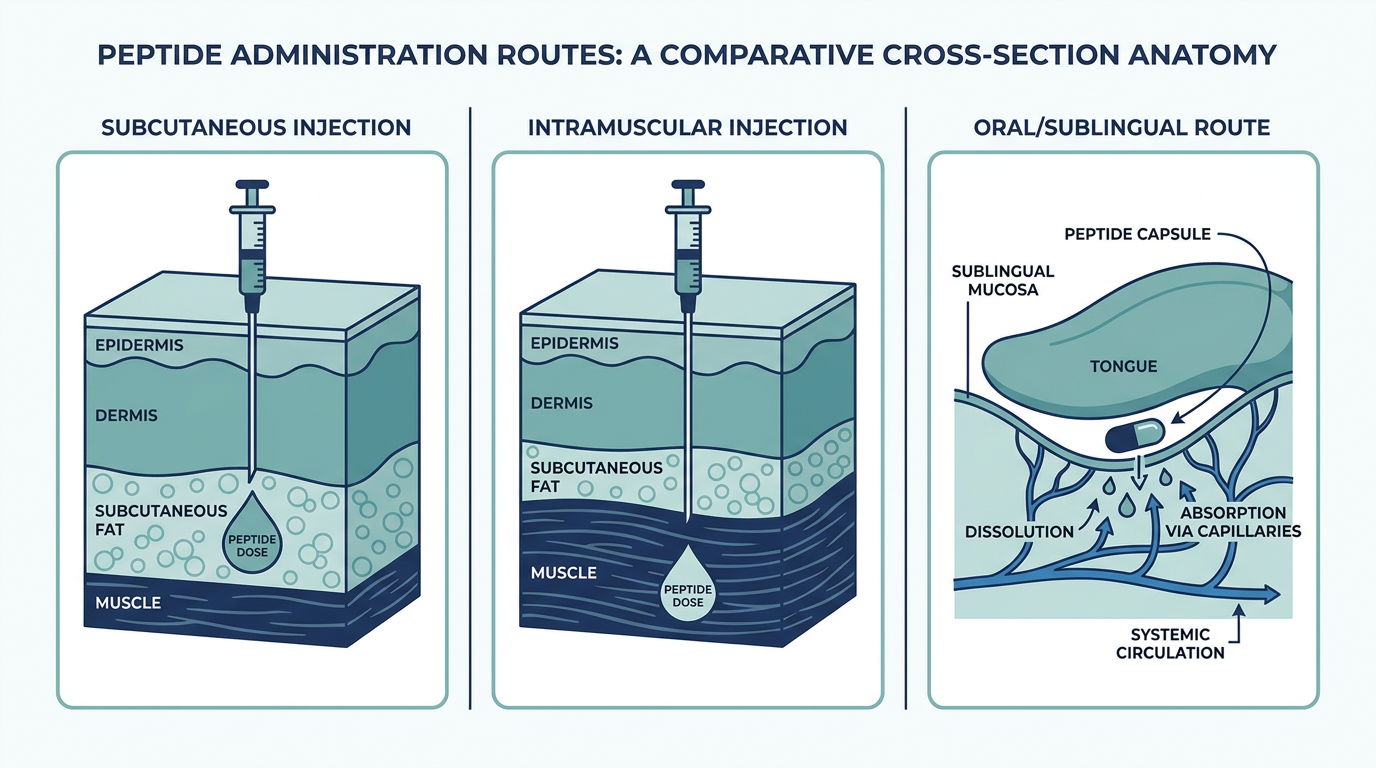
Most confusion around “how to take peptides” collapses as soon as you identify which lane you are in. There are three practical categories, and they share almost nothing in terms of administration.
Lane 1, prescription pens. Semaglutide (Ozempic, Wegovy) and tirzepatide (Mounjaro, Zepbound) are delivered via prefilled, multi-dose autoinjector pens prescribed by a clinician and dispensed through a licensed pharmacy. The pen handles the dose; you handle the site and the timing. Once weekly, subcutaneous, rotating between the abdomen, front thigh, and outer upper arm.
Lane 2, collagen and supplement peptides. Hydrolyzed collagen peptides, BPC-157 oral capsules marketed as supplements, and topical copper-peptide (GHK-Cu) serums are sold openly as food supplements or cosmetics. No injection. No reconstitution. The rules here are simpler and the risks lower.
Lane 3, lyophilized vials. Research-grade or compounding-pharmacy peptides such as BPC-157, TB-500, CJC-1295, Ipamorelin, sermorelin, and GHK-Cu injectable arrive as freeze-dried white powder in sealed glass vials. You add bacteriostatic water, calculate a concentration, draw a volume on an insulin syringe, and inject subcutaneously. This lane is where technique genuinely matters, and it is the one most first-timers underestimate.
| Form | Example peptides | How to take | Key number |
|---|---|---|---|
| Prefilled autoinjector pen | Semaglutide, Tirzepatide | Weekly SubQ injection, fixed pen dose | Once every 7 days |
| Powder or capsule supplement | Hydrolyzed collagen, BPC-157 oral | Mix into any liquid, or swallow capsule | 10-15 g/day collagen; product-specific for others |
| Topical serum | GHK-Cu, copper peptide serums | Apply to clean skin, press in | 1-2 drops per area, twice daily typical |
| Lyophilized vial (SubQ) | BPC-157 injectable, sermorelin, CJC-1295/Ipamorelin | Reconstitute + insulin syringe SubQ | 29-31G, 1/2 inch needle |
| Nasal spray | Semax, Selank, PT-141 | One to two sprays per nostril | Bioavailability varies 20-93% by peptide |
How do you take collagen peptides? (the simple lane first)
Hydrolyzed collagen peptides are the most-used peptide product globally, sold as powders, capsules, gummies, and liquid shots. Research supports 2.5 to 15 grams daily for various outcomes, with most studies using 10 grams as a round working dose. A 2019 randomized controlled trial published in Nutrients found that 15 grams of collagen peptides daily for 12 weeks improved skin elasticity and hydration compared to placebo.
The form is forgiving. Hydrolyzed collagen powder is already broken down; it dissolves in hot or cold liquids without clumping and survives heat, so stirring it into coffee or a hot soup is fine. Consistency matters more than timing. If you want a reason to time it, a pre-workout or post-workout window may support connective tissue repair because mechanical loading during exercise increases the uptake signal.
One thing the packaging rarely says: collagen peptides do not contain tryptophan, so they are a nutritionally incomplete protein. Counting them toward total daily protein is technically correct but misleading if you are relying on them to cover essential amino acid requirements.
The only mistake worth avoiding in this lane is buying gummies or capsules and assuming a single serving delivers a therapeutic dose. Many collagen gummies contain 2 to 5 grams per serving, which is below the 10-gram level used in most positive studies. Check the label before you assume the dose is equivalent to the powder.
How do you use a GLP-1 autoinjector pen?
Prefilled pens for semaglutide and tirzepatide are engineered to remove most of the variables. The dose is pre-set, the needle is built in, and the injection depth is calibrated. That said, the three most common errors with pens are choosing a bad site, injecting through clothing, and skipping the 10-second hold after pressing the button.
The basic sequence for a weekly GLP-1 injection:
- Remove the pen from the refrigerator 30 minutes before injecting. Cold solution stings more than room-temperature solution.
- Check that the liquid inside is clear and colorless. A cloudy or discolored solution is a discard, not a “probably fine.”
- Wipe your chosen site with a 70% isopropyl alcohol swab and wait 10 to 15 seconds for it to dry completely. Injecting through wet alcohol carries it into the tissue and causes unnecessary stinging.
- Remove the outer and inner needle caps per your pen’s instructions.
- Pinch a fold of skin at the site, insert at 90 degrees in one smooth motion, and press the button all the way down.
- Hold for a full 10 seconds before withdrawing. Many patients who report “medication leaking out” are actually withdrawing before the dose completes, and the hold solves it.
- Recap with the outer cap only (never resheath with the inner cap), and dispose of the needle in an FDA-cleared sharps container.
Novo Nordisk and Eli Lilly both publish detailed visual guides for their specific pens; the manufacturer’s instructions override any general guide, including this one.
Rotate your pen injection sites weekly across the abdomen, front thigh, and outer upper arm. Do not inject in the exact same quadrant two weeks in a row. Lipodystrophy, the formation of hard scar tissue or visible dents under the skin, is a real consequence of repeated injection at the same point, and it impairs absorption of future doses at that site.
How do you reconstitute a lyophilized peptide?
Lyophilization (freeze-drying) is used because peptide bonds are fragile in liquid. The powder form extends shelf life to two or more years at minus 20 Celsius. Reconstitution is the process of adding a solvent to return the powder to a usable liquid. Getting this wrong is the single most consequential procedural error in the lyophilized vial lane.
What you need before you start
- Bacteriostatic water (BW), NOT sterile water for injection. Bacteriostatic water contains 0.9% benzyl alcohol, an antimicrobial preservative that extends the reconstituted vial’s shelf life to approximately 28 days at 2 to 8 Celsius. Sterile water has no preservative; a reconstituted vial lasts only 24 to 48 hours and must be single-use. This is not a minor distinction.
- 29 to 31 gauge, half-inch (12.7 mm) insulin syringes, U-100 graduated.
- 70% isopropyl alcohol swabs.
- A sharps disposal container.
The reconstitution sequence
- Allow the lyophilized vial and the bacteriostatic water vial to reach room temperature.
- Wipe the rubber stopper of both vials firmly with an alcohol swab. Wait 10 to 15 seconds for alcohol to evaporate before piercing.
- Draw the amount of bacteriostatic water you need into the syringe.
- Insert the needle into the peptide vial at an angle so the stream of water runs down the inside glass wall, not directly onto the powder. Direct contact causes foaming, which can denature some peptides and slows complete dissolution.
- Do not shake. Roll the vial gently between your palms or let it rest for 5 to 10 minutes until the powder fully dissolves. The solution should be clear and colorless.
- Write the reconstitution date on the vial. Discard at 28 days regardless of remaining volume.
- Store refrigerated at 2 to 8 Celsius. Do not freeze a reconstituted vial; a single freeze-thaw cycle can reduce peptide activity by 20 to 50% depending on the compound.
Concentration and dose math
This is the step where most first-timers make a dangerous error, and the error is always in the same direction: off by a factor of ten.
The standard approach: add 1 mL (100 units on a U-100 syringe) of bacteriostatic water to a 5 mg vial. This gives you a concentration of 5 mg/mL, which is 5,000 mcg/mL. On a U-100 syringe, each unit equals 0.01 mL, which at this concentration equals 50 mcg.
So at 5 mg/mL:
– 10 units drawn = 0.10 mL = 500 mcg
– 5 units drawn = 0.05 mL = 250 mcg
– 2 units drawn = 0.02 mL = 100 mcg
If you add 2 mL instead of 1 mL, your concentration halves to 2.5 mg/mL (2,500 mcg/mL), and every dose you draw is half as strong. The math is simple, but only if you know which variable you changed. The safest habit is to write the concentration on the vial label at the time of reconstitution, not to recalculate it from memory each time you draw.
Most peptide calculators online are correct but use different default water volumes. Plug your specific vial size and the water volume you actually added, not the volume a random forum post assumed.
Where do you inject a subcutaneous peptide?
Subcutaneous injection delivers the peptide into the fatty layer just beneath the skin, where it absorbs gradually via capillary diffusion. This is the right route for almost all research and compounding-pharmacy peptides because it is less painful than intramuscular, requires shorter needles, and produces sustained absorption that most therapeutic peptides are designed to leverage. Subcutaneous injection achieves 65 to 95% bioavailability for most water-soluble peptides, compared to 100% intravenous but with none of the access and risk issues.
The primary sites, in order of ease and reliability:
Abdomen: The preferred starting point. Use the area roughly two inches on either side of the navel, staying two inches away from the navel itself (which has dense connective tissue). The abdomen provides consistent fat depth, is easy to visualize, and gives the most rotation space. Use a clock-face rotation: upper right, lower right, lower left, upper left. Allow at least two weeks before returning to the exact same injection point.
Front of thigh: The middle third of the outer front thigh, between the knee and hip. A practical secondary site if the abdomen becomes irritated. Slightly less surface area for rotation than the abdomen.
Outer upper arm: The fleshy area on the back and outer portion between shoulder and elbow. Harder to self-inject cleanly because you need one hand to pinch and the other to hold the syringe. Best used when someone else is administering.
Injection angle: 45 degrees for lean body types with minimal abdominal fat; 90 degrees when there is adequate pinchable fat. Needle length of 4 to 6 mm is sufficient for lean individuals; 8 to 12.7 mm (half inch) for average to higher body fat. A 31-gauge needle produces significantly less pain than a 27 or 28 gauge; the additional step of drawing with a slightly larger gauge and swapping to a fresh 31G for injection is optional but can help.
Full-body lab membership: 100+ biomarkers, doctor-reviewed, tracked over time.
What about nasal sprays and sublingual drops?
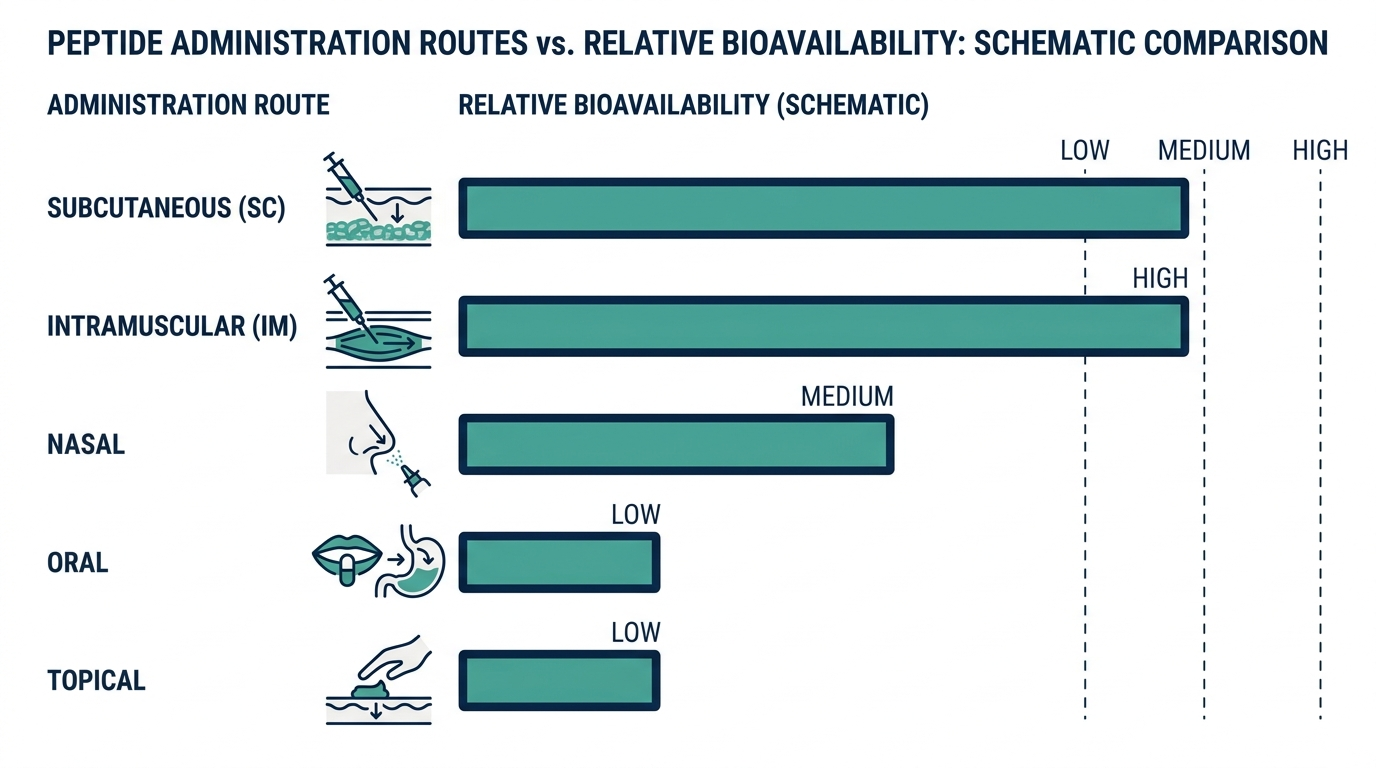
Nasal sprays are the non-injection delivery method with the widest range of real-world use. The bioavailability numbers vary dramatically by molecule. Selank achieves approximately 92.8% intranasal bioavailability due to its physicochemical properties. GHRP-2 demonstrates around 50% nasal bioavailability. Ipamorelin achieves approximately 20% nasally, which means dose adjustments are needed to match injected levels. Oral delivery for most peptides is under 1 to 2% because the gastrointestinal tract’s proteolytic enzymes cleave the amino acid chains before absorption.
The exception to the oral rule is oral semaglutide (Rybelsus), which uses a SNAC (sodium N-(8-(2-hydroxybenzoyl) amino caprylate) carrier to achieve approximately 0.4 to 1% bioavailability, which is enough for clinical effect when dosed appropriately. This is not a DIY formulation; it is an FDA-approved drug with a precise co-formulation.
For neuropeptides like Semax and Selank, the nasal route offers an advantage beyond bioavailability: the possibility of direct nose-to-brain delivery via olfactory pathways, which may support central nervous system effects at lower systemic doses than injection would require. This is the one context where nasal delivery is not simply a compromise but potentially a preferred route for the intended effect.
Sublingual delivery achieves approximately 10 to 25% for small peptides, higher than oral but lower than injection. Some compounding pharmacies formulate BPC-157 and other peptides as sublingual troches; this is a legitimate clinical format that a prescribing physician may choose, not a DIY workaround.
What is the timing that actually matters?
Not every peptide has meaningful timing requirements, but the ones that do, really do.
Growth hormone secretagogues (CJC-1295, Ipamorelin, sermorelin): These work by stimulating the pituitary to release growth hormone. Food, particularly carbohydrates, blunts GH release; even a moderate carbohydrate meal can suppress GH secretion by 50 to 80% for several hours. The clinical standard is to inject at least two hours after the last meal, with bedtime being the most common choice because it stacks with the body’s largest natural nocturnal GH pulse, which occurs during the first phase of deep sleep. Fasted morning is a valid second window for split dosing.
BPC-157 oral (research supplement context): Fasting is the conventional recommendation to maximize exposure to gut tissue before food changes the luminal environment. Thirty minutes before eating is a common protocol.
BPC-157 injectable: Timing is less strictly discussed in clinical literature because the systemic route bypasses the gut. Protocols typically call for once or twice daily at consistent intervals.
Collagen peptides: No meaningful timing effect. Consistency of daily intake matters; specific windows do not.
GLP-1 pens (semaglutide, tirzepatide): Once weekly, same day each week, any time of day, with or without food. The long half-life (tirzepatide: approximately five days; semaglutide: approximately seven days) makes intra-day timing irrelevant.
The insider reality nobody writes on product pages: copy-pasting a friend’s exact protocol is the most common reason a peptide cycle delivers nothing. Each molecule has its own pharmacokinetics, and the interaction between two peptides stacked together can change the timing math for both. If you are running a combination protocol, the clinician who prescribes it should be the one setting the timing, not a forum thread from three years ago.
What are the most common mistakes and how do you avoid them?
Mistake 1: Shaking the vial after adding water. Shaking denatures peptide bonds. Roll gently or wait for passive dissolution.
Mistake 2: Injecting through wet alcohol. The swab must dry completely, 10 to 15 seconds of air exposure, before piercing. Wet alcohol on the needle tip carries into the tissue and causes a burning sensation that people mistakenly attribute to the peptide itself.
Mistake 3: Getting the concentration math backwards. Adding more water to a vial produces a weaker concentration, not a stronger one. Write the concentration on the vial. Do not recalculate from memory.
Mistake 4: Injecting in the same spot. Lipodystrophy, the formation of hardened, scarred subcutaneous fat, is a real and visible consequence of insufficient rotation. It also impairs absorption at the affected site. The clock-rotation method around the navel solves this mechanically.
Mistake 5: Freezing a reconstituted vial. Room temperature to refrigerator is fine. Reconstituted to freezer is not. A single freeze-thaw cycle measurably degrades many peptides.
Mistake 6: Assuming “research use only” means the same as a pharmacy product. It does not. The label transfers liability entirely to you, there is no pharmacist checking the dose, and independent lab testing by Finnrick has shown that purity in research-grade vials can range widely, including batches that tested below 90% purity or failed identity checks entirely. The label does not tell you which kind of vial you have.
Do not believe anyone who tells you that sourcing peptides from a research vendor is equivalent to getting them from a compounding pharmacy for practical safety purposes. The supply chains, oversight mechanisms, and accountability structures are entirely different.
How does subcutaneous compare to intramuscular for peptides?
Most peptides do not require intramuscular injection, and most self-administering users should not attempt it without clinical guidance. That said, here is the honest comparison.
| Factor | Subcutaneous (SubQ) | Intramuscular (IM) |
|---|---|---|
| Needle length | 4-12.7 mm (1/4 to 1/2 inch) | 25-38 mm (1 to 1.5 inch) |
| Gauge | 29-31G | 22-25G |
| Absorption peak | Slower, sustained; sustained levels 18-24 hrs longer | 30-40% higher peak within first hour |
| Pain | Generally low | Moderate to higher |
| Volume max | 1-2 mL per site | 3-5 mL per site |
| Best for | Nearly all research/compounding peptides | Oil-based formulations, larger volumes |
| Self-injection ease | High | Lower; deltoid and vastus lateralis require positioning |
The clinical consensus is that subcutaneous injection is the appropriate route for nearly all water-soluble peptide formulations. The pharmacokinetic advantage of the faster IM peak is marginal for most therapeutic peptides, which are designed to operate over hours. The major exception is an oil-based formulation, which may require IM for physical reasons, but most research and compounding peptides are water-based.
Turn what you just learned into action.
Superpower lets you test 100+ biomarkers from home, then re-check them over time so you can actually see progress, physician-reviewed at every step.
Frequently asked questions
How do I know how many units to draw on an insulin syringe?
Divide your target dose in mcg by your concentration in mcg/mL to get the volume in mL. Multiply by 100 to convert to units on a U-100 syringe. Example: 250 mcg target, 5,000 mcg/mL concentration (5 mg in 1 mL of water) = 0.05 mL = 5 units. Use an online peptide calculator to verify your math before drawing, not after.
Can you take peptides orally instead of injecting?
For collagen peptides, yes, oral is the intended route. For most injectable peptides, oral delivery destroys the molecule; bioavailability is under 1 to 2% for most amino acid chains due to gastrointestinal proteolysis. The exceptions are oral semaglutide (Rybelsus, FDA-approved with a specialized carrier molecule) and some neuropeptides with intranasal routes that partially bypass systemic digestion.
Does it matter where on the abdomen you inject?
Yes, within limits. Stay at least two inches from the navel. Avoid areas with active bruising, scar tissue, moles, or visible vessels. Within the clear zone, the exact quadrant is less important than rotating to a different spot each injection. The abdomen has more rotation surface area than most people use.
How long does a reconstituted peptide vial last?
28 days when reconstituted with bacteriostatic water and stored at 2 to 8 Celsius. Do not freeze after reconstitution. Mark the date on the vial at the time of reconstitution; relying on memory is how people run expired product.
Do peptide injections hurt?
A 31-gauge, half-inch needle is the same gauge used for insulin injections and produces minimal pain in most people. The most common cause of injection discomfort is cold solution (allow to reach room temperature first), injecting through wet alcohol (wait for it to dry), or injecting too quickly. Slow the push on the plunger and hold for five seconds before withdrawing.
Is it safe to take two peptides at the same time?
Clinically, combinations like CJC-1295 plus Ipamorelin are commonly prescribed together because their mechanisms are complementary (one extends the GH pulse, the other amplifies its amplitude). However, stacking multiple peptides without clinical supervision is where protocols get complicated and error-prone. Timing windows, potential interactions, and cumulative hormonal effects all compound. A clinician who knows your baseline labs should set any combination protocol.
What is the difference between how a prescription peptide and a research peptide are administered?
The administration mechanics are identical: same syringe, same injection technique, same sites. The difference is what is in the vial. A prescription peptide from a licensed 503A or 503B compounding pharmacy has been prepared under USP standards, verified for identity and purity, labeled with a specific dose, and dispensed by a licensed pharmacist under a physician’s order. A research vial has none of those assurances. You can inject both with the same syringe. The supply chain and accountability are entirely different things from the injection technique.
Full-body lab membership: 100+ biomarkers, doctor-reviewed, tracked over time.
Author: Vital Signs Today Editorial Team, [credential]”]. Educational content, not medical advice. Sources linked inline.
Primary sources:
- PeptideDeck: How to Inject Peptides (2026)
- PeptideDeck: Subcutaneous vs Intramuscular Injection
- BetterLife Lab: Bacteriostatic Water Reconstitution Guide (2026)
- HealingMaps: FDA PCAC July 2026 Peptide Review
- Loti Labs: BPC-157 Legal Status 2026
- PeptideNerds: Injection Sites and Rotation Guide (2026)
- Onyx Biolabs: Peptide Stability Guide (2026)
- PeptideDeck: Fasting and Food Timing Guide
- Peptide Authority: Bioavailability Oral vs Injectable vs Nasal
- Peptide Deck: Collagen Peptides Guide
- Defy Medical vs Marek Health Comparison (FormBlends)
- Zepbound: How to Use (Eli Lilly)
- Dosed / TrackPeptides: SubQ vs IM Differences
Related reading
Vital Signs Today may earn a commission if you buy through links on this page. It does not affect our editorial assessments.