
Last updated June 2026. Educational content, not medical advice. Consult a licensed clinician before making changes to your supplement routine.
Short answer: Dissolve 10 to 20 grams in any liquid once per day, ideally with at least 50 mg of vitamin C. For joint and tendon support, take it 45 to 60 minutes before exercise. For skin, take it any time consistently. Dose by goal, not by the default scoop size on the label.
You’re timing collagen peptides around exercise, but do you know your joint and recovery markers? One at-home Superpower draw checks 100+ biomarkers, physician-reviewed.
Collagen peptides powder is genuinely one of the simpler supplements to use, and yet most people do one of three things wrong: they take the wrong dose for their goal, they skip vitamin C, or they give up after two weeks before results have had any chance to appear. This guide covers the mechanics that actually matter, the real numbers from clinical trials, and the one timing trick for athletes that the label never mentions.
Full-body lab membership: 100+ biomarkers, doctor-reviewed, tracked over time.
What dose of collagen peptides powder should you actually take?
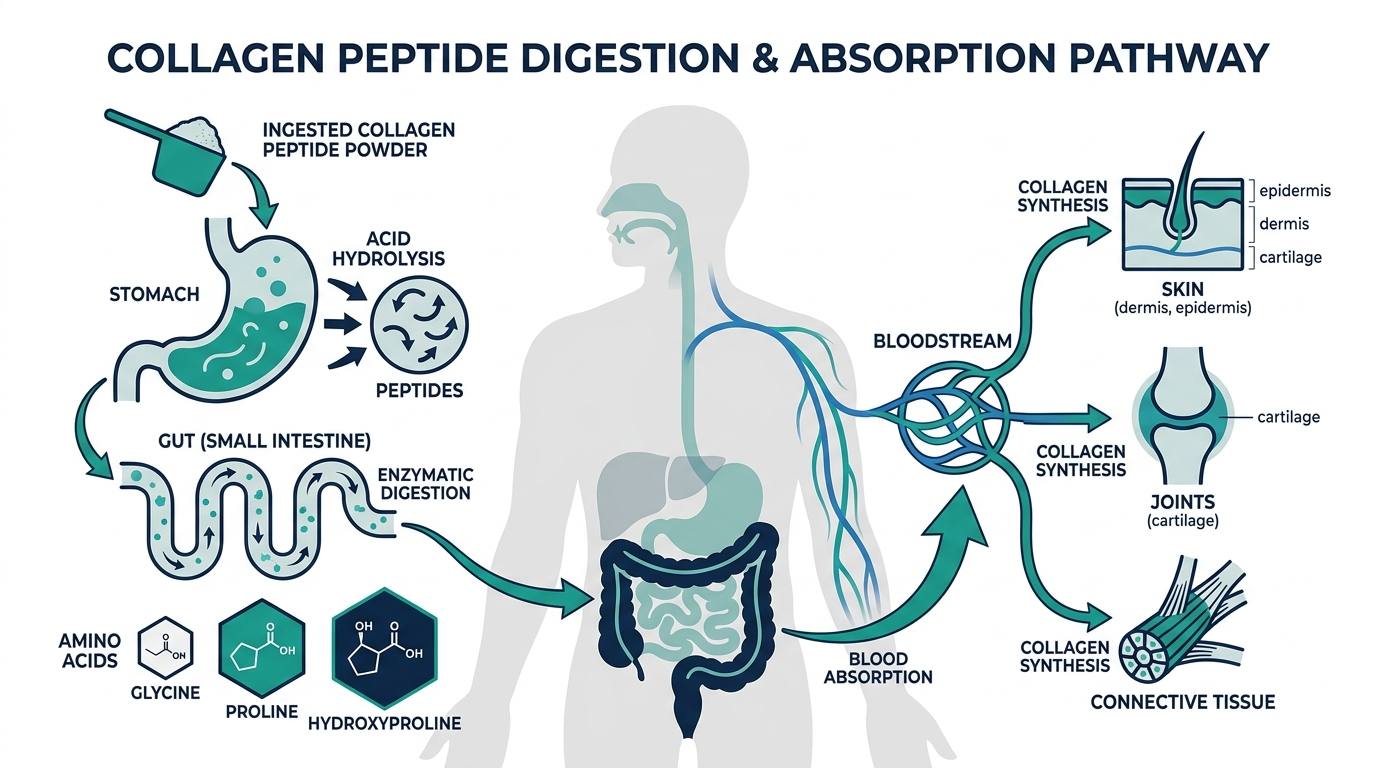
The honest answer is that “dose” depends entirely on what you are trying to achieve. Supplement labels default to a convenient 10 to 20-gram serving because it fits a single scoop, not because that number is universally optimal. Research suggests a narrower range by goal.
For skin benefits, the best-studied dose is surprisingly low. A 2025 double-blind placebo-controlled trial published in Cosmetics found that 2.5 grams of bovine-derived bioactive collagen peptides (the Verisol formulation) taken daily for 8 weeks increased forearm skin hydration by 26% compared with placebo, improved skin elasticity by 9%, and reduced wrinkle volume at the outer eye corner by 25%. Two point five grams. That is roughly half a teaspoon, less than most brands put in a single serving.
For joint and tendon recovery, the Shaw and Baar study (University of California Davis, 2017) is the most-cited reference: 15 grams of vitamin C-enriched hydrolyzed collagen consumed 60 minutes before exercise significantly raised procollagen synthesis markers compared with placebo. Follow-up systematic reviews through 2024 support 5 to 15 grams as the effective range for musculoskeletal applications.
For muscle recovery and general protein support, 10 to 20 grams per day is the commonly studied range, though collagen is not a complete protein (it lacks tryptophan) and should not replace a full protein source.
Upper limits: Dietitians treating specific patients sometimes prescribe up to 20 grams per day with good tolerability. Going beyond that regularly can cause bloating, loose stools, or a feeling of heaviness, especially if taken in a single large dose on an empty stomach.
A quick reference:
| Goal | Studied dose | Evidence strength |
|---|---|---|
| Skin hydration, elasticity, wrinkles | 2.5 to 5 g/day | Strong (multiple RCTs, Verisol, Peptan) |
| Joint pain, cartilage support | 5 to 10 g/day | Moderate (systematic reviews 2021, 2024) |
| Tendon / connective tissue synthesis | 15 g/day, pre-exercise + vit C | Single RCT (Shaw, Baar 2017), replicated |
| Muscle soreness reduction | 15 to 20 g/day | Moderate (crossover RCT, NCBI PMC10158542) |
| General connective tissue maintenance | 10 g/day | Practical consensus, not a single trial |
Does the timing of your collagen dose actually matter?
The simplest way to actually get this done
Superpower is a full-body lab membership that runs 100+ biomarkers, has each result reviewed by a doctor, and tracks your numbers year over year (about $199/year). It is what we point readers to when they would rather get one clean, complete draw than chase single tests one at a time. Here is superpower reviewed in full.
For most goals, timing matters less than consistency. Skin and bone trials typically instruct participants to take collagen once per day at a regular time, and morning is the most common choice simply because it is easiest to remember alongside breakfast or coffee.
The exception is athletes and anyone taking collagen specifically for tendons, ligaments, or joint cartilage. The pre-exercise timing protocol from the Baar lab asks for collagen 45 to 60 minutes before training. The reasoning is mechanistic: collagen peptides spike circulating amino acid levels (particularly glycine, proline, and hydroxyproline) and vitamin C stimulates the prolyl hydroxylase enzymes that stabilize the triple helix. You want those precursors circulating in blood at the moment mechanical load stimulates fibroblasts to synthesize new connective tissue. Taking it after training misses the window.
An honest aside: the pre-workout timing is supported by one well-designed study and its replications, not by a decade of head-to-head RCTs across large populations. It is the best available guidance, not carved-in-stone dogma.
Personally, I think the “take it at the same time every day” principle matters more for adherence than for pharmacokinetics. A slightly suboptimal time you stick to beats a perfect protocol you forget three days per week.
What should you mix collagen peptides powder with?
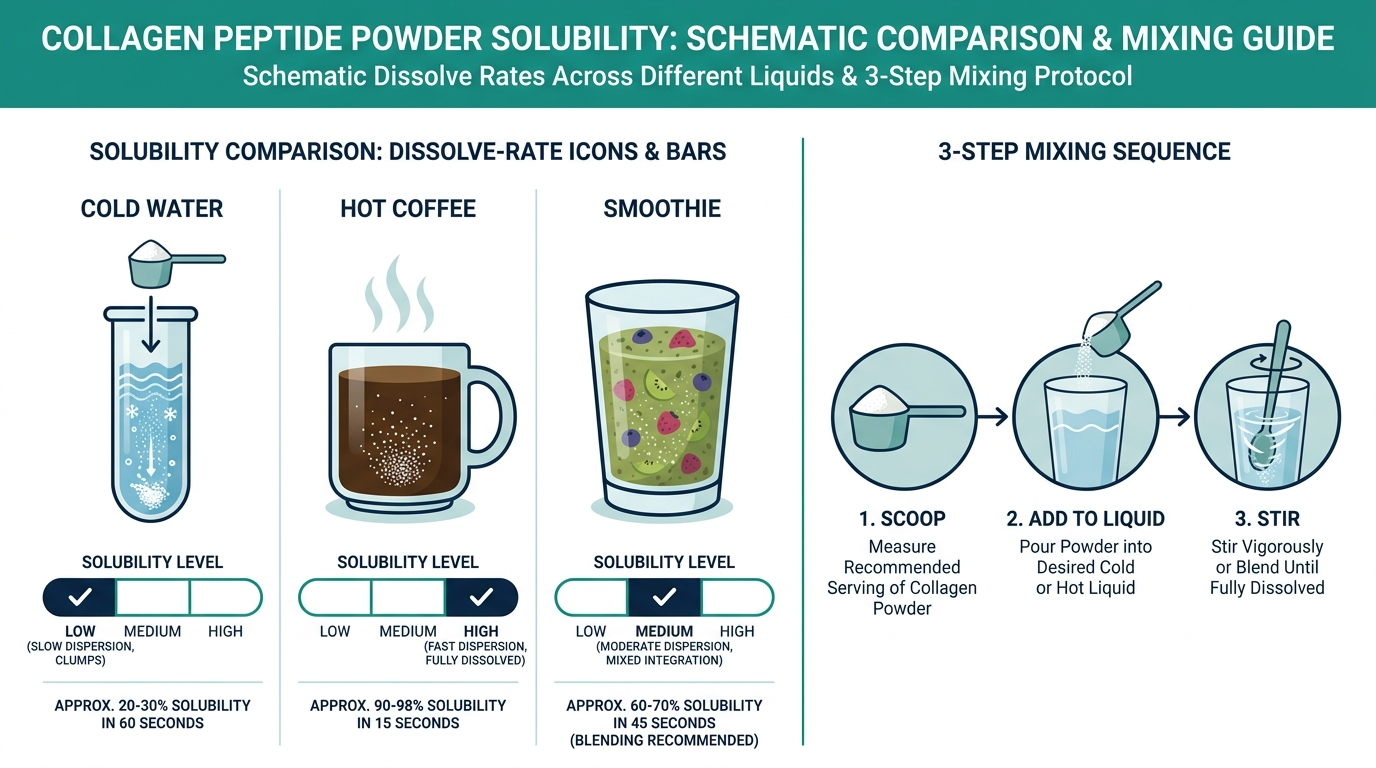
Hydrolyzed collagen peptide powder dissolves in both hot and cold liquids because the hydrolysis process has already broken the protein into short fragments, approximately 2,000 to 8,000 daltons depending on source and brand. Unlike gelatin (the unhydrolyzed form), collagen powder will not congeal your coffee.
Hot liquids (coffee, tea, broth): Stir directly into your drink. Collagen peptides are stable up to approximately 302 degrees Fahrenheit, well above typical brewing temperatures (195 to 205 degrees Fahrenheit for coffee), so the amino acids remain intact. The heat-destroys-collagen myth comes from a misunderstanding of protein denaturation: denatured does not mean nutritionally destroyed. Your stomach does the same thing on purpose.
Cold liquids (water, juice, smoothies): A common clumping issue with cold water is easy to prevent. Start with a small amount of lukewarm water (about two ounces), stir or shake until dissolved, then top with cold liquid or pour over ice. A milk frother eliminates clumping completely in about 15 seconds.
The vitamin C rule: Whatever you mix collagen into, add vitamin C to the same sitting. Vitamin C activates prolyl and lysyl hydroxylase enzymes that cross-link collagen’s triple helix structure. Without it, your body has fewer tools to convert the absorbed peptides into stable tissue. A squeeze of lemon in water, a side of citrus, or a standalone 50 to 100 mg supplement all work. The Shaw and Baar pre-exercise protocol included vitamin C specifically for this reason.
What to avoid mixing with collagen: Sugar-heavy drinks blended at once are a minor concern not because they harm collagen’s bioavailability but because dietary advanced glycation end-products (AGEs), formed when sugar binds to protein in high heat, can cross-link existing tissue collagen and accelerate skin aging. If you are cooking with collagen (baking into pancakes, stirring into soups), the therapeutic amino acids survive the process but keep temperature and browning in check.
Which source of collagen peptides powder is best for your goal?
There are two dominant sources on the retail market, and they are not interchangeable in every scenario.
Bovine collagen (from grass-fed cattle hide and bones) contains Type I and Type III collagen. Type I is the most abundant in skin, tendons, ligaments, and bone. Type III is important for muscle, organ, and vascular tissue. Bovine is the most widely researched source, and most of the clinical trials cited in this article used bovine hydrolysate. It is also the most affordable, typically $1 to $2 per serving for reputable brands.
Marine collagen (from fish skin and scales) is almost entirely Type I and has a smaller average peptide size (2,000 to 3,000 daltons versus 3,000 to 8,000 for bovine), which some research suggests improves intestinal absorption. Bioavailability is estimated at roughly 1.5 times that of bovine in some comparisons. For skin-focused users who do not eat beef or who find bovine’s taste profile off-putting, marine is a reasonable upgrade. Expect to pay 20 to 40% more per gram.
What source does not help: plant-based “collagen” products do not contain collagen. They contain vitamin C, zinc, and amino acids that support your body’s own collagen synthesis. That can be a legitimate strategy for vegans, but it is not the same biochemical input as consuming hydrolyzed animal collagen.
Personally, I would not chase marine collagen unless you have a specific reason. The clinical trial evidence overwhelmingly comes from bovine sources, which means you are extrapolating when you assume marine performs identically. The cost premium buys you a plausible bioavailability advantage but not a proven outcome advantage at the dosing ranges most people use.
Hydrolyzed type I & III collagen peptides, third-party tested, unflavored.
Myth-busting: does collagen powder “go directly to your skin”?
No, and this is the biggest misunderstanding that leads people to either overpay or give up too soon.
When you drink collagen peptides, your digestive system does not deliver intact collagen fibers to your dermis like a courier. Instead, proteases in your small intestine cleave the peptides into di- and tripeptides (two- and three-amino-acid chains, particularly Pro-Hyp and Gly-Pro-Hyp sequences), which are small enough to cross the intestinal wall. These specific sequences accumulate in skin tissue and cartilage, and there is evidence they stimulate fibroblasts to increase their own collagen synthesis. So collagen peptides work as signaling molecules more than building blocks.
What this means practically: the amino acids you ingest are not “tracked” to any one tissue. Your body allocates them where demand is highest. A collagen supplement supports production, but healing an acute injury or rebuilding significantly depleted joint cartilage will pull priority. If you are supplementing for cosmetic skin benefits while also recovering from surgery or a torn ligament, the cosmetic signal gets less than its fair share.
This is also why consistent long-term use (eight to twelve weeks minimum, not two weeks) is what all legitimate clinical trials use. Results reported at week two in any collagen review are anecdote, not data.
What common mistakes stop collagen powder from working?
Skipping vitamin C. Already covered, but it bears repeating because it is the highest-value change most people can make. Even 50 mg alongside your dose is meaningfully better than zero.
Dosing below the studied threshold for your goal. A 5-gram serving twice a day for joint pain is clinically supported. Half a scoop (5 grams) for the same goal is below the evidence range. Read your label, not just the brand marketing.
Expecting results in the first two weeks. Skin collagen density measured by ultrasound and forearm elasticity measured by cutometer take six to twelve weeks to show statistically significant change in clinical trials. If you are evaluating a product after two weeks, you are not in the data range yet.
Taking it inconsistently. Collagen synthesis is a slow, continuous process. Missing days and doubling up is not equivalent to daily dosing. Set a fixed habit: collagen in your morning coffee, your pre-workout drink, or your evening tea, and do not move it around.
Ignoring sleep and dietary protein. Collagen synthesis peaks during sleep in the cellular repair window. Chronic sleep deprivation measurably reduces skin collagen density. If you are sleeping five hours, no dose of collagen powder will fully compensate for the missing repair cycle.
How long before you see results from collagen peptides powder?
The honest timeline, based on clinical trial endpoints:
- Skin hydration and texture: 4 to 6 weeks at 2.5 to 5 grams per day. The 2025 Cosmetics trial found significant hydration gains at 8 weeks.
- Skin elasticity and visible wrinkle reduction: 8 to 12 weeks. The Verisol trials consistently report significant wrinkle volume reductions at 8 weeks, not sooner.
- Joint pain reduction: 3 to 6 months is the typical trial duration. A 2021 systematic review in PMC noted that shorter trials on joint outcomes often showed marginal effects while 12-week-and-longer trials showed consistent benefit.
- Connective tissue resilience (athletes, post-injury): 12 to 24 weeks of consistent dosing combined with relevant training stimulus.
Do not believe any review that describes transformative skin changes in “just two weeks” from collagen powder. The biology does not move that fast.
Two realistic examples: same powder, different plan
Consider two people using the exact same tub of collagen. The first is a 38-year-old who wants firmer, better-hydrated skin. Her plan is 2.5 to 5 grams in morning coffee with a slice of orange, every day, judged at the 8 to 12 week mark and not before. Low dose, one anchor habit, patience.
The second is a 45-year-old recreational runner nursing a cranky Achilles tendon. His plan is 15 grams with 50 to 100 mg of vitamin C in water, taken 45 to 60 minutes before his runs and rehab sessions, because the pre-load timing is the part that matters most for connective tissue. Same powder, roughly triple the dose, timed to training, judged over three to six months. Neither plan is more correct than the other. They are correct for different goals, which is the whole point of dosing by outcome rather than by scoop.
How do you build collagen into a routine you will actually keep?
The supplement only works if you take it, so the practical goal is to anchor the dose to something you already do every day. A few field-tested setups:
- The skin-first coffee habit. If your goal is skin, stir 2.5 to 5 grams into your morning coffee or tea every day and add a squeeze of lemon or a small vitamin C tablet. One drink, one habit, done before you have even opened your laptop.
- The athlete pre-session shake. If your goal is tendons or joints, keep the powder next to your gym bag and take 15 grams with vitamin C in water about 45 to 60 minutes before training. On rest days, take it at the same clock time so the habit does not drift.
- The evening wind-down. If mornings are chaotic, a mug of collagen in decaf tea after dinner works just as well for skin and joint goals, since consistency beats clock time for those uses.
One measuring note that trips people up: a scoop is not a fixed dose. Scoop sizes vary between brands from roughly 7 grams to 20 grams, and powder settles in the tub, so the same scoop can hold different amounts on different days. If your goal depends on hitting a specific dose, weigh the powder on a cheap kitchen scale for the first week until you can eyeball it. It is the single easiest way to stop accidentally under-dosing.
Curious what your own levels look like?
Baseline 100+ biomarkers today and retest as life changes, all in one membership with physician review.
FAQ
Can I take collagen peptides powder every day?
Yes, and daily use is exactly what clinical trials require to show benefit. There is no evidence that daily use at standard doses (up to 20 grams) causes any tolerance, habituation, or organ stress. Long-term safety studies have followed daily users for up to 6 months without adverse effects beyond occasional mild digestive symptoms in a minority of users.
Can I mix collagen peptides powder into hot coffee?
Yes. Collagen peptides are heat-stable well above coffee brewing temperatures, which typically peak around 200 degrees Fahrenheit. The “heat destroys collagen” concern applies to intact triple-helix collagen (gelatin), not to hydrolyzed peptides that are already denatured and fragmented. Stir directly into your cup and the amino acids arrive unchanged.
Should I take collagen peptides powder on an empty stomach?
There is some evidence that absorption is slightly higher fasted (one frequently cited figure is 87% bioavailability on an empty stomach), but the practical difference is small for most users. More important: if you experience bloating or nausea from collagen on an empty stomach, take it with a light meal. Tolerability matters more than a marginal absorption edge.
Can you take too much collagen peptides powder?
Exceeding 20 to 25 grams per day regularly can cause digestive discomfort, bloating, or loose stools in susceptible individuals, particularly when taken in a single large dose. There is no evidence of kidney or liver stress from dietary collagen at typical supplemental doses, but it is not a nutrient to “mega-dose.” More is not meaningfully better past the studied effective range for your goal.
Do collagen peptides break a fast?
Yes. Collagen contains calories (approximately 35 calories per 10-gram serving) and triggers an insulin response, which ends a strict fast. For intermittent fasters taking collagen for a training or skin goal, the recommended workaround is to schedule the dose just before the first meal of your eating window. The pre-exercise protocol for tendons (60 minutes before training) may matter more than preserving a fast.
Does marine collagen work better than bovine for skin?
The smaller peptide size of marine collagen is theoretically advantageous for intestinal absorption, but most of the robust multi-week RCTs showing skin elasticity and wrinkle improvement used bovine-derived peptides (Verisol and Peptan are both bovine). There are no well-designed head-to-head trials directly comparing marine versus bovine at equivalent doses in skin endpoints. Choose marine if you avoid beef, have a fish-friendly palate preference, or want to spend more for the theoretical bioavailability edge. Either source outperforms not taking it.
Is there anyone who should NOT take collagen peptides powder?
People with allergies to the source protein (fish allergy for marine collagen, beef allergy for bovine) should avoid the respective type. Individuals with hypercalcemia should note that some collagen supplements include added calcium. Collagen is generally considered safe during pregnancy, but consult your OB before adding any new supplement. If you are taking any medication that affects kidney function or protein metabolism, a quick check with your prescriber is sensible before starting.
Is collagen the same as regular protein powder?
No. Collagen is a protein, but it is not a complete one, because it lacks the essential amino acid tryptophan and is low in the branched-chain amino acids that drive muscle building. Whey or a complete plant protein is the better choice for building muscle. Collagen is a targeted tool for skin and connective tissue, not a general protein replacement, so plenty of people use both for different reasons.
Can I take collagen with creatine or other supplements?
Yes. There is no known negative interaction between collagen peptides and common supplements such as creatine, whey protein, vitamin D, or omega-3s, and stacking collagen with vitamin C is actively encouraged. If you take prescription medication rather than supplements, run the combination past your prescriber, but for everyday supplements, taking them together is fine.
Does collagen help hair and nails?
The evidence here is thinner than for skin and joints, but some trials report faster nail growth and fewer broken nails after several weeks of daily collagen, and users often describe similar effects for hair. Treat hair and nail benefits as a plausible bonus rather than the main reason to take it, and give it the same eight to twelve week window before you judge.
Hydrolyzed type I & III collagen peptides, third-party tested, unflavored.
Author: Vital Signs Today Editorial Team, [credential]”]. Educational content, not medical advice. Sources linked inline.
Primary sources:
– Shaw G, et al. “Vitamin C-enriched gelatin supplementation before intermittent activity augments collagen synthesis.” American Journal of Clinical Nutrition, 2017. PMC8521576
– Cosmetics MDPI 2025, “The Oral Intake of Specific Bovine-Derived Bioactive Collagen Peptides Has a Stimulatory Effect on Dermal Matrix Synthesis” (Verisol 2.5g RCT)
– Skov K, et al. “Absorption of bioactive peptides following collagen hydrolysate intake.” PMC11325589
– León-López A, et al. “Hydrolyzed Collagen, Sources and Applications.” PMC8521576 systematic review
– Clifford T, et al. “The effects of collagen peptides on muscle damage, inflammation and bone turnover following exercise.” Amino Acids, 2019
– Healthline, How Much Collagen Should You Take Per Day?
– Vital Proteins product page and FAQ
– Collagen Science Update February 2026, Collagen Stewardship Alliance
– Bubs Naturals, Does Heat Destroy Collagen Powder?
– ClinicalTrials.gov NCT07302789, Clinical Effects of Two Oral Bioactive Collagen Peptides On Skin Properties and Aging Hallmarks
Related reading
Vital Signs Today may earn a commission if you buy through links on this page. It does not affect our editorial assessments.