
Last updated June 2026. Educational content, not medical advice. Talk to a licensed clinician before starting any new supplement, especially if you take medications or have a chronic health condition.
Short answer: Take 10 to 15 grams of hydrolyzed collagen peptides dissolved in water or coffee, ideally 45 to 60 minutes before exercise or in the morning with 50 to 100 mg of vitamin C. Consistency over 8 to 12 weeks matters more than the exact time of day.
Collagen dosing science is solid, but your bloodwork shows what’s actually changing inside you. Want proof it’s working? One at-home Superpower draw checks 100+ biomarkers, physician-reviewed.
Most guides on this topic stop there. This one does not. Because the difference between collagen supplementation that visibly changes your skin elasticity or joint comfort and collagen supplementation that disappears quietly into your grocery budget comes down to a handful of specific decisions: the dose, the timing window relative to exercise, what you pair it with, and which type of collagen you are actually buying. A 2021 systematic review published in PMC analyzed collagen peptide supplementation across multiple outcomes and found that 15 g per day produced a 153% increase in the collagen synthesis marker PINP compared to just 59.2% at 5 g per day. That gap is not a footnote. It is the difference between a clinical dose and a marketing dose.
Full-body lab membership: 100+ biomarkers, doctor-reviewed, tracked over time.
Why does dose matter so much more than people realize?
The single biggest mistake with collagen peptides is underdosing. Scan the label of almost any grocery-store collagen product and you will find servings of 2.5 g or 5 g per scoop. Some products have a 2 g default serving. Those doses are not chosen because the science says 2 g is optimal; they are chosen because it keeps the per-serving cost low and the container count high.
The research tells a different story. For skin benefits, the dose that moved outcomes in a 2025 double-blind trial of 66 women was 2.5 g daily for 8 weeks, which is the credible floor for this outcome. For joint pain, the effective range in clinical trials is 5 to 10 g per day. For connective tissue synthesis around exercise, specifically the outcome measured by the Shaw et al. research, the winning dose is 15 g taken 60 minutes before exercise, paired with vitamin C.
The practical upshot: one scoop of most mainstream products gets you into the skin-benefit zone, but two to three scoops are closer to the joint and exercise-recovery evidence base.
Do not believe anyone who tells you a 1 g “nano-collagen” serving delivers the same outcome as a studied 10 g dose. The absorption advantage of smaller molecular weight peptides is real, but it does not compress the dose 10-fold. The studies used gram-level doses for a reason.
What is the best time to take collagen peptides?
The honest answer is that timing matters far less than dose and consistency, with one important exception: if you are supplementing specifically for joint or tendon repair alongside exercise.
Research at the University of Otago found that collagen-derived amino acids peak in the bloodstream roughly 60 minutes after ingestion. If those amino acids arrive while collagen-producing cells in your tendons and ligaments are actively stimulated by exercise, the synthesis effect is meaningfully amplified. The protocol that produced the best connective tissue outcomes in multiple studies was this: 15 g of hydrolyzed gelatin or collagen peptides with vitamin C, consumed 60 minutes before a jumping or loading exercise.
For skin and general health, timing is looser. A consistent daily habit matters more than the clock. The most sustainable approach for most people is mixing it into morning coffee or a smoothie, because the habit already exists. There is no evidence that an empty stomach increases bioavailability in a clinically meaningful way when you are using hydrolyzed peptides, since hydrolysis has already done the size-reduction work.
Personally, I would not stress about AM versus PM. I would stress about not missing days.
Does collagen dissolve in hot drinks without denaturing?
This is a question that deserves a direct answer, because a lot of people hesitate to put it in coffee.
Collagen peptides are already denatured. The full-length collagen protein found in connective tissue has been enzymatically broken down into short di- and tripeptides during the hydrolysis process. Those short chains do not have a three-dimensional structure to unravel at high temperatures. Dissolving collagen peptide powder in hot liquids does not degrade the active peptides. They survive your espresso.
The practical caveat: boiling collagen for extended periods may degrade some peptides. Adding a scoop to a hot drink and consuming it promptly is fine. Simmering it in a pot for an hour is not the same scenario.
What should you mix collagen peptides with, and why does vitamin C matter?
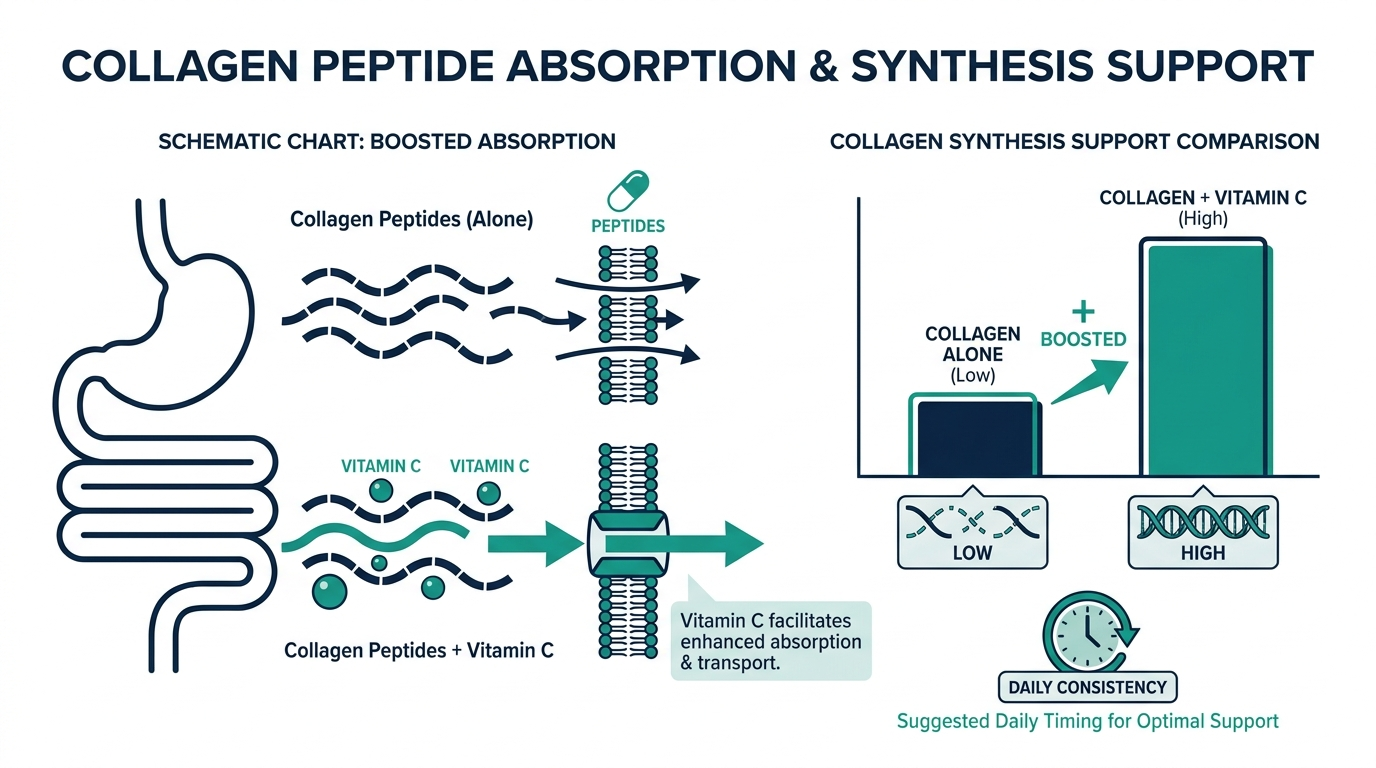
Collagen synthesis is a two-step biochemical process. Your body uses the amino acids in collagen peptides (primarily glycine, proline, and hydroxyproline) as raw material, and it uses vitamin C as the cofactor for the enzyme prolyl hydroxylase, which cross-links collagen fibers into stable structure. Without adequate vitamin C, that second step stalls.
This is not a supplement-marketing claim. It is established biochemistry, which is why Shaw et al.’s foundational 2017 study enriched its gelatin supplement with vitamin C before testing it, and why a current clinical trial registered on ClinicalTrials.gov (NCT06435637) is adding vitamin C to every collagen condition.
The dose of vitamin C shown to be effective in the collagen research context is modest: 48 to 100 mg per serving, which is roughly the vitamin C in half an orange. A dedicated C supplement is not required if your diet includes fresh fruit or vegetables regularly, but adding 50 to 100 mg alongside your collagen dose is a cheap, well-reasoned hedge.
Other useful pairings:
– Hyaluronic acid for skin hydration. Vital Proteins’ Advanced formula adds it directly. Multiple studies show a synergistic improvement in skin moisture compared to collagen alone.
– Coffee or tea for convenience, not bioavailability. The caffeine neither helps nor harms uptake.
– Protein-containing meals versus fasted: the evidence shows no meaningful bioavailability difference for hydrolyzed collagen. Take it when your routine holds.
One thing I have noticed in practice: people who add it to an existing daily habit, such as coffee or a morning smoothie, stay consistent for months. People who try to take it “on an empty stomach at an optimal time” quit within six weeks because life intervenes.
Hydrolyzed type I & III collagen peptides, third-party tested, unflavored.
Marine collagen versus bovine: which actually performs better?
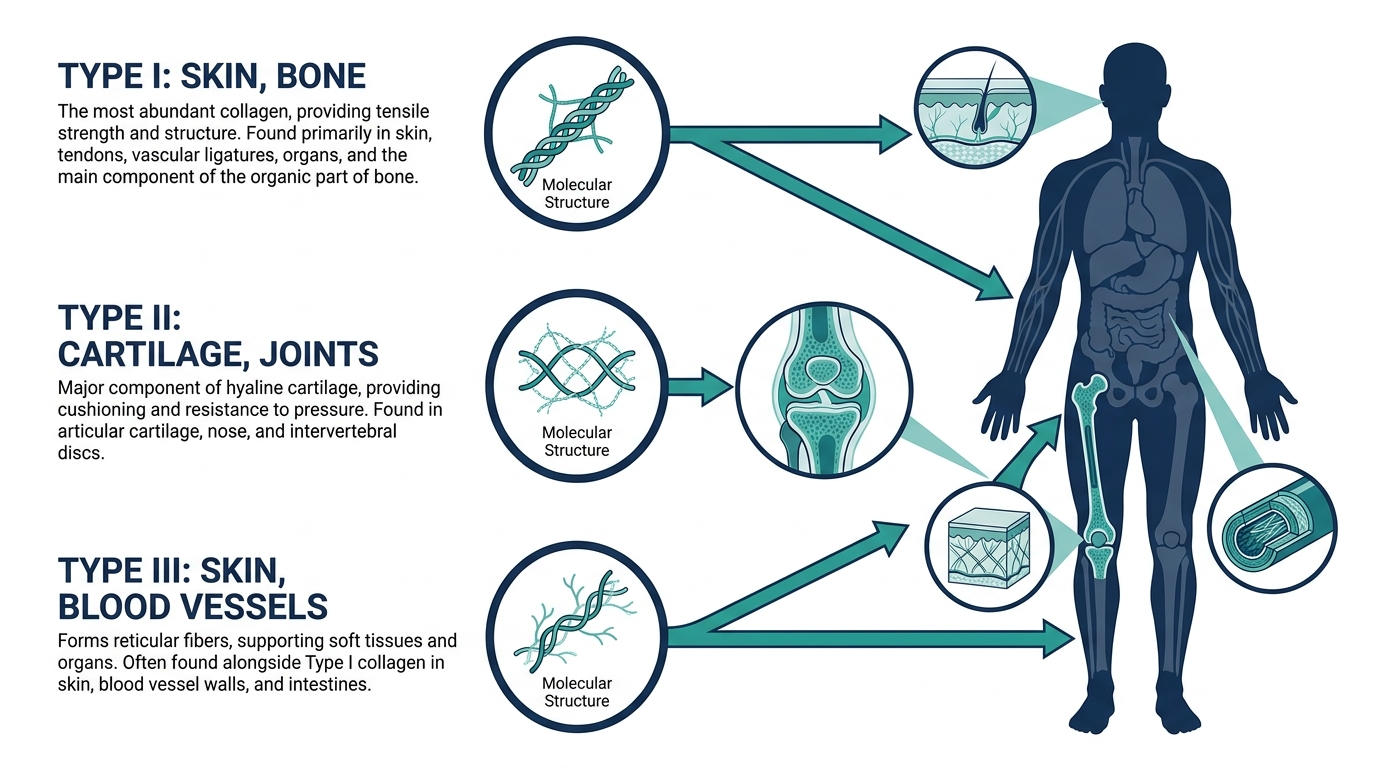
Both sources are predominantly Type I collagen, which is the collagen type found in human skin, bone, tendons, and ligaments. The structural difference people argue about most is molecular weight.
Marine collagen peptides (sourced from fish skin and scales) typically hydrolyze to a lower average molecular weight, roughly 3,000 to 5,000 daltons, compared to 15,000 to 50,000 for standard bovine. Proponents argue this makes marine collagen more bioavailable. The absorption advantage is real but measured, at approximately 1.5 times higher absorption in some studies. What that means in practice depends entirely on dose: 10 g of bovine at 90% bioavailability and 10 g of marine at 1.5 times higher bioavailability still both land you in the clinically relevant range.
What bovine collagen offers that marine does not is Type III alongside Type I. Type III collagen contributes to muscle tissue, blood vessels, and organ structure, and it is the dominant provisional matrix laid down during wound healing. If you are supplementing broadly for structural health rather than purely for skin appearance, the Type I and III combination from bovine is the more complete profile.
A 2025 head-to-head study in osteoarthritis patients compared Type I and III bovine peptides against Type II hydrolyzed collagen and found no statistically significant difference in pain or physical function scores. The implied conclusion: source and type matter less than dose and consistency.
The comparison in one table:
| Factor | Marine (fish) | Bovine (cow) |
|---|---|---|
| Collagen types | Primarily Type I | Type I and Type III |
| Avg molecular weight | 3,000 to 5,000 Da | 15,000 to 50,000 Da |
| Absorption | ~1.5x higher in some studies | High but lower than marine |
| Allergen risk | Fish allergy concern | Beef allergy concern |
| Best for | Skin hydration, elasticity | Skin, joints, gut, wound recovery |
| Typical price per 10 g serving | $1.50 to $2.50 | $0.80 to $1.80 |
| Religious or ethical fit | Kosher, pescatarian | Not halal/kosher from non-certified sources |
For most people with no dietary restriction, bovine is the practical default: lower cost per studied dose and broader Type I and III coverage.
What does real clinical evidence say about results timelines?
One of the most frequently misleading claims in the collagen supplement space is “see results in 7 days.” That number is not supported by any trial.
The honest timelines from controlled research:
- Skin hydration and early wrinkle softening: 4 to 8 weeks. A 2025 RCT of 66 women taking 2.5 g daily found significant improvements in eye wrinkle volume and skin elasticity at 4 weeks, with continued improvement at 8 weeks.
- Skin elasticity and deeper wrinkle reduction: 8 to 12 weeks. A 2024 trial with 112 participants on 10 g daily found significant improvements in elasticity (p = 0.009) and hydration (p less than 0.001) at 8 weeks.
- Joint pain and function: 12 to 24 weeks. The joint outcomes in the systematic review required 3 or more months of consistent supplementation to show statistically reliable improvements.
- Exercise-linked tendon and connective tissue synthesis: This is the most time-dependent outcome. Connective tissue remodeling is biologically slow. Studies measuring mechanical property improvements in tendons required 24 weeks.
A 2025 meta-analysis in the American Journal of Medicine pooling 23 randomized controlled trials with 1,474 participants confirmed significant aggregate improvements in wrinkles, hydration, and elasticity. The pattern across all 23 trials: 8 weeks minimum for skin, 12 weeks for structural outcomes.
Stop at six weeks and you are quitting before most of the biology has run.
Are there people who should not take collagen peptides?
Yes, and this section matters more than most guides acknowledge.
Collagen peptides are derived from animal connective tissue (bovine hide, fish skin and scales, chicken cartilage, porcine skin). Anyone with a confirmed allergy to the source animal needs to check the label carefully. Marine collagen is a real risk for people with fish allergies. Bovine-sourced products present a concern for those with beef allergies, which are less common but exist.
Beyond allergies, a few clinical flags:
Kidney disease. Collagen peptides are protein, and high daily protein intake can stress kidneys with impaired filtration. The 15 g/day clinical dose adds meaningful protein load. If you have chronic kidney disease at any stage, check with a nephrologist before starting.
Autoimmune conditions. Some practitioners advise caution for people with lupus, scleroderma, or active inflammatory arthritis, given collagen’s structural role in tissues targeted by those conditions. The theoretical concern has not been confirmed in large trials, but it is worth raising with a rheumatologist.
Anticoagulants. Some marine-derived collagen peptides show preliminary evidence of mild platelet-aggregation effects. If you take warfarin or another anticoagulant, discuss collagen supplementation with your prescriber before starting.
Antibiotics (quinolones and tetracyclines) and bisphosphonates. If your collagen product contains added calcium, the mineral can reduce absorption of these drug classes. A two-hour gap between the supplement and the medication is a practical safeguard.
The FDA classifies collagen peptides as a food supplement, not a drug. There is no required FDA approval before sale. The quality of the raw material, the hydrolysis process, and any contaminants are entirely the manufacturer’s responsibility, which is why third-party testing matters when choosing a product.
How to choose a collagen product: what to look for and avoid
The collagen supplement market had global sales estimated at over $2.1 billion in 2024 and is growing rapidly, which means the shelves are full of products priced to signal quality without evidence behind them.
Five things to look for:
- Hydrolyzed collagen peptides (collagen hydrolysate), not native collagen or gelatin. Only hydrolyzed collagen is broken down for bioavailability. Gelatin dissolves but produces larger peptide chains.
- A serving size that delivers 10 g per dose with a reasonable scoop count. If you have to take six capsules to hit 3 g, the product is designed for the price point, not the dose.
- Third-party purity testing. Certifications from NSF International, USP, Informed Sport, or independent lab testing with a published COA. Heavy metal contamination (lead, cadmium, arsenic) in marine and bovine collagen products has been documented in consumer testing.
- Single-source clarity. The product should state the source animal and whether it is grass-fed/pasture-raised (bovine) or wild-caught (marine). Vague labels like “proprietary blend” are a flag.
- No outlandish claims. A product promising “rebuilds cartilage in 3 days” or “reverses 20 years of aging” is not a signal of strength. It is a signal of a weak compliance department.
Vital Proteins Collagen Peptides (bovine, grass-fed, unflavored) is the category benchmark for consistency and third-party testing, with a 10 g serving delivering a functional dose at roughly $1.35 to $2.04 per day depending on the size you buy. The Advanced formula with hyaluronic acid and vitamin C pre-added is a sensible shortcut for skin-focused supplementation. A 1.5 lb tub at Costco runs approximately $28.99, the most cost-efficient entry point. Budget alternatives like California Gold Nutrition’s CollagenUP come in at roughly $0.36 per serving and perform well in independent reviews.
Don’t just read about your health, track it.
A single result is a snapshot. Superpower re-tests 100+ markers over time so you can watch them move as you change sleep, food, and training.
Frequently asked questions
How many grams of collagen peptides should I take per day?
For skin benefits, the clinical floor is 2.5 g per day, but most studies that show clear skin elasticity and wrinkle improvements used 5 to 10 g daily. For joint health, 5 to 10 g is the studied range. For connective tissue synthesis around exercise, 15 g taken 60 minutes before activity is the most evidence-supported dose. Most adults can start at 10 g per day and assess after 8 to 12 weeks before adjusting.
Can I take collagen peptides twice a day?
Yes. Splitting 15 g into two servings of 7.5 g each, one pre-workout and one at another time, is consistent with the research and has no known safety concern in healthy adults. There is no evidence that larger single doses clear better than split doses at the same daily total.
Do collagen peptides actually work for wrinkles?
The evidence is solid for modest, consistent improvement in skin hydration, elasticity, and wrinkle depth with 8 to 12 weeks of daily use at 2.5 g or above. A 2025 meta-analysis of 23 randomized trials with 1,474 participants confirmed statistically significant improvements across all three outcomes. The caveat: the effect size is moderate, not dramatic, and it does not replace UV protection or sleep quality as the primary drivers of skin aging.
Is it better to take collagen in the morning or at night?
Neither timing has a proven edge for non-exercise outcomes. Take it when you will be consistent. For exercise-related joint or tendon goals, timing it 60 minutes before activity is the approach supported by research. Your body runs a circadian collagen synthesis cycle with a nightly peak, but the evidence that supplementing at night meaningfully amplifies this is not strong enough to override habit.
Can I take collagen peptides if I am vegetarian or vegan?
All commercially available collagen peptides are animal-derived. There are no vegan collagen supplements, only vegan “collagen boosters” containing vitamin C, zinc, silica, and amino acid precursors that aim to stimulate endogenous collagen production. Those products are a fundamentally different category and have a thinner evidence base.
Does collagen peptide supplementation help with gut health?
Glycine and proline, the dominant amino acids in collagen, are structural components of the intestinal lining. Animal models and early human data suggest collagen peptides may support gut barrier integrity. A 2024 ScienceDirect study proposed a prebiotic mechanism via gut microbiota fermentation of collagen-derived peptides. The evidence is promising but not yet at the level of the skin and joint data. Gut support is a reasonable secondary benefit, not a primary reason to choose collagen over other gut-targeted interventions.
Are there side effects from taking collagen peptides daily?
Most healthy adults tolerate daily collagen peptides well. The most commonly reported side effects are mild digestive discomfort (bloating, heaviness) in the first one to two weeks, particularly at 10 g or higher doses. Starting at 5 g and stepping up over two weeks generally resolves this. Hypercalcemia is a theoretical risk if your product contains added calcium and you are also taking calcium supplements; check labels before stacking.
Hydrolyzed type I & III collagen peptides, third-party tested, unflavored.
Author: Vital Signs Today Editorial Team, [credential]”]. Educational content, not medical advice. Sources linked inline.
Primary sources:
– PMC Systematic Review: Effects of collagen peptide supplementation on body composition, collagen synthesis, and recovery: https://pmc.ncbi.nlm.nih.gov/articles/PMC8521576/
– MDPI Cosmetics 2025 RCT (bovine-derived 2.5 g, 66 women, 8 weeks): https://www.mdpi.com/2079-9284/12/2/79
– Wiley / Dermatology Research and Practice 2024 RCT (10 g, 112 women, 8 weeks): https://onlinelibrary.wiley.com/doi/10.1155/2024/8752787
– American Journal of Medicine 2025 Meta-analysis (23 RCTs, 1,474 participants): https://www.amjmed.com/article/S0002-9343(25)00283-9/abstract
– PMC Absorption of bioactive peptides study: https://pmc.ncbi.nlm.nih.gov/articles/PMC11325589/
– ClinicalTrials.gov NCT06435637 (multiple bolus collagen + vitamin C): https://clinicaltrials.gov/study/NCT06435637
– ScienceDirect, collagen peptides as prebiotics: https://www.sciencedirect.com/science/article/abs/pii/S2214799324000018
– Vital Proteins product and pricing: https://www.vitalproteins.com/products/collagen-peptides
– Collagen peptide contraindications overview: https://klow-peptide.com/en/articles/collagen-peptide-dangers/
Related reading
Vital Signs Today may earn a commission if you buy through links on this page. It does not affect our editorial assessments.