Quick answer: A cholesterol test, also called a lipid panel, is a blood draw that measures four numbers: total cholesterol, LDL (the kind that clogs arteries), HDL (the protective kind), and triglycerides. Most adults should get one every 4 to 6 years, more often with risk factors, and you do not always need to fast. Cash prices run about $10 to $50 at a lab, and a basic panel is covered as preventive care by most insurance.
The lipid panel is one of the oldest and most useful screening tests in medicine, and almost everyone gets one eventually. The catch is that the standard four-number readout is a decent first look but not the whole story. Below is what each number means, what counts as a good result, when fasting actually matters, where to get tested for the least money, the mistakes that quietly wreck people’s results, and the one marker (ApoB) that most basic panels leave off even though it predicts heart risk better than LDL alone.
Just read what your cholesterol numbers mean? See your full lipid panel plus 96 more biomarkers in one test. One at-home Superpower draw checks 100+ biomarkers, physician-reviewed.
What a cholesterol test measures
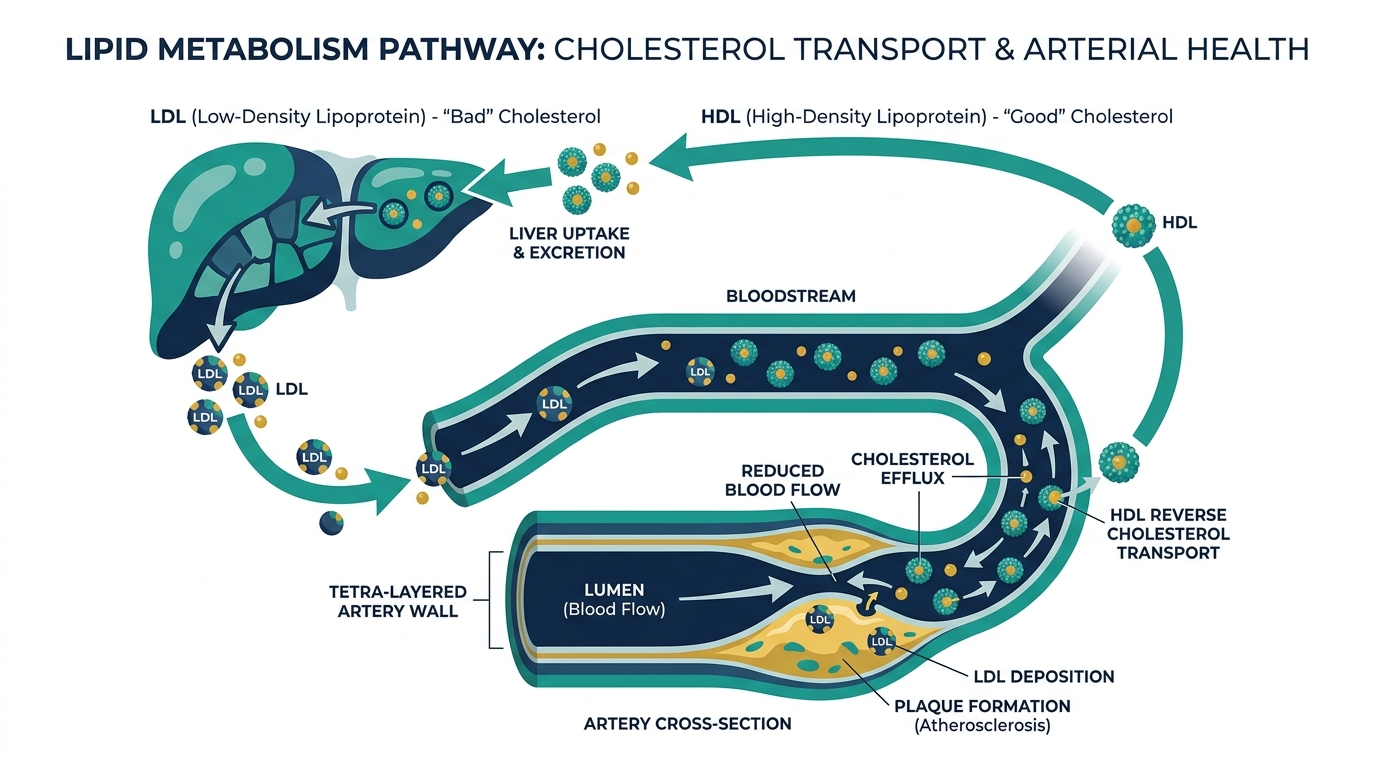
A standard cholesterol test reports four values, and each one tells you something different. Cholesterol itself is not the enemy. Your body needs it to build cell walls and hormones. The problem is how it travels through your blood and how much of the artery-damaging kind is circulating.
- Total cholesterol: the sum of everything. Useful as a quick flag, useless on its own, because a high HDL can inflate it in a good way.
- LDL cholesterol: low-density lipoprotein, the particle that deposits cholesterol into artery walls. This is the number cardiologists watch hardest.
- HDL cholesterol: high-density lipoprotein, which ferries cholesterol back to the liver for disposal. Higher is generally better here.
- Triglycerides: a blood fat tied closely to diet, alcohol, and metabolic health. High triglycerides often travel with insulin resistance.
One insider detail labs rarely explain: your LDL number is usually not measured directly. It is calculated with the Friedewald equation from the other three values, using the formula LDL equals total cholesterol minus HDL minus (triglycerides divided by 5). That math gets unreliable when triglycerides climb above 400 mg/dL, and it tends to underestimate LDL when triglycerides are high and LDL is already low. That is one reason a direct LDL measurement or an advanced marker like ApoB can be worth ordering.
What the lab actually does with your blood
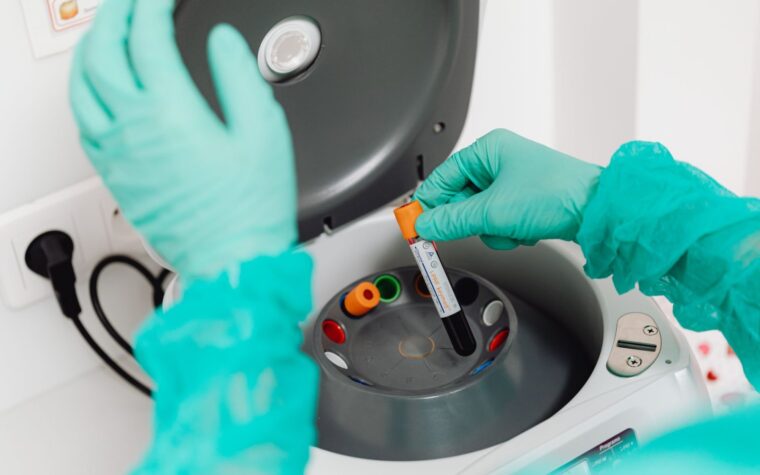
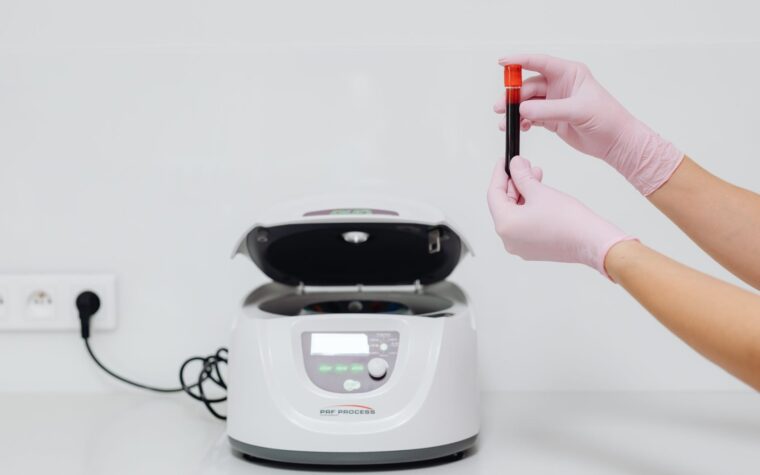
A phlebotomist draws one to two small tubes from a vein in your arm, usually less than two teaspoons total. The sample is spun in a centrifuge to separate the serum, then run through an automated analyzer that measures total cholesterol, HDL, and triglycerides directly by chemical reaction. LDL is then calculated or, on better panels, measured directly. The whole process takes the lab minutes, though you typically get results back in a day or two through a patient portal. The draw itself is over in under a minute, and most people feel nothing beyond a quick pinch.

Cholesterol test results and what counts as healthy
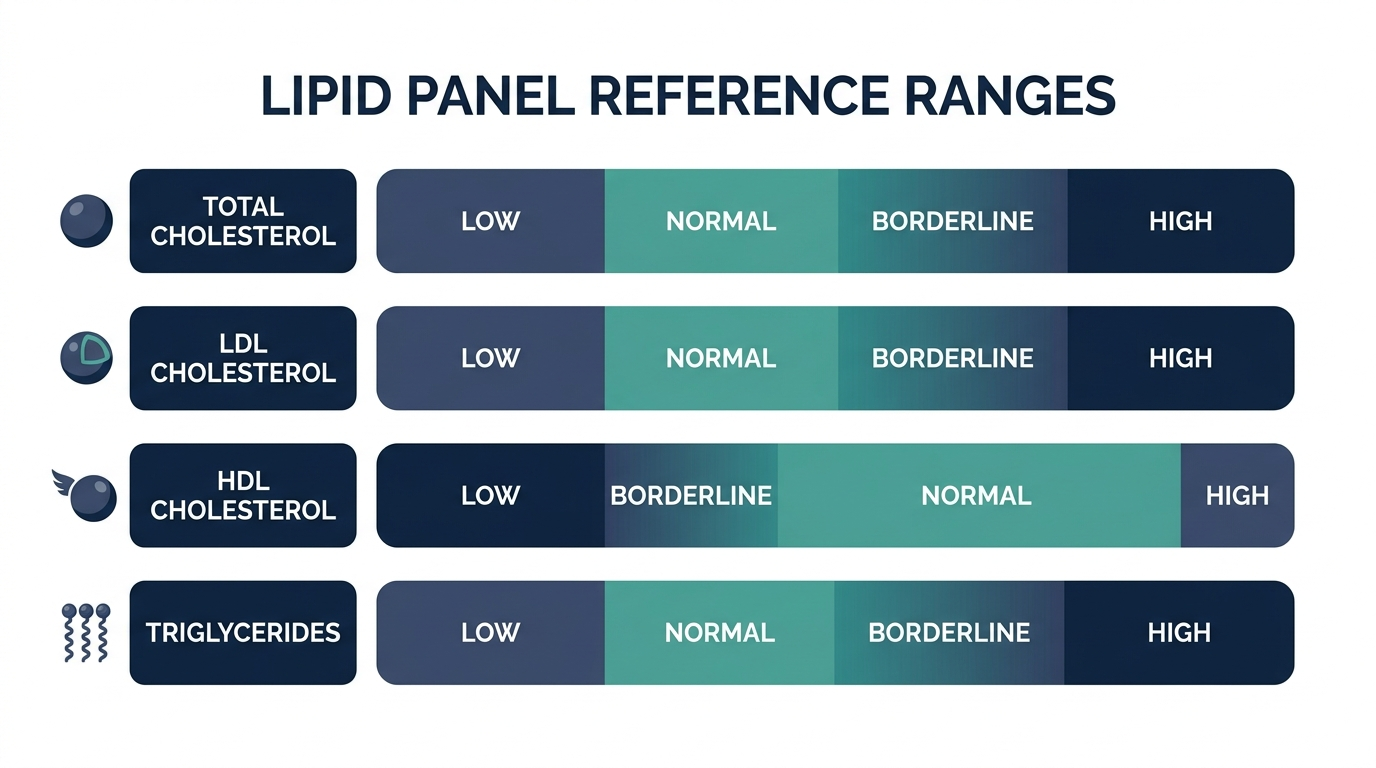
Here are the general adult target ranges used in the United States. Your personal targets shift based on age, family history, blood pressure, and whether you already have heart disease or diabetes, so treat these as a starting frame, not a verdict.
| Marker | Optimal | Borderline | High risk |
|---|---|---|---|
| Total cholesterol | Under 200 mg/dL | 200 to 239 | 240 and up |
| LDL cholesterol | Under 100 mg/dL | 100 to 159 | 160 and up |
| HDL cholesterol | 60 and up (protective) | 40 to 59 | Under 40 (men), under 50 (women) |
| Triglycerides | Under 150 mg/dL | 150 to 199 | 200 and up |
| Non-HDL cholesterol | Under 130 mg/dL | 130 to 159 | 160 and up |
A quick note on that bottom row: non-HDL cholesterol is simply total cholesterol minus HDL, so it captures every artery-damaging particle in one number, not just LDL. Many cardiologists now watch it more closely than LDL alone, and the rule of thumb is that your non-HDL target sits about 30 mg/dL above your LDL target (so under 130 for most adults, under 100 if your LDL goal is under 70). The catch is that the “borderline” and “high risk” labels are general screening cutoffs, not personal goals; the same number that is fine for a low-risk adult can be too high for someone with diabetes or existing heart disease.
People often ask what cholesterol test results are associated with heart health. The short version: a low LDL paired with a healthy HDL and low triglycerides is the combination that tracks with low cardiovascular risk. A single high total cholesterol reading is far less meaningful than the full pattern, which is why doctors read the panel together rather than fixating on one line. If your numbers land in the high-risk column, that is a conversation to have with a clinician, not a reason to panic over one draw.
Why your personal LDL target may be far below 100
The under-100 figure in the table is a general optimal, not a one-size goal. Cardiologists set LDL targets by risk tier, and the higher your risk, the lower they want the number. Someone with no risk factors might be fine in the 100 to 130 range, while someone who already had a heart attack is often pushed under 70, and increasingly under 55, with treatment. This is the part people miss when they read a single panel and conclude they are fine because LDL is 110. Fine for whom matters enormously. A reading that is reassuring for a healthy 30-year-old can be a warning sign for a 60-year-old diabetic with high blood pressure.
A worked example of reading the full pattern
Consider two people who both show a total cholesterol of 210, which lands in the borderline row. Person A has LDL 110, HDL 75, and triglycerides 90. Person B has LDL 150, HDL 35, and triglycerides 220. Same total, very different stories. Person A’s high HDL is doing the heavy lifting on that total, and the rest of the pattern is clean. Person B has a low protective HDL, a high LDL, and elevated triglycerides, the exact cluster that signals metabolic trouble. Reading total cholesterol alone would have called them roughly equal. Reading the full pattern shows they are nowhere close. This is why the four numbers only mean something together.
ApoB: the number your basic cholesterol test probably skipped
Here is the limit of a standard cholesterol test that most people never hear about. LDL cholesterol measures the cholesterol cargo, but heart disease is driven by the number of artery-penetrating particles, and that is what ApoB counts. Every LDL, VLDL, and Lp(a) particle carries exactly one ApoB protein, so ApoB is a direct headcount of the particles that cause plaque.
Why does this matter? Plenty of people have a normal-looking LDL but a high particle count, a mismatch that hides real risk on a basic panel. This is common in people with insulin resistance, who tend to carry many small, cholesterol-poor LDL particles. Their LDL cholesterol can read normal while their particle count, and their actual risk, runs high. Large outcome studies have repeatedly shown ApoB predicts cardiovascular events better than LDL or total cholesterol.
| Marker | What it counts | On a basic panel? | Optimal target |
|---|---|---|---|
| LDL cholesterol | Cholesterol carried by LDL particles | Yes | Under 100 mg/dL |
| ApoB | Total number of plaque-causing particles | No, ask for it | Under 90 mg/dL, lower with risk |
| Lp(a) | A genetic high-risk particle subtype | No, ask for it | Under 50 mg/dL, checked once |
| hs-CRP | Arterial inflammation | No, ask for it | Under 1.0 mg/L |
ApoB is not included in a routine lipid panel by default, and at many labs you have to ask for it specifically. The same goes for Lp(a), a genetic risk marker worth checking once in your life, since it is set largely by your genes and barely moves with diet. If you are serious about heart health, the panel that captures these alongside the basics is the one worth ordering. See what Superpower tests for if you want a sense of a full cardiac-marker lineup.

Do you need to fast for a cholesterol test?
Often, no. For years the rule was a strict 9 to 12 hour fast, but updated guidance from major cardiology and lab organizations now says a non-fasting lipid panel is fine for routine screening in most people. Total cholesterol, LDL, and HDL barely move whether you have eaten or not.
The one value that does swing is triglycerides, which spike after a fatty meal and can stay elevated for hours. So fasting still matters if your doctor is specifically tracking triglycerides, if your previous triglycerides were high, or if the lab is calculating your LDL rather than measuring it directly (because inflated triglycerides throw off the Friedewald math). A practical rule: if you are getting other fasting tests anyway, like an A1C or fasting glucose, just fast and knock it all out in one morning draw. If cholesterol is the only thing on the order, eating beforehand is usually fine. When in doubt, ask whoever ordered the test.
What fasting actually means for a blood draw
If you do fast, the rule is water only for 9 to 12 hours. Black coffee and tea are a gray zone that some labs allow and others do not, so when accuracy matters, stick to plain water. You can and should keep taking most prescription medications unless your doctor says otherwise. The most common practical mistake is scheduling a fasting draw for the afternoon, which forces you to skip breakfast and lunch and arrive cranky and dehydrated. Book the first slot of the morning, fast overnight while you sleep, and you barely notice it.
The simplest way to actually get this done
Superpower is a full-body lab membership that runs 100+ biomarkers, has each result reviewed by a doctor, and tracks your numbers year over year (about $199/year). It is what we point readers to when they would rather get one clean, complete draw than chase single tests one at a time. Here is superpower reviewed in full.
Where to get a cholesterol test and what it costs
You have more routes than you might think, and the price gap between them is large. The same lipid panel that costs $15 self-ordered can be billed at over $200 through a hospital outpatient lab, for identical blood and identical numbers. The difference is who orders it and how it is coded, not the test itself.
- Through your doctor: ordered at a checkup and sent to Quest or Labcorp. As preventive screening, most insurance covers a basic lipid panel at no out-of-pocket cost. Confirm coding, because if it is ordered to monitor an existing condition it can be billed as diagnostic and hit your deductible.
- Cash-pay at a lab: a basic lipid panel runs roughly $10 to $50 self-ordered through services that use Quest or Labcorp draw sites. This is the cheapest legitimate route for the uninsured.
- Retail clinic or pharmacy: CVS MinuteClinic and similar offer lipid screening, typically in the $50 to $100 range without insurance.
- At-home finger-prick kit: mail-in or instant kits exist for $30 to $60. Convenient, but accuracy lags a venous draw, and they rarely include ApoB.
- Full-body membership: a lab membership bundles the lipid panel with dozens of other markers in one draw, for a yearly fee rather than a per-test charge. This makes sense if you want ApoB, Lp(a), and metabolic markers captured together rather than ordered piecemeal.
| Where you test | Typical cash price | Includes ApoB? | Best for |
|---|---|---|---|
| Doctor plus insurance | $0 as preventive | Only if requested | Routine screening with a plan |
| Self-ordered lab (Quest/Labcorp) | $10 to $50 | Add-on for extra fee | Uninsured, lowest cost |
| Retail clinic or pharmacy | $50 to $100 | No | Walk-in convenience |
| At-home finger-prick kit | $30 to $60 | Rarely | Avoiding the lab entirely |
| Full-body lab membership | About $199/year | Yes | Full cardiac picture, tracking over time |
If you are deciding between a one-off cholesterol test and a broader workup, it is worth seeing how the lipid numbers fit into a complete blood panel. People watching cardiovascular risk closely often capture lipids inside a broader heart health panel that also pulls hs-CRP and ApoB in the same draw, which spares you a second trip to the lab. If cost is the deciding factor, it helps to compare it against how much Superpower costs across a full year of tracking rather than a single panel price. If you are weighing the two best-known full-body memberships, our Superpower vs Function Health comparison breaks down which one captures ApoB and Lp(a) by default.
The free-test-that-gets-billed trap
Here is the most common billing surprise, and it is worth understanding before you book. Under preventive-care rules, a screening lipid panel for an adult with no symptoms is supposed to be covered at no cost. But the moment the order is coded to monitor a known condition, say you already take a statin or carry a diagnosis of high cholesterol, the same test flips to diagnostic and lands on your deductible. Patients get a bill for a draw they were told would be free, and the culprit is a single diagnostic code, not a hidden charge. The fix is simple: ask, before the draw, whether it is being coded as screening or diagnostic, and what your share will be either way.
Common mistakes that wreck cholesterol test results
A lipid panel is only as good as the conditions you walk in under. These are the errors that quietly skew numbers and send people into needless worry or false reassurance.
- Drinking the night before: alcohol spikes triglycerides for up to 24 hours. A weekend of drinking before a Monday draw can push triglycerides well into the high-risk range on someone whose baseline is normal.
- Testing right after illness or surgery: acute illness, infection, and recent surgery temporarily lower cholesterol, sometimes dramatically. A panel run two days after the flu can read falsely reassuring. Wait at least two to three weeks after being sick.
- Reacting to a single reading: cholesterol fluctuates day to day. Doctors treat trends, not snapshots. One out-of-range number is a reason to repeat, not to start a medication.
- Eating a heavy meal before a fasting triglyceride test: if triglycerides are the point, a non-fasting draw can read 50 to 100 mg/dL high, enough to cross a treatment threshold.
- Assuming a normal LDL means low risk: as covered above, particle count can run high with a normal LDL. A clean basic panel does not rule out the metabolic pattern that ApoB would catch.
- Crash dieting in the days before: rapid recent weight loss shifts lipids and gives a number that will not hold once you return to a normal pattern. Test when your weight and diet have been stable.
Edge cases: uninsured, minors, employer-required, and Medicare
The standard advice assumes an insured adult getting a routine screen. Plenty of people fall outside that, and the route changes.
Uninsured: skip the doctor’s office and self-order through an online lab service that draws at Quest or Labcorp. A lipid panel runs $10 to $50 cash, and you control the order. This is almost always cheaper than walking into a clinic without coverage. You can pay with HSA or FSA funds if you have them.
Children and teens: pediatric cholesterol screening is real and recommended, typically once between ages 9 and 11 and again between 17 and 21, earlier if there is a strong family history of early heart disease or genetic high cholesterol. A child’s panel is read against pediatric ranges, not adult ones, so the targets above do not apply to them.
Employer or wellness-program required: these are usually finger-prick screenings done on-site. They are convenient and often free to you, but treat the result as a flag, not a diagnosis. A high reading from a wellness fair should be confirmed with a proper venous draw before anyone acts on it.
Medicare: Medicare Part B covers a cardiovascular screening blood test, including a lipid panel, once every five years at no cost when ordered as screening. More frequent testing is covered when it is monitoring a diagnosed condition, though that may involve cost sharing. As with private insurance, the coding determines your bill.
Who should test, how often, and which panel to pick
Matching the panel to the person saves both money and missed risk. Use this as a decision guide, then confirm with whoever orders the test.
| Your situation | How often | Which panel |
|---|---|---|
| Healthy adult, normal results, no risk factors | Every 4 to 6 years | Basic lipid panel |
| Family history of early heart disease | Every 1 to 2 years, plus Lp(a) once | Lipid panel plus ApoB and Lp(a) |
| On a statin or other lipid medication | Every 3 to 12 months while adjusting | Lipid panel, ApoB to confirm response |
| Diabetes or metabolic syndrome | At least yearly | Lipid panel plus ApoB, triglycerides matter |
| Borderline numbers, wanting a full picture | Yearly, tracked over time | Full cardiac panel with ApoB, Lp(a), hs-CRP |
The pattern across all of these: the higher your risk, the more value you get from the advanced markers and from tracking the same numbers year over year. A basic panel is genuinely enough for a low-risk adult. For everyone else, the particle count and inflammation markers earn their place.
How accurate is a cholesterol test, and how often should you repeat it?
A venous lab draw is highly accurate. The bigger source of variation is you, not the machine. Recent illness, a very fatty meal the night before, heavy drinking, or even significant weight change can nudge your numbers, which is why doctors look at trends across several tests rather than reacting to one reading. Finger-prick screenings, the kind done at wellness fairs and some pharmacies, are less precise than a venous draw and are best treated as a flag to confirm, not a final answer.
For repeat timing: healthy adults with normal results generally screen every 4 to 6 years. If you are on a statin, have diabetes, a strong family history, or borderline numbers, expect to retest every 3 to 12 months while things are being managed. The real value of cholesterol data shows up over time, which is the argument for tracking the same markers year over year instead of getting a scattered reading here and there. Whatever your numbers say, bring them to a clinician who can read them against your full risk picture.
Curious what your own levels look like?
Baseline 100+ biomarkers today and retest as life changes, all in one membership with physician review.
FAQ
Does a CMP or complete metabolic panel include cholesterol?
No. A complete metabolic panel (CMP) checks glucose, kidney and liver markers, and electrolytes, but it does not include a lipid panel. Cholesterol has to be ordered separately or as part of a broader screening panel. This trips people up constantly, because a CMP feels comprehensive, so they assume cholesterol is in there. It is not, and neither is a lipid panel part of a basic metabolic panel (BMP).
Does a complete metabolic panel include cholesterol if I add it on?
Only if you or your doctor specifically order a lipid panel alongside the CMP. The two are separate tests on separate order lines, even when drawn from the same blood. Many checkup orders bundle a CMP and a lipid panel together, which is why people assume they are one test. Ask to see the order if you want to be sure cholesterol is on it.
What can a lipid test show about your health beyond heart risk?
Beyond cardiovascular risk, the pattern can flag metabolic problems. High triglycerides with low HDL is a classic signature of insulin resistance and metabolic syndrome, and very high triglycerides (above 500 mg/dL) can point toward pancreatitis risk. A lipid panel is often an early window into how your metabolism is doing overall, sometimes before glucose or A1C have moved.
Does insurance cover a cholesterol test?
Most plans, including many Humana supplemental and ACA-compliant plans, cover a routine lipid panel as preventive care with no copay when it is coded as screening. Coverage gets murkier if the test is ordered to monitor a diagnosed condition, since that can be billed as diagnostic and apply to your deductible. Ask how it will be coded before the draw.
Does a Humana supplemental health plan cover a lipid test for cholesterol?
Generally yes for routine screening, since preventive lipid panels are a covered benefit under most Humana and Medicare Advantage plans at no cost when coded as screening. The exception, as always, is when the test monitors an existing condition, which can move it to diagnostic billing. Plan specifics vary, so confirm with your member services line and ask the ordering office to code it as preventive screening when that applies.
How accurate is a cholesterol test at a health clinic?
A clinic that draws blood from a vein and sends it to a lab like Quest or Labcorp gives you the same high accuracy as a hospital. The less accurate option is an on-site finger-prick screen, common at retail clinics and wellness events, which can be off by a meaningful margin. If a finger-prick result lands in the high-risk range, confirm it with a venous draw before acting on it.
How do I book a heart health screening that includes a cholesterol test?
You can ask your primary care doctor to add a lipid panel at your next visit, order one yourself cash-pay through an online lab service, or use a membership that bundles cholesterol with other cardiac markers in a single appointment. If you want advanced markers like ApoB and Lp(a) included, choose a panel that lists them, because a default lipid panel will not. For a sense of what a full lineup looks like, the the Superpower blood test review walks through one bundled approach.
Why is testing cholesterol and heart health important?
Because high LDL and high particle counts cause damage silently for years before any symptom appears. Heart disease remains the leading cause of death in the United States, and a cholesterol test is one of the few cheap, fast ways to catch the risk while it is still fully treatable. The point of testing early and repeatedly is to act on a number on a screen instead of waiting for a chest pain that announces the problem too late.
What is a good age to start getting a cholesterol test?
Adults should have a first lipid panel by their early 20s, with routine rescreening every 4 to 6 years if results are normal and risk is low. Children get screened once between ages 9 and 11. People with a family history of early heart disease or genetic high cholesterol should start earlier and test more often. There is no benefit to waiting until midlife to find out where you stand.
Can I lower my cholesterol before a test to get a better number?
You can change the number short term with a few days of clean eating and no alcohol, but that defeats the purpose. The test is meant to capture your real, stable baseline, not a one-week best effort. Gaming a single panel only hides risk that is still there. Test under normal conditions, and if the number is high, work on lowering it for real with a clinician’s help rather than for the next draw.
Related: see our ranking of the best at-home blood tests.
Vital Signs Today may earn a commission if you buy through links on this page. It does not affect our editorial assessments.