
Last updated 18 June 2026. Educational content, not medical advice. Talk to a licensed dermatologist or clinician before adding any new compound to your routine.
Short answer: Topical GHK-Cu, sold as Copper Tripeptide-1 on ingredient labels, has one of the strongest safety records of any active ingredient in modern skincare, with more than 40 years of cosmetic use and a 2023 review of 12 controlled studies (n=512) finding the most common side effects were transient redness in 4.2% of participants and mild itching in 2.8%, with no systemic adverse effects. Injectable GHK-Cu is a different risk category with far less human data, was briefly placed on the FDA’s Category 2 restricted list in 2023, and was removed from that list in April 2026.
Copper Tripeptide-1 has one of skincare’s strongest safety records. Want to see your own copper and skin markers? One at-home Superpower draw checks 100+ biomarkers, physician-reviewed.
Why are so many people suddenly asking whether GHK-Cu is safe?
The question is not coming from nowhere. GHK-Cu sits at the intersection of two fast-moving worlds: high-performance skincare, where it has been a professional-grade ingredient for decades, and the injectable peptide market, where it shares shelf space with compounds that have drawn FDA warning letters and federal raids since 2024.
If you found GHK-Cu in a dermatologist’s office serum, your question is almost certainly about the topical version, and the short answer is: yes, the evidence is reassuring. If you found it on a research-chemical vendor’s site in lyophilized powder form, the question is more complicated and the answer depends heavily on which route, which source, and which regulatory lane you are talking about.
This article separates those two conversations, because conflating them is where most of the confusion starts.
Full-body lab membership: 100+ biomarkers, doctor-reviewed, tracked over time.
What exactly is GHK-Cu, and why does the body make it in the first place?
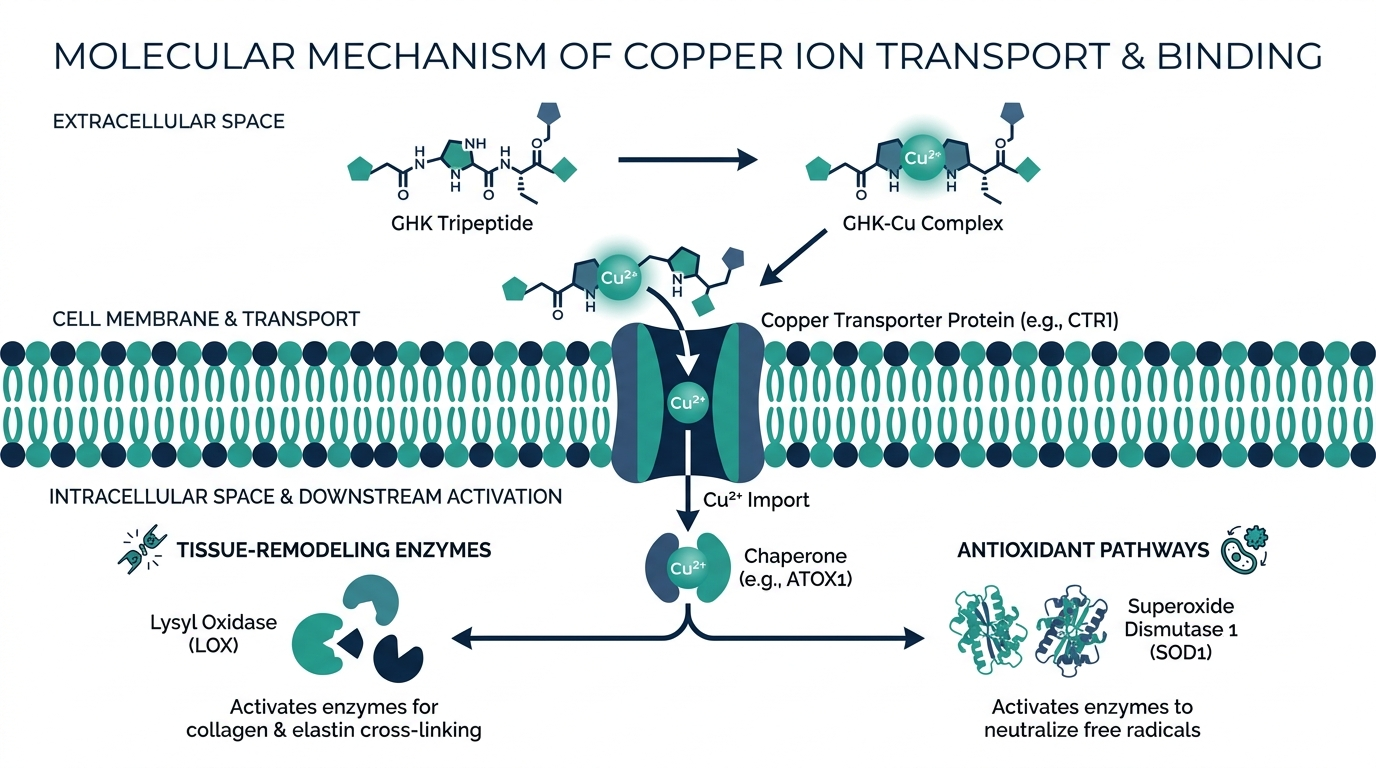
GHK-Cu stands for glycyl-l-histidyl-l-lysine, a tripeptide fragment naturally present in human plasma, saliva, and urine that has a high natural affinity for copper ions. It was first isolated from human albumin fraction by Dr. Loren Pickart in 1973, which means this is not a novel synthetic compound created in a lab five years ago, but something researchers have been studying for over half a century.
The body appears to use GHK as a wound-response signal. Plasma concentrations sit around 200 ng/mL in healthy young adults but fall substantially with age, roughly to 80 ng/mL by age 60, according to Pickart’s foundational research. That decline tracks closely with the skin’s reduced ability to repair itself, which is what gave researchers their initial hypothesis: replenishing GHK-Cu externally might restore some of that repair signaling.
The copper component is not a toxicological liability but a functional one. Copper is a required cofactor for superoxide dismutase, lysyl oxidase, and several other enzymes that maintain connective tissue and antioxidant defense. GHK’s high copper-binding affinity means it does not simply dump free ionic copper into tissue; it delivers it in a biologically controlled form.
What made researchers pay closer attention in recent years is a 2018 analysis published in the International Journal of Molecular Sciences by Pickart and Margolina, using Broad Institute Connectivity Map data across 13,424 genes. The analysis found GHK-Cu modulates approximately 4,192 human genes, with 59% upregulated and 41% suppressed, including 14 antioxidant defense genes upregulated and key pro-inflammatory cytokines including TNF-alpha downregulated. That is an unusually broad transcriptional footprint for a cosmetic ingredient, which is part of why interest has moved beyond topical serums into clinical research.
Is the topical form of GHK-Cu safe?
For the vast majority of users, yes, and the evidence base here is genuinely solid.
A 2023 safety review analyzed data from 12 controlled clinical studies involving 512 participants using topical GHK-Cu formulations. The most common adverse event was transient erythema (redness) in 4.2% of participants, followed by pruritus (itching) in 2.8%. No systemic effects were consistently reported across those trials. ClinicalTrials.gov listed three ongoing or completed trials as of early 2026, including NCT05239615, a Phase II trial for topical treatment of photoaging, which completed in 2024.
The Cosmetic Ingredient Review (CIR) Expert Panel, the independent body that evaluates ingredient safety for the cosmetic industry, has assessed Copper Tripeptide-1 and found it safe for cosmetic use at concentrations typically found in formulations, generally 0.5% to 2%.
One concentration nuance that almost no skincare brand will tell you: GHK-Cu shows optimal biological effects at surprisingly low concentrations, and at higher concentrations it simultaneously upregulates collagen-degrading matrix metalloproteinases (MMPs). The practical implication is that more is not always better with this ingredient. A 1% concentration in a well-formulated serum is likely more effective than a 5% formulation that tips the MMP balance the wrong way. This is one reason professional-grade formulations like NIOD’s Copper Amino Isolate Serum (CAIS 3), which delivers 1% GHK-Cu at around $62 for 0.5 oz, are not simply racing to the highest concentration number.
What is the “copper uglies” reaction, and does it mean the product is unsafe?
The “copper uglies” is community shorthand for a temporary breakout or skin purge that affects a subset of users in the first one to three weeks of using topical copper peptides. It shows up as redness, small bumps, increased sensitivity, or what looks like a mild acne flare.
It is not evidence of toxicity. The mechanism is accelerated cell turnover: GHK-Cu signals skin cells to behave younger, which speeds up the renewal cycle from the normal 28 to 40 days. Congestion that would otherwise surface gradually over the next couple of months shows up in the next two weeks instead. Think of it as the skin clearing its backlog at a faster rate than normal.
Personally, the “copper uglies” framing does the ingredient a disservice, because it leads people to abandon a product that is actually working. The more accurate framing is that it is an adjustment response, similar to what happens with retinoids, and it generally resolves within two to three weeks of continued use.
If the reaction does not resolve in three weeks, worsens, or spreads, that points to one of five more likely causes: using too high a concentration too quickly, incorrect layering (see the vitamin C issue below), a compromised skin barrier from overuse of exfoliants, a poor-quality formula with destabilizing excipients, or genuine copper sensitivity, which is uncommon but real.
Does GHK-Cu cause copper toxicity?
This is the most common fear in online forums, and the answer for topical use is: no, there is no credible evidence of copper overload from topical GHK-Cu at cosmetic concentrations.
Copper is an essential trace mineral. The adult dietary reference intake is 0.9 mg per day, with a tolerable upper intake of 10 mg per day established by the Institute of Medicine. The amount of copper in a typical topical GHK-Cu application is a small fraction of dietary intake. Studies measuring plasma copper levels after topical GHK-Cu application have not found statistically significant elevations.
That said, two groups should not use copper-based ingredients without medical clearance. People with Wilson’s disease, a rare autosomal recessive disorder of copper metabolism affecting roughly 1 in 30,000 people, cannot process copper normally and face genuine toxicity risk from even small additional copper loads. People with a known copper allergy, such as a documented reaction to copper IUDs, should treat copper peptides as a potential allergen.
For the general population, the copper overload concern is theoretical, not documented. Do not believe the social media posts claiming GHK-Cu will “poison your skin with heavy metals.” That framing misrepresents both the toxicology and the chemistry of how GHK coordinates copper.
How does topical GHK-Cu safety compare to injectable GHK-Cu?
These are not the same risk category, and they should not be discussed as though they are.
| Factor | Topical GHK-Cu | Injectable GHK-Cu |
|---|---|---|
| Human safety data | 40+ years, 12+ controlled studies, 500+ participants | Limited, no large-scale RCTs |
| FDA regulatory status (June 2026) | Cosmetic ingredient, CIR-reviewed, no approval needed | Removed from Category 2 list April 2026; PCAC review expected before Feb 2027 |
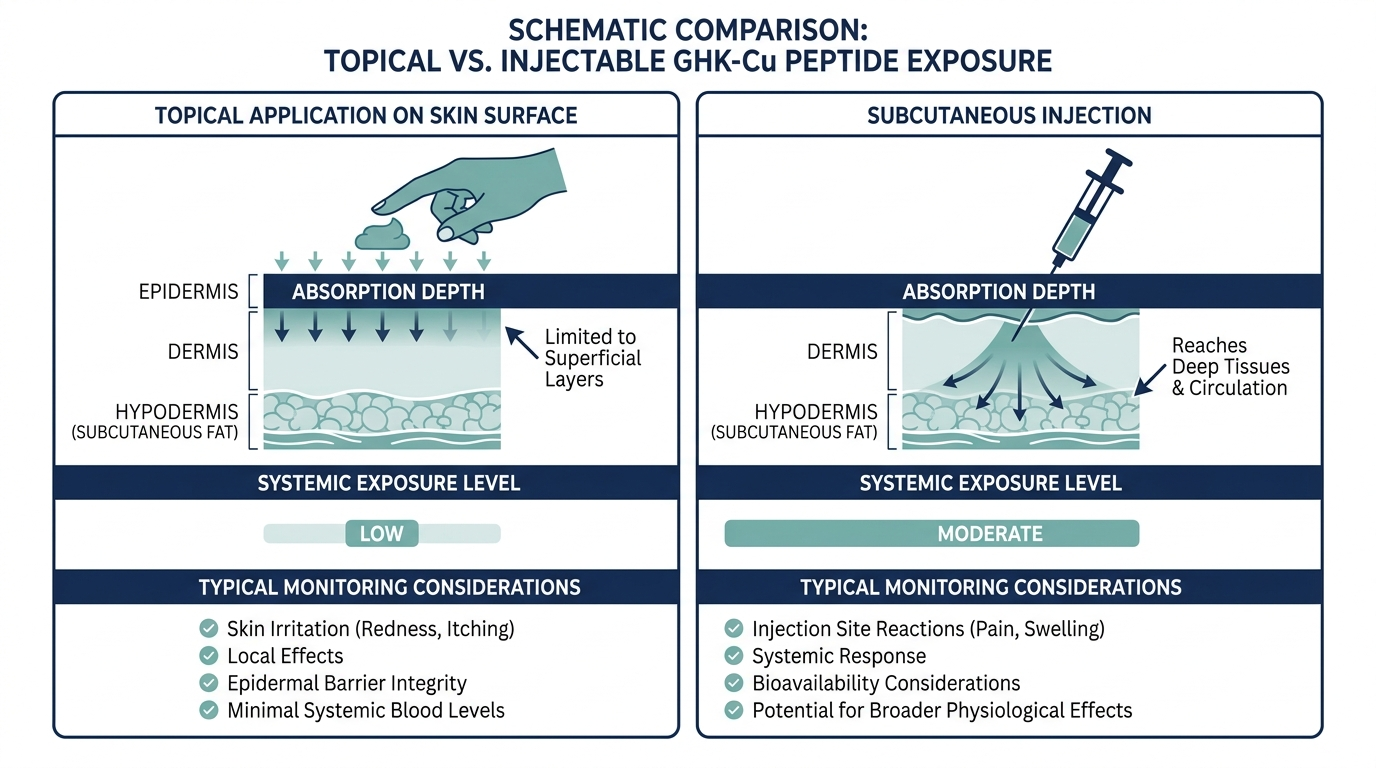
| Route of administration | Skin surface; systemic absorption minimal at cosmetic concentrations | Bypasses all dermal barriers; systemic exposure is the point |
| Common side effects | Transient redness 4.2%, itching 2.8%, temporary copper uglies purge | Injection-site pain, warmth/flush in face and upper chest within 5-15 min (dose-dependent), resolves by 30 min |
| Copper toxicity risk | Not documented at cosmetic concentrations | Theoretical at high cumulative doses; no documented cases at research doses |
| Legal status for personal use | Fully legal OTC and prescription-compounded | Research use only until PCAC process completes; compounded topical fully legal now |
| Quality assurance | Brand-regulated; major retailers vet suppliers | Depends entirely on vendor COA quality; no pharmacist in the supply chain |
The injectable form attracts attention because research suggests the systemic bioavailability route could amplify the gene expression effects that make GHK-Cu interesting. But amplification cuts both ways: it also amplifies the consequences of dosing errors, impure product, and lack of monitoring. The human safety data for injectable GHK-Cu is sparse enough that any confident claim about long-term safety is speculative.
Hydrolyzed type I & III collagen peptides, third-party tested, unflavored.
What is the current FDA and regulatory status of GHK-Cu?
In topical form, GHK-Cu (listed as Copper Tripeptide-1 on INCI labels) is a cosmetic ingredient that does not require FDA drug approval. It is fully legal to sell, buy, and use. The CIR panel’s safety assessment covers it at standard cosmetic use concentrations.
The injectable form had a more complicated 2023 to 2026 journey. The FDA placed injectable GHK-Cu on its 503A Category 2 substances list in 2023, a designation indicating a substance may present significant safety risks and restricting its use in compounding pharmacies. However, the original nominations for the Category 2 listing were subsequently withdrawn, and on April 15, 2026, the FDA confirmed removal of injectable GHK-Cu from the Category 2 list. As of June 2026, the FDA has announced it intends to consult the Pharmacy Compounding Advisory Committee (PCAC) before the end of February 2027 regarding potential inclusion of GHK-Cu on the 503A permitted bulks list.
What that means in practical terms: prescription-compounded topical GHK-Cu is fully compliant right now through licensed providers. Injectable GHK-Cu sourced from grey-market research-chemical vendors remains in a legal grey zone, marketed as “for research use only,” which transfers all risk to the buyer. The regulatory door toward licensed compounding is open and moving, but the PCAC process has not yet completed.
Can GHK-Cu be used with vitamin C, retinol, or other actives?
Yes, but the timing matters, and this is where most adverse reactions with this ingredient actually originate.
Vitamin C, specifically l-ascorbic acid (the most potent form), requires a very low pH of roughly 2.5 to 3.5 to remain stable and penetrate skin effectively. GHK-Cu is most stable and active at a near-neutral pH of 6 to 7. Applying both at the same time in the same layer can destabilize one or both actives, reduce efficacy, and increase irritation potential. The practical fix is simple: use vitamin C in the morning and GHK-Cu in the evening, or separate them by at least 20 to 30 minutes.
Retinoids and GHK-Cu do not degrade each other chemically, but both increase cell turnover. Using both daily at full potency, especially in the first few weeks of a new routine, stacks their irritation potential. Starting with one and adding the other after a four to six week acclimatization period is the more forgiving approach.
Hyaluronic acid, niacinamide, and peptide moisturizers are all compatible and commonly combined with GHK-Cu without issue.
The myth that GHK-Cu must be completely separated from all other actives is an overcorrection. The actual constraint is pH compatibility with L-ascorbic acid, not a general incompatibility with the entire actives tier.
What does good-quality GHK-Cu actually look like in a product?
This matters more than most reviews discuss. GHK-Cu is an unstable peptide in formulation. It oxidizes when exposed to air, degrades in highly acidic or alkaline environments, and loses potency if exposed to heat during manufacturing or storage. A cheap, poorly packaged serum with GHK-Cu listed last on the ingredient label is not equivalent to a stable, air-pump-dispensed formulation with 1% active concentration.
Signs of a quality GHK-Cu formulation:
– Copper Tripeptide-1 or GHK-Cu appears in the first 10 ingredients (or concentration is stated explicitly)
– Opaque or airless pump packaging, not a clear bottle with a dropper that exposes the formula to air on every use
– The product has a slight blue or blue-green tint; colorless GHK-Cu “serums” likely contain insufficient active concentration to produce the characteristic color of the copper complex
– The brand provides a pH range; formulation around 6 to 7 is optimal
The Ordinary’s Multi-Peptide + Copper Peptides serum at around $32 for 30mL remains one of the most accessible options with a stated 1% GHK-Cu alongside Matrixyl 3000 and Argireline. NIOD CAIS 3 at $62 for 0.5 oz offers a more concentrated and stable single-focus formula. Skin Biology, founded by Pickart himself, remains the original brand and offers a range of copper peptide serums for those who want to trace the ingredient back to the researcher who discovered it.
What are the known side effects of GHK-Cu, summarized?
Topical:
– Mild transient redness (4.2% of participants in controlled studies)
– Mild itching (2.8%)
– Temporary “copper uglies” purge in the first one to three weeks
– Temporary blue tint to skin (harmless, washes off)
– Irritation when layered incorrectly with low-pH vitamin C
Injectable (based on community reports and limited research data):
– Injection-site pain, particularly from copper ions (requires careful dilution with bacteriostatic water)
– Warmth and visible flush in the face, neck, and upper chest within 5 to 15 minutes of injection, typically resolving within 30 minutes; intensity is described as dose-dependent
– Temporary redness and swelling at the injection site
Absolute contraindications for both routes:
– Wilson’s disease (copper metabolism disorder)
– Known copper allergy
No documented serious adverse events in published literature for either route at studied doses. Long-term injectable human safety data at meaningful scale does not exist, which is the honest caveat.
Don’t just read about your health, track it.
A single result is a snapshot. Superpower re-tests 100+ markers over time so you can watch them move as you change sleep, food, and training.
Frequently asked questions
Is GHK-Cu safe for all skin types?
The controlled studies do not show elevated risk for any particular skin type, but people with reactive or sensitized skin should introduce it slowly, start with a lower concentration (0.5% to 1%), and monitor for the first two weeks. Anyone with a confirmed copper allergy or Wilson’s disease should not use copper peptide products.
Can you use GHK-Cu every day?
Yes, for topical use. Most clinical study protocols used daily or twice-daily application without safety issues. If you experience the “copper uglies” purge, reduce frequency to every other day until your skin adjusts, then build back up.
Does GHK-Cu interact with any medications?
There is no documented drug interaction with topical GHK-Cu at cosmetic concentrations. If you are taking medications for copper-related metabolic conditions or immune-modulating drugs that affect inflammatory pathways, discuss adding any new active ingredient with your prescribing physician.
Is GHK-Cu better for anti-aging than retinol?
They work through different mechanisms and are more complementary than competitive. Retinol speeds cell turnover and directly stimulates collagen via retinoic acid receptors. GHK-Cu modulates a broader set of repair genes, reduces inflammation, and supports wound-healing pathways. The evidence base for retinoids in anti-aging is longer and stronger, but GHK-Cu is significantly better tolerated and can be used by people who cannot tolerate retinoids.
Is the injectable form of GHK-Cu safe?
Injectable GHK-Cu has a much smaller human safety dataset than the topical form. No serious adverse events have been documented in research literature, but systemic long-term safety data at meaningful scale does not exist. It sits in a regulatory grey zone as of June 2026, pending a Pharmacy Compounding Advisory Committee review expected before February 2027. The safest approach is to use it only through a licensed clinical provider if and when compounding is formally permitted.
Is GHK-Cu the same as other copper peptides?
GHK-Cu (Copper Tripeptide-1) is the most studied and most commonly used copper peptide in skincare. Other copper peptides exist, including AHK-Cu, but GHK-Cu has the deepest evidence base by far, dating back to Pickart’s original 1973 isolation work.
Can GHK-Cu cause copper toxicity?
Not at cosmetic topical concentrations, based on current evidence. Clinical studies measuring plasma copper after topical application have not found significant elevations. The concern is theoretical for topical use. For injectable use, the theoretical risk is higher due to systemic delivery, but no documented toxicity cases exist at the doses discussed in research contexts. Wilson’s disease patients should not use copper peptide products in any form.
Author: Vital Signs Today Editorial Team, [credential]”]. Educational content, not medical advice. Sources linked inline.
Hydrolyzed type I & III collagen peptides, third-party tested, unflavored.
Primary sources
- Pickart L, Margolina A. “Regenerative and Protective Actions of the GHK-Cu Peptide in the Light of the New Gene Data.” Int J Mol Sci. 2018.
- Pickart L, Margolina A. “GHK-Cu may Prevent Oxidative Stress in Skin by Regulating Copper and Modifying Expression of Numerous Antioxidant Genes.” Cosmetics 2015.
- Pickart L, Vasquez-Soltero JM, Margolina A. “Skin Regenerative and Anti-Cancer Actions of Copper Peptides.” Cosmetics 2018.
- The Human Tripeptide GHK-Cu in Prevention of Oxidative Stress and Degenerative Conditions of Aging. PMC 2012.
- Expression of Glycosaminoglycans and Small Proteoglycans in Wounds, GHK-Cu modulation. Journal of Investigative Dermatology, ScienceDirect.
- FDA Bulk Drug Substances Under Section 503A, current list.
- PeptideLaws.com: FDA’s evolving stance on GHK-Cu cosmetic peptide ingredients, 2026.
- InnerbodyResearch: GHK-Cu peptide benefits, side effects, 2026.
- BodyNutrition: GHK-Cu clinical evidence guide 2026.
- Westlake Dermatology: A dermatologist’s take on the copper peptide trend.
- Asterwood Skincare: Copper Peptides GHK-Cu for Skin, Complete Guide 2026.
- Wikipedia: Copper peptide GHK-Cu.
- Superpower.com: GHK-Cu guide, gene expression, skin and hair.
Related reading
Vital Signs Today may earn a commission if you buy through links on this page. It does not affect our editorial assessments.