
Last updated 18 June 2026. Educational content, not medical advice. Talk to a licensed clinician before starting any peptide therapy.
Short answer: Topical GHK-Cu is among the best-documented cosmetic peptides in existence, with a 40-plus-year safety record, transient skin irritation reported in roughly 4% of users, and no systemic toxicity findings at standard concentrations. Injectable GHK-Cu is a different risk class entirely, was placed on the FDA’s 503A Category 2 restricted list in late 2023, and sits in regulatory limbo as of mid-2026 pending a Pharmacy Compounding Advisory Committee review. The molecule is not the variable. The delivery route is.
GHK-Cu has a 40-year safety record topically. Curious how your own copper and skin markers actually look? One at-home Superpower draw checks 100+ biomarkers, physician-reviewed.
Why is everyone suddenly asking about GHK-Cu safety?
The question used to come almost exclusively from dermatologists and formulators. Now it fills every skincare forum, and the reason is simple: copper peptide serums graduated from a niche anti-aging ingredient to a mainstream 2025-2026 trend, and with that volume of new users come the people who bought a serum, read the word “peptide,” went down a research-chemical rabbit hole, and ended up eyeing injectable vials.
The safety conversation splits completely along that line. A $32 bottle of The Ordinary Multi-Peptide + Copper Peptides 1% and a research-chemical vial of injectable GHK-Cu are the same molecule administered in entirely different contexts, with entirely different regulatory histories and entirely different risk profiles. Treating them as equivalent is where most safety anxiety comes from, and where most genuinely bad decisions get made.
I have tracked copper peptide research for long enough to watch this exact confusion play out in real time. So let us take it from the beginning, route by route.
Full-body lab membership: 100+ biomarkers, doctor-reviewed, tracked over time.
What is GHK-Cu, and how did it end up in your serum?
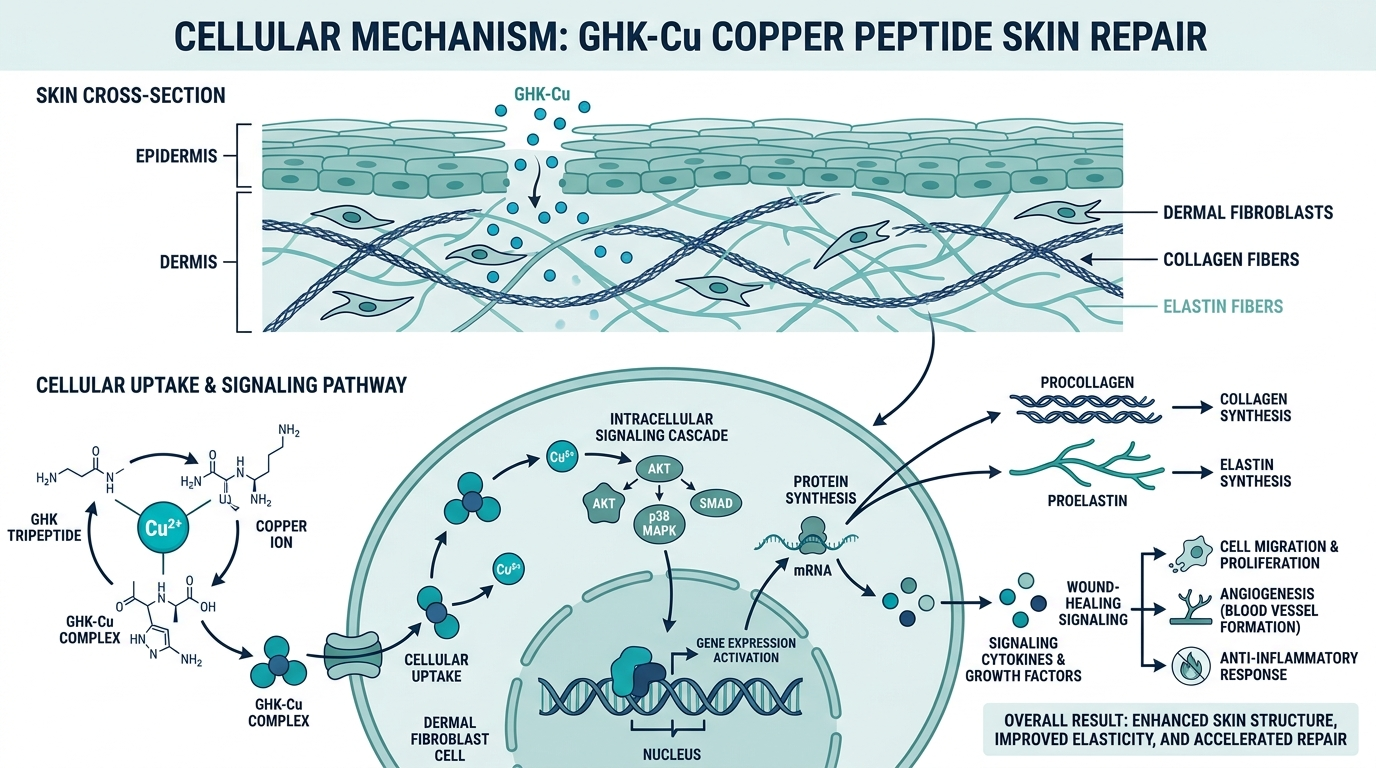
GHK-Cu is a copper-binding tripeptide, three amino acids (glycine, histidine, lysine) complexed to a copper(II) ion. It was isolated from human plasma albumin in 1973 by biochemist Loren Pickart at the University of California, San Francisco. Pickart noticed that plasma from younger adults drove older liver tissue to behave more like younger tissue, and the active fraction turned out to be this tiny peptide.
The compound circulates naturally in your blood. Human plasma GHK levels run around 200 nanograms per milliliter at age 20 and decline to roughly 80 ng/mL by age 60, a drop of 60% over four decades (Pickart & Margolina, International Journal of Molecular Sciences, 2018). That natural presence is one reason the topical safety record is as clean as it is: the body already makes it, already metabolizes it, and already has copper-handling enzymes specifically designed for it.
The ingredient appears on cosmetic labels as “copper tripeptide-1.” It is an INCI-listed cosmetic ingredient, which means it can be legally formulated into over-the-counter skincare without FDA drug approval. That regulatory status reflects more than 40 years of commercial use in cosmetics and, separately, several decades of wound-care research.
How safe is GHK-Cu in topical form?
Topical GHK-Cu has one of the cleaner safety profiles of any active skincare ingredient in regular use.
A 2023 safety review pooled data from 12 human studies with 512 combined participants and found the most common adverse events were transient erythema (redness) in 4.2% of subjects and mild pruritus (itching) in 2.8%. No systemic effects, meaning no elevation in serum copper or downstream metabolic disruption, were reported consistently across those trials. That is a cleaner adverse-event rate than published clinical data for retinol, glycolic acid, or even niacinamide at high concentrations.
There is a phenomenon called the “copper uglies” in skincare communities, referring to a temporary purge-like breakout that affects a small subset of first-time copper peptide users. It generally resolves within two to three weeks of continued use. This is not a toxicity signal; it appears to be a transient increase in cell turnover and sebum mobilization. Whether to push through it or pause is a judgment call, not a medical emergency.
The more important formulation note for topical safety: standard products use concentrations between 0.5% and 2% GHK-Cu. NIOD’s Copper Amino Isolate Serum 3 1:1 (CAIS3), one of the most studied commercial copper peptide products, uses 1% GHK-Cu plus 1% free-form GHK. Systemic copper absorption through intact skin at these concentrations is minimal. Published studies of daily topical application over 90 days have not demonstrated any measurable change in plasma copper levels.
Do not believe claims that copper peptides cause copper toxicity from topical use at normal concentrations. The physics do not support it. Copper ions do not meaningfully penetrate the stratum corneum in amounts that challenge a healthy body’s copper homeostasis.
What do the clinical studies actually show?
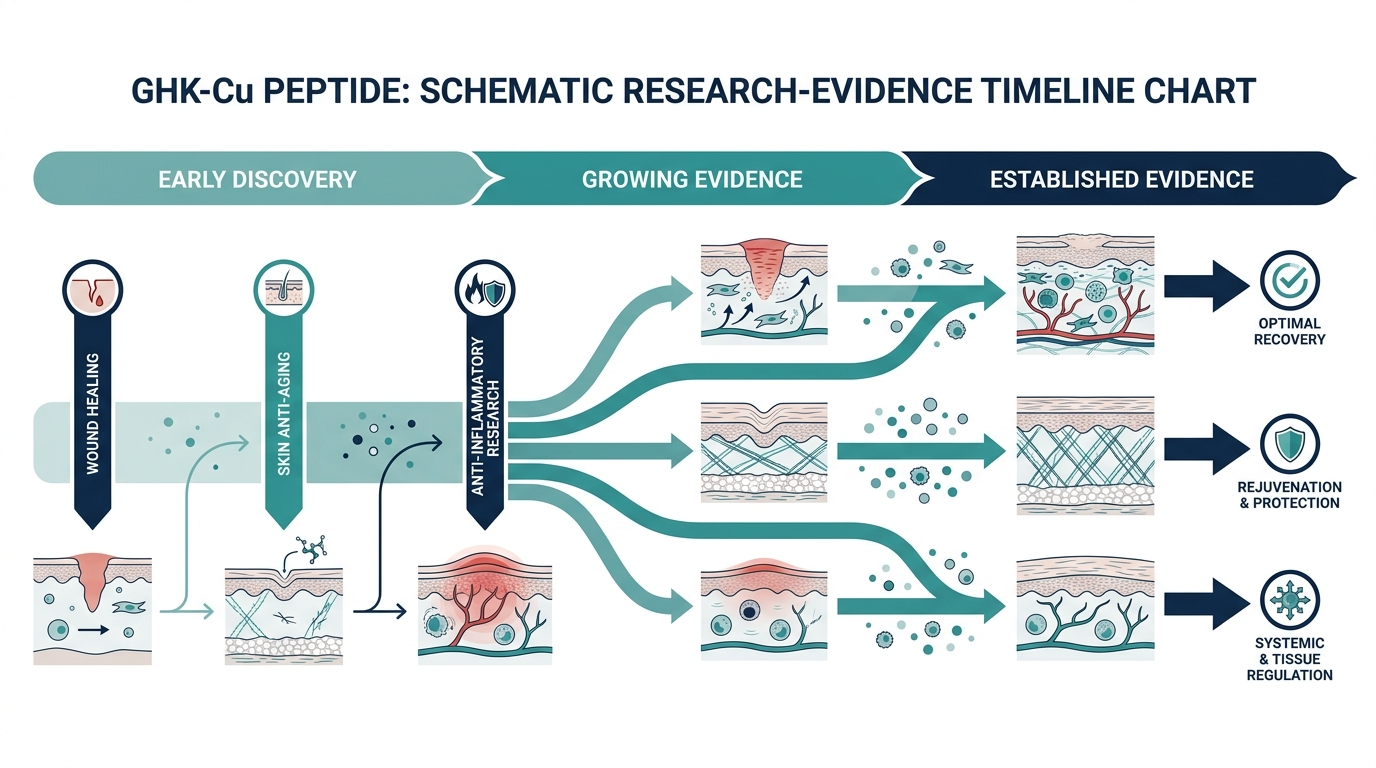
The evidence base for GHK-Cu is deeper than for most cosmetic actives, and the signal is consistent. Here are the real numbers:
Skin density and collagen: A clinical trial conducted by Wayne Carey, MD, Professor of Dermatology at McGill University, enrolled 21 adult women applying a GHK-Cu cream daily for 90 days (Yuvan Research / EurekAlert, 2023). Subdermal echogenic density, a measure of collagen organization captured by ultrasound, increased by 28% on average. The top quartile of participants showed a 51% improvement. These are structural changes, not surface cosmetic effects.
A separate 71-subject trial with women showing mild to advanced signs of photoaging applying a GHK-Cu facial cream for the same 90-day period showed statistically significant increases in skin density and thickness alongside measurable reductions in fine line depth and sagging.
The gene expression picture: A 2018 analysis by Pickart and Margolina, published in the International Journal of Molecular Sciences, cross-referenced GHK’s activity against the Broad Institute’s Connectivity Map database and found that GHK modulates expression of roughly 31.2% of all human genes, with changes of 50% or more (PMC6073405). Upregulation included 41 ubiquitin-proteasome system genes, which govern cellular waste clearance. Wrinkle volume reduction in a comparison study ran 55.8% versus control and 31.6% versus Matrixyl 3000. Cell viability in some models increased 12.5-fold. These are striking numbers, and they come with the caveat that in-vitro and gene-profiling results do not automatically translate linearly to what a serum does on your face.
Hair growth: A randomized, double-blind, placebo-controlled trial of 45 men with pattern hair loss found that topical GHK-Cu at the lower tested concentration produced 71.5 additional hairs versus 52.6 in the higher-concentration group, representing a 2.38-fold increase over baseline compared to 1.21-fold for placebo, with zero adverse events across all three groups over six months. Earlier Tricomin studies from the late 1990s showed statistically significant improvements in hair density and reductions in shedding, with one published in the International Journal of Dermatology reporting meaningful improvements in hair shaft diameter after six months.
Wound healing: The CuHeal trial (NCT07437586), currently enrolling at the time of this writing, is evaluating topical GHK-Cu gel for acute wound healing in healthy adults using standardized 5mm punch-biopsy wounds. It is the most rigorous wound-healing trial of the compound to date. Earlier preclinical and observational data showed healing acceleration of 30 to 50% compared to standard wound care in post-surgical and post-laser subjects, which is why GHK-Cu has been a wound-care staple for decades.
What is the 2026 FDA regulatory status?
This is where a lot of information on the internet is out of date, and the details matter.
Topical GHK-Cu: classified as a cosmetic ingredient (INCI name: copper tripeptide-1). No FDA drug approval required or pending. Legally sold in any skincare product. This has not changed.
Injectable / compounded GHK-Cu: The FDA placed injectable GHK-Cu on its 503A Category 2 restricted list in late 2023, flagging it as presenting “potential significant safety risks” related to immunogenicity and impurity concerns during the compounding process. This effectively barred licensed compounding pharmacies from preparing subcutaneous GHK-Cu injections.
Then the situation shifted. On February 27, 2026, HHS Secretary Robert F. Kennedy Jr. announced that roughly 14 peptides would be reclassified from Category 2 back to eligibility for compounding. GHK-Cu was included in that announcement. However, as of mid-2026, the compound does not sit cleanly in Category 1. It is in active regulatory re-evaluation, with a Pharmacy Compounding Advisory Committee review expected before the end of 2026 or in early 2027 (FDA bulk substances list). Physicians who want to prescribe compounded injectable GHK-Cu for dermatological applications should consult their 503A pharmacy about current compliance status, because the window may be open but the rules are still being written.
No injectable or systemic GHK-Cu formulation has received FDA drug approval for any indication, and none has completed a Phase III trial as of mid-2026.
The insider read: the FDA’s 2023 move onto Category 2 was widely interpreted as an overreach, since the immunogenicity concerns cited were largely theoretical. The 2026 reversal signal suggests the agency agrees, but the formal re-permitting process takes time. This is a case where the molecule’s actual safety record and the regulatory calendar are running on different timetables.
Topical vs injectable: why the risk class is completely different
Personally, I think the failure to distinguish these two routes is the single biggest source of GHK-Cu safety misinformation. Here is the concrete breakdown:
| Factor | Topical (serum/cream) | Injectable (research vial) |
|---|---|---|
| FDA status | Legal cosmetic ingredient | Category 2 restricted (re-eval in progress) |
| Systemic absorption | Minimal, no serum copper changes in trials | Directly systemic |
| Copper delivery | Negligible vs. dietary intake | 6-15 mcg per dose (well under 900 mcg RDA) |
| Common adverse events | Transient erythema 4.2%, pruritus 2.8% | Injection site pain (PIP) due to copper ion, flushing, metallic taste |
| Production oversight | Cosmetic GMP, batch testing | No regulatory oversight for research vials |
| Who oversees it | INCI/cosmetic regulatory framework | Nobody, unless from a licensed compounding pharmacy |
| Available retail | Yes, widely | No legitimate retail route exists |
The copper delivery numbers for injectable GHK-Cu are worth pausing on. A typical subcutaneous protocol of 200 to 500 mcg daily carries approximately 6 to 15 mcg of elemental copper per dose, well below both the 900 mcg adult recommended daily allowance and the 10,000 mcg per day upper limit set by the Institute of Medicine. So the raw copper load is not the primary injectable concern. The primary concerns are: impurities and sterility in research-grade vials, absence of clinical oversight, injection site pain that can be significant, and the legal category the formulation occupies.
What are the real contraindications?
The contraindications for GHK-Cu break along the same topical-vs-injectable line, with a few absolute exceptions that apply to both routes.
Absolute contraindications:
Wilson’s disease is the main one. Wilson’s disease is an autosomal recessive disorder of copper metabolism caused by an ATP7B gene mutation, and it results in pathological copper accumulation in the liver, brain, and kidneys. Even small exogenous copper loads can worsen hepatic and neurological damage in Wilson’s disease patients. This contraindication applies to any copper-containing product, not just GHK-Cu.
Active or suspected cancer is a theoretical contraindication for any route. GHK-Cu triggers controlled release of VEGF (vascular endothelial growth factor) to promote angiogenesis as part of wound healing. At the same time, a 2018 gene analysis showed that GHK suppresses 70% of genes in a metastasis-prone colon cancer signature and re-activates apoptosis in neuroblastoma and lymphoma cells, suggesting anti-cancer activity. The paradox is unresolved: GHK-Cu may be anti-cancer at the gene-expression level, but its pro-angiogenic signaling could theoretically provide vasculature to existing tumors. Without controlled human data, anyone with active or suspected cancer should discuss this with their oncologist before using any form of GHK-Cu beyond standard topical concentrations.
Practical precautions:
Pregnancy: no published safety data exists for GHK-Cu during pregnancy. This is not a signal of known harm; it is an absence of evidence. Standard practice is to avoid non-essential actives during pregnancy.
Allergy to copper or any component of the formulation. Patch-test any new copper peptide product on a small area for 48 hours before full application.
Existing inflammatory skin conditions: if you have active eczema, rosacea, or a compromised skin barrier, the 4.2% erythema rate in healthy-skin subjects is likely higher in your case. Lower frequency of use and gentler surrounding formulations are appropriate.
What should not be mixed with GHK-Cu?
The incompatibility that matters most is with L-ascorbic acid, the water-soluble form of vitamin C found in most brightening serums. At low pH, ascorbic acid disrupts the copper-peptide bond, reducing GHK-Cu’s effectiveness. Simultaneously, free copper ions catalyze the oxidation of ascorbic acid, producing degradation byproducts that can cause irritation on sensitive skin. Use vitamin C in the morning and copper peptides in the evening, or on alternating days.
Retinol does not have a true chemical incompatibility with GHK-Cu. They act through different pathways, with retinol driving direct procollagen gene activation and GHK-Cu providing the broader repair and barrier-support signal. If combining them at night, apply the copper peptide serum first, allow 10 to 20 minutes for absorption, then apply retinol. Some formulators consider them complementary: retinol increases turnover rate and GHK-Cu supports the barrier that retinol can temporarily disrupt.
Do not pair GHK-Cu with strong exfoliating acids, AHA or BHA, in the same application step. The acidic environment works against the copper-peptide complex. Morning actives and evening copper peptide is the cleanest protocol.
Which topical products are worth the price?
Product quality matters with copper peptides because the copper-peptide bond is fragile. Poor formulation pH, incompatible packaging, or incorrect concentration undercuts the active before it touches your skin.
At the clinically supported end of the market:
NIOD Copper Amino Isolate Serum 3 1:1 (CAIS3) is formulated at 1% GHK-Cu plus 1% free-form GHK (hence the “1:1”), priced at $62 for 15 mL or $93 for 30 mL. It is the most studied of the retail options and designed specifically around copper peptide stability.
The Ordinary Multi-Peptide + Copper Peptides 1% delivers 1% copper tripeptide-1 at $32 for 30 mL. The value-per-concentration ratio is competitive with anything in the category.
Allies of Skin Copper Tripeptide and Ectoin Advanced Repair Serum pairs GHK-Cu with ectoin, a stress-protection molecule, at $199 for 30 mL. After 28 days in user trials, 94% reported smoother skin and 83% felt their skin had fully recovered from prior irritation. Accepted by the National Eczema Association.
Hydrolyzed type I & III collagen peptides, third-party tested, unflavored.
Who should avoid GHK-Cu entirely?
To summarize, avoid GHK-Cu in any form if you have Wilson’s disease. Use only topical forms, and only after medical consultation, if you have active or suspected cancer. Avoid in pregnancy due to absence of data. Patch-test first if you have reactive, compromised, or eczema-prone skin.
For everyone else, topical GHK-Cu at standard cosmetic concentrations (0.5% to 2%) is a well-characterized, low-risk ingredient with a clinical evidence base that outpaces the majority of premium skincare actives. The risk is not zero, because no biological active is. But the four-decade commercial history and the structural findings in clinical trials position it among the safer evidence-backed choices in the anti-aging category.
Do not let the “peptide” label blur the risk lines. That label also covers research-grade injectable vials from unregulated vendors, and those are a categorically different product. The serum on your counter and the vial on a research-chemical site share a molecule. They do not share a safety record.
Curious what your own levels look like?
Baseline 100+ biomarkers today and retest as life changes, all in one membership with physician review.
Frequently asked questions
Is GHK-Cu FDA approved?
No, not as a drug. GHK-Cu (copper tripeptide-1) is an approved cosmetic ingredient that can be legally used in over-the-counter skincare products without drug approval. Injectable GHK-Cu has never received FDA drug approval for any indication and has no completed Phase III trial. Injectable formulations for compounding were added to the FDA’s 503A Category 2 restricted list in late 2023 and are in active re-evaluation as of mid-2026.
Can GHK-Cu cause copper toxicity?
Not through topical use at standard concentrations. Published 90-day human trials applying GHK-Cu cream daily show no measurable changes in plasma copper. The total elemental copper delivered through a normal topical application is negligible relative to dietary copper intake. Wilson’s disease remains the one absolute contraindication. For injectable forms, the per-dose copper delivery (6 to 15 mcg at typical subcutaneous protocols) sits well below both the 900 mcg adult RDA and the 10,000 mcg per day upper limit.
What are the side effects of GHK-Cu serum?
A pooled 2023 review of 12 studies found transient redness in 4.2% of subjects and mild itching in 2.8%, with no systemic effects. A small percentage of first-time users experience a temporary “copper uglies” purge period that usually resolves within two to three weeks. Compared to retinol, glycolic acid, or even high-concentration niacinamide, this is a mild adverse-event profile.
Can I use copper peptides with vitamin C?
Not in the same step. L-ascorbic acid disrupts the copper-peptide bond and gets oxidized by free copper ions in the process, reducing the effectiveness of both ingredients and potentially causing irritation. Use vitamin C in the morning and GHK-Cu copper peptides in the evening.
Is injectable GHK-Cu safe?
Injectable GHK-Cu sits in a different regulatory and risk category from topical forms. It was placed on the FDA’s 503A Category 2 restricted list in 2023, and while HHS announced in February 2026 that roughly 14 peptides including GHK-Cu would be reconsidered, the formal permitting process was not yet complete as of mid-2026. Injectable vials purchased from research-chemical vendors carry no clinical oversight, no sterility guarantee beyond a Certificate of Analysis, and no accountability for impurities. Injection site pain from the copper ion is commonly reported. The legal clinical route, via a licensed compounding pharmacy with a prescription, is the appropriate path if a clinician recommends injectable GHK-Cu.
Can people with sensitive skin use GHK-Cu?
Yes, with precautions. Patch-test on a small area for 48 hours before full application. Avoid layering with low-pH actives in the same step. Start with a lower-concentration product like The Ordinary’s 1% formula before moving to higher-concentration options. The ingredient itself is not a common sensitizer. People with active eczema or rosacea should consult a dermatologist before adding any new active.
Is GHK-Cu safe if you have had cancer?
This is a case where you need to speak with your oncologist rather than rely on a skincare article. GHK-Cu has shown anti-cancer activity in gene-expression studies, including suppression of 70% of genes overexpressed in metastasis-prone colon cancer. At the same time, its pro-angiogenic VEGF-stimulating activity could theoretically benefit existing tumor vasculature. The evidence base is preclinical and the question is unresolved. Do not use GHK-Cu in any injectable form without oncologist approval, and discuss even topical use with your care team.
Hydrolyzed type I & III collagen peptides, third-party tested, unflavored.
Author: Vital Signs Today Editorial Team, [credential]”]. Educational content, not medical advice. Sources linked inline.
Primary sources:
– Pickart L, Margolina A. Regenerative and Protective Actions of the GHK-Cu Peptide in the Light of the New Gene Data. Int J Mol Sci. 2018;19(7):1987. https://pmc.ncbi.nlm.nih.gov/articles/PMC6073405/
– Carey W (McGill University). Epigenetic mechanisms activated by GHK-Cu increase skin collagen density in clinical trial. EurekAlert, May 2023. https://www.eurekalert.org/news-releases/990464
– ClinicalTrials.gov. Topical GHK-Cu Gel for Acute Skin Wound Healing (CuHeal). NCT07437586. https://clinicaltrials.gov/study/NCT07437586
– FDA. Certain Bulk Drug Substances for Use in Compounding that May Present Significant Safety Risks. https://www.fda.gov/drugs/human-drug-compounding/certain-bulk-drug-substances-use-compounding-may-present-significant-safety-risks
– NIOD Copper Amino Isolate Serum 3 1:1 product page. https://niod.com/en-us/copper-amino-isolate-serum-3-11-cais3-serum-100368.html
– InnerBody Research. Best Copper Peptide Serum 2026. https://www.innerbody.com/best-copper-peptide-serum
– InnerbodyResearch. GHK-Cu Peptide: The benefits, side effects, and more [2026]. https://www.innerbody.com/ghk-cu-peptide
– Newtropin. FDA Removes 12 Peptides from 503A Category 2 (Physician Guide). https://newtropin.com/blog/fda-503a-category-update-april-2026/
Related reading
Vital Signs Today may earn a commission if you buy through links on this page. It does not affect our editorial assessments.