
Disclosure: Vital Signs Today may earn a commission if you buy through links on this page, at no extra cost to you. This does not influence our evidence-based assessments. We are not a medical provider; talk to a clinician before acting on test results.
Part of our Liver Function Tests guide.
Your liver releases two enzymes into your blood when its cells are stressed, and the ratio between them can quietly say more about your liver than either number alone. Most people stare at the AST and ALT lines on a lab report and never notice the relationship hiding between them. That relationship has a name, a backstory dating to 1957, and a surprising amount of diagnostic horsepower for a single division problem.
What is the ALT to AST ratio, in plain terms?
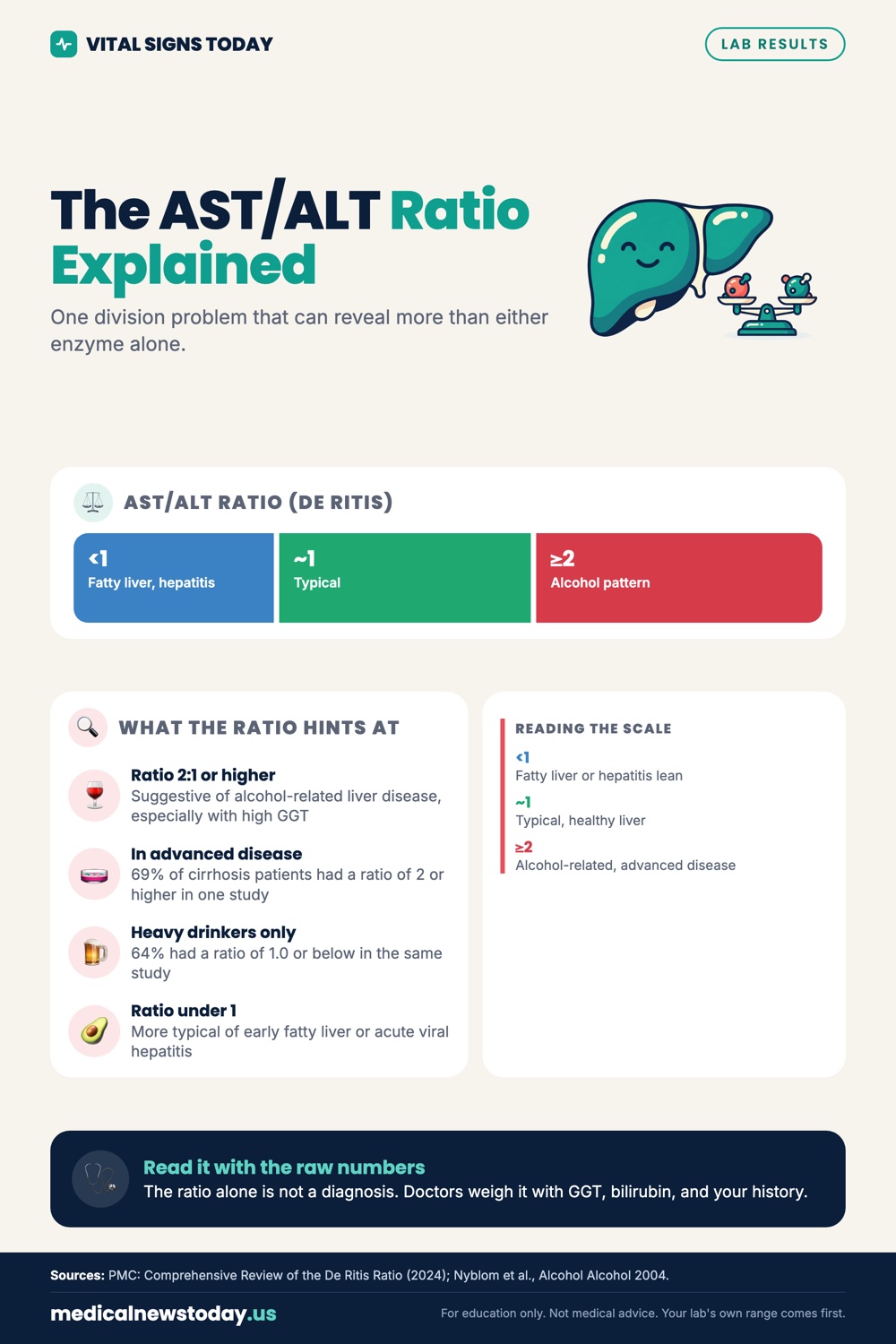
The AST/ALT ratio, also called the De Ritis ratio, divides aspartate aminotransferase (AST) by alanine aminotransferase (ALT), two enzymes that leak from liver cells when they are damaged. In healthy people the ratio sits near 1.0. A ratio that climbs well above 1, especially past 2, can point toward more advanced liver injury rather than a mild upset.
Here is the part nobody tells you at the lab counter: the order of the letters matters. People search for “ALT to AST ratio,” but clinicians almost always report it the other way, as AST over ALT. It is the same two enzymes, just flipped, and the convention is AST on top. So when you read about a “ratio of 2,” that means AST is twice ALT. Keep that straight and the rest of this makes sense.
Why does the De Ritis ratio exist at all?
Back in 1957, an Italian physician named Fernando De Ritis published the first systematic look at how these two transaminases behave in liver disease (AST/ALT ratio, Wikipedia, citing peer-reviewed sources). His insight was simple but durable: the two enzymes do not move in lockstep, and the gap between them carries information.
The biology underneath it is elegant. ALT lives almost entirely in the cytoplasm of liver cells and is fairly liver-specific. AST hides in two places, the cytoplasm and the mitochondria, and it shows up in heart, muscle, and red blood cells too. AST is also cleared from the bloodstream faster, with a half-life of roughly 18 hours versus about 36 hours for ALT (Wikipedia, AST/ALT ratio). Because AST disappears about twice as fast, a healthy liver that is not actively dumping enzymes settles into a ratio close to 1. When the ratio drifts away from 1, something is changing the usual balance.
What is a normal AST to ALT ratio?
In most healthy adults the ratio lands somewhere around 0.7 to 1.0, with AST and ALT roughly equal. There is no single official cutoff stamped on every lab slip, which frustrates people who want one clean number. Reference frameworks generally treat ratios in the 0.7 to 1.0 band as ordinary, 1.0 to 1.2 as borderline, and anything climbing past those marks as worth a second look in context.
A crucial caveat: the ratio is only meaningful alongside the absolute enzyme values. A ratio of 2 when both enzymes are stone-cold normal means something very different from a ratio of 2 when both are five times the upper limit. Doctors read the ratio and the raw numbers together, never in isolation. If you want the bigger picture on individual enzymes, our overview of liver enzymes explained walks through what AST and ALT each do on their own.
What does a high AST to ALT ratio mean?
This is where the ratio earns its reputation. A few classic patterns recur often enough that clinicians keep them in their back pocket.
Ratio of 2 or higher: the alcohol signature. An AST/ALT ratio of 2:1 or greater is the textbook hint of alcohol-related liver disease, particularly when gamma-glutamyl transferase (GGT) is also elevated (Wikipedia, AST/ALT ratio). Alcohol preferentially damages mitochondria and depletes a cofactor ALT needs, so AST pulls ahead.
But here is the nuance most articles skip. A landmark 2004 study by Nyblom and colleagues in Alcohol and Alcoholism found that a high ratio does not simply flag heavy drinking. It flags advanced disease. In their cirrhosis group, 69% had a ratio of 2.0 or higher, while in the alcohol-withdrawal group (heavy drinkers without severe liver damage) 64% had a ratio of 1.0 or below, and a ratio above 2 was rare (Nyblom et al., 2004, PubMed). Translation: a ratio above 2 in a drinker leans toward cirrhosis already present, not just the act of drinking.
Ratio rising above 1 in fatty liver: a fibrosis flag. Non-alcoholic fatty liver disease (NAFLD) without scarring usually shows a ratio below 1, with ALT often the higher of the two. As fibrosis advances, the ratio tends to flip and rise above 1. That crossover can hint at progression even when both enzymes still sit inside the normal lab range (Wikipedia, AST/ALT ratio).
Ratio above 5: look outside the liver. Because hepatocytes contain AST and ALT in a proportion of only about 2.5 to 1, liver cell death alone cannot push the ratio past roughly 2.5. A ratio above 5 essentially has to involve tissue beyond the liver, such as muscle or heart (Wikipedia, AST/ALT ratio). This is why a sky-high AST with a normal-ish ALT sometimes points a doctor toward a muscle problem, not a liver one.
What does a low AST to ALT ratio mean?
A ratio below 1, where ALT outpaces AST, is the common fingerprint of early NAFLD and acute viral hepatitis. In garden-variety fatty liver, ALT tends to be the more elevated enzyme, dragging the ratio down. A 2024 cross-sectional analysis of US data even explored the inverted ALT/AST ratio as a marker tracking with NAFLD risk and severity (Frontiers in Endocrinology, 2024).
So a low ratio is not automatically reassuring. It can mean an early, treatable fatty liver that still deserves attention to diet, weight, and metabolic health. The ratio is a direction signal, not a verdict.
How is the AST to ALT ratio actually used by doctors?
In practice the ratio is a triage tool, not a diagnosis. A clinician uses it to sort possibilities and decide what to order next. A 2024 clinical review of the De Ritis ratio framed it as a low-cost, widely available marker useful across hepatology and even some non-liver settings, while stressing that it works best as one input among many (PMC review of the De Ritis ratio, 2024).
What the ratio cannot do is name the cause by itself. It does not distinguish alcohol from a medication reaction from a viral infection without the rest of the clinical story: your history, GGT, bilirubin, platelets, imaging, and sometimes a FibroScan or biopsy. People sometimes treat noninvasive ratios like a home pregnancy test. They are closer to a weather vane, telling you which way the wind is blowing, not exactly when it will rain.
If your interest in biomarkers runs broader than the liver, you may also like our primer on biomarkers explained for how single numbers fit into a fuller picture of health.
Want to check your ALT?
Three ways to get it measured. Pick whichever fits you.
Affiliate links: we may earn a commission at no extra cost to you. A lab test does not replace a visit with your clinician.
Frequently asked questions
Is the AST/ALT ratio the same as the De Ritis ratio?
Yes. They are two names for the same calculation, AST divided by ALT. The label “De Ritis ratio” honors Fernando De Ritis, who first described the relationship between these enzymes in liver disease in 1957.
What ratio suggests alcohol-related liver damage?
A ratio of 2 or higher is the classic alcohol-related pattern, especially with elevated GGT. Research suggests a ratio above 2 often signals that advanced disease such as cirrhosis is already present, not just heavy drinking on its own.
Can my AST/ALT ratio be abnormal if both enzymes are normal?
Yes, and that is part of why the ratio is useful. In progressing fibrosis the ratio can climb above 1 even while AST and ALT both still fall within the lab’s normal range, which is why doctors read the ratio alongside the raw values.
Does a high ratio always mean a liver problem?
No. A ratio above 5 usually points outside the liver, often to muscle or heart tissue, because liver cells alone cannot produce a ratio that high. Context and additional tests sort this out.
Should I calculate my own ratio at home?
You can divide the numbers for curiosity, but interpretation belongs with a clinician who can read it against your full panel and history. The same ratio means different things in different people.
The bottom line
The AST/ALT ratio is one of the cheapest, oldest, and quietly cleverest tricks in liver medicine. Near 1 is typical. Below 1 leans toward fatty liver or acute hepatitis. Above 2 raises a flag for alcohol-related or advanced disease. Above 5 sends doctors looking past the liver entirely. None of those are diagnoses. They are arrows pointing toward the next, more definitive question.
This article is for general information only and is not medical advice. Lab values must be interpreted by a qualified clinician who knows your full history. If you have concerns about your liver enzymes or ratio, talk to your doctor.