
Educational content, not medical advice. Talk to a licensed clinician before starting any hormone-related therapy.
Short answer: HGH peptides are short chains of amino acids that signal your pituitary gland to release its own growth hormone, rather than replacing it with injected synthetic HGH. The most clinically used examples are sermorelin (legally compoundable in 2026), tesamorelin (FDA-approved for HIV-associated lipodystrophy), and the CJC-1295 plus ipamorelin stack (currently in regulatory review for compounding access). A single injection of CJC-1295 can raise IGF-1 levels 1.5 to 3 times above baseline for up to 11 days, while costing roughly 80% less per month than pharmaceutical-grade somatropin.
Considering an HGH-releasing peptide? Check your actual growth-hormone and IGF-1 markers before signaling for more. One at-home Superpower draw checks 100+ biomarkers, physician-reviewed.
Why are people suddenly searching for “HGH peptides” instead of just “HGH”?
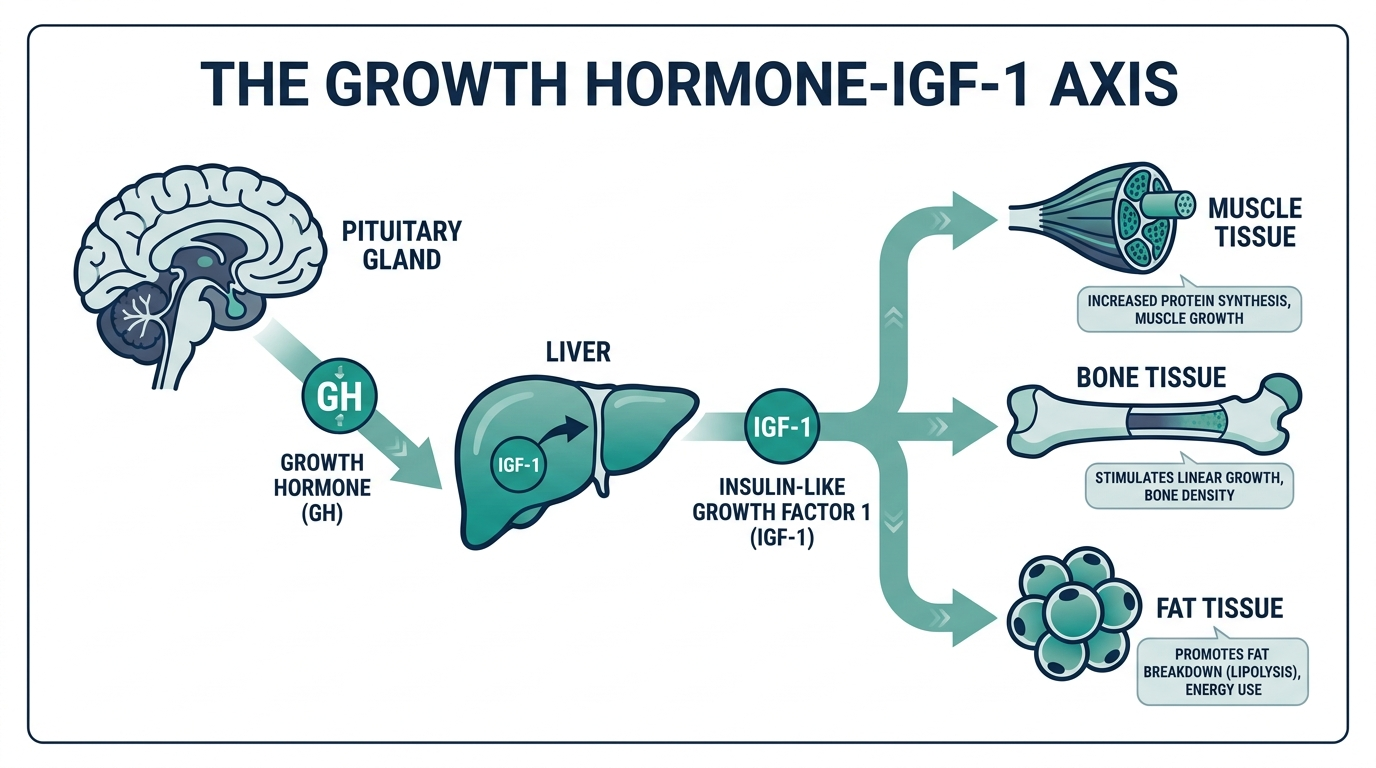
It is not a fad. The shift reflects a genuine change in how the medical community approaches the GH axis, driven by three converging factors: cost, safety, and the body’s own feedback loops.
Pharmaceutical-grade human growth hormone (somatropin, brand names Genotropin, Norditropin, Humatrope) runs $800 to $3,000 per month out of pocket, according to GoodRx 2026 pricing. That is for the molecule alone, without the clinical oversight that a responsible protocol demands. Meanwhile, telehealth-delivered sermorelin starts at around $130 to $225 per month through platforms like Hone Health and Defy Medical, including physician oversight and compounding pharmacy sourcing.
Cost explains the search volume spike. The science explains why clinicians are not just saying “cheaper version of the same thing.” These are mechanistically different, and that difference matters a lot once you understand how GH secretion actually works.
Full-body lab membership: 100+ biomarkers, doctor-reviewed, tracked over time.
What exactly is a “growth hormone peptide”?
A peptide is simply a short protein, a chain of amino acids shorter than a full protein. The human body uses hundreds of peptides as signals, and the GH axis runs on two of them natively: growth hormone-releasing hormone (GHRH), produced by the hypothalamus, tells the pituitary to release GH; ghrelin, produced mainly in the stomach, does the same thing through a separate receptor.
HGH peptides are synthetic analogs of one or both of those natural signals. They do not contain growth hormone. They contain a molecule that tells the pituitary to make and release GH on its own.
This distinction is easy to miss but is the whole ballgame. When you inject synthetic HGH, you are introducing a finished hormone directly. When you inject an HGH peptide, you are pressing a button inside the pituitary and waiting for it to respond. The former bypasses your body’s regulatory system entirely. The latter works through it.
The clinical name for this category is “growth hormone secretagogues,” from the Latin secretagere, to cause secretion. You will also hear the terms GHRH analogs (for peptides that mimic growth hormone-releasing hormone), GHRPs (growth hormone-releasing peptides, which mimic ghrelin), and the broader umbrella of GH peptide therapy.
How does the pituitary feedback loop make HGH peptides safer than synthetic HGH?
The pituitary gland is not a passive reservoir. It monitors GH and IGF-1 levels continuously, and when they rise too high, a counter-regulatory hormone called somatostatin suppresses further release. This is the natural feedback brake.
Synthetic HGH bypasses that brake entirely. You inject a fixed dose, GH levels rise in proportion to that dose, and the feedback system is overridden. That is why supraphysiological HGH use is associated with joint swelling, insulin resistance, elevated cancer risk (through IGF-1), and the suppression of the pituitary’s own production over time, as the gland detects constant high GH and reduces endogenous secretion (somatropin prescribing information via FDA).
HGH peptides do not remove the brake. They press the accelerator while the brake remains functional. If IGF-1 rises too high after a sermorelin injection, somatostatin will blunt the next GH pulse. The result is a ceiling effect that makes it difficult to push GH to frankly dangerous levels through a peptide alone, and it means the pituitary does not shut down its own production the way it can when flooded with exogenous hormone.
Personally, I think the feedback-preservation argument is the most underrated reason to choose peptides over synthetic HGH for the majority of wellness seekers. It is not a minor technical distinction. It is the difference between borrowing from your endocrine system and hiring a contractor to replace it.
What are the main HGH peptides, and how do they differ?
There are two main classes, and understanding the difference between them is what separates an informed conversation with a clinician from a confusing shopping list.
GHRH analogs (they mimic the hypothalamic signal): sermorelin, tesamorelin, and CJC-1295 all belong here. They bind to GHRH receptors in the pituitary and tell it to produce and release GH in a pulsatile pattern that follows the body’s natural overnight rhythm. Sermorelin is the shortest-acting of the three, with a half-life of roughly 10 to 20 minutes, which means its GH pulse is brief and closely mirrors a natural nocturnal surge. CJC-1295, modified to bind serum albumin, has a substantially longer half-life that sustains GH elevation for days rather than hours. Tesamorelin is a stabilized form of GHRH and the only GH secretagogue to complete the FDA’s full drug approval process.
GHRPs / ghrelin mimetics (they mimic the gut signal): ipamorelin is the most prescribed in this class. Rather than working at the hypothalamic pathway, ipamorelin binds the ghrelin receptor (GHSR-1a) directly on the pituitary and triggers GH release through a completely different mechanism. Critically, ipamorelin is highly selective: it stimulates GH without meaningfully raising cortisol or prolactin, which older GHRPs like GHRP-6 frequently did. That selectivity profile is why ipamorelin became the dominant GHRP in clinical and research settings.
The combination stack: CJC-1295 plus ipamorelin became the most widely prescribed GH peptide protocol because the two pathways are complementary. GHRH analogs prime the pituitary and extend the release window, while the ghrelin mimetic amplifies the pulse amplitude. A 2006 study published in the Journal of Clinical Endocrinology and Metabolism showed that a single injection of CJC-1295 in healthy adults raised GH levels 2 to 10-fold and IGF-1 levels 1.5 to 3-fold, with IGF-1 remaining elevated above baseline for 9 to 11 days. Combining that platform with ipamorelin’s pulse amplification is the mechanistic basis for the stack’s clinical adoption.
What is tesamorelin, and why is it the only FDA-approved HGH peptide?
Tesamorelin (brand name Egrifta WR, from Theratechnologies) is the gold standard data point in this entire category, and most of the influencer content about HGH peptides quietly ignores what it actually shows.
Tesamorelin received FDA approval in November 2010 for one specific indication: reducing excess visceral abdominal fat in HIV-positive adults with lipodystrophy, a condition where antiretroviral therapy causes metabolic fat redistribution. The approval was based on two double-blind, multicenter, randomized controlled trials enrolling 816 HIV-positive adults. At the standard dose of 2 mg subcutaneously daily, tesamorelin produced roughly an 18% reduction in visceral adipose tissue compared to placebo, measured by CT imaging.
That is real, controlled data from a Phase 3 RCT. No other GH peptide can claim the same bar.
Three things about the tesamorelin story that most writeups omit. First, the visceral fat effect was not maintained when the drug was discontinued, with fat returning toward baseline within a few months of stopping. Second, the FDA approval is narrow: HIV lipodystrophy only, not general wellness or body recomposition. Using it off-label for anti-aging purposes means the clinical evidence you are borrowing is from a very different patient population. Third, in March 2025, Theratechnologies received approval for an updated formulation, Egrifta WR (tesamorelin F8), which allows weekly reconstitution instead of daily, a meaningful practical improvement.
Do not believe anyone who presents tesamorelin’s approval as validation for using growth hormone peptides broadly for fat loss. The study was specific, the population was specific, and the FDA said as much in approving only that indication.
What is the regulatory status of HGH peptides in 2026?
This is where the market gets genuinely complicated, and getting it wrong is expensive in two directions: you either avoid something that is now legally accessible, or you pursue something that carries regulatory and safety risk.
Sermorelin is compoundable in 2026, with new requirements. As of January 2026, FDA guidance requires prescribers to document that FDA-approved alternatives (tesamorelin, somatropin) are clinically inappropriate or inaccessible before a licensed pharmacy can compound sermorelin for a specific patient. This created compliance burden that pushed pricing up 20 to 35% and reduced patient volume, but it did not ban sermorelin compounding. It is still legally available through licensed 503A pharmacies and 503B outsourcing facilities under a valid prescription from a clinician who has completed the required attestation. Telehealth platforms like Hone Health ($130 per month), Defy Medical ($200 to $500 per month depending on protocol), and Marek Health ($225 to $350 per month) currently prescribe it, according to PeptidesExplorer’s 2026 clinic review.
CJC-1295 and ipamorelin are in regulatory review. Both compounds are currently on the FDA’s 503A Category 2 list, which means licensed compounding pharmacies cannot legally prepare them pending formal review. As of April 2026, the FDA announced movement toward reclassifying these compounds, and the agency is expected to extend its review framework to growth hormone-releasing peptides before the end of 2026. The status is shifting, not settled.
The Pharmacy Compounding Advisory Committee (PCAC) July 23 to 24 meeting focuses on BPC-157, KPV, TB-500, MOTS-C, Emideltide, Semax, and Epitalon, not growth hormone secretagogues. CJC-1295 and ipamorelin are in a separate review pipeline (FDA advisory committee calendar).
Tesamorelin is FDA-approved and therefore accessible as a prescription drug through licensed channels, not through the compounding pathway.
For a prescriber telling you ipamorelin or CJC-1295 is available “right now through our pharmacy,” the correct response is to ask which specific 503A or 503B facility is dispensing it and to request the pharmacy’s name for verification. Clinics with full regulatory compliance will answer that question immediately. The ones who hedge are telling you something.
Telehealth GLP-1 program with provider visits and pharmacy coordination.
How do HGH peptides actually compare to synthetic HGH?
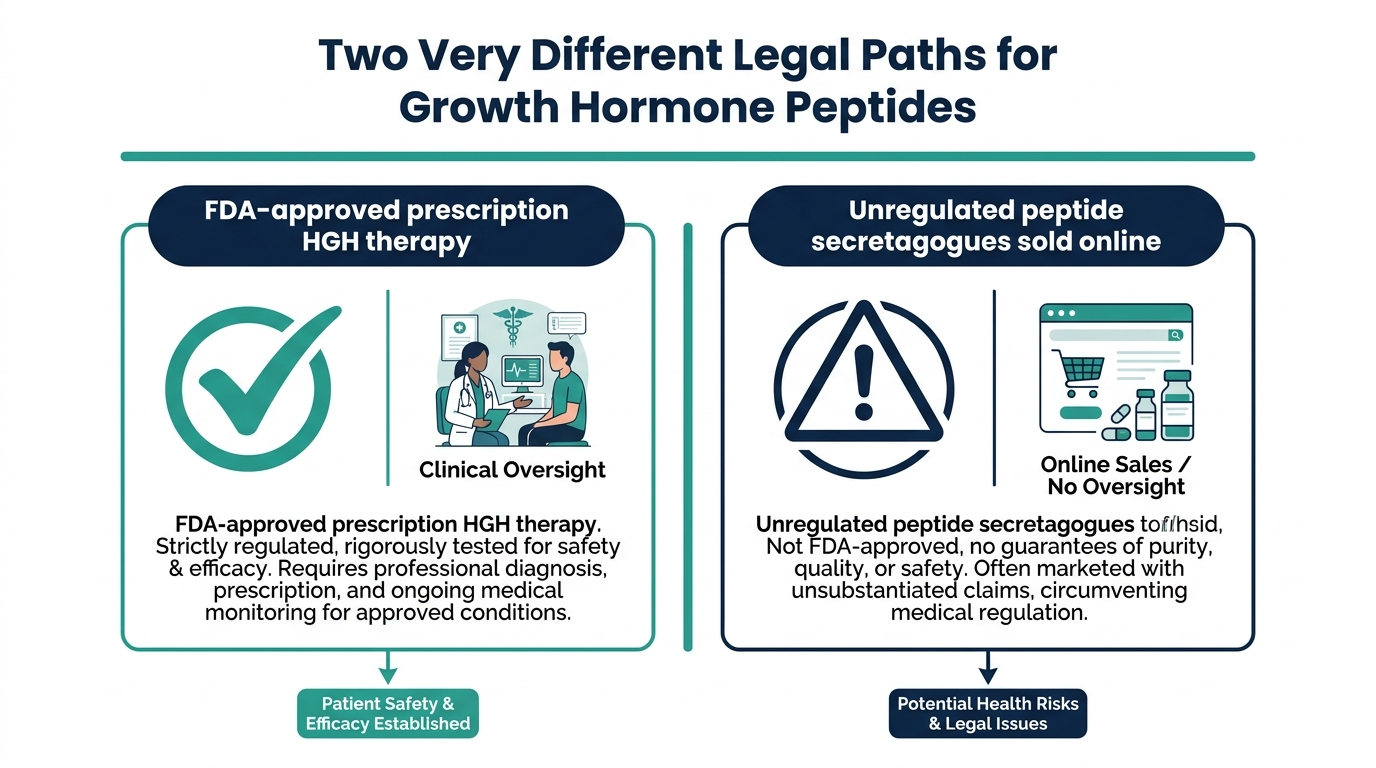
The table below lays out the dimensions that matter for someone deciding between the two approaches.
| Factor | HGH Peptides (e.g., sermorelin, CJC-1295/ipamorelin) | Synthetic HGH (somatropin) |
|---|---|---|
| Mechanism | Stimulates pituitary to produce and release GH naturally | Delivers manufactured GH directly, bypassing pituitary |
| Feedback loop | Preserved, somatostatin can blunt over-release | Bypassed entirely, dose-linear response |
| GH pattern | Pulsatile, mimics natural nocturnal surges | Sustained elevation, not physiologic |
| Pituitary impact | May preserve or restore natural function | Chronic use can suppress endogenous production |
| Monthly cost | $130 to $400 (telehealth, with oversight) | $800 to $3,000+ (brand, GoodRx pricing) |
| FDA approval | Tesamorelin only (narrow indication) | Multiple approvals for GH deficiency, pediatric growth |
| Side effect profile | Milder, lower carpal tunnel / insulin resistance / acromegaly risk | Higher risk of water retention, joint pain, insulin resistance |
| Evidence grade | Tesamorelin: Phase 3 RCT; sermorelin/CJC-ipamorelin: smaller studies | Robust for approved indications; extensive long-term data |
| Compounding access | Sermorelin compoundable with attestation; others under review | Not typically compounded; dispensed as branded drug |
| Legal status | Prescription required; some in regulatory grey zone | Prescription required; FDA-approved |
One number from that table deserves emphasis: the cost gap between sermorelin and synthetic HGH is not a minor markdown. At $150 per month versus $1,200 per month, you are looking at a difference of $12,600 per year for what is, in many cases, a mechanistically superior approach. The pituitary-preserving argument is compelling even before the price enters the discussion. Once it does, the decision tree for the average patient narrows fast.
What does the “somatopause” have to do with why people seek HGH peptides?
The term “somatopause” refers to the progressive, age-associated decline in GH secretion and circulating IGF-1, the principal mediator of GH’s anabolic effects. Cross-sectional data published in Endocrine Reviews shows that 11% of adults in their forties have IGF-1 levels in a range consistent with impaired GH production. By their seventies, that figure climbs to 55%.
This matters because the GH-IGF-1 axis influences several systems simultaneously: muscle protein synthesis, fat metabolism (particularly visceral fat oxidation), bone density, sleep architecture (deep-sleep GH pulses are where most GH is secreted), and cognitive function. The age-related decline in this axis contributes to what most people experience as “just getting older”: harder to build muscle, easier to accumulate abdominal fat, worse sleep quality, longer recovery times.
The honest framing is this: if your IGF-1 is genuinely low for your age and your symptoms match, HGH peptide therapy through a licensed clinician is a reasonable evidence-informed conversation to have. If your IGF-1 is already in the top third of the age-adjusted range, spending $200 a month trying to push higher is not well-supported by the evidence and may not be worth it.
HGH peptides are not anti-aging magic. They are an intervention for a specific, measurable deficiency in a specific axis. That distinction separates responsible clinical use from the peptide influencer aesthetic.
What results do people actually see, and on what timeline?
The honest answer requires separating the telehealth-plus-prescription population from the broader online discussion.
Within properly supervised protocols using compounded sermorelin or CJC-1295 plus ipamorelin:
Sleep quality tends to be the first improvement patients notice, typically within 1 to 2 weeks. GH is predominantly secreted during slow-wave sleep, and restoring GH axis signaling appears to deepen slow-wave sleep stages for many users.
Recovery and body composition changes follow at 4 to 6 weeks, coinciding with measurable changes in protein synthesis rates as IGF-1 rises. These changes are subtle at this stage: less soreness after training, slightly better body composition scores, a subjective sense of “better tissue quality.”
Meaningful fat loss and muscle changes in most supervised studies take 3 to 6 months of consistent use. The 2006 CJC-1295 study found IGF-1 remaining elevated for 9 to 11 days following a single injection, and with repeated dosing, IGF-1 stayed above baseline for up to 28 days, which is the mechanistic basis for the body composition claims.
What most of the content in this space omits: effect magnitude in healthy adults is modest. Tesamorelin in HIV lipodystrophy showed 18% visceral fat reduction, which is real and clinically meaningful for that population. In healthy adults with normal-to-low-normal GH, the body composition effects of secretagogue therapy are less dramatic, and no large randomized controlled trial in healthy adults has established a definitive efficacy benchmark for CJC-1295 plus ipamorelin on body composition. The smaller studies are promising; the Phase 3 data does not exist for this indication.
What should you look for in a legitimate HGH peptide therapy provider?
Not all telehealth platforms are equal, and the rapid expansion of peptide therapy marketing has created a tier of providers that use clinical language without clinical rigor.
Five non-negotiables when evaluating any provider:
- A licensed physician, nurse practitioner, or PA who is actually reviewing your case. Not a checkbox health history form, an actual clinical evaluation.
- Baseline labs required before first prescription. IGF-1, GH, and a comprehensive metabolic panel are the minimum. Any provider who prescribes without baseline biomarkers is guessing.
- The compounding pharmacy is named and verifiable. Ask specifically: “Which pharmacy will dispense this, and what is their 503A license number?” A real provider answers immediately.
- Follow-up labs are built into the protocol. IGF-1 should be rechecked at 8 to 12 weeks. If the provider has no follow-up lab requirement, they are not monitoring for over-response.
- The compound they are prescribing is currently legal for 503A dispensing. As of June 2026, this means sermorelin and tesamorelin, and explicitly not CJC-1295 or ipamorelin through a compounding pharmacy (those remain on the Category 2 list). A provider offering compounded CJC-1295 today is either misinformed about current regulations or working outside them.
The platforms with an established clinical reputation in this space, Defy Medical, Marek Health, and Hone Health, all meet this bar and publish their pharmacy sourcing transparently. Newer entrants should be evaluated against it, not assumed to meet it.
Turn what you just learned into action.
Superpower lets you test 100+ biomarkers from home, then re-check them over time so you can actually see progress, physician-reviewed at every step.
Frequently asked questions
What is the difference between HGH and HGH peptides?
Synthetic HGH (somatropin) is the hormone itself, injected to raise GH levels directly by bypassing the pituitary. HGH peptides are signaling molecules, short amino acid chains that tell the pituitary to release GH naturally. The key difference is the feedback loop: your body’s counter-regulatory system (somatostatin) remains active with peptides, placing a natural ceiling on GH elevation. With synthetic HGH, there is no feedback brake, which is why supraphysiological dosing carries greater risk of side effects like insulin resistance, joint swelling, and long-term pituitary suppression.
Are HGH peptides legal to use?
It depends on which peptide and how you obtain it. Tesamorelin is FDA-approved and legal with a prescription. Sermorelin is legally compoundable through licensed 503A pharmacies with a prescription and a documented clinical attestation, as of January 2026. CJC-1295 and ipamorelin are currently on the FDA’s 503A Category 2 list, meaning licensed compounding pharmacies cannot legally prepare them at this time. Buying any injectable peptide without a prescription and physician oversight is operating outside legal and safety guardrails, regardless of what the vendor’s website says.
How much do HGH peptides cost?
Sermorelin through telehealth platforms ranges from $130 per month at Hone Health to $225 to $400 per month at Defy Medical or Marek Health, typically including physician oversight and compounding pharmacy sourcing. Tesamorelin as a branded prescription drug is considerably more expensive. For comparison, pharmaceutical-grade somatropin (synthetic HGH) starts around $800 per month via GoodRx pricing for the lowest-dose branded options and exceeds $3,000 per month for common therapeutic doses, with no insurance coverage for wellness indications.
How long before HGH peptides work?
Most supervised patients report improved sleep quality within 1 to 2 weeks. Body composition changes, lower body fat and improved muscle quality, typically appear at the 4 to 6 week mark. Meaningful, measurable changes in IGF-1 and body composition require 3 to 6 months of consistent protocol adherence. The 2006 CJC-1295 clinical study found IGF-1 elevated above baseline for up to 11 days following a single injection, and remaining persistently elevated for up to 28 days with repeated dosing.
Do HGH peptides build muscle?
They can support muscle in the context of a deficit in the GH-IGF-1 axis. IGF-1 is a direct driver of protein synthesis, and restoring a low IGF-1 to a healthy range supports muscle maintenance and recovery. However, HGH peptides are not anabolic steroids. In healthy adults with normal IGF-1, the incremental muscle-building effect of adding a secretagogue is modest. The evidence for meaningful body composition benefits is strongest for individuals with documented low-normal or low IGF-1, which is why baseline labs are essential before starting.
What is the “somatopause”?
Somatopause is the term for the age-associated decline in GH secretion and IGF-1. Cross-sectional data shows 11% of adults in their forties have IGF-1 levels consistent with impaired GH production, rising to 55% by the seventies. The associated changes include reduced muscle mass, increased visceral fat, poorer sleep architecture, and slower tissue recovery. HGH peptide therapy is most evidence-supported when there is a documented decline in the GH axis, which is why clinicians measure IGF-1 first.
Can I buy HGH peptides without a prescription?
Cosmetic topical peptides (copper peptide serums, collagen peptides) are sold without a prescription and are not in the same category as injectable GH secretagogues. For any injectable HGH peptide, the legally and clinically appropriate route is through a licensed telehealth provider or physician who orders baseline labs, writes a prescription, and sources the compound through a named compounding pharmacy. Vendors selling injectable peptides without a prescription label are selling a “research use only” product that has no regulatory oversight and no clinical accountability.
Author: Vital Signs Today Editorial Team, [credential]”]. Educational content, not medical advice. Sources linked inline.
Telehealth GLP-1 program with provider visits and pharmacy coordination.
Primary sources:
– GoodRx: Recombinant Human Growth Hormones pricing 2026
– Endocrine Reviews: Growth Hormone Deficiency, Health and Longevity
– Journal of Clinical Endocrinology and Metabolism: CJC-1295 Phase 1 study
– FDA EGRIFTA prescribing information (tesamorelin)
– FDA advisory committee calendar: PCAC July 23-24, 2026
– HealingMaps: FDA PCAC July 2026 peptide review
– Meto: FDA July 2026 peptide meeting
– TrimRx: Sermorelin regulatory news 2026
– PeptidesExplorer: Marek Health reviews 2026
– IvyRx: Sermorelin cost 2026
– PeakedLabs: BPC-157 and peptide cost guide 2026
– PMC: The Safety and Efficacy of Growth Hormone Secretagogues
Related reading
Vital Signs Today may earn a commission if you buy through links on this page. It does not affect our editorial assessments.