
Educational content, not medical advice. Talk to a licensed clinician before starting any peptide regimen.
Short answer: Peptide therapy is the clinical use of short amino-acid chains to activate specific biological pathways in the body, ranging from FDA-approved GLP-1 drugs like semaglutide (Ozempic) that produce 15 to 17% average weight loss, to compounded growth-hormone secretagogues prescribed through telehealth for $175 to $225 a month. The molecules are real, the results for certain applications are backed by large randomized trials, and the regulatory landscape shifted significantly in early 2026 when HHS signaled that roughly 14 previously restricted peptides would return to legal compounding status.
Reading about GLP-1 drugs and growth-hormone peptides? Find out what your own bloodwork says before starting anything. One at-home Superpower draw checks 100+ biomarkers, physician-reviewed.
What exactly is a peptide, and why does size matter so much?
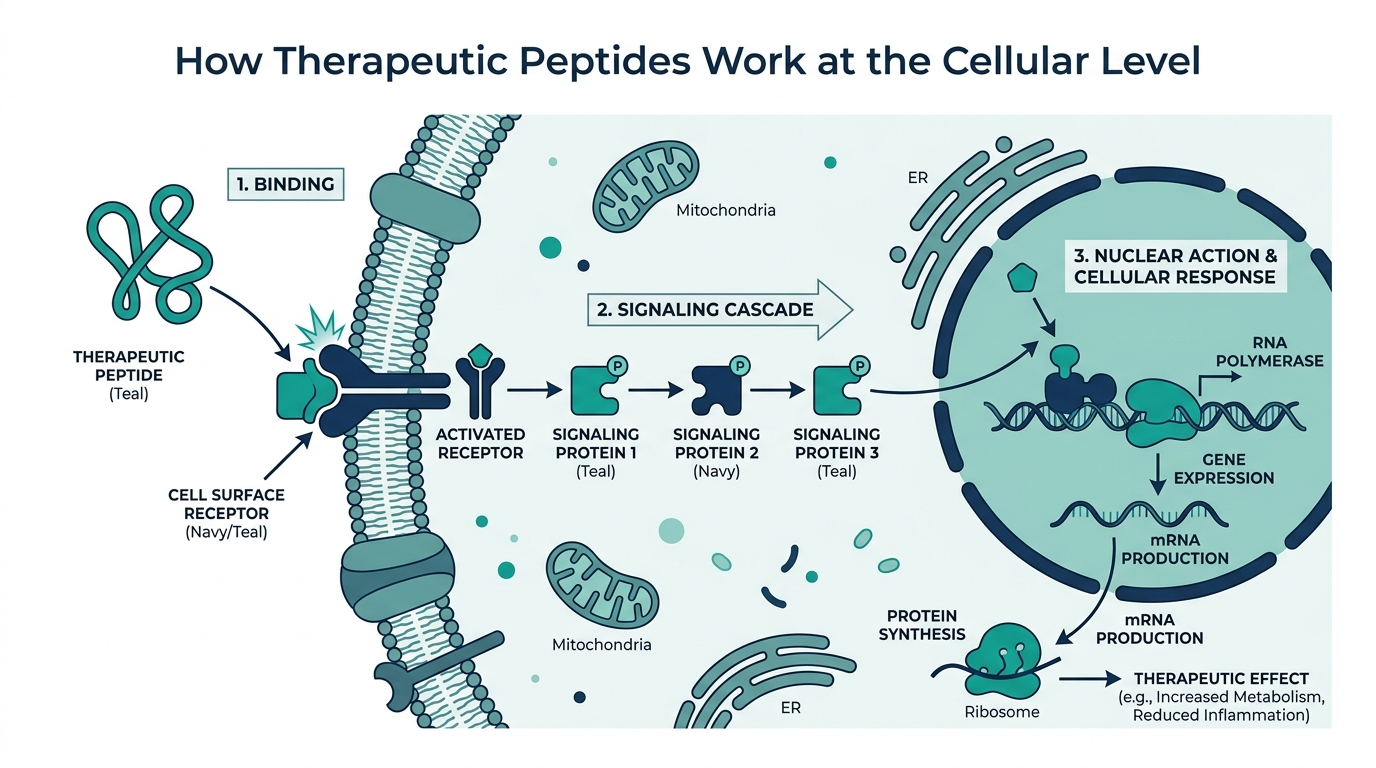
A peptide is a chain of between 2 and 100 amino acids. Proteins, by contrast, start at roughly 50 amino acids and fold into complex three-dimensional structures. That size gap is not just chemistry trivia. Because peptides are smaller and more linear, the body breaks them down faster, they enter the bloodstream more readily, and their shorter sequences make them far easier to design with precise receptor specificity.
Your body already makes thousands of peptides on its own. Insulin is a 51-amino-acid peptide. Glucagon-like peptide-1 (GLP-1), the hormone that tells your brain to stop eating after a meal, is a 30-amino-acid peptide. Growth-hormone-releasing hormone (GHRH), the signal that tells your pituitary to pulse out growth hormone during deep sleep, is a 44-amino-acid peptide. Peptide therapy, at its core, is the practice of adding more of these signaling molecules, either exact replicas or modified analogs, to influence processes the body is performing too slowly, too weakly, or no longer performing at all.
The simplest framing I have found: peptides are the body’s text messages. Each one carries a short, specific instruction to a specific receptor. Peptide therapy just sends more of the right messages.
How does peptide therapy actually work inside the body?
The simplest way to actually get this done
Superpower is a full-body lab membership that runs 100+ biomarkers, has each result reviewed by a doctor, and tracks your numbers year over year (about $199/year). It is what we point readers to when they would rather get one clean, complete draw than chase single tests one at a time. Here is superpower reviewed in full.
When a therapeutic peptide is administered, usually by subcutaneous injection but sometimes as a nasal spray, oral capsule, or topical serum, it travels to cells expressing the complementary receptor on their surface. Receptor binding triggers an intracellular signaling cascade. Depending on which receptor is activated, the downstream effects can include releasing a hormone, modulating immune cell behavior, upregulating collagen synthesis, or initiating tissue repair.
What makes peptides clinically interesting compared to broad-spectrum drugs is specificity. A well-designed peptide targets one receptor family with minimal off-target activity. Ipamorelin, a growth-hormone secretagogue used in many telehealth protocols, selectively activates the ghrelin receptor (GHS-R1a) to trigger a GH pulse without raising cortisol or prolactin the way older compounds like GHRP-6 did. That selectivity is why side-effect profiles in properly supervised peptide therapy tend toward mild injection-site reactions and transient GI symptoms rather than the systemic disruptions associated with hormone replacement using full hormones.
The catch is that specificity cuts both ways. A peptide that does one thing well does only that one thing. Stacking peptides to hit multiple pathways simultaneously is common in clinical practice, but it also multiplies the variables a clinician needs to monitor.
Full-body lab membership: 100+ biomarkers, doctor-reviewed, tracked over time.
What is the difference between FDA-approved peptides and research peptides?
This is the most important distinction in the entire conversation, and most beginner guides blur it entirely.
FDA-approved therapeutic peptides have cleared Phase 1, Phase 2, and Phase 3 clinical trials and carry a full prescriber label. You get a named manufacturer, a verified dose, a pharmacist who filled the prescription, and a clinician accountable for the protocol. As of mid-2026, the list includes:
- Semaglutide (Ozempic, Wegovy): GLP-1 agonist, 15 to 17% average weight loss in STEP trials
- Tirzepatide (Mounjaro, Zepbound): GLP-1/GIP dual agonist, 22.5% average weight loss in SURMOUNT-1
- Sermorelin: GHRH analog, FDA-approved for GH deficiency in children, prescribed off-label for adults via telehealth
- Tesamorelin (Egrifta SV): GHRH analog, FDA-approved for HIV-related lipodystrophy
- Thymosin alpha-1 (Zadaxin): approved in over 30 countries outside the US for immune modulation; a 2025 Phase 3 trial enrolled 1,106 sepsis patients across multiple centers
Compounded peptides occupy a middle zone. 503A and 503B compounding pharmacies can legally prepare peptides that are not commercially available or are on the FDA’s “bulk substances” permitted list. From November 2023 through April 2026, BPC-157 sat on the 503A Category 2 list, effectively banning it from compounding. On April 22, 2026, the FDA removed BPC-157 from Category 2. HHS Secretary Kennedy announced on February 27, 2026 that approximately 14 of the previously restricted peptides, including BPC-157, TB-500 (Thymosin Beta-4), CJC-1295, Ipamorelin, and Sermorelin, are expected to return to Category 1 (permitted for compounding), pending a Pharmacy Compounding Advisory Committee meeting scheduled for July 23 to 24, 2026. That meeting is the reason informed clinics are already preparing to add these peptides back to their menus.
Research-grade peptides are the vials sold online labeled “for research use only.” They are not approved for human use, are not dispensed by a licensed pharmacy, and carry no manufacturing accountability. This is a legal and safety distinction, not a quality guarantee, and some research batches test below 75% purity on independent analysis.
Which types of peptide therapy are actually used clinically?
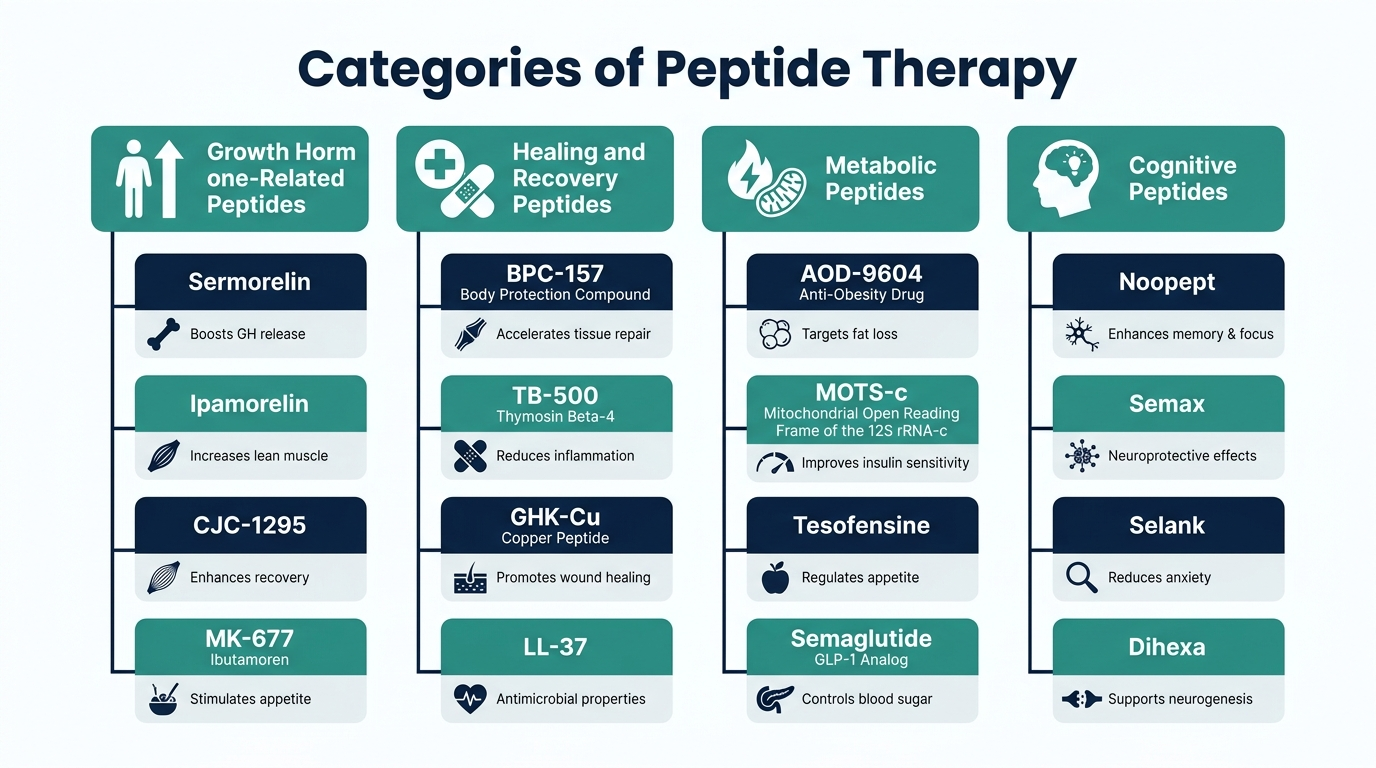
The landscape breaks into four practical categories based on mechanism and evidence base.
| Category | Example Peptides | Primary Application | Evidence Level |
|---|---|---|---|
| GLP-1 and incretin agonists | Semaglutide, tirzepatide, retatrutide | Weight loss, metabolic disease, T2D | Phase 3 RCT data, FDA-approved |
| GH secretagogues | Sermorelin, CJC-1295 + Ipamorelin, tesamorelin | GH optimization, body composition, sleep | Phase 2/3 for some; off-label for most |
| Tissue repair | BPC-157, TB-500 | Tendon/ligament healing, gut repair | Preclinical strong; human trials limited |
| Skin and cosmetic | GHK-Cu (copper peptide), collagen peptides | Skin elasticity, wound healing, hair | Topical: controlled trials; injectable: research |
| Immune and neuroprotective | Thymosin alpha-1, Selank, Semax | Immune modulation, cognitive support | Approved outside US; investigational in US |
Two things worth noting in that table. First, the GLP-1 category now includes a third drug on the horizon: Eli Lilly’s retatrutide (a triple GLP-1/GIP/glucagon agonist) posted Phase 3 TRIUMPH-1 results on May 21, 2026, with participants on the 12 mg dose losing an average of 28.3% of body weight at 80 weeks and 30.3% at 104 weeks in the higher-BMI cohort. In 65.3% of participants on the highest dose, BMI dropped below 30, leaving the obese range entirely. FDA submission is expected later in 2026. Second, the tissue-repair category (BPC-157, TB-500) has strong preclinical evidence but thin human trial data. A 2025 systematic review of 36 studies found BPC-157 improved functional, structural, and biomechanical outcomes across muscle, tendon, ligament, and bone injury models, but almost all of those studies used animal models. The human evidence is early-stage.
What conditions is peptide therapy used for?
The clearest indication is obesity and metabolic disease: GLP-1 agonists have reshaped the treatment of type 2 diabetes, obesity, and cardiovascular risk over the past five years with a trial evidence base few drug classes can match.
Beyond that, the honest answer is that different peptide categories have very different evidence profiles. Sermorelin and the CJC-1295 / Ipamorelin stack are prescribed through licensed telehealth for GH optimization: low energy, poor sleep quality, reduced lean mass, and recovery from strenuous training. A 2006 study published in the Journal of Clinical Endocrinology and Metabolism found that CJC-1295 produced approximately a 7.5-fold increase in GH pulse amplitude compared to placebo in healthy adults, and that IGF-1 levels remained elevated for up to 14 days after a single dose. The human trial base here is real but small, with most published studies enrolling fewer than 50 participants.
Telehealth providers like Defy Medical, Marek Health, and Hone Health prescribe these protocols after reviewing labs, with a physician, NP, or PA signing off on every prescription and a named compounding pharmacy filling the order.
BPC-157 and TB-500 are used in functional medicine settings for injury recovery and gut healing, though the regulatory status update described above means the legal pathway for these is actively changing.
Do not believe claims that a single peptide will simultaneously build muscle, burn fat, heal injuries, clear brain fog, and reverse aging. The specificity that makes peptides interesting also limits any one peptide to a narrow biological target. Multi-peptide protocols can address multiple goals, but each peptide addresses its own pathway, not all pathways at once.
What does the treatment process actually look like from day one?
Personally, the most useful thing I have found is to separate the first-month experience from the long-term arc, because they are genuinely different.
In a licensed telehealth program, the sequence is: intake questionnaire, lab order (a baseline panel checking IGF-1, complete metabolic panel, CBC, thyroid, and often a hormonal panel), physician review, prescription sent to a compounding pharmacy, and medication mailed to your door. From first contact to first dose, most programs take two to three weeks.
Administration depends on the peptide. GLP-1 drugs are once-weekly subcutaneous injections with an auto-inject pen that most people find easier than a traditional syringe. Sermorelin and the CJC-1295 / Ipamorelin stack are typically injected five nights per week before bed because GH pulses naturally during deep sleep, and the peptide should work with that rhythm rather than against it. BPC-157, when accessed through a licensed program, follows a protocol set by the prescribing clinician.
The first four weeks often produce minimal dramatic change. GH secretagogues typically take six to twelve weeks before body-composition shifts become visible. GLP-1 effects on appetite and weight start faster, often within the first two weeks, but the meaningful weight-loss trajectory runs over months, not days.
Common side effects across peptide categories include mild injection-site reactions (redness, minor swelling), transient headache, and GI discomfort. For GLP-1 drugs specifically, nausea affects 42.4% of participants at higher doses per TRIUMPH-1 data, though it tends to decrease after the dose-escalation phase stabilizes. Serious immunogenic reactions are rare when pharmaceutical-grade peptides are used but represent a real risk with research-grade vials that may be contaminated or misidentified.
Telehealth GLP-1 program with provider visits and pharmacy coordination.
What does peptide therapy cost in 2026?
The honest breakdown, sourced from current telehealth and compounding pharmacy data:
- FDA-approved GLP-1 drugs (brand, commercial): $900 to $1,400 per month list price; insurance copays $150 to $400; patient assistance programs $0 to $250
- Compounded semaglutide or tirzepatide (before shortage resolution deadlines): Previously as low as $99 to $199; most 503A pharmacy programs for these ended with FDA enforcement in early to mid-2025
- Sermorelin via telehealth: $175 to $225 per month, labs and provider fees typically included, versus $600 to $1,200 for synthetic recombinant HGH
- CJC-1295 / Ipamorelin stack via telehealth: $200 to $350 per month depending on the provider
- BPC-157 via compounding pharmacy (as regulations permit): $200 to $600 per month including provider fees
- Research-grade vials (grey market): $40 to $120 per vial, no labs, no monitoring, no pharmacy accountability
None of the peptide therapy categories above are covered by standard health insurance. They are classified as elective, off-label, or experimental for most indications, which means the full cost lands on you.
Budget note: clinics that price services dramatically below those ranges without explaining why usually achieve it by cutting labs, skipping clinical review, or sourcing from non-compliant pharmacies. The low-price tell is the absence of a baseline lab requirement.
What are the real risks, and when does peptide therapy not make sense?
The risk profile splits cleanly by route of access.
Through a licensed telehealth program with a verified compounding pharmacy, the most common adverse events are mild and manageable: injection-site reactions, transient GI symptoms, and headache. Chronic use without monitoring carries a subtler risk: unchecked IGF-1 elevation over time has theoretical associations with tissue-growth pathways that warrant periodic lab review, which is why legitimate programs require follow-up panels every three to six months.
Through grey-market research vendors, purity is the dominant risk. Independent testing platforms have documented vials from popular vendors testing below 75% purity, with identity failures (the vial contains the wrong peptide entirely) appearing in batch-level testing. A research vial that tests correctly at ≥99% HPLC purity with an independent mass-spec identity confirmation is a different risk class than one purchased on the basis of a forum recommendation. But verifying that requires reading a Certificate of Analysis correctly, and most buyers skip the verification step.
Peptide therapy is not appropriate as a first-line intervention for any serious disease without physician supervision. The categories where it genuinely adds value: as an adjunct to obesity management under a metabolic medicine physician, for GH optimization in symptomatic adults through a licensed program, for injury recovery where conventional physical therapy has plateaued and a licensed practitioner is coordinating care. The categories where it is being oversold: as a standalone anti-aging solution, as a substitute for sleep, training, and nutrition, and as a DIY project sourced from research-chemical vendors.
What is the regulatory picture heading into late 2026?
The single most useful thing to understand about the regulatory landscape right now is that it is moving in a specific direction, and that direction favors the licensed route.
The 2025 FDA enforcement campaign against grey-market peptide vendors narrowed the grey zone considerably. The 2026 HHS signals point toward returning the most clinically useful peptides (BPC-157, TB-500, CJC-1295, Ipamorelin) to legal compounding status through 503A pharmacies, pending the July 2026 PCAC meeting. Meanwhile, retatrutide’s TRIUMPH-1 Phase 3 results from May 2026 mean the FDA application pipeline now has a third-generation weight-loss drug producing 28 to 30% body-weight reductions that is expected to compete with semaglutide and tirzepatide as soon as approval clears.
The practical implication: the gap between “stuff you can get through a licensed clinic” and “stuff people want for optimization” is narrowing faster in 2026 than at any point in the past decade. The grey-market argument that the legal route lacks access is becoming harder to make as the compounding pharmacy door reopens.
Turn what you just learned into action.
Superpower lets you test 100+ biomarkers from home, then re-check them over time so you can actually see progress, physician-reviewed at every step.
Frequently asked questions
Is peptide therapy safe?
When prescribed by a licensed clinician, dispensed by a verified 503A or 503B compounding pharmacy, and monitored with follow-up labs, FDA-approved and compounded peptides have a well-characterized safety profile. Mild injection-site reactions and transient GI discomfort are the most common adverse events. Research-grade vials sourced without pharmacy oversight carry significantly higher risk due to purity and identity failures documented in independent testing.
How long does peptide therapy take to work?
It depends entirely on the peptide and the goal. GLP-1 drugs show appetite effects within one to two weeks and measurable weight loss over months. Growth-hormone secretagogues like CJC-1295 and Ipamorelin typically require six to twelve weeks before body-composition changes are apparent, because the mechanism is indirect (stimulating the pituitary, not injecting GH directly). BPC-157 for tissue repair varies by the injury type and severity.
Can you get peptide therapy without a prescription?
Collagen peptides and topical copper-peptide serums are sold over the counter as dietary supplements and cosmetics. Injectable therapy and growth-hormone-related peptides require a prescription from a licensed clinician. Any site selling injectable peptide therapy without a prescription or clinical review is not operating within US regulatory guidelines.
What peptides are FDA-approved?
As of mid-2026, FDA-approved peptides include insulin (51 amino acids), semaglutide (Ozempic, Wegovy), tirzepatide (Mounjaro, Zepbound), sermorelin (approved for GH deficiency in children), tesamorelin (Egrifta SV, approved for HIV-related lipodystrophy), and several peptide-based cancer therapies. Retatrutide is in Phase 3 and expected to file for approval later in 2026.
What is the difference between peptide therapy and HGH?
Human growth hormone (HGH) replacement injects the full hormone exogenously, suppressing the body’s own GH production over time and requiring precise dosing to avoid excess. GH secretagogues like sermorelin and the CJC-1295 / Ipamorelin stack signal the pituitary to release its own GH, preserving the natural pulse pattern and feedback loop. Sermorelin costs $175 to $225 per month versus $600 to $1,200 or more for synthetic HGH, and the physiological mechanism is considered more aligned with normal endocrine function.
Does insurance cover peptide therapy?
Generally, no. GLP-1 drugs like semaglutide and tirzepatide may be covered when prescribed for type 2 diabetes, but coverage for obesity management alone varies widely by plan and is not guaranteed. Compounded peptides for GH optimization, tissue repair, and longevity applications are classified as elective or experimental and are not covered.
What is the best peptide for weight loss?
Among approved options, tirzepatide (Mounjaro, Zepbound) currently leads on clinical trial data: 22.5% mean body-weight loss in SURMOUNT-1. Retatrutide’s TRIUMPH-1 Phase 3 data from May 2026 showed 28.3% at 80 weeks on the 12 mg dose, and is expected to be the most potent approved weight-loss peptide drug once it clears FDA review.
Telehealth GLP-1 program with provider visits and pharmacy coordination.
Author: Vital Signs Today Editorial Team, [credential]”]. Educational content, not medical advice. Sources linked inline.
Primary sources:
– Eli Lilly TRIUMPH-1 Phase 3 press release (May 21, 2026): https://www.prnewswire.com/news-releases/lillys-triple-agonist-retatrutide-delivered-powerful-weight-loss-in-pivotal-phase-3-obesity-trial-302778859.html
– FDA bulk drug substances under 503A (compounding permitted/category lists): https://www.fda.gov/drugs/human-drug-compounding/bulk-drug-substances-used-compounding-under-section-503a-fdc-act
– HHS Secretary Kennedy announcement on peptide reclassification (February 27, 2026): https://www.hhs.gov/
– UPMC HealthBeat: What Is Peptide Therapy? (January 2026): https://share.upmc.com/2026/01/peptide-therapy/
– Peptide Dossier: What Is Peptide Therapy? (2026): https://peptidedossier.com/guides/what-is-peptide-therapy/
– IvyRx Sermorelin cost guide 2026: https://www.ivyrx.com/blog/sermorelin-cost
– PeakedLabs BPC-157 cost guide 2026: https://peakedlabs.com/blog/bpc-157-cost-guide-2026
– Sermorelin.com affordable peptide therapy guide: https://sermorelin.com/article/affordable-peptide-and-hormone-therapy
– AMA: What doctors want patients to know about injectable peptides: https://www.ama-assn.org/public-health/prevention-wellness/what-doctors-want-patients-know-about-injectable-peptides
– Journal of Clinical Endocrinology and Metabolism, CJC-1295 in healthy adults (2006): referenced via PerfectB clinical summary https://www.perfectb.com/what-is-cjc-1295-ipamorelin/
Want a real clinician to run the numbers, not a guess?
Joi + Blokes is a telehealth clinic that prescribes GLP-1 medication (Zepbound, compounded semaglutide and tirzepatide), hormone therapy (TRT, HRT), thyroid care, and peptides after a real lab panel and clinician review, with no membership or consult fee (prescriptions from about $59/month, lab panels from $149). If the scale will not budge, this is where you find out whether insulin, thyroid, or hormones are the real reason. Here is Joi + Blokes reviewed in full.
Related reading
Vital Signs Today may earn a commission if you buy through links on this page. It does not affect our editorial assessments.