
Last updated 18 June 2026. Educational content, not medical advice. Ipamorelin is not FDA-approved for any human use. Talk to a licensed clinician before considering any peptide therapy.
Short answer: Ipamorelin is a synthetic five-amino-acid peptide (a pentapeptide) that binds the ghrelin receptor in the pituitary gland, triggering a pulse of growth hormone release without raising cortisol, prolactin, or ACTH. That hormonal selectivity, confirmed in the original Raun et al. 1998 study at Novo Nordisk, is the single feature that separates ipamorelin from every older growth hormone releasing peptide before it, and the reason it became the most widely discussed secretagogue in longevity clinics.
Looking into a growth-hormone peptide like Ipamorelin? See where your own GH and IGF-related markers actually stand. One at-home Superpower draw checks 100+ biomarkers, physician-reviewed.
Why does ipamorelin keep coming up in the same breath as GH therapy?
Growth hormone declines with age. By the time most people are in their 40s, peak GH pulse amplitude at night has dropped significantly compared to their 20s, and IGF-1, the downstream signal GH triggers in the liver, follows the same slope. That matters because GH and IGF-1 together regulate lean mass, fat metabolism, bone turnover, sleep quality, and connective tissue repair. The pharmaceutical solution, injectable synthetic HGH, costs $600 to $1,200 a month and suppresses your body’s own production loop. Ipamorelin is a different approach: rather than replacing GH, it nudges the pituitary to release more of its own, through a mechanism that preserves the natural pulsatility and feedback brakes.
That is an elegant idea on paper. Whether the clinical reality lives up to the forum enthusiasm is a more complicated question, and the 2026 regulatory picture makes it even more complicated. More on both below.
Full-body lab membership: 100+ biomarkers, doctor-reviewed, tracked over time.
What exactly is ipamorelin, and where did it come from?
Ipamorelin is a pentapeptide: five amino acids in a specific sequence (Aib-His-D-2-Nal-D-Phe-Lys-NH2), with a molecular weight of 711.85 daltons. It was developed by Novo Nordisk and first described by Raun and colleagues in 1998, in a landmark paper published in the European Journal of Endocrinology that now carries over 400 citations. The authors called it “the first selective growth hormone secretagogue,” which remains its defining claim two and a half decades later.
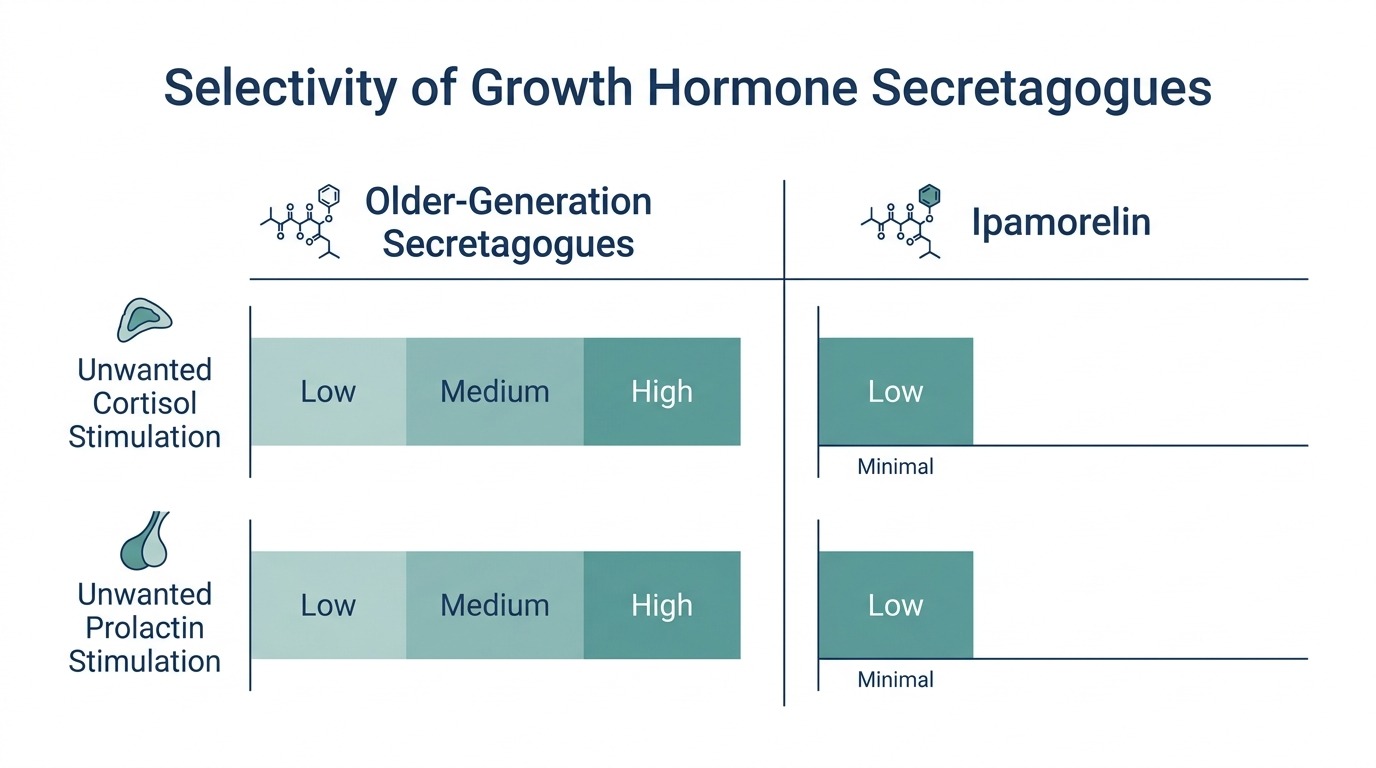
The compound belongs to a family of molecules called growth hormone secretagogues (GHS), all of which mimic ghrelin, the gut peptide that among other things signals the pituitary to release GH. What makes ipamorelin different from its predecessors, GHRP-2 and GHRP-6, is what it does not do. At doses up to 200-fold above its GH-releasing effective dose, ipamorelin did not raise ACTH or cortisol to levels significantly different from a GHRH stimulation baseline. GHRP-2 and GHRP-6 both spike cortisol. That difference matters clinically, because elevated cortisol drives fat storage, muscle breakdown, immune suppression, and sleep disruption. All things a GH optimization protocol is specifically trying to reverse.
The pentapeptide structure itself deserves a note: “Aib” stands for alpha-aminoisobutyric acid, a non-standard amino acid that resists enzymatic breakdown. That is part of why ipamorelin survives long enough in plasma to work, with a half-life in humans of approximately two hours following subcutaneous injection, and peak GH concentrations appearing 30 to 40 minutes post-dose.
How does ipamorelin actually trigger growth hormone release?
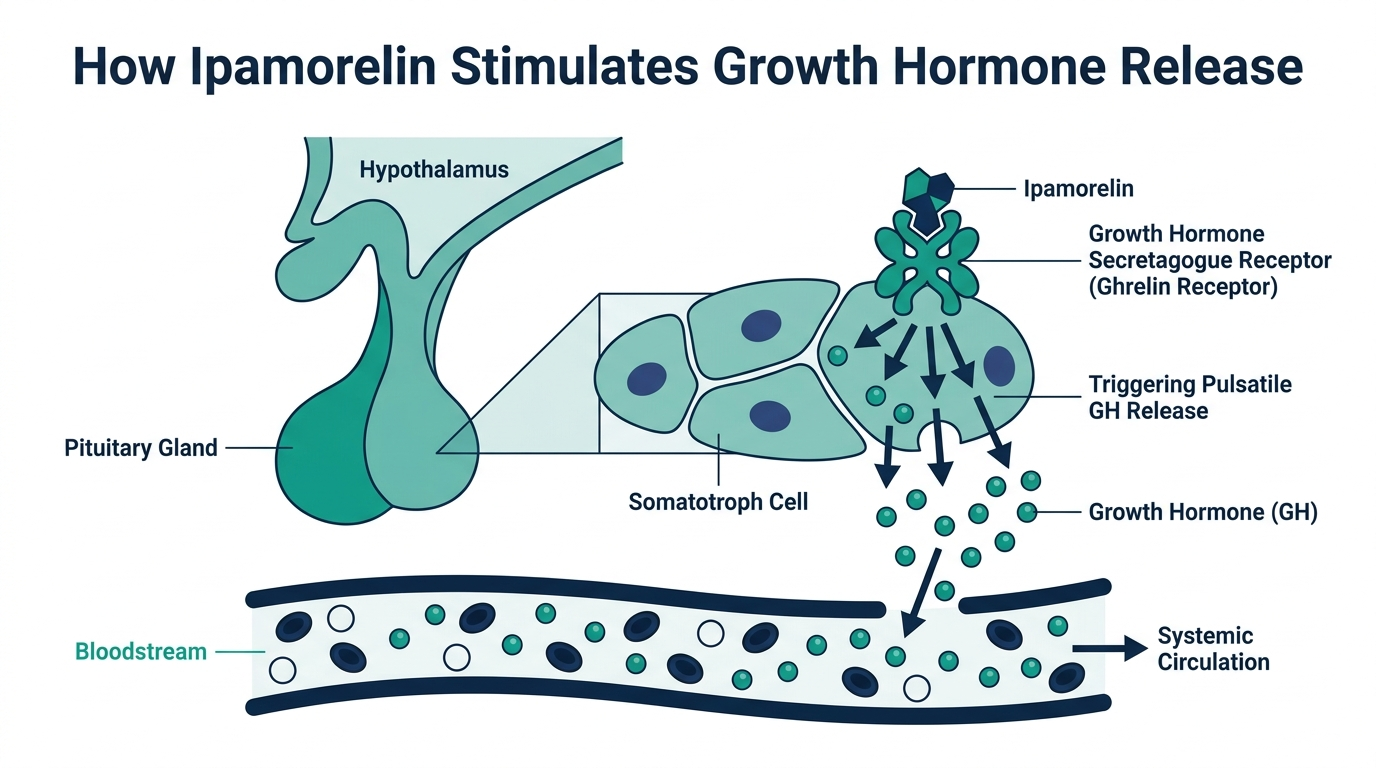
The mechanism runs through two receptor pathways that converge on somatotrope cells (GH-secreting cells) in the anterior pituitary.
Ipamorelin binds the ghrelin receptor, formally called GHS-R1a. That binding activates a G-protein-coupled signaling cascade that increases intracellular calcium and triggers GH vesicle release. Separately, ipamorelin partially reduces somatostatin tone, the inhibitory brake the hypothalamus normally applies to GH release. The net effect is a pulse of GH that mirrors the body’s natural nocturnal pattern, rather than the flat, pharmacological flood that exogenous HGH creates.
This is why ipamorelin is almost always discussed alongside CJC-1295 without DAC, a GHRH analog that works on the separate GHRH receptor. The two molecules hit different receptor populations, and their effects are additive rather than redundant. In community protocols, this combination has become the default GH-optimization stack precisely because it produces a more pronounced GH pulse than either agent alone while preserving the feedback architecture that keeps GH from running unchecked.
Personally, I think the feedback preservation point is undersold. Exogenous HGH shuts down your own production axis after prolonged use. A secretagogue that works with the pituitary’s own circuitry, rather than bypassing it, is a fundamentally different risk profile. That said, the clinical evidence confirming that distinction over multi-year timeframes in humans is still thin.
What does ipamorelin actually do in the body?
GH release is the upstream trigger. The downstream effects are what people actually care about, and they run through three main channels:
IGF-1 production. The liver responds to circulating GH by producing insulin-like growth factor 1 (IGF-1), which is the primary mediator of GH’s anabolic and metabolic effects. IGF-1 stimulates protein synthesis in muscle, promotes lipolysis in fat tissue, and supports bone mineral density. In clinical studies of GH secretagogues as a class, IGF-1 elevations from baseline appear within the first two weeks of treatment.
Sleep architecture. Growth hormone is predominantly released during slow-wave (deep) sleep, and there is a bidirectional relationship: GH release is triggered by sleep, and GH in turn modulates the depth and duration of slow-wave sleep. Patients using secretagogues frequently report improved sleep quality, including faster onset of deep sleep. This is not placebo noise. GH-deficient adults on GH replacement show measurable increases in slow-wave sleep in controlled studies.
Lean tissue and fat metabolism. GH is lipolytic, meaning it accelerates fatty acid release from adipose tissue. It also supports muscle protein synthesis. The net effect over a sustained protocol is typically a modest improvement in body composition, less body fat, more lean mass. In studies using sermorelin (a GHRH analog with a similar downstream mechanism), 16-week treatment produced approximately 1.26 kg of lean mass gains in men. Ipamorelin-specific human body composition data is more limited, but the GH-mediated mechanism is the same.
Bone and connective tissue. Preclinical studies in female Sprague-Dawley rats showed significant increases in bone mineral content after 12 weeks of ipamorelin administration, and studies in hypophysectomized (pituitary-removed) rats demonstrated increased longitudinal bone growth. These are animal data, not human trials, but they are consistent with the well-established role of GH in bone metabolism.
How does ipamorelin compare to other growth hormone peptides?
The peptide landscape is crowded, and “growth hormone peptide” is a phrase that covers several mechanistically distinct categories. Here is where ipamorelin sits relative to the most commonly discussed alternatives:
| Peptide | Receptor Target | Cortisol Effect | Half-Life | Clinical Data Level | Legal Status (US, June 2026) |
|---|---|---|---|---|---|
| Ipamorelin | GHS-R1a (ghrelin) | Negligible | ~2 hours | Limited human data | FDA Category 2 (restricted) |
| Sermorelin | GHRH receptor | None | ~10-20 min | Stronger; FDA-approved past | Prescription (compounding) |
| GHRP-2 | GHS-R1a + others | Moderate spike | ~30 min | Animal + limited human | Research-use-only grey zone |
| GHRP-6 | GHS-R1a + others | Moderate spike + hunger | ~30 min | Animal + limited human | Research-use-only grey zone |
| CJC-1295 (no DAC) | GHRH receptor | None | ~30 min | Limited human | FDA Category 2 (restricted) |
| MK-677 (ibutamoren) | GHS-R1a | Mild | 5-6 hours (oral) | Phase 2 human trials | Not approved; oral research compound |
The comparison that matters most in clinical practice is ipamorelin versus sermorelin. Sermorelin acts on the GHRH receptor, which is subject to somatostatin suppression when already-elevated GH is circulating. Ipamorelin acts on GHS-R1a, which operates more independently of somatostatin tone. In theory, that makes GHS-R1a agonism more reliable across a broader range of baseline GH levels. In practice, sermorelin has a longer track record with US compounding pharmacies and is currently available through licensed telehealth providers, while ipamorelin sits in regulatory limbo.
Do not believe the claim that ipamorelin is “basically FDA-approved” because it was once tested in clinical trials. It was. A 2014 phase 2 randomized controlled trial tested IV ipamorelin for postoperative ileus in 117 patients after colonic resection, published in the International Journal of Colorectal Disease. Median time to first tolerated meal was 25.3 hours with ipamorelin versus 32.6 hours with placebo, and the p-value was 0.15. Not significant. The trial failed, the indication was abandoned, and ipamorelin never progressed to an FDA approval application. The fact that it reached human trials is meaningful for safety data, but it is not a path to the finish line.
What is the real regulatory status of ipamorelin in 2026?
This is where precision matters, because the situation moved in early 2026 and a lot of what circulates online is either outdated or wishful.
In September 2023, the FDA placed ipamorelin on its 503A Category 2 restricted list, effectively ending licensed compounding pharmacies’ ability to prepare it for human use. That was the ban. In February 2026, HHS Secretary RFK Jr. announced that roughly 14 restricted peptides, including ipamorelin and CJC-1295, were expected to return to Category 1 (permitted for compounding). That announcement set off a wave of “ipamorelin is back” coverage across peptide forums and clinic blogs.
Here is what that announcement did not mean: it did not restore compounding access. The legal pathway requires the FDA’s Pharmacy Compounding Advisory Committee (PCAC) to review the substances and make a recommendation, followed by formal FDA rulemaking. The July 23-24, 2026 PCAC meeting is scheduled, but the first-batch agenda covers seven other peptides: BPC-157, KPV, MOTs-C, Emideltide, Epitalon, Semax, and TB-500. Ipamorelin’s review is in a second batch expected in early 2027.
As of June 2026, ipamorelin remains in FDA Category 2. A licensed compounding pharmacy cannot legally prepare it for a patient. The HHS announcement is a signal of direction, not a change in status. Any telehealth platform currently advertising injectable ipamorelin prescriptions should be asked exactly which 503A-compliant pharmacy is fulfilling those orders, and what their answer is.
The FDA’s own bulk substances list is the ground truth here, not any clinic’s FAQ page or forum thread.
What are the known risks and side effects?
The favorable tolerability profile is real, but it is not absence of risk.
The documented side effects in available studies and clinical observation include injection site reactions (localized redness, a small itchy raised area), mild transient headache, and occasional flushing, particularly in the first weeks of use. These are consistent with the GH-release response, specifically a brief elevation in GH and the vasodilation that can accompany it.
Water retention is possible but notably less common with ipamorelin than with synthetic HGH or with older GHRPs. Some patients report mild puffiness in the hands and ankles, most visible in the first month. Unlike GHRP-6, which stimulates appetite strongly enough that it is sometimes used intentionally for that purpose, ipamorelin has minimal appetite effect. Mild hunger at higher doses has been reported in some users, but it is not a reliable or prominent effect.
The concerns that matter more over longer timeframes are less about what ipamorelin acutely does and more about what chronic GH elevation could do. GH promotes cell growth broadly, not selectively. Oncologists have long been cautious about GH and IGF-1 axis stimulation in patients with personal or family history of cancer, specifically hormone-sensitive cancers. There are no clinical trial data connecting ipamorelin specifically to increased cancer risk, but the mechanistic concern is legitimate, and no long-term safety study has cleared it.
Anyone with a history of pituitary adenoma, active cancer, or poorly controlled diabetes should treat any GH-pathway intervention with extreme caution. That list applies to clinician-supervised protocols, not just research vials.
Who actually uses ipamorelin, and what for?
The three populations are meaningfully different in what they are trying to accomplish.
Longevity-oriented adults over 40 use ipamorelin primarily for sleep improvement, body composition, and what they describe as “general recovery quality,” the feeling that muscle soreness resolves faster and energy is more stable. This population overlaps heavily with the biohacker community and is the segment most likely to have purchased from grey-market research vendors before 2023.
Athletes and strength-focused users stack it with CJC-1295 to amplify GH pulsatility during recovery windows, particularly overnight. The logic is that enhanced GH output during sleep accelerates tissue repair after training stress. The sports performance angle has attracted scrutiny from anti-doping bodies. The World Anti-Doping Agency (WADA) prohibits growth hormone releasing peptides in competition, and ipamorelin is listed by name.
Patients in supervised hormone optimization programs, the smallest but most defensible group, have accessed ipamorelin through telehealth clinics prior to the 2023 Category 2 designation. For this group, the regulatory change is the most disruptive: they were on a prescription protocol that became unavailable overnight.
The myth worth debunking: “ipamorelin is just like HGH but cheaper”
This framing circulates constantly and gets multiple things wrong. Exogenous HGH bypasses the pituitary entirely, flooding the bloodstream with a flat pharmacological dose and, with prolonged use, downregulating the body’s own GH production feedback. Ipamorelin stimulates a GH pulse from the pituitary itself, which respects the natural feedback loop: when somatostatin rises in response to GH, the pulse ends. The hypothalamus keeps its regulatory role.
The magnitude is also different. Exogenous HGH can sustain GH levels many times above physiological range for hours. An ipamorelin-triggered GH pulse is larger than baseline but still within a physiological window. For some applications that is a meaningful advantage (lower risk of acromegalic side effects). For others it is a limitation, because the smaller amplitude may not be sufficient for the therapeutic effects seen with supraphysiological HGH doses in GH-deficient patients.
Telehealth GLP-1 program with provider visits and pharmacy coordination.
What does the legitimate access path actually look like right now?
For ipamorelin specifically, there is no compliant prescription path in the US as of June 2026. For the broader category of GH secretagogue therapy, legitimate options exist. Sermorelin, which works through a distinct but complementary mechanism (GHRH receptor rather than ghrelin receptor), is available through licensed telehealth platforms such as Defy Medical, Marek Health, and Hone Health, typically at $175 to $225 per month with labs and clinician oversight included. That cost is roughly the same as the CJC-1295/ipamorelin stack was when it could be obtained through compliant compounding pharmacies before 2023.
The full access path through a legitimate provider looks like this: initial clinical intake and baseline labs (usually $150 to $300 for the panel), clinician review and prescription, dispensing from a named 503A compounding pharmacy, and structured follow-up every 90 days with repeat IGF-1 and metabolic markers. Total first-month cost, including labs, typically lands between $350 and $550. Ongoing maintenance is $175 to $400 monthly depending on the protocol and clinic.
A five-minute conversation with a grey-market vendor page will make that look expensive. The comparison being hidden is between a prescription from a licensed clinician with a verifiable compounding pharmacy and a vial of reconstituted powder with no accountability chain, no baseline, and no one to call if something goes wrong.
The PCAC process for ipamorelin is moving. Assuming the second-batch review proceeds in early 2027 and the political direction from HHS holds, ipamorelin could be re-authorized for compounding by mid to late 2027. When that happens, the price for a compliant ipamorelin prescription will likely land in roughly the same range as sermorelin today. The grey-market arbitrage window that existed before 2023 is not coming back.
Curious what your own levels look like?
Baseline 100+ biomarkers today and retest as life changes, all in one membership with physician review.
Frequently asked questions
What is ipamorelin used for?
Ipamorelin is used in research settings and, historically in supervised clinical contexts, to stimulate pulsatile growth hormone release from the pituitary. The primary areas of interest are body composition improvement (lean mass, fat loss), sleep quality, recovery from training, and bone health. It has never been FDA-approved for any specific medical indication.
Is ipamorelin the same as HGH?
No. Human growth hormone (HGH) is the hormone itself, injected exogenously to bypass the pituitary. Ipamorelin is a secretagogue: it triggers the pituitary to release its own GH. The two approaches have meaningfully different pharmacological profiles and risk structures, with ipamorelin preserving natural feedback mechanisms that exogenous HGH overrides.
Is ipamorelin legal in the US in 2026?
As of June 2026, ipamorelin remains on the FDA’s 503A Category 2 restricted list, which means compounding pharmacies cannot legally prepare it for patient use. It is not FDA-approved. HHS announced in February 2026 that it expects ipamorelin and several other peptides to return to permitted-for-compounding status, but that process requires a PCAC review and formal rulemaking. Ipamorelin’s review batch is scheduled for early 2027, not the July 23-24, 2026 PCAC meeting. Possession for personal use has not been subject to federal prosecution, but that is distinct from the peptide being legal to prescribe or dispense.
How does ipamorelin differ from sermorelin?
Sermorelin is a GHRH analog that binds the GHRH receptor in the pituitary, mimicking the hypothalamic signal that normally triggers GH release. Ipamorelin binds the ghrelin receptor (GHS-R1a) instead. The two mechanisms are complementary, which is why they are sometimes combined. A practical difference in 2026: sermorelin is available through licensed US telehealth providers with a prescription; ipamorelin is not.
What is the CJC-1295/ipamorelin stack?
It is the most widely discussed GH secretagogue combination in the longevity and optimization community. CJC-1295 without DAC is a GHRH analog, and ipamorelin is a ghrelin receptor agonist. Because they work on different receptor systems, their GH-stimulating effects are additive. Both are currently in the FDA Category 2 restricted category, so the stack is not available through compliant US compounding pharmacies as of mid-2026.
Can ipamorelin cause cancer?
There are no clinical trial data linking ipamorelin specifically to increased cancer risk. However, the mechanism, stimulating the GH and IGF-1 axis, is subject to legitimate long-term caution because GH promotes cell proliferation broadly. Anyone with personal or family history of cancer, particularly hormone-sensitive types, should discuss GH-axis interventions with an oncologist before proceeding.
What does ipamorelin actually feel like?
Clinician reports from patients who used ipamorelin before the 2023 compounding ban describe improved sleep depth, mild flushing or warmth at the injection site for the first few weeks, and gradual body composition changes over 8 to 12 weeks of consistent use. Unlike GHRP-6, hunger is not a prominent effect. Cortisol-related side effects, elevated anxiety, sleep disruption, and fat deposition, documented with older GHRPs, are not consistently reported.
Telehealth GLP-1 program with provider visits and pharmacy coordination.
Author: [CAN XAC NHAN: ten + credential]. Educational content, not medical advice. Sources linked inline.
Primary sources:
– Raun et al. 1998, European Journal of Endocrinology: Ipamorelin, the first selective growth hormone secretagogue
– PMC: Beyond the androgen receptor, GHS in body composition management
– International Journal of Colorectal Disease 2014: Ipamorelin RCT for postoperative ileus
– FDA advisory committee calendar: July 23-24, 2026 PCAC meeting
– FDA bulk drug substances under Section 503A
– PeptideWise: FDA peptide reclassification 2026, 503A list
– Superpower Health: CJC-1295 and ipamorelin stack guide
– IvyRx: Sermorelin cost and monthly pricing 2026
Related reading
Vital Signs Today may earn a commission if you buy through links on this page. It does not affect our editorial assessments.