
Last updated 18 June 2026. Educational content, not medical advice. Epitalon is not approved by the FDA for human use and is sold in the US as a research compound only. Speak with a licensed clinician before considering any peptide therapy.
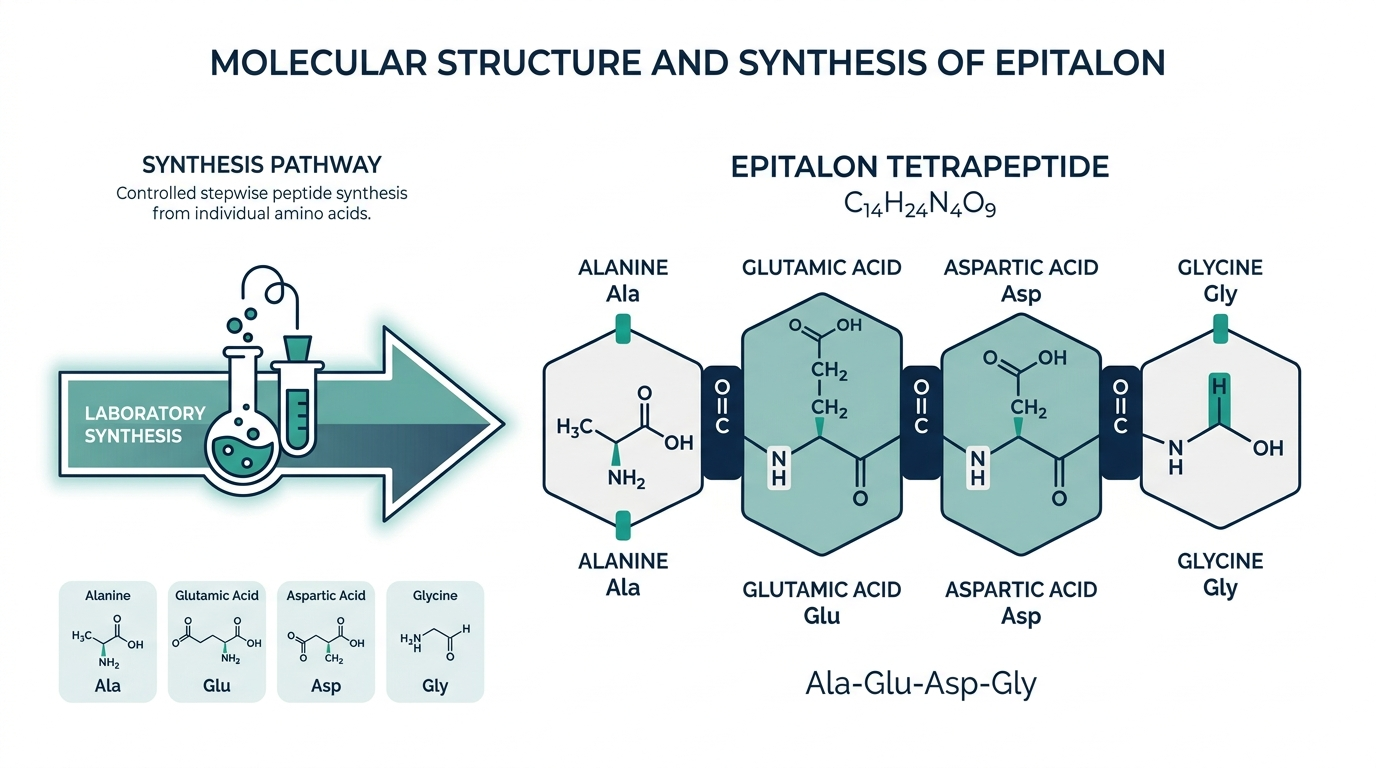
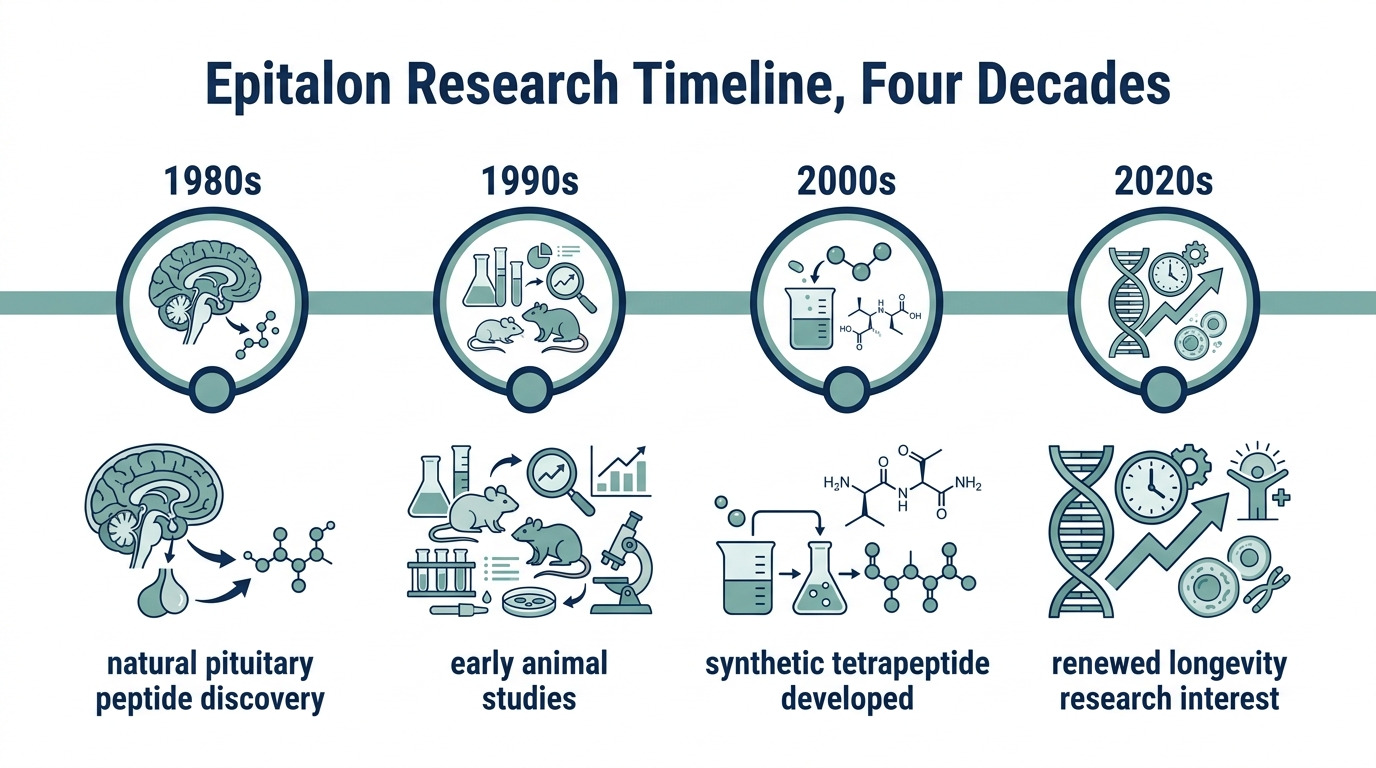
Short answer: Epitalon is a synthetic tetrapeptide (four amino acids: Ala-Glu-Asp-Gly) first developed by Russian gerontologist Vladimir Khavinson at the St. Petersburg Institute of Bioregulation and Gerontology in the 1980s, based on a natural pineal-gland extract called epithalamin. Its primary proposed mechanism is activation of telomerase, the enzyme responsible for maintaining the protective caps on chromosomes. A 2003 cell-culture study found epitalon extended human fetal fibroblasts beyond 44 population doublings compared to 31 in untreated controls, a 42% increase in replicative capacity. Rodent lifespan studies report median life extension of 12 to 24%. The FDA is scheduled to review epitalon for legal compounding status on July 24, 2026.
Forty years of telomere research on Epitalon, but what does your own aging biology actually look like today? One at-home Superpower draw checks 100+ biomarkers, physician-reviewed.
Why are people suddenly talking about a Soviet-era peptide in 2026?
Epitalon did not appear on Western longevity radar overnight. Its research base is 40 years old, most of it published in Russian-language journals by Khavinson’s team. The compound gained traction in English-language biohacking forums around 2018 to 2020 as longevity enthusiasts began translating and citing those Soviet studies. What changed in 2026 is regulatory: the FDA removed epitalon from its Category 2 bulk drug substances list, which previously flagged it as posing “significant safety concerns,” and the Pharmacy Compounding Advisory Committee (PCAC) is scheduled to vote on whether to allow licensed US pharmacies to compound it.
The specific indication under review is insomnia, which tells you something about how epitalon actually works. This is not primarily a performance peptide or a body-composition compound. Its most consistent effects across both animal and human studies point to the pineal gland, melatonin rhythm restoration, and, more speculatively, slowing of cellular aging through telomere maintenance.
Full-body lab membership: 100+ biomarkers, doctor-reviewed, tracked over time.
What exactly is epitalon, at the molecular level?
Epitalon is a tetrapeptide, meaning it is built from exactly four amino acids joined in sequence: alanine, glutamic acid, aspartic acid, and glycine. Written in standard notation it is Ala-Glu-Asp-Gly. That chain is short enough to cross epithelial barriers reasonably well, which partly explains why intranasal and sublingual delivery routes have been studied alongside subcutaneous injection.
The compound is a synthetic analog of epithalamin, a polypeptide complex originally isolated from bovine pineal glands by Khavinson’s team in the early 1980s. Epithalamin itself is a mixture of several peptides; the goal in synthesizing epitalon was to identify the minimal active sequence, something pharmaceutical researchers routinely do to create a stable, reproducible, purer compound from a messy natural extract.
One piece of context most overviews skip: Khavinson’s work originated inside Soviet military medicine, specifically in programs looking at how to restore tissue function under extreme physiological stress. Gerontology came later, as the group noticed that the peptides showing resilience effects in stressed tissue also correlated with slower aging metrics in long-running animal cohorts. The longevity angle was a consequential detour, not the original mission.
The four-letter sequence has been confirmed in multiple peer-reviewed analyses, and the compound is chemically well-characterized. What remains genuinely uncertain is not the molecule’s identity but the magnitude and durability of its effects in living humans.
How does epitalon work? The two main pathways
Researchers propose two main mechanisms, both supported by laboratory data but with different levels of human evidence:
Pathway 1: Telomerase activation. Telomeres are the repetitive DNA sequences that cap the ends of chromosomes, functioning like the plastic tips on shoelaces. Every time a cell divides, telomeres shorten slightly. When they become critically short, the cell stops dividing or undergoes programmed death. Telomerase is the enzyme that rebuilds telomere length, and it is normally silenced in most adult somatic cells.
Epitalon appears to induce expression of hTERT, the catalytic subunit of telomerase, in cultured human cells. The landmark 2003 Khavinson study showed that fibroblast cultures treated with epitalon divided beyond 44 passages versus 31 in controls, an approximately 42% extension of replicative lifespan. In stimulated lymphocyte studies, telomere length increased by an average of 33.3% with individual variation across participants aged 25 to 88.
Pathway 2: Pineal gland restoration and melatonin normalization. The pineal gland’s output of melatonin declines with age, and that decline cascades through circadian function, sleep architecture, immune regulation, and antioxidant defense. Epitalon is proposed to stimulate the pineal gland directly, restoring the amplitude of the nightly melatonin pulse rather than adding exogenous melatonin from outside.
A human study in 75 women given 0.5 mg/day sublingual epitalon for 20 days found a 1.6-fold increase in melatonin metabolites relative to placebo. Clock gene expression changed measurably: Clock expression decreased 1.8-fold, Cry2 doubled, and Csnk1e decreased 2.1-fold. These are not trivial numbers in circadian biology; they represent a genuine molecular shift in the machinery that keeps cells synchronized with the 24-hour cycle.
Personally, the sleep signal is the most believable part of the epitalon story to me, because it is the most direct pathway with the most mechanistically coherent human evidence. The telomere angle is extraordinary if it holds in vivo; the melatonin angle is ordinary-extraordinary, meaning it is surprising that a peptide this short could do it, but the biology is at least well-understood.
What does the animal research actually show?
The animal evidence is real, substantial, and worth reading carefully, because it is both the strongest case for epitalon and the most honest illustration of its limitations.
In a 2006 Anisimov-Khavinson study, female rats receiving epitalon showed 25% median lifespan extension versus controls; male rats showed 18%. Those numbers are not trivial in a rodent longevity study. A 2025 review in Frontiers in Aging summarized the broader rodent literature as reporting 12 to 24% lifespan extension across studies.
The cancer findings are counterintuitive and worth highlighting as a myth-buster. The standard concern about any telomerase activator is that it might fuel cancer, since cancer cells famously hijack telomerase to become immortal. But in epitalon’s animal studies, the opposite pattern emerged: in a HER-2/neu transgenic mouse model prone to breast adenocarcinoma, epitalon reduced overall tumor incidence, and tumors that did develop appeared later and were smaller. In a colon cancer rat model using 1,2-dimethylhydrazine, epitalon consistently reduced overall tumor burden. This does not eliminate the theoretical concern, but it inverts the naive assumption.
Worth noting: all of the lifespan and tumor outcome studies were conducted by Khavinson’s own institute or close collaborators. That is not a disqualifier, but it is a reason to weight the evidence at “promising, not proven” rather than “established.”
What does the human evidence actually show?
Here is where the intellectual honesty matters most. The human evidence base for epitalon is genuinely thin by Western clinical standards, and anyone selling you certainty here is overselling.
The strongest human data comes from the clock-gene and melatonin studies described above. Those are small but mechanistically coherent. A published case report from 2023 documented one 44-year-old who self-administered 5 mg/day subcutaneously for 10 days across three cycles and reported improvements in telomere length biomarkers, biological age markers, and cognitive function. That is one person. Russian open-label cohort studies reported favorable changes in sleep quality, mood, and senescence biomarkers in elderly participants, but these lacked randomized placebo controls.
No Western double-blind randomized controlled trials (RCTs) on epitalon have been published as of mid-2026. The evidence gap is not unique to epitalon: many compounds used in longevity protocols sit in the same position of strong mechanistic and animal data with limited large-scale human validation. The distinction matters for anyone comparing it to FDA-approved peptides or deciding between the research-chemical route and waiting for the licensed compounding pathway to open.
The Alzheimer’s Drug Discovery Foundation’s cognitive vitality review on epithalamin and epitalon concludes the evidence is insufficient to recommend it for cognitive protection, while acknowledging the mechanistic plausibility. That is a precise and useful calibration: “plausible but unproven” is a different category from “disproven.”
How does epitalon compare to other longevity peptides?
The longevity peptide landscape in 2026 is not a competition between alternatives; most serious protocols layer compounds that hit different aging pathways. Understanding where epitalon sits requires knowing which pathways the others target.
| Peptide / Compound | Primary mechanism | Evidence level | Regulatory status (US, 2026) |
|---|---|---|---|
| Epitalon | Telomerase activation, pineal melatonin | Animal + limited human | Research chemical; PCAC vote July 2026 |
| GHK-Cu | Tissue repair, gene expression (collagen, antioxidant) | Cell + animal + cosmetic human data | Cosmetic (topical); research (injectable) |
| Sermorelin | Growth hormone release (GHRH analog) | Multiple human RCTs | Prescription via telehealth |
| BPC-157 | Soft-tissue repair, gut integrity | Animal + self-report human | Grey zone; PCAC vote July 2026 |
| NAD+ precursors (NMN, NR) | Mitochondrial energy metabolism, sirtuin activation | Human RCTs emerging | OTC supplement |
| Rapamycin | mTOR inhibition, autophagy | Human data (transplant; longevity off-label) | Prescription (off-label) |
| Epithalamin (natural extract) | Broader pineal polypeptide (includes epitalon’s sequence) | Older Russian trials | Not commercially available in US |
The pattern to notice: epitalon occupies a specific and largely uncrowded lane. NAD+ targets metabolic machinery. BPC-157 targets tissue. Sermorelin targets GH signaling. Epitalon’s primary target, telomere maintenance and circadian rhythm restoration, is not covered by any of them. That makes it a complement, not a competitor, in a longevity stack. The Frontiers in Aging 2025 review explicitly frames it this way: epitalon targets five overlapping hallmarks of aging simultaneously (telomere attrition, epigenetic alterations, mitochondrial dysfunction, cellular senescence, altered intercellular communication), which is an unusually broad mechanism for a four-amino-acid compound.
Do not believe anyone who tells you epitalon is a replacement for rapamycin or GLP-1 therapy in a longevity protocol. Those compounds have fundamentally different evidence bases, regulatory statuses, and mechanism profiles. Epitalon is an interesting addition to an already-intelligent protocol, not a shortcut past one.
What is epitalon’s legal status in 2026?
This is where the situation is moving in real time, and getting the nuance right matters.
Currently, epitalon is not FDA-approved for any indication and is not on the 503A Bulk Drug Substances List, which means licensed US compounding pharmacies cannot legally prepare it for patients. It is sold as a research chemical, with the “research use only” label that transfers legal risk to the buyer.
On July 24, 2026, the FDA’s Pharmacy Compounding Advisory Committee is scheduled to vote on whether to add epitalon to the 503A list, with insomnia as the nominated indication. Comments on FDA Docket No. FDA-2025-N-6895 were open through July 22, 2026.
The pathway from here to legal compounding pharmacy availability has multiple steps: a positive PCAC recommendation is advisory, not binding. After that, the FDA conducts formal notice-and-comment rulemaking before adding a substance to the list, a process that typically takes months to over a year. A yes vote in July does not mean your doctor can prescribe it in August.
What the PCAC review does mean, practically: epitalon is now in the same regulatory conversation as BPC-157, Semax, and TB-500, all being evaluated at the same meeting. The grey market is not getting a pass; it is getting a legitimate lane built alongside it, and eventually the licensed route will be both legal and more reliably dosed.
Telehealth GLP-1 program with provider visits and pharmacy coordination.
What do clinics and researchers actually use epitalon for?
In practice, across longevity clinics and self-experimenting researchers, epitalon is used for three overlapping purposes:
Sleep and circadian restoration. This is the most evidence-supported use and the one the FDA is directly evaluating. In aging individuals, particularly those 50 and over, where melatonin amplitude has declined meaningfully, epitalon’s pineal-restoration mechanism is the most biologically direct match. Users consistently report vivid dreams and subjectively improved sleep depth, which aligns mechanistically with melatonin rhythm normalization rather than melatonin supplementation.
Cellular aging / biological age. This is the primary marketing claim and the most speculative application. The telomerase activation pathway is real in cell culture; whether a 10-day course twice yearly translates to measurable telomere lengthening in living humans at clinical scale is not established. Some longevity clinics use epitalon as one layer of a broader anti-aging protocol alongside NAD+, GHK-Cu, and periodic rapamycin.
Eye health, specifically retinitis pigmentosa. This is the most specific and most underreported human evidence. Multiple Russian clinical studies used epitalon in patients with retinitis pigmentosa, a progressive retinal degeneration. A 2025 retinal cell study found epitalon improved wound healing under high-glucose conditions, reduced reactive oxygen species, and improved antioxidant gene expression, suggesting a protection mechanism in retinal tissue. This narrow application has more focused human data than the general anti-aging use case.
It is an interesting tell about the research priorities: the compound that got famous for telomeres has its strongest human organ-specific data in the eye.
Is epitalon safe? What are the real risks?
The safety profile in 40 years of published research is unusually clean for a compound of this age and complexity. Reported adverse effects include injection-site redness and mild discomfort, occasional headache in a minority of users, and vivid dreams attributed to melatonin normalization. No serious adverse events have been documented in peer-reviewed literature.
The FDA flagged epitalon under an immunogenicity concern: any peptide administered subcutaneously can theoretically trigger an immune response ranging from localized irritation to, in rare cases, systemic reactions. This concern is not unique to epitalon and applies to any injectable peptide from a non-pharmaceutical-grade source with variable purity.
The theoretical cancer concern, telomerase activation potentially fueling malignant cells, has not materialized in animal data, which actually shows reduced tumor incidence. That said, no long-term human oncology data exists, and anyone with an active or suspected cancer diagnosis should have an explicit conversation with an oncologist before considering any telomerase-influencing compound.
Standard contraindications that appear across clinical commentaries: pregnancy and breastfeeding (insufficient safety data), active cancer or a history of hormone-sensitive cancers pending evaluation, and use of immunosuppressive medications without medical supervision.
The research-chemical safety risk that the human studies cannot capture is impurity and dosing error. When epitalon comes from a grey-market vial rather than a licensed pharmacy, purity is not guaranteed, and reconstitution math errors can deliver 10x the intended dose in a single injection. That gap, not the compound’s intrinsic profile, is where most of the practical risk sits in 2026.
What does the access pathway actually look like today?
Right now, US residents who want epitalon under medical supervision have essentially two options: a telehealth longevity clinic that operates in jurisdictions where compounding or importation rules permit it, or purchasing from a research chemical vendor and accepting all the associated legal and quality risk.
Protocole is one platform the innerbody.com analysis cited as offering pharmaceutical-grade epitalon in injectable forms, starting at $225 for a four-week supply. Integrated longevity stacks including epitalon plus GHK-Cu run from $325 to $600. The application process involves clinical intake, though the depth of lab review varies by provider.
Marek Health and Defy Medical are telehealth platforms with physician-supervised peptide protocols, though neither explicitly lists epitalon on their public formularies as of mid-2026, consistent with its current compounding status.
If the PCAC vote in July 2026 goes favorably and the FDA follows through on rulemaking, the landscape changes: licensed 503A pharmacies could compound it with a prescription, which would broaden access, standardize dosing, and make it categorically different from the grey-market product most people currently encounter. That change, if it comes, is likely 12 to 18 months out from a positive vote.
Don’t just read about your health, track it.
A single result is a snapshot. Superpower re-tests 100+ markers over time so you can watch them move as you change sleep, food, and training.
Frequently asked questions
What is epitalon peptide used for?
Epitalon is studied primarily for three applications: sleep and circadian rhythm improvement (the most evidence-supported use), cellular anti-aging through telomerase activation (the most discussed), and retinal protection in conditions like retinitis pigmentosa (the most specific human evidence). It is not FDA-approved for any of these indications and is currently used as a research compound or through specialized longevity clinics.
How is epitalon different from other anti-aging peptides?
Most peptides used in longevity protocols target a single pathway. GHK-Cu focuses on tissue repair and collagen gene expression. BPC-157 targets soft-tissue healing. Sermorelin stimulates growth hormone release. Epitalon’s proposed mechanism spans multiple hallmarks of aging simultaneously, including telomere attrition, circadian disruption, and oxidative stress, through two primary pathways: telomerase activation and pineal gland melatonin restoration.
Is epitalon legal in 2026?
In the US, epitalon is sold legally as a research chemical under a “research use only” label, but it cannot legally be compounded by pharmacies for patient use under the current 503A rules. The FDA’s Pharmacy Compounding Advisory Committee was scheduled to vote on adding it to the 503A Bulk Drug Substances List on July 24, 2026. A positive recommendation would begin the process toward licensed pharmacy compounding, but formal rulemaking would still be required before that becomes legal.
What did the Khavinson studies actually show?
Vladimir Khavinson’s landmark 2003 study showed that epitalon extended human fetal fibroblast cultures beyond 44 population doublings versus 31 in untreated controls, approximately 42% more divisions. Rodent studies by Khavinson and Anisimov reported 12 to 24% median lifespan extension across several experiments. These are real published findings, but nearly all of them came from Khavinson’s own institute with no independent large-scale replication in Western trials.
What are the main risks of taking epitalon?
Reported adverse effects are mild: injection site irritation, occasional headache, and vivid dreams. The FDA flagged a theoretical immunogenicity concern for any subcutaneous peptide. The telomerase-cancer concern is theoretically plausible but has not appeared in 40 years of animal data; in fact, epitalon reduced tumor incidence in multiple rodent cancer models. The practical risks in 2026 are impurity and dosing errors from research-grade sourcing rather than the compound’s intrinsic profile. People with active cancer or hormone-sensitive cancer histories should consult an oncologist specifically.
How is epitalon typically used in longevity protocols?
In research and clinical settings, epitalon is typically cycled, not taken continuously. The common protocol involves 10 mg/day subcutaneously for 10 to 20 consecutive days, once or twice per year. Intranasal and sublingual routes have also been studied at 2 to 5 mg/day with lower bioavailability. Annual cost through a licensed provider like Protocole runs from $450 to over $1,000 depending on whether it is standalone or part of a combination stack. These are research observations, not prescriptive recommendations; dose and route should be determined by a qualified clinician.
How does epitalon differ from melatonin supplements?
Melatonin supplements add exogenous melatonin from outside. Epitalon is proposed to stimulate the pineal gland to restore its own natural production. The distinction matters because endogenous melatonin follows a precise circadian pulse pattern that oral supplements replicate poorly. The 75-person human study showing 1.6-fold melatonin metabolite increase with sublingual epitalon, alongside measurable clock gene changes, supports a restoration mechanism rather than simple supplementation.
Telehealth GLP-1 program with provider visits and pharmacy coordination.
Author: Vital Signs Today Editorial Team, [credential]”]. Educational content, not medical advice. Sources linked inline.
Primary sources:
– FDA PCAC July 23-24 2026 Meeting Calendar
– Khavinson et al., 2003, Peptides and Ageing, PubMed 12374906
– Pineal peptides restore age-related hormonal disturbances, ScienceDirect
– Therapeutic peptides in gerontology, Frontiers in Aging 2026, PMC13095733
– Epithalamin and Epitalon cognitive vitality review, ADDF
– Epitalon benefits and safety analysis, Innerbody 2026
– Epitalon telomerase science, Healthspan / GetHealthspan
– FDA to Review 7 Peptides for Compounding July 2026, HealingMaps
– Vladimir Khavinson, Wikipedia
– Epithalon longevity evidence, PeakedLabs 2026
Related reading
Vital Signs Today may earn a commission if you buy through links on this page. It does not affect our editorial assessments.