
Last updated 18 June 2026. Educational content, not medical advice. Skincare ingredients affect individuals differently. Consult a dermatologist for personalized guidance.
Short answer: A peptide serum is a leave-on skincare concentrate containing short amino acid chains that signal your skin to produce more collagen, slow muscle contractions, or transport copper into the dermis. The best-studied formulas, those built around Matrixyl 3000, GHK-Cu, or Argireline, have shown measurable results in controlled trials: a 2024 study in Skin Research and Technology found Matrixyl 3000 components stimulated Collagen I synthesis by 117% and Collagen IV by 327% in fibroblast cultures. That is not marketing copy. Those are lab numbers from independent peer review.
Peptide serums claim to boost your collagen, so why not check the biomarkers that actually reflect your skin and inflammation? One at-home Superpower draw checks 100+ biomarkers, physician-reviewed.
What exactly is a peptide serum?
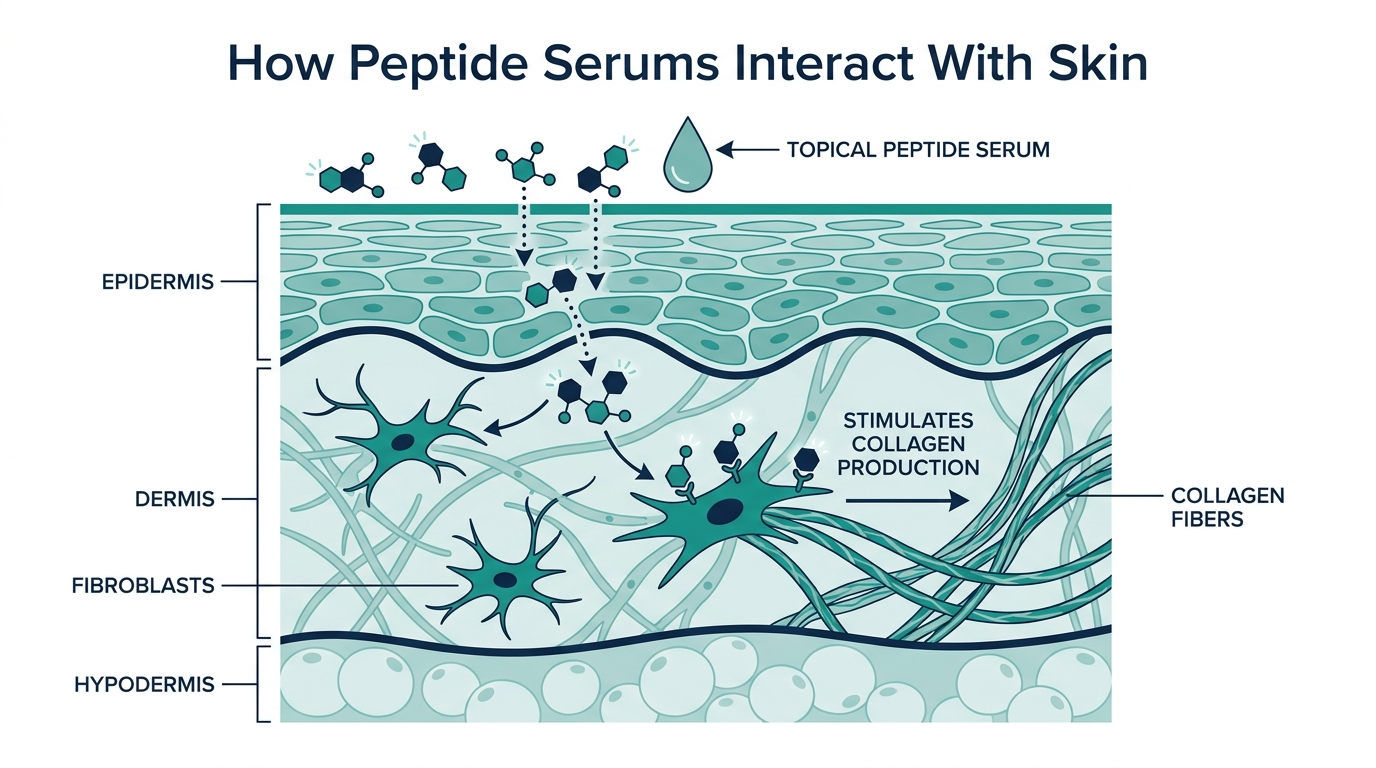
A peptide is a chain of amino acids, shorter than a full protein, that acts as a biological messenger. When you apply one to skin, the goal is to slip a signal through the outer barrier layer (the stratum corneum) and reach the fibroblasts in the dermis, the cells that build collagen and elastin.
A serum is the delivery vehicle: a lightweight, high-concentration formula, usually water- or silicone-based, designed to carry actives into the skin faster than a cream can. Combine the two and you get a peptide serum, a targeted dose of signaling molecules in a format designed to penetrate rather than sit on top.
The word “serum” has no regulatory definition in cosmetics. It just means the brand decided to call it a serum. What matters is what is in it and at what concentration.
The global peptide serum market reached $497.4 million in year-to-date sales through April 2026, up from $443.0 million over the same period in 2025, according to Simporter market data. Serums are the fastest-growing delivery format in the peptide cosmetics category, holding a 32.4% market share and growing at 9.8% annually. That is a lot of interest, and a lot of money changing hands on claims that deserve scrutiny.
How does a peptide serum actually work?
Here is where most product marketing glosses over something important: most peptides do not penetrate skin easily. Peptides tend to be hydrophilic (water-loving) and relatively large in molecular weight, which means the lipid-rich stratum corneum actively resists them. One published study found that only 0.22% of applied peptide made it through to the stratum corneum, and just 0.01% reached the epidermis, as noted in a review published in the International Journal of Cosmetic Science.
Formulators solve this problem in a few ways. The most common is attaching a fatty acid tail, turning a peptide into a “palmitoyl” version. Palmitoyl pentapeptide-4 (the original Matrixyl) is exactly this: a five-amino-acid signal peptide attached to a palmitic acid chain to help it cross the lipid barrier. Other approaches include encapsulating peptides in nanocarriers, combining them with chemical penetration enhancers like propylene glycol, or formulating them with ingredients that temporarily open the skin barrier.
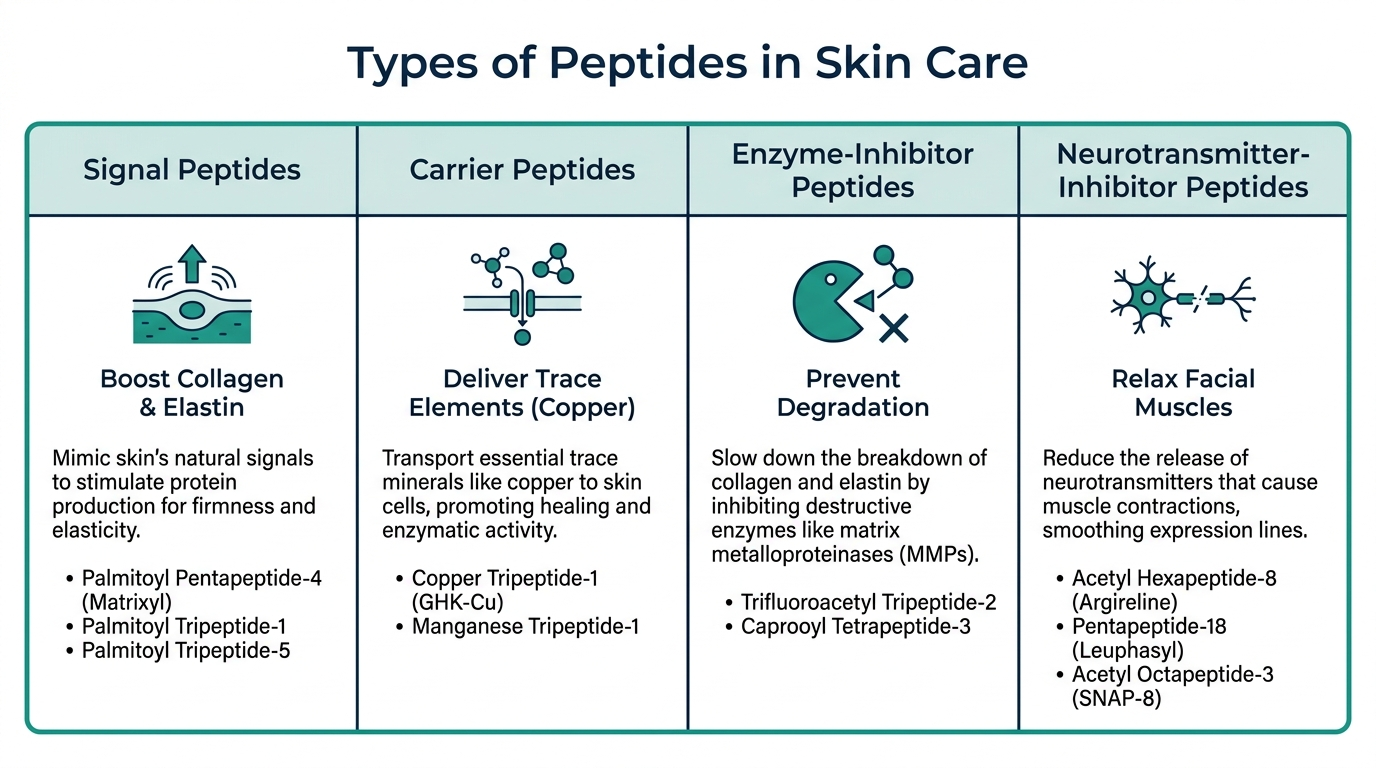
Once inside, the peptide does one of four things depending on its type:
- Signal the dermis to produce more collagen or elastin (signal peptides like Matrixyl).
- Carry copper into the skin to trigger wound-healing and repair cascades (carrier peptides like GHK-Cu).
- Blunt nerve signals that cause repetitive muscle contraction (neurotransmitter inhibitor peptides like Argireline).
- Block enzymes that break down existing collagen (enzyme inhibitor peptides).
The distinction matters because you cannot stack two peptides with identical mechanisms and expect double the result. A well-formulated product uses complementary types.
What are the main peptides used in serums, and what does the evidence say?
Not all peptides perform equally. The peer-reviewed record on the five most common ones in 2026 serums looks like this.
Matrixyl 3000 (palmitoyl tripeptide-1 + palmitoyl tetrapeptide-7)
Matrixyl 3000 is a blend of two palmitoyl peptides from Sederma, the French cosmetic ingredient company. In fibroblast cultures, it raised Collagen I synthesis by 117%, Collagen IV by 327%, and hyaluronic acid production by 267%, per published ingredient data from the manufacturer. A double-blind clinical study with 93 Caucasian women found statistically significant improvement in fine lines and overall skin appearance after 12 weeks of twice-daily application (PMC review, 2025). A multi-peptide eye serum containing 4% Matrixyl 3000 components reduced wrinkle count by 31.8% by day 14 and 33.3% by day 28 in a separate trial published in the Journal of Cosmetic Dermatology.
The catch: in vitro fibroblast numbers do not always translate directly to what you see in the mirror. The clinical wrinkle studies are real, but the effect sizes in consumer-grade concentrations are modest rather than dramatic.
GHK-Cu (copper tripeptide-1)
GHK-Cu was first isolated in 1973 by Dr. Loren Pickart, who observed that it caused aged liver tissue to behave like younger tissue. Its concentrations in human plasma decline by more than half between your 20s and your 60s, according to Innerbody Research (2026).
For skin, a 2023 double-blind split-face study (60 women, ages 40 to 65) compared 0.05% GHK-Cu serum to placebo over 12 weeks and found a 22% increase in skin firmness and a 16% reduction in fine lines measured by optical profilometry. An eight-week serum trial showed GHK-Cu reduced wrinkle depth significantly more than a vehicle alone or a Matrixyl 3000 commercial product, per a review in PMC (2025). A separate 71-woman trial using a GHK-Cu cream for three months improved skin density and thickness while reducing sagging.
In head-to-head in vitro comparisons, GHK-Cu stimulated Collagen I synthesis 2.1-fold versus 1.4-fold for palmitoyl pentapeptide-4.
Argireline (acetyl hexapeptide-8)
Argireline is the “topical Botox” peptide that shows up in every influencer’s morning routine. The mechanism is real: it competes with the SNARE protein complex that triggers muscle contraction, reducing the repetitive facial movements that etch in expression lines. In a 2002 randomized trial at 10% concentration, wrinkle depth dropped 27% after 28 days of twice-daily use. A separate four-week study found up to 30% reduction in wrinkle depth with 10% Argireline. A trial in Chinese subjects found 48.8% anti-wrinkle efficacy versus placebo over four weeks (PMC, 2025).
Personally, I find the Argireline science more compelling than the marketing implies, but only for expression lines around the eyes and forehead. It does nothing structural for skin texture, hydration, or firmness.
SNAP-8 and SYN-AKE
SNAP-8 (acetyl octapeptide-3) is a longer version of Argireline with a similar mechanism. SYN-AKE (dipeptide diaminobutyroyl benzylamide diacetate) mimics a viper venom peptide that blocks acetylcholine at the neuromuscular junction. Both appear in multi-peptide serums like The Ordinary’s Multi-Peptide + HA ($22 for 30mL) alongside Matrixyl 3000, Matrixyl Synthe’6, and Argirelox. Fewer head-to-head human trials exist for these two; they ride the evidence from Argireline and the in vitro data from their developers.
Palmitoyl hexapeptide-12 (Biopeptide EL)
Often listed on ingredient decks as the third signal peptide in a blend, this one targets elastin rather than collagen. Limited independent clinical trial data exists, but it is frequently combined with Matrixyl components to address both structural proteins at once.
Peptide serum vs. retinol: which should you choose?
The honest answer is that these two actives do not compete, they complement. But since people always ask:
| Feature | Peptide serum | Retinol |
|---|---|---|
| Primary mechanism | Signal collagen/elastin production, inhibit muscle contraction | Accelerate cell turnover, normalize cell communication |
| Speed of visible results | Gradual: 6 to 12 weeks for meaningful change | Faster surface texture change: 6 to 8 weeks |
| Irritation potential | Low; generally suitable for sensitive skin | High initially; peeling, redness common |
| Compatible with pregnancy | Most topical peptides are considered safe | Retinoids contraindicated during pregnancy |
| Best for | Structural support, sensitive skin, long-term firmness | Texture, deeper wrinkles, acne, pigmentation |
| Can you layer them? | Yes, in the correct order | Yes, apply peptide first, wait, then retinol |
| Morning or night? | Either | Night only (photosensitizing) |
Dermatologists who use both recommend applying the peptide serum first, waiting 10 to 20 minutes for absorption, then applying retinol in the evening. The hypothesis, supported by some in vitro data, is that peptides may help buffer retinol-induced irritation by reinforcing the skin barrier while the retinoid is doing its turnover work.
Do not believe anyone who says you must choose. The science supports using both, in the right sequence, on the same evening.
Full-body lab membership: 100+ biomarkers, doctor-reviewed, tracked over time.
What does the label actually tell you? (and what it hides)
Reading a peptide serum label is a small skill with real payoff. Here is what to look for.
INCI name vs. trade name. Matrixyl is a trade name. The INCI (International Nomenclature of Cosmetic Ingredients) names are palmitoyl tripeptide-1 and palmitoyl tetrapeptide-7. GHK-Cu is formally copper tripeptide-1. If you see only trade names and no INCI names, the brand is betting you will not look up what is in the formula. Always look up what is in the formula.
Position in the ingredient list. Cosmetic ingredients are listed in descending order of concentration down to 1%, after which they can be listed in any order. A peptide listed fifteenth means it is at or below 1% concentration. That is not necessarily useless, Argireline is clinically effective at 10% but also shows some benefit at lower concentrations, but a “peptide-first” product with a water carrier listed before the peptide complex is almost certainly under-dosed.
Preservation and formulation. Peptides are fragile. They degrade in formulas with incompatible pH, in the presence of certain enzymes, and under UV light. A serum in opaque or airless packaging is protecting the peptides. A clear glass jar with a spatula is not. This sounds like a small thing until you realize you paid $120 for a formula that has been oxidizing on your bathroom shelf since week two.
Concentration claims. Brands are not required to disclose the percentage of each peptide in a formula. NIOD’s Copper Amino Isolate Serum 3 1:1 (CAIS3) at $62 for 15mL explicitly discloses 1% GHK-Cu alongside 1% GHK peptide. The Ordinary’s copper peptide serum at $32 for 30mL also states 1% copper tripeptide-1. Seeing the concentration stated is a sign the brand has something worth disclosing.
How to use a peptide serum correctly
Step 1: Cleanse, then tone if that is part of your routine. Apply peptide serum to damp, not wet, skin. Some active-ingredient absorption studies suggest slightly damp skin supports better penetration than bone-dry skin.
Step 2: Apply a few drops. For a 30mL bottle, three to four drops cover the face and neck adequately. Press gently rather than rubbing hard; you are not buffing a floor.
Step 3: Let it absorb for 30 to 60 seconds before applying anything on top. In the evening, if you are following with retinol, extend this to 10 to 20 minutes, especially when using copper peptide serums. Some formulators note that highly acidic vitamin C (L-ascorbic acid at pH 2.5 to 3.5) may destabilize copper peptide complexes on skin, so it is worth separating them: vitamin C in the morning, copper peptides at night.
Step 4: Seal with moisturizer. Peptide serums are not occlusive. They deliver their signals and then need a moisturizer or facial oil on top to support barrier function and hydration.
Step 5: Consistency matters more than volume. In the GHK-Cu studies, wrinkle depth improvements appeared at weeks six to twelve of daily use. The improvement timeline for Matrixyl studies runs similarly. A jar used four times and abandoned will show nothing. Six months of consistent daily use is where the published results live.
One more thing many people skip: always use SPF in the morning. Peptide serums build collagen infrastructure. UV radiation breaks it down. Without daily sunscreen, you are rebuilding a sandcastle at low tide.
Hydrolyzed type I & III collagen peptides, third-party tested, unflavored.
What skin concerns does a peptide serum actually address?
Fine lines and wrinkles. The primary indication and the best-evidenced one. Signal peptides (Matrixyl family) and carrier peptides (GHK-Cu) support collagen synthesis; neurotransmitter inhibitor peptides (Argireline) reduce expression-related deepening. Using a formula with all three types addresses both structural loss and dynamic wrinkling simultaneously.
Skin firmness and elasticity. GHK-Cu’s 22% improvement in firmness at 12 weeks is the most robust number in the category. Matrixyl components contribute via Collagen IV synthesis, which supports the basal membrane and overall skin architecture.
Uneven skin tone and texture. GHK-Cu has documented anti-inflammatory and wound-healing properties. Several formulations show reductions in redness and hyperpigmentation over three to six months of use. The mechanism is partially through suppression of inflammatory cytokines, not just collagen signaling.
Barrier function. Certain peptides, particularly those combined with ceramides or hyaluronic acid in the formula, support transepidermal water loss reduction. This is a secondary benefit, not a primary mechanism of peptides themselves, but it explains why peptide serums often feel more comfortable than retinol.
What a peptide serum will not do is clear active acne, treat melasma at the level a prescription retinoid or hydroquinone would, or visibly transform severely sun-damaged skin in four weeks. Managing expectations matters because the supplement and skincare industries both profit from the gap between “has real evidence” and “does everything the ad implies.”
Myth-buster: “Peptides are just moisturizing, they do not do anything structural”
This was a legitimate debate in the early 2000s, when the evidence base was thin and the skepticism from dermatologists was reasonable. The 2020s changed that.
The 71-woman GHK-Cu trial measuring skin density, the double-blind Matrixyl studies in peer-reviewed journals, the Argireline randomized controlled trials with profilometry measurements, these are not cherry-picked testimonials. They are the kind of data that gets a molecule included in a textbook review on peptides for skin senescence (PMC, 2025).
The honest qualification is this: most studies use concentrations of 0.05% to 10% depending on the peptide, and those concentrations in a well-formulated product with good penetration support do produce real, measured changes. Products that list a peptide nineteenth on the label, behind sixteen other ingredients, at a concentration probably well below 0.1%, are probably not delivering those effects. The ingredient works. The dose and the formulation still matter enormously.
Curious what your own levels look like?
Baseline 100+ biomarkers today and retest as life changes, all in one membership with physician review.
Frequently asked questions
What is a peptide serum used for?
Primarily for reducing fine lines and wrinkles, improving skin firmness, and supporting collagen production. Different peptide types target different mechanisms: signal peptides rebuild collagen, copper carrier peptides accelerate repair, and neurotransmitter inhibitor peptides reduce expression-related deepening.
How long does it take for a peptide serum to work?
Expect the earliest visible changes in hydration and texture within two to four weeks. Measurable improvement in fine lines and firmness in the published GHK-Cu and Matrixyl trials appeared between weeks six and twelve of daily use. Maximum benefit in longer studies builds over three to six months.
Can I use peptide serum every day?
Yes. Unlike retinol, which requires a gradual introduction, most peptide serums are well-tolerated for daily morning and evening use from the start. Skin sensitivity to peptides is uncommon.
Does peptide serum work better than hyaluronic acid?
They address different problems. Hyaluronic acid is a humectant that attracts and holds water in the skin, delivering immediate plumping and hydration. Peptide serums signal structural repair at the cellular level, which takes weeks to show but addresses the underlying cause of skin aging rather than the surface appearance. The two pair well; many peptide serums include hyaluronic acid in the formula.
Is copper peptide serum better than regular peptide serum?
GHK-Cu (copper tripeptide-1) has strong head-to-head clinical evidence, including outperforming Matrixyl 3000 on certain collagen synthesis metrics. It also has well-documented anti-inflammatory and wound-healing properties. For most users interested in firmness and anti-aging, a formula combining GHK-Cu with Matrixyl-family peptides covers more ground than either alone.
Can you use peptide serum with retinol?
Yes, in sequence. Apply the peptide serum first, wait at least 10 to 20 minutes, then apply retinol. Some evidence suggests peptides may help the skin tolerate retinol-induced irritation better when layered this way.
Are there any side effects from peptide serums?
Topical peptide serums are considered low-risk cosmetic ingredients with a long safety record. The most common reactions are mild redness or itching from other ingredients in the formula, not the peptides themselves. Copper peptides (GHK-Cu) should be used with caution in anyone with Wilson’s disease (a copper metabolism disorder). Pregnant or breastfeeding individuals should consult a physician before adding new actives.
Hydrolyzed type I & III collagen peptides, third-party tested, unflavored.
Author: Vital Signs Today Editorial Team, [credential]”]. Educational content, not medical advice. Sources linked inline.
Primary sources:
- PMC review: Peptides for Prevention and Treatment of Skin Senescence (2025)
- International Journal of Cosmetic Science: Skin permeability and anti-wrinkle peptides (2022)
- Innerbody Research: GHK-Cu Peptide Guide (2026)
- Innerbody Research: Best Copper Peptide Serums (2026)
- Simporter: Peptide Serum Market Trends, April 2026
- Wiley Dermatological Reviews: Copper Peptides in Regenerative Aesthetic Dermatology (2026)
- CI Guide: Matrixyl 3000 ingredient data
- Maelove Skincare Science: How to Select a Peptide Serum
- PeptideJournal: Matrixyl Clinical Studies
- Grand Ingredients: Copper Peptides Clinical Evidence 2025
Related reading
Vital Signs Today may earn a commission if you buy through links on this page. It does not affect our editorial assessments.