
Educational content, not medical advice. Melanotan II is not approved for human use by the FDA, EMA, TGA, or MHRA. Speak to a licensed clinician before considering any peptide therapy.
Short answer: Melanotan is a family of synthetic peptides that mimic alpha-melanocyte-stimulating hormone (alpha-MSH), triggering melanin production and skin darkening. Melanotan I (afamelanotide, brand name Scenesse) received FDA approval in 2019 for a rare light-sensitivity disease. Melanotan II has no regulatory approval anywhere in the world, carries documented risks including melanoma case reports and cardiovascular events, and remains on the FDA’s restricted compounding list as of mid-2026, with no formal timeline for reclassification.
Reading about an unapproved tanning peptide like Melanotan? See real, physician-reviewed numbers instead of an unregulated compound. One at-home Superpower draw checks 100+ biomarkers, physician-reviewed.
Where did melanotan come from, and why does it exist?
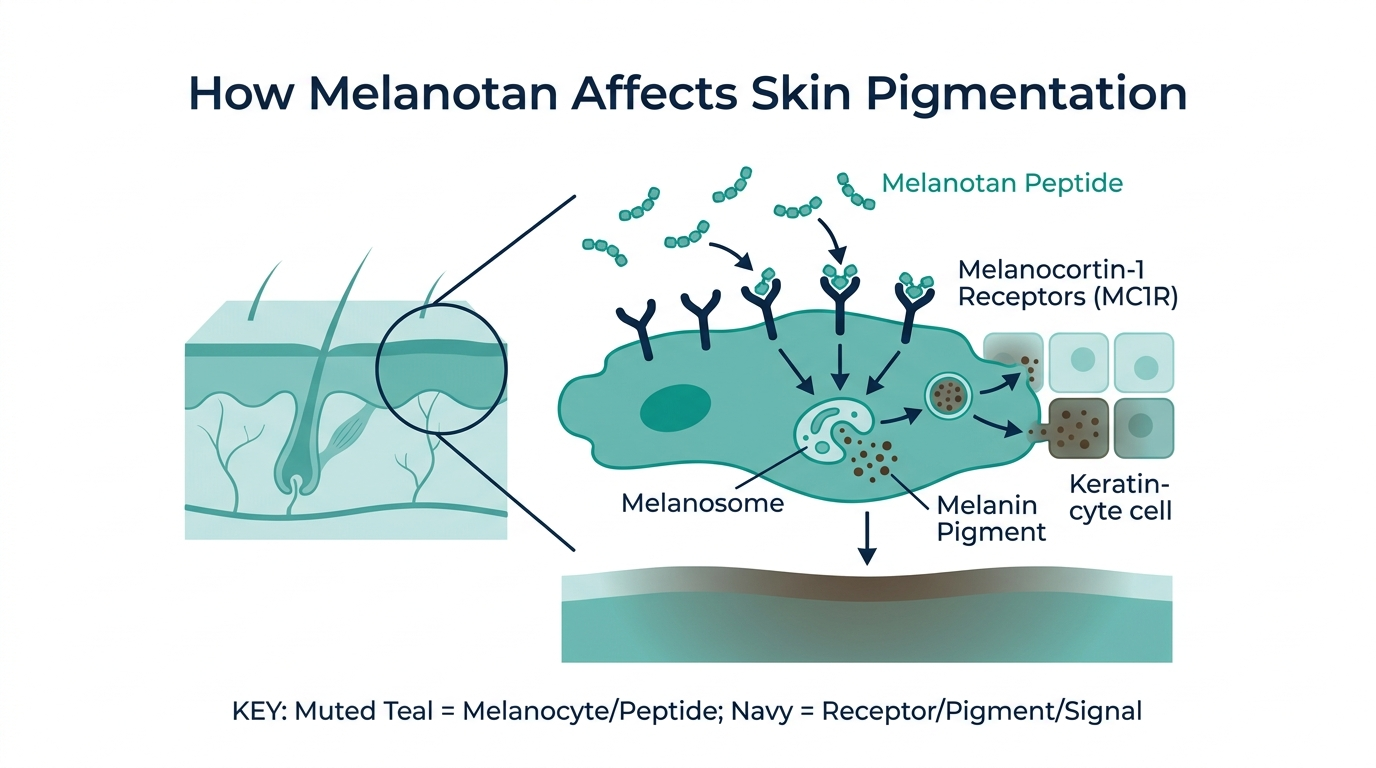
The melanotan story begins not with bodybuilders or tanning salon culture but inside a University of Arizona pharmacology lab in the late 1980s. Researchers including dermatologist Norman Levine and peptide chemist Victor Hruby were looking for a way to reduce skin cancer risk in fair-skinned, UV-sensitive patients by inducing protective melanin production without requiring sun exposure. The hypothesis was elegant: if you could trigger the body’s own tanning response through a hormone analog, you might block UV damage before it happened.
The natural hormone they were mimicking, alpha-MSH, had a half-life of only a few minutes in circulation, which made it useless as a therapeutic agent. So the Arizona team synthesized a more stable cyclic analog, a lactam-bridged cyclic heptapeptide. The first version, melanotan I, worked but required large doses. The second, melanotan II, was 1,000-fold more potent in animal models for melanin stimulation. A 1996 pilot Phase I clinical study by Dorr et al., published and indexed on PubMed, confirmed that MT-II produced measurable tanning in healthy volunteers at doses around 0.025 mg/kg over ten to fourteen days.
Then the researchers noticed something no one had planned for. Men in the trial were presenting with spontaneous erections. That single unexpected finding eventually split the melanotan lineage into two completely different development paths, one toward a licensed sexual dysfunction drug, the other into the unregulated grey market.
The irony worth knowing: the compound that became an illegal internet tanning agent was originally designed to protect you from cancer.
How does melanotan actually work in the body?
Melanotan II is a non-selective melanocortin receptor agonist. It binds to four of the five known melanocortin receptors, MC1R, MC3R, MC4R, and MC5R, which is exactly what causes both its effects and its problems. Those receptors are not all sitting in the skin doing tanning work. They are distributed across the central nervous system, the cardiovascular system, the reproductive system, and the gastrointestinal tract.
Here is what each receptor activation actually does:
| Receptor | Location | Effect when activated by MT-2 |
|---|---|---|
| MC1R | Melanocytes in skin | Melanin (eumelanin) synthesis, skin and hair darkening |
| MC3R | Hypothalamus | Energy balance, nutrient partitioning, libido modulation |
| MC4R | Hypothalamus, CNS broadly | Sexual arousal, appetite suppression, blood pressure modulation |
| MC5R | Exocrine glands | Sebaceous gland regulation, some immune signaling |
When MT-2 binds MC1R, it activates the enzyme tyrosinase, which converts the amino acid tyrosine into eumelanin, the brown-black pigment that darkens skin and hair. This happens independently of UV radiation. The melanin is real; the problem is that it is produced without the controlled, localized signaling that normally governs pigmentation. Every melanocyte that carries MC1R responds at once, including the ones in atypical or dysplastic moles.
The MC4R activation is responsible for appetite suppression and the spontaneous erections documented in early trials. A single 0.025 mg/kg dose produced erections sufficient for intercourse in 17 of 20 men with psychogenic ED in a 1996 trial, according to data summarized by PeakedLabs. That same receptor is also why blood pressure fluctuations and cardiovascular side effects show up in case reports.
What is the difference between melanotan I, melanotan II, and PT-141?
This is the most commonly confused piece of the melanotan story, and the distinction matters because the legal status of each compound is entirely different.
Melanotan I (afamelanotide, brand name Scenesse) is the FDA-approved member of the family. On October 8, 2019, the FDA approved afamelanotide as a subcutaneous implant for adults with erythropoietic protoporphyria (EPP), a rare genetic disorder where sunlight exposure causes severe, often disabling pain due to abnormal porphyrin accumulation. In EPP patients, a 16 mg Scenesse implant placed under the skin every 60 days provides a protective tan that meaningfully extends their time in natural light. A Phase III trial registered at ClinicalTrials.gov also explored its use in polymorphic light eruption. Melanotan I is selective for MC1R, which limits the off-target cardiovascular and sexual effects seen with MT-2.
Melanotan II (MT-2) is the potent, non-selective second-generation version. It was never brought through Phase III trials. The development team pivoted when they discovered the sexual arousal mechanism, and the compound effectively became a research molecule rather than a pharmaceutical candidate. It has no regulatory approval anywhere, cannot be legally compounded by US pharmacies, and is sold only as a “research use only” powder.
Bremelanotide (PT-141, brand name Vyleesi) is the direct descendant of the sexual arousal observation in the Arizona lab. Researchers stripped down the melanotan II structure to make a more selective MC3R/MC4R agonist with minimal MC1R activity, meaning it produces sexual arousal without significant tanning. The FDA approved bremelanotide in June 2019 (NDA 210557) for hypoactive sexual desire disorder (HSDD) in premenopausal women. It is the only legal prescription pathway in the melanocortin space for sexual dysfunction, and it is the proof that the science underlying MT-2 is sound while MT-2 itself never got there.
The three compounds share a parent hormone but have completely different legal and clinical profiles. Melanotan I: FDA-approved for EPP. Bremelanotide: FDA-approved for HSDD. Melanotan II: no approval, no legal human use.
Why do people use melanotan II, and what does the evidence say?
Despite having no regulatory clearance, MT-2 has a persistent underground following across three stated use cases: tanning without UV exposure, enhancement of libido and erectile function, and appetite suppression for body composition. The evidence quality is low for all three, because no large randomized Phase III trials exist. Development stopped after Phase I/II work in the 1990s.
Tanning: The Phase I trial (Dorr 1996) did confirm melanin stimulation, but the Arizona team documented nausea in the majority of participants at effective doses. The darkening is real but non-selective. It affects every pigmented area, including existing moles, which is the core dermatological concern. It also does not fade at the same rate as UV-induced melanin.
Libido: The 17-of-20 result in psychogenic ED is the most-cited efficacy number, but it comes from a very small trial with no placebo control at Phase I. No Phase III data exists. Bremelanotide, which cleared the FDA bar that MT-2 never reached, produces comparable arousal effects with a cleaner safety profile.
Appetite suppression: MC4R activation reliably reduces food intake in both trials and animal models, but this is a CNS effect with cardiovascular co-activation, and no clinical protocol has been established for using MT-2 as a weight management agent. People are essentially running an uncontrolled experiment on their own hypothalamic signaling.
Personally, I find it striking that the compound with the most colorful forum culture is also the one that never made it past Phase II. That is not a coincidence. Regulatory filing requires large safety datasets, and the early trial profile, nausea in the majority, spontaneous priapism, blood pressure changes, was not the foundation for a Phase III investment.
What are the documented risks of melanotan II?
The risk profile of MT-2 is meaningfully different from other popular research peptides like BPC-157 or sermorelin, because it directly activates melanocyte pathways in every cell that carries the receptor. That systemic, non-selective activation is what makes the dermatological concerns distinct and serious.
Nausea and flushing are the most common acute effects, occurring in a majority of users at tanning-effective doses. They tend to be strongest during a “loading” phase and blunt over time. They are not trivial; early clinical trials were abandoned in part because the severity was not compatible with a tanning product that normal people would use.
Melanoma risk and mole changes are the concern that dermatologists raise most urgently. MT-2 does not merely darken your existing moles; it stimulates all MC1R-bearing melanocytes simultaneously, including atypical ones. A 2014 case series by Hjuler et al. in the journal Dermatology documented patients who developed melanoma from pre-existing moles within months of beginning MT-2 injections. A 2012 case by Ong and Bowling in the Australasian Journal of Dermatology documented melanoma in situ in a user. A 2025 paper in ScienceDirect (oral mucosal melanoma case report) documented oral mucosal malignant melanoma potentially associated with nasal spray use.
The diagnostic masking problem is the insider detail that rarely reaches consumer-facing explainers. Dermatologists use the ABCDE criteria (asymmetry, border irregularity, color variation, diameter, evolution) to catch early melanoma. MT-2 induces darkening and color changes across the entire skin, including in lesions that would otherwise be flagged by those criteria. A user is simultaneously increasing melanoma risk and making that risk harder for a physician to detect on routine skin check.
Cardiovascular events: A 2020 case report published in PMC documented renal infarction following MT-2 injection. Nelson et al. (2012) documented rhabdomyolysis (skeletal muscle cell destruction) requiring hospitalization. Transient blood pressure elevation is reported widely.
Priapism (prolonged, painful erection not associated with arousal) has been documented in male users and can cause permanent tissue damage if not treated promptly.
Encephalopathy and central nervous system effects have been reported in case literature, consistent with the broad CNS distribution of MC4R.
Full-body lab membership: 100+ biomarkers, doctor-reviewed, tracked over time.
What is the 2026 legal status of melanotan II in the US?
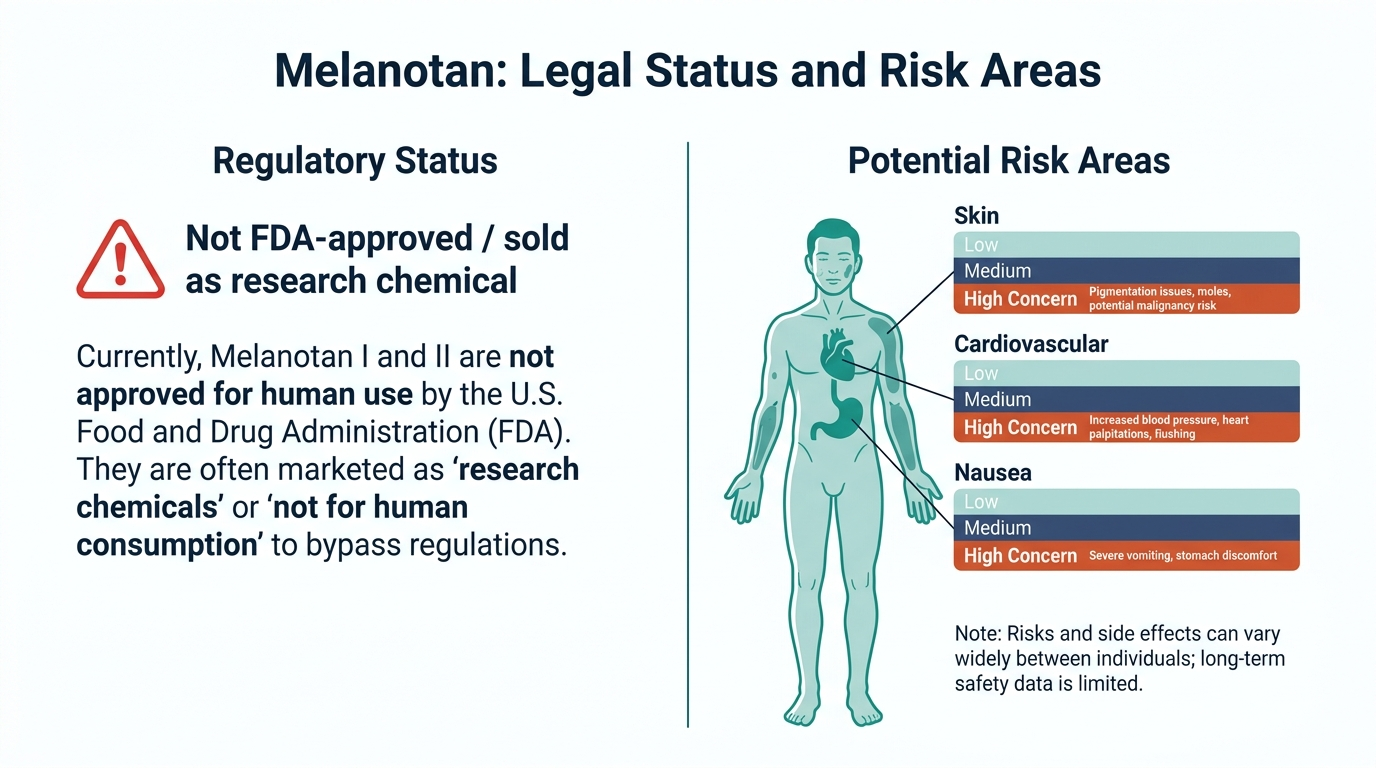
The short version: melanotan II is among the most legally isolated compounds in the peptide space in 2026, and the regulatory situation actually got more complicated this year, not less.
Here is the timeline:
- September 29, 2023: The FDA moved 19 peptides onto the 503A Category 2 restricted list, including melanotan II, BPC-157, TB-500, and others. “Category 2” means they cannot be used as bulk drug substances in compounding, effectively banning licensed pharmacies from making them.
- September 2024: Five peptides were removed from the Category 2 list (AOD-9604, CJC-1295, Ipamorelin, Thymosin alpha-1, Selank), but melanotan II was not among them.
- February 27, 2026: HHS Secretary RFK Jr. announced that 14 of the remaining restricted peptides would be reclassified back to Category 1 (permitted). The announcement named BPC-157, TB-500, and others as expected to return to compounding. Melanotan II is included in the group announced for potential reclassification, according to formblends.com’s regulatory tracker.
- April to June 2026: No formal FDA rule change has been published. The Pharmacy Compounding Advisory Committee (PCAC) meeting required to finalize reclassification has not completed. The formal FDA bulk drug substances list accessed at FDA.gov still reflects the pre-announcement status.
What that means practically: melanotan II cannot be legally dispensed by a US compounding pharmacy today. No licensed telehealth clinic can prescribe it. Selling it as a “research chemical” for laboratory use is technically permitted, but administering it to humans, including yourself, is not covered by that designation. The FDA and US Customs can seize imported shipments.
Globally, the legal environment is consistent and unfavorable. The UK’s MHRA bans melanotan II in injectable form; nasal sprays occupied a technical loophole for years, but active enforcement is increasing. In Australia, the TGA issued 27 infringement notices totaling $101,412 to a single NSW-based individual in November 2025 for supplying MT-2 to Australian consumers, under the Therapeutic Goods Act 1989, according to the TGA’s own enforcement announcements. It is illegal to supply, use, or advertise melanotan in Australia regardless of form, including through social media.
Do not believe anyone who tells you the February 2026 HHS announcement made melanotan II legal to use. It did not. It initiated a regulatory process that may eventually open a licensed compounding pathway, but that process has no completed timeline and melanotan II’s distinct safety profile, specifically the melanoma concern, means it faces a more intensive review than BPC-157 or sermorelin.
Is there a legal route to melanocortin peptide therapy?
Yes, for two specific indications.
For erythropoietic protoporphyria, afamelanotide (Scenesse) is FDA-approved and dispensed through licensed channels. This is a genuine patient population with a diagnosed rare disease, not a cosmetic pathway.
For sexual dysfunction, bremelanotide (Vyleesi) is FDA-approved for hypoactive sexual desire disorder in premenopausal women, and off-label use in men for erectile dysfunction or low libido is an active area in men’s health clinics. Several telehealth platforms now offer bremelanotide prescriptions after clinical intake, typically $150 to $350 per month with physician oversight. That is the legal, monitored route to MC4R stimulation, and it comes with a pharmacist, a named dose, and a chain of accountability that a research-chem vial does not.
For people interested in the tanning benefits specifically: there is no legal tanning route through the melanocortin system in 2026. The “sunless tan” use case that originally motivated the University of Arizona research program never produced a licensed product. The only lawful tanning options remain UV-based sunbathing (with sun-protective skincare), topical bronzers, or spray tans.
Telehealth GLP-1 program with provider visits and pharmacy coordination.
Why did melanotan II never get FDA approval?
This is the question that cuts through most of the forum mythology. The compound clearly works for tanning and for sexual arousal; two different Phase I/II programs confirmed that. So why does it sit in permanent research-chemical limbo while a derivative compound (bremelanotide) sailed to FDA approval in the same year?
The answer is receptor selectivity. Bremelanotide was engineered specifically to activate MC3R and MC4R (arousal, appetite) while minimizing MC1R activity (tanning, melanocyte stimulation). The development team essentially removed the mechanism that makes MT-2 dangerous, the uncontrolled activation of every melanocyte in the body, to get to a compound that a risk-benefit analysis could survive.
Melanotan II activates all four receptors simultaneously with limited selectivity. That means every time you dose it for tanning, you are also activating your hypothalamic appetite circuits, your cardiovascular regulation via MC4R, and every dysplastic mole you carry. A pharmaceutical filing requires that risk to be quantified across thousands of patients, and the melanoma case reports that accumulated in the literature during the years when MT-2 was circulating online made that a very difficult dataset to navigate.
The development history is also shaped by economics. By the time enough clinical data existed to consider Phase III, the compound had leaked into the grey market entirely. There was no commercial incentive to fund a $100 million trial for a molecule anyone could buy for $60 from a research vendor, especially when the derivative compound (bremelanotide) offered the same core benefit with a safer profile.
The real lesson: the University of Arizona work was legitimate science. The compound just had the wrong receptor profile for pharmaceutical development, and the one that did work went a different direction. The grey market filled the gap, which is its own kind of commentary on how these things go.
What do dermatologists actually say about melanotan II?
Dermatology as a field has been consistently, clearly opposed to melanotan II for over a decade, and the concern is not theoretical. Documented melanoma cases have appeared in peer-reviewed journals going back to 2012.
The specific clinical concern is not just that MT-2 might cause melanoma, though the stimulation of atypical melanocytes is a plausible mechanism. It is the diagnostic interference. DermNet, a peer-reviewed clinical resource for dermatologists, explicitly notes that MT-2 “induces mole darkening and proliferation” that can mimic the color change and border irregularity criteria that trigger melanoma referrals. A user who has been on MT-2 is, to a dermatologist doing a skin check, extremely difficult to read. Moles that should be concerning have been uniformly darkened, new pigmented lesions may have appeared, and the baseline that the physician would normally compare against has been artificially altered.
The ABCDE criteria are not a perfect screening tool under any circumstances. Adding a compound that systematically darkens every pigmented lesion on the body is not a small modification to that risk environment.
Cancer Research UK’s guidance, available at their site, directly advises against melanotan use and notes that existing moles may change rapidly. The Cleveland Clinic’s health guidance similarly warns against nasal tanning sprays containing melanocortin peptides. These are not fringe positions; they reflect the mainstream clinical consensus.
Turn what you just learned into action.
Superpower lets you test 100+ biomarkers from home, then re-check them over time so you can actually see progress, physician-reviewed at every step.
Frequently asked questions
Is melanotan the same as a tanning injection?
Melanotan II is the compound most commonly sold as “tanning injections” or promoted in the context of “nasal tanning sprays.” It is not FDA-approved, it is not legal to administer to humans in the US, and the tanning effect comes with documented risks including melanoma case reports, cardiovascular events, and nausea. Afamelanotide (melanotan I, Scenesse) is an FDA-approved version of a related compound, but it is only approved for patients with erythropoietic protoporphyria, a rare genetic disease.
Is melanotan II legal in the US in 2026?
No, not for human use. It cannot be legally dispensed by US compounding pharmacies. Selling it as a “research use only” chemical is technically permitted, but the “research use only” label does not cover human administration. The HHS Secretary announced a plan in February 2026 to reclassify 14 restricted peptides including MT-2, but no formal FDA rule change has been published as of mid-2026, and the process has no firm completion date.
What happened to melanotan II development after the Arizona trials?
The University of Arizona team developed bremelanotide (PT-141) as a more selective derivative focused on the MC3R/MC4R sexual arousal pathway. Bremelanotide received FDA approval in 2019 as Vyleesi for hypoactive sexual desire disorder in premenopausal women. Melanotan II itself was never brought to Phase III, partly due to the adverse event profile in early trials (nausea, priapism, blood pressure changes) and the melanoma concern that emerged from case reports as the compound circulated in the grey market.
What is the difference between melanotan I and melanotan II?
Melanotan I (afamelanotide, Scenesse) is FDA-approved, selective for MC1R, and produces melanin synthesis with less off-target CNS and cardiovascular activation. Melanotan II is more potent (roughly 1,000-fold stronger in early animal models) but non-selective across MC1R, MC3R, MC4R, and MC5R, producing simultaneous tanning, libido, appetite, and cardiovascular effects. Melanotan I has a regulatory approval path for a rare disease; melanotan II has none.
Can melanotan II cause skin cancer?
Case reports, including Hjuler et al. (2014) and Ong and Bowling (2012), documented melanoma in patients using or shortly after using MT-2. The mechanism, widespread stimulation of all MC1R-bearing melanocytes including atypical ones, is biologically plausible as a cancer-promoting pathway. No large epidemiological study exists to quantify the population-level risk, partly because the compound has never been studied in a licensed clinical program. The additional diagnostic masking concern, that MT-2 makes routine melanoma screening less reliable, is separate from but equally important to the direct risk.
Are nasal tanning sprays containing melanotan safer than injections?
No. The active compound is the same, and the biological effects are the same. The nasal route does not bypass systemic MC1R activation. The UK’s MHRA legal loophole for nasal spray form (which applied only because the injectable was classified as a “medicine” while the spray was not) does not make the compound safer. Australia’s TGA bans all forms including sprays, and case reports of oral mucosal melanoma have been linked to nasal spray use.
What is the legal way to access melanocortin receptor therapy?
Bremelanotide (Vyleesi) for HSDD in premenopausal women is the only FDA-approved MC receptor therapy outside of the rare disease indication for Scenesse. Several licensed telehealth platforms prescribe bremelanotide off-label for men experiencing low libido or ED after clinical evaluation. This is the legal, monitored route to MC3R/MC4R stimulation. There is no legal tanning route through the melanocortin system in 2026.
Telehealth GLP-1 program with provider visits and pharmacy coordination.
Author: Vital Signs Today Editorial Team, [credential]”]. Educational content, not medical advice. Sources linked inline.
Primary sources:
- Dorr RT, Lines R, Levine N, et al. “Evaluation of melanotan-II, a superpotent cyclic melanotropic peptide in a pilot phase-I clinical study.” PubMed (1996): https://pubmed.ncbi.nlm.nih.gov/8637402/
- DermNet NZ, “Melanotan II” clinical topic page: https://dermnetnz.org/topics/melanotan-ii
- FDA bulk drug substances under 503A (updated May 2026): https://www.fda.gov/media/94155/download
- FDA GINAS substance record, Melanotan II: https://precision.fda.gov/ginas/app/ui/substances/ea753edd-ab89-4212-8f75-d704ff9b05e3
- Afamelanotide (Scenesse) FDA approval, EPP indication (2019): Wikipedia afamelanotide entry with source citations
- ClinicalTrials.gov NCT04704713, afamelanotide in polymorphic light eruption: https://clinicaltrials.gov/study/NCT04704713
- PMC case report, renal infarction following melanotan II (2020): https://pmc.ncbi.nlm.nih.gov/articles/PMC7148395/
- PMC case report, oral mucosal melanoma and MT-2 nasal spray (2025): https://www.sciencedirect.com/science/article/abs/pii/S0901502725001109
- Cancer Research UK, melanotan and tanning: https://www.cancerresearchuk.org/about-cancer/causes-of-cancer/sun-uv-and-cancer/fake-tan-and-melanotan-injections
- TGA Australia enforcement notices (November 2025): https://www.tga.gov.au/news/blog/dont-risk-using-tanning-products-containing-melanotan
- RethinkPeptides, melanotan II and melanoma risk (Hjuler 2014, Ong and Bowling 2012 case summaries): https://rethinkpeptides.com/articles/melanotan-ii-and-melanoma-risk-what-dermatologists-are-concerned-about
- FormBlends FDA peptide legal status tracker (2026): https://formblends.com/articles/safety-hub/fda-peptide-ban-legal-status-2026
- PeakedLabs melanotan II overview: https://peakedlabs.com/blog/melanotan-ii
- MyPeptideMatch melanotan 2 legal status: https://www.mypeptidematch.com/blog/melanotan-2-mt2
Related reading
Vital Signs Today may earn a commission if you buy through links on this page. It does not affect our editorial assessments.