
Educational content, not medical advice. Talk to a licensed clinician before starting any supplementation protocol.
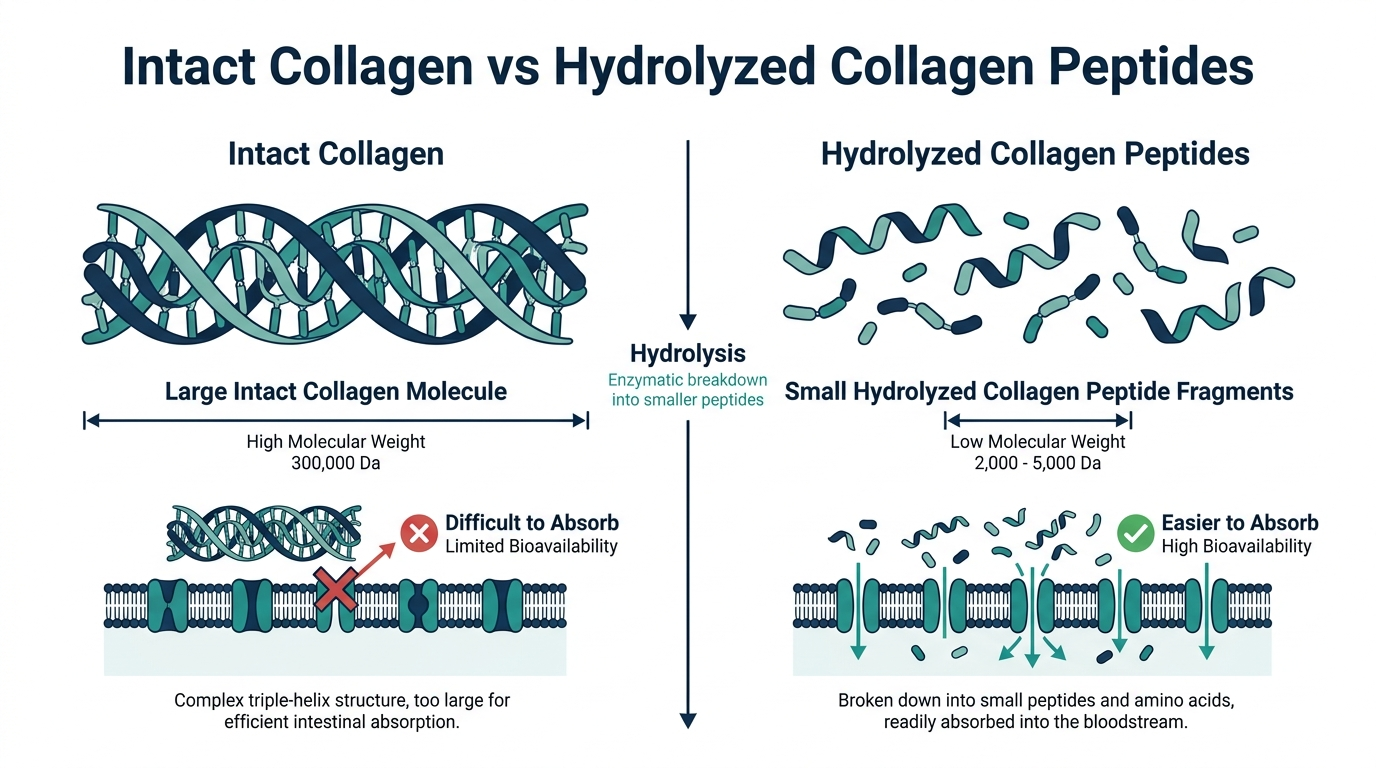
Short answer: Hydrolyzed collagen peptides are collagen protein that has been enzymatically cut into fragments averaging 2,000 to 5,000 Daltons, small enough that some chains cross the gut wall intact, enter your bloodstream as the dipeptide Pro-Hyp, and signal your own fibroblasts to ramp up collagen, hyaluronic acid, and elastin production. Native collagen weighs roughly 300,000 Daltons and does not absorb this way. The hydrolysis step is not marketing, it is the mechanism.
Collagen peptides promise to rebuild what you’re losing, so how do you know what your body actually needs right now? One at-home Superpower draw checks 100+ biomarkers, physician-reviewed.
What exactly is “hydrolyzed collagen” and why does the word matter?
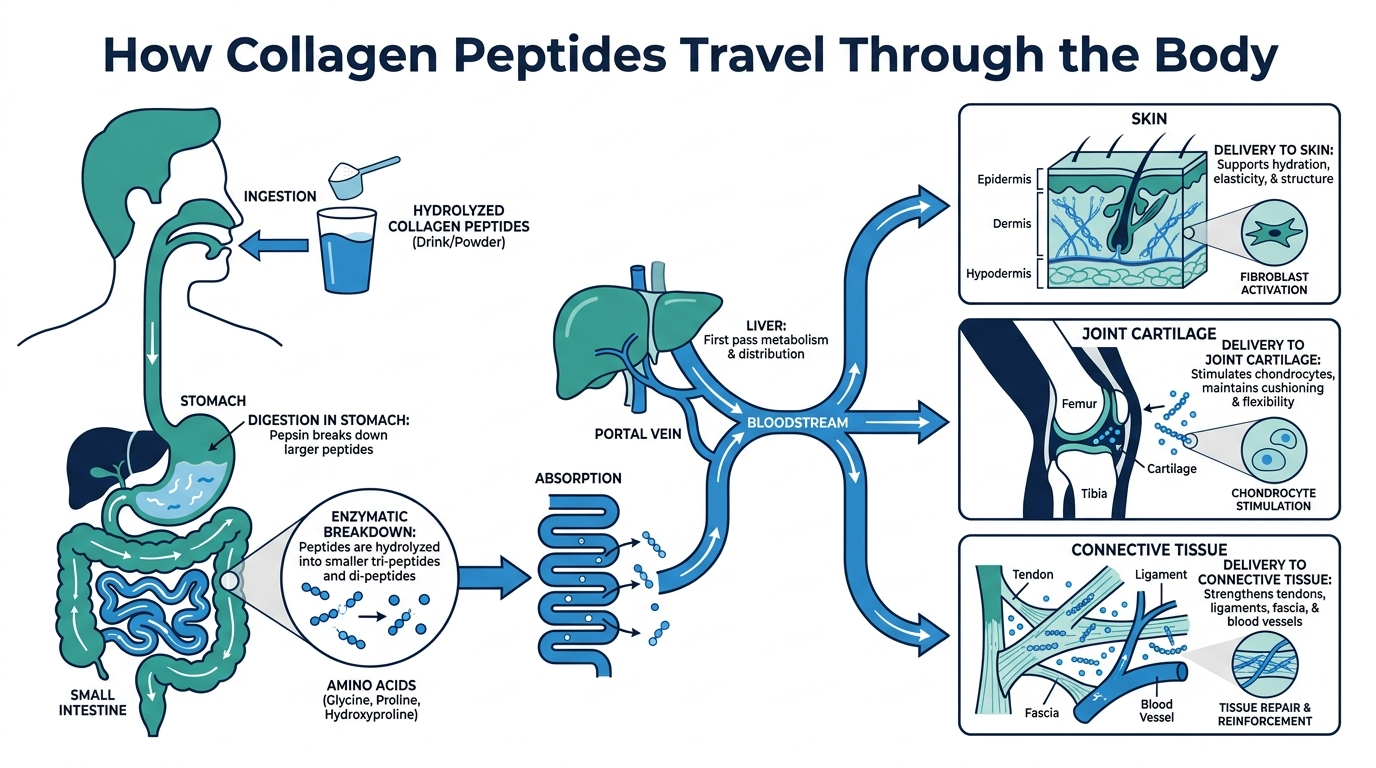
Collagen is the most abundant protein in the human body, making up about 30 percent of all protein by mass. It forms the scaffolding inside skin, the padding inside joint cartilage, the connective tissue wrapping your tendons, and the structural matrix of bone. Structurally, it is a triple helix of three polypeptide chains wound together, giving it the tensile strength of a thin steel cable.
The word “hydrolyzed” just means the molecule was cut. Specifically, it means enzymes (or, in cheaper processing, acids or heat) severed the peptide bonds holding the triple helix together, chopping that 300,000-Dalton macromolecule into fragments of roughly 2 to 20 amino acids. Those fragments are the peptides. The full name, hydrolyzed collagen peptides, is technically redundant once you know the chemistry, since all collagen peptides are hydrolyzed, but the label serves a practical purpose: it tells you the product went through controlled enzymatic processing, not the random fragmentation of boiling down bones.
Most consumers see “collagen peptides” and “hydrolyzed collagen” and assume they are different things. They are the same thing. The interchangeable labeling is a regulatory artifact, not a product distinction.
Full-body lab membership: 100+ biomarkers, doctor-reviewed, tracked over time.
How do collagen peptides actually get into your body?
This is the question the skeptics ask, and it is a fair one. The standard criticism goes: “You eat protein, your gut breaks it down into amino acids, and nothing special happens. Why would collagen be different from eating a chicken breast?”
The answer is that some of it is not fully broken down before absorption. Research published in the Journal of Agricultural and Food Chemistry identified the dipeptide prolyl-hydroxyproline (Pro-Hyp) in human blood within two hours of collagen hydrolysate ingestion. Pro-Hyp is a collagen-specific sequence; it is essentially absent in any other common food protein. Finding it in circulation intact means the gut did not fully digest those chains before shuttling them across the intestinal wall via a peptide transporter called PepT1.
That absorbed Pro-Hyp does real signaling work. In cell culture studies, Pro-Hyp at a concentration of 200 nmol/mL increased dermal fibroblast proliferation by 1.5-fold and, more significantly, boosted hyaluronic acid synthesis 3.8-fold, driven by a 2.3-fold elevation of hyaluronan synthase 2 (HAS2) mRNA expression, according to research from the National Center for Biotechnology Information. Fibroblasts are the cells that manufacture your skin’s structural proteins. Activating them from outside, via a blood-borne signal, is the mechanism behind virtually every clinical skin benefit attributed to collagen supplementation.
Molecular weight is the rate-limiting variable. Peptides below roughly 3,000 Daltons are efficiently absorbed via PepT1. Fragments above that threshold get broken down further before crossing the gut wall, losing the intact-peptide signaling advantage. This is why researchers at Ohhira and product developers at brands like Peptan specify their target range of 2,000 to 3,500 Daltons as the absorption sweet spot, not as marketing copy but as a direct constraint of intestinal transport physiology.
What types of collagen are in these supplements, and does the source animal matter?
Collagen peptide products almost always derive from one of three animal sources: bovine (cattle hide or bone), porcine (pig skin), or marine (fish skin and scales). Each source skews toward different collagen types, and those types do different structural jobs in the body.
| Source | Collagen types | Average peptide MW | Best supported use |
|---|---|---|---|
| Bovine hide | Type I, Type III | 3,000-8,000 Da | Skin, connective tissue, gut lining |
| Marine (fish skin) | Type I | 2,000-3,000 Da | Skin, fine lines, bioavailability-first use cases |
| Chicken cartilage | Type II | Variable | Joint cartilage, OA pain (undenatured form) |
| Porcine skin | Type I, Type III | 2,500-5,000 Da | Skin, broadly similar to bovine |
Marine collagen has a real absorption advantage in its natural form: fish-derived peptides average 2,000 to 3,000 Daltons compared to bovine peptides, which run higher before downstream processing. Research aggregated at Pierre Health summarizes the consensus view: marine collagen absorbs at roughly 1.5 times the rate of bovine, but the gap narrows considerably when the bovine product is well-hydrolyzed. For joint health specifically, chicken-derived Type II collagen operates by a different mechanism (immune tolerance, not fibroblast signaling), and the two forms should not be compared on the same axis.
Personally, I would not pay a premium for marine collagen over a properly hydrolyzed bovine product for skin benefits, because the published RCTs show comparable skin elasticity and hydration outcomes at equal doses. Where marine collagen earns its price is in products that need to advertise the lowest possible molecular weight, or in markets where bovine sourcing conflicts with dietary restrictions.
What does the clinical research actually show? (and where it does not hold up)
The honest answer to “does it work?” is: it depends on what you mean by “work,” and who funded the study.
Skin benefits: effect is real, but the independent-study picture is sobering
A 2023 meta-analysis of 26 randomized controlled trials across 1,721 participants found statistically significant improvements in skin hydration and skin elasticity compared with placebo. A 2025 systematic review published in the American Journal of Medicine examined 23 RCTs with 1,474 participants and confirmed significant improvements in skin hydration, elasticity, and wrinkles as an overall effect.
Here is the uncomfortable caveat: when that 2025 meta-analysis isolated only the non-industry-funded studies, the effect on skin hydration, elasticity, and wrinkle reduction lost statistical significance. That single finding should give any honest reviewer pause. It does not mean collagen peptides have no effect on skin, it means the magnitude of the effect in paid studies is probably inflated, and the independent literature is not yet large enough to cleanly resolve the question.
A 2024 double-blind RCT published in MDPI’s Journal of Clinical Medicine, examining 112 adult females who took 10 g of CollaSel Pro daily for eight weeks, found significant improvements in skin elasticity (p = 0.009), skin hydration (p less than 0.001), and skin roughness (p = 0.002). That is a meaningful signal. Do not believe any vendor who tells you the skin evidence is as clean as, say, vitamin C and scurvy. But do not believe the dismissal that collagen supplements are pure hype either. The truth is that the effect is real at adequate doses and probably modest in magnitude.
Joint and tendon benefits: the strongest independent case
Joint benefits have a more credible body of evidence than skin benefits, partially because industry funding bias is less entrenched in orthopedic research. A 2025 double-blind, placebo-controlled trial in Joint Diseases and Related Surgery examined type I, type III, and type II hydrolyzed collagen peptides on osteoarthritis-related pain, quality of life, and physical function, finding favorable outcomes for the peptide groups. A systematic review published in Orthopedic Reviews documented consistent improvements across bone density, muscle function, and joint mobility in studies using Type I collagen hydrolysate.
Muscle recovery and tendon remodeling in athletes
A 2024 study in Frontiers in Nutrition found that 15 g of specific collagen peptides per day, taken alongside concurrent training, significantly reduced systemic muscle stress markers (myoglobin, creatine kinase, lactate dehydrogenase) compared to placebo within 48 hours of exercise-induced muscle damage. A 2024 meta-analysis of 19 studies published on PubMed confirmed statistically significant effects of long-term collagen peptide intake on fat-free mass, tendon morphology, and maximal strength. For athletes, the tendon data is particularly compelling: tendons adapted with increased cross-sectional area after collagen supplementation paired with strength training, making them more resilient to loading-related injury.
Tendon and ligament adaptation is a slower process than muscle hypertrophy. Researchers consistently use protocols of 12 weeks or longer, which is worth knowing if you expect joint benefits in the first two weeks.
Gut lining support: promising but early
Collagen is roughly 33 percent glycine by amino acid composition. Glycine has direct anti-inflammatory effects on gut epithelial tissue and helps regulate the tight-junction proteins controlling intestinal permeability. A 2024 study referenced in ScienceDirect explored collagen-derived peptides as prebiotics, finding they boost butyrate production, a short-chain fatty acid that feeds the gut lining. The mechanistic case is coherent, but large independent RCTs on gut permeability are thin. This is an area to watch, not a settled claim.
The biggest myth about collagen supplements
The most persistent argument against oral collagen is: “Your digestive system breaks proteins into amino acids, so what you swallow as collagen just becomes generic amino acids. You are paying for expensive gelatin.”
This argument was reasonable before 2005 and is now factually incorrect for properly hydrolyzed products. As noted above, Pro-Hyp is detectable in human blood within two hours of ingestion, intact. The gut does partially break collagen down, but “partially” is doing a lot of work in that sentence. The fragments that survive intact are bioactive and are not present in equivalent amounts in chicken breast or whey protein, because neither contains significant hydroxyproline in the same dipeptide configuration.
The glycine-rich amino acid argument also undersells the point. Even if you grant that collagen is eventually fully catabolized, it delivers glycine and hydroxyproline in concentrations that virtually no other food protein matches. If you are not eating bone broth daily, your glycine intake is almost certainly suboptimal for collagen synthesis, and supplementing with hydrolyzed collagen is one of the most efficient ways to correct that without adding significant calories.
Hydrolyzed type I & III collagen peptides, third-party tested, unflavored.
How much do you need, and when should you take it?
Effective dose range
Published RCTs used doses ranging from 2.5 g to 20 g per day, and the outcome matters for the dose.
- Skin benefits: 5 to 10 g per day shows consistent results in 8-week trials. The 2024 MDPI study above used 10 g.
- Joint pain: Studies typically use 5 to 10 g. The SURMOUNT analog for joints, a 2025 double-blind RCT, used doses in this range.
- Tendon and muscle recovery in athletes: 15 g per day appears in the strongest sports-performance studies.
- Vitamin C co-factor: Collagen synthesis requires vitamin C to hydroxylate proline and lysine residues so the triple helix can fold. Studies using 2.5 to 5 g of collagen combined with 50 to 100 mg of vitamin C show measurable improvements after 8 to 12 weeks, per BubsNaturals. Without adequate vitamin C, the peptides arrive but the fibroblast cannot assemble them correctly. This is not a minor footnote; chronic sub-clinical vitamin C insufficiency is more common than most people think, particularly in smokers and under high oxidative stress.
Timing
The honest answer is that the timing evidence is weaker than the dose evidence. The common advice to take it in the morning, 20 to 30 minutes before breakfast, has a plausible rationale: it reduces competition with dietary amino acids for the PepT1 transporter. But no published RCT has directly compared morning vs. evening dosing or pre-meal vs. with-meal on absorption outcomes in humans. Consistency matters more than clock time.
Vital Proteins, the category leader with approximately 20 g per serving from pasture-raised bovine hide, recommends one daily serving of 4 tablespoons (20 g) mixed into any liquid. Their single-serve packets contain 10 g, which aligns with the skin-benefit dose threshold. Both formats are widely available on Amazon and at major retail.
What to look for on a collagen peptide label
Most collagen supplements do not report molecular weight on the consumer label. That is a real gap, because you cannot distinguish a 2,500-Dalton marine product from an 8,000-Dalton commodity bovine blend without third-party documentation. Here is what you can verify at retail:
- Source: Bovine, marine, or chicken? This tells you which collagen types you are getting.
- Hydrolyzed confirmation: The label should say “hydrolyzed” or “collagen peptides.” If it says “collagen protein” without that qualifier, the absorption story changes completely.
- Amino acid profile: Look for glycine, proline, and hydroxyproline as the top three. Their combined percentage should exceed 30 percent of the amino acid profile. If hydroxyproline is absent or listed near the bottom, the processing may have degraded the most bioactive chains.
- Additives: Pure collagen peptide powders need nothing else. Products that combine collagen with vitamin C, hyaluronic acid, or biotin are not problematic, but you should understand that the vitamin C is there to support synthesis, not to make the collagen “stronger.”
- Third-party testing: NSF Certified for Sport or Informed Sport certification matters for athletes who face drug testing, because collagen powders can be co-processed in facilities handling banned substances.
When collagen peptides probably will not help you
Knowing the limits matters as much as knowing the applications.
Wrinkle reversal as a stand-alone treatment: Hydrolyzed collagen supports skin hydration and elasticity from within, but it does not replace the extracellular matrix degraded by UV damage, which is primarily a cross-linking and MMP-driven structural problem. For visible wrinkle reduction, the clinical evidence consistently points to topical retinoids, sunscreen, and collagen-stimulating procedures (microneedling, laser) as the first-order interventions. Collagen peptides are a useful complement, not a substitute.
Building muscle mass: Collagen protein is low in leucine, the branched-chain amino acid that triggers mTOR and muscle protein synthesis. In head-to-head comparisons with whey, collagen loses consistently for lean mass gain. It is not a muscle-building protein. It is a connective tissue protein. Replacing your whey with collagen to cut costs will slow your gains.
Immediate joint pain relief: The mechanisms by which collagen peptides benefit cartilage and joints operate on a timeline of weeks to months. Studies show benefits at 12 to 24 weeks, not at 48 hours. If you need acute joint pain relief, this is not the right tool.
People with histamine intolerance: Collagen is extraordinarily high in specific amino acids that feed histamine-producing gut bacteria, particularly if the product includes bone broth or gelatin co-products. A subset of individuals with histamine intolerance or mast cell activation syndrome reports worsening symptoms on high-dose collagen supplementation. This is an underreported issue that mainstream supplement content consistently ignores.
Don’t just read about your health, track it.
A single result is a snapshot. Superpower re-tests 100+ markers over time so you can watch them move as you change sleep, food, and training.
Frequently asked questions
Is hydrolyzed collagen the same as collagen peptides?
Yes. “Hydrolyzed collagen,” “collagen peptides,” and “collagen hydrolysate” all refer to the same product: collagen protein that has been enzymatically broken into short peptide chains (typically 2 to 20 amino acids). The varying names are a labeling convention, not a product distinction.
How is hydrolyzed collagen different from regular collagen?
Native collagen (the kind in bone broth or gelatin) has a molecular weight around 100,000 to 300,000 Daltons and does not absorb efficiently as an intact molecule. Hydrolyzed collagen sits at 2,000 to 5,000 Daltons and can be transported across the intestinal wall by the PepT1 transporter as short intact chains, including the bioactive dipeptide Pro-Hyp, which signals your fibroblasts to produce new collagen and hyaluronic acid.
How long does it take to see results from collagen peptides?
Skin hydration and smoothness changes tend to show up in published RCTs at 4 to 8 weeks of daily use (5 to 10 g per day). Joint and tendon benefits require 12 to 24 weeks. No reliable study shows meaningful structural changes in under four weeks, regardless of dose.
What is the best dose of hydrolyzed collagen peptides per day?
The effective dose varies by goal. For skin benefits, 5 to 10 g per day is well-supported. For tendon and muscle recovery in active adults, studies use 15 g per day. For joint pain in osteoarthritis trials, 5 to 10 g is most common. Taking it alongside 50 to 100 mg of vitamin C improves the synthesis step downstream of absorption.
Does hydrolyzed collagen actually survive digestion?
Partially, and that partial survival is the mechanism. Research published in peer-reviewed journals confirms that the collagen-specific dipeptide Pro-Hyp appears in human blood within two hours of oral ingestion. Some chains are fully digested, delivering amino acids. Others are absorbed intact and act as systemic signals. Both pathways are real and neither undermines the other.
Is hydrolyzed collagen peptides safe?
Hydrolyzed collagen is classified as Generally Recognized As Safe (GRAS) by the U.S. FDA (GRAS SCOGS report #58 on gelatin) and confirmed safe by the European Food Safety Authority. Across published clinical trials, no serious adverse events have been reported at doses up to 20 g per day. The main caveats are the histamine-sensitivity issue noted above and allergic reactions in people with fish or shellfish allergies when using marine-derived products.
What is the difference between Type I, II, and III collagen?
Type I is the most abundant collagen in the body and the primary type in skin, tendon, and bone. Type II is found in cartilage and is the relevant type for joint-specific supplements. Type III often appears alongside Type I in skin and vascular tissue. Most bovine hide supplements supply Types I and III. Chicken cartilage supplements supply Type II, typically in an undenatured form for a different (immune-tolerance) mechanism.
Author: Vital Signs Today Editorial Team, [credential]”]. Educational content, not medical advice. Sources linked inline.
Hydrolyzed type I & III collagen peptides, third-party tested, unflavored.
Primary sources
- Beneficial Effects of Collagen Peptide Ingestion and Its Underlying Mechanism (Springer Nature, 2024)
- Pro-Hyp detected in human blood after collagen ingestion (JACS, PubMed)
- Pro-Hyp stimulates fibroblast proliferation and hyaluronic acid synthesis (PMC)
- Effects of Hydrolyzed Collagen as a Dietary Supplement on Fibroblast Activation: Systematic Review (PMC 2024)
- CollaSel Pro double-blind RCT, skin health 112 females (MDPI Journal of Clinical Medicine 2024)
- Effects of Collagen Supplements on Skin Aging: Meta-analysis (American Journal of Medicine 2025)
- Collagen peptides and osteoarthritis pain RCT (Joint Diseases and Related Surgery 2025)
- Collagen peptides, muscle damage and fatigue: integrative review (PMC 2024)
- Reduction in systemic muscle stress markers after collagen supplementation: RCT (Frontiers in Nutrition 2024)
- Collagen Peptide Supplementation Enhances Muscle-Tendon Stiffness: 16-week RCT (PubMed 2025)
- Collagen and gut microbiome / prebiotic effects (ScienceDirect 2024)
- Vital Proteins Collagen Peptides product page
- FDA GRAS SCOGS report #58 (Gelatin / hydrolyzed collagen)
- Frontiers in Nutrition: Collagen supplementation and regenerative health, biomarker detection (2025)
Related reading
Vital Signs Today may earn a commission if you buy through links on this page. It does not affect our editorial assessments.