
Last updated June 2026. Educational content, not medical advice. PT-141 (bremelanotide) is FDA-approved for a specific indication; its use in men and certain other applications is off-label. Consult a licensed clinician before starting any peptide therapy.
Short answer: PT-141, also known as bremelanotide, is a synthetic cyclic heptapeptide that works in the brain, not the genitals, to stimulate sexual desire and arousal by activating melanocortin-3 and melanocortin-4 receptors (MC3R/MC4R) in the hypothalamus and limbic system. The FDA approved it in June 2019 as Vyleesi, a 1.75 mg subcutaneous autoinjector, for premenopausal women with acquired, generalized hypoactive sexual desire disorder (HSDD). Its use in men for erectile dysfunction and low libido is off-label but supported by Phase II data.
Before trying an off-label peptide like PT-141, wouldn’t it help to know your actual hormone levels first? One at-home Superpower draw checks 100+ biomarkers, physician-reviewed.
Why is PT-141 different from every other sexual health drug?
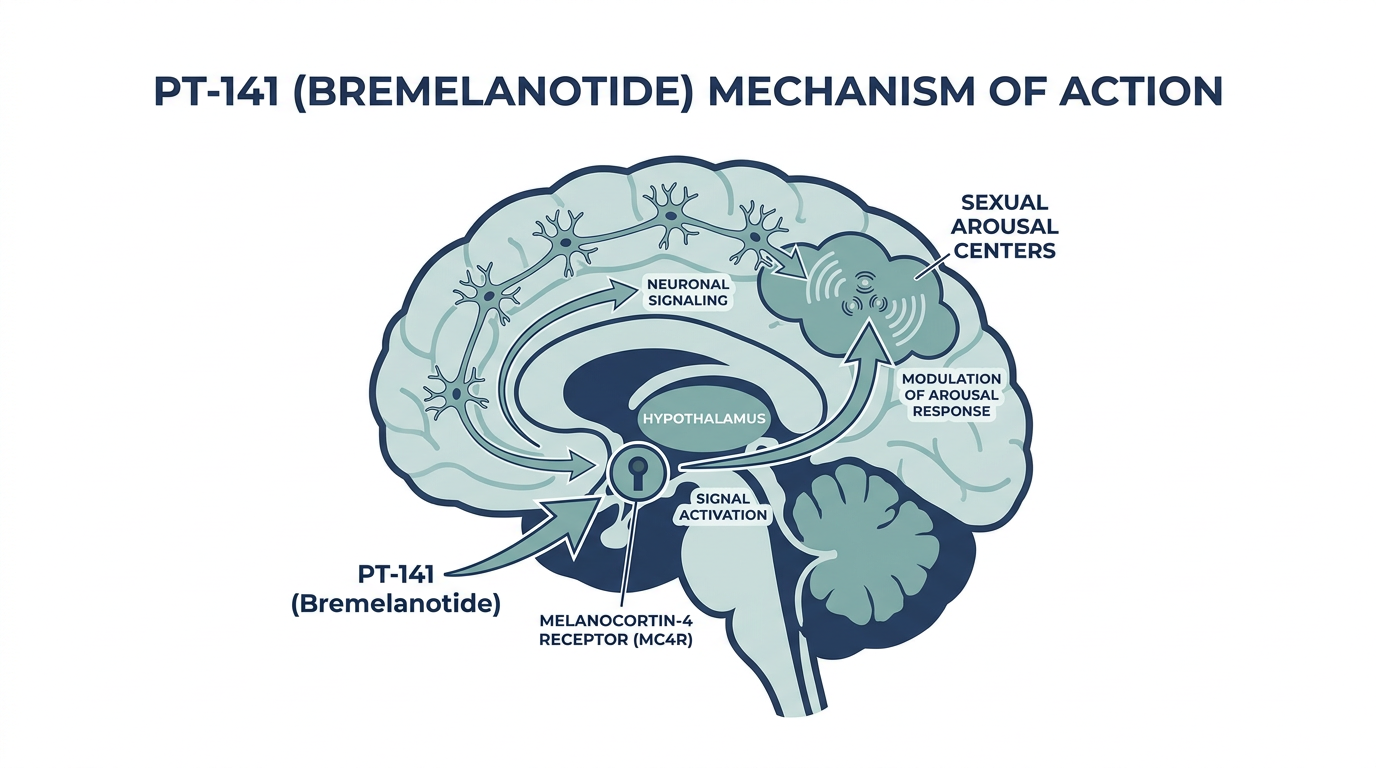
The most important thing to understand about PT-141 is where it acts. Sildenafil (Viagra), tadalafil (Cialis), and vardenafil (Levitra) all work in the penis, by blocking an enzyme called PDE5 to keep blood vessels relaxed and blood flowing. They require arousal to already be present. A man who is not sexually interested will not get an erection from Viagra, no matter how high the dose.
PT-141 skips that problem entirely. It activates melanocortin receptors in the brain, triggering dopamine release in the mesolimbic reward system and generating the motivational drive for sex before any physical stimulus is needed. A 2022 Journal of Clinical Investigation study by Clayton et al. found that MC4R agonism enhanced sexual brain processing in women with HSDD by reducing self-consciousness, increasing sexual imagery, and heightening sensitivity to erotic stimuli, with measurable changes in amygdala-to-insula functional connectivity on fMRI. The drug does not just improve plumbing. It shifts the brain’s orientation toward sex.
This is why the two drug classes are not competing for the same patient. Viagra is for men who want sex but cannot perform. PT-141 is for people, men and women, who have lost the desire itself.
Where did PT-141 come from?
The origin story is genuinely strange, and understanding it helps avoid one of the most common confusions in the peptide space.
In the 1960s, researchers observed that injecting alpha-melanocyte-stimulating hormone (alpha-MSH) into rats produced spontaneous erections. That observation sat mostly dormant until the 1980s, when scientists at the University of Arizona began trying to synthesize tanning agents from alpha-MSH analogs. They succeeded, but the molecule they created, Melanotan-II, turned out to have an unexpected side effect: it caused erections and sexual arousal in male volunteers before it caused any tanning. One subject in a self-experiment reportedly developed an erection lasting 8 hours.
Palatin Technologies licensed the technology and, around 2000, synthesized and patented a refined molecule, bremelanotide (PT-141), by stripping out the tanning-related portions of Melanotan-II and keeping the CNS-active core. Palatin received the patent in 2003. The molecule went through multiple failed attempts, including an intranasal formulation halted by the FDA in 2008 due to blood pressure concerns, before the subcutaneous reformulation eventually gained FDA approval as Vyleesi in June 2019 after the Phase 3 RECONNECT trials.
This history matters because Melanotan-II and PT-141 are not the same compound, a distinction the internet routinely blurs. Melanotan-II is unregulated, untested for human safety, and strongly linked to dangerous hyperpigmentation and melanoma risk. PT-141/bremelanotide is FDA-evaluated, has a known safety profile, and has a legitimate prescription path.
How does the MC4R mechanism actually work?
The pathway runs like this:
PT-141 binds preferentially to melanocortin-3 and melanocortin-4 receptors in the hypothalamus, amygdala, and nucleus accumbens. MC4R signaling in the mesolimbic system, particularly in Sim1 neurons and dopamine neurons in the ventral tegmental area (VTA), increases dopamine activity. Dopamine in the nucleus accumbens generates motivational salience, the neurochemical signature of “wanting.” Downstream, this also reduces activity in the prefrontal cortex regions associated with sexual inhibition and self-monitoring.
The clinical effect is what patients describe as desire that arises without a trigger rather than arousal that develops in response to one. A 2025 review in Frontiers in Endocrinology noted that the majority of MC3R and MC4R mRNA is expressed in dopamine neurons in the VTA, which explains why PT-141 has a character more like a motivational primer than a blood-flow enhancer.
This also explains one thing clinical users report that surprises them: PT-141 can increase desire even in low-arousal environments. Viagra requires touch. PT-141 can operate without it.
What does the clinical evidence actually show?
For women with HSDD, the evidence is solid. The RECONNECT trials enrolled over 1,200 premenopausal women across two Phase 3 randomized, double-blind, placebo-controlled studies at doses of 1.75 mg on demand over 24 weeks. Both studies met their co-primary endpoints. The Female Sexual Function Index desire domain score improved by +0.54 for bremelanotide versus +0.27 for placebo (p < 0.001). Roughly 25% of women on PT-141 reported a clinically meaningful increase in desire, compared to 17% on placebo. Distress related to low desire fell significantly in the active arm. These are the numbers that earned FDA approval.
What the trials did not show: a dramatic effect size. The absolute responder difference of 8 percentage points is real and statistically significant, but modest. Personally, I think patients deserve to hear that upfront rather than discovering it after a $300+ prescription. PT-141 works, but it is not a desire restoration switch. It is a statistical nudge in the right direction, meaningful for those who respond and negligible for those who do not.
For men, the evidence is promising but incomplete. The FDA has not approved PT-141 for men. A 2024 observational study by Goldstein and Goldstein evaluated 21 men with sexual dysfunction treated with bremelanotide and reported positive outcomes across desire, arousal, and erectile function domains. An earlier Phase 2b trial in men with diabetes-related ED reported that 67% of PT-141 recipients reported improved erections versus 33% on placebo (p < 0.01). Palatin Technologies announced plans for a larger Phase 3 combination trial (bremelanotide plus a PDE5 inhibitor) in 2025, with results pending. Until Phase 3 data exists, male use remains off-label but clinically practiced.
Full-body lab membership: 100+ biomarkers, doctor-reviewed, tracked over time.
What are the real side effects? (Not the watered-down list)
The package insert for Vyleesi lists nausea, flushing, and injection site reactions. That is accurate but incomplete as a decision-making tool.
Nausea is the dominant complaint. Approximately 40% of women in the Phase 3 trials reported nausea after their first dose, with onset at 15 to 60 minutes post-injection and duration of 1 to 2 hours. Critically, nausea rates dropped after the first one or two doses as the body acclimatized. Clinical protocols typically recommend starting with a smaller exploratory dose (0.5 mg to 1.0 mg rather than the full 1.75 mg) to minimize first-dose nausea. Many users take an over-the-counter antiemetic 30 minutes before injection on the first dose.
Blood pressure rises transiently in most users: approximately 6 to 8 mmHg systolic and 3 to 4 mmHg diastolic, peaking around 1 hour and resolving within 12 hours. This is why Vyleesi carries a contraindication for people with cardiovascular disease or uncontrolled hypertension, and why it should not be combined with nitrates.
Hyperpigmentation is the side effect that surprises people the most. With frequent use (more than 8 times per month), melanocortin activation can darken skin in areas with high pigmentation density, particularly the face, gums, and breast tissue. Some of these changes may not fully reverse on discontinuation. At label-compliant use frequency, this risk is low. At the doses floated in grey-market peptide forums, it is not.
Facial flushing occurs in roughly 20% of users and is described as a warm wave across the face lasting 10 to 20 minutes. It is benign but noticeable.
Do not believe anyone who tells you PT-141 is “side effect free” or “gentle” because it is a peptide. The 40% nausea rate in Phase 3 trials is a real number, not a theoretical risk. The blood pressure elevation is real and clinically relevant for a specific population. These are manageable, but they are not trivial.
How does PT-141 compare to the alternatives?
| Drug | Works in | Onset | FDA-Approved For | Key Limitation |
|---|---|---|---|---|
| PT-141 (Vyleesi) | Brain (MC3R/MC4R) | 45 min | Women with HSDD | Off-label for men; nausea common |
| Sildenafil (Viagra) | Penile vasculature (PDE5) | 30-60 min | Male ED | Requires pre-existing arousal; no effect on desire |
| Tadalafil (Cialis) | Penile vasculature (PDE5) | 30 min (up to 36 hr window) | Male ED, BPH | Same mechanism as Viagra; no desire effect |
| Flibanserin (Addyi) | Brain (5-HT1A/2A, dopamine) | Daily x 8+ weeks | Women with HSDD | Must be taken daily; risk of hypotension; alcohol interaction |
| Testosterone therapy | Systemic hormones | Weeks | Male hypogonadism | Off-label for women’s libido; systemic effects |
The sharpest comparison is PT-141 versus flibanserin (Addyi), the other FDA-approved HSDD drug for women. Flibanserin is a daily oral pill that rebalances serotonin and dopamine over weeks of continuous use. PT-141 is an on-demand subcutaneous injection with onset in under an hour. Flibanserin requires nightly dosing and carries a black-box warning against alcohol consumption. PT-141 requires an injection before planned activity but imposes no dietary restrictions. For women who want on-demand control rather than a daily pill, PT-141 is a more practical tool.
The comparison with PDE5 inhibitors is equally clean: they are not competing; they are complementary. For men with desire plus performance issues, a combination protocol (PT-141 for desire, a PDE5 inhibitor for mechanics) is what the pending Palatin Phase 3 trial is designed to validate.
Is PT-141 legal and how do you actually get it?
There are three routes, and they sit in very different risk categories.
Route 1: Branded Vyleesi prescription. This is the only route with full FDA backing. A licensed clinician prescribes the 1.75 mg autoinjector, dispensed exclusively through BlinkRx specialty pharmacy. Cost without insurance is $800 to $1,000 per 4-dose kit, roughly $200 to $250 per dose. Some commercial insurance plans cover it; Medicare and Medicaid do not. The manufacturer’s copay assistance card can reduce cost to as low as $99 per fill with eligible insurance.
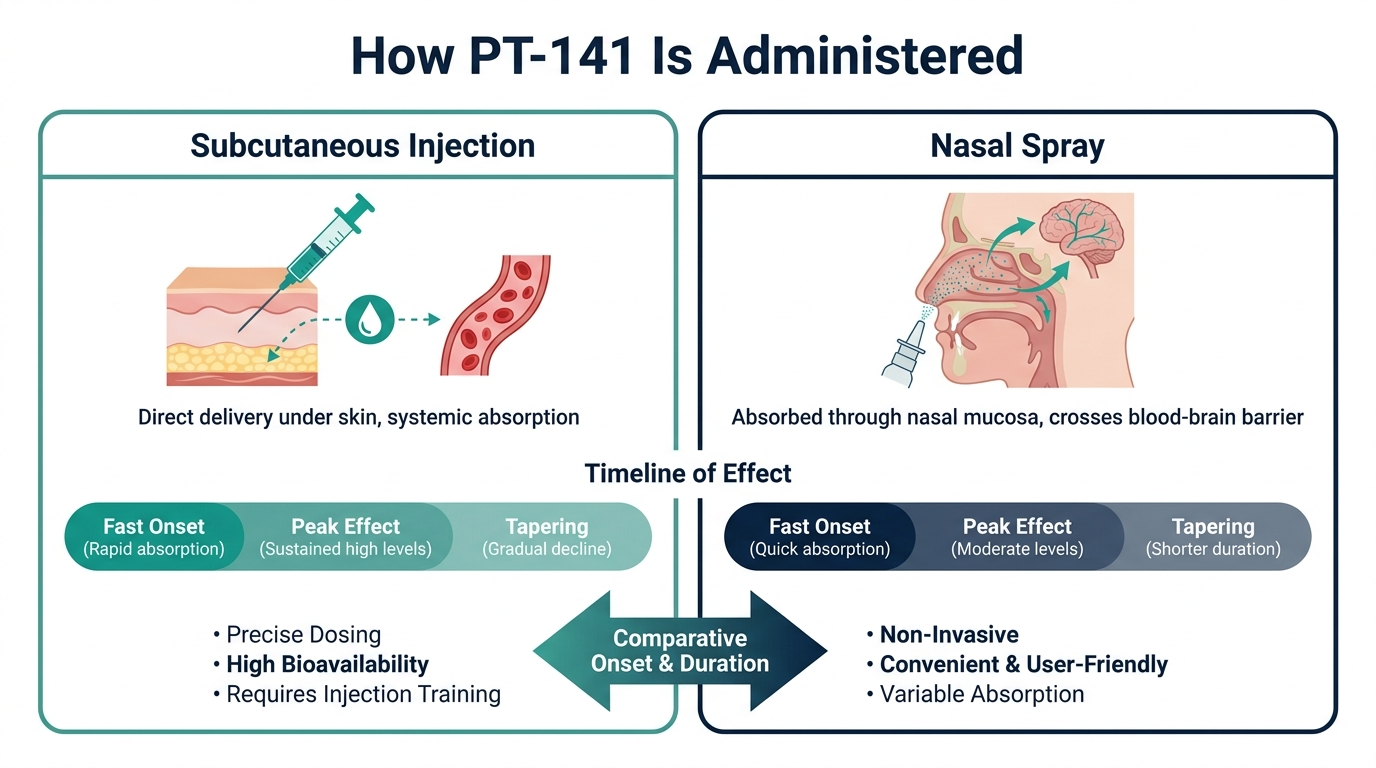
Route 2: Compounded bremelanotide via telehealth. This is the fastest-growing access route in 2026. Licensed telehealth platforms prescribe compounded PT-141 (injectable vials or nasal spray) through 503A compounding pharmacies. Pricing runs $50 to $150 per month for the medication, plus a consultation fee of $75 to $175, often waived on the first visit. Platforms that offer this include Hims, Eden, AlphaMD, and Hello Cake (the latter specifically for women’s HSDD). Nasal spray formulations (10 mL multi-dose) run $80 to $150 per month. Compounded PT-141 is not FDA-approved as a finished drug product, but it is legally dispensed when prescribed by a licensed clinician and filled by a compliant compounding pharmacy.
Route 3: Research-grade vendors. Grey-market research peptide vendors sell PT-141 labeled “for research use only” at $30 to $60 per 10 mg vial. These products are not FDA-evaluated, purity is not guaranteed without an independently verifiable Certificate of Analysis, and no clinician is involved. Given that a legal, clinician-supervised compounded route now costs only marginally more than the grey-market option, there is very little argument for choosing the research-vendor route for anything you intend to use on yourself.
Telehealth GLP-1 program with provider visits and pharmacy coordination.
What do insiders know about PT-141 that the product pages skip?
A few things rarely make it into the glossy telehealth landing pages.
The “warm-up” period is real. Patients who experience significant nausea on dose one often quit before dose two, which is a shame, because dose two and three typically have substantially lower nausea rates. Titrating up from 0.5 mg rather than starting at 1.75 mg is standard practice in experienced clinical settings, even though it is not in the Vyleesi label. Any clinician who starts every patient at the full dose without offering a titration protocol is not optimizing for tolerability.
The timing window matters more than people realize. Vyleesi is labeled at 45 minutes before activity. In practice, many patients find the window of peak effect runs from 45 minutes to 3 hours post-injection. Planning activity for the 1.5 to 2 hour mark tends to catch the peak desire effect while avoiding the worst of the nausea window. Individual pharmacokinetics vary enough that the first dose is essentially a calibration run.
PT-141 is not on the World Anti-Doping Agency (WADA) prohibited list and is not a controlled substance under the Controlled Substances Act. This is relevant for competitive athletes who use telehealth for various optimization protocols and worry about testing.
The nasal spray formulation has lower bioavailability than subcutaneous injection, typically in the range of 50 to 70% of the injectable dose being absorbed. This is why the injectable route tends to produce cleaner, more predictable effects per dose. The nasal spray is popular because patients prefer not to inject, but the tradeoff is reduced dose consistency.
Who is a good candidate for PT-141 therapy?
PT-141 is most clinically appropriate for people whose sexual dysfunction originates in low desire rather than mechanical performance issues, specifically:
- Premenopausal women with acquired, generalized HSDD (the FDA-approved indication)
- Men with confirmed low libido who do not respond to PDE5 inhibitors alone, particularly where the underlying cause is psychogenic or neurological rather than purely vascular
- Patients who have ruled out hormonal causes (low testosterone, thyroid disorders) as the primary driver of low desire
- People who want on-demand treatment rather than daily medication
PT-141 is not appropriate for people with cardiovascular disease, significant hypertension, or who take nitrate-based medications. It is not a performance enhancer for people who already have normal desire. And critically, it is not a substitute for addressing the root cause when low desire traces back to a correctable hormonal imbalance.
A note that applies to roughly half the patients who come in asking for PT-141: if your testosterone is low or your thyroid is subclinical hypothyroid, no melanocortin agonist is going to compensate for that. Get the labs first.
Don’t just read about your health, track it.
A single result is a snapshot. Superpower re-tests 100+ markers over time so you can watch them move as you change sleep, food, and training.
Frequently asked questions
What is PT-141 and how is it different from Viagra?
PT-141 (bremelanotide) is a synthetic peptide that activates melanocortin receptors in the brain to generate sexual desire. Viagra works in the penis by blocking the PDE5 enzyme to increase blood flow. Viagra requires pre-existing arousal to work; PT-141 creates desire without a prior stimulus. They address different phases of sexual function and are sometimes used together.
Is PT-141 FDA-approved?
Yes, but only for one specific indication: acquired, generalized hypoactive sexual desire disorder (HSDD) in premenopausal women, under the brand name Vyleesi, approved June 2019. Its use in men and in postmenopausal women is off-label.
What are the most common PT-141 side effects?
Nausea affects approximately 40% of users, most severely after the first dose and improving with subsequent doses. Transient blood pressure elevation (6 to 8 mmHg systolic) occurs in most users and resolves within 12 hours. Facial flushing occurs in roughly 20% of users. With frequent overuse (more than 8 times per month), hyperpigmentation of the face, gums, or breast tissue can develop.
How much does PT-141 cost?
Branded Vyleesi costs $800 to $1,000 per 4-dose kit without insurance, or $200 to $250 per dose. Compounded bremelanotide through a licensed telehealth clinic runs $50 to $150 per month for medication. Insurance does not typically cover either route; it is a cash-pay treatment.
Can men use PT-141?
Yes, off-label. PT-141 is not FDA-approved for men, but Phase 2 clinical data supports its use in male sexual dysfunction, particularly low libido and psychogenic or neurological erectile dysfunction. A Phase 3 trial combining bremelanotide with a PDE5 inhibitor for men was planned to start in 2025. Prescriptions are available through telehealth clinics specializing in men’s sexual health.
How long does PT-141 take to work?
Onset of desire effects typically begins 45 minutes to 1 hour after subcutaneous injection. Peak effect is usually at 1.5 to 2 hours. The window of effect can last 6 to 12 hours, though desire intensity peaks earlier. The labeled window is 45 minutes before anticipated sexual activity.
Is PT-141 the same as the “Barbie drug”?
No. The “Barbie drug” is a nickname for Melanotan-II, a related but distinct compound used (illegally and dangerously) as a tanning agent. PT-141 was derived from Melanotan-II by Palatin Technologies, specifically refining out the tanning-related activity and retaining the CNS-active libido component. The two share an origin but are different molecules with different safety profiles and regulatory status. Melanotan-II is not FDA-approved for anything and carries serious risks including melanoma.
Telehealth GLP-1 program with provider visits and pharmacy coordination.
Author: Vital Signs Today Editorial Team. Educational content, not medical advice. Sources linked inline.
Primary sources:
- FDA Vyleesi Approval (June 2019)
- RECONNECT Phase 3 trial data via PeptideDeck
- Clayton et al. 2022, JCI: MC4R agonism enhances sexual brain processing in HSDD
- Frontiers in Endocrinology: MC4R in Sim1 neurons and sexual receptivity
- Telehealth Ally PT-141 Guide 2026
- PeptideDeck: How to Get PT-141 in 2026
- Vyleesi.com: Cost FAQ
- Boston Medical Group: PT-141 vs Viagra comparison
- Healthon: Bremelanotide for men
- PubMed: Double-blind intranasal PT-141 in men with ED
- Palatin Technologies: Bremelanotide development history
- MedLinx: “Barbie Drug” vs PT-141 distinction
Related reading
Vital Signs Today may earn a commission if you buy through links on this page. It does not affect our editorial assessments.