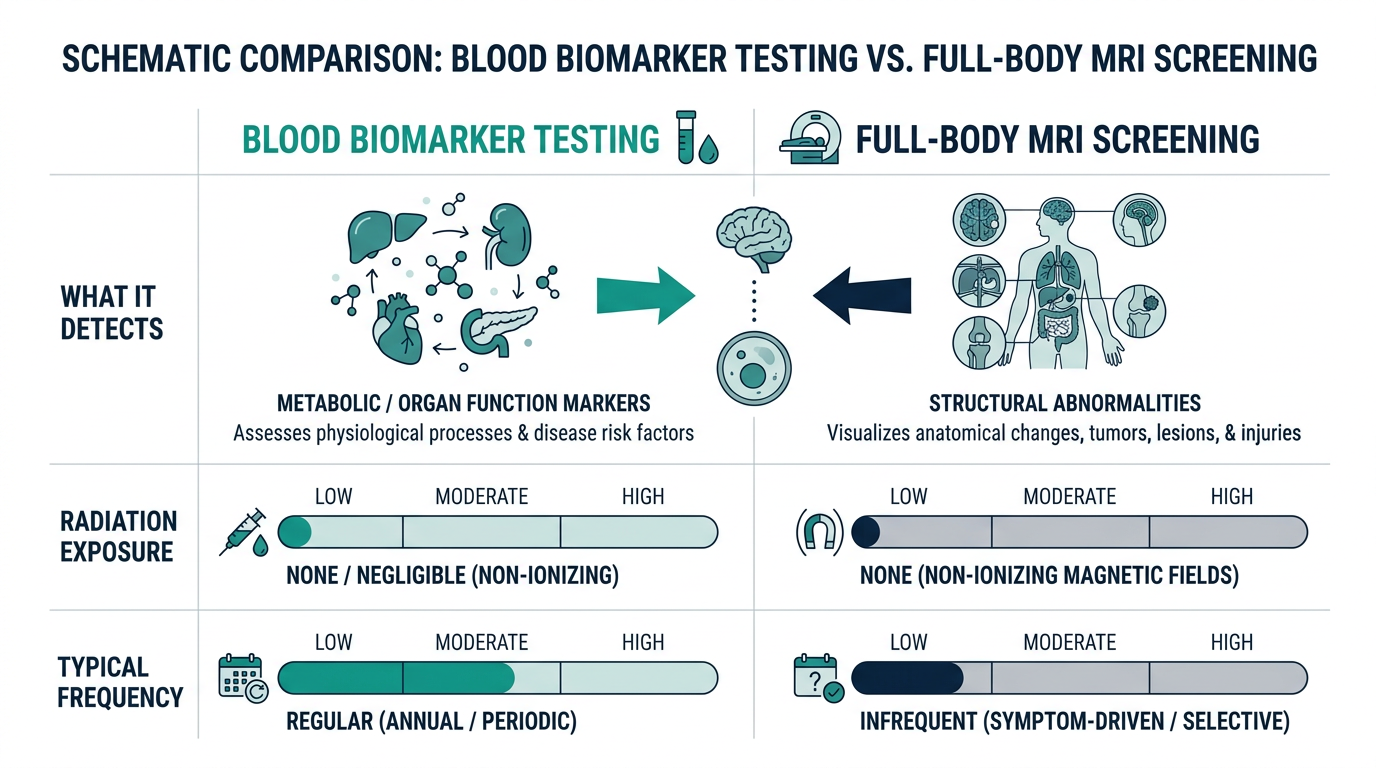
Quick answer: In the function health vs Prenuvo comparison, the two services are not competitors, they answer completely different questions. Function runs 100-plus blood and urine biomarkers to reveal what is happening inside your cells: metabolic dysfunction, hormonal imbalance, nutrient deficiencies, early organ stress. Prenuvo is a whole-body MRI that hunts for structural abnormalities: tumors, aneurysms, organ lesions, and soft-tissue masses you cannot detect with any lab panel. Most prevention-minded adults should start with a thorough blood panel and add imaging only after they understand their baseline biochemistry, primarily because blood testing costs roughly one-tenth of what Prenuvo charges and delivers answers that are immediately actionable through lifestyle and medication changes.
What Function Health and Prenuvo actually test
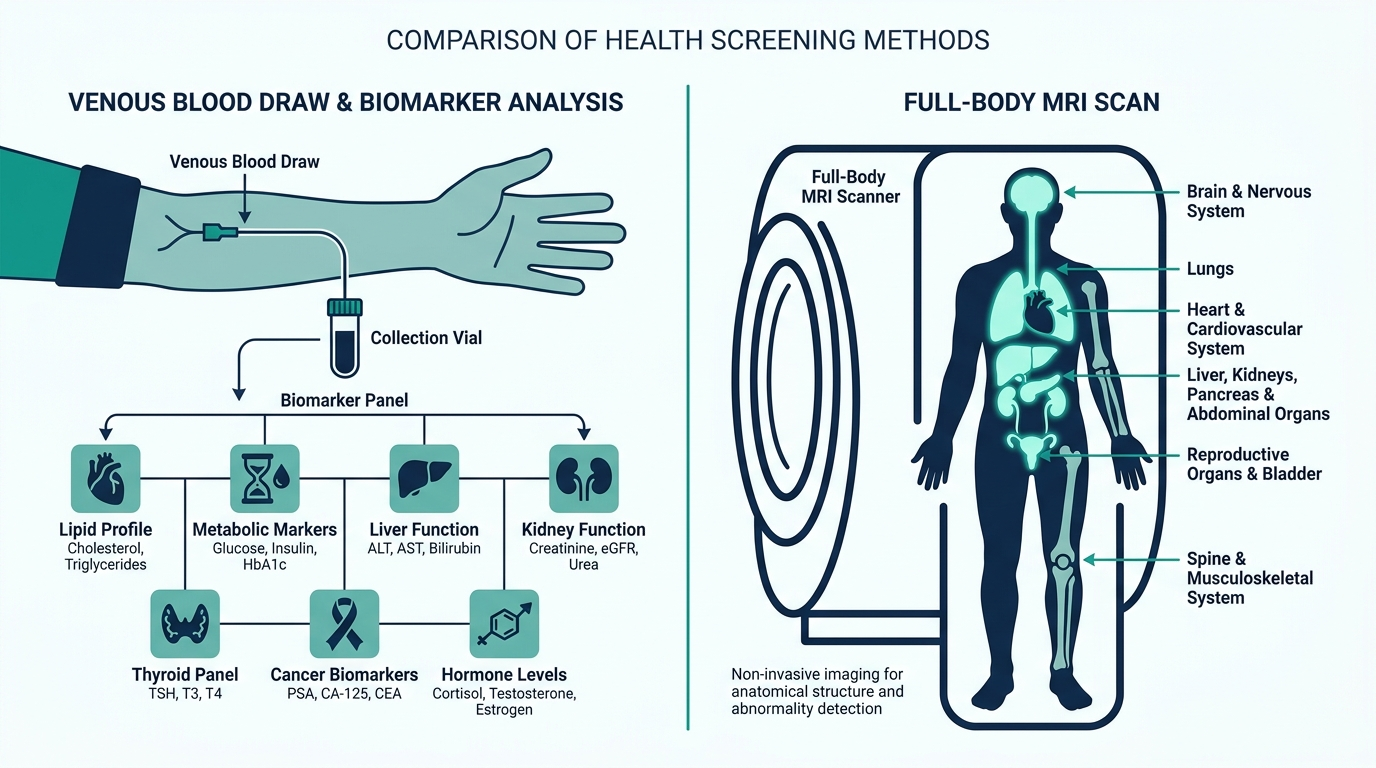
The core difference between Function Health and Prenuvo is the type of signal each one captures. Function draws blood and urine, then sends it to CLIA-certified labs. The panel covers thyroid (TSH, free T3, free T4, reverse T3, TPO antibodies), metabolic markers (fasting glucose, insulin, HbA1c, full lipid fractionation including LDL particle size), liver enzymes, kidney function, complete blood count with differential, inflammatory markers (hs-CRP, homocysteine), vitamin and mineral levels, sex hormones, and more. You get a number for each marker, a reference range, and a trajectory if you have retested. That data tells you whether your glucose is creeping toward prediabetes territory, whether your ferritin is depleted, or whether your testosterone has dropped 40 percent in three years.
Blood biomarkers and full-body MRI answer different questions. See what 100+ biomarkers reveal about what’s happening in your cells. One at-home Superpower draw checks 100+ biomarkers, physician-reviewed.
Prenuvo works differently. You lie inside a 3-Tesla MRI scanner for 60 to 90 minutes while the machine generates cross-sectional images of your brain, spine, chest, abdomen, and pelvis. No ionizing radiation, no contrast dye (in the standard scan). The radiologists review for structural lesions: a 4mm brain aneurysm, a suspicious renal mass, a liver hemangioma that warrants follow-up, a small pulmonary nodule. What Prenuvo cannot tell you is whether your insulin resistance is worsening, what your LDL particle count is, or whether you are heading toward hypothyroidism. Blood biomarkers simply do not show up on MRI images.
Put bluntly: blood panels catch the metabolic and inflammatory processes that drive 80 percent of chronic disease before structural damage appears. Imaging catches structural damage after it has formed. Both matter. But if you can only afford one right now, the blood panel comes first.
How much does Prenuvo cost in 2026?
Prenuvo pricing runs from about $999 for a focused scan (head and spine) to roughly $2,499 for the full-body scan that includes brain, spine, chest, abdomen, and pelvis as a combined study. Most people discussing Prenuvo are referring to the full-body option, which is the $2,499 price point at their US clinics in cities including San Francisco, New York, Dallas, and Chicago. Insurance almost never covers preventive whole-body MRI. HSA and FSA dollars can technically pay for it if a physician orders it for a specific medical reason, but purely elective screening is a stretch under current IRS guidelines.
Function Health costs $499 per year for the core membership, which includes two full lab draws annually. That is a 5-to-1 price ratio compared to a single Prenuvo scan. For the detail on what each tier of Function’s membership actually includes, the function health cost breakdown covers exact line items. Competitors like Superpower price their annual membership at about $199 per year, making the cost gap with Prenuvo even wider.
| Feature | Function Health | Prenuvo (Full Body) |
|---|---|---|
| What it tests | Blood and urine biomarkers (100+) | Structural anatomy via MRI |
| 2026 price (typical) | $499/year (2 draws) | ~$2,499 per scan |
| Ionizing radiation | No (blood draw only) | No (MRI, not CT) |
| Catches metabolic dysfunction early | Yes | No |
| Catches structural lesions | No | Yes |
| Actionable lifestyle changes from results | Immediate and specific | Limited unless finding is positive |
| Physician review of results | Yes (included) | Yes (radiologist reads) |
| Insurance coverage | Sometimes (if ordered separately) | Almost never for elective screening |
| Frequency recommended | 1 to 2 times per year | Every 1 to 3 years |
Is Prenuvo worth it?
Prenuvo is worth it for a specific subset of people, not universally. The clearest case for Prenuvo is someone with a meaningful family history of cancer, aneurysm, or other structural disease who wants to establish a baseline scan, or someone in their 50s and 60s who already knows their blood biomarkers are solid and wants to add a structural layer. The scan has genuine value: Prenuvo has published data showing a meaningful percentage of scans return at least one actionable finding in asymptomatic adults. Catching a small renal cell carcinoma before symptoms appear is real, potentially life-saving medicine.
The case against Prenuvo as a first step is straightforward. If your blood work shows insulin resistance, dyslipidemia, chronic inflammation, or a hormone abnormality, those are the things most likely to kill you over the next decade. Fixing them is directly within your control through diet, exercise, medication, or supplementation. A Prenuvo scan will not tell you any of that, and spending $2,499 on imaging when your metabolic house is unknown is a poor use of healthcare dollars. There is also the problem of incidentalomas: findings that look unusual on MRI but are benign, which trigger expensive follow-up imaging, biopsies, and anxiety. Studies in general radiology literature suggest incidental findings appear in 30 to 40 percent of whole-body MRI scans in asymptomatic adults.
The right mental model: Prenuvo is insurance against being surprised by a structural event. Blood biomarker testing is a dashboard telling you where your physiology is headed right now. Most 35 to 55 year olds will get far more decision-relevant information from the dashboard.

Full-body MRI vs blood test: what each one can and cannot catch
Understanding which diseases each modality detects is the most practical way to decide which to prioritize. Here is where blood biomarkers clearly win: insulin resistance and prediabetes (fasting insulin, glucose, HbA1c), early liver fibrosis risk (ALT, AST, GGT trends), hypothyroidism and thyroid autoimmunity (TPO antibodies years before symptoms), anemia and iron overload, vitamin D deficiency, dyslipidemia including elevated small dense LDL, chronic low-grade inflammation predictive of cardiovascular risk, testosterone and estrogen decline, cortisol dysregulation, and kidney filtration decline (eGFR, cystatin C). None of those show up on MRI.
Here is where Prenuvo has a clear edge: solid organ masses (kidney, liver, adrenal, ovarian), brain aneurysms and AVMs, spinal cord compression, early multiple sclerosis lesions, aortic aneurysm, and certain lymph node abnormalities. Notably, Prenuvo does not replace a mammogram, colonoscopy, or DEXA scan. It does not assess breast tissue as thoroughly as dedicated breast MRI. It is one layer of imaging, not a complete cancer screening program.
One nuance that surprises many people: a full-body MRI does not reliably detect pancreatic cancer until it is fairly large, does not detect prostate cancer as reliably as a dedicated prostate MRI with endorectal coil, and misses lung cancer detection that a low-dose CT (LDCT) handles better for high-risk smokers. Prenuvo is a generalist screening tool, not a replacement for organ-specific screenings.
Prenuvo vs blood biomarker testing: the sequencing argument
The strongest argument for doing blood biomarkers before Prenuvo is sequencing logic. If your blood panel comes back clean, you have meaningful evidence your metabolic processes are healthy, which changes the calculus of structural screening. If your panel reveals problems, you fix those first, and your risk profile for structural disease likely improves before you ever step into an MRI scanner.
Consider a 42-year-old with no symptoms. Blood work reveals fasting insulin of 18 uIU/mL (insulin resistant), small dense LDL pattern B, hs-CRP of 3.8 mg/L, and testosterone at the bottom quartile. Every one of those findings has a direct intervention. Two years of dietary change, resistance training, and targeted supplementation can move those numbers substantially. At that point, a Prenuvo scan is capturing a genuinely different (improved) physiological snapshot. Doing Prenuvo first would have missed all of that metabolic data entirely.
The sequencing argument is not about dismissing MRI. It is about recognizing that most people in their 30s and 40s have far more modifiable risk than structural risk, and blood biomarkers are the tool that quantifies modifiable risk. Our function health review covers how the panel design is built around exactly this insight.
The simplest way to actually get this done
Superpower is a full-body lab membership that runs 100+ biomarkers, has each result reviewed by a doctor, and tracks your numbers year over year (about $199/year). It is what we point readers to when they would rather get one clean, complete draw than chase single tests one at a time. Here is superpower blood test reviewed in full.
Should I get a Prenuvo scan?
You should seriously consider Prenuvo if you are over 45 and have not had comprehensive imaging, if you have a first-degree relative with aneurysm or early-onset solid-organ cancer, if you have already nailed down your blood biomarkers and want an additional layer, or if you simply want the peace of mind that structural screening provides and can afford it without financial stress. The scan is not a scam. The radiologists are real, the MRI technology is excellent, and positive findings are clinically meaningful.
You should deprioritize Prenuvo if you do not know your metabolic numbers, if the $2,499 cost would strain your budget in a meaningful way, or if you are under 35 with no family history. In those cases, a comprehensive blood panel and the resulting interventions will do more for your long-term health trajectory than a structural snapshot.
One practical note: Prenuvo is not available everywhere. US locations as of 2026 include San Francisco, Los Angeles, New York, Dallas, Chicago, Atlanta, and a few others. If you live outside those metros, travel time and hotel costs add to the real price. Quest Diagnostics and Labcorp have thousands of draw sites nationwide, and mail-in options exist for many biomarker panels if you want to compare accessibility.
Combining Function Health and Prenuvo: who should do both?
A genuinely comprehensive preventive health program for a high-achieving 50-year-old probably includes both. The blood panel runs twice a year and tracks your metabolic trajectory continuously. The full-body MRI runs every two to three years and checks structural health. Together they cover the two main ways serious disease announces itself: biochemical drift over years and structural lesions that appear between lab draws.
The people who realistically combine both tend to be high earners who treat health as a capital investment, those with strong family histories on both fronts, and anyone who has already discovered a biomarker abnormality and wants to rule out downstream structural consequences (for example, someone with a 10-year history of metabolic syndrome who wants to know if their liver looks normal on MRI). For comparison purposes, if you are deciding between Function and alternatives in the blood-testing space, the function health vs 10x health comparison and function health vs empirical health breakdown cover the competitive landscape on the biomarker side.
For those who want the blood-testing layer but find Function’s $499 annual price harder to justify, Superpower’s $199 annual membership delivers a comparable 100-plus biomarker panel with physician review, and the how much does superpower cost page covers exactly what is included. Getting the blood baseline established is the move that makes every other screening decision smarter.

What people get wrong about MRI screening vs lab panels for prevention
The biggest misconception is that a clean MRI means you are healthy. It means you have no visible structural abnormalities at the time of the scan. Insulin resistance, early kidney disease, dyslipidemia, and chronic inflammation are essentially invisible on MRI until they have caused end-organ structural damage. A person can have completely normal Prenuvo results and be five years into a metabolic trajectory toward type 2 diabetes and cardiovascular disease.
The second misconception is that blood tests only catch things that are already wrong. Biomarkers like fasting insulin, ApoB, hs-CRP, and LP(a) are predictive, not just diagnostic. They tell you the direction your physiology is trending before any disease state meets clinical threshold. That predictive window is exactly why the longevity medicine community focuses so heavily on blood panels as the primary tool.
Third, people assume no radiation means no downside for MRI. MRI itself is safe, but the incidentaloma problem is real. Finding a 6mm adrenal nodule on a Prenuvo scan that turns out to be benign after a follow-up CT and possible biopsy is not a costless outcome. The psychological burden, the radiation from follow-up imaging, and the financial cost of the workup are legitimate considerations. That does not make screening wrong, but it means informed consent requires knowing this risk exists. Talk to a clinician familiar with preventive imaging before booking, particularly if you are prone to health anxiety.
The screenings neither Function nor Prenuvo replaces
It is easy to assume a big blood panel plus a full-body MRI covers you completely. It does not. Several evidence-based screenings sit outside both, and skipping them because you “already did Prenuvo” is a genuine risk. These are the guideline-backed screenings that stand on their own:
- Colorectal cancer screening from age 45. The U.S. Preventive Services Task Force recommends screening for colorectal cancer starting at 45, with colonoscopy and stool-based tests among the accepted options (USPSTF). A whole-body MRI does not reliably catch early colon lesions, and blood work does not either.
- Mammography for breast cancer. USPSTF recommends screening mammography for women in the roughly 40 to 74 age range. A general full-body MRI does not assess breast tissue as thoroughly as dedicated breast imaging.
- Low-dose CT for lung cancer in eligible smokers. For adults with a significant smoking history in the recommended age window, low-dose CT is the screening tool of choice, not a general MRI.
- Bone density (DEXA) and cervical screening follow their own age-based schedules and are not covered by either service.
The takeaway: think of Function or Superpower as your biochemical dashboard and Prenuvo as a structural snapshot, but keep the standard, guideline-driven screenings running on their own timetable regardless of what those two tell you.
How to prepare for a whole-body MRI so the results are usable
If you do book a Prenuvo-style scan, a little preparation improves both comfort and image quality. The scan itself is straightforward, but people are often caught off guard by the logistics.
- Plan for the enclosed time. You will lie still inside the bore of the scanner for roughly an hour or more. If you are claustrophobic, tell the clinic in advance and ask what accommodations they offer, because staying still is what keeps the images sharp.
- Leave all metal at home. Jewelry, watches, and clothing with metal fasteners interfere with an MRI. Wear simple, metal-free clothing or expect to change into a gown.
- Disclose implants and devices. Pacemakers, certain aneurysm clips, cochlear implants, and some older metallic implants are safety concerns in an MRI environment. Report every implant and device during screening; this is non-negotiable for your safety.
- Follow any fasting or bladder instructions. Some abdominal and pelvic protocols ask you to arrive with a specific bladder state or after a light-food window. Following those instructions keeps the abdominal and pelvic images clean.
- Bring your context. Have your family history and any prior imaging available, because the value of a scan rises when the radiologist can interpret findings against your actual risk background.
Good preparation is the cheapest way to avoid a repeat scan or an ambiguous read, both of which cost far more than the ten minutes it takes to prepare properly.
What to do if a scan finds something incidental
The single most underdiscussed part of elective imaging is what happens when the scan flags a small, probably-benign finding, the incidentaloma. Because these are common on whole-body MRI, having a calm plan matters more than most people expect.
- Do not panic, and do not act unilaterally. A large share of incidental findings are benign. The reflex to immediately pursue aggressive workup is exactly what drives unnecessary cost and radiation.
- Take the report to a physician who knows you. The right next step depends on the finding, your age, your history, and your symptoms. A clinician can tell you whether a finding warrants watchful waiting, a follow-up scan in several months, or nothing at all.
- Ask about the follow-up cascade before agreeing to it. A follow-up CT carries radiation, and a biopsy carries its own small risks. Understand the trade-offs of each proposed step rather than defaulting to “just check it.”
- Weigh the anxiety cost honestly. If you are prone to health anxiety, an ambiguous finding can be its own harm. That is a legitimate factor to discuss with your clinician when deciding how aggressively to chase a low-probability result.
Knowing this cascade exists is part of informed consent. It does not mean screening is wrong; it means you go in understanding that a “finding” is often the start of a decision, not an automatic diagnosis. Talk to a clinician familiar with preventive imaging before booking, especially if you know you tend toward health anxiety.
A sensible preventive stack by age and risk
Rather than choosing one tool, most people are better served by layering the right tools at the right time. Here is a reasonable way to think about it, adjusted up or down for your personal and family risk.
- 20s and early 30s: establish a comprehensive blood biomarker baseline, keep up with age-appropriate primary care, and act on any metabolic or nutrient issues. Structural imaging is rarely the priority here absent a specific reason.
- Mid 30s to 40s: retest biomarkers regularly to catch trends in glucose, lipids, and inflammation early, since these are the highly modifiable risks in this window. Begin the standard guideline screenings as you reach their recommended ages.
- 45 and up: stay current on colorectal and other guideline screenings, keep the biomarker cadence, and this is where a full-body MRI starts to earn its place, particularly with a relevant family history or a clean but curious metabolic baseline.
- Any age with strong family history of structural disease: an earlier baseline scan can be reasonable, ideally after your blood biomarkers are understood, so the imaging adds a layer rather than substituting for the cheaper, more actionable data.
The unifying logic across every age band is the same: quantify and fix the modifiable, biochemical risk first because it is cheaper and more actionable, then add structural imaging as a complementary layer once that foundation is in place.
Curious what your own levels look like?
Baseline 100+ biomarkers today and retest as life changes, all in one membership with physician review.
FAQ
Is Function Health better than Prenuvo?
They are not directly comparable because they test different things. Function Health is better for understanding your metabolic, hormonal, and nutritional status. Prenuvo is better for detecting structural abnormalities like tumors and aneurysms. Most people benefit more from starting with blood biomarkers because the findings are more immediately actionable and the cost is significantly lower.
What does Prenuvo cost in 2026?
Prenuvo’s full-body MRI scan runs approximately $2,499 at US locations as of 2026. A focused head-and-spine scan is available for less, around $999. Neither is typically covered by insurance for elective preventive screening, though HSA or FSA funds may be usable with appropriate medical documentation.
Can Prenuvo replace annual blood work?
No. MRI imaging cannot measure glucose, cholesterol, insulin, inflammatory markers, hormone levels, vitamins, or kidney and liver enzymes. These are biochemical values that only blood and urine analysis can reveal. Prenuvo and blood panels are complementary tools, not substitutes for each other.
Does Prenuvo detect cancer early?
Prenuvo can detect certain solid-organ cancers at early stages, including renal cell carcinoma, liver masses, and some lymph node abnormalities. It is less reliable for prostate cancer (compared to dedicated prostate MRI), lung cancer (where low-dose CT is the recommended screening tool for high-risk individuals), and pancreatic cancer at very early stages. It is not a substitute for colonoscopy, mammography, or other organ-specific cancer screenings.
What is the main difference between a full-body MRI and a blood test for prevention?
A full-body MRI captures structural anatomy, the physical architecture of your organs. A comprehensive blood panel captures biochemical function, what your organs are actually doing at the cellular level. Structural disease is often a downstream consequence of years of biochemical dysfunction, which is why blood biomarkers tend to signal problems earlier and more actionably.
Should I get Prenuvo before or after blood testing?
Blood testing first is the stronger sequence for most people under 55 without a significant family history of structural disease. Your blood biomarkers will reveal whether lifestyle changes are needed immediately, and that information is valuable regardless of what imaging shows. Once your metabolic baseline is established, you can make an informed decision about whether structural imaging adds enough additional information to justify the cost.
Is a full-body MRI covered by insurance?
Almost never for elective preventive screening. Most commercial insurers in the US classify whole-body MRI for asymptomatic adults as not medically necessary and deny claims. If you have a specific symptom or documented risk factor that justifies imaging, a physician can order a targeted MRI that may be covered. HSA and FSA funds can sometimes cover Prenuvo if a letter of medical necessity is obtained, but this requires coordination with your physician and is not guaranteed.
How does Superpower compare to Prenuvo for preventive health?
Superpower is a blood-biomarker membership at about $199 per year that tests 100-plus markers with physician review, sitting in the same category as Function Health but at a lower price point. Prenuvo is structural imaging at roughly $2,499 per scan. They target different aspects of health, and the superpower blood test review covers what the panel includes in detail. For someone building out a preventive health stack, Superpower or Function typically comes first, with Prenuvo added once the blood baseline is understood.
Vital Signs Today may earn a commission if you buy through links on this page. It does not affect our editorial assessments.