Quick answer: A health screening is a test you take while you feel fine, to catch a problem early enough to do something about it. It is checking, not diagnosing. The screenings that matter change with your age and sex: blood pressure and a lipid and glucose blood panel start in your twenties, colon and breast or cervical cancer checks ramp up in your forties and fifties, and bone density and aneurysm checks arrive in your sixties. The goal is simple. Find the silent stuff (high blood pressure, prediabetes, early cancer) before it announces itself.
What is a health screening, exactly?
A health screening is a test given to people who have no symptoms, to find a disease or risk factor early. That is the whole point, and it is the line that separates screening from diagnostic testing. When you get an A1C drawn at your annual physical because you feel normal, that is screening. When you get the same A1C because you are thirsty all the time and losing weight, that is diagnostic. Same blood, different intent, and often a different bill.
Standard screenings by age catch a handful of issues. See what shows up when you check 100+ biomarkers at once. One at-home Superpower draw checks 100+ biomarkers, physician-reviewed.
That distinction is not academic. Under the Affordable Care Act, a long list of preventive screenings is covered at zero cost to you when they are coded as screening. The catch most people never hear about: if the doctor adds a symptom or the lab finds something and reruns it, the visit can flip to diagnostic and the deductible kicks in. It is worth asking your clinician to keep a routine check coded as preventive when it truly is one.
Screening only earns its place when the math works. There has to be a test that is reasonably accurate, a disease worth catching early, and a treatment that changes the outcome. Public-health bodies call these the Wilson and Jungner criteria, and they are stricter than most people assume. The test has to be safe and acceptable, because you are doing it to people who feel fine, and catching the condition early has to actually help, not just give you more years of knowing about something you cannot change. That is why there is no national prostate or ovarian cancer screen for everyone, but there is one for colon cancer. The colon test catches polyps you can remove before they ever turn into cancer.
There is a second reason screening is selective: every screen has a cost beyond money. A test that flags too many healthy people sends them into biopsies, scans, and anxiety they never needed. Doctors call this overdiagnosis, and it is the main argument against screening everyone for everything. When you see a guideline say a test starts at 45 instead of 25, that gap is usually the false-alarm math, not laziness.
Screening vs diagnostic: why the same test gets billed two different ways
The single most useful thing to understand about screening is that the same blood draw or scan can be billed as either a free preventive screen or a deductible-eligible diagnostic test, and the only thing that changes is the reason your clinician wrote on the order. This is not a loophole. It is how billing codes work, and it costs people real money every day because nobody explains it.
Here is the mechanism. When a test is ordered with a preventive code (no symptoms, routine, age-appropriate), the Affordable Care Act forces most plans to cover it with no copay and no deductible. When the same test is ordered with a diagnostic code (you reported a symptom, or a prior result was abnormal and is being followed up), it falls under your normal cost-sharing, which means you might owe the full negotiated price until your deductible is met.
| Situation | Likely coding | What you pay |
|---|---|---|
| Routine A1C at your annual physical, no symptoms | Preventive screening | Usually $0 |
| A1C ordered because you mentioned thirst and fatigue | Diagnostic | Subject to deductible |
| First-ever screening colonoscopy at 45, no symptoms | Preventive screening | Usually $0 |
| Colonoscopy because a stool test came back positive | Diagnostic | Often subject to cost-sharing |
| Mammogram on schedule with no lump | Preventive screening | Usually $0 |
The insider move is simple. Before any routine test, ask: is this being ordered as preventive screening or diagnostic? The classic trap is the screening colonoscopy that finds and removes a polyp. In many plans, the polyp removal can flip the procedure to diagnostic and trigger a bill, which feels like a punishment for the test doing its job. Federal rules have tightened this for colonoscopies specifically, but it still surprises people, so confirm coverage before the procedure, not after.
What are the screening tests almost every adult should get?
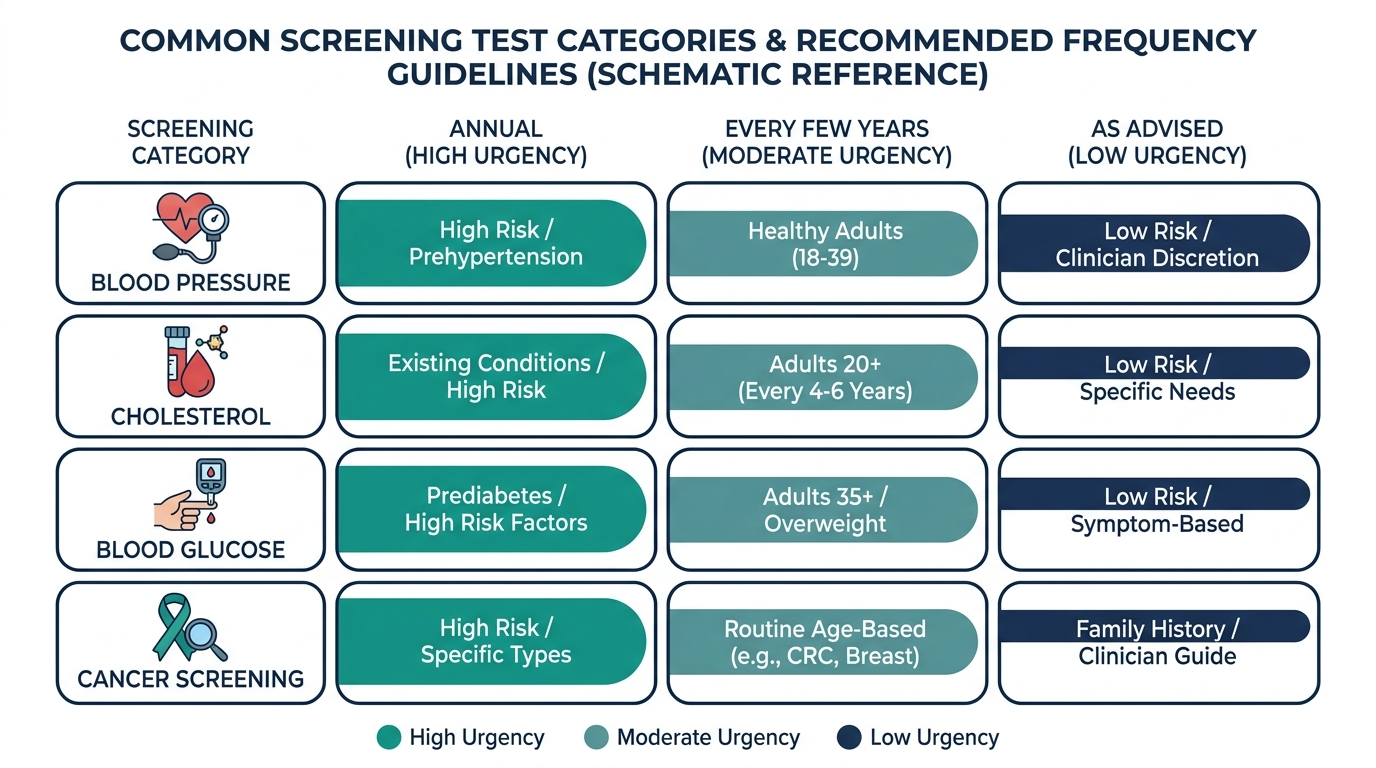
A handful of screening tests apply to nearly every adult, regardless of how you feel, and most cost little or nothing with insurance.
- Blood pressure. Checked at essentially every visit from your twenties on. High blood pressure has no symptoms until it has done damage, which is exactly why it gets measured so often.
- Cholesterol (a lipid panel). A blood draw that measures total, LDL, HDL, and triglycerides. Start in your twenties if you have risk factors, and by your thirties or forties for everyone. Fasting matters here mostly for triglycerides, not for the LDL number itself.
- Blood glucose or A1C. Screens for prediabetes and diabetes. The A1C is convenient because it does not require fasting, reflecting your average sugar over about three months.
- Depression and tobacco and alcohol use. Short questionnaires count as screening too. They catch things a blood test never will.
These four anchor the rest. Blood pressure and the blood panel together flag the conditions that quietly drive the most heart attacks and strokes, and they form the backbone of routine bloodwork. If you want the full picture of which values are on a standard draw, this breakdown of a complete blood panel covers what each one means.
What each core screen is actually catching
It helps to know what disease sits behind each routine check, because the abstract number on a portal means little until you connect it to the thing it is guarding against.
| Screen | What it measures | What it is catching early |
|---|---|---|
| Blood pressure | Force of blood against artery walls | Hypertension, the top driver of stroke and heart and kidney damage |
| Lipid panel | LDL, HDL, total cholesterol, triglycerides | Atherosclerosis risk, the plaque buildup behind most heart attacks |
| A1C or fasting glucose | Average or current blood sugar | Prediabetes and type 2 diabetes, often years before symptoms |
| Colonoscopy or stool test | Polyps and blood in stool | Colorectal cancer and the polyps that become it |
| Mammogram | Density and masses in breast tissue | Breast cancer, often before it can be felt |
| Pap and HPV test | Abnormal cervical cells and high-risk HPV | Cervical cancer and the precancer that precedes it |
| DEXA scan | Bone mineral density | Osteoporosis and fracture risk |
Notice the pattern. Almost every one of these targets a condition that is silent in its early, treatable phase and loud only once it is hard to reverse. That is not a coincidence. It is the entire design brief for a screening test.
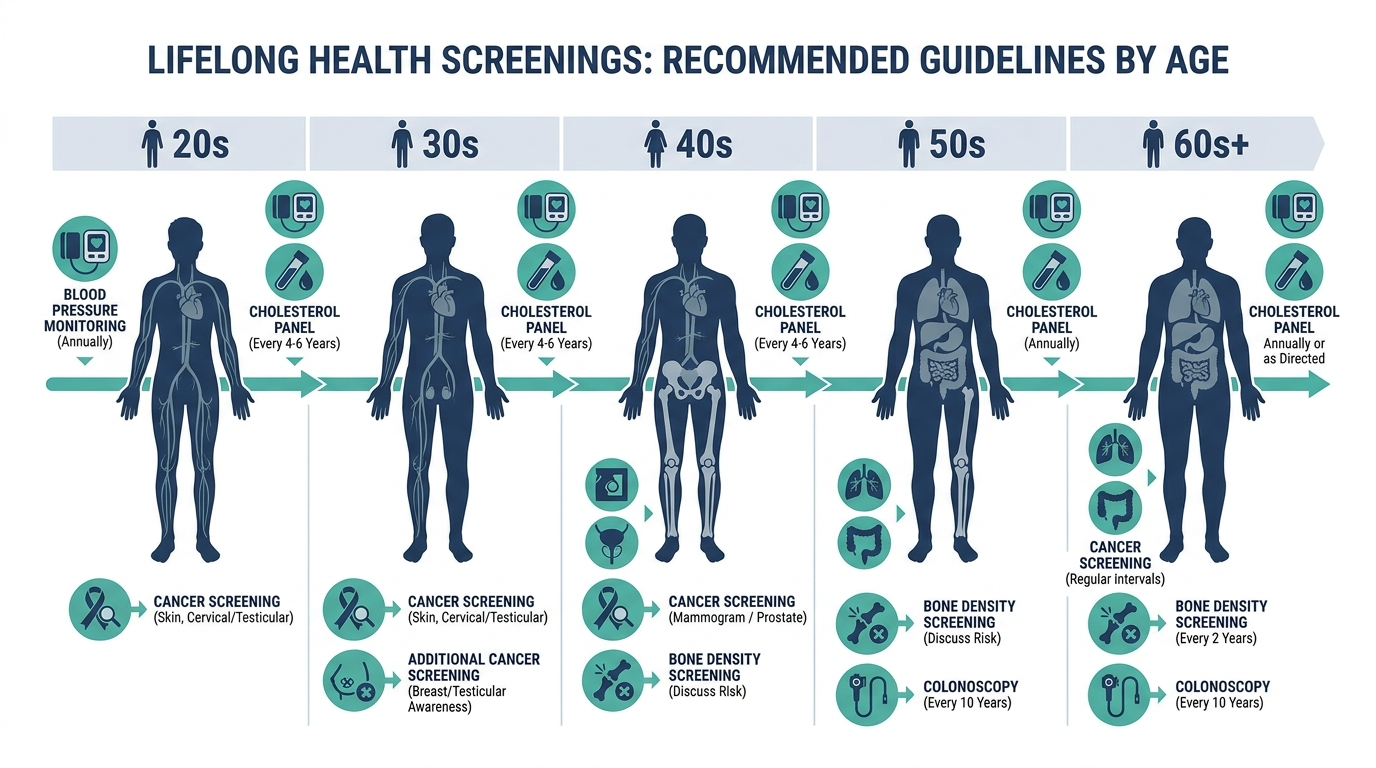
Health screening schedule by age and sex
This is the part people actually want: a health screening schedule that tells you what to get and roughly when. The table below follows current US guidance from the US Preventive Services Task Force and major specialty groups. Ranges exist because guidelines differ and your personal risk shifts the timing. Use it as a map, then confirm with your clinician.
| Age | Everyone | Women | Men |
|---|---|---|---|
| 20s to 30s | Blood pressure yearly; lipid panel; glucose or A1C if overweight or family history; STI screening if sexually active | Cervical cancer (Pap) every 3 years from 21; HPV co-test option from 30 | Baseline blood pressure and lipids |
| 40s | Lipid panel every 4 to 6 years or more often with risk; diabetes screen every 3 years from 35; blood pressure yearly | Mammogram discussion starting 40, routine by 45 to 50 | Discuss prostate (PSA) testing case by case from 45 to 50 |
| 50s | Colon cancer screening starts at 45 (colonoscopy every 10 years or stool test more often); lung CT if heavy smoking history | Mammogram every 1 to 2 years | Continue PSA conversation; colon screening on schedule |
| 60s | Continue colon and blood pressure and lipids; bone density once at 65 | Bone density (DEXA) at 65; continue mammograms to about 74 | One-time abdominal aortic aneurysm ultrasound at 65 to 75 if you ever smoked |
| 70s+ | Continue based on health and life expectancy; many screens can stop after 75 if low risk | Discuss stopping cervical and breast screening with your clinician | Discuss stopping PSA and colon screening |
Two things the table cannot show. First, family history can move every one of these earlier. A parent with colon cancer before 60 can pull your first colonoscopy a decade forward. Second, the cancer screens get the headlines, but the boring blood-based checks (pressure, lipids, glucose) prevent far more total harm because the conditions they catch are so common.
What moves your personal schedule earlier
The ages above are for average-risk adults. Several common factors override them, and most people qualify for at least one without realizing it.
- Family history of a specific cancer. A first-degree relative with colon, breast, or prostate cancer (especially before age 60) usually pulls your start date earlier and can change the test itself.
- Smoking history. A heavy smoking history (the rough threshold is 20 pack-years) qualifies you for annual low-dose lung CT from your fifties, and any smoking history triggers the one-time aortic aneurysm scan for men.
- Body weight and metabolic risk. Being overweight with another risk factor drops the diabetes screening age and tightens how often you repeat it.
- A prior abnormal result. A borderline lipid panel, a slightly high A1C, or a low-grade Pap result all shorten the interval until your next check.
- Inherited genetic risk. A known BRCA mutation or Lynch syndrome rewrites the schedule entirely.
A worked example: two people, same age, different plan
Take two 46-year-old men. The first has no family history, normal weight, never smoked, and normal numbers last time. His plan is light: blood pressure yearly, a lipid panel every few years, a diabetes screen, and a case-by-case chat about the PSA test, plus the colon screening that now starts at 45.
The second is the same age but his father had colon cancer at 55, he carries extra weight, and he smoked a pack a day for fifteen years. His plan looks nothing alike. His first colonoscopy should already have happened, pulled forward by family history, he needs a diabetes screen now and repeated more often, and he is on the cusp of qualifying for annual lung CT. Same birthday, completely different map.
What is medical screening with blood, and what does it catch?
Blood is the workhorse of medical screening because one draw covers a lot of ground. From a single tube a lab can read your cholesterol, your blood sugar, your kidney and liver function, your thyroid, and your red and white cell counts. Each one is a window into a system that usually fails quietly.
Here is the insider view a lab tech sees every day. The values that change earliest and warn you the most are rarely the dramatic ones. A creeping fasting glucose, an LDL drifting up year over year, a thyroid number slipping out of range. None of these cause symptoms when they first appear, and all of them respond to action when caught early. That is the entire case for tracking your numbers over time rather than glancing at one snapshot. If you are curious which markers earn the most attention, this guide to the biomarkers worth tracking is a good place to start, and a wider what Superpower tests for rundown shows how far a modern panel reaches beyond the basics.
What a standard screening blood draw actually covers
Most routine bloodwork is two or three panels bundled together, and knowing the pieces tells you what you are and are not screening for.
- Complete blood count (CBC). Red cells, white cells, and platelets. Catches anemia, signs of infection, and some blood disorders.
- Comprehensive metabolic panel (CMP). Glucose, kidney markers, liver enzymes, and electrolytes. This is your kidney and liver early-warning system in one block.
- Lipid panel. The cholesterol and triglyceride numbers that drive cardiovascular risk.
- A1C. The three-month sugar average, the cleanest single diabetes screen.
- Thyroid (TSH). Often added because thyroid drift is common and mimics so many other complaints.
What a basic draw does not screen for is just as important. A standard panel will not flag most cancers, will not check vitamin D or iron unless specifically ordered, and will not include inflammation markers like hs-CRP or hormone levels unless you ask. This is why two people can both say they had bloodwork and have tested for wildly different things.
The fasting rule that trips everyone up
One practical note that trips people up: fasting matters for some blood screens and not others. Triglycerides and a true fasting glucose want you to skip food for 9 to 12 hours. The A1C does not care, because it averages months of sugar. So if you booked a fasting draw and only need an A1C, you fasted for nothing. The reverse mistake is worse: eating a big breakfast before a fasting lipid and glucose panel can spike your triglycerides and glucose and make a perfectly healthy person look borderline, triggering a repeat draw and, sometimes, a diagnostic recode.
The simplest way to actually get this done
Superpower is a full-body lab membership that runs 100+ biomarkers, has each result reviewed by a doctor, and tracks your numbers year over year (about $199/year). It is what we point readers to when they would rather get one clean, complete draw than chase single tests one at a time. Here is superpower reviewed in full.
Where do you get screened, and what does it cost?
You have more options than you think, and the price swings hard depending on where you go.
- Primary care annual visit. The standard route. Most preventive screenings are bundled and covered at zero cost under the ACA when coded as screening. This is the cheapest path for the core blood and pressure checks.
- Pharmacy clinics (CVS MinuteClinic, Walgreens). Good for quick blood pressure, glucose, and cholesterol checks. Expect roughly $30 to $100 cash for a basic panel without insurance.
- Direct-to-consumer labs (Quest, Labcorp self-order). You can order many panels yourself online, then walk in for the draw. A lipid and metabolic combo often runs $40 to $150 cash. No doctor visit required, though no one interprets the result for you either.
- Full-panel memberships. Services that draw 100+ markers in one sitting and have a clinician review them, usually a flat annual fee. Worth it if you value one complete baseline and year-over-year tracking over piecing tests together.
The same panel, three very different prices
The price of an identical test depends almost entirely on where it is ordered and how it is billed. A comprehensive metabolic panel is the clearest example. Through a cash-pay discount lab a CMP runs about $29, self-ordered through Quest or Labcorp online it might be $40 to $60, and the exact same panel billed through a hospital outpatient lab without a preventive code can hit $200 or more. The blood is identical. The number on the statement is not.
| Setting | Typical cash price for a basic panel | Best for |
|---|---|---|
| Primary care, coded preventive | $0 with most insurance | The core screens, interpreted by your doctor |
| Pharmacy clinic | $30 to $100 | Fast single checks without an appointment |
| Self-order discount lab | $29 to $150 | Cheap a la carte panels, no interpretation |
| Hospital outpatient lab | $150 to $250+ | Almost nobody by choice |
| Full-panel membership | Flat annual fee around $199 | One baseline plus year-over-year tracking |
The one rule that saves money: ask before the needle goes in whether the order is coded preventive or diagnostic. A screening lipid panel can be free, while the same test ordered to investigate a symptom lands on your deductible. If something does come back off, that is the moment to talk to a clinician about your results rather than self-diagnosing from a number on a portal.
Common mistakes people make with screening
After enough years around lab results, the same avoidable errors show up over and over. Most cost money, time, or a real chance to catch something early.
- Treating one reading as the truth. A single high blood pressure or borderline glucose on a stressful morning is not a diagnosis. Trends across visits matter far more than any one number, which is why retesting beats panicking.
- Skipping the coding question. Not asking whether a test is preventive or diagnostic is the most expensive omission on this list. It is one sentence at the front desk that can be the difference between $0 and a deductible.
- Assuming a physical screens for cancer. A routine annual visit and basic bloodwork do not look for most cancers. Colon, breast, cervical, and lung screening are separate, scheduled events you have to actually book.
- Over-testing for reassurance. Ordering every available marker every year is not more careful, it is a false-alarm generator. More tests on a healthy person mean more incidental findings that lead to scans and biopsies you never needed.
- Stopping too late or too early. Some screens have an upper age where the harms start to outweigh the benefits, and some people stop core checks the moment they feel fine. Both are mistakes the schedule is meant to prevent.
- Ignoring the result that comes back normal. A normal result is data, not a free pass. It establishes the baseline the next one will be compared against.
Edge cases: uninsured, minors, employer-required, and Medicare
The standard advice assumes a privately insured adult choosing their own screens. Plenty of people are not in that situation, and the rules shift.
If you are uninsured
You lose the ACA zero-cost coverage, but screening is still very doable on cash. Discount self-order labs put a lipid and metabolic panel in the $30 to $150 range, pharmacy clinics handle blood pressure and glucose cheaply, and community health centers offer sliding-scale visits based on income. For the big cancer screens, state and CDC programs cover mammograms and Pap tests for low-income and uninsured people in every state.
For minors
Childhood screening is its own track, driven by well-child visit schedules rather than the adult calendar. It centers on growth, vision and hearing, lead exposure, developmental milestones, and, in adolescence, depression and risk behaviors. Adult cancer and cardiovascular screens generally do not apply.
Employer-required and pre-employment screening
This is a different animal entirely. When an employer requires a screening, it is usually a drug test, a TB test, or a fitness-for-duty exam, not preventive health screening for your benefit. Two-step TB testing, for instance, exists because the immune response can fade and a single test can miss it, so a negative first test gets confirmed by a second. These are compliance checks, and they do not replace the age-based preventive screens you still need on your own.
On Medicare
Medicare covers a strong list of preventive screenings, including a yearly wellness visit, cardiovascular blood tests, diabetes screening, several cancer screens, and bone density. The catch mirrors the private world: the wellness visit is preventive and free, but if it turns into managing an active problem, part of it can become a billable service. The same screening-versus-diagnostic question applies, just with different paperwork.
How to decide what you personally need
If a schedule and a price list still leave you unsure, walk it in this order and the decision usually makes itself.
- Start with the non-negotiables. Blood pressure, a lipid panel, and a glucose or A1C apply to essentially every adult. If you have not had these recently, that is step one regardless of age.
- Layer in the age-based cancer screens. Use the schedule table to see which cancer screens your age has unlocked, then book the ones you are due for. These are scheduled events, not something a physical does for you.
- Apply your personal risk multipliers. Run through family history, smoking, weight, and any prior abnormal result. Each one can pull a start date earlier or shorten an interval.
- Pick the cheapest correct setting. For covered preventive screens, your primary care visit is usually free and includes interpretation. For extra markers you want out of curiosity, a self-order lab or full panel is often the better value.
- Decide a la carte versus baseline. If you only need one or two checks, order them individually. If you want a complete picture you can track year over year, one full panel often costs less than chasing tests one at a time and gives you a real baseline to compare against.
The reader who benefits most from a single full draw is the one who has been meaning to check several things or simply wants a clean starting line to measure future results against. The reader who should stay a la carte is the one with a specific, narrow question and an insurance plan that already covers it for free.
Turn what you just learned into action.
Superpower lets you test 100+ biomarkers from home, then re-check them over time so you can actually see progress, physician-reviewed at every step.
FAQ
What is the difference between screening and a screening test?
Screening is the overall practice of checking healthy people for hidden disease. A screening test is the specific tool used to do it, like a mammogram, an A1C, or a colonoscopy. One is the strategy, the other is the instrument.
What is a health screening test versus a diagnostic test?
A health screening test is run when you have no symptoms, to look for risk early. A diagnostic test is run because of a symptom or an abnormal screening result, to confirm what is going on. The same blood test can be either, depending on why your clinician ordered it.
What are screenings that insurance covers for free?
Under the ACA, most plans cover blood pressure, cholesterol, diabetes, colon cancer, mammograms, cervical cancer, and several others at no out-of-pocket cost when coded as preventive screening. The free status can disappear if the visit gets recoded as diagnostic.
What’s a screening if I feel completely healthy?
That is exactly when screening is meant to happen. The whole value is catching conditions like high blood pressure or early cancer before they cause any symptoms, because by the time you feel sick, the easy window has often closed.
How often should I redo my screening blood work?
Most routine blood screens repeat every 1 to 3 years for healthy adults, more often if you have risk factors or a borderline result. Tracking the same markers over time is more useful than a single reading, since the trend tells the real story.
Does a regular physical screen me for cancer?
Mostly no. A standard physical and basic bloodwork do not look for the major cancers. Colon, breast, cervical, lung, and prostate screening are separate, scheduled tests you have to book specifically, even though they often get arranged at the same visit.
At what age should health screenings start?
Blood pressure checks begin in your twenties, cholesterol and glucose screening start in your twenties to thirties depending on risk, cervical cancer screening starts at 21 for women, and colon cancer screening now starts at 45 for everyone. Family history and other risk factors can move any of these earlier.
Why do some screenings stop at a certain age?
Several screens have an upper age where the harms begin to outweigh the benefits. If a cancer would grow too slowly to ever cause trouble in your remaining years, finding it only leads to treatment you did not need. That is why guidelines suggest discussing when to stop screens like mammograms, cervical tests, and colonoscopy in your seventies.
Can I screen myself without seeing a doctor?
Yes, for many blood-based screens. Direct-to-consumer labs and full-panel memberships let you order and complete a draw without a physician visit. The tradeoff is that no one interprets the result for you, so anything abnormal still needs a clinician to make sense of it.
What is the most important screening if I can only do one?
For most adults it is the combination that costs the least and prevents the most: blood pressure plus a lipid and glucose blood panel. These catch the silent cardiovascular and metabolic problems that drive the largest share of preventable heart attacks, strokes, and diabetes, and they are cheap or free with insurance.
Vital Signs Today may earn a commission if you buy through links on this page. It does not affect our editorial assessments.