Quick answer: When you ask what do they test for in a blood test, the default lineup a US doctor orders is a CBC (complete blood count), a metabolic panel (BMP or CMP), and a lipid panel, often joined by a thyroid test (TSH) and an A1C for blood sugar. Together these check your red and white blood cells, kidney and liver function, electrolytes, cholesterol, and average glucose. They screen for anemia, infection, diabetes, kidney and liver problems, and heart disease risk, which covers most of what a routine physical is looking for.
That standard set answers a lot, but it has real blind spots. A regular checkup usually skips iron stores, vitamin D, inflammation, and most hormones unless you specifically ask for them. Below is exactly what the common panels include, what each one rules in or out, the different types of blood tests you may run into, two worked cost examples, the mistakes that send people back for a second draw, and how to fill the gaps before you ever roll up your sleeve.
Curious what routine bloodwork actually leaves out? See a panel that goes well past the standard CBC and metabolic test. One at-home Superpower draw checks 100+ biomarkers, physician-reviewed.
What do they test for in a blood test at a routine physical
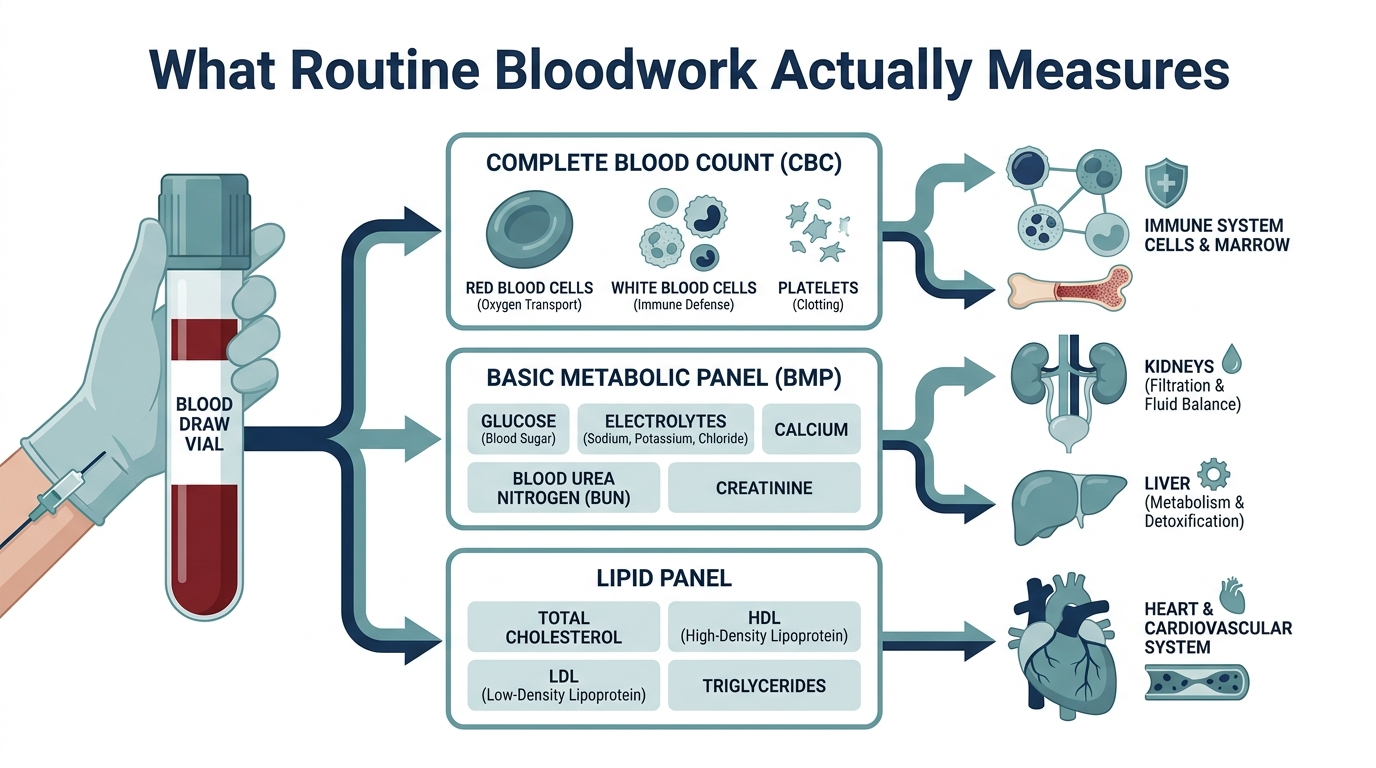
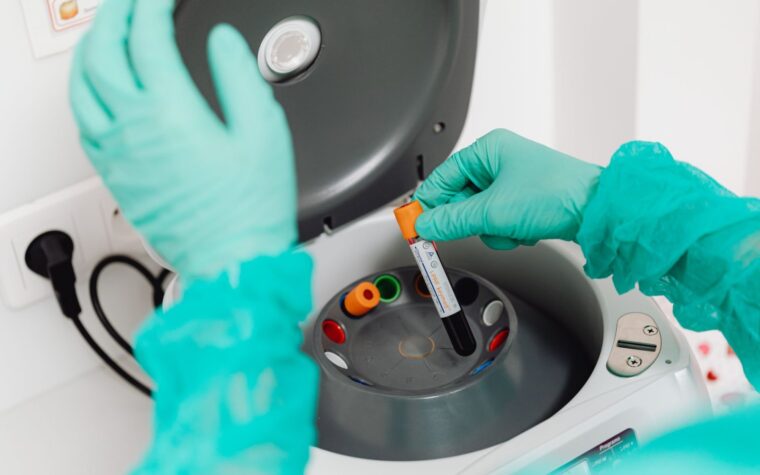
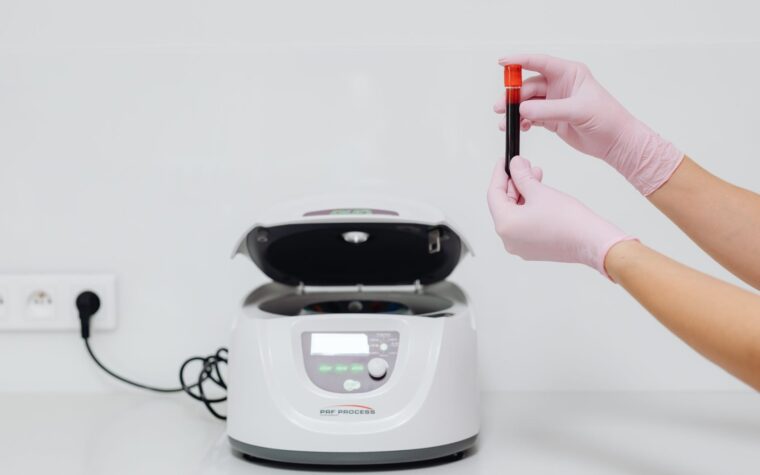
At a routine physical, what do they test for in a blood test comes down to four or five panels your doctor checks the box for almost reflexively. Each one bundles several individual markers, so a single draw can produce 20 to 40 numbers from two or three vials of blood. People assume each vial is one test. In reality one vial of plasma can feed an entire metabolic panel plus a lipid panel, because the lab spins it down and runs the chemistries off the same sample.
- CBC (complete blood count): red blood cells, hemoglobin, hematocrit, white blood cells, and platelets. It flags anemia, signs of infection, and clotting issues.
- BMP or CMP (basic or comprehensive metabolic panel): glucose, sodium, potassium, chloride, calcium, and kidney markers (BUN, creatinine). The comprehensive version adds liver enzymes (ALT, AST) and proteins.
- Lipid panel: total cholesterol, LDL, HDL, and triglycerides, used to estimate heart disease risk.
- TSH: the screening test for an under or overactive thyroid.
- A1C: your average blood sugar over the past three months, the main test for prediabetes and diabetes.
If you want the plain-English version of every acronym on the printout, we keep a running glossary in Blood Test Abbreviations Decoded (CBC, CMP, A1C, and More). It is the page people pull up while the nurse is still drawing.
Worth knowing: most insurers cover exactly one of these screening physicals per year at no cost to you, and the lab work attached to it rides along as preventive. Order a second round three months later because you were curious, and that one usually bills as diagnostic. The panels are identical. The billing code is not.
The exact default panel a doctor orders, and what each one rules in or out
The single most useful thing to understand about routine bloodwork is that each panel exists to answer a specific clinical question. Doctors do not order a CBC hoping it tells them everything. They order it to rule anemia and infection in or out, then move to the next panel for the next question. Read this way, the printout stops being a wall of numbers and becomes a checklist of conditions someone wanted to exclude.
| Panel | What it measures | Rules in or out |
|---|---|---|
| CBC | Hemoglobin, hematocrit, RBC, WBC, platelets | Anemia, infection, bleeding and clotting disorders, some blood cancers |
| BMP | Glucose, sodium, potassium, chloride, CO2, calcium, BUN, creatinine | Kidney function, dehydration, dangerous electrolyte swings, high blood sugar |
| CMP | Everything in the BMP plus ALT, AST, ALP, bilirubin, albumin, total protein | The above plus liver stress, fatty liver, malnutrition |
| Lipid panel | Total cholesterol, LDL, HDL, triglycerides | Cardiovascular risk, candidacy for statins |
| TSH | Thyroid stimulating hormone | Underactive or overactive thyroid |
| A1C | Glucose bound to hemoglobin over 3 months | Prediabetes and diabetes |
Notice what is and is not here. A CMP looks at the liver but says nothing about hepatitis. A lipid panel estimates heart risk but cannot see a clogged artery. TSH screens the thyroid but a normal TSH does not rule out every thyroid problem. These panels are wide and shallow on purpose. They are built to catch common problems cheaply, then point you toward a narrower, more expensive test only if something looks off.
This is also why a clean routine panel can sit alongside a real health problem. If nobody ordered the marker that would have caught it, the report comes back normal and everyone moves on. The panel did its job. It just was not asked the right question.
What is checked in blood work, marker by marker
What is checked in blood work breaks down into a few clear buckets, and knowing the bucket tells you what the result is actually screening for. Group the markers by what they protect, and the whole printout makes sense in about a minute.
Blood cells and oxygen
The CBC is the oxygen-and-immune snapshot. Low hemoglobin or hematocrit points to anemia, which is why fatigue is the symptom that most often triggers this test. A high white blood cell count suggests your body is fighting something, while a very low one can signal the opposite problem. Low platelets raise a flag about bleeding and clotting. The CBC also reports cell size (MCV), which is the clue that tells a doctor whether anemia is more likely from iron loss or from a B12 or folate shortfall.
Kidneys, liver, and electrolytes
The metabolic panel is the organ-function check. Creatinine and BUN tell you how well your kidneys filter, and the lab usually calculates an eGFR from your creatinine to grade kidney function as a percentage. ALT and AST are liver enzymes that climb when liver cells are stressed, which is why this panel matters before and during certain medications. Sodium and potassium have to stay in a tight range, and a number outside it can be urgent on its own, sometimes urgent enough that the lab phones the ordering doctor before the patient has left the parking lot.
Heart and metabolic risk
Cholesterol and triglycerides feed your cardiovascular risk estimate, while A1C and fasting glucose track sugar handling. Here is an insider detail: triglycerides genuinely require a 9 to 12 hour fast to read accurately, but A1C does not, because it measures sugar bound to your red blood cells over months. If a lab tech tells you to fast for everything, it is usually to keep the front desk instructions simple, not because every marker needs it.
Hormones and signaling
TSH is the one hormone almost everyone gets by default. Past that, hormones are opt-in. Testosterone, estrogen, cortisol, and the wider thyroid markers (free T4, free T3) only appear if someone specifically requested them. This is the bucket most often left empty on a routine draw, and the one people are most surprised to learn was never measured.
Types of blood tests you will actually run into
Not all bloodwork is a routine screen. The same vein can feed very different kinds of tests, and knowing which type you are getting tells you what the result can and cannot say.
- Screening tests: the routine panels above, run on people with no symptoms to catch silent problems early. Wide and shallow.
- Diagnostic tests: ordered because of a specific symptom or an abnormal screen, to confirm or rule out one condition. Narrow and deep, like a hepatitis panel after high liver enzymes.
- Monitoring tests: repeated over time to watch a known condition or a medication, such as A1C every three months in someone with diabetes, or liver enzymes on a new prescription.
- Genetic and specialized tests: things like Lp(a), which is largely set by your genes and usually needs to be measured only once in a lifetime.
- Infection and antibody tests: looking for a specific pathogen or your immune response to it, from a strep titer to a hepatitis C antibody.
The practical takeaway is that a screening result is not a clean bill of health. It is a low-resolution scan designed to flag the few things worth looking at more closely. A normal screen means nothing common jumped out, not that nothing is wrong.
What does Quest Diagnostics test for, and what about Labcorp
What does Quest Diagnostics test for is the same core menu as Labcorp and hospital labs, because the panels are standardized across US laboratories. A CBC at Quest reports the same markers as a CBC at Labcorp. What differs is the ordering, the reference ranges (each lab sets its own normal bands), and the price, not the underlying test.
Both Quest and Labcorp also sell direct-to-consumer panels you can buy without a doctor, which is how a lot of people now get tested. That route skips the office visit but also skips the clinician who would normally interpret the result, so you are on your own to read it. The blood draw is identical. The difference is whether a trained person calls you about the one number that matters.
| Where you get tested | Typical cash cost (2026) | What you get |
|---|---|---|
| In-network doctor’s order | $0 to $50 with insurance | Panels chosen and read by your clinician |
| Quest or Labcorp direct-to-consumer | $29 to $150 per panel | Standard panels, you interpret the results |
| Retail clinic (CVS MinuteClinic, urgent care) | $60 to $200 | Limited panels, same-visit basics |
| Full-body membership lab | $199 to $500 per year | 100+ markers with doctor review and year-over-year tracking |
Cash prices are often payable with an HSA or FSA card, and a “preventive” screen can still get billed as diagnostic if your doctor links it to a symptom, which is the surprise line item people complain about most.
A worked example: the same CMP, three prices
Pricing on identical bloodwork is wild, so here is a concrete walkthrough of one panel. A comprehensive metabolic panel ordered through a discount direct-to-consumer lab runs about $29 cash. The exact same CMP, drawn the exact same way and run on the exact same analyzer, can be billed at $150 to $250 when it goes through a hospital outpatient lab, because hospitals attach a facility fee. With in-network insurance and a preventive code, your share of that same panel might be $0. Same blood, same markers, a price swing of roughly ten to one depending on nothing but where the requisition was written.
The lesson is not that hospitals are ripping you off. It is that for routine screening, where you draw matters as much as what you draw. If you are paying cash, a direct-to-consumer order or a membership lab almost always beats the hospital outpatient route on price for the identical test.
What shows up in blood work, and what does not
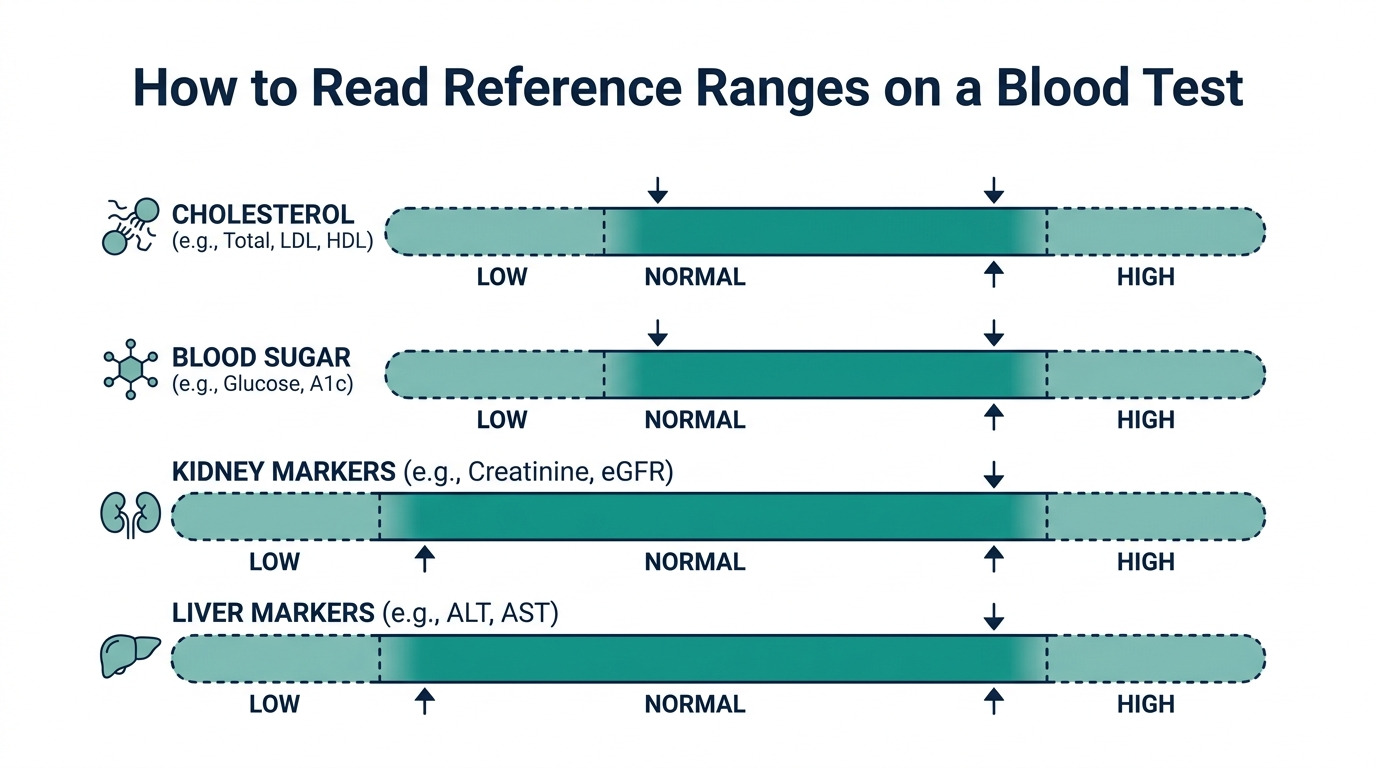
What shows up in blood work depends entirely on which markers were ordered, and this is the part that trips people up. A blood test only reports what someone asked the lab to measure. If iron, vitamin D, or B12 were not on the requisition, they simply will not appear, no matter how complete the printout looks. The page can be three columns long and still be missing the one number that explains your symptoms.
The common gaps in a standard physical include:
- Iron studies and ferritin: your iron stores, which a basic CBC does not directly measure. You can have a normal CBC and still be running on empty iron tanks.
- Vitamin D and B12: deficiencies that drive fatigue, mood symptoms, and nerve complaints, and that are genuinely common.
- hs-CRP: an inflammation marker tied to cardiovascular risk that a lipid panel never touches.
- Hormones: testosterone, estrogen, cortisol, and a full thyroid panel beyond TSH.
- ApoB and Lp(a): finer-grained heart risk markers that often outperform standard cholesterol, especially in people with a strong family history.
If you want to see a fuller default, compare your results against a complete blood panel and review the biomarkers worth tracking before your next draw. Asking for two or three add-ons up front is far easier than booking a second appointment.
Common mistakes people make with routine bloodwork
After enough result printouts, the same handful of avoidable errors show up over and over. None of these are exotic. They are the things that quietly waste a draw or send you back for a second one.
- Assuming “normal” means “complete.” A normal report only covers what was ordered. The gaps above are invisible on the page, so a clean printout can hide a vitamin D of nearly zero that nobody measured.
- Fasting when you did not need to, or eating when you should not have. A non-fasting triglyceride reads high and can trigger an unnecessary follow-up. Meanwhile A1C and TSH do not care whether you ate, so people fast for no reason and feel miserable in the waiting room.
- Drawing right after a hard workout. Intense exercise the day before can transiently bump liver enzymes and creatinine, making a perfectly healthy person look like they have an organ problem.
- Not telling the phlebotomist about supplements. High-dose biotin, common in hair and nail supplements, can skew certain lab assays including some thyroid and hormone tests. It is the classic hidden cause of a weird result.
- Treating one out-of-range number as a diagnosis. Reference ranges are built so that a small slice of perfectly healthy people fall outside them by design. A single mildly off value is usually a reason to recheck, not to panic.
- Comparing results across labs as if the ranges match. Each lab sets its own normal bands, so a value flagged “high” at one lab can be “normal” at another. Always read a result against the range printed on that same report.
How to make sure the right things get tested
The fix is simple: tell your clinician what you are worried about and ask for the specific markers, because the order drives the result. If you are tired, ask for ferritin and vitamin D. If heart disease runs in your family, ask about ApoB and Lp(a). If you are over 45 or carrying extra weight, confirm A1C is on the list. Walk in with two or three named markers and you will almost never leave with a half-empty draw.
Many people would rather not negotiate panel by panel. If you are getting blood drawn anyway, it is often smarter to capture a full baseline at once instead of chasing single tests across multiple visits. Always talk to a clinician about your results before changing anything, since a single out-of-range number is rarely the whole story.
The simplest way to actually get this done
Superpower is a full-body lab membership that runs 100+ biomarkers, has each result reviewed by a doctor, and tracks your numbers year over year (about $199/year). It is what we point readers to when they would rather get one clean, complete draw than chase single tests one at a time. Here is superpower reviewed in full.
Edge cases: uninsured, minors, employer-required, and Medicare
The standard advice assumes an insured adult walking into a routine physical. Plenty of draws do not look like that, and the rules shift.
If you are uninsured
Cash is often cheaper than people fear. Direct-to-consumer labs let you order a CBC, CMP, and lipid panel for roughly $29 to $80 total without a doctor, and the draw happens at a regular Quest or Labcorp location. Ask for the cash or self-pay price before you book, because the listed insurance price is frequently several times higher than what they will accept in cash.
If the patient is a minor
Pediatric bloodwork leans on smaller draw volumes and age-specific reference ranges, since a child’s normal hemoglobin and alkaline phosphatase differ from an adult’s. A value flagged abnormal on an adult range can be perfectly normal for a growing kid. Pediatricians order far fewer routine panels than adult doctors and usually test only when there is a reason.
If your employer requires it
Employer wellness screens and pre-employment draws are narrow by design. A wellness screen is typically a lipid panel, glucose, and sometimes A1C, aimed at insurance discounts, not a full workup. A pre-employment draw is often a drug test, which is a different category of test entirely and tells you nothing about your general health.
If you are on Medicare
Medicare covers specific screening labs on a set schedule, like a lipid panel every five years and diabetes screening for at-risk patients, but it does not blanket-cover everything a curious patient might want. Add-on markers outside the covered schedule may come with an out-of-pocket cost, so it is worth asking what is covered before the draw rather than after the bill arrives.
Who should ask for what: quick decision guidance
If you only remember one thing, make it this: match the add-on to your actual risk, not to the longest panel you can buy. Here is the short version of who benefits from going beyond the default.
- Persistently tired: add ferritin and iron studies, vitamin D, B12, and a fuller thyroid panel (free T4 alongside TSH).
- Strong family history of heart disease: add ApoB and a one-time Lp(a), which standard cholesterol misses.
- Over 45, overweight, or a parent with diabetes: make sure A1C and fasting glucose are both on the order.
- Unexplained weight change, hair thinning, or temperature intolerance: push beyond a lone TSH into the broader thyroid markers.
- Healthy and just want a baseline: a CBC, CMP, lipid panel, A1C, vitamin D, and ferritin is a reasonable, well-rounded starting draw.
You do not need every marker every year. Genetic ones like Lp(a) are largely a one-and-done. Most others are worth a baseline now and a recheck only when something changes or a number sits near the edge of its range.
Don’t just read about your health, track it.
A single result is a snapshot. Superpower re-tests 100+ markers over time so you can watch them move as you change sleep, food, and training.
FAQ
What is in a blood test that a doctor orders?
What is in a blood test ordered at a physical is usually a CBC, a metabolic panel, a lipid panel, and often TSH and A1C. That covers blood cells, organ function, cholesterol, thyroid, and blood sugar in one draw. Anything beyond that, like iron, vitamin D, or hormones, has to be requested specifically.
What is tested for in a blood test if I have no symptoms?
Even with no symptoms, a screening draw checks for silent conditions like high cholesterol, prediabetes, anemia, and early kidney or liver changes. These often have no warning signs until a number shows up off-range. That is the whole point of screening: catching the quiet problems before you can feel them.
What is checked in a blood test for fatigue?
For fatigue, the useful additions beyond the standard panels are ferritin and iron studies, vitamin D, B12, and a full thyroid panel. A plain CBC alone often misses the cause, because you can have low iron stores with a still-normal CBC. Naming these markers when you book the draw saves you a second appointment.
What would show up in a blood test that surprises people?
The two that surprise people most are prediabetes caught by A1C and elevated liver enzymes from everyday causes like alcohol or fatty liver. Both are common, both are usually silent, and both show up on a routine draw. Mildly high liver enzymes in particular catch people off guard because they feel completely fine.
What are bloods tested for before surgery?
Before surgery, labs typically check a CBC for anemia and platelets, a metabolic panel for kidney function, and clotting tests (PT/INR). These confirm you can safely tolerate anesthesia and the procedure itself. Depending on your age and history, the team may add a blood type and crossmatch in case a transfusion is needed.
How many vials of blood do they take for a full panel?
A standard routine panel usually takes two to four small vials, often less than a tablespoon total. One vial can feed several tests at once, since the lab runs many chemistries off the same spun-down sample. A bigger workup with hormones and specialized markers may add a vial or two, but it is still a modest amount of blood.
Do I have to fast for a blood test?
It depends entirely on the markers. Triglycerides and fasting glucose need a 9 to 12 hour fast to read accurately, but A1C, TSH, a CBC, and most of a metabolic panel do not. Labs often ask everyone to fast just to keep instructions simple. If your order is only A1C and thyroid, you can usually eat normally, but confirm with the ordering office.
Can a routine blood test detect cancer?
Routine bloodwork is not a cancer screen, but it can surface clues. A CBC may show anemia or abnormal white cell counts that prompt further testing, and some blood cancers like leukemia first turn up as odd CBC numbers. Dedicated cancer screening, such as a PSA or specific tumor markers, has to be ordered on its own and is not part of a standard physical.
How long do blood test results take?
Most routine panels resolve within one to three business days, and many basic results post to your patient portal the next morning. Specialized or send-out tests, like certain hormones or genetic markers, can take a week or more because they run at a reference lab rather than the local one. If a value is dangerously off, the lab calls the ordering doctor the same day rather than waiting.
What is the difference between a BMP and a CMP?
A BMP (basic metabolic panel) covers glucose, electrolytes, and kidney markers, about eight values. A CMP (comprehensive metabolic panel) includes everything in the BMP and adds liver enzymes and proteins, about fourteen values. Doctors order the CMP when they also want a look at liver function, which is why it is the more common choice at a routine physical.
Vital Signs Today may earn a commission if you buy through links on this page. It does not affect our editorial assessments.