
Last updated June 2026. Educational content, not medical advice. Consult a licensed clinician before starting any supplement regimen.
Short answer: Collagen peptides are short chains of amino acids produced by breaking whole collagen protein into fragments small enough for your gut to absorb. In a double-blind, placebo-controlled trial published in Cosmetics (MDPI, 2025), 66 women taking bovine collagen peptides daily for eight weeks saw a 25% reduction in eye wrinkle volume and a 26% increase in skin hydration compared to placebo, with no adverse events reported.
Collagen peptide trials show real skin gains after weeks of use. Want a baseline reading before you judge if it’s working for you? One at-home Superpower draw checks 100+ biomarkers, physician-reviewed.
What exactly are collagen peptides?
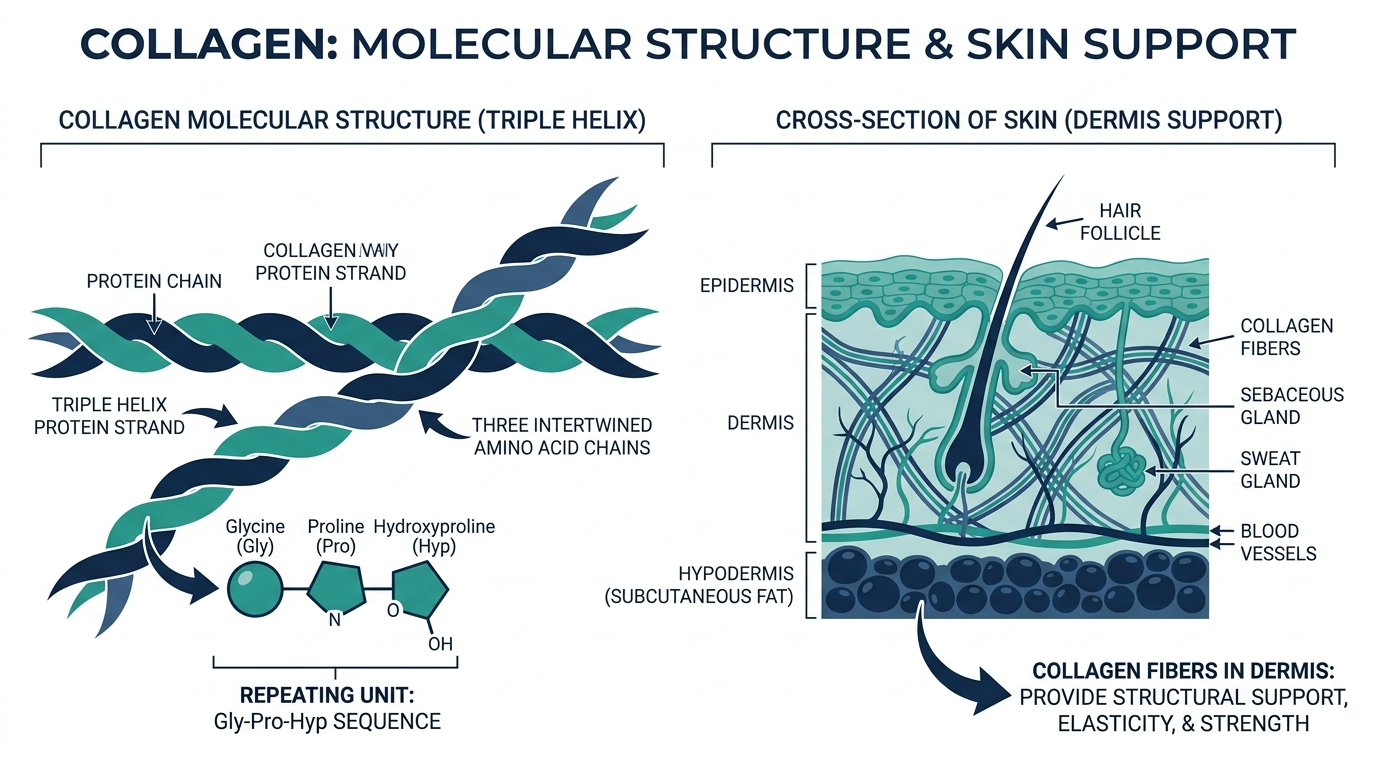
Collagen is the most abundant protein in the human body, accounting for roughly 30% of total protein mass. It forms the structural scaffold of skin, tendons, cartilage, bone, and blood vessel walls. The problem is that a whole collagen molecule weighs 300,000 daltons or more, which is far too large to pass through the intestinal wall intact.
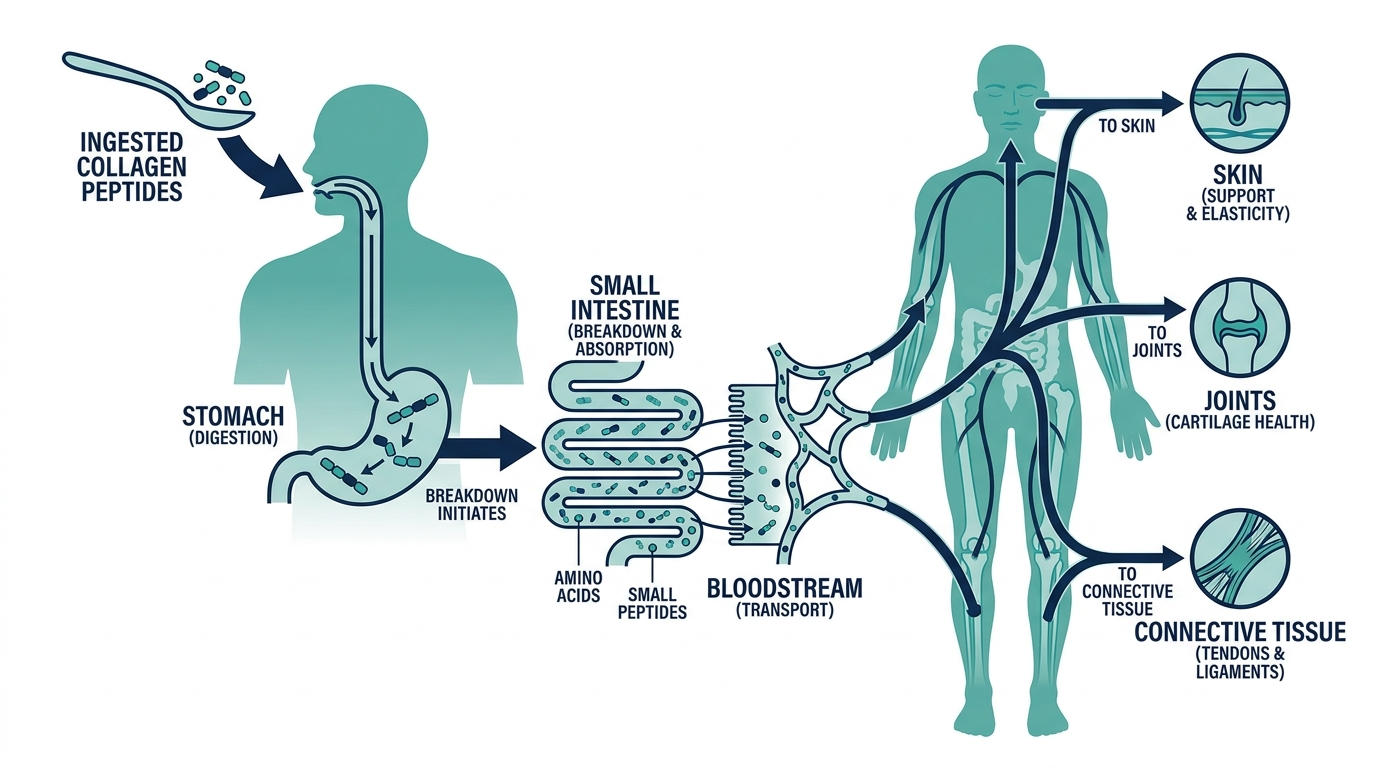
Collagen peptides solve that problem through a process called hydrolysis. Manufacturers treat raw collagen, typically sourced from bovine hide, fish skin and scales, or chicken cartilage, with enzymes or heat and water. This breaks the long triple-helix protein into short fragments averaging 2,000 to 5,000 daltons. Those fragments are small enough to cross the gut lining, enter circulation, and accumulate in connective tissue.
The terms “collagen peptides,” “hydrolyzed collagen,” and “collagen hydrolysate” all describe the same end product. You will see them used interchangeably on supplement labels.
The key amino acids are glycine, proline, and hydroxyproline. Hydroxyproline is almost exclusive to collagen; its presence in blood after supplementation is the biomarker researchers use to confirm absorption actually occurred.
Are collagen peptides the same as collagen protein?
No, and the distinction matters for absorption. Native collagen protein, the kind you would get from simmering bones into a broth, contains intact triple-helix structures that your digestive enzymes break down incompletely. Much of it is excreted rather than absorbed.
Hydrolyzed collagen peptides have already been pre-digested into dipeptides and tripeptides, particularly Pro-Hyp (proline-hydroxyproline) and Hyp-Gly (hydroxyproline-glycine). A randomized, double-blind crossover study published in Frontiers in Nutrition (2024) confirmed these bioactive dipeptides reach peak blood concentration 60 to 120 minutes after ingestion, at micromolar levels higher than virtually any other food-derived peptide.
Proline and hydroxyproline form unusually resistant bonds that survive the digestive tract intact. This is not a flaw in your digestion. It is the mechanism that allows collagen-specific signaling in fibroblasts and chondrocytes once the peptides reach target tissue.
Full-body lab membership: 100+ biomarkers, doctor-reviewed, tracked over time.
The simplest way to actually get this done
Superpower is a full-body lab membership that runs 100+ biomarkers, has each result reviewed by a doctor, and tracks your numbers year over year (about $199/year). It is what we point readers to when they would rather get one clean, complete draw than chase single tests one at a time. Here is superpower reviewed in full.
What are the different types of collagen and which one is in your supplement?
There are 28 types of collagen in the human body, but three account for roughly 90% of total collagen mass.
| Type | Primary location | Common supplement source |
|---|---|---|
| Type I | Skin (80% of skin protein), tendons, bone, hair | Bovine hide, marine (fish) |
| Type II | Cartilage, intervertebral discs | Chicken sternum |
| Type III | Blood vessels, intestinal walls, skin (alongside Type I) | Bovine hide |
Most collagen peptide powders on the market, including Vital Proteins and Sports Research, use bovine hide or marine sources, which deliver Types I and III. Marine collagen, sourced from fish skin and scales that would otherwise be discarded during seafood processing, is almost exclusively Type I and has a slightly smaller average peptide size, estimated to give it roughly 1.5 times the bioavailability of bovine collagen in some studies.
Personally, the “marine is always better” claim gets overstated in marketing. The practical absorption difference at normal doses is modest. What actually separates a good product from a mediocre one is manufacturing transparency, third-party testing, and consistent molecular weight, not the animal species.
What does the clinical evidence actually show?
The research landscape for collagen peptides improved substantially between 2024 and 2026. A 2026 systematic review and meta-analysis published in Frontiers in Medicine analyzed randomized controlled trials on oral peptides for skin aging and confirmed significant improvements in skin hydration, elasticity, and wrinkle-related outcomes in supplemented groups. The important caveat the review authors noted: the effect size was weaker in trials without industry funding, which is worth keeping in mind when evaluating manufacturer-sponsored studies.
For skin:
A 2025 double-blind, placebo-controlled trial (66 women, aged 35 to 55, bovine collagen peptides, 8 weeks) found that eye wrinkle volume fell 9% at week four and 25% at week eight, while skin hydration increased 26% and elasticity improved 9%. The same study showed that collagen peptides directly stimulated fibroblasts to produce more collagen, elastin, and proteoglycan in cell culture, suggesting a signaling mechanism that goes beyond simply supplying amino acid building blocks.
A separate 2025 MDPI trial found that specific bovine-derived bioactive collagen peptides at 2.5 g/day for 8 weeks improved dermal matrix synthesis markers and multiple clinical skin parameters compared to placebo.
For joints:
A 2024 randomized, double-blind, placebo-controlled study published in PMC enrolled 120 adults with knee osteoarthritis who received 10 g of hydrolyzed collagen daily for six months. The treatment group reported a 43.6% reduction in VAS pain scores (from 62.6 to 35.5 mm, p less than 0.001) against only a 6.8% reduction in the placebo group. C-reactive protein, a key inflammatory marker, dropped 56.2% in the collagen group versus no meaningful change with placebo. By the end of the study, 90% of the collagen group had reached “mild disability” classification, compared to just 8.3% in the placebo group.
A September 2025 randomized trial in Frontiers in Nutrition found that 3 g/day of low-molecular-weight collagen peptides for 180 days was safe and effective for knee osteoarthritis with no adverse events.
For muscle:
A 2026 clinical trial published in Frontiers in Physiology assigned 29 healthy males to 15 g/day of specific collagen peptides or placebo during 12 weeks of high-load resistance training. The supplemented group showed a 29.8% increase in Type I collagen content in skeletal muscle, compared to 9.9% in the placebo group (p = 0.003, large effect size). The authors concluded that collagen peptide supplementation combined with resistance training produces structural improvements beyond what training alone achieves.
Why do you need vitamin C with collagen peptides?
Do not believe any product that claims collagen peptides work just as well without vitamin C. The two are biochemically intertwined at a step you cannot work around.
After collagen peptides are absorbed and transported to fibroblasts, your body rebuilds them into new collagen fibers. That assembly process requires an enzyme called prolyl hydroxylase, which cannot function without vitamin C as a cofactor. Vitamin C donates electrons to keep the enzyme active. Without adequate vitamin C, newly synthesized procollagen chains cannot be hydroxylated into hydroxyproline, the modified amino acid that stabilizes the triple-helix structure. Unstable collagen fibers are weaker and degrade faster.
Research cited in a 2026 formulation review showed that exposing fibroblasts simultaneously to collagen peptides and ascorbic acid increased collagen Type I expression by up to 200% compared to either alone. The vitamin C is not improving absorption of the peptides. It is enabling what happens after they arrive.
50 to 100 mg of vitamin C taken alongside your collagen supplement is adequate for this purpose. Many products, including Vital Proteins’ Advanced Collagen Peptides with Hyaluronic Acid and Vitamin C (20 oz, available on Amazon for approximately $40 to $50), now include it in the formula. If yours does not, a piece of citrus or a low-dose vitamin C supplement at the same time fills the gap.
How much should you take, and when?
The dosing picture has become clearer as more trials have been published.
| Goal | Studied dose range | Evidence quality |
|---|---|---|
| Skin hydration and wrinkle reduction | 2.5 g to 5 g/day | Multiple RCTs, good evidence |
| Joint pain and cartilage support | 5 g to 10 g/day | Multiple RCTs, strong evidence |
| Muscle connective tissue (with resistance training) | 15 g/day | Single 2026 RCT, promising |
| General daily maintenance | 10 g/day | Commonly studied, well tolerated |
The sweet spot for most people doing collagen for both skin and joint health is 10 g/day. That is the dose used in the 6-month knee osteoarthritis trial above, and it falls comfortably within the safety range of 2.5 to 15 g/day reviewed in a 2021 systematic analysis in PMC.
Timing is less critical than consistency. Taking collagen peptides in the morning with vitamin C is a reasonable habit. Some sports medicine practitioners recommend taking 10 to 15 g about 30 to 60 minutes before collagen-stimulating exercise, on the theory that circulating peptides are available when the mechanical stimulus triggers connective tissue remodeling. The evidence on timing is preliminary, but the logic is sound and the cost of doing so is zero.
Hydrolyzed type I & III collagen peptides, third-party tested, unflavored.
How do you take collagen peptides day to day?
The practical mechanics matter more than most people think, because the reason collagen fails for many users is not the science, it is that they quietly stop taking it. Hydrolyzed collagen peptides are close to tasteless and dissolve cleanly in warm or cold liquid, which is the feature that makes a daily habit survivable in the first place.
- Hot liquid is fine. A common worry is that stirring collagen into hot coffee “denatures” it and ruins the benefit. Hydrolyzed peptides are already broken into small fragments, so normal brewing heat does not undo that. Your stomach acid was going to work on them anyway.
- Any daily drink works as the vehicle. Coffee, tea, a smoothie, or plain water all carry an unflavored scoop without changing the taste much. Attach it to a drink you already have every morning and you will actually remember it.
- Pair it with vitamin C. Whether that is the vitamin C already in the formula, a squeeze of citrus, or a low-dose tablet at the same time, this is the one pairing that is biochemically non-negotiable, for the reason covered above.
- Give it a real trial. Skin studies ran eight to twelve weeks and joint studies ran six months. Judging collagen after ten days is like weighing yourself after a single gym session.
Who should not rely on collagen peptides alone?
Collagen peptides are a supplement, not a treatment. Several situations where expecting them to do heavy lifting leads to disappointment:
Severe joint disease. Collagen peptides significantly reduce pain in mild to moderate osteoarthritis, but the 2024 trial enrolled adults with diagnosed OA, not end-stage joint degeneration. If imaging shows substantial structural damage, a conversation with an orthopedic specialist takes precedence.
Skin laxity from rapid weight loss or sun damage. Collagen production supports ongoing skin structure, but it cannot reverse the mechanical stretching or UV-induced cross-linking that causes deep structural skin changes. Retinoids, in-office procedures, and sun protection address the actual pathology.
People with connective tissue disorders. Conditions like Ehlers-Danlos syndrome involve defects in collagen synthesis or structure. Oral collagen peptides are not a substitute for genetic counseling or specialized medical management.
Anyone expecting overnight results. The wrinkle studies that showed 25% improvement used 8 weeks as the endpoint. Joint studies ran for 6 months. Collagen remodeling is a slow process. A timeline of less than 8 weeks is not long enough to draw any conclusion.
A myth worth busting: does stomach acid destroy collagen peptides?
This question circulates constantly on supplement forums, and the short answer is no. Stomach acid does not destroy collagen peptides; it is actually part of the digestion process that breaks collagen hydrolysate further into the di- and tripeptide fragments that survive to reach systemic circulation. The mechanism was confirmed in a study published in Nature npj Science of Food (2022), which identified a highly stable 3-hydroxyproline-containing tripeptide in human blood after collagen hydrolysate ingestion, demonstrating that specific collagen-derived fragments survive the entire gastrointestinal journey intact.
The confusion comes from conflating whole native collagen, which stomach acid would begin to denature, with already-hydrolyzed collagen peptides, which are already small enough to resist complete degradation and emerge as bioactive fragments. This is precisely the difference that justifies buying hydrolyzed over gelatin or plain bone broth.
How do you choose a collagen peptide worth buying?
The collagen aisle is crowded with products that are underdosed, oversweetened, or vague about what is actually in the tub. A short checklist separates the useful from the decorative.
- Look for a real dose per serving. The studied ranges run from roughly 2.5 g for targeted skin peptides up to 10 to 15 g for joint and muscle goals. If a serving delivers a fraction of a gram, especially in gummy form, you are buying flavor, not the dose the trials used.
- Confirm it is hydrolyzed. The label should say collagen peptides, hydrolyzed collagen, or collagen hydrolysate. Plain “collagen” or gelatin is the larger, less efficiently absorbed form.
- Check for third-party testing. An NSF Certified for Sport or USP Verified mark, or a published certificate of analysis, tells you an outside lab checked identity, dose, and contaminants like heavy metals, which matters because collagen is an animal-tissue product.
- Match the source to your goal and diet. Bovine hide gives you Types I and III, marine is almost purely Type I and suits pescatarians, and chicken-derived Type II targets cartilage. People with fish or shellfish allergies should avoid marine collagen.
- Read the extras. Some “beauty” blends add real vitamin C and hyaluronic acid, which is fine. Others add sugar, sweeteners, and a long flavor list you did not ask for. Simpler is usually better.
Are collagen peptides regulated by the FDA?
Collagen peptide supplements sold in the United States are regulated as dietary supplements under the Dietary Supplement Health and Education Act (DSHEA) of 1994. That means the FDA does not approve them before sale, and manufacturers are responsible for ensuring safety and following Good Manufacturing Practices (GMP). The FDA can take action against a product after it reaches the market if it is found to be unsafe or mislabeled.
Practically, this means you cannot assume any collagen peptide product is accurately labeled without independent verification. The NSF Certified for Sport and USP Verified marks are the two most meaningful third-party certifications. If a product carries neither, check whether the brand publishes batch-level certificates of analysis from an independent testing laboratory.
The collagen supplement market is projected to reach between approximately $2.8 billion and $4.2 billion in 2026 depending on methodology, growing at roughly 7 to 8% annually through 2032. That size brings both investment in genuine research and a long tail of underdosed, poorly tested products chasing the same shelf space.
Don’t just read about your health, track it.
A single result is a snapshot. Superpower re-tests 100+ markers over time so you can watch them move as you change sleep, food, and training.
The mistakes that make collagen a waste of money
Most disappointed reviews trace back to a handful of avoidable errors rather than a failure of the ingredient itself.
- Underdosing. Taking half a scoop because the tub is expensive puts you below the studied range. If cost is the issue, a smaller effective dose beats a larger imaginary one.
- Quitting at two weeks. Connective tissue remodels slowly. The visible skin changes in the trials showed up around weeks four to eight, not in a few days.
- Treating it as a protein replacement. Collagen is low in some essential amino acids, so it should sit on top of adequate total protein, not stand in for a chicken breast or a scoop of whey.
- Skipping the vitamin C. Without it, the enzyme that stabilizes new collagen cannot do its job, and you undercut the very fibers you are trying to build.
- Expecting it to fix structural problems. Deep sun damage, advanced joint degeneration, and skin laxity from major weight loss are mechanical or degenerative problems that a supplement supports at the margins but does not reverse.
Frequently asked questions
What are collagen peptides made from?
Most are made from bovine hide and connective tissue (cattle), fish skin and scales (marine), or chicken cartilage. The raw material is treated with enzymes or heat and water to break down large collagen proteins into small, absorbable peptide fragments averaging 2,000 to 5,000 daltons.
Do collagen peptides actually work?
For skin hydration, elasticity, and wrinkle reduction, multiple randomized controlled trials show measurable improvements at doses of 2.5 to 5 g/day over 8 to 12 weeks. For joint pain in osteoarthritis, a 2024 trial found a 43.6% reduction in pain scores at 10 g/day over 6 months. Results are real but not instant, and effects are more modest in higher-quality trials without industry sponsorship.
Are collagen peptides the same as hydrolyzed collagen?
Yes. “Collagen peptides,” “hydrolyzed collagen,” and “collagen hydrolysate” all describe collagen protein that has been broken down into shorter amino acid chains through hydrolysis. The terms are interchangeable on supplement labels.
What is the best time to take collagen peptides?
Consistency matters more than timing. Most people take 10 g in the morning with a source of vitamin C. Athletes sometimes take it 30 to 60 minutes before exercise involving connective tissue loading (running, strength training), based on the logic that circulating peptides are available during the mechanical stimulus for collagen synthesis.
Can I get enough collagen from food?
Bone broth, chicken skin, fish with skin, and gelatin all contain collagen, but in the native form that is less efficiently absorbed than hydrolyzed peptides. You can contribute to collagen intake through diet, but hitting the doses used in clinical trials (5 to 15 g of hydrolyzed collagen peptides) through food alone is difficult in practice.
Are collagen peptides safe?
Multiple long-term trials, including the 6-month knee osteoarthritis study, reported no adverse events. Collagen peptides are generally considered safe at 2.5 to 15 g/day. People with fish or shellfish allergies should avoid marine collagen. People with religious or dietary restrictions regarding beef should check the source animal.
Is bovine or marine collagen better?
Marine collagen has a slightly smaller average peptide size and may absorb at roughly 1.5 times the rate of bovine collagen. The practical difference at standard doses is modest. Bovine collagen delivers both Types I and III, while marine is almost exclusively Type I. The bigger factor is product quality and testing, not the species.
Can you take collagen peptides with coffee?
Yes. Stirring an unflavored scoop into hot coffee does not destroy hydrolyzed peptides, since they are already broken into small, heat-stable fragments. Coffee is one of the easiest daily vehicles precisely because the powder dissolves and disappears.
How long before collagen peptides show results?
Skin trials generally used eight to twelve weeks and joint trials ran up to six months. Expect nothing meaningful in the first two weeks, and give any honest trial at least eight weeks of consistent daily use before you judge it.
Do vegans have a collagen peptide option?
Not a true one. Collagen is an animal protein, so all genuine collagen peptides come from cattle, fish, or poultry. “Vegan collagen” products supply nutrients like vitamin C, amino acids, and plant extracts that support your own collagen production rather than collagen itself.
Hydrolyzed type I & III collagen peptides, third-party tested, unflavored.
Author: Vital Signs Today Editorial Team, [credential]”]. Educational content, not medical advice. Sources linked inline.
Primary sources:
– Frontiers in Physiology 2026: collagen peptides and Type I collagen in skeletal muscle, https://www.frontiersin.org/journals/physiology/articles/10.3389/fphys.2026.1839695/full
– Frontiers in Medicine 2026: systematic review of oral peptides for skin aging, https://www.frontiersin.org/journals/medicine/articles/10.3389/fmed.2026.1618306/full
– PMC (Frontiers in Nutrition 2024): bioactive peptide absorption after collagen hydrolysate, https://pmc.ncbi.nlm.nih.gov/articles/PMC11325589/
– Dr. Brad Stanfield analysis of MDPI Cosmetics 2025 trial (25% wrinkle reduction): https://drstanfield.com/blogs/articles/25-reduction-in-skin-wrinkles-after-8-weeks-new-collagen-study
– PMC 2024: hydrolyzed collagen in knee osteoarthritis, 43.6% VAS reduction, https://pmc.ncbi.nlm.nih.gov/articles/PMC11745964/
– Frontiers in Nutrition 2025: low-molecular-weight collagen peptides in knee OA, https://www.frontiersin.org/journals/nutrition/articles/10.3389/fnut.2025.1644899/full
– Nature npj Science of Food 2022: 3-hydroxyproline tripeptide surviving digestion, https://www.nature.com/articles/s41538-022-00144-4
– PMC 2021: systematic review collagen supplementation body composition and joint injury, https://www.ncbi.nlm.nih.gov/pmc/articles/PMC8521576/
– Superpower biomarker pricing 2026: https://superpower.com/blood-test-for-biomarkers
Related reading
Vital Signs Today may earn a commission if you buy through links on this page. It does not affect our editorial assessments.