Educational content, not medical advice. Talk to a licensed clinician before starting any supplement or therapy program.
Short answer: A peptide bond is a covalent amide linkage that forms when the carboxyl group of one amino acid reacts with the amino group of the next, releasing a water molecule. This single type of bond, repeated thousands of times, is the reason a chain of 51 amino acids becomes insulin, a chain of ~1,480 amino acids becomes collagen, and a chain of 39 amino acids becomes tirzepatide (Mounjaro).
Peptide bonds built the insulin keeping you alive right now. Curious what your actual insulin and metabolic numbers look like? One at-home Superpower draw checks 100+ biomarkers, physician-reviewed.
Peptide bonds are not exotic biochemistry. They are the backbone of every protein you have ever eaten, every hormone your pancreas secretes, and every therapeutic peptide discussed in a longevity clinic. Understanding how they work, why they are rigid instead of flexible, and how your digestive system dismantles them is the foundation for understanding why peptide supplements behave the way they do, and why some “peptide therapies” survive a stomach and others do not.
What exactly is a peptide bond?
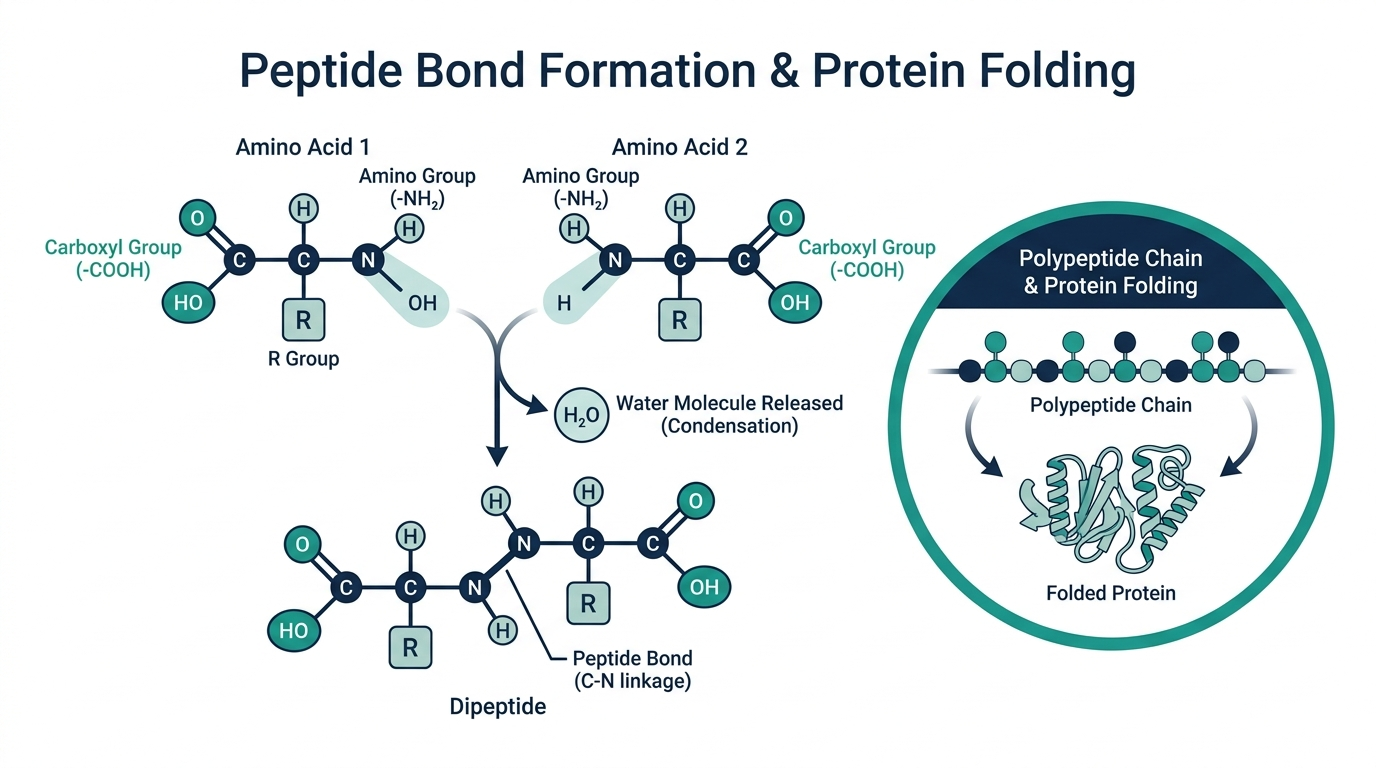
A peptide bond is an amide bond formed between the carboxyl group (–COOH) of one amino acid and the alpha-amino group (–NH2) of another. One water molecule leaves as the bond forms. The product is called an amide because of the –CO–NH– arrangement at the junction point.
In its simplest form: amino acid 1 + amino acid 2 → dipeptide + H2O. A dipeptide contains exactly one peptide bond. Add a third amino acid and you get a tripeptide with two peptide bonds. The pattern holds: a chain of n amino acids holds n-1 peptide bonds. Insulin, with its 51 amino acids across two chains, contains 48 peptide bonds holding those amino acids in sequence, plus three disulfide bridges that cross-link the two chains.
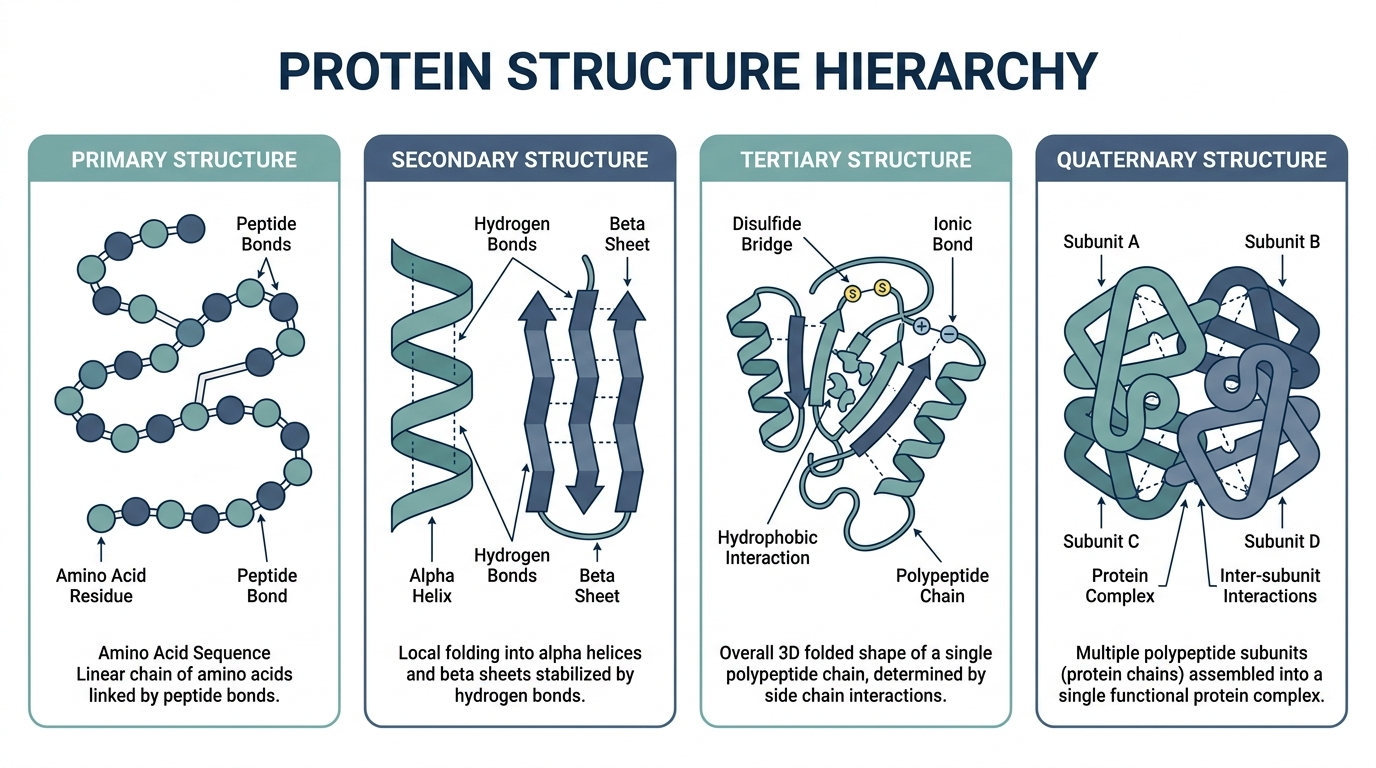
The resulting chain is called a polypeptide. When a polypeptide reaches a molecular weight of roughly 10,000 daltons or folds into a defined three-dimensional structure, biologists call it a protein. The line is blurry, but the underlying chemistry is identical: stacks of peptide bonds, all the same linkage, all built one condensation reaction at a time.
Why is the peptide bond rigid, not freely rotating?
This is the detail most popular explanations skip, and it is the one that explains almost everything about protein shape.
You might expect a single bond between carbon and nitrogen to rotate freely, the way C–C single bonds rotate in a chain. It does not. The peptide bond has partial double-bond character, because the nitrogen atom’s lone-pair electrons are donated into the adjacent carbonyl group through resonance. The result is electron delocalization across four atoms: O, C, N, and H. The bond length between the carbonyl carbon and the amide nitrogen measures approximately 0.132 nm, shorter than a typical C–N single bond (0.147 nm) and longer than a typical C=N double bond (0.127 nm), exactly as you would expect for a bond that is somewhere between the two.
The practical consequence is planarity. The six atoms that make up the peptide group (the carbonyl carbon, the carbonyl oxygen, the amide nitrogen, the amide hydrogen, and the two flanking alpha-carbons) all lie in the same plane. Rotation around the C–N bond itself is blocked. Rotation is only allowed at the alpha-carbon on either side, which is why protein structure is described using the phi (φ) and psi (ψ) dihedral angles at the alpha-carbons, not at the peptide bond itself.
In other words: the backbone of every protein is a series of rigid, flat units linked by rotating hinges. The hinges determine the fold; the flat units keep the chain from becoming a floppy string.
A landmark 2025 analysis published in IUCrJ (Panjikar and Weiss) examined 1,024 high-resolution protein crystal structures and found that peptide bond geometry differs measurably between secondary structures. In alpha-helices, the dihedral angle omega is tightly centered at 180° with a standard deviation of only 4.1°, while in beta-strands it spreads across 145° to 220° with a standard deviation of 6.9°. The same study found that 33.4% of identifiable protonated peptide bonds occur in helices versus 20.3% in strands, suggesting helical peptide bonds carry more enol-like, double-bond character than strand peptide bonds. This level of structural nuance is invisible in any introductory textbook.
How does a peptide bond form in a living cell?
Inside cells, peptide bond formation does not happen spontaneously. The reaction is energetically uphill on its own, requiring input from ATP.
The process unfolds in two stages. First, an enzyme called aminoacyl-tRNA synthetase attaches an amino acid to its matching transfer RNA (tRNA). This step consumes one ATP molecule, forming a high-energy aminoacyl-AMP intermediate that makes the amino acid’s carboxyl group reactive. The energy stored in that intermediate is what will drive the eventual peptide bond formation.
Second, the ribosome does the actual joining. The ribosome’s peptidyl transferase center is made entirely of RNA, not protein, making the ribosome a ribozyme. It catalyzes the reaction by precisely orienting the two substrates and excluding water from the active site. The aminoacyl-tRNA in the A site attacks the ester carbon of the peptidyl-tRNA in the P site, forming the new peptide bond in a reaction that does not require ATP at this step because the energy was pre-loaded in the aminoacyl intermediate.
A eukaryotic ribosome can polymerize approximately 5 to 10 amino acids per second, each extension forming one peptide bond. A typical mid-sized protein of 500 amino acids takes roughly one minute to synthesize under normal cellular conditions. Your body builds an estimated 100,000 distinct protein types, each with its own precise amino acid sequence and therefore its own exact pattern of peptide bonds.
Full-body lab membership: 100+ biomarkers, doctor-reviewed, tracked over time.
How are peptide bonds broken? The digestive story
Forming a peptide bond releases water. Breaking one requires water, via a reaction called hydrolysis. Under normal conditions, an isolated peptide bond in water is remarkably stable. At physiological pH and temperature, the estimated half-life for spontaneous hydrolysis of a peptide bond is on the order of 1,000 years. Evolution did not leave protein digestion to wait.
Your digestive system uses a family of enzymes called proteases to catalyze hydrolysis at rates millions of times faster than the uncatalyzed reaction. The sequence goes:
-
Stomach (pepsin): Chief cells secrete pepsinogen. Stomach acid (pH 1.5 to 2) both denatures dietary proteins by unfolding them and converts pepsinogen to the active enzyme pepsin. Pepsin preferentially cleaves peptide bonds flanking aromatic amino acids: phenylalanine, tyrosine, and tryptophan. It achieves this through two aspartic acid residues in its active site that form a tetrahedral intermediate with the carbonyl carbon of the target peptide bond.
-
Small intestine (trypsin, chymotrypsin, elastase): Pancreatic proteases pick up where pepsin stops. Trypsin cleaves after positively charged residues (lysine, arginine). Chymotrypsin cleaves after large hydrophobic residues. Elastase cleaves after small aliphatic residues. Together they reduce polypeptides to short oligopeptides.
-
Brush border (peptidases): Enzymes on the surface of intestinal cells, including aminopeptidases and dipeptidyl peptidases, complete the cleavage to free amino acids and di- or tripeptides that enterocytes absorb.
The reason oral peptide drugs are notoriously difficult to deliver is this same cascade. Semaglutide (Ozempic, Wegovy) is a 30-amino-acid peptide that would be digested within minutes if swallowed as a simple solution. The oral formulation (Rybelsus) uses sodium N-(8-[2-hydroxybenzoyl]amino) caprylate (SNAC) to temporarily raise local gastric pH and promote absorption through the stomach mucosa before proteases can act. It still achieves only about 1% bioavailability, which is why the dose must be 14 mg versus 1 mg for the injectable version.
What is the difference between a peptide bond and a disulfide bond?
Both are covalent bonds that hold protein structure together, but they serve very different roles and live in different parts of a protein’s hierarchy.
| Feature | Peptide bond | Disulfide bond |
|---|---|---|
| Chemistry | Amide bond (C–N) between amino + carboxyl groups | Sulfur–sulfur (S–S) bond between two cysteine residues |
| Location | Backbone (primary structure) | Side chains (tertiary or quaternary structure) |
| Formed by | Condensation; loss of water | Oxidation of two –SH groups |
| Broken by | Hydrolysis (acids, bases, proteases) | Reduction (DTT, beta-mercaptoethanol) |
| Role | Defines the sequence; holds the chain together | Cross-links and stabilizes folded shape |
| Example | Every amino acid junction in every protein | The A7–B7 and A20–B19 bridges in insulin |
Insulin is the classic teaching molecule for both. Its 51 amino acids form 48 peptide bonds in sequence, but the two chains (A-chain: 21 amino acids; B-chain: 30 amino acids) stay connected only because of two interchain disulfide bonds at A7–B7 and A20–B19, with a third intrachain disulfide loop within the A-chain at A6–A11. Destroy the peptide bonds and you have amino acid soup. Destroy only the disulfide bonds and you have two separate inactive chains that cannot signal the insulin receptor.
Personally, I find this distinction clarifies a common misconception: people assume “peptide bonds make proteins strong.” Peptide bonds make proteins long, they enforce sequence. The rigidity and thermal stability of a folded protein come primarily from the sum of weaker forces: hydrogen bonds, hydrophobic packing, electrostatic interactions, and yes, in certain structural proteins, disulfide cross-links.
What do peptide bonds have to do with collagen and skin?
Collagen is the most abundant protein in the human body by mass and the most peptide-bond-dense structure you will find outside a textbook. A single type I collagen molecule consists of approximately 1,400 amino acids per chain, arranged in a triple helix of three chains, forming roughly 4,200 amino acid-to-amino acid peptide bonds per molecule. The hallmark sequence is Gly-X-Y repeated hundreds of times, where X is frequently proline and Y is frequently hydroxyproline.
When manufacturers produce collagen supplements, they use enzymatic hydrolysis, the same chemistry your gut uses, to break those peptide bonds deliberately and reduce intact collagen molecules to short fragments called collagen peptides or collagen hydrolysate, typically 2,000 to 5,000 daltons. Those short peptides are small enough to survive partial digestion and absorb through the intestinal wall.
A 2025 systematic review and meta-analysis published in Frontiers in Medicine on oral and topical peptides for skin aging (Frontiers, 2026) confirmed that hydrolyzed collagen supplementation improves skin elasticity and hydration in randomized controlled trials. A separate 2026 Springer Nature study on bioactive collagen peptides in middle-aged women (Springer, 2026) found immune-modulatory effects supporting skin health outcomes. Low-molecular-weight fragments (2,000 to 3,500 daltons) showed the strongest bioavailability signal across multiple trials.
The same peptide-bond logic governs copper peptides. GHK-Cu is a naturally occurring tripeptide: glycine-histidine-lysine, three amino acids connected by two peptide bonds, complexed with a copper ion. Plasma concentrations run around 200 ng/mL at age 20 and fall to roughly 80 ng/mL by age 60, a drop of more than 60% (GrandIngredients clinical review, 2025). Because it is only three amino acids, topical GHK-Cu can penetrate the outer dermal layers without being digested away, unlike the much larger intact collagen molecule that definitely cannot.
Full-body lab membership: 100+ biomarkers, doctor-reviewed, tracked over time.
Do peptide bonds survive digestion? The myth that needs correcting
Do not believe the claim that you can “eat peptides and they work the same way as injecting them.” It is a simplification that collapses an important distinction.
Most therapeutic peptides, specifically the ones discussed in longevity forums, are not designed for oral delivery. BPC-157 is a 15-amino-acid synthetic peptide. CJC-1295 is a 30-amino-acid growth hormone releasing hormone analog. Semaglutide is a 30-amino-acid GLP-1 mimic. Each has multiple peptide bonds that pepsin, trypsin, and chymotrypsin will attack if the peptide reaches them in an exposed form.
The difference between oral collagen supplements (which demonstrably work to a degree) and most injectable research peptides is precisely the size and the number of modifications protecting the peptide bonds. Collagen hydrolysate is pre-digested into fragments small enough to slip through. Semaglutide’s oral formulation uses a protective carrier and still achieves only 1% bioavailability. Unmodified research peptides sold for self-injection have no such protection.
The peptide bond is the target. Proteases evolved specifically to break it. Whether a given peptide survives to its target tissue depends entirely on whether its peptide bonds have been protected by size reduction, chemical modification, or route of administration.
This is why licensed telehealth platforms deliver GLP-1 peptides by injection or pen device, not by capsule. The peptide bonds are intact and biologically active; a stomach would deactivate them in minutes without the engineered oral delivery system.
Peptide bonds in therapeutic peptides: a quick map
Understanding what you are looking at when you read about a therapeutic peptide becomes much easier once you recognize the bond count and engineering involved.
| Therapeutic peptide | Chain length | Peptide bonds | Key engineering protecting bonds |
|---|---|---|---|
| Semaglutide (Ozempic) | 30 amino acids | 29 | 2 substitutions (Aib8, Arg34) + C18 fatty acid chain for albumin binding; extends half-life to ~1 week |
| Tirzepatide (Mounjaro) | 39 amino acids | 38 | C20 diacid fatty acid; dual GIP/GLP-1 agonism; half-life ~5 days |
| Sermorelin | 29 amino acids | 28 | Truncated GH-releasing hormone; no modification; short half-life ~10-20 min; injected subcutaneously |
| BPC-157 | 15 amino acids | 14 | Derived from gastric juice protein; no modifications; research use only |
| GHK-Cu (topical) | 3 amino acids | 2 | Tiny size; copper coordination; topical only |
| Insulin (human) | 51 amino acids, 2 chains | 48 + 3 disulfide bridges | Zinc hexamer storage form; pH-sensitive release |
The table makes clear that the engineering around the peptide bonds, not the amino acid sequence alone, is what determines half-life, route, and clinical viability. Sermorelin has 28 peptide bonds and a 10-minute half-life. Semaglutide has 29 peptide bonds and a 7-day half-life. The chemistry of the bond is identical; what differs is the fatty acid tether that anchors semaglutide to albumin in the blood and shields it from peptidase attack.
Curious what your own levels look like?
Baseline 100+ biomarkers today and retest as life changes, all in one membership with physician review.
Frequently asked questions
What is a peptide bond in simple terms?
A peptide bond is the chemical link that joins two amino acids. One amino acid’s acid end reacts with the next amino acid’s amine end, releasing water, and leaving behind a –CO–NH– connection. Repeat that connection thousands of times and you have a protein.
Why can’t you just eat therapeutic peptides instead of injecting them?
Because your digestive system uses enzymes called proteases to break peptide bonds. Most therapeutic peptides, including GLP-1 agonists and research peptides like BPC-157, would be dismantled in the stomach and small intestine before reaching the bloodstream. Oral collagen supplements work partially because they are pre-digested into small fragments; even so, oral semaglutide (Rybelsus) uses a specialized carrier and achieves only about 1% absorption.
How many peptide bonds does a protein have?
A protein with n amino acids has exactly n-1 peptide bonds in its backbone. Insulin has 51 amino acids across two chains and holds 48 peptide bonds. A large structural protein like titin, the largest known human protein at ~34,000 amino acids, contains approximately 33,999 peptide bonds.
Is a peptide bond a covalent bond?
Yes. It is a covalent amide bond, meaning the carbon and nitrogen atoms share electrons directly. It is stronger than hydrogen bonds, ionic interactions, or van der Waals forces, but it is not the strongest bond in biology (that would be a covalent disulfide bond on a per-bond basis in terms of specific breaking force under mechanical load).
Why is the peptide bond planar?
Resonance between the nitrogen’s lone-pair electrons and the adjacent carbonyl group gives the C–N bond partial double-bond character. The six atoms of the peptide group are locked into a single plane because rotation around a partial double bond is restricted. This planarity is what allows proteins to adopt specific and repeatable secondary structures like alpha-helices and beta-sheets.
Do collagen peptide supplements actually work?
The evidence supports modest benefits. Hydrolyzed collagen peptides are pre-broken versions of collagen protein, small enough to absorb. Randomized controlled trials published through 2025 and 2026 show statistically significant improvements in skin elasticity, hydration, and joint discomfort. Low-molecular-weight fragments of 2,000 to 3,500 daltons show the best absorption profiles. The effect size is real but modest; collagen supplementation is not a replacement for lifestyle factors.
What breaks peptide bonds in the body?
Enzymes called proteases and peptidases. In the stomach, pepsin cleaves bonds adjacent to aromatic amino acids. In the small intestine, pancreatic proteases including trypsin and chymotrypsin continue the work. At the intestinal brush border, aminopeptidases finish the job. Outside digestion, cells use specialized intracellular proteases (like the proteasome) to recycle old or misfolded proteins by systematically breaking their peptide bonds.
Author: Vital Signs Today Editorial Team, [credential]”]. Educational content, not medical advice. Sources linked inline.
Full-body lab membership: 100+ biomarkers, doctor-reviewed, tracked over time.
Primary sources:
– Peptide Bond planarity and geometry: Panjikar & Weiss, IUCrJ 2025, PMC12044857
– Protein synthesis on the ribosome, Chemistry LibreTexts
– Peptide bond overview, ScienceDirect Topics
– Why is the peptide bond planar?, AAT Bioquest
– Digestion of food proteins: the role of pepsin, Tandfonline 2025
– Pepsin and protease hydrolysis, Biology Insights
– Oral and topical peptides for skin aging: systematic review, Frontiers in Medicine 2026
– Bioactive collagen peptides and skin health in middle-aged women, Springer Nature 2026
– GHK-Cu copper peptide clinical benefits, GrandIngredients 2025
– Tirzepatide structural determinants, PNAS
– 18.3 Peptides, Chemistry LibreTexts
– GHK-Cu guide 2026, Asterwood
Related reading
Vital Signs Today may earn a commission if you buy through links on this page. It does not affect our editorial assessments.