
Educational content, not medical advice. Talk to a licensed clinician before starting any peptide therapy.
Short answer: Peptides are chains of 2 to 50 amino acids linked by peptide bonds. Your body already makes thousands of them, including insulin, which has kept diabetics alive since 1922, and the GLP-1 hormone mimicked by semaglutide (Wegovy), the drug that just became the first oral GLP-1 pill approved for weight loss in December 2025. Peptides are not exotic supplements; they are the molecular switches your body uses to run its most critical systems.
Your body already makes thousands of peptides, including insulin and GLP-1. Want to see how well yours are working? One at-home Superpower draw checks 100+ biomarkers, physician-reviewed.
Why does everyone suddenly seem to be talking about peptides?
The word has jumped from biochemistry textbooks into gym locker rooms, dermatology offices, and Weight Watchers replacement communities in the span of roughly five years, and it happened for one reason: GLP-1 receptor agonists like semaglutide and tirzepatide made the pharmaceutical peptide market impossible to ignore.
The global peptide therapeutics market was valued at roughly $88 to $140 billion in 2025, depending on which analyst you believe, with the wide range reflecting how fast the category is moving. Metabolic diseases alone now account for more than 60% of that market share, driven almost entirely by GLP-1 drugs. The success of one peptide class pulled popular attention toward the entire category, and now everyone from longevity clinics to skincare brands is working with the same word.
That is actually a problem, because the word “peptide” covers radically different things. A collagen peptide in a $35 powder at Target, a copper peptide serum from a dermatologist, and an injectable semaglutide prescription from a licensed clinician are all peptides. They share a chemistry class, not a risk level or a legal status. Before you spend a dollar, or take a dose, the single most useful thing you can do is understand exactly what you are talking about.
Full-body lab membership: 100+ biomarkers, doctor-reviewed, tracked over time.
What exactly is a peptide, biologically speaking?
The simplest way to actually get this done
Superpower is a full-body lab membership that runs 100+ biomarkers, has each result reviewed by a doctor, and tracks your numbers year over year (about $199/year). It is what we point readers to when they would rather get one clean, complete draw than chase single tests one at a time. Here is superpower reviewed in full.
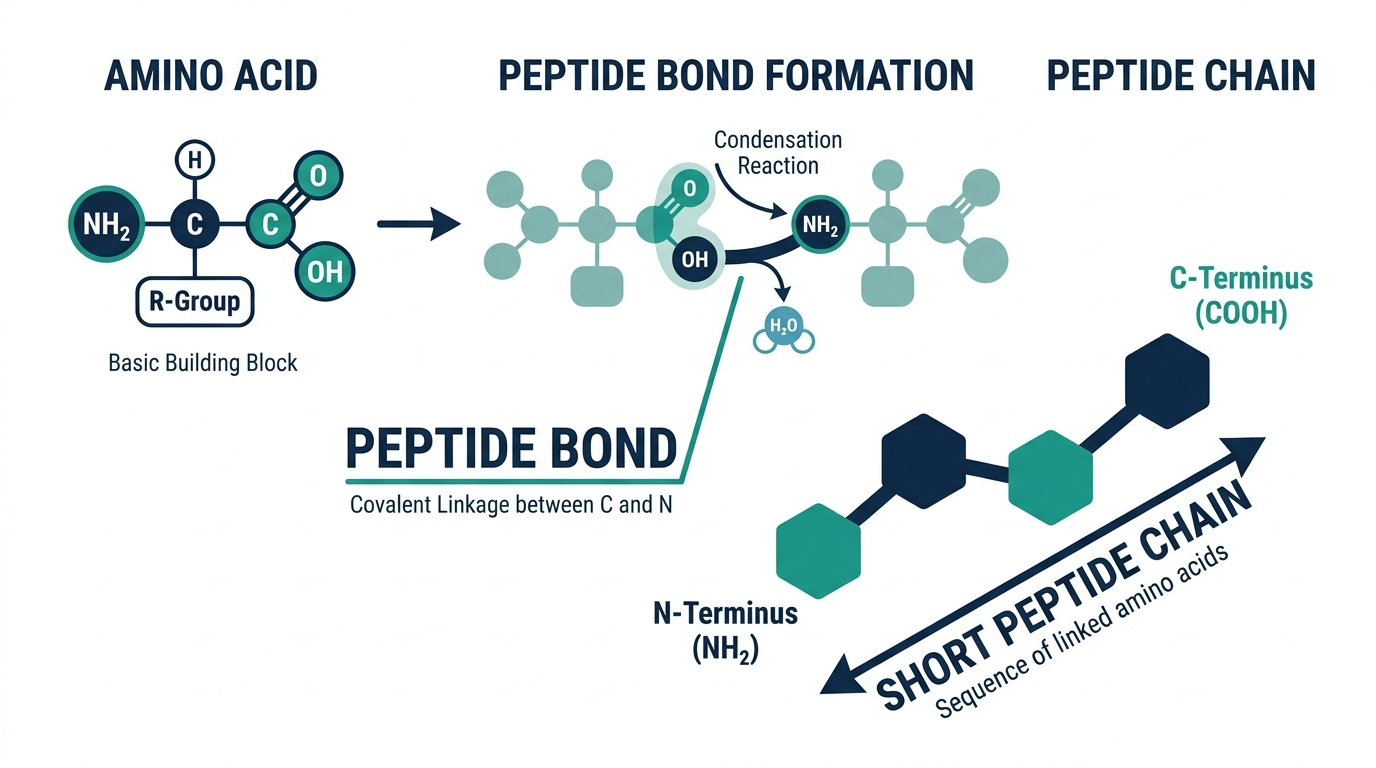
Amino acids are the alphabet of life. There are 20 of them in the human body, each with a slightly different side chain that gives it a different chemical personality. When you string amino acids together, the carboxyl group (-COOH) of one reacts with the amino group (-NH2) of the next, releasing a water molecule in a process called a condensation reaction. The covalent bond formed at that junction is a peptide bond, and the chain that results is a peptide.
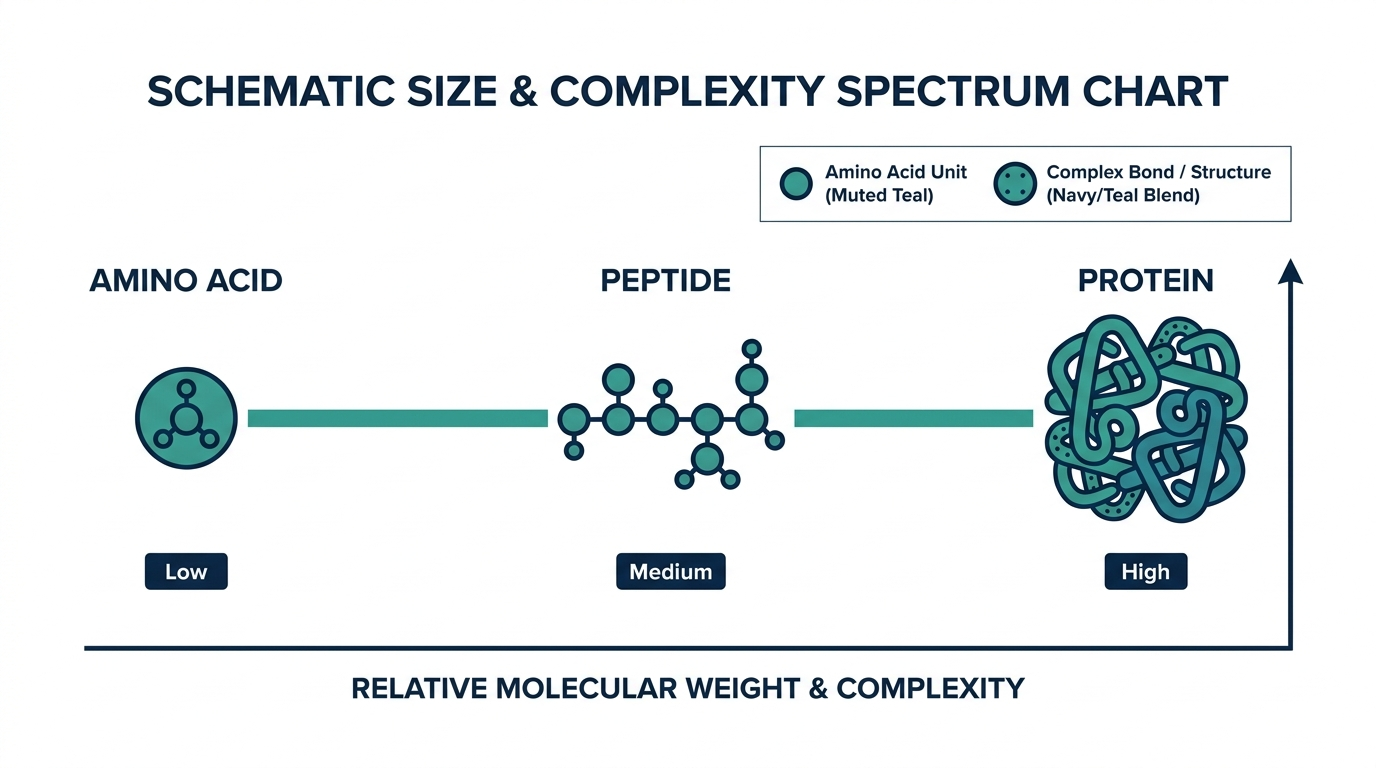
Chain length is the key classifier:
- Dipeptide: 2 amino acids (one peptide bond)
- Oligopeptide: 3 to roughly 20 amino acids
- Polypeptide: 20 to 50 amino acids
- Protein: generally 50 or more amino acids, with a stable folded 3D structure
The boundary between a peptide and a protein sits at approximately 50 amino acids, though the cutoff is a practical convention rather than a hard chemical rule. Insulin, arguably the most famous peptide in medicine, is 51 amino acids long, which is why it sometimes gets called either one. The more important distinction is functional: peptides are generally too short to hold a rigid three-dimensional shape on their own, so they act primarily as chemical messengers and modulators rather than structural machines. That flexibility is what makes them fast and specific, and both of those qualities are exactly what a signaling molecule needs.
The “short chain” framing matters clinically: shorter chains are easier to synthesize, easier to modify, and often easier to deliver than full proteins, which is why pharma companies have been building peptide pipelines at record pace.
What do peptides actually do in the human body?
Your body runs on peptides. Not metaphorically, literally. Here are the categories, with specific examples that most people have already heard of:
Peptide hormones
These are the peptides that carry signals between organs. Insulin is a 51-amino-acid peptide hormone secreted by pancreatic beta cells. It tells muscles and fat tissue to take glucose from the bloodstream. Without it, blood sugar climbs until it becomes fatal, which is why insulin’s isolation in 1921 by Frederick Banting and Charles Best at the University of Toronto is one of medicine’s most dramatic inflection points. In January 1922, a 14-year-old boy named Leonard Thompson received the first clinical injection and survived; within months, children across North America were being pulled back from diabetic coma.
Other peptide hormones you already have circulating right now include oxytocin (social bonding and uterine contractions, 9 amino acids), vasopressin (water retention, 9 amino acids), ghrelin (hunger, 28 amino acids), and glucagon-like peptide-1, GLP-1 (satiety and insulin release, 30 to 31 amino acids, depending on the isoform). The GLP-1 hormone is the natural prototype that drug developers engineered semaglutide and tirzepatide to mimic and extend.
Neuropeptides
Neuropeptides are produced by neurons and act as neuromodulators, turning up or turning down activity in neural circuits. The brain contains more than 100 identified neuropeptides. Endorphins, the peptides behind the runner’s high, are a well-known example. Neuropeptide Y drives appetite and stress response. Substance P modulates pain signaling. These are not fringe molecules; they are the chemical grammar of how your nervous system talks to itself.
Antimicrobial peptides
Many organisms, including humans, produce short peptides that destroy bacteria by punching holes in cell membranes. Human beta-defensins are one class. In food science, lactoferricin, derived from the milk protein lactoferrin, kills bacteria, fungi, and some viruses through the same membrane-disruption mechanism. This category is a significant area of antibiotic-resistance research precisely because bacteria find it much harder to evolve resistance against a mechanical disruption of their membrane than against a targeted drug molecule.
Bioactive peptides from food
When your gut digests a protein, enzymes break it into peptide fragments. Some of those fragments are biologically active in ways the intact protein is not. Milk casein, when broken down during fermentation, releases peptides with ACE-inhibitory activity, meaning they mildly lower blood pressure by blocking the same enzyme targeted by some antihypertensive drugs. Aged Parmesan and Gouda are actually among the highest-concentration natural sources. Soy, wheat, and fish proteins yield bioactive fragments with antioxidant and anti-inflammatory properties.
What is the difference between a peptide and a protein?
The question comes up in every conversation about skincare, supplements, and pharma, and the answer is shorter than people expect:
| Feature | Peptide | Protein |
|---|---|---|
| Chain length | 2 to ~50 amino acids | 50 or more amino acids |
| 3D structure | Minimal or absent | Stable folded structure (tertiary/quaternary) |
| Typical role | Signal, messenger, regulator | Enzyme, structural scaffold, antibody |
| Synthesis difficulty | Lower (easier to make in a lab) | Higher (harder to engineer) |
| Absorption (oral) | Depends on size; smaller peptides absorb better | Most proteins degraded before absorption |
| Classic drug examples | Semaglutide, insulin, oxytocin | Monoclonal antibodies (Humira, Keytruda) |
The practical takeaway: you cannot eat a collagen peptide supplement and send the exact peptide to your skin like a targeted delivery package. The gut will break it into amino acids and oligopeptide fragments, which your body then uses as raw material. That does not make it useless, but it means the mechanism is systemic, not topical-via-gut.
How many peptide drugs are FDA-approved, and what are they used for?
Approximately 80 to 100 FDA-approved peptide drugs exist, depending on whether you count all formulations of the same molecule or just distinct chemical entities. The category has grown steadily since insulin was commercialized by Eli Lilly in 1923. Key approved peptides by therapeutic area include:
Metabolic / obesity: Semaglutide (Ozempic for diabetes, Wegovy for weight loss; plus the new oral Wegovy pill approved December 2025), tirzepatide (Mounjaro/Zepbound), liraglutide (Saxenda/Victoza).
Endocrine: Synthetic insulin analogs, teriparatide for osteoporosis, tesamorelin for HIV-related lipodystrophy, sermorelin for growth hormone deficiency.
Reproductive / obstetric: Synthetic oxytocin (Pitocin) for labor induction, leuprolide (Lupron) for endometriosis and prostate cancer via GnRH receptor.
Anti-infective: Daptomycin (Cubicin), a cyclic lipopeptide antibiotic approved 2003 that kills gram-positive bacteria by the membrane-disruption mechanism mentioned above.
Oncology/other: Octreotide for acromegaly and carcinoid tumors, approved 1988.
The reason the number matters: this is not a fringe category. It is over a century old and growing faster than any other drug class. The 2025 FDA “TIDES Harvest” report counted seven new peptide and oligonucleotide approvals in that calendar year alone.
What are the main types of peptides people use outside a prescription?
Outside the FDA-approved lane, three categories dominate the consumer market:
Collagen peptides (supplements)
Hydrolyzed collagen is the most commercially mainstream peptide product. A 2023 meta-analysis of 26 randomized controlled trials with 1,721 participants found statistically significant improvements in skin hydration and elasticity with oral collagen supplementation versus placebo. The mechanism is indirect: collagen peptide fragments absorbed from the gut appear to stimulate fibroblasts to produce more of their own collagen. Typical doses studied range from 2.5 g to 10 g per day. Effects take 8 to 12 weeks to appear in skin outcomes. Joint and bone support are also studied, with more modest evidence.
Do not believe the marketing copy that implies a specific collagen peptide molecule travels intact from your stomach to the precise wrinkle on your forehead. It does not work that way. What the evidence does support is a systemic signaling effect that shows up in measurable skin parameters over time.
Topical cosmetic peptides
GHK-Cu (glycine-histidine-lysine-copper, also called copper peptide) is the cosmetic peptide with the strongest clinical evidence. In one trial, 71 women with mild to advanced photoaging applied a GHK-Cu facial cream daily for three months and showed increased skin density, reduced sagging, and reduced fine lines versus placebo. A separate 2-inch scalp application study found GHK-Cu outperformed 3% minoxidil on hair density metrics without the irritation profile. Palmitoyl peptides (palmitoyl tripeptide-1, palmitoyl tetrapeptide-7, the so-called Matrixyl family) have peer-reviewed evidence for wrinkle depth reduction and collagen synthesis stimulation.
These are legitimate cosmetics with real mechanisms. They are also not drugs. The distinction matters because cosmetics make “appearance” claims legally; they cannot claim to treat a disease. When a skincare brand says its peptide serum “reduces the appearance of wrinkles,” that is both accurate and carefully bounded language.
Therapy and research peptides
This is the category generating the most cultural noise and the most legal complexity. It includes BPC-157, TB-500, CJC-1295, Ipamorelin, sermorelin (now available via telehealth with a prescription), and GLP-1 derivatives. The legal landscape here is actively shifting in 2026, and the specifics matter, which is why the next section exists.
What is the legal status of peptide therapy in 2026?
Three legal lanes exist simultaneously, and most content on the internet conflates them:
Lane 1 (fully approved): Prescription peptides including semaglutide, tirzepatide, sermorelin, tesamorelin, and teriparatide. You can access these through a licensed telehealth clinic or physician. The oral Wegovy pill, approved December 22, 2025, at a manufacturer list price of $149 per month, represents the first oral GLP-1 approved specifically for weight loss, a major access shift for people who prefer pills to injections.
Lane 2 (thawing grey zone via compounding): The FDA removed BPC-157 from its 503A Category 2 list on April 15, 2026, and a Pharmacy Compounding Advisory Committee (PCAC) meeting on July 23 to 24, 2026 will formally review BPC-157, TB-500, KPV, MOTS-c, DSIP, Epitalon, and Semax for reclassification to Category 1 (permitted for compounding). Even a positive PCAC vote requires a further Notice of Proposed Rulemaking and a 60-day public comment period, so official reclassification before late 2026 is unlikely. But the direction is clear: the door is reopening toward licensed compounding pharmacies for several of the most popular therapy peptides.
Lane 3 (research use only): Most of the injectable peptides available online today are sold under the label “for laboratory research use only, not for human use.” That label transfers the entire legal and safety risk to the buyer. The FDA’s enforcement campaign in 2025 to 2026, which included warning letters, a warehouse raid on Amino Asylum in June 2025, and DOJ criminal pleas, targeted the vendor side of this market, not individual buyers. But the risk was never primarily legal for individuals. It was, and still is, that a “research grade” vial has no pharmacist, no licensed compounder, and no regulatory body standing behind its contents or its dose.
Personally, the framing I find most useful is this: the legitimate clinical lane is catching up to what the grey market has offered for years, and it is doing so at better prices than most people assume. Telehealth sermorelin runs $175 to $225 per month. Comprehensive peptide therapy programs run $199 to $399 per month, with lab monitoring included. That is not dramatically more than the grey-market vial plus supplies, and it comes with a clinician, a named pharmacy, and accountability.
Full-body lab membership: 100+ biomarkers, doctor-reviewed, tracked over time.
GLP-1 peptide drugs: what the clinical trials actually show
Because semaglutide and tirzepatide are the reason most people are Googling “peptides” right now, the numbers deserve their own section.
Semaglutide (injectable Wegovy) produced a mean body weight reduction of approximately 14.9% at 68 weeks in the STEP 1 trial. Oral semaglutide (the new Wegovy pill) achieved a mean weight reduction of 16.6% at week 64 in the OASIS 4 trial.
Tirzepatide, a dual GIP/GLP-1 receptor agonist (it targets two peptide hormone receptors simultaneously rather than one), outperformed semaglutide in the head-to-head SURMOUNT-5 trial at 72 weeks: 20.2% mean body weight loss for tirzepatide versus 13.7% for semaglutide. In the longer SURMOUNT-4 trial, participants who stayed on tirzepatide through 88 weeks achieved a mean reduction of 25.3% from baseline.
Those are not marketing claims. Those are randomized controlled trial results, published in peer-reviewed journals, with placebo comparisons. They represent the largest weight loss outcomes ever demonstrated by a pharmacological agent short of bariatric surgery. The reason peptide drugs are the biggest story in medicine right now is because those numbers are real and unprecedented.
What peptides do in skincare: the insider version
The skincare peptide category is saturated with overclaiming, and separating signal from noise requires understanding what the biology actually permits.
Three mechanisms are real and backed by human trials:
-
Signal peptides (like palmitoyl tripeptide-1 and GHK-Cu) mimic breakdown products of collagen. When fibroblasts detect these fragments, they interpret it as a sign that collagen has been damaged and upregulate new collagen synthesis. This is a real, documented feedback loop. The catch: topical application requires a formulation that gets the peptide through the outer skin barrier (stratum corneum), which is why good cosmetic peptide formulations use penetration enhancers and encapsulation strategies.
-
Carrier peptides (like GHK-Cu) deliver trace minerals, in this case copper, which is a cofactor in collagen and elastin cross-linking enzymes. Remove the copper, and the enzyme cannot stabilize new collagen fibers.
-
Neurotransmitter-inhibitor peptides (like acetyl hexapeptide-3, known commercially as Argireline) relax the muscle contractions that deepen expression lines. This is a topical, cosmetic version of the Botox mechanism, and the effect is real but modest compared to an injectable neuromodulator.
The myth worth busting directly: no topical peptide crosses into the dermis in sufficient quantity to deliver systemic effects or drug-equivalent results. A GHK-Cu serum and injectable GHK-Cu are not the same product at different price points. They are different delivery systems with different risk profiles, mechanisms, and regulatory categories. The topical version is a cosmetic. The injectable version is a research compound. Both get called “copper peptide” in casual conversation, which is where a lot of confusion starts.
How are therapeutic peptides made?
Most therapeutic peptides sold commercially today are produced by one of two methods:
Solid-phase peptide synthesis (SPPS): Amino acids are assembled one at a time onto a solid resin support, each step chemically protected to prevent incorrect bonding. This method is precise and scalable for peptides up to roughly 50 residues. It is how most research peptides and many drug peptides are manufactured.
Recombinant fermentation: For larger or more complex peptides, bacteria or yeast are engineered to produce the peptide via fermentation and then the product is purified. Insulin switched from extraction from animal pancreases to recombinant production (Humulin, approved 1982) as the first recombinant pharmaceutical ever approved, reducing costs and animal-welfare concerns simultaneously.
Purity matters enormously in both routes. A peptide synthesis that produces a 95% pure product sounds good until you consider that the 5% impurities are structurally similar molecules with unknown biological activity and unknown safety profiles. The pharmaceutical and compounding standard for human-grade peptides is typically 99% HPLC purity. The grey-market research standard is 96% minimum. Independent testing of grey-market products by platforms like Finnrick has found samples below 75% in some batches, which is functionally a different molecule profile than what was ordered.
Don’t just read about your health, track it.
A single result is a snapshot. Superpower re-tests 100+ markers over time so you can watch them move as you change sleep, food, and training.
Frequently asked questions
What is the simplest definition of a peptide?
A peptide is a short chain of amino acids, between 2 and roughly 50 of them, linked by peptide bonds. Chains longer than 50 amino acids are generally called proteins. Your body makes thousands of peptides naturally; they function as hormones, immune signals, and cell communicators.
Are peptides safe?
It depends entirely on the specific peptide, the dose, the delivery method, and the source. FDA-approved peptide drugs like insulin and semaglutide have extensive safety records from clinical trials and post-market surveillance. Collagen peptide supplements have strong tolerability data from multiple randomized trials. Injectable research peptides from grey-market vendors have none of that, because they have never been through the regulatory process that generates safety data. “Peptide” is not a safety category; the specific product and source determine the risk.
What is the difference between peptides and proteins?
Chain length and structure. Peptides are 2 to ~50 amino acids with minimal stable 3D structure. Proteins are 50 or more amino acids and fold into a stable 3D shape that defines their function. The distinction matters for absorption, synthesis difficulty, and how the body processes each.
Are GLP-1 drugs peptides?
Yes. Semaglutide and tirzepatide are synthetic peptides designed to mimic and extend the action of the natural GLP-1 hormone your gut secretes after eating. Semaglutide is a 31-amino-acid peptide with fatty acid modifications that slow its breakdown and allow once-weekly dosing. The oral Wegovy pill, approved December 2025 at $149/month, is the first oral GLP-1 approved for weight loss, making peptide therapy accessible in pill form for the first time.
Do collagen peptide supplements actually work?
The evidence says yes, with measured expectations. A 2023 meta-analysis of 26 randomized controlled trials found statistically significant improvements in skin hydration and elasticity. The mechanism is indirect: absorbed peptide fragments signal fibroblasts to produce more collagen. Typical study doses are 2.5 to 10 grams per day, with measurable effects appearing after 8 to 12 weeks. It will not reverse sun damage overnight, but it has more clinical support than most supplements.
What peptides can I get from a doctor or telehealth clinic in 2026?
Through a licensed clinician: semaglutide, tirzepatide, liraglutide (prescription GLP-1s), sermorelin and tesamorelin (growth hormone secretagogues), and NAD+ infusions. For the broader therapy peptide list (BPC-157, TB-500, etc.), access through compounding pharmacies is expected to expand after the FDA PCAC meeting on July 23 to 24, 2026, but formal reclassification will take additional months. The safest path is a licensed telehealth provider who prescribes through a named, verifiable compounding pharmacy.
What is the difference between a peptide serum and a peptide injection?
Delivery, risk, and regulatory category. A peptide serum is a cosmetic applied to the surface of the skin; it is regulated for safety and labeling as a cosmetic and makes appearance claims. A peptide injection is a pharmaceutical or research compound administered subcutaneously. The mechanisms differ, the risks differ, and the regulatory frameworks differ. A GHK-Cu serum and injectable GHK-Cu both contain the same molecule but are not equivalent products.
Full-body lab membership: 100+ biomarkers, doctor-reviewed, tracked over time.
Author: Vital Signs Today Editorial Team. Educational content, not medical advice. Sources linked inline.
Primary sources:
– FDA GLP-1 compounding policy (semaglutide shortage resolved)
– FDA oral semaglutide approval (HCPLive, Dec 2025)
– Oral Wegovy pricing and access (BioSpace, 2026)
– SURMOUNT-5 tirzepatide vs semaglutide head-to-head
– OASIS 4 oral semaglutide trial results
– BPC-157 Category 2 removal and PCAC July 2026 (LotiLabs)
– FDA-approved peptides complete list 2026 (Guide to Peptide)
– Collagen peptides RCT meta-analysis (Wiley JOCD 2025)
– GHK-Cu skin and hair benefits (Drip Hydration)
– Peptide bond formation chemistry (Chemistry LibreTexts)
– Peptide vs protein differences (Bachem)
– Peptide therapeutics market size (Precedence Research)
– 2025 FDA TIDES harvest, PMC
– Bioactive peptides food sources review (PMC)
– Discovery of insulin history (RethinkPeptides)
Want a real clinician to run the numbers, not a guess?
Joi + Blokes is a telehealth clinic that prescribes GLP-1 medication (Zepbound, compounded semaglutide and tirzepatide), hormone therapy (TRT, HRT), thyroid care, and peptides after a real lab panel and clinician review, with no membership or consult fee (prescriptions from about $59/month, lab panels from $149). If the scale will not budge, this is where you find out whether insulin, thyroid, or hormones are the real reason. Here is Joi + Blokes reviewed in full.
Related reading
Vital Signs Today may earn a commission if you buy through links on this page. It does not affect our editorial assessments.