
Last updated 18 June 2026. Educational content, not medical advice. Talk to a licensed clinician before starting any injection protocol.
Short answer: Peptide injections deliver short chains of amino acids directly into your bloodstream via a subcutaneous needle, bypassing the digestive system that would otherwise destroy them. Depending on the peptide, the goal might be to stimulate growth hormone release, slow digestion for weight loss, accelerate tissue repair, or improve sexual function. The FDA has approved a handful of these outright; several dozen more exist in a legal grey zone as “research chemicals.” The molecule that is right for you, and whether you should be injecting anything at all, depends almost entirely on which category it falls into.
Peptide injections bypass digestion to hit your bloodstream directly. Ever seen what’s actually circulating in yours? One at-home Superpower draw checks 100+ biomarkers, physician-reviewed.
What exactly is a peptide injection?
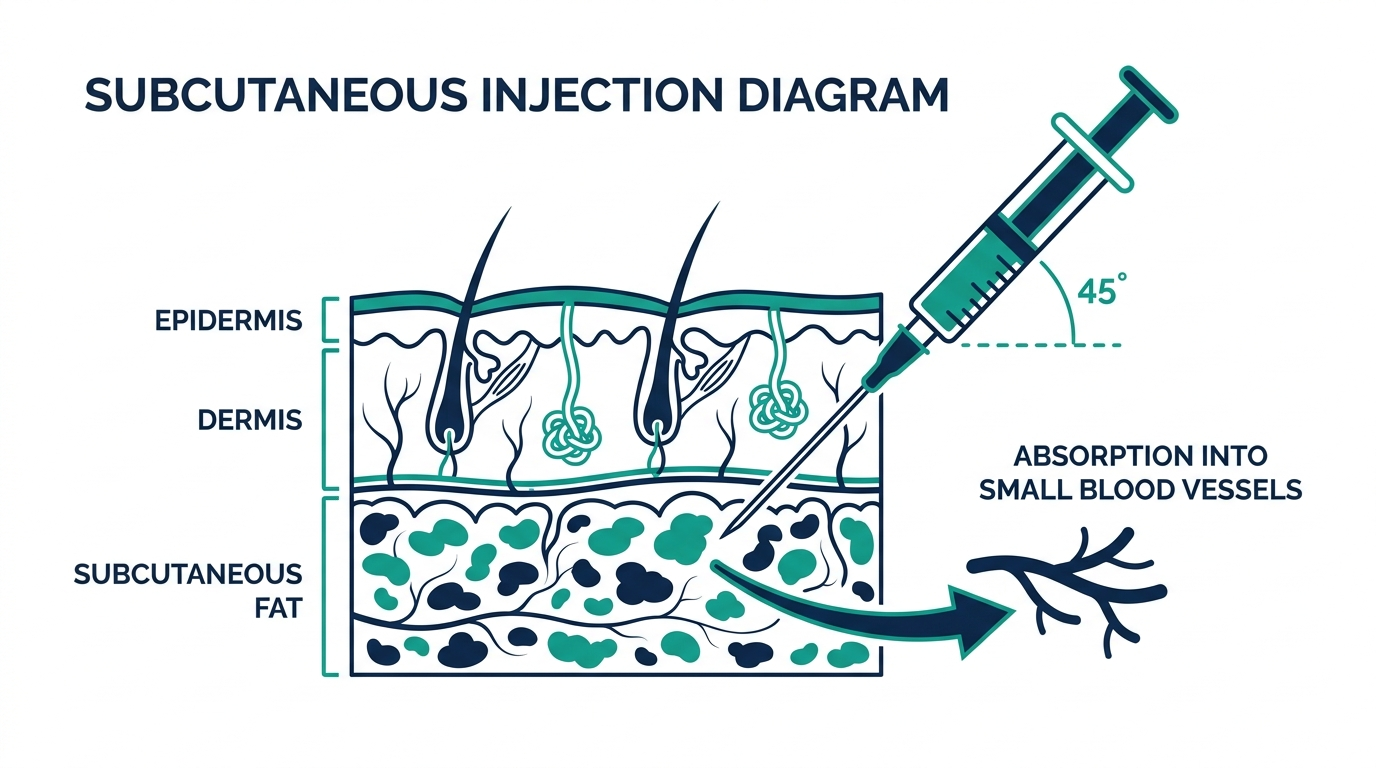
Peptides are short chains of amino acids, typically between 2 and 50 amino acids long, that act as chemical messengers throughout the body. Your body already makes thousands of them naturally; insulin is a peptide, so is glucagon, and so are the signaling molecules that tell your pituitary gland to release growth hormone. A peptide injection simply delivers a lab-made version of one of those signals.
The reason injections exist at all comes down to biology. When you swallow a peptide, stomach acid and intestinal enzymes break the amino-acid chain apart before it can reach the bloodstream intact. Subcutaneous bioavailability for most therapeutic peptides reaches 75 to 100% when injected, versus under 2% for the same compound taken orally. That gap is not a marketing claim, it is a function of how digestive enzymes work, and it is the reason almost every meaningful peptide therapy is delivered by needle.
Most injectable peptides arrive as a lyophilized (freeze-dried) powder in a small glass vial. Before use, you mix the powder with bacteriostatic water, draw the liquid into an insulin syringe, and inject into subcutaneous fat, typically the abdomen or thigh. The process is more involved than swallowing a capsule, and that involvement matters when we talk about risk later.
Why do people inject peptides instead of just taking supplements?
The supplement industry is full of “peptide” products in pill or powder form, and most of them are collagen hydrolysates, which are genuinely useful for skin and joint connective tissue because collagen peptides have up to 63% oral bioavailability after enzymatic processing. Oral collagen is a real product for a real application.
The therapeutic peptides, the ones people inject for weight loss, recovery, hormonal support, and anti-aging, do not survive oral delivery. Growth hormone secretagogues like sermorelin and ipamorelin, repair peptides like BPC-157, and metabolic peptides like semaglutide all require injection because their amino-acid sequences are too fragile and too large to pass through the gut wall intact.
This is the first thing any honest conversation about peptide injections needs to establish: not all peptides are injections, and not all injections are equal. The category “peptide” spans everything from the collagen in your morning smoothie to a prescription GLP-1 drug your doctor orders from a licensed pharmacy.
Full-body lab membership: 100+ biomarkers, doctor-reviewed, tracked over time.
How do peptide injections work inside the body?
Each therapeutic peptide binds to a specific receptor on target cells. The binding triggers a downstream signaling cascade, exactly the way a key fits a lock and unlocks a door. A few examples make this concrete:
GLP-1 receptor agonists (semaglutide, tirzepatide) bind to GLP-1 receptors in the gut, pancreas, and brain. They slow gastric emptying, suppress appetite signals in the hypothalamus, and stimulate insulin secretion in response to meals. The result is a dramatic reduction in caloric intake. In the SURMOUNT-5 head-to-head trial, tirzepatide produced approximately 20.2% mean body-weight loss versus 13.7% for semaglutide over 72 weeks.
Growth hormone secretagogues (sermorelin, CJC-1295, ipamorelin) bind to either the GHRH receptor or the ghrelin receptor in the pituitary gland, prompting the gland to release pulses of your own growth hormone. They do not introduce synthetic growth hormone; they ask your body to make more of its own. This distinction matters because GH pulses remain physiologic rather than pharmacologic.
Tissue repair peptides (BPC-157, TB-500) are proposed to activate fibroblasts, promote angiogenesis, and modulate inflammatory cytokines at injury sites. The mechanism is plausible and the animal data is promising; however, peer-reviewed human clinical evidence for these remains essentially nonexistent as of 2026. Three small, poorly-designed human studies exist for BPC-157, none with control groups.
Melanocortin receptor agonists (PT-141, bremelanotide) act on melanocortin receptors in the central nervous system rather than peripheral vascular tissue, addressing sexual desire at the brain level rather than through blood flow.
The mechanism is never “this peptide heals you.” It is always “this peptide tells a specific receptor to trigger a specific response.” Getting that receptor targeting wrong, or delivering a peptide that turns out to be a contaminant, produces an outcome that is just as specific, and far less welcome.
Which peptide injections are FDA-approved?
This is the question that separates a clinical conversation from a forum conversation. The FDA has approved a relatively small number of peptide drugs, each for a specific indication:
| Peptide | Brand name | Approved indication |
|---|---|---|
| Semaglutide | Ozempic, Wegovy | Type 2 diabetes; chronic weight management |
| Tirzepatide | Mounjaro, Zepbound | Type 2 diabetes; obesity; obstructive sleep apnea |
| Sermorelin | Geref (discontinued as brand; used compounded) | Adult GH deficiency |
| Tesamorelin | Egrifta | HIV-associated lipodystrophy (visceral fat) |
| PT-141 (bremelanotide) | Vyleesi | Hypoactive sexual desire disorder in premenopausal women |
| Glucagon | GlucaGen, Baqsimi | Severe hypoglycemia |
| Insulin (multiple) | Humalog, Lantus, others | Diabetes |
Outside this list, you enter a different world. Peptides like BPC-157, TB-500, CJC-1295, ipamorelin, melanotan II, and retatrutide are sold as “research use only” chemicals. They are legal to purchase as research compounds. They are not legal for human administration, and no licensed pharmacy can dispense them without regulatory authorization. The regulatory picture is shifting, and that matters a great deal for the near future.
What is the current legal status for non-FDA-approved peptides?
The honest answer is: complicated, and moving fast. As of June 2026, three legal lanes exist, and most buyers never realize they are choosing between them.
Lane 1: Fully legal, prescription required. GLP-1 drugs, sermorelin, tesamorelin, PT-141. You get these through a licensed physician and a licensed pharmacy, period. The compounded semaglutide shortcut closed in early 2025 when the FDA declared the GLP-1 shortage resolved and the compounding deadline passed.
Lane 2: Grey zone thawing. BPC-157 is the bellwether here. The FDA removed it from the 503A Category 2 list (substances presenting possible safety risks) on 22 April 2026. The U.S. Department of Health and Human Services signaled in early 2026 that roughly 14 peptides, including BPC-157, TB-500, CJC-1295, ipamorelin, and several others, are under review for return to Category 1 (permitted for compounding), with a Pharmacy Compounding Advisory Committee meeting scheduled for late July 2026. The door that slammed in 2023 is being pried back open, but through licensed pharmacies, not grey-market vendors.
Lane 3: Research use only. The legal fiction that keeps the grey market alive. Selling a vial of retatrutide labeled “not for human use” is permitted. The moment you draw it into a syringe and inject it, you have left every protection that label pretended to offer. Nobody prosecutes individuals for buying a single vial. The risk is what is in the vial, and nobody legally stands behind it.
A JAMA analysis found that nearly 25% of non-FDA-approved peptide products contained undisclosed compounds. Purity ranged from 5% to 75% in tested samples. Toxic elements including arsenic and lead have been documented in illicit peptide markets. The Alabama Board of Medical Examiners issued an explicit 2026 warning to physicians against prescribing, dispensing, or recommending research-grade peptides, citing patient safety.
Personally, the single most clarifying thing I have read on this topic came from Dr. Cate Varney, director of obesity medicine at UVA Health: FDA-approved options now offer better value and safety than unregulated alternatives purchased from med spas or online grey markets. Not marginally better. Straightforwardly better, once you account for what you are actually buying.
What are the real side effects and risks of peptide injections?
Side effects split cleanly along the FDA-approved versus non-approved divide.
For approved peptides, the side-effect profile is documented, monitored, and disclosed on the label. GLP-1 drugs produce nausea, vomiting, and diarrhea in up to 80% of patients, though typically mild and transient. Injection-site redness and transient flushing are common to most injectables. Growth hormone secretagogues carry a contraindication for anyone with active cancer or a strong family history, because GH promotion can theoretically accelerate tumor growth.
For non-approved peptides, the risk profile is categorically different because it includes the unknown. Documented concerns include:
- Bacterial contamination and sepsis from improperly sterile vials or self-injection errors
- Heavy metal poisoning from products manufactured without pharmaceutical-grade controls
- Immunogenicity, meaning the body may mount an antibody response to a synthetic peptide it recognizes as foreign, potentially triggering anaphylaxis
- Cardiovascular strain and arrhythmia reported with certain peptides used at supraphysiologic doses
- Acute kidney injury and compartment syndrome in documented cases
The injection-site reactions are the visible part. What is harder to see is what happens when a vial tests at 40% purity and 60% “something else.”
Do not believe the forums when they say “I have been on BPC-157 for three years with no problems.” The absence of a visible adverse event is not a safety signal when there is no measurement, no baseline, and no one qualified to interpret either.
Full-body lab membership: 100+ biomarkers, doctor-reviewed, tracked over time.
What types of peptide injections do people actually use?
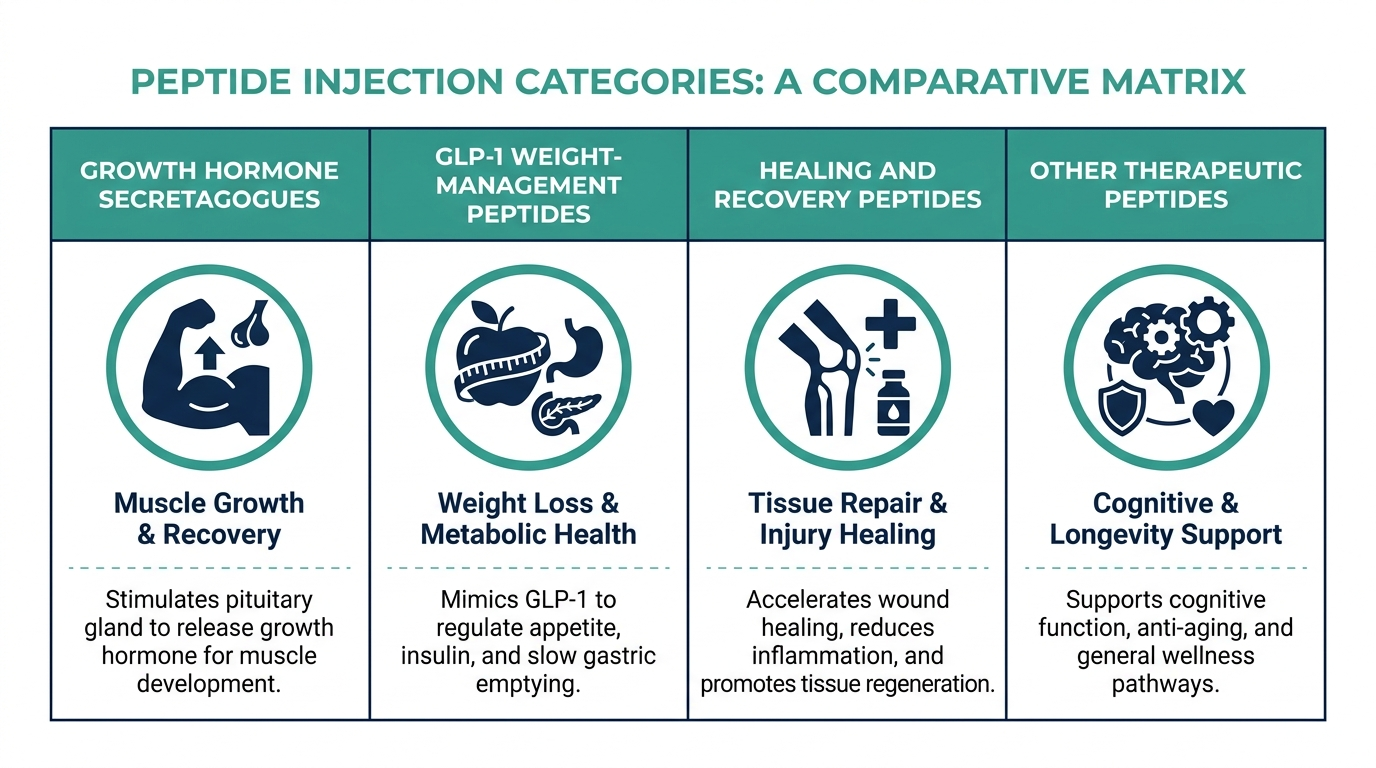
The “peptide injection” category is broader than most people realize when they first encounter it. Here is the honest map:
| Category | Examples | Mechanism | Evidence quality |
|---|---|---|---|
| GLP-1 / metabolic | Semaglutide, tirzepatide | GLP-1 / GIP receptor binding; appetite + insulin | Phase 3 RCTs; FDA-approved |
| Growth hormone secretagogues | Sermorelin, CJC-1295 + ipamorelin | GHRH or ghrelin receptor; GH pulse | Prescription available; compounded |
| Tissue repair | BPC-157, TB-500 | Fibroblast activation, angiogenesis | Animal studies; human data minimal |
| Fat metabolism | Tesamorelin | GHRH analog; visceral fat reduction | FDA-approved (HIV lipodystrophy) |
| Sexual function | PT-141 (bremelanotide) | Melanocortin MC4 receptor; CNS arousal | FDA-approved (Vyleesi, women) |
| Longevity / immune | Thymosin alpha-1, MOTS-c, Epitalon | T-cell modulation; mitochondrial signaling | Under FDA review 2026-2027 |
| Melanocortin (tanning) | Melanotan II | MC1 receptor; melanin production | Not approved; linked to melanoma risk |
Two things stand out in that table. First, the strongest evidence sits firmly in the prescription lane, GLP-1 drugs especially. Second, the most hyped compounds in wellness communities (BPC-157, TB-500, melanotan) are the ones with the weakest human evidence and the highest regulatory uncertainty.
How are peptide injections actually administered?
Most therapeutic peptides are given subcutaneously, meaning into the fatty tissue just beneath the skin, usually on the abdomen, outer thigh, or upper arm. The needle used is typically 28 to 31 gauge and 4 to 8 mm long, comparable to an insulin syringe. The injection itself is largely painless; the preparation beforehand is where most errors occur.
Here is what the process involves in practice (educational overview, not a protocol):
-
Reconstitution: Lyophilized powder is mixed with bacteriostatic water, which contains 0.9% benzyl alcohol to prevent bacterial growth and allow multi-draw use. The water is injected slowly down the glass wall of the vial, not directly onto the powder cake.
-
Concentration math: If you add 1 mL of water to a 5 mg vial, you have 5,000 mcg/mL. A 250 mcg dose requires 0.05 mL (5 units on a U-100 syringe). A single decimal error in that calculation changes the dose by a factor of ten.
-
Injection site rotation: Repeated injections into the same spot create lipodystrophy, localized fat or tissue damage that is visible and sometimes permanent.
-
Storage: Reconstituted peptides are refrigerated at approximately 4°C and discarded 30 days after mixing.
With a prescribed peptide from a licensed pharmacy, your pharmacist verifies the concentration, the compounding pharmacy certifies the sterility, and your prescribing clinician sets the dose. With a grey-market vial, every one of those steps is yours to manage alone, and the vial carries no guarantee that what is printed on the label matches what is inside.
How much do peptide injections cost in 2026?
Pricing divides predictably across the three lanes:
- Oral/topical collagen and copper peptides: $20 to $60 per month. No injection, widely available.
- Grey-market research vials: Roughly $40 to $120 per vial depending on the compound. Add bacteriostatic water, syringes, and alcohol swabs. No monitoring, no clinical oversight, and no recourse if purity fails.
- Telehealth sermorelin: $150 to $225 per month through platforms like Defy Medical, Marek Health, or Hone Health, all-in with physician oversight and pharmacy-grade medication.
- Broader peptide therapy / GLP-1 protocols: $199 to $399 per month, including labs and follow-up.
- Brand-name GLP-1 drugs (Wegovy, Zepbound): $900 to $1,400 per month at retail; significantly lower with manufacturer coupons or GoodRx-type discount programs for qualifying patients.
None of these are covered by standard commercial insurance, except brand-name GLP-1 drugs when prescribed for obesity by a physician who documents medical necessity. Budget accordingly before your first invoice.
What is the honest case for and against peptide injections?
The case for is real. GLP-1 drugs produce weight loss of 14 to 20% of body weight in clinical trials, a magnitude that exceeds almost any lifestyle-only intervention. Sermorelin is substantially cheaper than synthetic HGH therapy and works through a physiologic mechanism. The entire class of FDA-approved peptides represents genuine pharmaceutical innovation.
The case against grey-market self-injection is equally real. “Natural” is not a synonym for safe. A 15-amino-acid peptide that forces angiogenesis at an injury site is not a benign supplement. The UNSW medical review from April 2026 notes that human studies remain small, short-term, and lacking controls. The mechanism sounds compelling; the human evidence to match it does not exist yet.
The myth worth busting directly: “research peptides are just unregulated versions of the same thing clinics use.” They are not. A compounding pharmacy works under FDA-inspected conditions with batch testing. A grey-market vendor works under the legal fiction of “not for human use.” Those are not the same supply chain, and treating them as equivalent is the most common and most consequential misunderstanding in the peptide conversation.
Turn what you just learned into action.
Superpower lets you test 100+ biomarkers from home, then re-check them over time so you can actually see progress, physician-reviewed at every step.
Frequently asked questions
What do peptide injections actually feel like?
Most subcutaneous peptide injections are nearly painless because the needle is thin (28 to 31 gauge) and short (4 to 8 mm). Mild injection-site redness or a small welt lasting 15 to 30 minutes is common. GLP-1 peptides like semaglutide may cause nausea, especially in the first 4 to 8 weeks at escalating doses; this is the most common reason people reduce or discontinue them.
Are peptide injections safe?
FDA-approved peptide injections administered under clinical supervision have documented safety profiles. Non-approved research peptides carry meaningfully higher risk due to unverified purity, possible contamination, and the absence of any clinical oversight. A JAMA analysis found that nearly 25% of non-FDA-approved peptide products contained undisclosed compounds.
How long does it take for peptide injections to work?
It depends entirely on the peptide. GLP-1 drugs begin suppressing appetite within days of the first injection, with meaningful weight loss visible by weeks 4 to 8. Growth hormone secretagogues typically require 8 to 12 weeks before users report changes in body composition, sleep quality, or recovery. Tissue repair peptides are even harder to benchmark because there are no validated human timelines.
Can I get peptide injections without a prescription?
For FDA-approved peptides, no. For research peptides sold as “not for human use,” the legal answer is yes, though using them on yourself places you entirely outside any regulatory protection. Several states are moving to restrict even the research-chemical loophole; Alabama’s 2026 warning to physicians is one indicator of the direction of travel.
Do peptide injections require refrigeration?
Lyophilized (dry) peptides are stable at room temperature for months. Once reconstituted with bacteriostatic water, they should be refrigerated at approximately 4°C (39°F) and used within 30 days. Repeated freeze-thaw cycles degrade the peptide chain and reduce potency.
What is the difference between a peptide injection and hormone therapy?
Hormones are typically larger molecules (proteins or steroids) that act on many tissues broadly. Peptides are shorter, often more targeted, and frequently work by stimulating the body to produce its own hormones rather than replacing them directly. Sermorelin, for example, does not contain growth hormone; it tells your pituitary gland to release more of your own. This is called a “secretagogue” approach, and it preserves the pituitary’s feedback loop rather than overriding it.
Are peptide injections the same as steroids?
No. Anabolic steroids are synthetic derivatives of testosterone, a cholesterol-based steroid hormone. Peptides are amino-acid chains. They operate through entirely different receptors and pathways. Growth hormone secretagogues are sometimes lumped in with “performance-enhancing drugs” in competitive sports contexts, but the pharmacology is distinct.
Author: Vital Signs Today Editorial Team, [credential]”]. Educational content, not medical advice. Sources linked inline.
Full-body lab membership: 100+ biomarkers, doctor-reviewed, tracked over time.
Primary sources (verify live before publish):
– InnerBody: Beginner’s Guide to Peptide Therapy 2026
– NEJM: Tirzepatide vs. Semaglutide SURMOUNT-5 trial
– FDA bulk drug substances under 503A compounding
– UVA Health Q&A: Should you trust trending peptide injections?
– UNSW: Injectable peptides anti-aging trend, evidence review (April 2026)
– Spectrum News: Health experts warn against injecting non-FDA-approved peptides (May 2026)
– IvyRx: Sermorelin cost 2026
– Sermorelin.com: Affordable peptide and hormone therapy pricing
– PeptideMag: Peptide bioavailability and route of administration
– WebMD: What are peptides?
Related reading
Vital Signs Today may earn a commission if you buy through links on this page. It does not affect our editorial assessments.