
Last updated June 2026. Educational content, not medical advice. Most injectable peptides are not FDA-approved for healthy adults. Always consult a licensed clinician before starting any peptide protocol.
Short answer: Peptides for bodybuilding are short chains of amino acids that signal your body to do specific things, most commonly to release more growth hormone, accelerate tissue repair, or improve recovery. A 2006 human study showed a single dose of CJC-1295 raised mean GH levels 2- to 10-fold for six or more days; but that does not mean they are safe, legal, or superior to training alone.
Bodybuilding peptides push your growth hormone and recovery systems hard. Want to see how those systems are actually running? One at-home Superpower draw checks 100+ biomarkers, physician-reviewed.
So what exactly is a peptide?
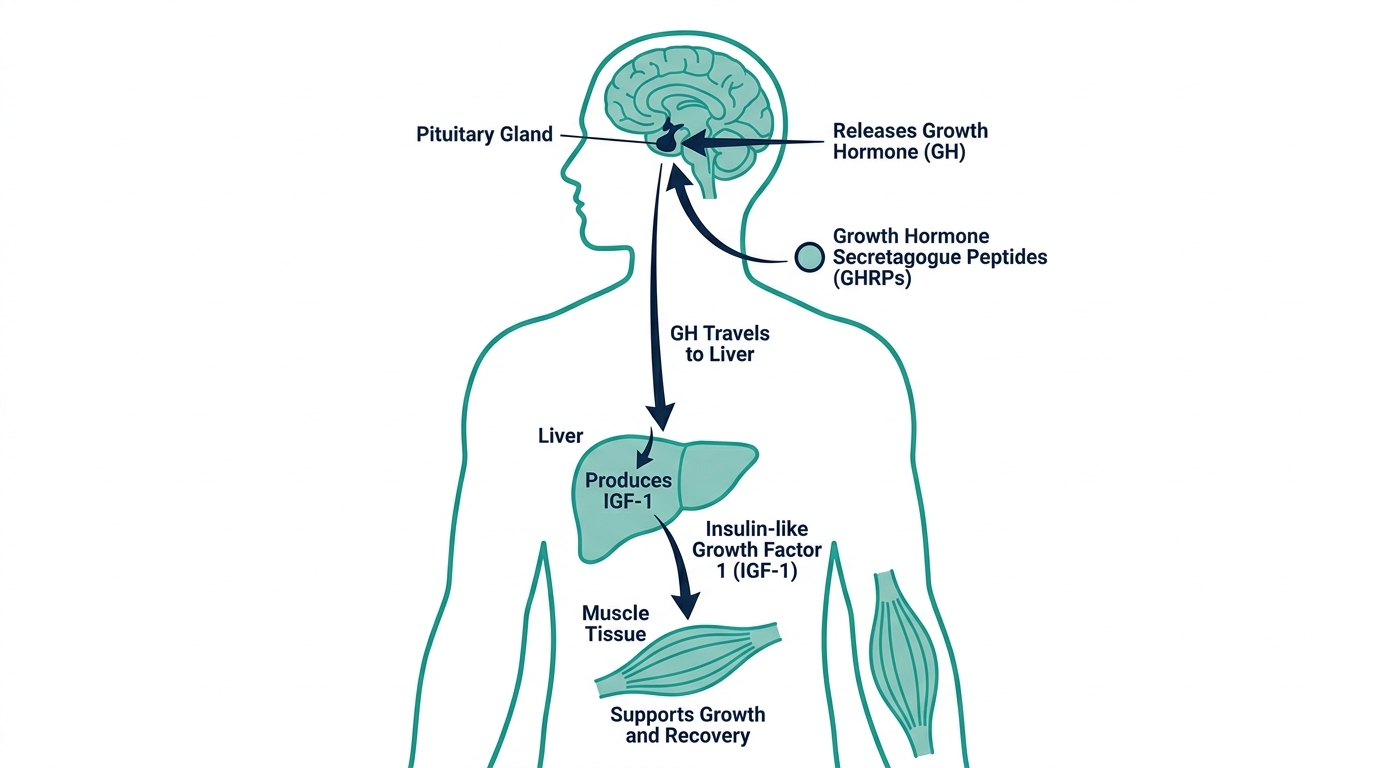
A peptide is any chain of 2 to 50 amino acids linked by peptide bonds. Below 50 amino acids, you have a peptide. Above 50, the molecule is typically called a protein. Your body manufactures thousands of peptides naturally, including insulin, oxytocin, and growth hormone releasing hormone (GHRH), each acting as a precise molecular signal.
What bodybuilders are chasing is a narrow subset of that universe: synthetic peptides that mimic or amplify hormonal signals tied to muscle protein synthesis, fat metabolism, or tissue repair. These are not vitamins, not protein powders, and not steroids. They sit in a category of their own, and that category has different rules for each compound.
The name “peptide” covers everything from the collagen powder in your morning coffee to the injectable research chemicals your gym’s most secretive member keeps in a mini-fridge. The word alone tells you almost nothing useful.
Why has the bodybuilding world gotten obsessed with peptides?
Three things collided at once. First, synthetic HGH (human growth hormone) costs $600 to $1,200 a month and is tightly controlled. Growth hormone secretagogue peptides (GHSPs) like sermorelin and the CJC-1295/Ipamorelin stack stimulate your own pituitary to release GH at a fraction of that cost, typically $175 to $225 per month through a telehealth clinic (IvyRx). The cheaper path to similar signaling is compelling on a spreadsheet.
Second, the internet gave research-chemical vendors a direct route to consumers. What used to require a grey-market contact in the 1990s is now a Google search and a credit card. Third, forums and podcasts normalized “biohacking” language around peptides, stripping the clinical context and making a lyophilized vial sound like a supplement rather than an unregulated injectable.
Personally, the hype has run significantly ahead of the human evidence. Most of the dramatic before-and-after stories circulate on platforms where nobody checks sources, and the actual randomized controlled trial data on healthy adults is thin to nonexistent for several of the most-discussed peptides.
Full-body lab membership: 100+ biomarkers, doctor-reviewed, tracked over time.
What are the main categories of bodybuilding peptides?
The mistake most beginners make is treating “peptides for bodybuilding” as one thing. There are actually four distinct categories, each with different mechanisms, different evidence levels, and different legal statuses.
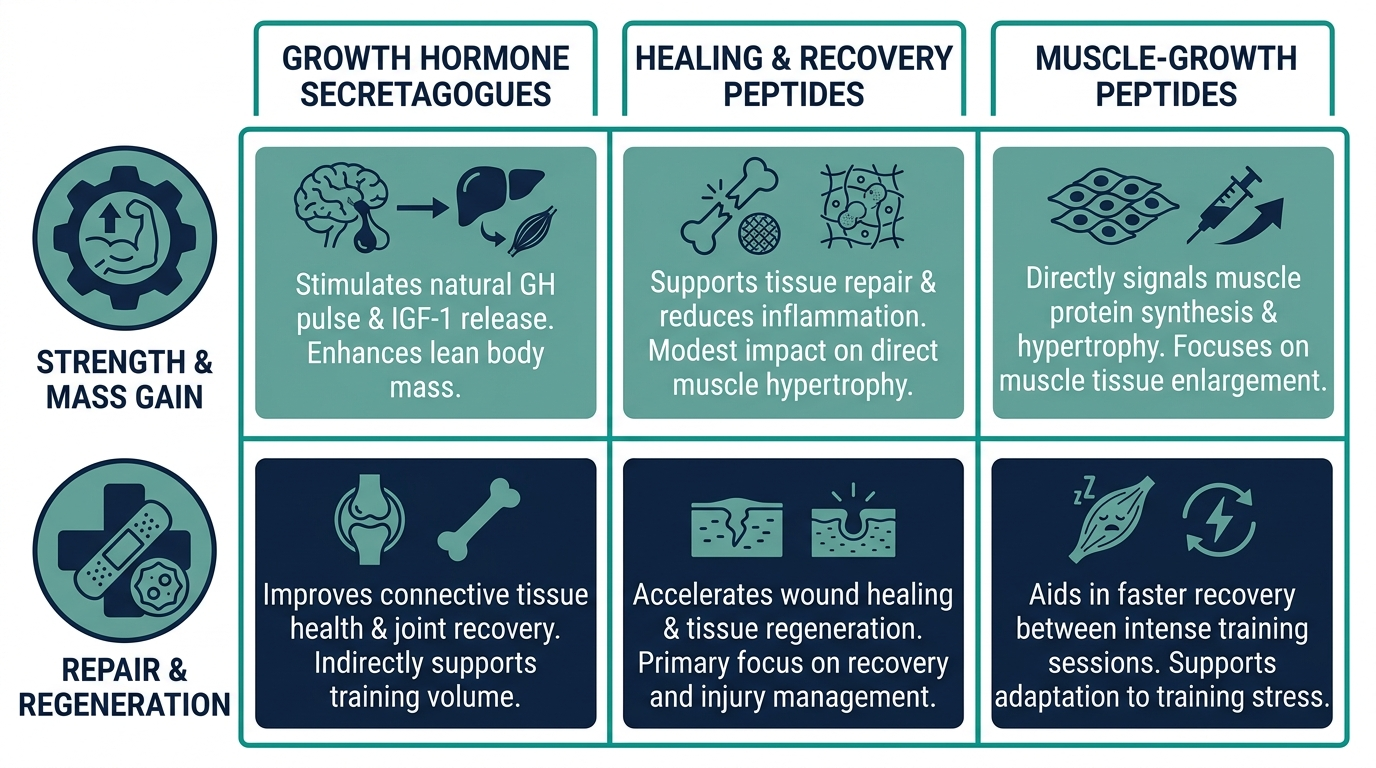
1. Growth hormone secretagogues (GHSPs)
These are the most-used class in the bodybuilding world. They stimulate the pituitary gland to release more of your own GH, which elevates IGF-1, which drives lean tissue growth and fat oxidation. The GH and IGF-1 pathways also feed into mTOR signaling, a central regulator of muscle protein synthesis.
The two most common stacks:
CJC-1295 (a GHRH analogue) + Ipamorelin (a ghrelin mimetic). CJC-1295 provides a sustained baseline increase in GH pulse amplitude. Ipamorelin adds a sharp GH spike while, unlike older ghrelin mimetics (GHRP-2, GHRP-6), it does not meaningfully raise cortisol or significantly increase appetite. A 2006 Phase I/II study published in the Journal of Clinical Endocrinology and Metabolism found that a single subcutaneous dose of CJC-1295 raised mean GH levels 2- to 10-fold for six or more days and raised IGF-1 by 1.5- to 3-fold for 9 to 11 days, in healthy adults (PubMed, PMID 16352683). That is real human data, not a rodent study.
Sermorelin. An older, shorter-acting GHRH analogue with the longest clinical track record of this class. It is FDA-approved for diagnosing GH deficiency and has the most mature telehealth prescribing infrastructure. The significant increase in lean body mass seen in clinical studies (mean difference +1.42 kg, 95% CI [1.13, 1.71], p < 0.001 in a tesamorelin meta-analysis) gives a sense of what GHRH-class stimulation can do in a controlled setting (PubMed, PMID 41545261), though most of that data comes from populations with disease-related muscle loss, not healthy athletes.
What they do not do: GHSPs are not a steroid shortcut. GH-mediated lean mass gains are gradual, measured in weeks to months, and most pronounced in people who are GH-deficient or older. In a well-trained 28-year-old with normal GH levels, the marginal effect of flooding an already-adequate system is likely smaller than the marketing implies.
2. Recovery and repair peptides
BPC-157 (Body Protection Compound 157) is a 15-amino-acid synthetic fragment derived from a stomach protein. It has substantial preclinical evidence for tendon healing, gut lining repair, and anti-inflammatory action, mostly from rodent studies. A 2025 systematic review screened 544 papers and found 35 of 36 papers on musculoskeletal use were in rodents or cells, with only one involving humans (The Conversation). That gap between animal data and human evidence is the defining problem of BPC-157’s reputation.
TB-500 (Thymosin Beta-4). Often stacked with BPC-157 (the so-called “Wolverine stack” in forum shorthand). TB-500 promotes actin regulation, angiogenesis, and cellular migration, mechanisms that theoretically support soft-tissue repair. Again: animal data is compelling; controlled human data is sparse.
Do not believe anyone who tells you BPC-157 has been “proven” to rebuild tendons in humans. It has not. What it has is a strong preclinical signal that justified human research, which barely exists yet.
3. Myostatin-blocking peptides
Myostatin is a protein that limits muscle growth. Block it, and muscle fibers theoretically grow without the normal ceiling. Follistatin-344 and ACE-031 are the two most-discussed in this category. ACE-031 showed approximately +3.5% lean body mass increase in a clinical trial for Duchenne muscular dystrophy but did not translate that into improved functional strength (ResearchGate). Both are WADA-prohibited and experimental. This category sits closer to science fiction than clinical reality for healthy athletes.
4. Collagen and cosmetic peptides
Hydrolyzed collagen peptides are the safest and best-evidenced member of the family. A 2024 randomized controlled trial published in Frontiers in Nutrition found that 15 g of specific collagen peptides daily for 12 weeks, combined with concurrent training, significantly reduced acute muscle stress markers and improved early-phase recovery vs. placebo (Frontiers in Nutrition). These are not injectable, not regulated as drugs, and available at every supplement retailer. They are also the only peptide category where “buy it over the counter” is accurate and legal.
How do bodybuilding peptides compare to steroids?
This is the question that lives in every forum thread, so here is the honest table.
| Factor | GH Secretagogue Peptides | Anabolic Steroids |
|---|---|---|
| Mechanism | Stimulate your own pituitary/axis | Directly bind androgen receptors, alter gene expression |
| Speed of results | Gradual (weeks to months) | Fast (days to weeks) |
| Muscle gain ceiling | Modest for healthy adults | Significant, dose-dependent |
| Hormonal suppression | Low to none (GHSPs) | Suppresses natural testosterone production |
| Cardiovascular risk | Lower, not zero | Elevated; cardiomyopathy risk at sustained use |
| Legal status (US) | Complex grey zone; many moving to prescription | Schedule III controlled substance |
| WADA banned | Yes (most peptides) | Yes |
| Acne, hair loss risk | Very low | Common |
Peptides are not a “safe steroid.” They work through different pathways and carry different risk profiles. What they are is a slower, softer intervention with a lower ceiling and, in most cases, a lower risk floor. For anyone whose goal is gradual optimization rather than extreme hypertrophy, that tradeoff can make sense.
What is the legal and WADA status in 2026?
This changed significantly in early 2026. On 22 April 2026, the FDA removed BPC-157 from its 503A Category 2 (restricted substances) list, and HHS signaled in February 2026 that 14 peptides including BPC-157, TB-500, CJC-1295, Ipamorelin, and GHK-Cu are expected to return to Category 1 status (permitted for compounding pharmacies), pending a Pharmacy Compounding Advisory Committee meeting scheduled for 23 to 24 July 2026 (FDA bulk substances list). This is the most significant regulatory shift for these peptides since 2023.
However, “moving toward legal compounding” is not the same as “legal to buy online without a prescription.” The research-use-only market still operates under the same fiction it always has: vendors sell for “laboratory research,” and you absorb 100% of the legal and medical risk the moment you use the product on yourself.
For competitive athletes, the picture is unambiguous. WADA’s 2026 Prohibited List bans growth hormone secretagogues (including ipamorelin, CJC-1295, GHRP-2, GHRP-6, hexarelin), GLP-1 receptor agonists (semaglutide, tirzepatide), IGF-1 analogues, myostatin inhibitors (follistatin, ACE-031), and peptides with pharmacological activity not approved by any regulatory authority, explicitly including BPC-157 (WADA Prohibited List 2026). “I bought it as a research chemical” is not a WADA defense.
What does getting peptides through the legitimate route actually look like?
If you want to pursue GH optimization through peptides in 2026, the legitimate route runs through a telehealth clinic. Platforms like Marek Health, Defy Medical, and Hone Health provide a licensed physician, NP, or PA to review your bloodwork, prescribe through a named compounding pharmacy, and monitor your labs (Marek Health, Defy Medical).
Marek Health costs roughly $225 to $350 per month and includes 65 to 100+ biomarker panels. Defy Medical costs $99 to $150 per month with a more basic lab panel. Both operate with actual clinical oversight, which is precisely what a grey-market vial eliminates.
One insider detail that does not show up in most articles: as of June 2026, no legitimate compounding pharmacy can dispense BPC-157 or TB-500 regardless of how the clinic’s marketing reads. The FDA advisory committee meeting is July 23 to 24, 2026. Until that review concludes and formal guidance follows, any clinic advertising injectable BPC-157 now is either using a non-compliant pharmacy or sourcing from grey-market supply. Ask the clinic to name the compounding pharmacy it uses, and verify that pharmacy’s 503A or 503B accreditation independently.
Full-body lab membership: 100+ biomarkers, doctor-reviewed, tracked over time.
What are the actual risks of using research peptides without a prescription?
The risks live in two buckets that most discussions conflate: the risk of the peptide itself, and the risk of what is actually in the vial.
The purity problem. Independent testing platform Finnrick, which has run more than 8,000 tests across 225 vendors, found that even the largest grey-market vendor (Peptide Sciences, which shut down in March 2026) was shipping retatrutide at purity as low as 75% in some batches, including batches that triggered a counterfeit flag. Purity problems are not the exception at the margins; they were present at the top of the market.
The dosing problem. A lyophilized peptide vial arrives as freeze-dried powder. You reconstitute it yourself with bacteriostatic water, calculate your dose concentration (a math step where being off by one decimal changes the dose tenfold), draw it into an insulin syringe, and inject subcutaneously. Every clinic that charges a monthly fee has a pharmacist and a physician managing those steps. Every grey-market buyer manages them alone.
Known side effects of GHSPs at typical use levels include water retention, joint stiffness, mild carpal tunnel symptoms, and transient numbness in extremities, usually dose-dependent and reversible. More serious theoretical risks include insulin resistance from chronically elevated GH/IGF-1 and, at extreme use, promotion of dormant tumor growth (a concern that warrants clinical monitoring rather than a flat ban, but a concern nonetheless).
Three things about peptides that even experienced gym-goers often get wrong
Myth: peptides work immediately. They do not. GH secretagogues take 4 to 8 weeks of consistent use before body composition changes become measurable. Recovery peptides like BPC-157 may show effect in preclinical models within 2 weeks, but the human timeline is unknown. Anyone selling you a “feel it in 3 days” result is selling something else.
Myth: peptides are basically hormones, so more is always better. GHSPs stimulate a pulsatile system. Flooding it with too much stimulation can paradoxically desensitize pituitary receptors (tachyphylaxis), reducing the body’s GH response over time. This is why experienced clinicians use cycling protocols. Unsupervised higher dosing can produce diminishing returns or none at all.
Myth: because they are “natural” secretagogues, they are safe for competitive sport. They are banned. Full stop. WADA includes them explicitly under peptide hormones, growth factors, and related substances, and the prohibition applies both in-competition and out-of-competition for most of them. “Natural” and “permitted by your sport’s governing body” are completely different questions.
Who should actually consider peptide therapy in 2026?
Honestly? The strongest case exists for people over 40 with documented sub-optimal GH output, slow recovery that limits training frequency, or a clinical indication like HIV-related wasting or documented GH deficiency. In those populations, the clinical data is clearest and the risk-benefit calculus favors intervention.
For a healthy, well-sleeping, well-nourished 25-year-old male training seriously, the marginal benefit of adding a GH secretagogue on top of an optimized lifestyle is genuinely unclear from the existing evidence. The honest answer is: the forums overclaim and the evidence undersupports for this population.
The smart move before spending money on any of this is to measure where you stand first.
Full-body lab membership: 100+ biomarkers, doctor-reviewed, tracked over time.
Curious what your own levels look like?
Baseline 100+ biomarkers today and retest as life changes, all in one membership with physician review.
Frequently asked questions
What are peptides for bodybuilding?
Peptides for bodybuilding are synthetic amino acid chains that interact with hormonal pathways tied to muscle growth, recovery, and fat metabolism. The most used categories are GH secretagogues (CJC-1295, Ipamorelin, Sermorelin), recovery peptides (BPC-157, TB-500), and collagen peptides. They differ from steroids in mechanism, speed, and risk profile.
Do peptides actually build muscle?
Growth hormone secretagogues have the strongest human evidence: a Phase I/II CJC-1295 trial showed a 2- to 10-fold GH increase and 1.5- to 3-fold IGF-1 elevation in healthy adults (PubMed, PMID 16352683). Whether that translates to meaningful lean mass gains in already-healthy, well-trained individuals is a separate question the published data does not clearly answer. Collagen peptides have solid evidence for recovery and connective tissue support (15 g daily for 12 weeks in a 2024 RCT reduced muscle damage markers).
Are peptides legal for bodybuilding?
Depends on which peptide and what you mean by “legal.” Collagen peptides are fully legal as supplements. GH secretagogues like sermorelin and CJC-1295/Ipamorelin are legal with a prescription through a licensed telehealth clinic. BPC-157 and TB-500 are moving toward legal compounding pharmacy status pending a July 2026 FDA committee ruling. Research-use-only sales are legal for the vendor but transfer all risk to the buyer. For competitive sports, most are banned by WADA regardless of how they were obtained.
Are peptides banned in sports?
Yes. WADA’s 2026 Prohibited List bans growth hormone secretagogues (ipamorelin, CJC-1295, GHRP-2, GHRP-6), IGF-1 and its analogues, myostatin inhibitors, and peptides not approved by any regulatory authority (including BPC-157 and TB-500). The ban applies in-competition and out-of-competition for most of them (WADA Prohibited List).
Peptides vs steroids: which is better for bodybuilding?
Steroids produce faster, larger muscle gains but suppress natural testosterone production and carry significant cardiovascular and hormonal risks. GH secretagogue peptides produce slower, more modest gains through your own hormonal axis with lower suppression risk. Neither is “better” without specifying goals, timelines, and acceptable risk. Steroids remain Schedule III controlled substances; most bodybuilding peptides exist in a grey zone moving toward prescription requirements.
What peptides are used most in bodybuilding?
The most-used stack is CJC-1295 + Ipamorelin for GH/IGF-1 support. BPC-157 + TB-500 (the “Wolverine stack”) is the most-used recovery combination. Sermorelin is the safest GH secretagogue with the longest clinical history and the cleanest path to a legitimate prescription. Collagen peptides are the most-used supplement-class peptide for connective tissue and recovery.
Can you get peptides without a prescription?
Collagen and topical cosmetic peptides, yes. Injectable therapeutic peptides, no legitimate route exists without a prescription in the US. Research-use-only vendors sell without a prescription legally (to themselves), but that label is a legal disclaimer that transfers full risk to the buyer, not a license for human self-administration.
Author: Vital Signs Today Editorial Team, [credential]”]. Educational content, not medical advice. Sources linked inline.
Primary sources:
– PubMed PMID 16352683: CJC-1295 GH/IGF-1 human trial
– PubMed PMID 41545261: Tesamorelin meta-analysis lean body mass
– The Conversation: The peptide problem, hype is outrunning the evidence
– Frontiers in Nutrition 2024: Collagen peptides RCT recovery
– FDA 503A bulk drug substances list: BPC-157 reclassification
– WADA 2026 Prohibited List
– Finnrick: independent peptide testing database
– ResearchGate: ACE-031 Duchenne muscular dystrophy RCT
– Marek Health review 2026
– Defy Medical vs Marek Health comparison
– IvyRx: sermorelin cost guide
Related reading
Vital Signs Today may earn a commission if you buy through links on this page. It does not affect our editorial assessments.