Quick answer: You can order a full blood test panel online without a doctor referral through direct-to-consumer lab services like Superpower, Ulta Lab Tests, or Walk-In Lab. You choose a panel, pay upfront (cash prices range from $89 to $499 depending on how many biomarkers are included), visit a nearby Quest or Labcorp draw site, and receive results digitally within one to three business days. No insurance required, no prior appointment with a physician needed.
What is a full blood panel workup, exactly?
A full blood test panel is a collection of individual lab tests ordered together to give a broad snapshot of how your body is functioning. Unlike a single-marker test (say, just TSH for thyroid), a full panel simultaneously checks metabolic health, organ function, blood cell counts, hormones, lipids, and inflammatory markers from one blood draw. The term is not standardized, which is why two companies advertising a “full comprehensive blood panel” may include 40 biomarkers or 120. Always look at the actual marker list, not the marketing name.
Comparing full panel prices from $89 to $499? See where a 100+ biomarker, physician-reviewed panel actually lands. One at-home Superpower draw checks 100+ biomarkers, physician-reviewed.
A genuinely complete workup typically includes:
- Complete Blood Count (CBC with differential): red cells, white cells, platelets, hemoglobin, hematocrit.
- Comprehensive Metabolic Panel (CMP): glucose, kidney markers (BUN, creatinine), liver enzymes (ALT, AST, ALP, bilirubin), electrolytes, total protein, albumin.
- Lipid panel: total cholesterol, LDL, HDL, triglycerides, and ideally ApoB or LDL-P for cardiovascular risk precision.
- Thyroid panel: TSH at minimum, free T3 and free T4 for a full picture.
- Iron studies: serum iron, ferritin, TIBC (ferritin alone misses several iron disorders).
- Key hormones: total testosterone and free testosterone for men, estradiol for women, DHEA-S, cortisol.
- Inflammatory and metabolic markers: hsCRP, homocysteine, uric acid, insulin, HbA1c.
- Vitamins and minerals: vitamin D (25-OH), vitamin B12, magnesium, zinc.
A full blood panel testing service that does not include at least most of these categories is really selling you a basic metabolic screen, not a comprehensive workup. Read the marker list before you buy.
How do you get a full blood panel without a doctor?
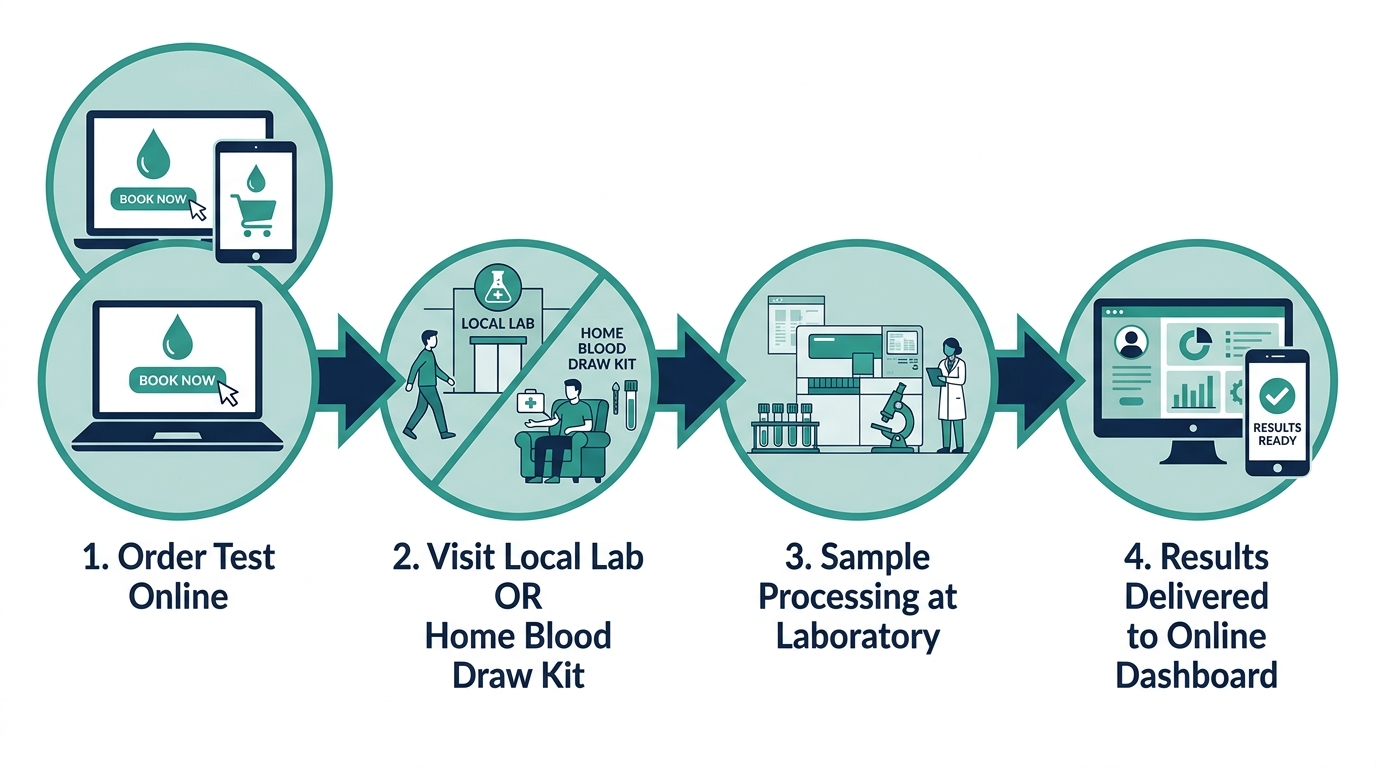
Ordering a full blood test panel without a physician is legal in most US states through direct-to-consumer (DTC) lab testing services. The process takes about ten minutes online and involves three steps: order, draw, receive results.
- Choose a service and panel: Visit a DTC platform, pick a panel that matches your biomarker goals, and pay at checkout. Prices and marker counts vary significantly (see comparison below).
- Visit a draw site: Most services use Quest Diagnostics or Labcorp networks, giving you access to thousands of Patient Service Centers nationwide. No appointment is required at many locations, though booking one cuts wait time. Bring your order confirmation (email or app QR code) and a photo ID.
- Receive digital results: Results appear in your online account or app, typically one to three business days post-draw. Some services include a physician review or interpretation layer; others give you raw numbers only.
Three US states restrict consumer-ordered lab tests more than others: New York, New Jersey, and Maryland require physician involvement. If you live in those states, a telehealth order (available through many DTC platforms for a small fee) satisfies the requirement. You still pay cash and still go to a standard draw site.
If you are new to reading your own labs, can you buy blood tests online explains the state-by-state legal landscape in more detail.
How much does a full comprehensive blood panel cost without insurance?
Cash prices for a full comprehensive blood panel range from about $89 to $499 depending on the number of biomarkers and whether physician review is included. Here is a realistic 2026 breakdown of what you get at each price tier:
| Price tier | Typical biomarker count | What you usually get | What is missing |
|---|---|---|---|
| $29 to $89 | 12 to 25 | CBC + CMP or lipids | Hormones, thyroid, vitamins, inflammation |
| $90 to $199 | 30 to 60 | CBC + CMP + lipids + thyroid + basic vitamins | Hormones, ApoB, hsCRP, HbA1c |
| $200 to $349 | 60 to 90 | Above plus hormones, HbA1c, ferritin, hsCRP | ApoB, advanced cardiac markers, micronutrients |
| $350 to $499 one-time | 90 to 120+ | Full metabolic + hormones + cardiac + inflammation + vitamins | Usually nothing material; check for ApoB and free hormones |
| ~$199/year (membership) | 100+ | Annual draw, doctor review, year-over-year tracking | N/A; best value for annual baseline |
HSA and FSA cards are accepted by most DTC lab platforms, so if you have a health savings account, this is a qualified expense. Medicare does not cover DTC-ordered labs ordered outside a physician relationship, and most private insurance will not reimburse them either unless your doctor submits the orders separately.
For context on what the membership model actually costs annually, the how much does Superpower cost breakdown is useful before you commit.

Which services actually offer a full blood panel online?
The DTC lab market has a wide spread in quality. A few platforms worth knowing:
- Superpower: The most complete consumer-facing panel on the market as of 2026, running 100+ biomarkers with a physician review of every result set. Annual membership model (about $199/year) means your numbers are tracked over time, which is where the real clinical value comes in. Uses Labcorp draw sites. Read the full superpower blood test review for marker-by-marker detail.
- Ulta Lab Tests: A la carte ordering at competitive cash prices. Good for one-off single-marker checks, less ideal for a comprehensive annual baseline because you are assembling the panel yourself and the total cost can creep up fast.
- Walk-In Lab: Similar a la carte model to Ulta, solid panel breadth, uses both Quest and Labcorp. No physician review layer.
- Everlywell: At-home finger-prick kits for some markers; venous draw panels also available through their physician network. Convenient but marker counts on their comprehensive panels are lower than venous-draw competitors. See the everlywell review for specifics.
- Any Lab Test Now: Brick-and-mortar DTC chain. Walk in, choose from their menu, draw on-site. No online-order-then-draw-site friction, but locations are limited geographically.
For a side-by-side of these platforms including turnaround times and marker depth, best online blood test services 2026 covers all major options.
The simplest way to actually get this done
Superpower is a full-body lab membership that runs 100+ biomarkers, has each result reviewed by a doctor, and tracks your numbers year over year (about $199/year). It is what we point readers to when they would rather get one clean, complete draw than chase single tests one at a time. Here is superpower reviewed in full.
What to do before your blood draw (fasting and prep rules)
For a full blood panel workup, fast for eight to twelve hours before the draw. Water, black coffee (no milk or sugar), and plain tea do not break a fast for most panels, but check your specific service’s instructions because some panels, particularly cortisol and insulin, have stricter requirements.
A few prep details that get people tripped up:
- Timing of the draw matters for hormones: Testosterone, cortisol, and growth hormone peak in the morning. Draw before 10 a.m. if your panel includes them, otherwise your numbers will read artificially low.
- Supplements: Biotin (vitamin B7) at doses above 5 mg can interfere with immunoassay-based thyroid tests and produce falsely normal or falsely abnormal results. Stop biotin 72 hours before the draw.
- Strenuous exercise: A hard workout 24 to 48 hours before your draw elevates creatine kinase, ALT, and sometimes creatinine, which can flag as abnormal on your CMP. Either reschedule the workout or tell your reviewing clinician you trained recently.
- Alcohol: Even one drink within 24 hours raises triglycerides and can temporarily elevate liver enzymes (GGT, AST). Avoid alcohol for at least 24 hours, ideally 48, before a lipid or liver panel.
- Hydration: Being well-hydrated makes venipuncture easier and reduces hemoconcentration artifacts. Drink a full glass of water before you leave for the draw site.
How to read a full blood test: normal ranges, flags, and what actually matters
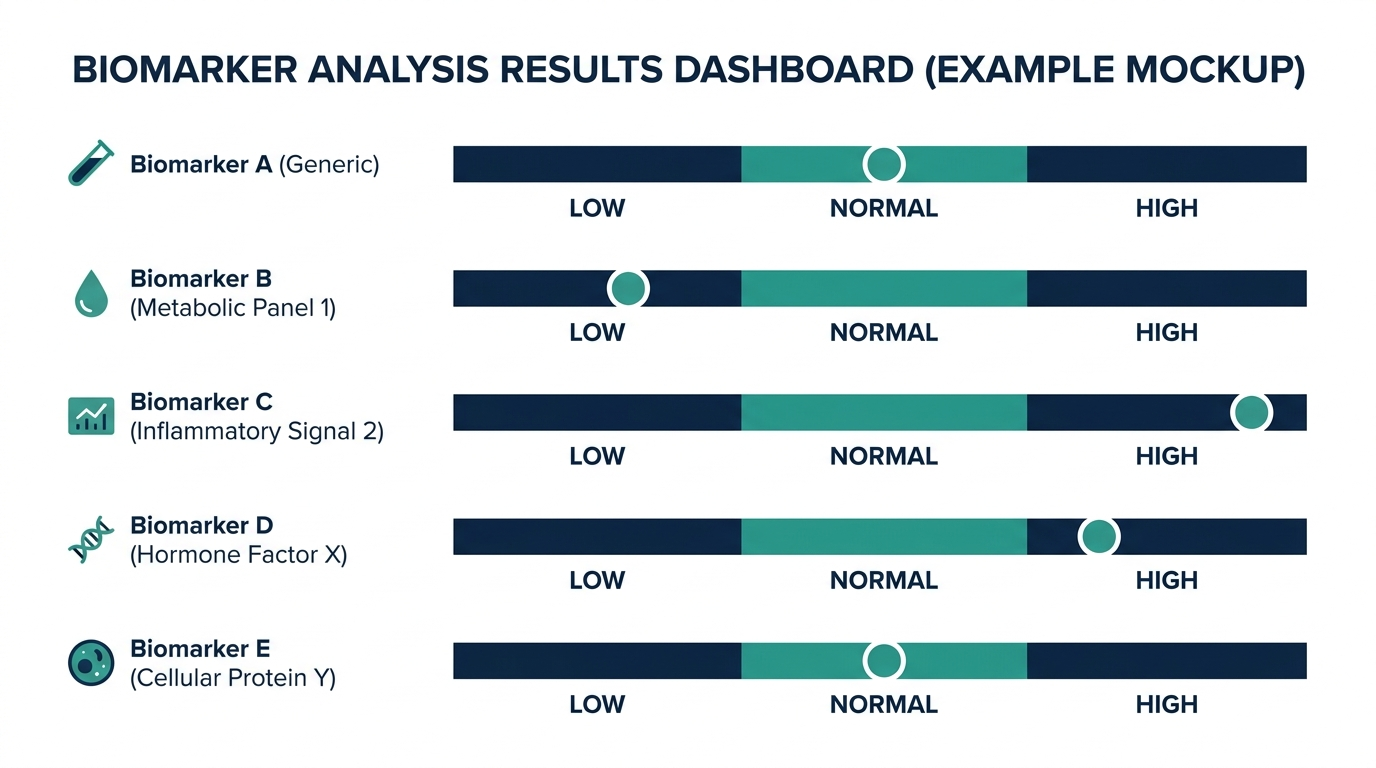
Lab reports flag results as High or Low using reference ranges that represent the middle 95% of a population, not what is optimal for your biology. That distinction matters more than most people realize.
A few common examples where the reference range misleads:
- Vitamin D: The lab normal lower limit is often set at 20 ng/mL. Most functional medicine and longevity-oriented clinicians consider 40 to 60 ng/mL optimal. You can be flagged as “normal” at 22 ng/mL while genuinely deficient by any meaningful standard.
- Testosterone: A total testosterone of 310 ng/dL may fall within the reference range for adult men (typically 264 to 916 ng/dL), but if your free testosterone is also low and you feel fatigued, that number is not fine. Reference ranges reflect population averages, including men with metabolic disease.
- LDL vs. ApoB: Standard LDL-C can underestimate cardiovascular risk in people with small, dense LDL particles. ApoB counts every atherogenic particle directly. If your panel includes it, prioritize that number over LDL-C for cardiovascular risk assessment.
- Ferritin: Lab normal range for ferritin is wide (12 to 300 ng/mL in women). Many practitioners see suboptimal energy and hair loss in women with ferritin under 50 ng/mL, even within the official normal range.
Services that include physician review flag these nuances rather than just color-coding High/Low. Talk to a clinician about any result you are unsure how to act on, particularly if you are on medications or managing a chronic condition.
What people get wrong about full blood panel testing
The biggest mistake is treating a one-time panel as a diagnostic conclusion rather than a baseline data point. A single normal HbA1c does not rule out prediabetes progression; a single normal PSA at 38 is not a lifetime guarantee. The value compounds when you repeat the panel annually and watch trends, not absolute values. A ferritin that drops from 90 to 42 over two years tells you something that neither number alone would.
The second mistake is buying the cheapest panel available and thinking you have done a full workup. A CBC plus CMP for $29 is a useful screen, but it tells you almost nothing about your hormones, thyroid, cardiovascular risk precision, or micronutrient status. That is not a full blood panel; it is two panels.
The third mistake: ordering a full panel when you have an active illness, fever, or recent injury. Acute inflammation will spike your hsCRP, white count, and liver enzymes, rendering those markers uninterpretable as a baseline. Wait two to four weeks after resolution before drawing for a true baseline.
For a broader look at what the online ordering process looks like start to finish, full body health screening online walks through the full workflow including result interpretation options.

Special situations: minors, Medicare, and uninsured adults
Minors: Most DTC lab services require the account holder to be 18 or older. A parent or legal guardian must create the account and accompany the minor to the draw site in most states. Some services have a lower age limit of 16 with parental consent. Call the draw site ahead of time to confirm their policy.
Medicare: Medicare Part B covers many blood tests but only when ordered by a Medicare-enrolled physician. DTC-ordered labs are not covered. If you are on Medicare and want a full panel beyond what your physician orders, you will pay entirely out of pocket, but you still have that right. Some Medicare Advantage plans have added DTC lab benefits as a supplemental perk, so it is worth checking your plan’s Evidence of Coverage document.
Uninsured adults: DTC lab testing is arguably most valuable here. Cash prices at DTC platforms are consistently lower than the retail rates hospitals charge uninsured patients. A full comprehensive blood panel through a DTC service at $199 to $349 compares favorably to hospital-billed rates for the same draw, which can run $800 to $2,400 before any negotiation. The trade-off is no physician relationship and no automatic insurance billing, but for a healthy adult seeking a baseline, that trade-off is often worth it.
Match the panel to your goal or symptom
A “full panel” is not one-size-fits-all. The smartest orders start from a question, then make sure the panel actually answers it. Use your reason for testing to prioritize the markers that matter, rather than paying for breadth you will never look at.
- Fatigue or low energy: prioritize a full iron study (iron, ferritin, TIBC), thyroid axis, vitamin D, vitamin B12, fasting glucose and HbA1c, and for men, free and total testosterone. Fatigue is one of the most common reasons people test, and these are the usual culprits.
- Cardiovascular risk or family history: make sure ApoB, Lp(a), hs-CRP, and a full lipid panel are included, not just total cholesterol and LDL. This is the cluster that actually stratifies risk.
- Metabolic and weight concerns: fasting insulin alongside glucose and HbA1c catches insulin resistance early, well before glucose alone drifts out of range.
- Hormonal symptoms: for men, free and total testosterone with a binding marker; for women, the picture depends on cycle timing and life stage, so read the results with a clinician who knows your context.
- General baseline with no specific concern: the six-system comprehensive draw is the right call, since you are looking for silent signals rather than confirming a suspicion.
Starting from the question keeps you from two mistakes at once: paying for markers irrelevant to your situation, and skipping the one marker that actually would have answered it.
When the draw or the result goes sideways
Occasionally a draw does not go cleanly, or a result comes back in a way that needs a second look. Knowing the common snags saves you a wasted trip and unnecessary worry.
- A hemolyzed sample: if red cells rupture during collection or handling, certain results (notably potassium) can be falsely elevated and the lab may reject the sample. This is not your fault and usually just means a redraw.
- A missed or short draw: if the phlebotomist cannot get enough blood, some markers may not run. Ask which tests were affected so you can redraw only those rather than the whole panel.
- A single wildly out-of-range value with no symptoms: lab and pre-analytic errors happen. A value that makes no sense against how you feel and your other markers is worth confirming with a repeat before you act on it.
- Results that do not post on time: advanced hormone and niche micronutrient assays can take a few extra days. If routine results are delayed well beyond the usual window, contact the service rather than assuming a problem.
The unifying habit is simple: confirm anything surprising before you change medication, diet, or supplements around it. One odd number is a prompt to recheck, not a diagnosis.
What a critical value means and what to do next
Most abnormal results are mild and non-urgent, but occasionally a panel returns a value the lab marks as critical, meaning it may need prompt attention. Knowing the difference between “flagged” and “critical” keeps you calm and appropriately responsive.
- Understand the two tiers. A standard High or Low flag simply means outside the reference range and is often minor. A critical value is a result far enough outside range that labs are generally expected to notify the ordering provider quickly, because it can signal something that needs timely evaluation.
- Know that a reviewed service should surface it. One advantage of a panel with physician review is that a genuinely urgent result is more likely to be flagged and communicated, rather than buried in a raw PDF you skim days later.
- Do not self-treat an urgent result. If a value is marked critical, or if you have severe symptoms alongside any result, contact a clinician or seek in-person care rather than adjusting things on your own.
- Bring the full panel, not one number. A clinician interprets a critical value in the context of your other markers, your history, and your symptoms, which is why the complete report matters more than the single scary line.
Framed this way, a comprehensive online panel is a powerful early-warning tool without becoming a source of panic. Talk to a clinician about any critical or concerning result before making changes to medication or lifestyle.
Don’t just read about your health, track it.
A single result is a snapshot. Superpower re-tests 100+ markers over time so you can watch them move as you change sleep, food, and training.
FAQ
What is included in a full blood panel workup?
A complete workup includes CBC with differential, comprehensive metabolic panel, full lipid panel (ideally with ApoB), thyroid panel (TSH, free T3, free T4), sex hormones (testosterone, estradiol), iron studies with ferritin, inflammatory markers (hsCRP, homocysteine), metabolic markers (HbA1c, fasting insulin), and key vitamins (D, B12, magnesium). Budget panels labeled “full” that only include CBC and CMP are not a genuine full workup.
Can I get a full blood test panel without a doctor’s order?
Yes, in 47 US states you can order directly through a DTC service like Superpower or Ulta Lab Tests without any physician involvement. New York, New Jersey, and Maryland require a physician order, which most DTC platforms can facilitate via a telehealth consultation for a small additional fee. The blood is still drawn at a standard Quest or Labcorp site.
How long does it take to get results from a full blood panel?
Most full panels return results within one to three business days of the draw. Specialized tests, particularly advanced hormones or niche micronutrients, can take up to five days. Results land in your online account or app and are available 24/7. Some services send a push notification when results are ready.
Do I need to fast for a full comprehensive blood panel?
Yes, eight to twelve hours of fasting is standard. Lipids, glucose, insulin, and many metabolic markers require a fasted state to be accurate. Water and black coffee are typically allowed. If your panel includes cortisol or growth hormone, draw before 10 a.m. regardless of fasting status, as these follow a diurnal pattern that makes afternoon results significantly lower.
Is a full blood panel covered by HSA or FSA?
Yes. Blood testing is a qualified medical expense under both HSA (Health Savings Account) and FSA (Flexible Spending Account) rules. You can use your HSA or FSA debit card directly at checkout on most DTC lab platforms. Keep the receipt for your records in case your plan administrator requests documentation.
What is the difference between a full blood panel and a basic metabolic panel?
A basic metabolic panel (BMP) covers eight markers: glucose, calcium, sodium, potassium, CO2, chloride, BUN, and creatinine. A comprehensive metabolic panel (CMP) adds liver enzymes and is 14 markers total. A genuine full blood test panel includes the CMP plus CBC, lipids, thyroid, hormones, vitamins, and inflammatory markers, often totaling 60 to 120+ individual tests. The BMP and CMP are components of a full panel, not substitutes for one.
How often should I get a full blood panel?
Once a year is the standard recommendation for healthy adults who want to track baseline trends. If you are managing a chronic condition, adjusting medications, making significant dietary or exercise changes, or following up on a previous abnormality, your clinician may recommend every three to six months for specific markers. Annual draws at the same time of year give the cleanest year-over-year comparisons.
Can a full blood test detect cancer?
Standard full blood panels are not cancer screening tools, but they can flag signals that warrant further investigation: unexplained anemia on CBC, abnormal liver enzymes, elevated calcium, or markedly high white cell counts can all prompt follow-up. Dedicated cancer screening tests (PSA for prostate, CA-125 for ovarian, CEA, AFP) are separate add-on markers not included in most standard panels, and even those are screening signals, not diagnoses. A tissue biopsy is required for any cancer diagnosis.
What is the best full blood panel service in 2026?
For comprehensive marker depth, physician review, and annual tracking value, Superpower leads the consumer market at about $199/year for 100+ biomarkers. For a la carte flexibility without a commitment, Ulta Lab Tests and Walk-In Lab are solid. For at-home convenience with lower marker counts, Everlywell works for specific panels. The right choice depends on whether you want a one-time snapshot or a longitudinal health record.
Will my employer or insurance company see my DTC lab results?
No. Results from DTC-ordered labs ordered on your own account are not automatically shared with your employer, insurance company, or any other third party. They are not routed through your electronic health record unless you manually share them. Some services offer HIPAA-compliant result sharing with a physician of your choice, but that is opt-in. Your lab data belongs to you.
Vital Signs Today may earn a commission if you buy through links on this page. It does not affect our editorial assessments.