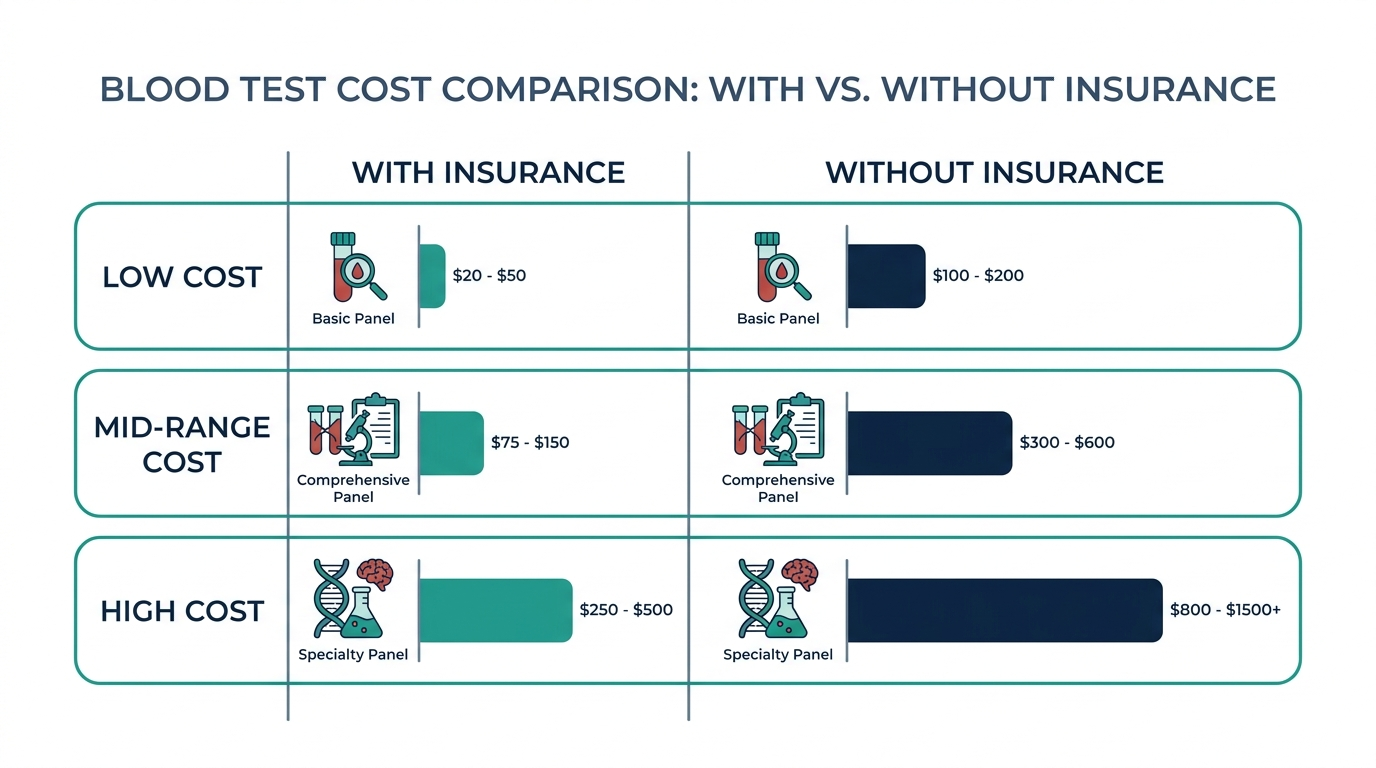
Quick answer: Most routine blood work costs $0 to $50 with insurance, and $29 to $150 cash for a single common panel like a complete blood count or a basic metabolic panel. A broader wellness draw of 5 to 10 panels runs roughly $100 to $400 out of pocket through discount labs, and a hospital or specialty test can hit $500 or more. The single biggest variable is not the test, it is where you get drawn and whether the order is coded as preventive or diagnostic.
If you have ever paid $12 for a cholesterol check at one clinic and gotten a $230 bill for the same draw at another, you are not imagining it. Lab pricing in the US is some of the least transparent pricing in healthcare, and the same vial of blood can carry wildly different numbers depending on the setting, the billing code, and your plan. So when people ask how much does blood work cost, the honest answer starts with: it depends on four levers you can actually control, which are your insurance status, the setting you walk into, whether the order is preventive or diagnostic, and how many tests you bundle into one draw.
Comparing prices for a single panel? One draw from Superpower checks 100+ biomarkers for $199 a year. One at-home Superpower draw checks 100+ biomarkers, physician-reviewed.
The four things that actually move your blood work bill
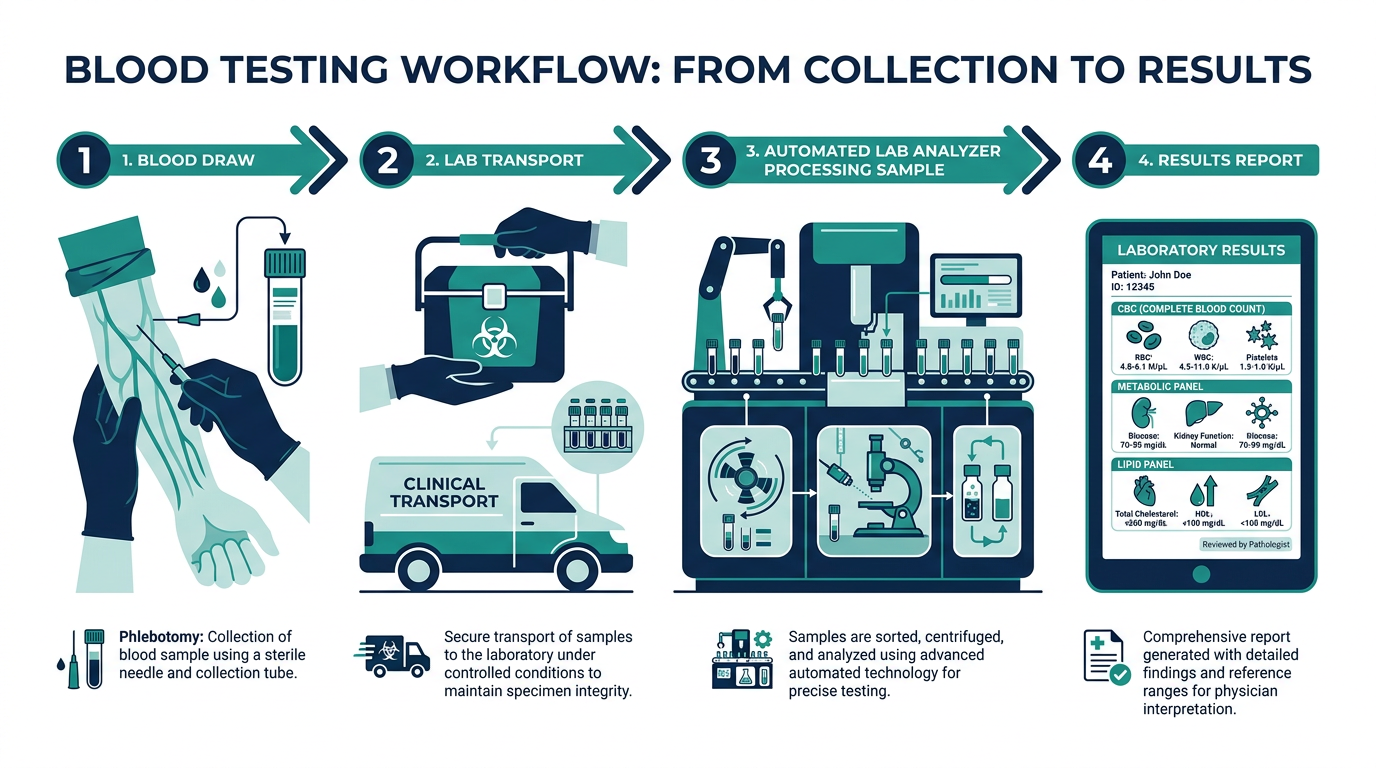
Before any single price, understand the four levers, because they explain nearly every confusing lab bill you will ever see. Get these right and you rarely overpay.
- Setting. The exact same complete blood count can cost $10 at a direct-pay lab and $250 through a hospital outpatient lab. The blood is identical. The overhead and the chargemaster behind it are not. Setting is the single largest driver of price, full stop.
- Billing code (preventive vs diagnostic). A preventive screening ordered on a healthy person is often covered at 100% by insurance. The moment the same test is ordered to investigate a symptom, or to recheck a known problem, it becomes diagnostic and lands on your deductible.
- Insurance status and where you are in your deductible. Insured does not mean free. If you have a high-deductible plan and have not met your deductible, you pay the plan’s negotiated rate, which can still be a real number.
- Bundling. Ordering ten tests one at a time stacks ten separate order fees and sometimes multiple draw fees. The same ten tests as a single bundled panel almost always cost less in total.
Keep these four in mind as you read the prices below. Every range that follows is really a function of these levers.

How much does blood work cost with insurance?
With insurance, routine blood work usually costs you between $0 and $50, and often nothing at all when it is ordered as preventive care. The Affordable Care Act requires most plans to cover a defined set of preventive screenings at 100%, which is why an annual cholesterol or diabetes screen can show up on your statement as a zero. The catch is the coding. The instant a result is flagged or a test is ordered to investigate a symptom, the lab work gets billed as diagnostic, and that flips it back to your deductible and coinsurance.
Here is the insider detail almost nobody explains at the front desk: the difference between a free preventive lipid panel and a $180 diagnostic one can come down to a single word on the order. If your chart already lists “high cholesterol” and the doctor orders a recheck, that is diagnostic by definition, even though it feels like the same yearly test. It is worth asking your clinician, before the draw, whether the order is coded preventive or diagnostic, and whether your plan covers it.
If you have a high-deductible plan and have not met your deductible, “covered” can still mean you pay the full negotiated rate. That negotiated rate is frequently lower than the cash price, so it is not always bad, but it is rarely free. The reason this surprises people is that a single annual physical can mix codes: the office visit and the preventive screens are free, but if you mention you have been tired and the doctor adds a thyroid and an iron panel to chase that symptom, those two tests can quietly fall on your deductible while everything else stays covered.
Why your “free” annual physical sometimes comes with a bill
This is the most common lab surprise in America, so it deserves its own breakdown. A preventive visit is covered at 100% only for the screening tests on the preventive list, ordered on someone without a matching diagnosis. Three things commonly break that:
- You volunteer a symptom. Mentioning fatigue, heartburn, or a sore joint can convert part of the visit to diagnostic, which is appropriate care but changes the billing.
- A prior diagnosis is on your chart. Known high cholesterol, prediabetes, or thyroid issues make the recheck diagnostic, not preventive.
- The test is not on the preventive list. A vitamin D level or a full thyroid panel, for example, is usually not a covered preventive screen for an average adult, so it bills to your plan’s cost-sharing even at a wellness visit.
None of this is a billing error. It is how the rules are written. Knowing it lets you ask the right question up front instead of opening a statement three weeks later and wondering what happened.
How much is blood work without insurance?
Without insurance, a single common blood test typically costs $29 to $150 cash, and you almost always pay less by ordering through a direct-to-consumer lab than by walking into a hospital. The uninsured and the high-deductible crowd have quietly become the savviest lab shoppers in the country, because they see the real number before they pay.
Direct-pay services such as Quest’s own consumer arm, Labcorp OnDemand, and independent marketplaces let you order tests online, then walk into the same Quest or Labcorp patient service center for the draw. You skip the doctor visit, the test is performed in the exact same lab, and the price is fixed up front. The same A1C that might land as a $120 line item on a hospital bill often runs $29 to $49 this way.
Retail clinics like CVS MinuteClinic and urgent care centers sit in the middle: convenient, transparent-ish, and usually pricier than direct-pay labs but cheaper and faster than an ER. If you want to understand exactly what a standard panel includes before you shop, see a complete blood panel broken down test by test.
One thing the uninsured should know: if a test does come back abnormal and you end up needing follow-up care, an itemized cash receipt is your friend. It is far easier to discuss a single transparent price with a clinician than to untangle a hospital bill after the fact. Paying cash up front, ironically, often buys you the cleanest paper trail.

What do individual blood tests cost?
Per-test cash prices cluster in tight, predictable ranges once you strip out the hospital markup. Here is what common tests realistically cost out of pocket through discount and direct-pay labs in 2026, alongside a typical insured copay.
| Test or panel | Cash price (direct-pay) | Typical insured cost |
|---|---|---|
| Complete blood count (CBC) | $10 to $40 | $0 to $25 |
| Basic metabolic panel (BMP) | $15 to $45 | $0 to $30 |
| Comprehensive metabolic panel (CMP) | $20 to $60 | $0 to $35 |
| Lipid panel (cholesterol) | $15 to $50 | $0 (preventive) to $40 |
| Hemoglobin A1C (diabetes) | $29 to $49 | $0 to $30 |
| Thyroid panel (TSH plus free T4) | $40 to $90 | $10 to $50 |
| Vitamin D | $30 to $70 | $0 to $40 |
| Testosterone (total) | $35 to $75 | $10 to $45 |
| Ferritin / iron studies | $25 to $65 | $5 to $40 |
| Hemoglobin A1C plus lipid (combo) | $45 to $90 | $0 to $50 |
One reason fasting matters here: triglycerides in a lipid panel can swing meaningfully if you ate beforehand, while an A1C, which reflects three months of blood sugar, does not care whether you had breakfast. Showing up fasted for the right tests can save you a repeat draw, and a repeat fee.
A worked example, single tests vs a bundle
Say you want five things checked this year: a CBC, a CMP, a lipid panel, an A1C, and a thyroid panel. Buy them as five separate direct-pay orders and a realistic mid-range total looks like $40 plus $45 plus $40 plus $39 plus $70, which is $234, and that is before any per-order or draw fees that some services tack on. The same five tests bought as a single bundled wellness panel routinely lands around $120 to $180, because you pay one order fee and one draw. That is the bundling lever in plain numbers: roughly a quarter to a third cheaper for the identical blood, drawn from the identical arm, on the identical day.
How much does full blood work cost?
A full blood work panel, meaning a broad wellness draw of 5 to 10 panels covering blood count, metabolic health, cholesterol, thyroid, and a few key vitamins, typically costs $100 to $400 cash, with most well-shopped bundles landing near $150 to $250. Order those same tests one at a time and the total climbs fast, both in dollars and in friction, because each test carries its own ordering and sometimes its own draw fee.
This is where the math quietly flips. If you are getting blood drawn anyway, it is often smarter to capture a full baseline at once instead of chasing single tests across the year. A flat-fee annual membership that bundles a large biomarker set, a clinician review, and year-over-year tracking can come out cheaper per test than a la carte pricing, especially if you would otherwise repeat several panels. Here is how a full-body panel compares on both price and what you actually get back.
Before you buy a giant panel, though, it is worth knowing which numbers actually move decisions. More tests are not automatically better. A focused set of the biomarkers worth tracking usually tells you more than a scattershot 80-marker dump you will never look at twice.
What “full blood work” usually includes
There is no single legal definition of “full” blood work, which is part of why prices vary so much. When people use the phrase, they usually mean a wellness baseline along these lines:
- Complete blood count (CBC): red cells, white cells, platelets, hemoglobin. Screens for anemia and infection signals.
- Comprehensive metabolic panel (CMP): kidney function, liver enzymes, electrolytes, glucose.
- Lipid panel: total, LDL, HDL cholesterol and triglycerides.
- Hemoglobin A1C: average blood sugar over roughly three months.
- Thyroid (at least TSH): energy, weight, and metabolism signals.
- A few key vitamins and minerals: commonly vitamin D, B12, ferritin/iron.
A 100-plus biomarker membership extends well beyond this into hormones, inflammation, advanced cardiac and metabolic markers, and more. Whether that breadth is worth it depends on your goals, which is the decision section below.
The simplest way to actually get this done
Superpower is a full-body lab membership that runs 100+ biomarkers, has each result reviewed by a doctor, and tracks your numbers year over year (about $199/year). It is what we point readers to when they would rather get one clean, complete draw than chase single tests one at a time. Here is superpower reviewed in full.

Cost by setting: the same test, five different prices
Because setting is the biggest lever, it helps to see one identical test priced across the places you can actually get it. Here is a realistic spread for a comprehensive metabolic panel (CMP), cash, in 2026.
| Where you get drawn | Typical CMP cash price | Best for |
|---|---|---|
| Direct-to-consumer lab (Quest/Labcorp draw site) | $20 to $60 | Routine and wellness testing, lowest price |
| Community health center (sliding scale) | $0 to $40 by income | Uninsured or low-income |
| Retail clinic (CVS MinuteClinic) | $50 to $120 | Convenience, walk-in |
| Urgent care | $75 to $200 | Same-day, off-hours |
| Hospital outpatient lab | $150 to $250+ | Avoid for routine if you can |
Read that table once and the whole topic clicks. When you ask how much does blood work cost, this table is most of the answer. The blood is the same. The analyzer may even be the same. You are paying for the building and the billing department wrapped around the draw. If turnaround is your concern rather than price, the setting also affects how fast results land, so check How Long Does Blood Work Take? Draw Time and Result Turnaround before you pick where to go.
Where can you get the cheapest blood work?
The cheapest blood work, dollar for dollar, almost always comes from direct-pay lab marketplaces that use Quest or Labcorp draw sites, not from a hospital outpatient lab. Settings matter more than most people realize, so here is the rough order from least to most expensive for the same test.
- Direct-to-consumer labs: lowest cash prices, fixed up front, no doctor visit required. Best for routine and wellness tests.
- Community health centers: often sliding-scale based on income, excellent if you are uninsured.
- Retail clinics (CVS MinuteClinic) and urgent care: convenient and fast, mid-range cost.
- Primary care office draws: reasonable with insurance, but watch for a separate facility or draw fee.
- Hospital outpatient labs: the most expensive for identical tests, sometimes several times the cash rate.
Two practical tips. First, you can pay for nearly all of this with an HSA or FSA, which effectively gives you a tax discount on every draw. Second, if a clinician hands you a lab order, you are usually free to take that requisition to a cheaper lab rather than using the one they default to.
If you do see something abnormal, that is the moment to talk to a clinician about your results rather than re-ordering tests on your own. The cheapest test is the one you do not have to repeat because you skipped the interpretation.
Common mistakes that quietly inflate your bill
Most overpaying is not bad luck, it is a handful of avoidable moves. Here are the ones we see again and again.
- Getting routine labs drawn at a hospital. This is the single most expensive choice for ordinary tests. Unless you are already admitted or the test is genuinely specialized, a hospital outpatient lab is the wrong place for a standard panel.
- Not asking whether the order is preventive or diagnostic. Thirty seconds of asking can be the difference between $0 and $180. Ask before the draw, not after the bill.
- Assuming insured beats cash. On a high-deductible plan, the cash direct-pay price is sometimes lower than your negotiated insured rate. Compare both. You are allowed to choose the cheaper one.
- Ordering tests one at a time. Each separate order can carry its own fee. Bundling the same tests into one draw is cheaper and means one needle, not five visits.
- Not eating or fasting correctly. Showing up unfasted for a test that needs fasting (or skipping medication you should have taken) can force a repeat draw, which is a repeat charge.
- Paying full price without checking HSA/FSA. Lab tests are eligible expenses. Using pre-tax dollars is a quiet discount most people forget.
- Walking into urgent care for non-urgent labs. Convenient, but you pay a premium for the door. For planned wellness testing, plan ahead and use a direct-pay lab.
Edge cases: uninsured, Medicare, minors, and employer-required tests
The general advice changes in a few specific situations. Here is how to think about each.
If you are uninsured
Your two best paths are direct-pay labs for routine wellness testing and community health centers for sliding-scale pricing tied to income. Many federally qualified health centers will not turn you away based on ability to pay, and their lab fees scale down accordingly. For one-off panels, direct-pay marketplaces give you a fixed price with no surprise billing. Avoid hospital outpatient labs for routine work unless you have negotiated a self-pay discount in writing first.
If you have Medicare
Medicare Part B covers many medically necessary blood tests at no cost to you when ordered by your provider and run at a participating lab, including a defined set of preventive screenings on set schedules (for example, diabetes and cardiovascular screenings for eligible beneficiaries). The key phrase is medically necessary and ordered by your provider. Tests you request purely out of curiosity, or that fall outside Medicare’s covered list, may not be covered, and you would pay out of pocket. If a test is not covered, you may be asked to sign an Advance Beneficiary Notice acknowledging you accept the cost.
If the test is for a minor
Pediatric blood work generally follows the same coverage rules, and many preventive screenings for children are covered at 100% under ACA plans. A parent or guardian typically must order and consent. Direct-pay marketplaces often restrict ordering to adults, so for a child, going through a pediatrician’s order is usually the cleaner route.
If an employer or program requires the test
Employer-required tests (pre-employment panels, DOT physicals, some wellness program screenings) are a different category. These are frequently paid by the employer or program, not by you or your insurance, and they are usually ordered through a specific vendor the employer designates. Do not pay for one of these yourself before confirming who is responsible. If you are asked to pay up front and seek reimbursement, keep the itemized receipt. Importantly, an employer-ordered test is not the same as a personal wellness panel, so do not assume your preventive coverage applies to it.
How to decide: pay per test or buy a membership?
Price ranges are only half the decision. The other half is matching the option to how you actually use lab data. Here is straightforward guidance by situation.
- You need one or two specific tests this year. Pay cash per test at a direct-pay lab. A CBC, an A1C, or a lipid panel as a one-off is cheap and there is no reason to buy more. This is the clear winner for occasional, targeted checks.
- You have a known condition your doctor is monitoring. Use your insurance and your physician’s orders. These rechecks are diagnostic and your plan, not a consumer marketplace, is the right channel. Ask about cost-sharing, but do not go off-script on monitored conditions.
- You want a broad annual baseline you will actually act on. This is where a flat-fee membership earns its keep. If you would otherwise order five or more panels a year and want clinician-reviewed results plus year-over-year tracking, the per-biomarker math often favors a bundle. See how much Superpower costs against what you would spend a la carte.
- You are optimizing health, not just screening. If you track trends, adjust habits, and re-test to see movement, breadth and longitudinal tracking matter more than a single low price. A large panel reviewed by a doctor, repeated yearly, is the format that supports that. See what Superpower tests for to judge whether the marker set fits your goals.
The honest rule of thumb: per-test cash wins for occasional and targeted needs, a membership wins for broad, repeated, trend-driven testing. Be skeptical of any answer that says one always beats the other. And remember that how much does blood work cost is rarely a fixed number, it is a choice shaped by the four levers, so the cheapest version is the one where you control all four.
Don’t just read about your health, track it.
A single result is a snapshot. Superpower re-tests 100+ markers over time so you can watch them move as you change sleep, food, and training.
FAQ
How expensive are blood tests on average?
A single routine blood test averages around $30 to $80 cash, and $0 to $50 with insurance. The wide range comes almost entirely from setting and billing code, not from the test itself. Move the same test from a hospital outpatient lab to a direct-pay lab and the price often drops by more than half.
How much do labs cost if I pay cash?
Paying cash through a direct-pay lab usually costs $29 to $150 for a common single panel, and $100 to $400 for a broad wellness bundle. Cash through a hospital outpatient lab can cost several times that for the exact same draw. Always check the direct-pay price before you assume insurance is cheaper.
How much is a lab test without a doctor?
Many direct-to-consumer services let you order without a separate doctor visit, and the test itself runs the same $29 to $150 for common panels. A network physician signs off on the order behind the scenes, so you skip the visit copay entirely. This is one of the simplest ways to control how much your blood work costs.
How much does full blood work cost out of pocket?
A full wellness draw of 5 to 10 panels typically runs $100 to $400 cash, with well-shopped bundles near $150 to $250. The total depends mostly on how many markers are included and whether you bundle them into one order or buy them separately. Buying them separately is almost always more expensive.
Why is the same blood test cheaper at one place than another?
Setting is the reason. Hospitals carry far higher overhead and chargemaster prices than direct-pay labs, even when the blood is analyzed on the same kind of machine. The test is not different, the building and the billing around it are. This is why a CMP can be $20 in one place and $250 in another.
Does insurance always make blood work cheaper?
No. If you have not met a high deductible, you pay the negotiated rate, which is sometimes higher than the cash direct-pay price. Insurance shines for preventive screenings covered at 100% and for diagnostic monitoring of known conditions. For one-off wellness tests, compare your insured rate against the cash price and pick the lower one.
Does Medicare cover blood work?
Medicare Part B covers many medically necessary blood tests ordered by your provider at a participating lab, including specific preventive screenings on set schedules. Tests that are not medically necessary or fall outside the covered list may be your responsibility, and you might be asked to sign an Advance Beneficiary Notice accepting the cost beforehand.
Can I use my HSA or FSA to pay for blood work?
Yes. Lab tests are eligible expenses for HSA and FSA accounts, which effectively gives you a tax discount on the draw. This applies whether you pay cash at a direct-pay lab or cover a copay through insurance, so it is worth using pre-tax dollars wherever you can.
Does a membership ever beat paying per test?
Yes, often. If you would otherwise order five or more panels a year and want clinician-reviewed results plus tracking, a flat annual fee like Superpower (about $199/year) can cost less per biomarker than buying tests one at a time. To see the full breakdown, check how much Superpower costs and what Superpower tests for.
What is the cheapest way to get blood work done?
For routine tests, order online through a direct-pay lab marketplace that uses a Quest or Labcorp draw site, pay with HSA or FSA dollars, and bundle multiple tests into one draw. If you are uninsured and low-income, a community health center on a sliding scale is often even cheaper. Avoid hospital outpatient labs for anything routine.
Related: best at-home biomarker tests of 2026.
Vital Signs Today may earn a commission if you buy through links on this page. It does not affect our editorial assessments.