- A normal ALT (alanine aminotransferase) level for most adults falls between roughly 7 and 56 units per liter (U/L), and many labs use a single upper limit near 40 U/L for general screening.
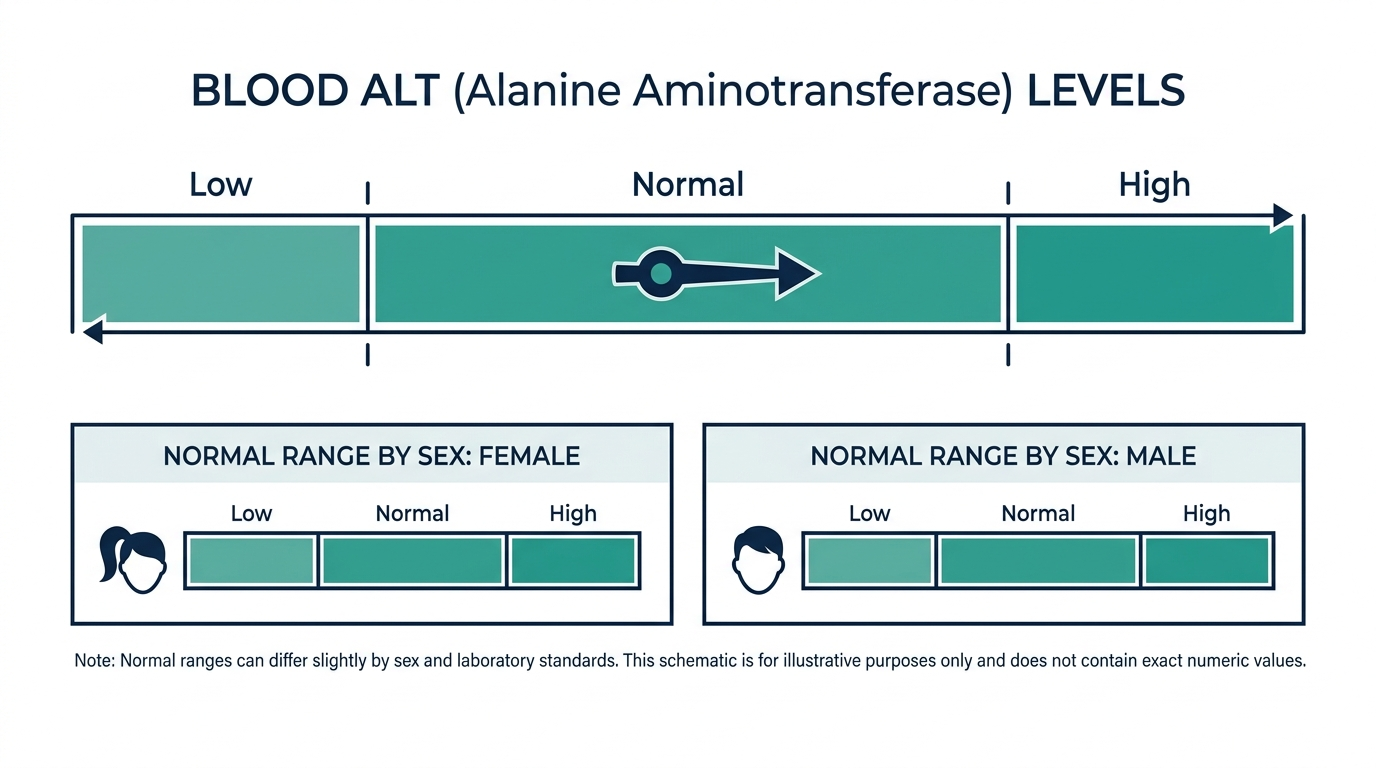
- ALT reference ranges differ by sex, with men typically allowed up to about 40 to 56 U/L and women up to about 29 to 36 U/L, because muscle mass and hormones raise baseline ALT in men.
- Stricter “healthy” thresholds proposed by liver specialists are 29 to 35 U/L for men and 19 to 25 U/L for women, since values inside the old normal range still carry liver-disease risk.
Part of our Liver Function Tests guide.
What is a normal ALT level?
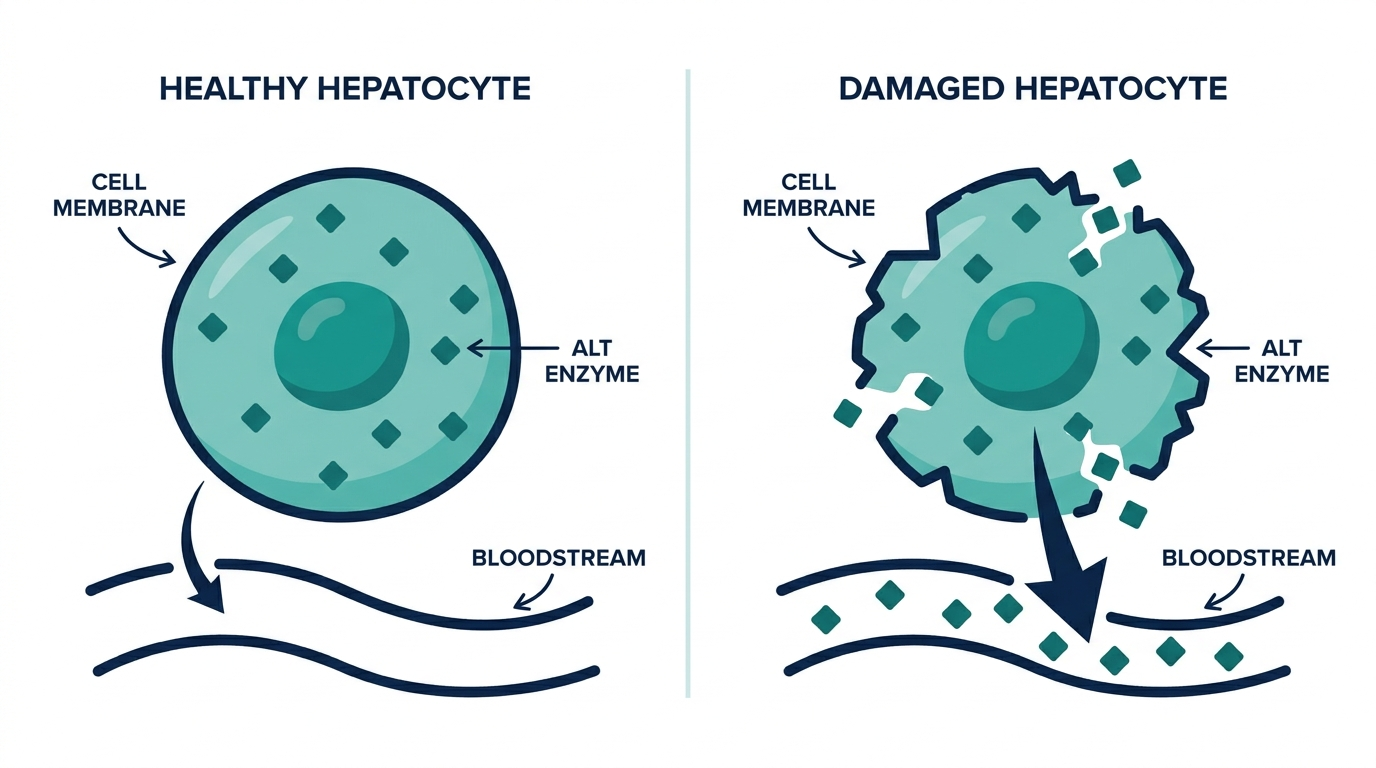
For most adults, a normal ALT level sits between about 7 and 56 units per liter (U/L), the range listed by Cleveland Clinic and many US laboratories. ALT, or alanine aminotransferase, is an enzyme found mostly inside liver cells. When liver cells are stressed or damaged, ALT leaks into the blood, so the test is one of the most useful markers of liver health. StatPearls (NCBI) describes ALT as “normally detectable in the serum at low concentrations, typically less than 30 IU/L,” which reflects how tight the healthy band really is.
Wondering where your ALT falls for your age? See it alongside your complete liver panel. One at-home Superpower draw checks 100+ biomarkers, physician-reviewed.
The single most important thing to know: there is no one universal number. Each lab calibrates its own reference range against its local population and equipment, which is why your report may say 0 to 44 U/L while another says 7 to 56 U/L. Always read the result against the range printed on your own lab sheet, then discuss it with your clinician.
What can push your ALT up before you even reach the lab
ALT is measured in units per liter, written U/L, which is the same as the IU/L you will sometimes see quoted. Unlike a cholesterol or glucose panel, an ALT test does not require fasting, so a morning coffee will not change it. What can change it is your gym schedule. Because ALT also lives in skeletal muscle, a hard leg day, a long run, or any intense workout in the day or two before the draw can lift the number without a thing being wrong with your liver. If your ALT comes back mildly high and you trained hard that week, that is worth mentioning before anyone worries about the liver.
A handful of everyday things nudge ALT the same way. A few drinks the night before, a recent course of acetaminophen, starting a statin, or an ordinary viral illness can each raise it modestly and temporarily. This is exactly why a single mildly elevated ALT is almost never acted on immediately. The standard move is to fix the obvious variables, wait, and repeat, because ALT has a half-life of roughly two days and a temporary bump clears quickly once the cause is gone.
ALT normal range by age
The simplest way to actually get this done
Superpower is a full-body lab membership that runs 100+ biomarkers, has each result reviewed by a doctor, and tracks your numbers year over year (about $199/year). It is what we point readers to when they would rather get one clean, complete draw than chase single tests one at a time. Here is superpower reviewed in full.
ALT reference ranges shift modestly across the lifespan, but the biggest jumps happen between childhood, adolescence, and adulthood. In one large reference study, the upper limit for healthy adolescents was about 30 U/L for boys and 21 U/L for girls (PLOS One), lower than typical adult cutoffs. The table below gathers cited reference values so you can place your own result in context. Treat these as guides, not diagnoses.
| Group | Typical ALT upper limit (U/L) | Source |
|---|---|---|
| Children and adolescents (boys) | about 30 | PLOS One |
| Children and adolescents (girls) | about 21 | PLOS One |
| Adult men (general lab range) | about 40 to 56 | Cleveland Clinic, Quest |
| Adult women (general lab range) | about 29 to 36 | Cleveland Clinic, Quest |
| Adult men (stricter “healthy” cutoff) | 29 to 35 | AASLD, US population study |
| Adult women (stricter “healthy” cutoff) | 19 to 25 | AASLD, US population study |
| Older adults (65+) | often flat or slightly lower; standard adult limits apply | NCBI/PMC |
Notice that ALT does not climb steadily with age the way some markers do. After the adolescent rise, the adult range stays fairly stable, and in older adults the same adult limits generally apply. Research has even argued that the upper limit for the elderly may be set too high, meaning some real liver disease in seniors hides inside the “normal” band (NCBI/PMC).
Why normal ALT may be set too high
ALT is the textbook example of a lab value where the printed normal range and the genuinely healthy range are not the same thing. The old upper limits near 40 to 56 U/L were set decades ago against populations that, in hindsight, already included plenty of undiagnosed fatty liver. That is why liver specialists now argue for tighter healthy thresholds, closer to 30 U/L for men and the low 20s for women. A result of 38 U/L will be flagged as normal by most labs, yet for a woman it can be an early hint of fat building up in the liver.
The practical takeaway is to read your ALT against the stricter sex-specific number, not just the lab ceiling. If you are watching your metabolic health, treat a steady drift from the low 20s into the high 30s as a signal worth acting on, even while every one of those readings still prints as normal. The trend inside the range often matters more than any single value crossing the line.
How does sex change the range?
Sex changes ALT meaningfully: men run higher than women at every adult age. StatPearls (NCBI) states plainly that “ALT is higher in males compared to females,” attributing the gap to hormonal differences. In practice, many US labs allow adult men up to roughly 40 to 56 U/L but cap women near 29 to 36 U/L. Quest Diagnostics, for example, uses an upper limit of 46 U/L for men and 29 U/L for women.
Why men run higher: ALT also exists in skeletal muscle, and men carry more muscle mass on average, which nudges baseline values up.
Why it matters clinically: applying a male cutoff to a woman can mask early liver injury. The American Association for the Study of Liver Diseases (AASLD) recommends sex-specific “true normal” thresholds of 35 U/L for men and 25 U/L for women, and a US population study found even tighter healthy limits of 29 U/L for men and 22 U/L for women. A 30 U/L result is comfortably normal for a man but worth a second look in a woman.
What makes ALT rise or fall with age?
ALT shifts with age mainly because the body composition and metabolic factors that drive it change over a lifetime. StatPearls (NCBI) lists age, sex, body mass index, pubertal stage, triglycerides, insulin resistance, and blood glucose as the main physiological influences on serum ALT. The single biggest modern driver is metabolic: as body fat and insulin resistance rise in midlife, fatty liver becomes the most common reason ALT creeps up.
Key factors that move ALT across age:
- Puberty and muscle growth: adolescent boys see ALT rise as muscle mass increases, which is why teen reference ranges differ from younger children.
- Weight and metabolic health: higher BMI, insulin resistance, and elevated triglycerides push ALT upward, a pattern common in adults aged 40 and over.
- Medications and alcohol: statins, acetaminophen, and regular alcohol use can raise ALT at any age.
- Very low ALT: unusually low ALT can reflect low muscle mass, frailty, or vitamin B6 deficiency, and is sometimes seen in older or sarcopenic adults.
When is an out-of-range result a concern?
A mildly elevated ALT, meaning up to about 2 to 3 times the upper limit, is common and often points to fatty liver, medication effects, or recent alcohol rather than emergency disease. The level of concern rises with how high the number climbs and whether other liver tests move with it. Cleveland Clinic notes that markedly elevated ALT, often more than 10 to 20 times normal, suggests acute liver injury such as viral hepatitis or drug toxicity and needs prompt evaluation.
What clinicians weigh alongside the number:
- Trend over time: a single mildly high reading is far less worrying than a value that keeps rising on repeat testing.
- The AST-to-ALT ratio: the partner enzyme AST and its ratio to ALT help separate alcohol-related from other liver injury.
- Symptoms: jaundice, dark urine, right-upper-abdominal pain, or fatigue raise the urgency.
- Your sex-specific limit: a “normal-by-the-old-range” value can still be abnormal for a woman under stricter cutoffs.
If your ALT is out of range, do not panic and do not self-diagnose. Bring the actual numbers, your medication list, and your alcohol history to your clinician, who can decide whether to repeat the test, order an ultrasound, or check for hepatitis.
A realistic example of a mildly high result
Picture a 45-year-old man with an ALT of 68 U/L on a routine panel, a bit above the lab ceiling. On paper it looks like liver trouble. His doctor does not order a scan that day. She asks about alcohol and exercise, notes that his AST is 40 so the ratio sits below 1, and sees that his triglycerides and fasting glucose are creeping up and his waistline has grown. That cluster points squarely at fatty liver from metabolic changes, not hepatitis. The plan becomes weight loss, less alcohol, and a repeat ALT in three months, and when he loses ten pounds the number often drifts back toward normal on its own. The lesson is that a mildly high ALT is usually a metabolic message, not a crisis.
How ALT connects to the rest of your liver panel
ALT is rarely read alone, and the enzymes drawn next to it usually tell you what a high number actually means. AST is the closest partner. On its own AST is less liver-specific, but the ratio of AST to ALT, sometimes called the De Ritis ratio, is a genuine shortcut. A ratio comfortably below 1, where ALT is the higher of the two, is the classic pattern of fatty liver and many kinds of viral or drug-related injury. A ratio above 2, where AST outruns ALT, leans strongly toward alcohol-related liver disease. Same two enzymes, very different stories depending on which one leads.
Three more markers fill in the picture. GGT is the tiebreaker for alcohol, since it rises with heavy drinking and helps confirm what the AST-to-ALT ratio hints at. ALP and bilirubin point instead toward the bile ducts, so when those climb while ALT stays modest, the problem may be a blockage rather than the liver cells themselves. And platelets, oddly enough, belong in this conversation too. A falling platelet count alongside a mildly high ALT can be an early sign of scarring, which is why clinicians plug age, AST, ALT, and platelets into a simple score called FIB-4 to estimate how much fibrosis may be present.
None of these replace a proper liver workup, but together they explain why a doctor almost never treats an ALT number in isolation. Seeing the whole liver panel from a single draw turns one enzyme into a readable picture of what your liver is doing.
Curious what your own levels look like?
Baseline 100+ biomarkers today and retest as life changes, all in one membership with physician review.
Frequently asked questions
Is an ALT of 40 normal?
An ALT of 40 U/L is within the standard normal range for most adults and clearly normal for adult men. For women, 40 sits at or above stricter sex-specific cutoffs (25 to 36 U/L), so it may warrant a repeat test. Check it against your own lab’s range and your clinician’s advice.
Does ALT increase with age?
Not steadily. ALT rises from childhood into adolescence, then stays fairly stable through adulthood. In older adults the standard adult range still applies. Most age-related increases actually come from rising body weight and metabolic changes rather than aging itself (StatPearls, NCBI).
What is a dangerously high ALT level?
Levels more than 10 to 20 times the upper limit, often above roughly 400 to 1,000 U/L, suggest acute liver injury such as viral hepatitis or drug toxicity and need urgent evaluation (Cleveland Clinic). Any sharp rise paired with jaundice, dark urine, or abdominal pain should be assessed quickly by a clinician.
Why is the ALT range different for men and women?
ALT also exists in skeletal muscle, and men carry more muscle mass on average, plus hormonal differences raise male baselines. StatPearls (NCBI) confirms ALT runs higher in men. That is why labs cap women lower, around 29 to 36 U/L, versus up to 40 to 56 U/L for men.
Can a low ALT be a problem?
Usually a low ALT is harmless, but very low values can reflect low muscle mass, frailty, or vitamin B6 deficiency, sometimes seen in older adults. It is rarely an emergency. If your ALT is unexpectedly low alongside fatigue or weakness, mention it to your clinician for context.
Do I need to fast before an ALT test?
No, an ALT test does not require fasting. It is often drawn as part of a wider panel that does need fasting, such as glucose or a lipid profile, so you may be asked to fast for those. For ALT itself, the bigger thing to avoid is intense exercise in the day or two beforehand.
How long does it take for a high ALT to come down?
It depends on the cause. Because ALT clears the blood with a half-life of about two days, a temporary bump from exercise, a few drinks, or a passing virus can settle within a week or two once the trigger stops. A rise from fatty liver falls more slowly and tracks with weight loss and better metabolic health over months, not days.
Can exercise raise my ALT?
Yes. ALT is present in muscle as well as liver, so strenuous or unaccustomed exercise can push it up for a couple of days. This is a common and harmless reason for a mildly elevated result, which is why clinicians ask about recent workouts before assuming the liver is the source.
What does it mean if ALT is high but AST is normal?
An isolated rise in ALT, with AST still normal, is one of the most common patterns on a routine panel and usually points toward fatty liver or a mild drug or viral effect rather than serious damage. Because ALT is more specific to the liver than AST, this pattern keeps the focus on the liver cells and is typically followed with a repeat test and a look at metabolic health.
Sources
- Cleveland Clinic, Alanine Transaminase (ALT) Blood Test
- Cleveland Clinic, Liver Test Interpretation
- StatPearls (NCBI Bookshelf), Alanine Aminotransferase (ALT) Test
- PLOS One, Gender Differences in Healthy Ranges for Serum ALT in Adolescence
- NCBI/PMC, Lowering the upper limit of serum ALT in the elderly
- NCBI/PMC, Upper limits of normal for serum ALT and local reference populations
This article is for general educational purposes and is not medical advice. It cannot diagnose or treat you and does not replace your clinician. Always discuss your lab results and any health decisions with a qualified healthcare professional.
Related: see our ranking of the best at-home blood tests.
Vital Signs Today may earn a commission if you buy through links on this page. It does not affect our editorial assessments.