
You scanned your complete blood count, your white cells looked roughly normal, and then your eye snagged on one line: lymphocytes, flagged high. Maybe it was the absolute number, maybe it was just the percentage. Either way, the word that comes to mind for most people is leukemia, and the heart rate goes up. Take a breath. In the overwhelming majority of cases, a high lymphocyte count is your immune system doing exactly what it was built to do, not a sign that something is taking over your blood.
That said, high lymphocytes are worth understanding properly, because the few times they matter, they matter a lot, and the difference between the harmless version and the worrying version comes down to details most reports never explain.
Part of our Complete Blood Count guide.
What are high lymphocytes in a blood test?
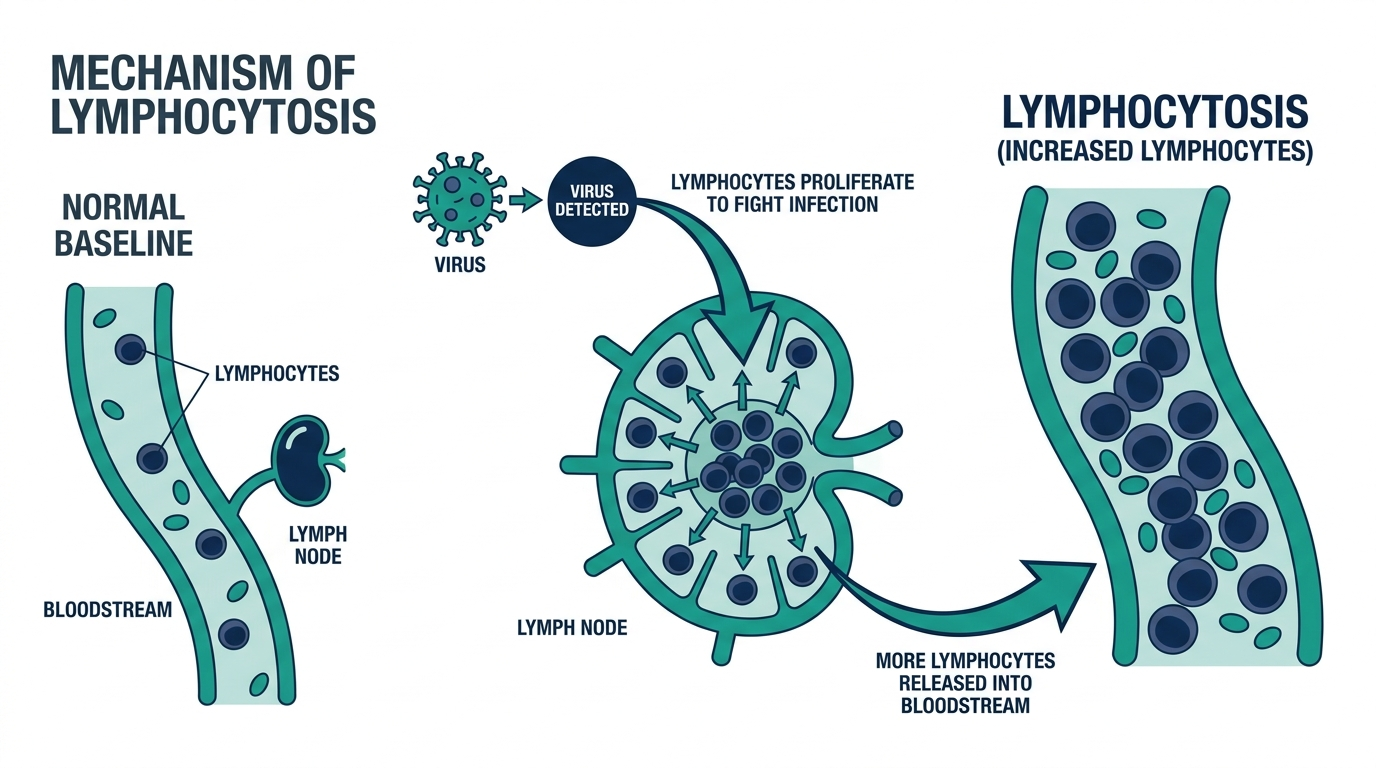
Lymphocytes are a type of white blood cell, the part of your immune system that hunts viruses and abnormal cells. They include B cells, which make antibodies, and T cells, which directly attack infected and cancerous cells (Cleveland Clinic). When you have more of them in your blood than expected, that is called lymphocytosis, and on your report it usually shows up simply as lymphocytes flagged high.
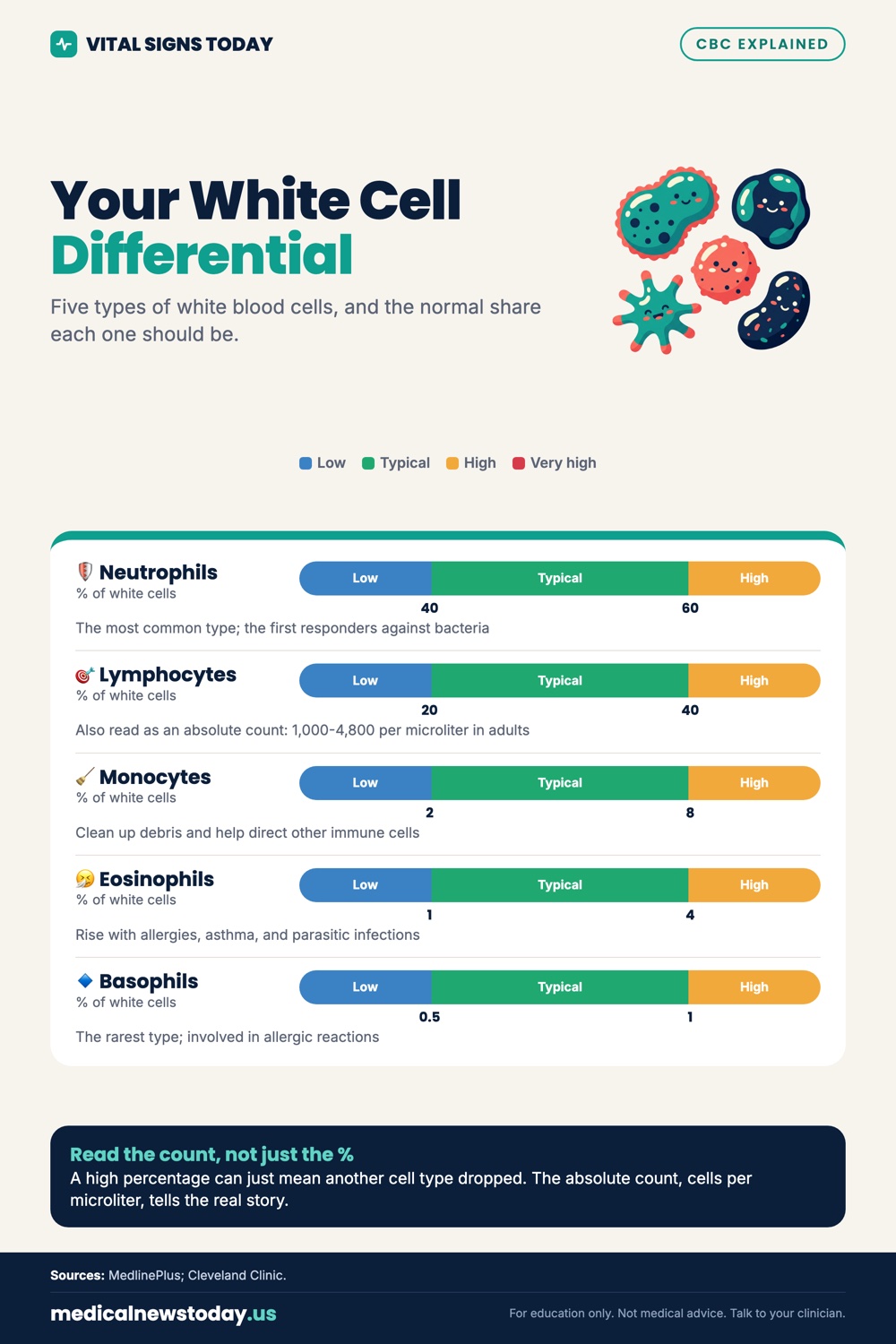
Here is the number that matters. In adults, a normal absolute lymphocyte count runs roughly 1,000 to 4,800 cells per microliter of blood, making up about 20 to 40 percent of your white cells (Cleveland Clinic). Above about 4,800 per microliter is generally considered high in an adult (Cleveland Clinic). Children naturally run higher, with the threshold sitting closer to 9,500 per microliter, which is why a number that looks alarming in a kid is often completely normal for their age (Cleveland Clinic).

What does a high lymphocytes mean on a blood test?
The direct answer: a high lymphocyte count almost always means your immune system has recently been activated, most often by a virus. Clinicians draw a line at an absolute lymphocyte count above roughly 4,000 to 4,800 cells per microliter in adults, and the StatPearls clinical reference uses more than 4,000 per microliter as the working definition of absolute lymphocytosis (StatPearls, NIH).
One distinction is doing a lot of quiet work here, and it is the single most useful thing to understand about a high lymphocyte result. There are two different ways to be high:
- Absolute lymphocytosis means the actual count of lymphocytes is elevated, more than about 4,000 per microliter. This is the real thing.
- Relative lymphocytosis means the percentage is high, over 40 percent, but the total white count is normal or even low (StatPearls, NIH). This often happens not because lymphocytes went up, but because neutrophils went down, so lymphocytes simply make up a bigger slice of a smaller pie.
That is why your lymphocyte percentage can read high while your absolute count is perfectly fine. Always look at the absolute number, not the percentage, before you worry.
What causes a high lymphocytes?
The differential runs from extremely common and benign to rare and serious. Most common first (Cleveland Clinic, Mayo Clinic):
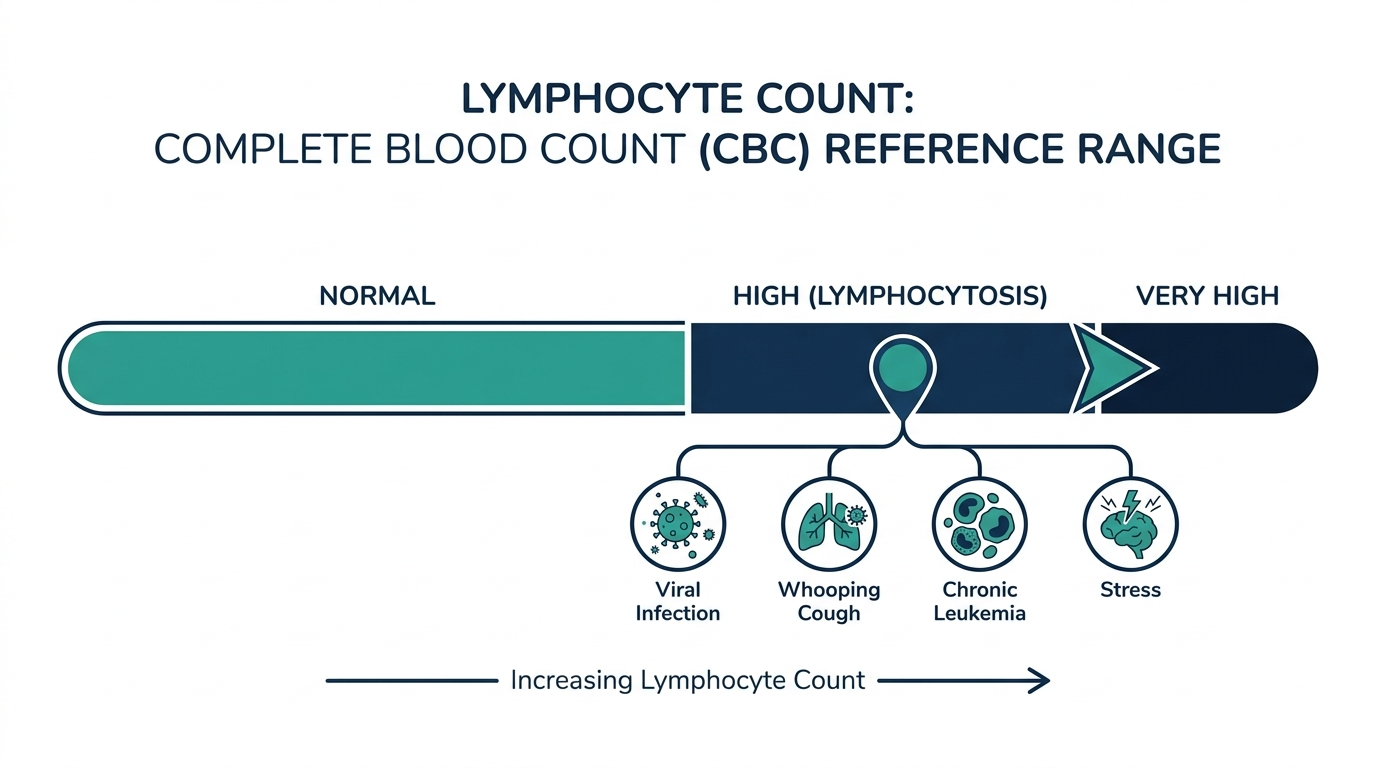
- Viral infections. By far the leading cause. Epstein-Barr virus (mononucleosis), cytomegalovirus, influenza, hepatitis, chickenpox and shingles, measles, mumps, and HIV all drive lymphocytes up. Mono is famous for it (Mayo Clinic).
- Certain bacterial infections. Whooping cough (pertussis) and tuberculosis are the classic ones, and pertussis in particular can push counts very high (Mayo Clinic).
- Chronic inflammation, such as rheumatoid arthritis and other autoimmune conditions (Cleveland Clinic).
- Physical stress on the body, including major trauma, severe illness, or a recent medical emergency, which can transiently raise lymphocytes (Cleveland Clinic).
- Smoking and having had your spleen removed (asplenia), both of which can keep lymphocytes chronically on the high side (Mayo Clinic).
- A reaction to a new medication.
- Blood cancers, the cause everyone fears but the least likely on this list. Chronic lymphocytic leukemia (CLL) is the most common in adults, along with non-Hodgkin lymphoma and acute lymphoblastic leukemia (Cleveland Clinic).
Keep the base rate in mind. A high lymphocyte count showing up right after a cold, a flu, or a bout of mono is the rule. A high lymphocyte count as the first sign of leukemia is the rare exception, and even then it usually leaves clues we will get to below.
What are the symptoms of a high lymphocytes?
Here is the part that surprises people: a high lymphocyte count itself causes no symptoms at all (Mayo Clinic). The cells are just numbers on a printout. You cannot feel them.
What you can feel are symptoms of whatever is driving the count up. With a viral infection that might be fever, fatigue, a sore throat, body aches, and swollen lymph nodes. The symptoms that should get more attention, because they point toward the serious end of the differential, include drenching night sweats, unexplained weight loss, persistent swollen lymph nodes that do not go down, and a feeling of fullness or a mass in the upper left abdomen, which can signal an enlarged spleen (Mayo Clinic). Those are the company-you-keep symptoms. A high count next to a head cold is one story; a high count next to night sweats and weight loss is a different conversation.

When is a high lymphocytes dangerous or a medical emergency?
A modestly elevated lymphocyte count after an infection is not an emergency. The features that move a result from routine to urgent are about how high, how long, and what else is going on.
Clinicians get more concerned when (StatPearls, NIH):
- The count is extremely high, for example an absolute lymphocyte count above 30,000 per microliter, which strongly prompts specialized testing such as flow cytometry.
- It persists for more than a month with no infection to explain it. Reactive lymphocytosis from a virus should settle as you recover; one that lingers needs a reason.
- It comes with cytopenias, meaning low red cells (anemia) or low platelets on the same CBC, which suggests the bone marrow is being crowded.
- It travels with swollen lymph nodes or an enlarged spleen or liver, or with abnormal young cells called lymphoblasts on the blood smear.
A high count plus B symptoms (fevers, night sweats, weight loss) plus a count that will not normalize is the combination that earns a prompt hematology referral. None of these single findings is a diagnosis, but together they are the pattern that should not wait.
What should you do about a high lymphocytes?
The honest answer is that for most people, the right next step is to do very little and recheck. Because reactive lymphocytosis from a virus resolves on its own, a common and sensible plan is simply to repeat the CBC in a few weeks once you have recovered, and confirm the count comes back down.
If the count stays up, or if it was high to begin with, the workup is straightforward and your doctor will likely order one or more of these (Cleveland Clinic):
- A peripheral blood smear, where a technician actually looks at the cells under a microscope. This is more powerful than people realize and often the single most informative test.
- Flow cytometry, which sorts your lymphocytes by type and can tell whether they are a varied (reactive) population or a single cloned (monoclonal) one. This is the test that distinguishes a harmless immune response from a clonal process.
- Targeted infection testing if mono, hepatitis, HIV, or another specific virus is suspected.
On lifestyle, there is no diet or supplement that meaningfully lowers a high lymphocyte count, and you should be skeptical of anything that claims to. If smoking is the driver, stopping helps over time. Otherwise the count follows the cause, so treating the underlying problem, or letting an infection resolve, is what brings it back to normal. Treatment for the count itself is only needed when a serious condition is found, in which case a hematologist takes over (Cleveland Clinic).
When should you see a doctor?
If a high lymphocyte count turned up on routine bloodwork and you feel fine, you do not need the emergency room, but you should bring it to your primary care doctor and ask the obvious question: is this reactive, and should we recheck it? That single follow-up resolves most cases.
See a doctor sooner, and ask specifically about a referral, if your high count comes with unexplained weight loss, drenching night sweats, lymph nodes that stay swollen for more than two weeks, easy bruising or bleeding, or repeated infections (Mayo Clinic). And if a previous CBC was already flagged and the number has been climbing across repeat tests rather than settling, that trend is worth a hematology opinion even if you feel well.

The insider read: what gets missed on a high lymphocyte result
After years of reading these reports, the most common mistake is not missing a leukemia. It is the opposite, panicking over a relative lymphocytosis that is not real. Remember the percentage trap. If your lymphocyte percentage is flagged high but your absolute lymphocyte count is normal, you very likely do not have lymphocytosis at all. What you have is a low neutrophil count making lymphocytes look like a bigger share (StatPearls, NIH). Before anyone worries, the absolute number has to be elevated.
The second under-appreciated point lives at the quiet boundary between normal and cancer. When the elevated lymphocytes are a single clone of B cells, but the clonal B-cell count stays below 5,000 per microliter and there are no other findings, the label is not leukemia. It is monoclonal B-cell lymphocytosis (MBL), a precursor state that most people carry for years without it ever progressing (PubMed). CLL is only diagnosed once that clonal count crosses 5,000 per microliter with the right features. MBL is common, it is found in a meaningful share of healthy adults over 40, and only a small fraction per year ever advances (PubMed). The practical message: a clonal population on flow cytometry is not an automatic cancer diagnosis, it is a reason to monitor.
The third thing pathologists watch for is appearance. Reactive lymphocytes from a virus are pleomorphic, meaning they look varied and a bit messy, the look of a busy immune response. Malignant lymphocytes tend to look monomorphic, eerily identical, and in CLL the smear often shows fragile smudge cells (StatPearls, NIH). That is why an automated analyzer flagging high lymphocytes is never the end of the story. A trained eye on the actual cells answers most of the questions a number alone cannot.
The three lymphocyte families, and why the mix matters
A standard CBC reports lymphocytes as a single number, but that number is a blend of three distinct cell populations, each with a different job. When a high count needs explaining, the next layer of testing looks at which family is expanded, because that reshapes the interpretation.
- B cells. These produce antibodies and form long-term immune memory. A high count driven by a single clone of B cells is the pattern that flow cytometry looks for, because a clonal B-cell expansion is what defines monoclonal B-cell lymphocytosis and, at higher counts, chronic lymphocytic leukemia.
- T cells. These directly attack infected and abnormal cells and coordinate the immune response. Reactive rises after viral infection are often rich in T cells and are typically a varied, healthy-looking population.
- Natural killer (NK) cells. These provide rapid, non-specific defense against infected and stressed cells. NK-cell expansions are less common and have their own specific causes.
The practical point: a high lymphocyte count on the CBC is a headline, and flow cytometry reads the fine print by sorting these families apart. A varied mix of B, T, and NK cells reassures; a single dominant clone prompts closer follow-up.
Reading high lymphocytes alongside the rest of your CBC
Lymphocytes are far more informative when read next to the other lines on the same report, because the pattern across the whole count separates a benign immune response from something that needs a workup.
- Total white cell count and the neutrophil number. First, confirm whether this is a real (absolute) rise or a percentage artifact. If the total white count is normal or low and neutrophils are down, a high lymphocyte percentage may simply reflect that shift, not a true lymphocytosis.
- Hemoglobin and platelets. When high lymphocytes come with low red cells (anemia) or low platelets (thrombocytopenia), the concern rises, because it can suggest the marrow is being crowded. High lymphocytes with normal red cells and platelets is the more reassuring pattern.
- The rest of the differential. A rise in atypical or reactive lymphocytes reported by the lab often points to a viral cause like mononucleosis, while the presence of abnormal young cells (lymphoblasts) is a flag for urgent evaluation.
The habit to build: when lymphocytes are flagged high, check the absolute count first, then scan hemoglobin and platelets, before deciding whether the result is routine or worth a closer look.

What can skew a lymphocyte count, and how to prepare
A CBC with differential does not require fasting, so preparation is minimal. But several ordinary factors can move the lymphocyte count enough to matter.
- Recent or current infection. This is the dominant driver. A count drawn during or shortly after a viral illness can read high simply because of that, which is exactly why a recheck after recovery is the standard next step.
- Acute physical stress. Major trauma, severe illness, or intense physical stress can transiently raise lymphocytes. A count drawn in the middle of an acute event may not reflect your baseline.
- Smoking and asplenia. Both can keep lymphocytes chronically on the higher side, so a persistently mild elevation in a smoker or someone without a spleen may have a benign explanation.
- Recent vaccination or a new medication. Immune activation from a recent vaccine or a reaction to a new drug can nudge the count. Mention anything recent to your clinician.
Consistency helps most: comparing counts drawn at the same lab over time, ideally when you are well, is the best way to know whether a high lymphocyte count is a passing reaction or a stable trend.
How persistent lymphocytosis is monitored
When a high lymphocyte count does not resolve and a clonal population is found but stays below the threshold for leukemia, the usual approach is watchful monitoring rather than treatment. Understanding this prevents unnecessary alarm.
- Periodic CBCs. The clonal lymphocyte count is tracked over time to see whether it is stable or slowly rising.
- Clinical checks. Follow-up looks for the development of swollen lymph nodes, an enlarged spleen, anemia, or low platelets, since those are the features that would change the picture.
- A high bar for intervention. Many precursor states, such as monoclonal B-cell lymphocytosis, persist for years without progressing, and only a small fraction advance annually (PubMed). Monitoring, not treatment, is the norm for stable, symptom-free cases.
Sample interpretation scenarios
These illustrative patterns show how the same flagged high lymphocyte count can mean very different things. They are examples, not a substitute for your clinician’s read of your actual numbers.
- Absolute lymphocytes 6,000 two weeks after mono, otherwise well. Almost certainly a reactive rise. A recheck once recovered usually shows it settling.
- Lymphocyte percentage high but absolute count normal, with low neutrophils. This is relative lymphocytosis, an artifact of the neutrophil drop, and usually not a lymphocyte problem at all.
- Absolute lymphocytes stable at 5,500 for a year, no symptoms, clonal B cells below 5,000 on flow cytometry. This fits monoclonal B-cell lymphocytosis, a precursor state that is monitored, not treated.
- Absolute lymphocytes above 30,000 with anemia, low platelets, and swollen nodes. This combination prompts prompt specialized testing and a hematology referral.
Common misconceptions about high lymphocytes
- “High lymphocytes means leukemia.” Infection, especially viral, is by far the most common cause. Blood cancer is the least likely explanation and usually leaves additional clues.
- “A high lymphocyte percentage is the same as a high count.” Not necessarily. The percentage can read high when neutrophils fall while the absolute lymphocyte count stays normal. Always check the absolute number.
- “I can lower my lymphocytes with diet or supplements.” There is no diet or supplement that reliably lowers a high lymphocyte count. The count follows its cause, so an infection resolving or smoking cessation is what moves it.
- “A clonal population means cancer.” A clonal B-cell population below the diagnostic threshold, with no other findings, is a precursor state to monitor, not an automatic cancer diagnosis (PubMed).
Frequently asked questions
What does high lymphocytes mean in a blood test?
It means you have more lymphocytes than normal, a state called lymphocytosis. In adults that is usually an absolute count above about 4,800 per microliter (Cleveland Clinic). The most common reason by far is a recent viral infection, and the count typically returns to normal as you recover.
Should I worry if my lymphocytes are high?
Usually not, especially if you have recently been sick. A high lymphocyte count is most often a normal immune response to infection (Mayo Clinic). It deserves a closer look if it stays high for more than a month, is very high, or comes with weight loss, night sweats, or persistently swollen lymph nodes.
What if lymphocytes in a blood test is high but I feel fine?
That is common and often fine. A high lymphocyte count causes no symptoms on its own (Mayo Clinic). The standard step is to repeat the CBC in a few weeks to confirm it normalizes. If it persists, a blood smear and flow cytometry can clarify the cause.
Can high lymphocytes mean cancer?
It can, but that is the least likely explanation. Blood cancers such as chronic lymphocytic leukemia can raise lymphocytes, yet infection is far more common (Cleveland Clinic). Red flags include a very high count, cytopenias, or swollen lymph nodes and spleen, which prompt specialized testing.
What is the difference between absolute and relative high lymphocytes?
Absolute lymphocytosis means the true count is elevated, above roughly 4,000 per microliter. Relative lymphocytosis means only the percentage is high, often because neutrophils are low, while the absolute count stays normal (StatPearls, NIH). Always check the absolute number first.
This article is for general educational purposes and is not medical advice. It cannot diagnose or treat you and does not replace your clinician. Always discuss your lab results and any health decisions with a qualified healthcare professional.
Vital Signs Today may earn a commission if you buy through links on this page. It does not affect our editorial assessments.